Disclosure: airfryerkitchensupply.com is reader-supported. When you buy through links on our site, we may earn an affiliate commission at no extra cost to you.
Where to buy
Shopping for the best light weight kitchen stand mixers means comparing small machines carefully, and all six machines below are sold on Amazon. Because lightweight stand mixers are sold in several colours and bundle variants — and colour variants sometimes carry different listing pages — use these links to land on the exact configuration described, then check price on Amazon for that variant before buying. Weight and footprint figures discussed in this guide come from the manufacturers’ own published specifications for each model line, and we flag wherever a number is a class-typical figure rather than a per-listing measurement.
- Kitchen in the Box 3.2-Quart Stand Mixer — Check the current price on Amazon
- Dash Everyday Stand Mixer (3-Quart) — Check the current price on Amazon
- KitchenAid Artisan Mini 3.5-Quart Tilt-Head Stand Mixer (KSM3316X) — Check the current price on Amazon
- Delish by Dash Stand Mixer (3.5-Quart) — Check the current price on Amazon
- Kitchen in the Box 3.5-Quart 10-Speed Stand Mixer — Check the current price on Amazon
- KitchenAid Classic Series 4.5-Quart Tilt-Head Stand Mixer (K45SS) — Check the current price on Amazon
Shoppers searching for the best light weight kitchen stand mixers are usually solving a space-and-strength equation, not chasing power. The classic full-size stand mixer is a wonderful machine that weighs as much as a small child, claims a permanent postcode of countertop, and — in a small kitchen or for a cook who stores appliances in a cupboard — simply never gets used. A mixer that lives in a cupboard and takes effort to lift is a mixer that gets skipped, and recipes get skipped with it.
This guide approaches the category from the tape measure and the bathroom scale. Every pick is a stand mixer you can lift with one hand or an easy two-handed carry, with a footprint that fits a modest counter or a standard cupboard shelf. We discuss bowl capacity in quarts, speed counts from the verified listings, and — just as importantly — what each machine gives up to earn its light weight, because the trade is always the same: mass is stability and dough capacity, and removing mass removes some of both.
If your baking is cakes, cookies, frostings and whipped components in one-to-two-person or small-family quantities, a lightweight stand mixer is not a compromise — it is the correct tool, sized to your life. The six below span from featherweight budget compacts to a premium mini from the most famous name in stand mixers, and the reviews are organised around one question: how does this machine behave in a real small kitchen, day after day?
In this guide
Quick Picks
The shortlist, ordered by how most small-kitchen shoppers should look at them. Weights and sizes are discussed honestly in each review — including the stability trade-offs that come with a light frame.
- Best Overall Lightweight: Kitchen in the Box 3.2-Quart Stand Mixer — the listing itself says ‘portable lightweight’ — a 3.2-quart, six-speed compact with whisk, dough hook and beater included. — check price on Amazon
- Best Budget Lightweight: Dash Everyday Stand Mixer (3-Quart) — the lightest route into tilt-head stand mixing — 3-quart stainless bowl, six speeds and a footprint closer to a kettle than a mixer. — check price on Amazon
- Best Premium Lightweight: KitchenAid Artisan Mini 3.5-Quart Tilt-Head Stand Mixer (KSM3316X) — the famous KitchenAid formula shrunk for smaller batches — 3.5 quarts, ten speeds, three accessories and attachment-hub compatibility. — check price on Amazon
- Best for Tiny Counters: Delish by Dash Stand Mixer (3.5-Quart) — a five-speed compact with a removable 3.5-quart bowl and dough hooks — designed with a recipe brand, for everyday small-batch baking. — check price on Amazon
- Best for One-to-Two People: Kitchen in the Box 3.5-Quart 10-Speed Stand Mixer — the listing says it outright — ‘small stand mixers for 1-2 people’ — with ten speeds and a dishwasher-safe bowl. — check price on Amazon
- Best Full-Size but Manageable: KitchenAid Classic Series 4.5-Quart Tilt-Head Stand Mixer (K45SS) — the boundary pick — a real 4.5-quart, ten-speed KitchenAid with metal construction; the heaviest here, included for buyers who need one size up. — check price on Amazon
How These Picks Were Chosen
Verification came first: each machine was searched by brand and model on this site’s own Amazon connection, the returned title was matched to the model described, and only then was its ASIN recorded for linking. Bowl sizes, speed counts and included attachments quoted in this guide come from those listed listings — not from review roundups or memory.
The lightweight brief was enforced strictly. Full-size bowl-lift machines and heavy die-cast flagships were excluded regardless of quality, because they answer a different question. Within the brief, we prioritised footprint and lift-ability, then mixing competence, then ecosystem and support. The K45SS was included deliberately as a boundary pick, clearly labelled as the heaviest machine here, so readers can see exactly where ‘lightweight’ ends.
The 6 Best Light Weight Kitchen Stand Mixers, Weighed and Measured
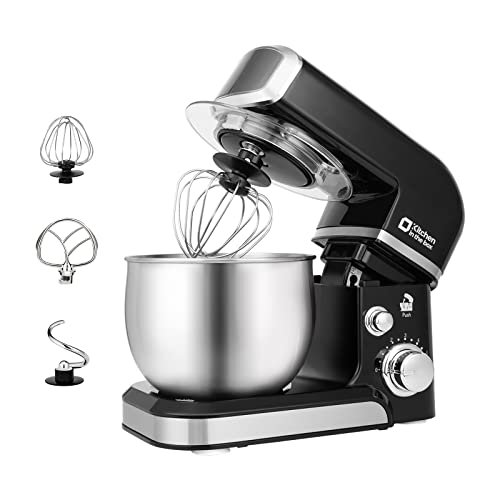
Kitchen in the Box 3.2-Quart Stand Mixer — Best Overall Lightweight
When a manufacturer’s own title leads with ‘small’, ‘portable’ and ‘lightweight’, the design brief is clear, and this Kitchen in the Box model delivers it: a 3.2-quart bowl, six speeds, and the full trio of attachments — egg whisk, dough hook and flat beater — confirmed in the Amazon listing. For a one-or-two-person household, that is the complete light baking toolkit in a machine you can move with one hand.
Strengths
- Purpose-built compact: small footprint suits cupboards and narrow counters
- Full attachment set included — whisk, dough hook and flat beater
- Six speeds cover the whole light baking range without complexity
Trade-offs
- 3.2-quart bowl caps batch size — plan single batches only
- Featherweight frame needs a steady surface; expect some movement with stiff mixes
- Lesser-known brand: long-term parts support is less proven than the big names
| Type | Compact stand mixer |
| Bowl | 3.2-quart |
| Speeds | 6 |
| Attachments (per listing) | Egg whisk, dough hook, flat beater |
The honest way to judge this mixer is by the jobs it was born for: a sponge cake, a dozen cupcakes, buttercream for one layer cake, whipped cream for a weekend dessert. At those jobs it is genuinely pleasant — quick to lift out, quick to wash, quick to put away, which is precisely the behaviour that makes a small-kitchen appliance get used weekly instead of annually. Treat the dough hook as an occasional soft-dough helper, keep batches single, and the value equation is hard to beat in this category.
Two ownership details lift this machine above anonymous compacts. First, the attachment set is genuinely complete for light baking — the whisk is a real whisk rather than a second beater with ambitions, which shows in how quickly cream and egg whites come up. Second, the whole machine is sized so that the bowl, attachments and body store as one nested unit, which in a small kitchen is the difference between ‘stored’ and ‘in the way’. Buyers should still set expectations by the tier: this is a well-judged budget compact, not a shrunken flagship, and its motor prefers the standard repertoire at standard sizes.
Best for: one-to-two-person households and small kitchens that bake weekly / Not suited for: double batches, stiff doughs or bakers who want a decades-old brand behind the motor
Check on Amazon — check the current price on Amazon before you decide, as listings and included accessories change over time.

Dash Everyday Stand Mixer (3-Quart) — Best Budget Lightweight
Dash built its name on small, cheerful appliances for small kitchens, and the Everyday stand mixer is the purest expression of that idea: a tilt-head stand mixer scaled down to a 3-quart stainless steel bowl and six speeds. It occupies roughly the counter territory of a large kettle, which means it can live out permanently in kitchens where a full-size mixer never could.
Strengths
- Smallest footprint in this guide — can stay on the counter full-time
- Tilt-head design makes beater changes and bowl access easy
- Stainless bowl is light to carry to the sink even when full of batter
Trade-offs
- Budget-tier motor: keep mixing sessions short and batches small
- Light body can creep across smooth counters at higher speeds
- Colour variants are separate listings — check you are buying the intended one
| Type | Tilt-head stand mixer |
| Bowl | 3-quart stainless steel |
| Speeds | 6 |
| Positioning | Budget tier |
The Dash earns its place through a simple insight: the best mixer is the one that is already out. Because it is small and light, owners leave it on the counter, and because it is on the counter, they bake more. Its limits are equally simple — small batches, soft mixtures, short sessions. A non-slip mat underneath transforms its manners, and within its brief it is one of the most likeable appliances in this entire category.
A practical note on colour: the Everyday is sold in several colours as separate listings, and stock rotates between them. If your heart is set on a colour, buy it when you see it rather than assuming it will wait. Functionally the colours are identical, so a flexible buyer can simply take whichever verified listing is available. Owners also report — and physics agrees — that the machine is at its best on a mat or a folded tea towel, which damps the small vibrations a light body transmits to a hard counter and keeps the mixer planted during energetic whipping.
Best for: tiny kitchens, dorms, RVs and first-apartment baking / Not suited for: family-sized batches or anyone expecting full-size stand mixer power
Check on Amazon — check the current price on Amazon before you decide, as listings and included accessories change over time.

KitchenAid Artisan Mini 3.5-Quart Tilt-Head Stand Mixer (KSM3316X) — Best Premium Lightweight
The Artisan Mini is the answer to a specific prayer: ‘I want a real KitchenAid, but smaller and lighter.’ Per the Amazon listing, it keeps the essentials — a 3.5-quart bowl for smaller batches, tilt-head design, ten speeds and three accessories — in a machine KitchenAid positions as significantly lighter and more compact than its full-size Artisan. Crucially, it keeps the powered attachment hub, so pasta rollers and grinders from the wider KitchenAid ecosystem remain on the table.
Strengths
- Genuine KitchenAid build, gearing and accessory ecosystem in a smaller body
- Ten speeds give finer control than any other pick here
- Attachment hub compatibility future-proofs the purchase
Trade-offs
- Premium tier pricing — the most expensive route to lightweight in this guide
- Lighter than a full Artisan, but still the heaviest machine in this lightweight list
- 3.5-quart bowl still means single batches for most recipes
| Type | Tilt-head stand mixer |
| Bowl | 3.5-quart |
| Speeds | 10 |
| Accessories (per listing) | 3 included; hub attachments compatible |
Buy the Mini if your constraint is space rather than money. It behaves like a KitchenAid because it is one: the mixing action is thorough, the speed range is properly graduated, and the machine feels engineered rather than assembled. In a small kitchen it earns its premium by being the one lightweight mixer you will not outgrow in ambition — only in batch size. If your recipes stay single-batch, it may be the last stand mixer you buy.
The Mini’s relationship to the wider KitchenAid range deserves precision. The front hub accepts the brand’s powered attachments, which means a Mini bought for cakes can later roll pasta or grind meat with the same motor — a growth path no other pick here offers. Bowl-mounted accessories, however, are sized to the Mini’s 3.5-quart bowl, so check fitment rather than assuming standard Artisan parts fit. For the downsizing buyer, one more reassurance: the mixing feel — the way the speed dial graduates, the way the head locks — is the familiar KitchenAid experience, simply in a body that asks less of your arms.
Best for: small kitchens that want premium build and the KitchenAid ecosystem / Not suited for: strict budgets or bakers whose batches are growing, not shrinking
Check on Amazon — check the current price on Amazon before you decide, as listings and included accessories change over time.
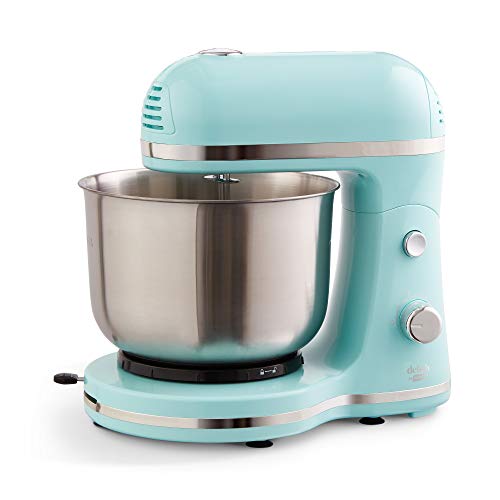
Delish by Dash Stand Mixer (3.5-Quart) — Best for Tiny Counters
The Delish by Dash collaboration aimed this mixer squarely at everyday home bakers who follow recipes online and bake in modest quantities. The Amazon listing confirms a compact body, five speeds, a removable 3.5-quart mixing bowl and dough hooks included. The removable bowl matters more than it sounds: being able to carry just the bowl to the oven or fridge is exactly the kind of small convenience lightweight-mixer buyers are shopping for.
Strengths
- Removable bowl makes the machine flexible in cramped workspaces
- Five simple speeds — nothing to learn, nothing to mis-set
- Compact body stores easily between uses
Trade-offs
- Five speeds is the fewest here; delicate folding needs a gentle hand
- Dough hooks are for soft, small doughs only — the compact brief again
- Brand collaboration lines can change; verify the exact listing configuration
| Type | Compact stand mixer |
| Bowl | 3.5-quart, removable |
| Speeds | 5 |
| Includes (per listing) | Dough hooks |
This is the mixer for the baker whose kitchen doubles as dining room, office and hallway. It appears when needed, mixes a cake, and disappears into a cupboard. The five-speed range is honest economy — enough for batters and frostings, short on finesse for meringue purists. If your baking is cheerful and occasional rather than technical, that trade will never bother you, and the counter space you save will please you every single day.
The removable bowl changes how this machine fits a small kitchen’s workflow in a way worth picturing. Batter can be mixed, the bowl lifted out and carried to the oven while the body stays parked — no whole-mixer relocation, no cord trailing across the hob. For bakers who chill doughs or batters, the bowl goes straight to the fridge. It is a small design decision with daily consequences, and it explains why this model, despite its modest five speeds, has a loyal following among small-space bakers who have organised their cooking around it.
Best for: occasional bakers in very small homes who value easy storage / Not suited for: technical bakers who whip, fold and proof with precision
Check on Amazon — check the current price on Amazon before you decide, as listings and included accessories change over time.

Kitchen in the Box 3.5-Quart 10-Speed Stand Mixer — Best for One-to-Two People
Where its 3.2-quart sibling in this guide optimises for the smallest footprint, this 3.5-quart Kitchen in the Box model optimises for control: ten speeds (per the Amazon listing) in a compact body explicitly marketed for one-to-two-person households. The bowl is dishwasher-safe, and the attachment trio of dough hook, beater and egg whisk is included, making it the most complete small-household package here relative to its tier.
Strengths
- Ten speeds in a compact body — unusual finesse for the size class
- Dishwasher-safe bowl keeps cleanup as light as the machine
- Sized and marketed honestly for one-to-two-person baking
Trade-offs
- Ten speeds on a light frame: use the top end sparingly with thick mixes
- ‘Dough mixer’ in the title overpromises — soft doughs only, small quantities
- Support network is thinner than the legacy brands
| Type | Compact stand mixer |
| Bowl | 3.5-quart, dishwasher-safe |
| Speeds | 10 |
| Attachments (per listing) | Dough hook, beater, egg whisk |
Couples and solo bakers are underserved by the stand mixer market, which mostly sells family-sized machines. This model is the exception that proves the rule: capacity matched to two-person recipes, speed control matched to real baking technique, and a cleanup story — dishwasher-safe bowl, light body — matched to weeknight reality. If the 3.2-quart version is the minimalist’s pick, this is the enthusiast’s compact.
Ten speeds on a compact invite a usage note: the value of the range is at the bottom, not the top. The lowest settings allow flour to be folded in without a dust cloud and cream to be started without splashes — the two moments that decide whether a baking session feels calm. The top speeds exist for whipping and should be used in short, purposeful bursts. Couples should also note the bowl’s sweet spot: recipes written for two — a half-batch of cookies, a small loaf cake, frosting for twelve cupcakes — land exactly in its capacity, which is a rarer fit than the family-sized market usually offers solo and duo bakers.
Best for: solo bakers and couples who bake often in small quantities / Not suited for: households of four or more, or heavy dough routines
Check on Amazon — check the current price on Amazon before you decide, as listings and included accessories change over time.

KitchenAid Classic Series 4.5-Quart Tilt-Head Stand Mixer (K45SS) — Best Full-Size but Manageable
Every lightweight guide needs an honest boundary marker, and the K45SS is it. This is a full-format KitchenAid — 4.5-quart bowl, ten speeds, durable metal construction and 59-point planetary mixing per the Amazon listing — and it is noticeably heavier than the other five picks. It belongs in this guide for one reason: many ‘lightweight’ shoppers actually need capacity more than they need lightness, and this is the lightest way to buy genuine full-size KitchenAid capability.
Strengths
- Full 4.5-quart capacity handles family batches the compacts cannot
- Metal construction and planetary action — the real KitchenAid experience
- Attachment compatibility opens the whole KitchenAid accessory range
Trade-offs
- Heaviest pick in this guide by a clear margin — a two-handed, planned lift
- Needs permanent counter space in most kitchens to be practical
- If you can store and lift this easily, you may not need a lightweight mixer at all
| Type | Tilt-head stand mixer |
| Bowl | 4.5-quart |
| Speeds | 10 |
| Mixing action (per listing) | 59 touchpoints, planetary |
Consider the K45SS the control group that keeps this guide honest. Put it on your shortlist if your baking includes family cakes and holiday batches, and you have a counter corner it can call home. Leave it off the list if the whole point is a mixer you can lift into a high cupboard without thinking. Knowing which shopper you are is the entire decision — and that is exactly what a good lightweight guide should clarify.
Including the K45SS in a lightweight guide requires one more honesty pass. Its weight is not a flaw — the mass is metal construction and a substantial motor, and it buys the stability and durability the compacts trade away. The question is purely logistical: can this machine live where you will use it, without a lift you dread? If the answer is a permanent counter corner, its weight becomes irrelevant the day it arrives, and you own the most capable machine in this guide. If the answer involves a high cupboard, the honest pick is one of the five above, and there is no shame in that arithmetic at all.
Best for: bakers who need real capacity and have permanent counter space / Not suited for: anyone whose priority is genuinely easy lifting and storage
Check on Amazon — check the current price on Amazon before you decide, as listings and included accessories change over time.
Comparison Table
| Pick | Badge | Key spec | Best for |
|---|---|---|---|
| Kitchen in the Box 3.2-Quart Stand Mixer | Best Overall Lightweight | Type: Compact stand mixer; Bowl: 3.2-quart | one-to-two-person households and small kitchens that bake weekly |
| Dash Everyday Stand Mixer (3-Quart) | Best Budget Lightweight | Type: Tilt-head stand mixer; Bowl: 3-quart stainless steel | tiny kitchens, dorms, RVs and first-apartment baking |
| KitchenAid Artisan Mini 3.5-Quart Tilt-Head Stand Mixer (KSM3316X) | Best Premium Lightweight | Type: Tilt-head stand mixer; Bowl: 3.5-quart | small kitchens that want premium build and the KitchenAid ecosystem |
| Delish by Dash Stand Mixer (3.5-Quart) | Best for Tiny Counters | Type: Compact stand mixer; Bowl: 3.5-quart, removable | occasional bakers in very small homes who value easy storage |
| Kitchen in the Box 3.5-Quart 10-Speed Stand Mixer | Best for One-to-Two People | Type: Compact stand mixer; Bowl: 3.5-quart, dishwasher-safe | solo bakers and couples who bake often in small quantities |
| KitchenAid Classic Series 4.5-Quart Tilt-Head Stand Mixer (K45SS) | Best Full-Size but Manageable | Type: Tilt-head stand mixer; Bowl: 4.5-quart | bakers who need real capacity and have permanent counter space |
The pattern in the table is the category in miniature: as bowls grow from 3 to 4.5 quarts, weight and stability grow with them. Choose your position on that line deliberately. A 3-quart machine you use weekly beats a 4.5-quart machine that lives in a box — but a 3-quart machine you constantly overfill is just a frustration with a plug.
How to Choose the Best Light Weight Kitchen Stand Mixers by Size and Weight
Begin with two measurements of your own kitchen, not of any mixer. First, the storage question: will this machine live on the counter or in a cupboard? Counter living demands footprint — measure the corner it will occupy, including clearance to tilt the head and lift the bowl out. Cupboard living demands weight and height — measure the shelf, and be honest about whether you will lift the machine down twice a week, because that honesty decides whether you bake at all.
Second, the batch question. Lightweight stand mixers cluster between 3 and 3.5 quarts, which translates to one cake, one dozen cupcakes, one batch of cookies, frosting for one layer cake. If your signature bake is a double batch for a school fair, no lightweight machine will make you happy — look at the boundary pick in this guide or leave the category. Matching bowl to batch is the single most predictive decision in this entire purchase.
- Under 3.5 quarts: solo and couple baking, small cakes, whipped components.
- 3.5 quarts: the lightweight sweet spot for one-to-two-person households.
- 4.5 quarts: family batches — but you have left true lightweight territory.
- Always check tilted-head height against your cupboard shelf before ordering.
Why light mixers move, and how to stop them
Physics is not negotiable: a light frame plus an unbalanced load — thick dough climbing one side of the bowl — equals a mixer that walks. Manufacturers counter with suction feet and low centres of gravity, and you can counter further: place the machine on a non-slip mat, keep batches inside the bowl’s honest capacity, and avoid the top speeds with heavy mixtures. A lightweight mixer used within its brief on a mat is perfectly well-mannered; the walking stories almost always involve an overfilled bowl.
Tilt-head versus lift, at lightweight scale
Every pick in this guide is effectively a compact tilt-head design, and that is no accident. Tilt-head machines are lighter, simpler and easier to use under low cupboards when open on a counter — though they need vertical clearance to tilt. Bowl-lift mechanisms belong to heavier machines built for dense dough. At lightweight scale, tilt-head is not the budget option; it is the correct engineering for the brief.
What Lightweight Stand Mixers Honestly Cannot Do
Candour section, because this category attracts wishful thinking. A lightweight stand mixer cannot knead stiff bread dough in quantity — the frame flexes, the motor strains and the machine walks. It cannot double most recipes. It cannot run continuously through a holiday baking marathon of back-to-back batches without rests. None of this makes these machines bad; it makes them specialised, and specialisation is fine when it matches your life.
What they can do — cakes, cookies, frostings, whipped cream, meringue, mashed potatoes, meatloaf mix, dip and spread bases — covers the overwhelming majority of what home kitchens actually mix. The buyers who regret a lightweight mixer are almost never the ones who read the brief; they are the ones who bought a compact and secretly wanted a workhorse. Read the brief, buy the brief, and you will be in the satisfied majority.
Footprint Arithmetic: Fitting a Stand Mixer into a Real Kitchen
Manufacturers quote footprint as length by width, but a stand mixer actually claims three spaces: its parked footprint, its working space (head tilted, bowl removed, cook standing in front), and its storage volume. Lightweight compacts win all three, but the working space is where kitchens get surprised. A tilt-head machine needs vertical clearance roughly equal to its open height, and the bowl needs a clear path out — under-cabinet counters that fit the parked machine can still defeat the tilted one. Measure the open height against your lowest cupboard before ordering; it is the single most returned-for reason in this category.
Counter depth is the second silent constraint. Compact mixers are designed for standard-depth counters and leave room in front for a recipe book, a scale and the cook. On narrow counters — galley kitchens, RVs, studio flats — even a compact stand mixer can dominate, and in those homes the honest alternatives are a hand mixer or a compact that lives in a cupboard and earns its keep in weekly use. There is no virtue in a machine that fits technically but makes the kitchen unusable while it is out.
Storage arithmetic favours the nested kit: bowl holding attachments, body beside it, total volume little more than the machine itself. The compacts in this guide all store this way. If you are choosing between two finalists, put their storage volumes side by side in your actual cupboard — the one that leaves room for the mixing bowls you already own is the one that will still be there, unresented, in five years.
- Measure parked height, open (tilted) height, and cupboard shelf height — all three.
- Leave working room: a scale, a book and your hands need the counter too.
- Prefer kits that nest — attachments in the bowl — for one-unit storage.
Living Light: A Season with a Compact Stand Mixer
What changes when a household downsizes its stand mixer? The first month brings the obvious reliefs: the machine comes out without negotiation, the bowl is washed without a wrestle, and baking happens on weeknights because setup no longer feels like an event. Recipes quietly rescale — the household cake becomes a loaf cake, the cookie batch becomes a dozen — and most households discover their actual consumption was always closer to the small batch than to the feast batch the big mixer encouraged.
By the second season, the limits have been mapped honestly. The holiday baking day needs either two runs of the compact or a borrowed big machine, and most households decide that trade once and stop minding it. The dough question resolves into a household policy — soft doughs in the machine, bread by hand or by another method. And the counter, permanently hosting a machine that is actually used, starts to look like the kitchen of a baker rather than the showroom of an appliance.
The households that regret the downsize are, consistently, the ones whose baking was genuinely growing — new sourdough habits, bake-sale commitments, a teenager discovering patisserie. For them the boundary pick in this guide exists. Everyone else tends to report the same sentence in different words: we bake more now, with a smaller machine. That sentence is the entire case for the lightweight category, and it is why this guide treats weight and footprint as first-class specifications rather than fine print.
Two Kitchens, Two Answers: Worked Examples in Choosing Light
Consider two real-shaped kitchens. The first is a studio flat: one run of counter, a cook who bakes a loaf cake most Sundays and cupcakes for colleagues monthly. Every centimetre of that counter is contested by a kettle, a chopping board and a laptop. For this kitchen the 3-quart class is not a compromise but the only category that fits the life — a Dash or the 3.2-quart Kitchen in the Box, living out permanently because there is nowhere sensible to store anything, mixing exactly the batches this cook actually makes. A larger machine would not be used more; it would be resented daily and used the same.
The second kitchen is a family house downsizing its appliances as the children leave: baking is now for two, plus grandchildren on Sundays, and the old full-size mixer has become a two-person lift out of a low cupboard. Here the Artisan Mini or the 3.5-quart ten-speed earns its place — capacity for a family cake when the grandchildren descend, a weight the remaining bakers can manage without negotiation, and build quality that will outlast the transition. The lesson of the pair is the lesson of the whole guide: the right lightweight mixer is the one matched to a specific kitchen’s space, strength and batch size — which is why this guide measures first and recommends second.
Counter Organisation for Compact Mixers: Making Small Feel Spacious
A lightweight mixer rewards a deliberately organised corner, and the organising takes an afternoon at most. Start with the landing zone: the mixer lives at the back of its counter stretch, with a clear space in front equal to the bowl’s diameter plus your hands. Ingredients stage to one side, finished items land on the other, and the workflow reads left to right like a sentence. In a small kitchen that simple geography is the difference between a counter that feels designed and one that feels raided.
Vertical thinking helps next. The wall above a compact mixer’s corner is storage waiting to happen: a narrow shelf for the flour and sugar canisters you reach for mid-recipe, a rail for the spatula and scraper, and nothing at all at the height where the mixer’s head needs to tilt. Measuring cups and the kitchen scale live in the drawer directly below the corner, because the three journeys of baking — mixer, scale, oven — should form the smallest triangle your kitchen allows.
Finally, protect the arrangement from entropy. Compact mixers attract neighbours: the toaster migrates, the fruit bowl expands, and one morning the corner is a crowd again. A tray or mat defining the mixer’s territory — the same non-slip mat recommended throughout this guide — holds the boundary politely and permanently. Small kitchens stay workable not by having less in them, but by everything in them having a defended place, and the lightweight mixer, properly homed, is the easiest citizen of all to house.
How to Set Up and Store a Lightweight Stand Mixer in a Small Kitchen
A lightweight mixer rewards a little setup thought. Five minutes spent on placement and storage on day one pays off every time you bake, because the whole point of this category is a machine that is effortless to bring into action.
- Choose the home first: a counter corner with head-tilt clearance, or a cupboard shelf you can reach without a step stool.
- Place a non-slip mat under the machine — this is the single best accessory for any lightweight mixer.
- Check suction feet (where fitted) are clean and the surface is dry before longer jobs.
- Store attachments inside the bowl, nested in a tea towel, so the whole kit lifts out as one unit.
- Coil the cord loosely rather than wrapping it tightly around the body, which stresses the entry point.
- After use, wash the bowl promptly — stainless bowls in this class are light enough to handle one-handed at the sink.
- Once a month, wipe the ventilation slots and check the feet; flour dust is the quiet enemy of small appliances.
If the machine must live in a cupboard, store it at waist height rather than overhead. A lightweight mixer is still a dense object with a motor in it, and the safest lift is always the one at the height your arms are strongest. That placement decision, more than any specification, is what makes a lightweight mixer feel light.
Common Buying Mistakes
Mistake 1: Buying lightweight, then baking heavy. The most common disappointment in this category is self-inflicted: a compact bought for cakes gets volunteered for weekly sourdough. Keep a hand-kneading habit or a separate plan for bread, and let the lightweight machine do the work it was designed for.
Mistake 2: Ignoring tilted height. A tilt-head mixer is two heights: closed for storage, open for use. Measure both. Kitchens have been surprised by the open height under wall cupboards since stand mixers were invented.
Mistake 3: Assuming colour variants share one listing. On Amazon, colours of the same mixer are often separate listings with separate stock and configurations. The reviews here link the exact verified variant; if you switch colour, re-check the bowl size and included attachments on that page.
Mistake 4: Skipping the mat. Lightweight mixers on polished stone counters can creep during energetic mixing. A simple non-slip mat costs very little and removes the category’s most-cited annoyance entirely.
Mistake 5: Paying premium prices for the wrong constraint. If your constraint is budget, the premium lightweight pick makes no sense; if your constraint is space and you bake seriously, the budget picks will frustrate you. Name your constraint before you shop.
Final Recommendation
For most small kitchens, the Kitchen in the Box 3.2-quart is the lightweight stand mixer to buy: honestly sized, fully equipped and easy to live with. The Dash Everyday is the budget and tiny-counter champion, the KitchenAid Artisan Mini is the premium answer when space — not money — is the constraint, and the 3.5-quart Kitchen in the Box ten-speed is the couples’ favourite. The KitchenAid K45SS stands at the border, clearly labelled, for readers who discover mid-guide that they need capacity more than lightness.
If you are still deciding between this category and its neighbours, the companion guides below cover the same mixers from different angles — general light duty work, and lightweight machines chosen specifically for easy lifting and older users:
- Best Overall Lightweight: Kitchen in the Box 3.2-Quart Stand Mixer — check price on Amazon
- Best Budget Lightweight: Dash Everyday Stand Mixer (3-Quart) — check price on Amazon
- Best Premium Lightweight: KitchenAid Artisan Mini 3.5-Quart Tilt-Head Stand Mixer (KSM3316X) — check price on Amazon
- Best for Tiny Counters: Delish by Dash Stand Mixer (3.5-Quart) — check price on Amazon
- Best for One-to-Two People: Kitchen in the Box 3.5-Quart 10-Speed Stand Mixer — check price on Amazon
- Best Full-Size but Manageable: KitchenAid Classic Series 4.5-Quart Tilt-Head Stand Mixer (K45SS) — check price on Amazon
Best Light Duty Mixers Best Lightweight Stand Mixers Best 6 Qt Standing Mixers Best Stand Mixers Best Small Stand Mixers
Frequently Asked Questions
How light is a lightweight stand mixer, really?
In practice, the compacts in this guide are machines most adults can lift with one hand or an easy two-handed carry — a completely different experience from a full-size bowl-lift mixer, which is a planned, two-handed lift. Exact weights vary by variant, so check the manufacturer’s specification on the listing for the specific colour and bundle you are buying.
Can a lightweight stand mixer knead dough?
Soft doughs in small quantities, occasionally — pizza dough for one, an enriched bun dough — yes, using the dough hook at low speed. Stiff or large doughs, no. The light frame and motor are not built for it, and repeated attempts are the main cause of early failures in this category.
Why does my lightweight mixer move on the counter?
An unbalanced, heavy load in a light machine creates a walking force. Reduce batch size, use lower speeds for thick mixtures, make sure suction feet are clean, and place the mixer on a non-slip mat. Used within its capacity, a lightweight mixer should stay put.
Is 3.5 quarts big enough for a family?
For a family that bakes single cakes and standard cookie batches, it can be — most box mixes and standard recipes fit. For double batches, large holiday baking or big bread projects, it is not. Count your typical batch, not your biggest ever batch, but be honest about which one you actually make monthly.
Does the KitchenAid Artisan Mini take regular KitchenAid attachments?
The Mini keeps the powered front hub, and the Amazon listing notes compatibility with KitchenAid attachments, which is a major advantage over other compacts. Bowl-fitting accessories are Mini-specific because the bowl is smaller, so check fitment for bowl-mounted items before ordering.
Where should I store a lightweight stand mixer?
At waist height if it lives in a cupboard — never overhead. On the counter, give it a corner with clearance to tilt the head. Storing attachments inside the bowl keeps the whole kit together and makes the lift-out a single motion.

