Disclosure: airfryerkitchensupply.com is reader-supported. When you buy through links on our site, we may earn an affiliate commission at no extra cost to you.
Where to buy
Shopping for the best light duty mixers starts on Amazon, where every mixer in this guide is sold, and that is where we send you to check the current configuration, because light duty mixers are frequently bundled with different beaters, bowls or storage cases depending on the listing. Use the links below to compare the exact package on offer, and check price on Amazon at the moment you buy rather than relying on any number printed elsewhere — prices on small appliances move constantly.
- KitchenAid 5 Ultra Power Speed Hand Mixer (KHM512) — Check the current price on Amazon
- Hamilton Beach 6-Speed Electric Hand Mixer (62682G) — Check the current price on Amazon
- Cuisinart Power Advantage 5-Speed Hand Mixer (HM-50) — Check the current price on Amazon
- Breville Handy Mixer (BHM800SIL) — Check the current price on Amazon
- Dash Everyday Stand Mixer (3-Quart) — Check the current price on Amazon
- Hamilton Beach 4-Quart Electric Stand Mixer — Check the current price on Amazon
The best light duty mixers are not the machines you buy for a bakery, a wedding-cake side business or a weekly double batch of stiff pizza dough. They are the mixers that live comfortably in an ordinary home kitchen and handle the work ordinary home kitchens actually produce: cake batter, cookie dough in single batches, whipped cream, mashed potatoes, pancake and waffle batter, frosting, muffin mixes and the occasional soft bread dough. Light duty is a workload description, not an insult. It means the motor, gears and frame are sized for short, intermittent jobs with rests in between, rather than continuous kneading under heavy load.
That distinction matters because the most common way people kill a mixer is not age — it is asking a light machine to do heavy work repeatedly. A compact hand mixer will happily cream butter and sugar for years, yet burn out in a season if it is forced through dense whole-grain dough every weekend. This guide is built around honest matching: six mixers that are genuinely good at light duty work, with clear notes on where each one’s ceiling sits so you can buy the right side of that ceiling.
The list deliberately mixes formats. Four picks are hand mixers, because for truly light work a hand mixer is often the smartest tool in the kitchen — it stores in a drawer, weighs almost nothing, cleans in seconds and costs a fraction of a stand mixer. Two picks are small stand mixers for readers who want hands-free mixing but do not need, or cannot store, a full-size tilt-head machine. If your baking is cakes, cookies and comfort food rather than artisan loaves, one of these six is very likely the right size of tool.
In this guide
Quick Picks
Short on time? These are the six, in the order most readers should consider them. The full reviews below explain the limits of each machine in plain terms, because with light duty mixers the limits are the buying decision.
- Best Overall: KitchenAid 5 Ultra Power Speed Hand Mixer (KHM512) — the balanced default for most home bakers — five speeds, quiet manners at low speed and beaters that eject with one button. — check price on Amazon
- Best Budget: Hamilton Beach 6-Speed Electric Hand Mixer (62682G) — the value benchmark — six speeds plus a QuickBurst button, a bowl-rest ridge and a snap-on case that keeps beaters with the machine. — check price on Amazon
- Best for Small Kitchens: Cuisinart Power Advantage 5-Speed Hand Mixer (HM-50) — a slim, simple five-speed mixer with extra-long beaters and a long swivel cord — easy to store, easy to live with. — check price on Amazon
- Best Premium Hand Mixer: Breville Handy Mixer (BHM800SIL) — nine speeds plus boost and a reputation for quiet, controlled mixing — the hand mixer for people who bake often and notice details. — check price on Amazon
- Best Light-Duty Stand Mixer: Dash Everyday Stand Mixer (3-Quart) — a genuinely small tilt-head stand mixer with a 3-quart stainless bowl and six speeds — hands-free mixing without the counter commitment. — check price on Amazon
- Best for Bigger Light Batches: Hamilton Beach 4-Quart Electric Stand Mixer — a step up in capacity with planetary mixing, seven speeds, a splash guard and a full attachment set — the ceiling of light duty, done properly. — check price on Amazon
How These Picks Were Chosen
Every product in this guide was verified against Amazon’s own catalogue data before it earned a link: we searched by brand and model, matched the returned title to the machine described, and only then recorded its ASIN. Picks that could not be matched with confidence would have been written up in prose without a buying link rather than linked on a guess — in this batch, all six picks verified cleanly.
Selection favoured machines whose design brief is openly light duty: hand mixers with genuinely gentle low speeds, and compact stand mixers with modest bowls. We weighted low-speed control, beater or attachment quality, storage practicality and brand support above headline wattage, because wattage claims on small mixers are peak figures that say little about how a machine behaves with batter in the bowl. Anything marketed primarily for heavy dough work was excluded — that is a different guide.
The 6 Best Light Duty Mixers for Everyday Home Baking

KitchenAid 5 Ultra Power Speed Hand Mixer (KHM512) — Best Overall
If one hand mixer has to be recommended to the widest range of home bakers, it is this one. The KHM512 covers the classic light duty jobs — batters, frostings, whipped cream, soft cookie dough — with a five-speed range that starts genuinely slowly, which is the single most useful trait a hand mixer can have. A slow first speed means flour stays in the bowl instead of coating your counter, and it is where cheaper mixers most often cut corners.
Strengths
- Low first speed is truly gentle, so dry ingredients incorporate without a flour cloud
- Lockable swivel cord keeps the cord out of the bowl and suits left- or right-handed use
- One-button beater eject and dishwasher-safe Turbo Beaters make cleanup nearly effortless
Trade-offs
- Five speeds is enough for light work but gives less fine control than nine-speed rivals
- No storage case or extra attachments in this configuration
- Turbo Beaters are not the tool for thick, stiff dough — that is beyond its brief
| Type | Corded hand mixer |
| Speeds | 5 (Ultra Power range) |
| Attachments in Amazon listing | Turbo Beaters, dishwasher-safe |
| Cord | Lockable swivel cord |
What makes this mixer the overall pick is not raw power — it is behaviour. The motor ramps smoothly instead of lurching, the body balances well in the hand during a three-minute whipped-cream session, and the beater eject button means you never have to pull sticky beaters out by hand over the sink. For the reader who bakes a cake or a tray of cookies most weekends, this is the machine that simply never becomes annoying, and a tool that never annoys you is a tool you keep using for a decade.
Ownership details reinforce the recommendation. The beater release is a thumb button rather than a pull, so hands covered in batter stay clean; the cord locks to either side, which matters more than it sounds when your only free counter corner puts the outlet on the ‘wrong’ side; and the whole machine rinses down under a tap in seconds because there are no crevices for batter to hide in. KitchenAid’s service network and the model’s long production run mean replacement beaters are easy to source years later — a quiet but real advantage over short-lived budget models whose accessories vanish when the model is discontinued.
Best for: most home bakers doing cakes, cookies, frostings and whipped cream / Not suited for: heavy bread dough or anyone who wants a whisk and dough hooks included
Check on Amazon — check the current price on Amazon before you decide, as listings and included accessories change over time.

Hamilton Beach 6-Speed Electric Hand Mixer (62682G) — Best Budget
Hamilton Beach has sold versions of this mixer for years because the formula is right for light duty work: a 250-watt motor (as stated in the manufacturer’s listing), six speeds, a QuickBurst button for a short extra push of power, and a snap-on storage case so the beaters are never lost in a drawer. It is the mixer to buy when the budget is firm and the baking is honest home baking.
Strengths
- QuickBurst button adds a short power boost for thicker batter moments
- Bowl-rest feature lets the mixer sit on the bowl rim while you add ingredients
- Snap-on storage case keeps mixer and beaters together in the cupboard
Trade-offs
- Lowest speed is less delicate than the KitchenAid, so add flour gradually
- Traditional beaters are fine for batter but not ideal for stiff mixes
- Build is functional plastic rather than premium — it feels like its price tier
| Type | Corded hand mixer |
| Speeds | 6 + QuickBurst |
| Motor (per listing) | 250 watts peak power |
| Storage | Snap-on case included |
The bowl rest sounds like a gimmick until you have scraped a bowl with one hand while holding a running mixer in the other. Being able to park the mixer on the rim, drip-free, changes how relaxed a baking session feels. Combined with the storage case — a small thing that prevents the classic lost-beater problem — this is a thoughtfully designed budget tool. Keep it inside light duty work and it will repay its modest cost many times over.
A word about the QuickBurst button, because it is the feature owners actually mention. Batter is not uniformly thick: a cake mix has dense pockets where the flour landed, and a five-second burst walks the beaters through those pockets without raising the base speed for the whole job. Used that way — as a momentary tool rather than a setting — it extends what a budget motor can comfortably do. The snap-on case deserves a second mention too: it doubles as the mixer’s storage footprint, so the whole kit stacks neatly in a cupboard instead of rattling loose in a drawer.
Best for: budget-conscious bakers and occasional bakers who want tidy storage / Not suited for: daily bakers who will notice the less refined low-speed control
Check on Amazon — check the current price on Amazon before you decide, as listings and included accessories change over time.
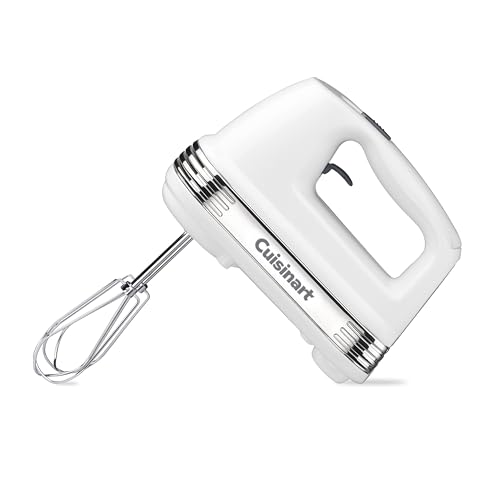
Cuisinart Power Advantage 5-Speed Hand Mixer (HM-50) — Best for Small Kitchens
The HM-50 is the minimalist’s hand mixer: five speeds, extra-long beaters that reach the bottom of deep bowls, and a 60-inch swivel cord (per the Amazon listing) that reaches awkward outlets without dragging across the hob. It has been in Cuisinart’s range for a long time, which means beaters and support remain easy to find — an underrated virtue in small appliances.
Strengths
- Extra-long beaters suit deep mixing bowls and stockpot-sized batches of mash
- Long swivel cord gives real freedom around crowded counters
- Simple slider control is easy to operate with floury hands
Trade-offs
- Five speeds only, with less low-end finesse than the KitchenAid picks
- No storage case included in this configuration
- White finish shows turmeric and tomato stains more than darker colours
| Type | Corded hand mixer |
| Speeds | 5 |
| Motor (per listing) | 220 watts |
| Cord | 60-inch swivel cord |
Choose this mixer if your kitchen is small and your style is practical. It disappears into a drawer, the beaters go in the dishwasher, and the long cord means it works at whichever corner of the counter is free. It will not whip egg whites quite as silkily as the nine-speed machines elsewhere in this guide, but for batters, frostings and everyday mixing it is a durable, honest tool from a brand with a long support tail.
The extra-long beaters deserve more than a bullet point. In a deep bowl — the kind you need for a double batch of mashed potatoes or a large trifle — standard beaters leave an unmixed layer at the bottom that only reveals itself at serving time. The HM-50’s beaters reach that layer, and the long swivel cord means the mixer can work at the stove for gravy-adjacent jobs without an extension lead. It is a plain machine, deliberately so, and its plainness is why examples stay in service for a very long time: there is almost nothing on it to break.
Best for: small kitchens, deep bowls and anyone who values simplicity / Not suited for: bakers who whip a lot of egg whites and want maximum speed control
Check on Amazon — check the current price on Amazon before you decide, as listings and included accessories change over time.

Breville Handy Mixer (BHM800SIL) — Best Premium Hand Mixer
Breville’s Handy Mixer is what you buy when you have used basic hand mixers and know exactly what frustrates you about them: the violent start, the noise, the splatter. With nine speed settings plus a boost function (per the Amazon listing), it offers the finest control in this guide, and its low speeds are genuinely low — the difference shows the first time you fold flour into a sponge batter.
Strengths
- Nine speeds plus boost give the widest control range here
- Gentle low end makes delicate batters and splash-free starts easy
- Premium build and ergonomics suit frequent, longer mixing sessions
Trade-offs
- Premium tier pricing for a hand mixer — overkill for twice-a-year bakers
- Heavier in the hand than the lightest rivals during long whipping jobs
- Still a hand mixer: thick dough remains outside its honest workload
| Type | Corded hand mixer |
| Speeds | 9 + boost |
| Finish | Silver (per listing) |
| Positioning | Premium tier |
The case for the Handy Mixer is frequency. If you bake weekly, the small refinements — smooth speed changes, controlled starts, comfortable grip — compound into a noticeably calmer kitchen. It is also the strongest choice here for whipped components: meringue, chantilly and sponge cakes all benefit from being able to climb the speed range gradually instead of jumping from off to frantic. Buy it once, use it for years, and keep it away from pizza dough.
The nine-speed range earns its keep in a specific, repeatable moment: egg whites. Foam building is a gradient — too fast too early and the bubbles are coarse and fragile; too slow at the end and the peaks never firm. Being able to climb through intermediate speeds lets you build a fine, stable foam that survives folding, and that is the difference between a sponge that rises and one that merely exists. Frequent bakers will feel this advantage weekly; occasional bakers should be honest about whether they will ever use it, because that honesty is what separates this pick from the KitchenAid above it.
Best for: frequent bakers who whip, fold and make delicate batters / Not suited for: occasional bakers who will never use the extra control they paid for
Check on Amazon — check the current price on Amazon before you decide, as listings and included accessories change over time.

Dash Everyday Stand Mixer (3-Quart) — Best Light-Duty Stand Mixer
Some bakers simply prefer a stand mixer: hands free to add ingredients, no wrist fatigue, and a bowl that stays put. The Dash Everyday is the light duty expression of that idea — a compact tilt-head machine with a 3-quart stainless steel bowl and six speeds, sized for one-to-two-person households and small batches. It is honest about its scale, and that honesty is its charm.
Strengths
- True hands-free stand mixing in a countertop-friendly footprint
- 3-quart stainless bowl is light to lift, wash and store
- Six speeds cover batters, frostings and soft doughs for small households
Trade-offs
- Capacity tops out quickly — double batches of cookie dough will strain it
- Lightweight body can walk on the counter at higher speeds with stiff mixes
- Not built for bread dough beyond the softest, smallest loaves
| Type | Tilt-head stand mixer |
| Bowl | 3-quart stainless steel |
| Speeds | 6 |
| Positioning | Budget tier |
Think of the Dash as a hand mixer that holds itself. For small households — a batch of six muffins, a single cake layer, whipped cream for two — it removes the one real annoyance of hand mixing, which is holding the machine. Place it on a non-slip mat, keep batches small, and it earns its counter space. Ask it to behave like a full-size stand mixer and you will be disappointed; treat it as the compact appliance it is and it is delightful.
Living with the Dash teaches a useful lesson about batch discipline. Its bowl is happiest at roughly two-thirds full, which in practice means one standard cake mix, one batch of frosting, or dough for a small loaf — and owners who internalise that limit report a cheerful machine, while those who treat the rim as a suggestion report a mess and a straining motor. A small kitchen scale helps: weighing ingredients for a single batch keeps you inside the brief automatically. Given its size, it is also the only stand mixer here that can plausibly travel — to a holiday rental, a dorm kitchen, a bake-sale prep table — and that portability is a genuine use case, not a gimmick.
Best for: small households wanting hands-free mixing for small batches / Not suited for: families, double batches or regular bread bakers
Check on Amazon — check the current price on Amazon before you decide, as listings and included accessories change over time.

Hamilton Beach 4-Quart Electric Stand Mixer — Best for Bigger Light Batches
This Hamilton Beach marks the top end of what light duty can honestly mean. The Amazon listing confirms a 4-quart bowl, seven speeds, planetary mixing action, a 300-watt motor, a splash guard, and a whisk, flat beater and dough hook in the box. Planetary action — the beater orbits the bowl while spinning — is the feature that separates real stand mixers from toys, because it actually reaches the bowl’s edges.
Strengths
- Planetary mixing gives full bowl coverage without constant scraping
- Full attachment set (whisk, beater, dough hook) included per the listing
- Easy-carry handle and splash guard make it practical to move and use
Trade-offs
- The dough hook invites ambition — keep doughs soft and batches modest
- Larger footprint than the Dash; measure your cupboard before buying
- At this size some buyers should compare full mid-range stand mixers too
| Type | Stand mixer, planetary action |
| Bowl | 4-quart |
| Speeds | 7 |
| Motor (per listing) | 300 watts |
If your light duty baking leans toward the generous side — birthday cakes for a family, big batches of frosting, mashed potatoes for a holiday table — this is the pick that will not feel undersized in November. The honest framing stays the same: it is a light duty machine with a bit more room and a better mixing action, not a disguised heavy-duty one. Respect the dough hook’s limits and it is the most capable machine in this guide.
The planetary action deserves a practical explanation. On a basic stand mixer the beater spins on a fixed axis and can leave a ring of unmixed flour at the bowl’s edge and a pocket at the bottom. Planetary action moves the beater around the bowl as it spins — the listing counts full bowl coverage as the design goal — so the mixture is gathered from the edges continuously. In practice you still scrape once, but ‘once’ replaces ‘constantly’, and over a long creaming job that difference is felt in your shoulders and in the finished crumb. It is the feature that justifies this machine’s position at the top of the light duty class.
Best for: families whose baking is light in type but generous in quantity / Not suited for: serious bread bakers or very small kitchens
Check on Amazon — check the current price on Amazon before you decide, as listings and included accessories change over time.
Comparison Table
| Pick | Badge | Key spec | Best for |
|---|---|---|---|
| KitchenAid 5 Ultra Power Speed Hand Mixer (KHM512) | Best Overall | Type: Corded hand mixer; Speeds: 5 (Ultra Power range) | most home bakers doing cakes, cookies, frostings and whipped cream |
| Hamilton Beach 6-Speed Electric Hand Mixer (62682G) | Best Budget | Type: Corded hand mixer; Speeds: 6 + QuickBurst | budget-conscious bakers and occasional bakers who want tidy storage |
| Cuisinart Power Advantage 5-Speed Hand Mixer (HM-50) | Best for Small Kitchens | Type: Corded hand mixer; Speeds: 5 | small kitchens, deep bowls and anyone who values simplicity |
| Breville Handy Mixer (BHM800SIL) | Best Premium Hand Mixer | Type: Corded hand mixer; Speeds: 9 + boost | frequent bakers who whip, fold and make delicate batters |
| Dash Everyday Stand Mixer (3-Quart) | Best Light-Duty Stand Mixer | Type: Tilt-head stand mixer; Bowl: 3-quart stainless steel | small households wanting hands-free mixing for small batches |
| Hamilton Beach 4-Quart Electric Stand Mixer | Best for Bigger Light Batches | Type: Stand mixer, planetary action; Bowl: 4-quart | families whose baking is light in type but generous in quantity |
Read the table as a workload map rather than a league table. The hand mixers win on storage, price tier and cleanup; the two stand mixers win on hands-free comfort. The right choice is the one whose ceiling sits just above your real baking, not the one with the longest feature list.
How to Choose the Best Light Duty Mixers for Your Kitchen
Start with a workload audit, not a product page. Write down what you actually mixed in the last three months. For most households the honest list is batter, frosting, whipped cream, eggs and the occasional soft dough — and that list is exactly what light duty mixers are built for. If bread dough appears weekly on your list, stop reading this guide and look at mid-range stand mixers instead; no wording on a box will make a light machine enjoy kneading.
Next, decide the format question: hand or stand. Hand mixers store in a drawer, cost less, clean faster and are the better tool for quick jobs like whipping cream or beating eggs in the pan you are already using. Stand mixers free your hands, hold a steadier speed under load and suit longer jobs like creaming a full batch of cookie dough. Many experienced bakers own a hand mixer first and add a stand mixer years later only if their baking grows.
- Choose a hand mixer if: storage is tight, jobs are under five minutes, and your baking is batter-based.
- Choose a compact stand mixer if: you bake weekly, dislike holding a mixer, and your batches are small.
- Choose the larger light stand mixer if: your batches are family-sized but still batter, frosting and soft dough.
- Skip light duty entirely if: stiff dough, double batches or daily use are your normal pattern.
Speeds, and why the low end matters most
Manufacturers advertise speed counts, but the speed that decides your daily happiness is the slowest one. A gentle first speed folds flour without a dust cloud and starts whipped cream without splashing the walls. When you compare mixers, look for smooth, progressive speed changes rather than a big number: five well-spaced speeds beat nine bunched ones. Boost or burst buttons are useful for a five-second push through a thick patch of batter, not as a substitute for a stronger machine.
Beaters and attachments decide what light duty can cover
Standard beaters handle batters and frostings. A whisk attachment transforms egg whites and cream. Dough hooks on a hand mixer are for soft, small doughs only — enriched dough for cinnamon rolls, not a lean baguette dough. Check what is actually in the box on the listing before buying; configurations of the same model vary, and a missing whisk is the most common disappointment in this category.
Budget Tiers for Light Duty Mixers, Explained Honestly
This category falls into three natural tiers, and we describe them in words rather than prices because listings change constantly. The budget tier — where the Hamilton Beach hand mixer sits — buys you a competent motor, basic beaters and a short feature list; it is the right spend for occasional baking. The mid tier — the KitchenAid hand mixer and the compact stand mixers — adds refinement: better low-speed control, nicer ergonomics, storage cases and bowls that feel made rather than moulded.
The premium tier in a light duty guide is still modest by appliance standards: the Breville hand mixer and the larger Hamilton Beach stand mixer live there, and what the extra money buys is control and capacity headroom rather than a different category of machine. The mistake is spending premium money expecting heavy duty performance. If your workload is genuinely heavy, the correct move is to change category, not to buy the most expensive light machine and hope.
Light Duty Mixers in Real Recipes: A Workload Field Guide
Abstract workload labels become clear when they are translated into dishes. Cake batter — the core light duty job — is a medium-resistance mixture that any pick in this guide handles in two to four minutes. Buttercream and cream-cheese frosting are thicker but brief. Whipped cream and egg whites are low-resistance but time-sensitive, rewarding speed control over power. Mashed potatoes are the surprise heavyweight of the category: dense, starchy and often made in large holiday quantities, they are the job most likely to make a small hand mixer labour, and the reason the larger stand mixer earns its place here.
Cookie dough sits at the category’s honest border. A standard batch with room-temperature butter is fine in the stand mixers and manageable in the stronger hand mixers if you add the flour gradually. The same dough made with cold butter, doubled, or loaded with frozen mix-ins crosses the line — and the machine will tell you so with a changed motor note and a warm body. Bread dough, pizza dough and bagel dough live beyond the border entirely. A light duty kitchen that bakes bread weekly should own a plan for dough that does not involve these mixers: hand kneading, a no-knead recipe, or a separate machine built for the work.
The practical rule is resistance multiplied by time. A thick mixture for thirty seconds is a light job; a medium mixture for ten continuous minutes is not. When a recipe asks for a long, continuous mix — some buttercreams and marshmallow frostings do — work in bursts with short rests, and let the machine’s temperature be your guide. These habits are not coddling; they are how a modest appliance delivers a decade of service.
- Green zone (any pick): batters, frostings, whipped cream, egg whites, pancake and muffin mixes.
- Amber zone (stand picks, brief bursts): standard cookie dough, mashed potatoes, soft enriched dough.
- Red zone (wrong tool): stiff bread and pizza dough, doubled dense batches, continuous commercial-style use.
Care, Storage and Making a Light Mixer Last a Decade
Light duty mixers rarely die from a single dramatic overload; they fade from accumulated small abuses — heat cycles, flour in the vents, beaters bent in drawers, cords kinked at the entry point. The countermeasures are correspondingly small. Wipe the body after use rather than weekly, because dried batter is a chisel job while fresh batter is a cloth job. Keep the ventilation slots clear of flour dust with a soft brush once a month. Store beaters in their case or a utensil crock, never loose under heavier tools, because a bent beater wobbles, and a wobbling beater stresses the motor on every revolution for the rest of its life.
Cords deserve a sentence of their own: coil them loosely, never wrap them tightly around the body, and never carry a mixer by its cord. For stand mixers, store the bowl with a cloth inside it and the attachments nested in the cloth — the kit stays together, nothing rattles, and the whole unit lifts out as one. If a machine will sit unused for months, a minute of cleaning before storage prevents the stale-oil smell that greets neglected appliances. None of this is elaborate; it is simply the difference between an appliance that ages and one that merely gets old.
Finally, know the retirement signs, because a failing mixer announces itself: a burning smell that persists after rest, speeds that surge or fade on their own, grinding or clicking from the head, beaters that no longer lock firmly. At that point the honest options are the manufacturer’s service route or replacement — small mixers are rarely economical to repair at third-party rates. Readers who bought a mainstream brand will find that service route exists; that support tail is part of what the mid-tier money buys, and part of why this guide’s picks lean toward established names.
Accessories and Add-Ons Worth Owning with a Light Duty Mixer
A light duty mixer needs very little company, but three accessories earn their drawer space. The first is a second set of beaters: mixing is full of two-stage recipes — cake then frosting, whites then yolks — and a spare set means no washing mid-recipe with wet hands and a running clock. Buy the manufacturer’s own beaters for your model rather than universal ones, because shaft fit decides whether a beater stays in the mixer or takes a dive into the batter. The second is a tall, narrow mixing bowl: hand mixers splash less and whip faster in a deep bowl, and the bowl’s shape does more for whipped cream volume than any speed setting.
The third is organisational rather than mechanical: a small lidded container or the mixer’s own storage case, kept with the machine, for the attachments. Light duty mixers fail socially — they stop being used — when a beater goes missing and the hunt through the utensil drawer becomes part of every recipe. A kit that lives together gets used together. Beyond these, resist the accessory spiral: splash guards, novelty beaters and counter stands solve problems this category mostly does not have, and the money is better spent stepping up one tier in the mixer itself.
One consumable deserves mention because it is really a technique: parchment, soft butter and room-temperature eggs are the light duty mixer’s true accessories. Cold ingredients are the hidden overload in home baking, and a thirty-minute head start on the counter does more for a small motor’s lifespan than any feature printed on a box. The best-equipped light duty kitchen is not the one with the most attachments; it is the one whose ingredients arrive at the bowl ready to be mixed.
How to Use a Light Duty Mixer Without Wearing It Out
Light duty mixers last for years when they are used the way they were designed to be used. The rules below apply to every pick in this guide, hand or stand, and they are the difference between a mixer that dies in two seasons and one that is still creaming butter a decade from now.
- Start every job on the lowest speed and climb gradually — this protects the motor, the gears and your kitchen walls.
- Bring butter and eggs to room temperature before mixing; cold butter is the hidden heavy load in most ‘light’ recipes.
- Add flour in two or three additions and let each one mostly incorporate before adding the next.
- Keep individual mixing bursts short — a few minutes at a time — and let the machine rest between batches.
- For stand mixers, scrape the bowl once mid-job rather than raising the speed to force coverage.
- If the motor note changes, the body gets hot or the mixer smells warm, stop. Rest it for fifteen minutes; heat is the machine asking for mercy.
- Wash beaters promptly (most in this guide are dishwasher-safe per their listings) and store them with the mixer so nothing gets lost or bent.
One habit deserves emphasis: never use a light duty mixer to finish a dough that has already come together stiffly. If a recipe crosses from batter to dough in the bowl, switch to a spoon, a dough whisk or your hands for the final stage. That single habit extends the life of every machine in this guide more than any other.
Common Buying Mistakes
Mistake 1: Buying by wattage alone. Peak wattage on small mixers is a marketing figure measured in a way that flatters the box. Low-speed control, beater design and gearing decide real performance. A modest-wattage mixer with a gentle first speed will make better cakes than a powerful one that starts like a blender.
Mistake 2: Treating the dough hook as a promise. A dough hook in the box means the machine can handle soft, small doughs occasionally. It does not convert a light duty mixer into a bread machine. Repeated stiff dough is the fastest route to a burnt motor in this category.
Mistake 3: Ignoring storage until the mixer arrives. Stand mixers — even compact ones — need a home. Measure the cupboard or the counter corner first, including the height with the head tilted open. Hand mixer buyers should check whether a storage case is included; beaters loose in a drawer get bent.
Mistake 4: Starting on high speed ‘to save time’. It saves no time; it redecorates the kitchen with flour and shocks the motor. Thirty seconds of patience at low speed is the cheapest performance upgrade in baking.
Mistake 5: Doubling recipes in a compact bowl. A 3-quart bowl that handles a single batch beautifully will overflow or stall on a double. If you regularly double recipes, buy the larger light stand mixer or step up a category.
Final Recommendation
For most readers, the KitchenAid KHM512 is the light duty mixer to buy: controlled, comfortable and durable, at a mid-tier position that makes sense for weekly baking. On a firm budget, the Hamilton Beach 62682G loses little that matters and gains a storage case. If you whip and fold often, the Breville Handy Mixer is worth its premium tier; if you want hands-free mixing in a small kitchen, the Dash Everyday is the compact answer, and the Hamilton Beach 4-quart stand mixer is the choice when your light baking comes in family-sized batches.
Whichever you choose, buy the machine that matches the baking you actually do, keep it inside its workload, and it will quietly serve you for years. Readers comparing the neighbouring categories on this site may also find these guides useful:
- Best Overall: KitchenAid 5 Ultra Power Speed Hand Mixer (KHM512) — check price on Amazon
- Best Budget: Hamilton Beach 6-Speed Electric Hand Mixer (62682G) — check price on Amazon
- Best for Small Kitchens: Cuisinart Power Advantage 5-Speed Hand Mixer (HM-50) — check price on Amazon
- Best Premium Hand Mixer: Breville Handy Mixer (BHM800SIL) — check price on Amazon
- Best Light-Duty Stand Mixer: Dash Everyday Stand Mixer (3-Quart) — check price on Amazon
- Best for Bigger Light Batches: Hamilton Beach 4-Quart Electric Stand Mixer — check price on Amazon
Best Lightweight Stand Mixers Best Light Weight Kitchen Stand Mixers Best 6 Qt Standing Mixers Best Stand Mixers Best Hand Mixers
Frequently Asked Questions
What does ‘light duty’ actually mean for a mixer?
It describes the workload the machine is designed for: short, intermittent mixing of batters, frostings, whipped cream and soft doughs, with rests between jobs. Light duty mixers are not built for continuous kneading of stiff dough or for commercial volumes. Used inside their brief, they last for years; used outside it, they overheat and wear out quickly.
Can a light duty mixer make bread dough at all?
Soft, small, enriched doughs — cinnamon roll dough, a single batch of dinner rolls — are fine occasionally, especially with the stand mixers in this guide. Lean, stiff doughs and double batches are not. If bread is a weekly habit, buy a machine designed for it rather than stretching a light duty model.
Is a hand mixer or a small stand mixer better for light baking?
Hand mixers win on storage, price tier and cleanup, and they are perfect for jobs under five minutes. Small stand mixers win on comfort for longer jobs because your hands are free. Most light bakers are happiest starting with a good hand mixer.
How many speeds do I really need?
Five well-spaced speeds cover nearly all home baking. What matters more than the count is a genuinely gentle lowest speed and smooth changes between speeds. Nine-speed models help with delicate work like meringues, which is why the premium pick in this guide offers them.
Why do light duty mixers overheat, and what should I do?
Heat builds when the motor works hard against resistance — cold butter, thick batter, long continuous runs. If the body feels hot or the motor note changes, stop and rest the machine for fifteen minutes. Bringing ingredients to room temperature and mixing in shorter bursts prevents most overheating.
Are the beaters and bowls dishwasher-safe?
On the picks in this guide, the listings indicate dishwasher-safe beaters for the hand mixers, and stainless bowls on the stand mixers are straightforward to wash by hand or machine. Always confirm the exact configuration on the product listing, because bundled accessories vary between listings of the same model.


