Disclosure: airfryerkitchensupply.com is reader-supported. When you buy through links on our site, we may earn an affiliate commission at no extra cost to you.
Where to buy
If you are shopping for the best large bowl mixers, start with this verified shortlist. Every mixer below was verified as a current Amazon listing before a link was attached, and every bowl capacity quoted comes from the verified listing title rather than from marketing copy. Bowl size is the whole subject of this guide, so check the current price on Amazon for your pick — and check your cabinet height twice, because large-bowl machines are tall machines.
- KitchenAid 7 Quart Bowl-Lift Stand Mixer KSM70 — Best Overall Large Bowl: check price on Amazon.
- Kenwood Chef Titanium Kitchen Machine 7 qt — Best European Alternative: check price on Amazon.
- Kitchen in the box Stand Mixer 8.5 QT — Largest Bowl in the Guide: check price on Amazon.
- Aucma Stand Mixer 6.5-QT — Best Budget Large Bowl: check price on Amazon.
- Ankarsrum AKM6230 Assistent Original — Best Large Bowl for Dough: check price on Amazon.
- Bosch Universal Plus with Stainless Bowl — Best for Multiple Loaves: check price on Amazon.
A note on variants: several of these models are sold with different bowls or bundles under the same model family. Confirm the bowl size in the listing title matches the capacity in the review before buying; a large-bowl mixer bought in its small-bowl variant defeats the entire purpose of this guide.
The best large bowl mixers answer a frustration every growing baker knows: the moment a recipe has to be halved, doubled in two shifts, or coaxed into a bowl it clearly overflows. A large bowl — in this guide, six quarts and upward — changes baking from batch management back into baking. Double cookie recipes run in one pass, dough for several loaves kneads in a single session, and the big holiday mixtures that define a family’s year stop being logistical exercises. This guide compares the strongest large-bowl options across every price philosophy, from a budget 6.5-quart tilt-head to the 7-quart flagships and the rotating-bowl specialist.
But capacity has honest costs, and this guide states them as plainly as the benefits. A large bowl mixes small quantities worse — the beater cannot reach a thin layer spread across a wide base — and large-bowl machines are taller, heavier and more expensive to house. The right question is not ‘what is the biggest bowl I can buy’ but ‘what is the largest batch I actually make, and how often’. The six picks below are ordered to help you answer it, from the most complete large-bowl machine to the most affordable route into the class.
One more distinction matters: bowl volume is not working capacity. A 7-quart bowl does not knead seven quarts of dough; flour-and-water loads must sit well below the rim for the tools to work. The reviews judge each machine by realistic working loads — loaves, dozens and batches — rather than by the brim number on the box, because that is the number your baking will actually meet.
In this guide
Quick Picks
Six routes to a bigger bowl: two flagships, a European alternative, the largest bowl in the guide, the dough specialist and the budget step-up. Start with the badge that matches your batch problem.
- Best Overall Large Bowl — KitchenAid 7 Quart Bowl-Lift Stand Mixer KSM70: seven quarts on a rigid bowl-lift frame, eleven speeds plus a folding half speed, and five accessories — the most complete large-bowl package you can buy for a home.
- Best European Alternative — Kenwood Chef Titanium Kitchen Machine 7 qt: a 7-quart stainless bowl, an 800W motor and electronic variable speed from the other great mixer tradition — Britain’s Kenwood Chef line.
- Largest Bowl in the Guide — Kitchen in the box Stand Mixer 8.5 QT: eight and a half quarts with a handle, a motor rated at 900 watts and ten speeds — sheer capacity beyond every branded flagship here, at a budget-brand price.
- Best Budget Large Bowl — Aucma Stand Mixer 6.5-QT: six and a half quarts and a 660W motor for a fraction of flagship money — the value route into genuinely large capacity.
- Best Large Bowl for Dough — Ankarsrum AKM6230 Assistent Original: the rotating-bowl Swedish design whose effective dough capacity embarrasses planetary machines — the large-bowl choice when dough is the load.
- Best for Multiple Loaves — Bosch Universal Plus with Stainless Bowl: the bottom-drive German platform famous among bread bakers for kneading batch after batch — here in its stainless bowl configuration.
How These Picks Were Chosen
Verification came first, as in every guide in this series: each model was matched against Amazon’s catalogue, and the bowl capacity in every heading and specification box is taken from the verified listing title. In a category where manufacturers quote capacity generously and variants abound, that discipline is the difference between a guide and a brochure.
Judgement then worked from realistic loads. We assessed each machine on the batches it will genuinely run — how many loaves, how many dozen cookies, how large a holiday mixture — and on the behaviours that decide large-bowl ownership: frame stability when a big, unbalanced load starts moving, head or bowl access when you are adding a kilo of flour in stages, and the small-batch penalty, honestly scored, because a large-bowl machine that ruins a single cake will be resented weekly and used for crowds monthly.
We deliberately included three philosophies of large: the premium bowl-lift, the European tilt-head tradition, and the budget big-bowl machines that put capacity within everyone’s reach. They are not interchangeable, and the reviews do not pretend otherwise — but each is the best expression of its philosophy, which is what a buyer comparing across price tiers actually needs.
The 6 Best Large Bowl Mixers
Ordered by completeness as large-bowl machines — capacity, stability and versatility together — rather than by bowl size alone. The biggest bowl in the guide is not first, and the reviews explain why.

KitchenAid 7 Quart Bowl-Lift Stand Mixer KSM70 — Best Overall Large Bowl
The KSM70 is for the baker whose batches outgrew the standard 4.5 to 5-quart world: multi-loaf households, batch bakers, holiday producers. Its bowl-lift frame keeps big loads composed, and its accessory bundle means the large bowl arrives ready for production rather than waiting on extras.
Strengths
- 7-quart capacity with bowl-lift stability under load
- Half speed mitigates the big bowl’s small-batch penalty
- Double flex-edge beater scrapes the large bowl as it mixes
Trade-offs
- Tall and heavy — a permanent station, not a stored appliance
- Premium price for the capacity class
- Single small batches still mix better in a smaller bowl
| Specification | Detail |
|---|---|
| Bowl capacity | 7 quart (from Amazon listing title) |
| Design | Bowl-lift |
| Speeds | 11, including 1/2 speed for folding |
| Included tools | Double Flex Edge Beater and 4 other accessories, per Amazon listing title |
Capacity is only useful when the machine stays calm using it, and that is the KSM70’s core achievement. Seven quarts of dough or batter is a moving, unbalanced mass; the clamped bowl and fixed head absorb it without the walking and nodding that plague lesser large machines. The double flex-edge beater matters more at this scale than any other — scraping a 7-quart bowl by hand, repeatedly, is the hidden labour of large-batch baking, and this beater automates most of it.
The half speed deserves its second mention in this guide series because it directly answers the large-bowl objection. Delicate folding in a big bowl is where flagship capacity usually fails; a genuine half speed, moving the tool slowly enough to fold rather than stir, makes the KSM70 usable across a far wider range of batch sizes than its bowl suggests. It remains a big machine for big work — but it is the least compromising big machine here.
Best for: batch bakers and large households wanting flagship capacity with stability / Not suited for: small kitchens or bakers whose batches are usually single recipes
Check the current price on Amazon for the KitchenAid 7 Quart Bowl-Lift Stand Mixer KSM70 — our Best Overall Large Bowl pick in this guide.

Kenwood Chef Titanium Kitchen Machine 7 qt — Best European Alternative
The Kenwood suits bakers who want flagship large-bowl capacity outside the KitchenAid platform: cooks who value its electronic variable speed, its long European service tradition, and its own attachment system. It is the connoisseur’s alternative — equally serious, differently flavoured.
Strengths
- 7-quart stainless steel bowl matches the flagship class
- 800W motor with electronic variable speed control
- Three mixing tools and a dishwasher-safe bowl included
Trade-offs
- Smaller retail and service footprint than KitchenAid in the US
- Its attachment ecosystem is separate — no cross-compatibility
- Less familiar controls for bakers raised on American machines
| Specification | Detail |
|---|---|
| Bowl capacity | 7 quart stainless steel (from Amazon listing title) |
| Motor | 800W, per Amazon listing title |
| Speed control | Electronic variable speed |
| Included tools | Three mixing tools, dishwasher-safe work bowl |
American roundups often treat KitchenAid as the only serious name, which would surprise the generations of British and European bakers raised on Kenwood Chefs. The Chef Titanium’s 7-quart format is that tradition at full scale: a powerful motor under electronic control, so speed stays where you set it as loads change, and a bowl and tool set built for family-and-beyond volumes. In dough and batter behaviour it belongs in the flagship conversation on merit.
The practical cautions are ecosystem ones. Kenwood’s attachments are its own, its US retail presence is thinner, and replacement parts travel further. For a buyer who values the machine itself over the platform around it — and who finds its control feel preferable — those are acceptable trades. As a large-bowl machine in isolation, this is as good as the category gets.
Best for: bakers wanting flagship 7-quart capacity beyond the KitchenAid platform / Not suited for: attachment collectors or buyers who prioritise US service convenience
Check the current price on Amazon for the Kenwood Chef Titanium Kitchen Machine 7 qt — our Best European Alternative pick in this guide.

Kitchen in the box Stand Mixer 8.5 QT — Largest Bowl in the Guide
This machine is for the buyer whose batch problem is absolute: the biggest bowls, the largest doughs, the crowd-scale mixtures — and whose budget does not extend to flagship frames. It suits event bakers, large families and anyone who has priced a 7-quart flagship and needs the capacity more than the badge.
Strengths
- 8.5-quart bowl is the largest in this guide
- Bowl handle helps manage full, heavy loads
- Whisk, beater and splash guard included
Trade-offs
- Budget-brand build, support and longevity expectations
- Tilt-head hinge works hard at these volumes
- Small batches are genuinely impractical in this bowl
| Specification | Detail |
|---|---|
| Bowl capacity | 8.5 quart, with handle (from Amazon listing title) |
| Motor | 900 watt, per Amazon listing title |
| Speeds | 10, adjustable |
| Design | Tilt-head |
| Included tools | Whisk, flat beater, splash guard |
| Colour verified | Silver |
There is no subtlety to this machine’s appeal, and none is needed: when your problem is that every bowl you own is too small, an 8.5-quart bowl with a handle, a splash guard and a full tool set at a budget price is a direct answer. The handle is a thoughtful touch — a full bowl at this scale is a two-handed lift, and the guard keeps the largest, flour-heaviest mixes contained.
The frame is where the money was saved, and the review must say so: a tilt-head hinge managing 8.5-quart loads is working at the architecture’s edge, so heavy doughs should be run at low speed in sensible sub-batches of the bowl’s volume, and longevity expectations should be set to the price. As a capacity purchase — the most bowl per dollar in this guide by a wide margin — it is unmatched. Just buy it as that, not as a flagship in disguise.
Best for: crowd-scale bakers who need maximum bowl capacity on a limited budget / Not suited for: buyers expecting flagship build or small-batch versatility
Check the current price on Amazon for the Kitchen in the box Stand Mixer 8.5 QT — our Largest Bowl in the Guide pick in this guide.

Aucma Stand Mixer 6.5-QT — Best Budget Large Bowl
The Aucma is the large-bowl guide’s value anchor: for families and batch bakers whose recipes overflow standard bowls but whose budgets stop well short of the flagships. It suits batter, dough and mixture work at family scale, with the honest expectation of budget-tier refinement.
Strengths
- 6.5-quart bowl at a budget price
- Dough hook, wire whip and beater included
- 660W motor figure leads its price class
Trade-offs
- Fit and finish below the branded machines
- Can shift on the counter under unbalanced big loads
- Parts and support network thinner than the majors
| Specification | Detail |
|---|---|
| Bowl capacity | 6.5 quart (from Amazon listing title) |
| Motor | 660W, per Amazon listing title |
| Design | Tilt-head |
| Included tools | Dough hook, wire whip, beater |
| Colour verified | Black |
Between the 5-quart standard and the 7-quart flagships sits the size most large families actually need, and the Aucma owns it at this price. Six and a half quarts runs double batches, family doughs and party mixtures in one pass, and the included tool trio covers the work without an accessories order. For a household upgrading from a standard mixer purely for room, this is the shortest path.
Manage it like a budget machine and it will serve: start big loads slowly, keep the heaviest doughs moderate, and expect more noise and movement than a flagship shows. What you are buying is capacity per dollar, and on that measure nothing in this guide beats it — the flagships are better machines, but they are not three times the bowl.
Best for: large families and batch bakers needing real capacity on a budget / Not suited for: buyers wanting flagship stability, quiet or longevity
Check the current price on Amazon for the Aucma Stand Mixer 6.5-QT — our Best Budget Large Bowl pick in this guide.
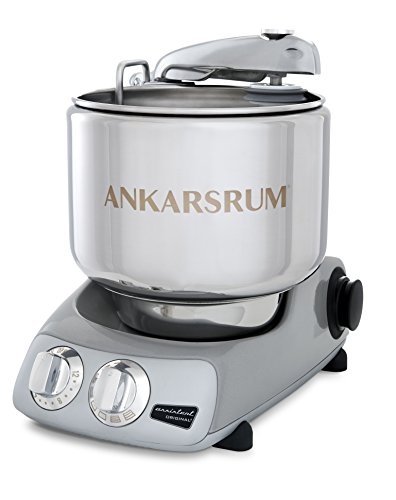
Ankarsrum AKM6230 Assistent Original — Best Large Bowl for Dough
The Ankarsrum’s bowl does not win on the number printed beside it; it wins on what its rotating design can develop. For bakers whose large batches are dough — multiple loaves, big pizza nights, wholegrain production — its working capacity and gentle, thorough kneading make it the specialist’s large-bowl answer.
Strengths
- Rotating bowl develops large doughs evenly and gently
- Scraper-and-roller action handles volumes planetary tools struggle with
- Decades-old design with a loyal production-baking following
Trade-offs
- Technique must be relearned; the first week frustrates
- Separate bowl and tools for whipping and creaming work
- Premium specialist pricing
| Specification | Detail |
|---|---|
| Model | AKM6230, per Amazon listing title |
| Design | Rotating bowl (manufacturer’s Assistent platform) |
| Colour verified | Jubilee Silver |
Planetary mixers knead by pushing dough around a bowl; the Ankarsrum turns the bowl beneath a roller and scraper, working the whole mass continuously the way hands do. At large volumes the difference compounds: dough develops evenly without the climbing, tearing and motor protest that big planetary batches can produce, and the bowl’s open top makes adding flour in stages — the rhythm of large dough work — completely natural.
The trade-offs are the platform’s known ones: a second bowl system for aeration tasks, a learning curve, and specialist pricing. But this guide is about large bowls, and for the largest, heaviest category of home load — dough — no planetary bowl at any printed size outworks this design. Dough-led batch bakers should start their shortlist here.
Best for: dough-led batch bakers producing multiple loaves and large dough volumes / Not suited for: batter-and-cream bakers or anyone unwilling to relearn technique
Check the current price on Amazon for the Ankarsrum AKM6230 Assistent Original — our Best Large Bowl for Dough pick in this guide.

Bosch Universal Plus with Stainless Bowl — Best for Multiple Loaves
The Bosch Universal Plus suits production bread bakers, especially wholegrain and multi-loaf households, who value its bottom-drive design: the bowl sits over the drive, the top stays open for adding ingredients, and the platform has a long reputation for dough endurance at family-production scale.
Strengths
- Bottom-drive design leaves the bowl top fully open
- Renowned among bread bakers for multi-loaf endurance
- Stainless bowl configuration in this listing
Trade-offs
- Unconventional design and workflow versus planetary norms
- Batter and whipping technique differs from standard mixers
- Its own accessory ecosystem and learning curve
| Specification | Detail |
|---|---|
| Configuration | Universal Plus with MUZ6ER1 stainless bowl, per Amazon listing title |
| Design | Bottom-drive (manufacturer’s Universal platform) |
Bosch’s Universal line is the other great alternative tradition in this guide: where planetary machines orbit a tool in a fixed bowl, the Bosch drives from beneath, which keeps the bowl’s mouth completely clear — a genuine ergonomic advantage when you are adding kilos of flour across a long kneading session — and gives the platform its reputation for tireless dough work among wholegrain and multi-loaf bakers.
Like the Ankarsrum, it asks for adaptation: the tools, the bowl handling and the batter technique all differ from the planetary mainstream, and its accessory world is its own. Bakers whose large-bowl need is specifically ‘many loaves, often’ have sworn by this platform for decades, and a large-bowl guide that omitted it would be telling only most of the story.
Best for: multi-loaf and wholegrain bakers wanting an open-top, dough-enduring platform / Not suited for: bakers wanting conventional planetary technique and accessories
Check the current price on Amazon for the Bosch Universal Plus with Stainless Bowl — our Best for Multiple Loaves pick in this guide.
Comparison Table
Capacity leads the table, but read it with the design column: how the bowl is driven matters as much as how much it holds.
| Pick | Badge | Key spec | Best for |
|---|---|---|---|
| KitchenAid 7 Quart Bowl-Lift Stand Mixer KSM70 | Best Overall Large Bowl | 7-qt bowl-lift, 11 speeds plus half speed | batch bakers and large households wanting flagship capacity with stability |
| Kenwood Chef Titanium Kitchen Machine 7 qt | Best European Alternative | 7-qt, 800W, electronic variable speed | bakers wanting flagship 7-quart capacity beyond the KitchenAid platform |
| Kitchen in the box Stand Mixer 8.5 QT | Largest Bowl in the Guide | 8.5-qt tilt-head, 900W, 10 speeds | crowd-scale bakers who need maximum bowl capacity on a limited budget |
| Aucma Stand Mixer 6.5-QT | Best Budget Large Bowl | 6.5-qt tilt-head, 660W | large families and batch bakers needing real capacity on a budget |
| Ankarsrum AKM6230 Assistent Original | Best Large Bowl for Dough | Rotating-bowl large-capacity dough specialist | dough-led batch bakers producing multiple loaves and large dough volumes |
| Bosch Universal Plus with Stainless Bowl | Best for Multiple Loaves | Bottom-drive platform, stainless bowl configuration | multi-loaf and wholegrain bakers wanting an open-top, dough-enduring platform |
The honest summary: flagships give you capacity with stability and support, budget big bowls give you capacity alone, and the two alternative platforms give you dough capacity of a different, arguably deeper kind. Your dominant load — batter, dough or mixture — should pick the row.
How to Choose the Best Large Bowl Mixers for Your Real Batch Sizes
Start by measuring your baking in the units that matter: loaves per session, dozen cookies per batch, litres of mixture at your biggest annual event. Then buy one size above your regular maximum — not three. A baker whose biggest regular batch is a double cookie recipe needs six quarts, not eight and a half, and will mix everything else better in the smaller large bowl. Oversizing is the large-bowl category’s most common and least admitted mistake, because the penalty is paid in every small batch for years.
Next, match the architecture to the load. Heavy, dough-led volume wants rigidity: bowl-lift frames or the rotating and bottom-drive specialists. Batter and mixture volume is kinder, and tilt-head flagships and even budget big bowls handle it well. Then check the unglamorous fit questions — overall height with the head open or bowl lifted, the weight you will move when cleaning, and whether the bowl, full, is a lift you can make safely to the oven or counter. A full 7-quart bowl of dough is a serious object; handles and manageable weight are safety features, not conveniences.
Finally, price the second bowl. Large-bowl bakers are batch bakers, and batch bakers live by the bowl swap — dough proofing in one while batter mixes in another. Confirm a second bowl exists for your model and what it costs before committing; on some platforms that single accessory decides whether production days flow or stall.
Working Capacity vs Bowl Volume: The Number That Actually Matters
Bowl volume is measured to the brim with water. Your working capacity is set by physics instead: dough must stay low enough for the hook to fold it rather than ride over it, batter must leave headroom for the beater’s wave, and whipped mixtures expand. As a working rule, dough loads should occupy no more than roughly half the bowl’s volume, batters about two-thirds, and anything whipped should start below half. That is why a 7-quart bowl is honestly a three-loaf machine rather than a seven-quart-of-dough machine — and why it is still transformative compared with a 4.5-quart bowl running the same maths.
This is also the lens for judging the budget giants. An 8.5-quart bowl run at honest working fractions delivers genuinely more per batch than a 6.5 — provided the frame tolerates the load, which is why this guide pairs every capacity claim with a stability judgement. Capacity without stability is a number; capacity with it is a capability.
Living With a Large-Bowl Mixer: Storage, Cleaning and the Small-Batch Problem
Large-bowl machines are furniture. Most will live permanently on the counter, so measure the station — including head-tilt or lift clearance and the bowl’s removal path — before the machine arrives, and be honest about whether a appliance of this height and weight will ever be cupboard-stored. If it will not fit your kitchen’s vertical space, a 6.5-quart tilt-head may serve you better than a 7-quart lift you have to house in the garage.
Cleaning scales with the bowl: large stainless bowls wash easily but occupy a sink, and large batches leave large residues in whisk wires and beater joints. Wash tools promptly and dry the bowl before remounting it. And solve the small-batch problem deliberately rather than resentfully: keep a smaller second bowl if your platform offers one, use a hand mixer for two-egg-white jobs, or accept the flagship half-speed’s help. Every large-bowl owner develops one of these answers; choosing yours in advance is the difference between a machine that serves all your baking and one that serves only its biggest days.
Bowl Materials at Scale: Stainless, Glass and the Weight of a Full Bowl
At standard sizes, bowl material is a preference; at large sizes, it becomes logistics. Stainless steel dominates this guide for structural reasons: a 7-quart stainless bowl is light enough to lift when full, shrugs off dents, chills and heats without complaint, and survives the dishwasher and the occasional drop that would end a glass bowl’s career — along with the batch inside it. When a bowl holds several kilos of dough or mixture, its own weight is part of the load you carry from mixer to oven, and stainless is the only common material that keeps that total manageable.
Glass and ceramic bowls exist at the smaller end of large, and their virtues are real — visibility, microwave convenience, serving at the table — but they scale badly: thickness grows with size, weight compounds, and the risk profile of a dropped full bowl changes from inconvenience to hazard. The practical rule for large-bowl buyers is to default to stainless for the working bowl, treat any second bowl as the place for material variety, and always lift a full large bowl as the two-handed, planned manoeuvre this guide’s how-to section describes. Capacity you cannot move safely is not capacity you own.
Large Bowls and Leavening: Why Big Batches Behave Differently
Scaling a recipe into a large bowl changes more than arithmetic, and bakers moving up from standard machines meet three effects worth knowing. First, mixing efficiency improves for the batch as a whole — one large mix develops more evenly than two small ones made in sequence — but ingredient incorporation at the start needs staging, because a deep mass of flour hides dry pockets a small bowl never forms. Second, dough temperature runs warmer in large masses: friction from a long knead dissipates into a bigger thermal mass that also retains it, so production bakers start with cooler water in summer and watch dough temperature rather than kneading time alone.
Third, fermentation scales non-linearly: a large dough mass generates and holds more of its own warmth, often proofing noticeably faster than the same recipe in a small bowl on the same counter. None of these effects is a problem; all of them are reasons the experienced large-bowl baker adjusts recipes rather than merely multiplying them. The machines in this guide give you the room to work at this scale — the adjustments are the craft that comes with the room, and they are a large part of why batch baking has its own literature, its own habits and, eventually, its own devotees.
One Large Mixer or Two Standard Ones? The Production Household’s Real Question
Households approaching large-bowl territory sometimes ask whether two standard mixers beat one large one, and the honest answer is: for parallel work, occasionally; for batch work, almost never. Two machines let two mixtures run at once — dough kneading while meringue whips — and provide redundancy when one fails. But they double the storage, the cleaning, the accessory ecosystems and the counter negotiation, while each individual batch remains capped at standard size. The baker whose problem is one enormous batch gains nothing; the baker whose problem is two simultaneous medium batches gains everything.
The deciding evidence is your production pattern. If your big days are built from single scaled recipes — the triple cookie batch, the four-loaf session, the holiday mixture — one large machine is the answer, and this guide is your shortlist. If your big days are built from many different recipes racing one deadline, a large machine plus the standard one you already own is usually the strongest combination of all: capacity where it is needed, parallelism where it counts, and no duplicated ecosystem. Large-bowl buying, like the baking it enables, rewards those who plan the whole session rather than the single biggest moment in it.
A Note on Sink Size, Storage and the Bowl’s Life Off the Machine
The large bowl’s least-discussed specification is whether it fits your sink. A 7 or 8.5-quart bowl under a standard tap, in a standard basin, is a washing negotiation that happens after every batch, and buyers should rehearse it mentally before the machine arrives: basin depth, tap height, and where a wet, heavy bowl drains without occupying the kitchen’s only workspace. Storage follows the same logic — the bowl lives on the machine for most owners because cupboards that fit the bowl rarely fit anything else beside it, which is one more reason the machine’s station should be planned rather than improvised. None of this diminishes the category; it simply completes the picture of ownership that capacity numbers begin. The bakers who thrive with large bowls are the ones who planned for the bowl’s whole life — mixing, proofing, washing, storing — and not only for its minutes under the beater.
Reading This Guide Backwards: From Your Biggest Day to Your Bowl
Most buyers read a guide like this one forwards, from the top pick down, and arrive at a machine; large-bowl buying works better backwards, from a day. Picture your biggest baking day of the year in concrete detail — the actual recipes, in the actual order, with the actual quantities your family expects. Now ask the only question that sizes a bowl correctly: on that day, which batches broke your current equipment? Was it the dough that had to be split, the mixture that crowned the bowl, the second batch that made you late? The machine that fixes that specific breakage, with one step of headroom and no more, is your machine — and it is identifiable in this guide’s reviews by the workload descriptions, not by the capacity numbers.
Then perform the second, quieter check: the ordinary Tuesday. The large bowl you buy for the biggest day must still live with the weekly single loaf and the small cake, through a second bowl, a hand mixer or a half-speed’s patience. A purchase that solves the biggest day by taxing every Tuesday has traded a yearly problem for a weekly one. The six machines here were chosen to span exactly that negotiation — capacity with the least collateral cost — and the reader who arrives backwards, day first and Tuesday second, will find the negotiation already mapped in the badges. Start from your calendar, and the bowl chooses itself.
Proofing, Chilling and Resting: The Large Bowl’s Second Career
A large bowl spends only part of its life on the mixer, and its off-machine career is a genuine part of its value. Dough proofed in the mixing bowl — oiled, covered, undisturbed — skips a transfer and its degassing entirely, which is why batch bakers plan their sessions around bowl availability rather than mixer availability. The same bowl chills cookie dough, marinates for a crowd, holds the holiday salad before dressing, and becomes the biggest, best mixing vessel in the kitchen for every hand task that overflows lesser bowls. Stainless bowls do all of this without absorbing odours or stains, which is one more reason the material dominates this guide.
This second career is the practical engine behind the second-bowl advice elsewhere in this guide: the constraint on production days is rarely the mixer’s minutes but the bowl’s hours, spent proofing and chilling while the next batch waits. A second bowl does not make the mixer faster; it makes the kitchen continuous. Buyers comparing large-bowl platforms should therefore ask the bowl questions with unusual care — price, availability, whether it fits their fridge and their sink — because at this scale the bowl is not an accessory to the system. It is half of it.
Scaling Recipes Into a Large Bowl: A Worked Approach
Multiplying a recipe is arithmetic; scaling it is craft, and large-bowl bakers develop a method worth borrowing. Start by scaling the flour and liquid exactly, but hold back a small portion of the liquid: large masses hydrate differently, and liquid can always join the dough while its excess cannot leave. Scale leavening slightly conservatively in warm kitchens, because a large dough mass ferments in its own warmth, and season mixtures — meat blends, slaws, stuffings — at ninety percent of the multiplied quantity, then adjust: salt and spice can be added to a mixed batch, never removed from one.
Work in the machine’s rhythm rather than against it: incorporate in stages, rest doughs midway, and judge doneness by the mixture’s appearance and temperature rather than by the original recipe’s minutes, which were written for a mass a third of yours. Finally, annotate the recipe itself with what the scaled batch did — times, temperatures, the liquid adjustment — because your own scaled, tested version is the only one that exists in the world for your machine and your kitchen. Large-bowl baking rewards this record-keeping disproportionately: the second production of any recipe is where the capacity you bought starts paying compound interest.
How to Use a Large Bowl Mixer for Big Batches Without Overloading It
Large bowls invite overload, and overload — not capacity — is what strains motors, walks machines and ruins mixtures. This sequence keeps big batches inside the machine’s honest envelope.
- Stage flour and dry ingredients beside the mixer and add them in three or four additions, letting each incorporate at low speed before the next
- For dough, combine liquids and about two-thirds of the flour first, mix to a shaggy mass, rest ten minutes, then add the remaining flour — the rest hydrates the flour and shortens the hard kneading
- Keep the working load below the bowl’s middle for dough and two-thirds for batter, splitting a batch into two runs rather than crowning the bowl
- Scrape once, deliberately, midway: stop, scrape the bottom centre and sides, and restart — one planned scrape beats five reactive ones
- Watch the machine, not the clock, on big loads: a steady rhythm is healthy, while rocking, walking or a labouring note means split the batch or slow down
- Lift the full bowl with two hands using its handle where fitted, and set it down before releasing the tilt or lift — most large-bowl accidents are handling accidents, not mixing ones
After the session, wash the bowl and tools while residue is soft, dry everything before storage, and note the batch sizes that worked in the recipe itself. Your own annotated recipes — ‘full batch, fine’ or ‘split this one’ — become the most reliable capacity guide you own, tuned to your machine rather than to any roundup, including this one.
Common Buying Mistakes
- Buying the largest bowl available and then mixing single recipes badly in it for years
- Treating brim volume as working capacity and crowning the bowl with dough
- Skipping the cabinet-height measurement on the tallest category of mixer in the kitchen
- Forgetting the full bowl’s weight — a loaded 7-quart bowl is a two-handed, plan-the-route lift
- Never buying the second bowl that turns batch days from washing relays into production
- Expecting budget big-bowl frames to shrug at maximum loads the way flagship bowl-lifts do
Each mistake is a mismatch between the number on the box and the life in the kitchen. Large-bowl buying done by batch diary rather than by brochure avoids all of them.
Final Recommendation
Buy the KSM70 if you want the complete large-bowl machine — capacity, stability, accessories and support in one. Consider the Kenwood if you prefer the European platform at the same scale, the Ankarsrum or Bosch if your large loads are dough above all, and the Aucma or the 8.5-quart Kitchen in the box if capacity per dollar is the deciding measure. Every one of them will change what your baking days look like; the right one changes them without taxing your small batches.
Check the current price on Amazon for your pick, confirm the bowl size in the listing title, measure your cabinets a final time, and then bake the batch you have been halving for years — in one go. The guides below cover the professional range and the broader large-mixer category.
Short on time? Start with the KitchenAid 7 Quart Bowl-Lift Stand Mixer KSM70, Kenwood Chef Titanium Kitchen Machine 7 qt, Kitchen in the box Stand Mixer 8.5 QT — check price on Amazon for each and compare the current bundles before you decide.
Best Large Mixers Best Kitchen Stand Mixers Best Kitchenaid Professional Mixers Best Kitchen Mixers Under $300 Best Kitchenaid Mixers For Cooks
Frequently Asked Questions
What counts as a large bowl for a stand mixer?
In this guide, six quarts and above. Standard home bowls run 4.5 to 5 quarts; the large class — 6.5, 7 and 8.5 quarts here — is where double and production batches become single-run work. Working capacity is always less than the brim figure, roughly half for dough.
Will a large bowl ruin my small batches?
It will mix them less efficiently: thin layers spread beyond the beater’s best reach. Mitigations include a smaller second bowl where offered, a hand mixer for tiny jobs, or a flagship’s gentle half speed for folding. Occasional small batches are fine; daily small batches argue for a smaller main machine.
Which is better for large dough batches, bowl-lift or rotating bowl?
Both beat tilt-heads at volume. Bowl-lift planetary machines are the versatile choice, mixing everything well with dough as a strength. Rotating-bowl designs like the Ankarsrum specialise further into dough and develop large masses most gently. Choose by how dough-dominated your baking is.
Do I need a second bowl for a large mixer?
Batch bakers benefit enormously: one bowl proofing or chilling while the other mixes removes the washing relay from production days. Confirm availability and price for your model before buying the machine, since not every platform offers one.
Are budget large-bowl mixers worth it?
As capacity purchases, yes — the Aucma and 8.5-quart picks here deliver bowl sizes the flagships charge far more for. Buy them with adjusted expectations for frame stability, noise and longevity, keep loads sensible, and they are rational tools rather than false economies.
How do I know if a large mixer fits my kitchen?
Measure counter-to-cabinet height against the machine’s height with its head tilted or bowl lifted, check the bowl’s removal path, and plan the full bowl’s route to your work surface. If the numbers are tight, a 6.5-quart tilt-head usually fits kitchens that a 7-quart bowl-lift cannot.


