Disclosure: airfryerkitchensupply.com is reader-supported. When you buy through links on our site, we may earn an affiliate commission at no extra cost to you.
Where to buy
If you are shopping for the best kitchen stand mixers under 100 dollars, start with this verified shortlist. All six machines below were verified as current Amazon listings before any link was attached. This is an entry-level tier where prices wobble around the $100 line with promotions, so check the current price on Amazon for each pick before you buy — and read the honest framing in the introduction about what this budget can and cannot buy.
- Dash Everyday Stand Mixer — Best Overall Budget Pick: check price on Amazon.
- Hamilton Beach Classic Stand and Hand Mixer — Best Dual-Use Value: check price on Amazon.
- Hamilton Beach 4 Quart Electric Stand Mixer — Best Mixing Action Under the Cap: check price on Amazon.
- Kitchen in the box Stand Mixer 3.2Qt — Best for Tiny Kitchens: check price on Amazon.
- bella 3.5 Qt Hand & Stand Mixer — Best Lightweight 2-in-1: check price on Amazon.
- Delish by Dash Stand Mixer — Best for Absolute Beginners: check price on Amazon.
If a pick is showing above the line when you check, it is usually a promotion that has ended rather than a different machine. The models were chosen because they belong to the entry tier of the stand mixer market; the links take you to the live listings so you can judge the price you would actually pay today.
Let us be straight about the best kitchen stand mixers under 100 dollars before we recommend any of them: no KitchenAid, Cuisinart or Smeg stand mixer lives at this price, and any roundup implying otherwise is selling you a refurbished unit, a hand mixer in disguise, or a price that expired last season. What genuinely exists under $100 is a class of compact, light-duty stand mixers from brands like Dash and Hamilton Beach — machines built for batter, frosting and small doughs, with plastic where the expensive machines have metal. Judged honestly against that brief, several of them are good value. Judged as cheap flagships, all of them will disappoint you.
That honesty shapes this whole guide. These six picks are the best of the entry tier: the ones with stainless bowls rather than plastic where it counts, real planetary or rotating-bowl action rather than wobbling twin beaters where possible, and designs that suit the small kitchens and first homes that buy them. What they share is a workload ceiling — small to medium batches, soft to moderate doughs, occasional rather than daily heavy use — and the reviews state that ceiling for each machine individually.
If your baking is weekly bread or double batches for a crowd, this is the wrong guide and the under-$300 guide linked below is the right one. But if your reality is pancakes, cakes, whipped cream, dips and the occasional pizza dough for two, spending flagship money would be the waste. This tier, bought with open eyes, is the sensible end of the mixer market.
In this guide
Quick Picks
Six entry-tier machines, ranked by how honestly and usefully they do entry-tier work. The badges name the small-kitchen or small-budget job each one is genuinely best at.
- Best Overall Budget Pick — Dash Everyday Stand Mixer: a compact 3-quart tilt-head with a stainless bowl and six speeds — the most complete small stand mixer in the entry tier.
- Best Dual-Use Value — Hamilton Beach Classic Stand and Hand Mixer: stand mixer and hand mixer in one: the head detaches for saucepan jobs, and the 4-quart bowl is the biggest in this guide’s core picks.
- Best Mixing Action Under the Cap — Hamilton Beach 4 Quart Electric Stand Mixer: true planetary mixing, seven speeds and a splash guard in the box — the most complete mixing geometry this budget buys.
- Best for Tiny Kitchens — Kitchen in the box Stand Mixer 3.2Qt: a portable, lightweight 3.2-quart machine with the full three-tool set — built for daily small jobs and easy storage.
- Best Lightweight 2-in-1 — bella 3.5 Qt Hand & Stand Mixer: another take on the hybrid idea in a soft Oatmilk finish — a 3.5-quart bowl with a detachable hand unit for quick jobs.
- Best for Absolute Beginners — Delish by Dash Stand Mixer: five speeds, a removable 3.5-quart bowl and dough hooks included — the simplest possible introduction to stand mixing.
How These Picks Were Chosen
Verification followed the same discipline as our flagship guides: every model was matched against Amazon’s catalogue, and only confirmed listings received links. In this tier that step matters even more, because the entry market is crowded with lookalike machines sold under rotating brand names; the six here are the ones with traceable models, real manufacturers and listings that matched exactly.
Tier placement used the API’s price data internally at verification — we do not print figures, because entry-tier prices swing the most of any in this category and a printed number would be wrong within weeks. The models selected are the established entry lines of their brands, the machines those brands themselves position at the bottom of their ranges. If a live price has drifted over the line when you check, that is the market moving, not the machine changing.
Judgement then focused on the entry-tier essentials: whether the bowl is stainless steel, whether the mixing action actually reaches the bowl’s contents, whether the machine stays put on the counter, and whether its limits are the forgivable kind — small capacity, modest power — rather than the fatal kind, like tools that bend or heads that wobble loose. Longevity expectations were set honestly: these are starter machines, and the reviews say which ones have the best chance of outgrowing that label.
The 6 Best Kitchen Stand Mixers Under 100 Dollars
Ordered by how confidently we would hand each machine to a first-time buyer on a firm budget. Every review names the workload ceiling plainly — in this tier, knowing what a mixer cannot do is the most valuable information in the guide.

Dash Everyday Stand Mixer — Best Overall Budget Pick
The Dash Everyday is the machine we would give a first-time baker in a small kitchen without a speech of warnings. It suits one-to-two-person households whose mixing is cakes, batters, frostings and whipped toppings, and whose counter or cupboard space rules out a full-size machine entirely.
Strengths
- Stainless steel bowl where many rivals use plastic
- Tilt-head design is simple to use and clean
- Compact enough to store in a standard cupboard
Trade-offs
- 3-quart bowl caps batch size firmly
- Light doughs only — this is not a bread machine
- Budget motor and gears set a modest lifespan expectation
| Specification | Detail |
|---|---|
| Bowl capacity | 3 quart stainless steel (from Amazon listing title) |
| Speeds | 6 |
| Design | Compact tilt-head |
| Colour verified | Black |
Within the entry tier, details separate the Dash from the anonymous crowd: the bowl is stainless rather than plastic, the tilt-head locks and releases without a fight, and the six speeds are spaced for the jobs the machine will actually do — gentle folding at the bottom, competent whipping at the top. For a single cake, a batch of cupcakes or a bowl of frosting, it behaves exactly as a stand mixer should, and it does so at a size that disappears into a cupboard afterwards.
The ceiling is capacity and dough. Three quarts means one standard recipe at a time, and the drive is built for light work; a small, soft pizza dough occasionally is fair, a weekly stiff loaf is not. Accept those terms and this is the entry tier’s most honest machine — the one whose promises and performance match.
Best for: first-time buyers, small households and small kitchens needing a real stand mixer on a firm budget / Not suited for: bread bakers, large families or anyone mixing double batches
Check the current price on Amazon for the Dash Everyday Stand Mixer — our Best Overall Budget Pick pick in this guide.
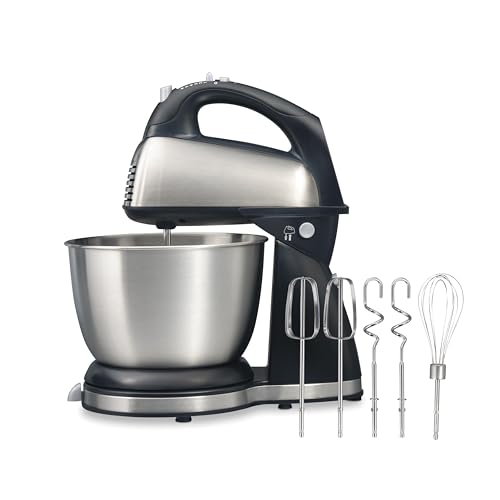
Hamilton Beach Classic Stand and Hand Mixer — Best Dual-Use Value
Buy this if your budget must cover two appliances. The Classic works on its stand for hands-free cake and cookie mixing, then lifts off as a hand mixer for mashed potatoes at the stove or a quick frosting in a small bowl. It suits small households that cook varied food but bake moderately.
Strengths
- Two appliances in one purchase and one footprint
- 4-quart bowl beats the other budget picks on capacity
- QuickBurst and Bowl Rest are genuinely useful details
Trade-offs
- 290 watts peak limits heavy dough work
- Stand stability is the weakest of the six under load
- Head on/off routine adds a step stand-only rivals skip
| Specification | Detail |
|---|---|
| Bowl capacity | 4 quart (from Amazon listing title) |
| Speeds | 6, with QuickBurst |
| Motor | 290 watts peak power, per Amazon listing title |
| Design | Stand mixer with detachable hand mixer head |
The hybrid idea is old, and Hamilton Beach’s version endures because the execution is practical: the stand gives you hands-free mixing with a bowl larger than any rival here, and the detachable head acknowledges a truth stand-mixer purists ignore — half of home mixing happens in pans and small bowls the stand cannot reach. The Bowl Rest feature, parking the hand unit on the bowl’s rim, saves the messy counter-laydown every other hand mixer demands.
As a stand mixer alone it is outclassed by the Dash for stability and by the Hamilton Beach below for planetary action; as a two-in-one purchase at this price, nothing else in the guide competes. Judge it as the budget’s best compromise, because that is exactly what it is designed to be.
Best for: buyers who need both a stand and a hand mixer and can only buy one appliance / Not suited for: buyers who want the most stable stand mixing at this price
Check the current price on Amazon for the Hamilton Beach Classic Stand and Hand Mixer — our Best Dual-Use Value pick in this guide.

Hamilton Beach 4 Quart Electric Stand Mixer — Best Mixing Action Under the Cap
This model suits the budget buyer who cares most about how thoroughly the bowl gets mixed. Planetary action — the beater orbiting the bowl as it spins — is the geometry premium brands use, and here it is at entry price with the full three-tool set and a splash guard included.
Strengths
- Planetary mixing for full bowl coverage
- Whisk, beater, dough hook and splash guard all included
- Seven speeds plus a printed mixing guide for beginners
Trade-offs
- 300W motor is for moderate loads
- Light frame can creep at top speed on smooth counters
- 4-quart bowl still limits ambitious batches
| Specification | Detail |
|---|---|
| Bowl capacity | 4 quart (from Amazon listing title) |
| Speeds | 7 |
| Motor | 300 watts, per Amazon listing title |
| Included tools | Whisk, flat beater, dough hook, splash guard, mixing guide |
If one specification justifies spending to the top of this budget, it is planetary action. Twin-beater budget mixers leave a dead zone in the bowl’s centre and demand constant scraping; this Hamilton Beach’s single orbiting beater sweeps the bowl properly, which shows up as evenly mixed batter with fewer interventions. Add the splash guard — an accessory other budget brands sell separately or not at all — and the included mixing guide that teaches speed selection, and you have the most complete entry package in the guide.
The limits remain the tier’s limits: 300 watts and a light frame mean moderate doughs, moderate batches, and a hand kept near the machine at full speed on glossy counters. Within those limits, this is the pick for buyers who want their small budget spent on mixing quality rather than size or styling.
Best for: beginners and batter bakers who want proper planetary mixing at entry price / Not suited for: heavy dough work or large-batch baking
Check the current price on Amazon for the Hamilton Beach 4 Quart Electric Stand Mixer — our Best Mixing Action Under the Cap pick in this guide.
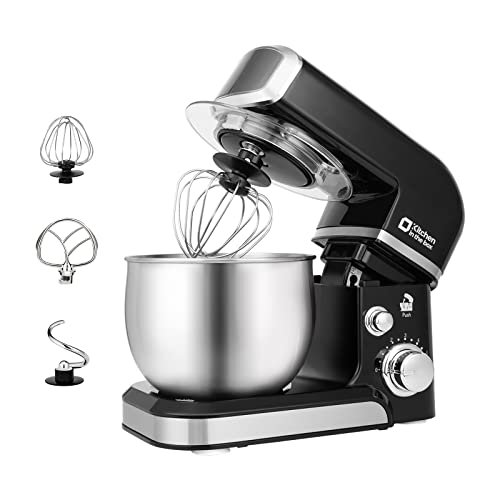
Kitchen in the box Stand Mixer 3.2Qt — Best for Tiny Kitchens
This pick is for the smallest kitchens and the lightest workloads: studio flats, dorm-adjacent cooking, elderly bakers who need a machine they can lift without effort, and anyone whose mixing is daily and small — pancake batter, a single sponge, whipped cream for two.
Strengths
- Lightweight and portable enough to store anywhere
- Whisk, dough hook and flat beater all included
- Six speeds cover the daily-job range
Trade-offs
- 3.2-quart bowl is for small recipes only
- Light build means light loads, always
- Brand support network is thinner than Hamilton Beach’s
| Specification | Detail |
|---|---|
| Bowl capacity | 3.2 quart (from Amazon listing title) |
| Speeds | 6 |
| Design | Small, portable, lightweight, per Amazon listing title |
| Included tools | Egg whisk, dough hook, flat beater |
| Colour verified | Black |
There is a category of buyer the big guides ignore: the person for whom a standard stand mixer is not too expensive but too big, too heavy and too much. This Kitchen in the box model is built for them. It lifts with one hand, stores on a shelf, and still brings the three core tools and six speeds to daily small-batch work. For its intended jobs it is not a compromise at all — it is the correctly sized tool.
The discipline is to keep it in its lane. Small, soft doughs in single quantities; batters and creams in modest bowls. Push it toward family batches and it will feel strained, because it is. Bought as a personal mixer rather than a household one, it is one of the most sensible purchases in this guide.
Best for: tiny kitchens, single cooks and anyone who needs a mixer they can lift and store effortlessly / Not suited for: household-scale baking or any regular dough work
Check the current price on Amazon for the Kitchen in the box Stand Mixer 3.2Qt — our Best for Tiny Kitchens pick in this guide.

bella 3.5 Qt Hand & Stand Mixer — Best Lightweight 2-in-1
The bella suits style-aware small kitchens and light bakers who like the hybrid concept but want a gentler footprint than the Hamilton Beach Classic. Think occasional cakes, frostings, batters and whipped toppings, with the hand unit covering small in-between jobs.
Strengths
- 2-in-1 flexibility in a compact body
- 3.5-quart bowl sized for small households
- Counter-friendly finish for open-plan small kitchens
Trade-offs
- Light-duty design throughout — loads must stay modest
- Smaller support and accessory ecosystem
- Stand action is convenience-grade rather than precision-grade
| Specification | Detail |
|---|---|
| Bowl capacity | 3.5 quart (from Amazon listing title) |
| Design | 2-in-1 hand and stand mixer with bowl |
| Colour verified | Oatmilk |
Bella’s design language — soft colours, rounded forms — targets kitchens where appliances stay visible, and in small flats that is a functional consideration, not a frivolous one. The machine itself is a straightforward hybrid: bowl and stand for hands-free batter work, detachable hand unit for the rest. Performance is convenience-grade: fine for the light repertoire, not intended for anything with the word ‘artisan’ in it.
Between this and the Hamilton Beach Classic, the choice is size and finish versus capacity and track record. The bella’s bowl is a little smaller and its brand support a little thinner, but its footprint and look suit the design-led small kitchen better. Either is defensible; this one wins where appearance and lightness lead the brief.
Best for: light bakers in small, visible kitchens who want hybrid flexibility with a softer look / Not suited for: anyone needing capacity, power or a long service record
Check the current price on Amazon for the bella 3.5 Qt Hand & Stand Mixer — our Best Lightweight 2-in-1 pick in this guide.
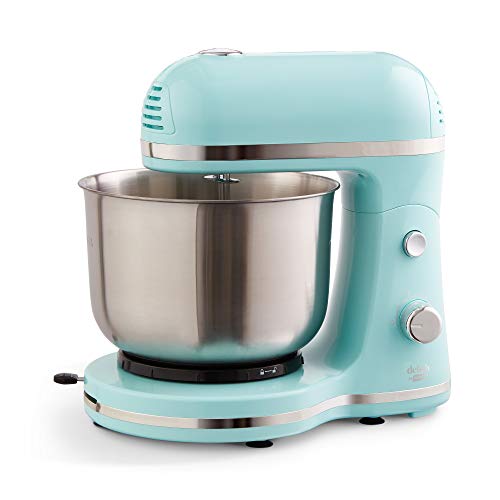
Delish by Dash Stand Mixer — Best for Absolute Beginners
This is the starter mixer in the purest sense: for new bakers, teen bakers, holiday-season bakers and gift buyers who want a friendly machine that cannot intimidate. Five speeds, a removable bowl for easy washing and serving, and a colour that makes it feel like a treat rather than a tool purchase.
Strengths
- Removable bowl washes and stores easily
- Simple five-speed control with no learning curve
- Dough hooks included for small, soft doughs
Trade-offs
- The lightest duty machine in this guide
- Five speeds means coarser control
- Aqua finish will not suit every kitchen
| Specification | Detail |
|---|---|
| Bowl capacity | 3.5 quart, removable (from Amazon listing title) |
| Speeds | 5 |
| Included tools | Dough hooks |
| Colour verified | Aqua |
Beginner appliances succeed by removing friction, and the Delish by Dash is engineered around that idea: the bowl lifts off for washing or for taking batter straight to the tin, the speed dial has no wrong answers, and the whole machine invites the kind of low-stakes experimentation — a first cake, a first frosting — that turns a novice into a baker. The dough hooks handle small soft doughs for rolls and flatbreads at this scale.
Experienced bakers will feel its limits within one session: coarse speed steps, light construction, modest bowl. That is fine. This machine’s job is to be a first mixer that gets used weekly rather than a forever mixer, and for new bakers it may be the smartest money in the guide precisely because it will teach them what they actually need next.
Best for: new bakers, young bakers and gift buyers wanting a friendly, simple first mixer / Not suited for: experienced bakers or any demanding workload
Check the current price on Amazon for the Delish by Dash Stand Mixer — our Best for Absolute Beginners pick in this guide.
Comparison Table
At this price the differences are about fit, not prestige: bowl size, mixing action and whether the machine doubles as a hand mixer decide everything.
| Pick | Badge | Key spec | Best for |
|---|---|---|---|
| Dash Everyday Stand Mixer | Best Overall Budget Pick | 3-qt compact tilt-head, 6 speeds, stainless bowl | first-time buyers, small households and small kitchens needing a real stand mixer on a firm budget |
| Hamilton Beach Classic Stand and Hand Mixer | Best Dual-Use Value | 4-qt 2-in-1, 6 speeds, 290W peak | buyers who need both a stand and a hand mixer and can only buy one appliance |
| Hamilton Beach 4 Quart Electric Stand Mixer | Best Mixing Action Under the Cap | 4-qt planetary, 7 speeds, 300W, splash guard | beginners and batter bakers who want proper planetary mixing at entry price |
| Kitchen in the box Stand Mixer 3.2Qt | Best for Tiny Kitchens | 3.2-qt portable, 6 speeds, full tool set | tiny kitchens, single cooks and anyone who needs a mixer they can lift and store effortlessly |
| bella 3.5 Qt Hand & Stand Mixer | Best Lightweight 2-in-1 | 3.5-qt 2-in-1 hand and stand | light bakers in small, visible kitchens who want hybrid flexibility with a softer look |
| Delish by Dash Stand Mixer | Best for Absolute Beginners | 3.5-qt removable bowl, 5 speeds | new bakers, young bakers and gift buyers wanting a friendly, simple first mixer |
If two picks look equal, choose the one whose bowl matches your typical recipe — in this tier, an oversized bowl is as much a handicap as an undersized one, because thin batters spread too wide for the beaters to reach.
How to Choose the Best Kitchen Stand Mixers Under $100 Without Regretting It
Set the expectation first: this budget buys light-duty machines for batter-centred baking. Every pick here will make cakes, cookies, frostings, whipped cream and small soft doughs happily. None will knead stiff bread dough weekly, mix double batches, or last a decade of daily service — and a buyer who accepts that on day one will be satisfied, while a buyer who secretly expects flagship performance will be back shopping within a year.
Within the tier, spend on three things in this order. First, bowl material: stainless steel over plastic, because it does not stain, absorb odours or flex under the beaters. Second, mixing action: planetary single-beater designs mix more thoroughly than twin-beater designs at the same price. Third, the tool set in the box: a dough hook and whisk included today are worth more than a theoretical accessory you will never find for an obscure model later.
Ignore, in this tier, speed counts above seven, wattage theatre, and colour ranges. And keep the receipt logic in mind: buy from the listing, test the machine in the first week with your heaviest realistic recipe, and let that test — not the spec sheet — confirm the purchase while returns are still simple.
Stand Mixer, Hybrid or Hand Mixer: Spending $100 the Smart Way
Two of this guide’s picks are hybrids — stand mixers whose heads detach as hand mixers — because at this budget the hybrid is often the smartest allocation. A pure stand mixer gives you hands-free mixing and nothing else; a hybrid gives you hands-free mixing plus the ability to mash potatoes in the pan and whip cream in a jug. If you own neither appliance today, the hybrid covers more of your cooking life per dollar.
The counter-argument is dedication: a stand-only machine at the same price usually stands steadier and mixes more thoroughly, as the planetary Hamilton Beach here demonstrates. So the rule is simple — if you already own a decent hand mixer, buy the stand-only pick; if you own neither, buy the hybrid; if you bake rarely and lightly, consider whether a hand mixer alone plus a strong arm serves you better than either, and spend the change on ingredients.
Making an Entry-Tier Mixer Last: Care Rules That Actually Matter
Cheap mixers die from overload and neglect, in that order, and both are preventable. Keep loads inside the bowl’s honest working capacity — roughly two-thirds full for batter, less for dough — and never ask the dough hook to handle a recipe you would struggle to knead by hand. Start slow, let flour incorporate before speeding up, and give the motor a rest between back-to-back batches on baking days.
Care is equally simple: wash tools by hand if they are coated, dry the bowl before storing it on the machine, wipe flour out of the head hinge before it compacts, and store the machine where you will actually use it. An entry-tier mixer treated this way routinely outlasts a neglected mid-range one — the tier sets the ceiling, but your habits set how close to it the machine gets.
What Breaks First on a Budget Mixer — and How to Postpone It
Budget mixers rarely die dramatically; they fade, and the fading follows a pattern worth knowing because most of it is preventable. The first casualty is usually the tool set: coated beaters chip where they strike the bowl, whisk wires bend out of true, and the machine starts mixing unevenly long before the motor weakens. The second is the head mechanism — hinge or lock — which loosens under loads it was never sized for, until the head nods through every rotation and each nod accelerates the wear. The motor itself, the part buyers worry about, is usually the last to go, and it goes because the first two failures made it work harder in mixtures it could no longer move properly.
Postponing all three is technique, not luck. Keep tools from clattering in an empty bowl by storing them separately or padded. Keep loads inside the honest fractions — batter to two-thirds, dough to a small single batch — and never use the dough hook as a challenge. Start slow so the drive engages a moving mixture rather than a static mass. And wipe flour out of the hinge area before it compacts into an abrasive paste. A budget mixer maintained this way routinely serves for years; the same model overloaded monthly can be loose and chipped within one holiday season. In this tier, the owner is the warranty.
Reading Entry-Tier Listings Like a Skeptic: Claims vs Hardware
Entry-tier listings are written to sound like flagship listings, and learning to translate them is a genuine buying skill. ‘Peak power’ wattage describes a momentary maximum the motor touches, not the sustained output it mixes with — compare it only against other peak figures, and treat it mainly as a size hint. Speed counts include settings you will never use; what matters is whether the lowest speed is gentle and the highest whips, which no number on the box can tell you. Bowl capacity is quoted to the brim with water, a condition no recipe will ever meet, so mentally discount it by a third before comparing it with your recipes.
The claims worth trusting are the physical ones, because they are checkable in the listing itself: bowl material, the named tools in the box, the mixing action described, the manufacturer’s own model number. That is why this guide verified every pick against catalogue data and quoted specifications from the verified titles — in a tier where marketing inflates fastest, the discipline of believing only what the hardware list says is the buyer’s main protection. When a listing promises flagship outcomes at entry prices in adjectives rather than in components, believe the components.
When to Stop Spending Down: The Upgrade Signals From This Tier
An entry-tier mixer is the right purchase until specific signals say otherwise, and naming them in advance turns an eventual upgrade from a failure into a plan. The first signal is recipe resistance: you catch yourself halving recipes, splitting batches or avoiding doughs because the machine cannot take them. The second is frequency: a mixer used four times a year can be modest forever, but one used four times a week is earning a better tool with every session. The third is attachment ambition — the day you price a pasta roller and discover your platform does not support one, the platform decision has been remade for you.
When those signals arrive, the under-$300 tier linked in this guide is the natural destination, and the entry machine retires honourably — as a second mixer for small jobs, a gift to a new baker, or the appliance that taught you exactly what you need. Bought with that lifecycle in mind, a sub-$100 mixer is not a compromise at all. It is the cheapest market research in the kitchen: a year of real baking data, purchased at the lowest possible price, that makes the next decision an informed one.
A Note on Safety and Supervision With Entry-Tier Machines
Light machines deserve one safety paragraph of their own, because their failure mode under load is movement. A budget mixer that walks on a glossy counter can walk toward an edge, and the habits that prevent it are the same ones this guide recommends for performance: a level, dry surface, a hand on the machine during the first seconds of a heavy mix, and loads kept inside the bowl’s honest fractions so the machine is never fighting for balance. Keep the cord routed behind the machine rather than across the work area, unplug before changing tools or scraping with anything metal, and supervise young bakers — for whom several picks here are otherwise ideal first machines — until the start-slow habit is automatic. None of this is specific to cheap mixers in principle; all of it matters more when the machine is light, which is the defining fact of this tier.
The Honest Summary: Who Should Buy From This Guide and Who Should Walk Past It
Everything in this guide reduces to a sorting question, and it deserves a direct statement before you spend anything. Buy from this tier if your baking is light and batter-led, your batches are single and standard, your kitchen is small or your budget is firm, and your expectations are set to the hardware: plastic where flagships have metal, modest motors honestly described, and a working life measured in years of light service rather than decades of anything you can imagine. For that buyer — and there are millions of them — these six machines are not the cheap seats. They are the correct seats, and the flagship tiers would be the waste.
Walk past this tier if any sentence in that paragraph made you negotiate. If your baking is weekly and doughy, if your batches double, if you are already pricing attachments, if you expect to hand this machine to your children — the tier above exists for you, it is linked throughout this guide, and arriving there directly is cheaper than arriving there via a year of frustration and a second purchase. The most expensive mixer in the world is the wrong one bought twice. This guide’s job was to make sure that whichever tier you choose, you choose it with the facts in front of you — the verified listings, the stated ceilings, and the workload honesty that entry-tier marketing rarely volunteers.
The Hand-Mixer Benchmark: What Your $100 Stand Mixer Must Beat to Be Worth It
Every machine in this guide competes with an opponent that never appears in it: the good hand mixer you could buy instead for similar or less money. That comparison is the honest test of the tier, because a stand mixer that does not beat a hand mixer at your actual baking is furniture, not equipment. The stand mixer’s case rests on three pillars: hands-free operation, so creaming and kneading happen while you do something else; capacity with stability, so a full batch mixes without your arm acting as the frame; and consistency, because a fixed tool in a fixed bowl behaves identically every session in a way a wandering hand cannot.
Judge the six picks against those pillars and the tier sorts itself. The planetary Hamilton Beach wins on consistency; the hybrids win by conceding the comparison — they are the hand mixer, upgraded with a stand for the hands-free jobs; the Dash machines win on the small-kitchen reality that a hand mixer plus a bowl is not, in fact, equivalent when both hands are needed elsewhere. If none of those victories matches your baking — if you mix rarely, lightly and always attended — the benchmark gives you permission to buy the hand mixer instead and spend the difference on ingredients. That is not this guide failing; that is this guide working.
Space, Storage and the Small-Kitchen Case for This Tier
This tier exists because kitchens are small, and its machines should be judged partly as furniture. The relevant measurements are not only height and footprint but retrieval weight: a mixer stored on a high shelf that its owner dreads lifting is a mixer that will be quietly replaced by a spoon. The Kitchen in the box and Dash picks lead this guide’s storage class precisely because they can be fetched with one hand and put away without a ceremony, and in a small kitchen that property is worth more than a quart of bowl capacity — a truth that flagship guides, written for flagship kitchens, rarely admit.
Counter-resident small machines face the opposite audit: they will be seen constantly, so finish and silhouette matter functionally, which is the bella’s whole argument. And every small-kitchen buyer should perform the tier’s essential ritual before ordering: clear the exact space, measure it in three dimensions, and rehearse the bowl’s path from machine to oven. Ten minutes of theatre with a tape measure has saved more small kitchens from bad purchases than any review ever written — including, we are happy to admit, this one.
How to Use a Budget Stand Mixer for Cakes, Frosting and Small Doughs
Budget mixers reward technique because they have no power to spare. These habits get flagship-adjacent results from entry-tier machines.
- Bring butter and eggs to room temperature before creaming — cold ingredients are the heaviest load a small motor faces
- Cream butter and sugar a full two minutes; the aeration you build here is your cake’s rise, and it costs the motor nothing once the butter is soft
- Add flour in thirds at the lowest speed, stopping as soon as each addition disappears — overmixing, not underpowering, toughens budget-mixer cakes
- For small doughs, use the hook at low speed, keep the batch to a single small loaf or one pizza base, and let a ten-minute rest do half the kneading
- Whip cream in a chilled bowl and stop at soft peaks to check — small bowls whip fast, and the line between cream and butter is seconds
- Anchor the machine with a hand on top during the first seconds of heavy mixes until it settles; light frames steady once the load is moving
After baking, wash the bowl and tools while residue is fresh — entry-tier finishes are least forgiving of dried-on dough and dishwasher abuse. Store the tools inside the bowl with a tea towel between them, and your budget mixer will start every session ready instead of rattling.
Common Buying Mistakes
- Expecting flagship dough performance because the box shows a loaf — marketing photos are not load limits
- Filling the bowl to the brim; working capacity is well below brim capacity, especially for dough
- Choosing by colour range or speed count instead of bowl material and mixing action
- Skipping the first-week test with your heaviest real recipe, then discovering the limit after the return window
- Leaving flour packed in the hinge and hub until the head stiffens
- Buying a second cheap mixer in a year instead of stepping up a tier when your baking outgrows this one — the most expensive outcome of all
The pattern in every mistake is the same: treating the tier as something it is not. Respect what these machines are — light, small, honest — and they are among the best-value appliances in the kitchen.
Final Recommendation
If the budget is firm and the baking is light, buy the Dash Everyday for the most complete small stand mixer, the planetary Hamilton Beach if mixing thoroughness matters most, or the Hamilton Beach Classic hybrid if one purchase must also be your hand mixer. The Kitchen in the box and Delish by Dash picks serve tiny kitchens and brand-new bakers respectively, and the bella splits the difference with style.
If your test bake in week one involves stiff bread dough and it struggles, believe it, return it, and move to the under-$300 guide — that is what the tiers are for. Check the current price on Amazon for your pick, since this tier’s prices move the most, and then enjoy baking with the machine your kitchen actually needed.
Short on time? Start with the Dash Everyday Stand Mixer, Hamilton Beach Classic Stand and Hand Mixer, Hamilton Beach 4 Quart Electric Stand Mixer — check price on Amazon for each and compare the current bundles before you decide.
Best Kitchen Mixers Under $300 Best Kitchen Stand Mixers Best Kitchenaid Hand Mixers Best Large Bowl Mixers Best Large Mixers
Frequently Asked Questions
Can you really buy a good stand mixer for under $100?
You can buy a good light-duty stand mixer: the picks here handle cakes, batters, frostings and small soft doughs well. You cannot buy flagship power, metal construction or bread-dough stamina at this price, and any listing claiming otherwise deserves suspicion.
Why are there no KitchenAid mixers in this guide?
Because no current KitchenAid stand mixer is an under-$100 product. Rather than pad the list with refurbished units or expired sale prices, we covered the genuine entry tier and linked the under-$300 guide, where the KitchenAid Classic is the entry point to that brand.
Are hybrid stand and hand mixers worth it?
At this budget, often yes: one purchase covers hands-free mixing and in-pan jobs. Stand-only models at the same price usually mix more thoroughly and stand steadier, so buyers who already own a hand mixer should choose those instead.
What size bowl should a beginner choose?
Three to four quarts matches single standard recipes and small households. Bigger bowls sound safer but mix small quantities worse; match the bowl to your usual recipe, not your biggest imagined one.
How long will a budget stand mixer last?
With loads kept inside its design brief and basic care, an entry-tier machine can serve several years of light baking. Weekly heavy dough is what shortens their lives fastest — that workload belongs to the next tier up.
Should I buy a used premium mixer instead?
It can be a smart route if you can test the machine, confirm the model and check that tools and bowl are included and undamaged. Factor in that warranties rarely transfer and replacement tools cost money; for many first-time buyers, a new entry-tier machine with a return window is the lower-risk start.


