Disclosure: airfryerkitchensupply.com is reader-supported. When you buy through links on our site, we may earn an affiliate commission at no extra cost to you.
Where to buy
Shopping for the best kitchen sinks for butcher block countertops? Every linked pick below was cross-checked against Amazon’s own catalogue data before it earned a link, and only listings that matched the product described here carry one. Start with the Kraus Drop-In Workstation 33 Inch Sink if you want the short answer, or work through the full list — each pick is linked again in its review, the comparison table and the final recommendation, and every link lands on the same verified listing so you can check price on Amazon before you order.
The best kitchen sinks for butcher block countertops are chosen by a rule that barely matters with stone: keep water off the wood’s cut edges. Butcher block is beautiful, warm and repairable, but it is timber — it absorbs water, swells, and can blacken where moisture sits. The sink is the wettest object in the kitchen, so the mount, the rim and your sealing habits matter more here than gauge, brand or bowl fashion.
That is why this guide leads with drop-in and apron-front sinks whose rims and aprons shield the wood, and includes exactly one undermount — an excellent bowl, clearly labelled with the sealing discipline it demands. Every pick was verified against Amazon’s catalogue data, and the advice throughout assumes the counter is worth protecting, because a good butcher block counter always is.
In this guide
Quick Picks
- Best Overall — Kraus Drop-In Workstation 33 Inch Sink: 33 inch drop-in workstation, 16-gauge TRU16 steel, integrated ledge, cutting board and roll-up rack included, 4 mm mounting deck per the verified listing. butcher block owners who want the safest mount plus a prep station.
- Best Compact Workstation — Kraus KWT302-30 Kore Drop-In Workstation 30 Inch: 30 inch drop-in/top mount workstation, 16 gauge, 50/50 double bowl with accessories, Kore series. smaller butcher block kitchens that still want two bowls and a ledge.
- Best Farmhouse for Wood Counters — TUKTUK 33 Inch White Fireclay Farmhouse Sink: 33 inch fireclay apron front farmhouse sink, single bowl, deep basin, drop-in or undermount reversible design per the verified listing. wood-counter kitchens going for the classic farmhouse scheme.
- Best Budget Drop-In — Elkay Dayton 33 Inch Double Bowl Drop-In Sink: 33 x 19 x 6-7/16 inch equal double bowl drop-in sink, stainless steel, Dayton series. budget remodels and rental-grade butcher block kitchens.
- Best Undermount — With Conditions — Kraus KHU100-30 Standart Pro 30 Inch Undermount: 30 inch undermount single bowl, 16 gauge stainless steel, KHU100-30, channel grooves and NoiseDefend pads per the verified listing. experienced butcher block owners committed to a sealing routine.
- Best Traditional Top Mount — American Standard Colony 33 Inch Top Mount Double Bowl: 33 x 22 inch top mount double bowl stainless steel sink, 3-hole deck, Colony series. traditional kitchens that want faucet and sink as one protected unit.
Short version: drop-in rims protect wood, aprons shorten drips, undermounts look best and demand the most sealing discipline. Choose your mount by your maintenance honesty, then choose your bowl.
How These Picks Were Chosen
We filtered for mount first and bowl second — the reverse of a normal sink guide. Candidates had to either sit on top of the counter with a real rim, present an apron that shortens the wet reach, or, in the single undermount case, be a bowl strong enough to justify the extra sealing work its install demands.
Each model was verified through the Amazon catalogue for airfryerkitchensupply.com, with mount type, size, bowl layout and deck details taken from the listing titles. Where this guide describes a sink as drop-in, top-mount or undermount, that word comes from the verified listing rather than from a retailer’s category page.
The final six balance protection levels and budgets: two drop-in workstations, a fireclay apron, two traditional top-mounts at different tiers, and one undermount with its conditions printed on the label. Prices are never printed — check price on Amazon from the links, and spend the savings from a budget pick on sealant and a spare hour of install care.
Two picks illustrate the standard best: the Kraus KWT302-30 Kore Drop-In Workstation 30 Inch and the TUKTUK 33 Inch White Fireclay Farmhouse Sink both matched their catalogue listings exactly, model number for model number, which is the level of certainty every linked pick in this guide had to reach.
The 6 Best Kitchen Sinks for Butcher Block Countertops
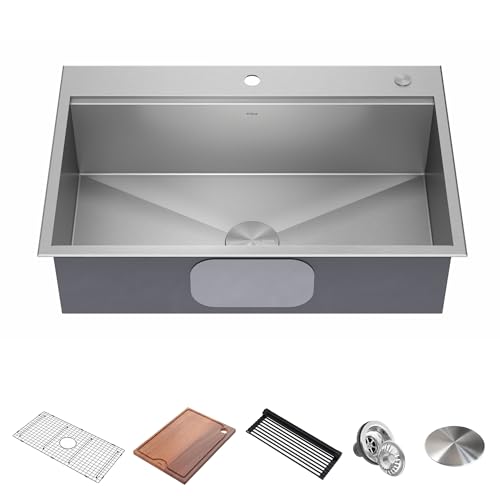
Kraus Drop-In Workstation 33 Inch Sink — Best Overall
Butcher block and water are lifelong negotiating partners, and the sink mount is where the negotiation is won or lost. This Kraus drop-in workstation wins the top spot because its rim sits on top of the counter: the wood’s surface — the sealed, finished face — stays between the sink and the water, and there is no raw cutout edge drinking splashes all day.
Strengths
- Drop-in rim sits on top of the wood — no exposed end grain at a cutout edge to soak up water
- Workstation ledge keeps wet prep over the bowl instead of on the timber
- Thick 4 mm mounting deck stated in the listing spreads the rim load on wood
Trade-offs
- The rim line needs its seal maintained or water creeps under it onto the wood
- Workstation accessories add cost and need storage
- Drop-in styling reads more practical than high-design
| Key spec (from verified listing) |
|---|
| 33 inch drop-in workstation, 16-gauge TRU16 steel, integrated ledge, cutting board and roll-up rack included, 4 mm mounting deck per the verified listing |
The workstation format is unusually well matched to butcher block, too. A board on the ledge gives you a sacrificial chopping surface over the bowl, so the beautiful timber counter can be spared the daily knife work it was never meant to take, while juices and rinsing water fall into the bowl instead of soaking into seams. The verified listing’s 4 mm deck detail matters here: a substantial rim sits flatter and seals better on wood than a flimsy flange.
Best for: butcher block owners who want the safest mount plus a prep station / Not suited for: purists who want a flush, rimless undermount look at any cost
Check the current price on Amazon for the Kraus Drop-In Workstation 33 Inch Sink.

Kraus KWT302-30 Kore Drop-In Workstation 30 Inch — Best Compact Workstation
Shorter butcher block runs — galley kitchens, cottage kitchens, islands — often cannot spare 33 inches. The KWT302-30 compresses the same protective idea into 30 inches: a top-mount rim over the wood, a workstation ledge, and a 50/50 double bowl for households that would rather divide tasks than maximise pan space.
Strengths
- Top-mount install protects butcher block cut edges the same way as the larger Kraus
- 50/50 double bowl in a smaller 30 inch footprint for modest counters
- Workstation accessories included per the listing
Trade-offs
- Each bowl of a 30 inch 50/50 is small — big pans will bridge the divider
- Double bowl plus ledge is a lot of system in a compact sink
- Rim seal maintenance is part of ownership on wood
| Key spec (from verified listing) |
|---|
| 30 inch drop-in/top mount workstation, 16 gauge, 50/50 double bowl with accessories, Kore series |
Be clear-eyed about the compromise the listing states: at 30 inches split 50/50, neither bowl takes a sheet pan flat. If your cooking is saucepan-and-skillet scale, that trade buys you a second bowl and a prep ledge in a footprint the counter can actually hold — a sensible exchange, made knowingly.
Best for: smaller butcher block kitchens that still want two bowls and a ledge / Not suited for: households whose largest pans must sit flat in one bowl
Check the current price on Amazon for the Kraus KWT302-30 Kore Drop-In Workstation 30 Inch.

TUKTUK 33 Inch White Fireclay Farmhouse Sink — Best Farmhouse for Wood Counters
If butcher block is half of the classic farmhouse pairing, a fireclay apron sink is the other half. The TUKTUK 33 inch puts a deep, glazed single bowl behind an apron front, and the apron does practical work on wood counters: it pulls the bowl’s front edge toward the user, shortening the reach and reducing the drips that otherwise land on the counter’s front edge — the exact spot where butcher block end grain drinks water.
Strengths
- Apron front moves the bowl toward you — less leaning and splashing onto the wood behind
- Fireclay’s glazed surface sheds water instead of absorbing it
- The farmhouse-plus-butcher-block pairing is a proven, timeless kitchen look
Trade-offs
- Apron front needs a farmhouse-ready cabinet — a real project on existing cabinetry
- Fireclay is heavy and unforgiving if a heavy pan is dropped on its edge
- White glaze shows every coffee and turmeric event until wiped
| Key spec (from verified listing) |
|---|
| 33 inch fireclay apron front farmhouse sink, single bowl, deep basin, drop-in or undermount reversible design per the verified listing |
Fireclay itself is a sensible partner for timber. The fired glaze is non-porous and wipes clean, and the material’s mass makes the sink feel as permanent as the counter looks. The honest costs are weight and commitment: this is a cabinet-modifying, two-person install, not a weekend swap.
Best for: wood-counter kitchens going for the classic farmhouse scheme / Not suited for: renters or anyone who cannot modify the sink cabinet
Check the current price on Amazon for the TUKTUK 33 Inch White Fireclay Farmhouse Sink.

Elkay Dayton 33 Inch Double Bowl Drop-In Sink — Best Budget Drop-In
The Elkay Dayton is the sink that has been dropped into more wood counters than almost any other: a 33 inch, equal double bowl top-mount from a mainstream plumbing brand, at a budget tier. For butcher block, its virtues are the mount and the shallowness — the rim protects the cut edge, and a shallower bowl throws less water around the surrounding timber.
Strengths
- Classic top-mount design that any installer — or confident DIYer — can seat on wood
- Equal double bowls at a budget-tier positioning
- Shallower bowl splashes less onto surrounding timber than deep bowls can
Trade-offs
- Shallow 6-7/16 inch depth fills fast and limits soaking big items
- Thinner, lighter construction than the 16 gauge picks — buy it as the budget option it is
- Plain styling; no workstation or accessory system
| Key spec (from verified listing) |
|---|
| 33 x 19 x 6-7/16 inch equal double bowl drop-in sink, stainless steel, Dayton series |
Its limits are equally plain. At roughly six and a half inches deep per the verified listing, this is a wash-and-rinse sink, not a soaking sink, and its construction is lighter than the 16 gauge models elsewhere in this guide. As a deliberate budget choice for a modest kitchen, it is entirely respectable; as a family workhorse, look up the list.
Best for: budget remodels and rental-grade butcher block kitchens / Not suited for: families who soak large pans daily and need real bowl depth
Check the current price on Amazon for the Elkay Dayton 33 Inch Double Bowl Drop-In Sink.

Kraus KHU100-30 Standart Pro 30 Inch Undermount — Best Undermount — With Conditions
An undermount sink under butcher block is the look many people want — wood flowing uninterrupted into the bowl — and the KHU100-30 is the strongest bowl for it here: 30 inches of 16 gauge Standart Pro steel. It earns its place with a condition stated in the badge and repeated in the review: undermounting into timber is a sealing discipline, not an install-and-forget choice.
Strengths
- 16 gauge bowl with a long-running model pedigree
- Undermount gives the wipe-straight-in clean-up butcher block owners love
- 30 inch size suits smaller wood counters
Trade-offs
- Undermount exposes the cutout edge of the wood — it MUST be sealed meticulously and re-sealed on schedule
- Any seal failure wicks water into end grain where damage hides
- Professional install strongly advised on timber
| Key spec (from verified listing) |
|---|
| 30 inch undermount single bowl, 16 gauge stainless steel, KHU100-30, channel grooves and NoiseDefend pads per the verified listing |
The cut edge of butcher block is end grain and edge grain exposed inside a wet hole. It must be saturated with finish — multiple coats, worked into the grain, including the underside — before the sink goes in, and inspected whenever the rim seal is renewed. Owners who enjoy that maintenance rhythm get the best-looking option in this guide. Owners who know they will skip it should buy the drop-in Kraus and sleep better.
Best for: experienced butcher block owners committed to a sealing routine / Not suited for: first-time wood-counter owners — start with a drop-in instead
Check the current price on Amazon for the Kraus KHU100-30 Standart Pro 30 Inch Undermount.

American Standard Colony 33 Inch Top Mount Double Bowl — Best Traditional Top Mount
The Colony is the old-school answer that still makes sense on wood: a 33 x 22 top-mount double bowl with its own 3-hole faucet deck. That deck is the underappreciated feature for butcher block — the faucet mounts to the sink, not through the timber, so the wood is spared two or three extra holes in its wettest zone.
Strengths
- Full 33 x 22 top-mount footprint covers and protects a generous cut area of wood
- Faucet deck built in — no drilling the butcher block for faucet holes
- Mainstream brand with straightforward replacement availability
Trade-offs
- The deck and rim footprint eats counter space front and back
- Double bowls are equal-split — neither takes the largest pans flat
- Dated, practical styling rather than a design statement
| Key spec (from verified listing) |
|---|
| 33 x 22 inch top mount double bowl stainless steel sink, 3-hole deck, Colony series |
Everything about this sink is proven and plain: equal double bowls, a generous rim that covers the cutout completely, and a brand any plumber knows. If your butcher block kitchen leans traditional and your priority is protecting the counter while keeping the project simple, the Colony is the low-drama choice.
Best for: traditional kitchens that want faucet and sink as one protected unit / Not suited for: minimalist wood counters where a big deck would spoil the look
Check the current price on Amazon for the American Standard Colony 33 Inch Top Mount Double Bowl.
Comparison Table
The mount column is the one that matters most on wood. Read it before the size column — a perfectly sized undermount installed casually will age a butcher block counter faster than a plain drop-in ever will.
| Pick | Badge | Key spec | Best for |
|---|---|---|---|
| Kraus Drop-In Workstation 33 Inch Sink | Best Overall | 33 inch drop-in workstation, 16-gauge TRU16 steel, integrated ledge, cutting board and roll-up rack included, 4 mm mounting deck per the verified listing | butcher block owners who want the safest mount plus a prep station |
| Kraus KWT302-30 Kore Drop-In Workstation 30 Inch | Best Compact Workstation | 30 inch drop-in/top mount workstation, 16 gauge, 50/50 double bowl with accessories, Kore series | smaller butcher block kitchens that still want two bowls and a ledge |
| TUKTUK 33 Inch White Fireclay Farmhouse Sink | Best Farmhouse for Wood Counters | 33 inch fireclay apron front farmhouse sink, single bowl, deep basin, drop-in or undermount reversible design per the verified listing | wood-counter kitchens going for the classic farmhouse scheme |
| Elkay Dayton 33 Inch Double Bowl Drop-In Sink | Best Budget Drop-In | 33 x 19 x 6-7/16 inch equal double bowl drop-in sink, stainless steel, Dayton series | budget remodels and rental-grade butcher block kitchens |
| Kraus KHU100-30 Standart Pro 30 Inch Undermount | Best Undermount — With Conditions | 30 inch undermount single bowl, 16 gauge stainless steel, KHU100-30, channel grooves and NoiseDefend pads per the verified listing | experienced butcher block owners committed to a sealing routine |
| American Standard Colony 33 Inch Top Mount Double Bowl | Best Traditional Top Mount | 33 x 22 inch top mount double bowl stainless steel sink, 3-hole deck, Colony series | traditional kitchens that want faucet and sink as one protected unit |
How to Choose a Kitchen Sink for Butcher Block Countertops
Mount type is a water-management decision
A drop-in (top-mount) sink’s rim rests on the counter’s finished top surface. The cutout edge is hidden under the rim and the sink, and water on the counter meets a sealed face, not raw grain. For most butcher block owners this is the correct default, and it is why drop-ins take four of the six slots here.
An undermount exposes the cutout edge inside the bowl’s perimeter. On stone that edge is inert; on wood it is thirsty end grain in a permanently damp hole. It can be done well — saturated sealing, renewed on schedule — but it converts a one-time install into a maintenance relationship. Apron-front sinks split the difference: the apron covers the front edge and shortens the drip path, while the bowl’s sides still need the usual care.
Sealing the cutout: the non-negotiable job
Whatever mount you choose, the cutout itself must be sealed as if the sink did not exist: multiple coats of your counter’s finish system — oil, hardwax oil or polyurethane, following that system’s rules — worked into the end grain until it stops drinking. Pay special attention to the underside lip of the cutout, where drips hang and nobody looks.
Around a drop-in rim, run a proper bead of kitchen-and-bath silicone under the rim flange, not just around its outer edge afterwards. The bead under the flange is the waterproofing; a cosmetic bead outside is decoration. Renew rim seals when they darken or lift — on wood, a failed seal is not an eyesore, it is a leak into timber.
Bowl depth, splash and the wood around the sink
Deep bowls hold more but also invite filling tall pots under a high faucet — the splash pattern that wets the counter behind the sink. On butcher block, the strip of wood behind the faucet is the highest-risk surface in the kitchen: it gets splashed daily and dries slowest. A slightly shallower bowl, a well-aimed faucet and a habit of wiping that back strip are worth more than an extra inch of depth.
Consider a small raised drying zone or a mat habit for the area beside the sink, and never let a wet dishcloth live on the wood. Butcher block forgives spills; it does not forgive permanent damp.
Materials that behave next to timber
Stainless steel is the default partner: it does not stain wood, its rims are well understood, and brushed finishes sit comfortably with timber’s matte warmth. Fireclay’s glazed surface is equally safe and adds the farmhouse note many wood-counter kitchens are built around.
What to avoid is less about the sink body than about habits and hardware: iron trivets left wet on the counter, steel-wool pads stored on the wood, and any cleaner that would strip your counter’s finish being used casually around the rim. The sink and the counter are one system — clean them like it.
Choosing the finish system around the sink zone
Not all butcher block finishes defend the sink zone equally. Film finishes and hardwax oils give the counter’s wettest area a more water-resistant skin than simple mineral oil, at the cost of more involved renewal. Whatever system your counter wears, the sink zone — cutout, front edge, back strip — deserves the system’s full schedule of coats, applied generously, while the rest of the counter can live on the standard routine.
Renewal timing should be water-led, not calendar-led: when water on the front edge stops beading and starts soaking in visibly, that zone is due, whatever the date says. Keep a small bottle of your finish within reach of the sink rather than in the garage; maintenance that lives where it is used actually happens.
Matching sink finish to timber tone
Warm, honeyed timbers pair naturally with brushed stainless and white fireclay; pale, Scandinavian-style blocks suit the same steel and can carry black accents in hardware if the room wants them. What rarely works is a high-polish sink against matte timber — the two finishes argue about light all day. Let the counter set the room’s temperature and choose the sink’s finish one step quieter.
Hardware harmony matters more than perfect matching: a faucet in the same family as the sink’s finish, cabinet pulls that do not fight either, and the whole run reads as composed. Butcher block is a forgiving backdrop — it flatters almost everything except carelessness with water, which is, for the last time in this guide, the only real subject.
The Rental and Resale Angles of a Wood Counter
Butcher block photographs as warmth, and a well-kept wood counter with a sound sink installation is a genuine asset when a home changes hands — buyers read it as character maintained, not as a project inherited. The reverse is equally legible: a water-stained sink zone tells a surveyor a story about the whole house’s maintenance, fairly or not. The stakes of the rim seal therefore include the value of the home, which tends to concentrate the mind wonderfully.
Keep the evidence of care: dated notes of seal renewals and refinishing, the sink’s paperwork, even the before-and-after photographs of a stain you sanded out. A counter with a service history is a feature; a counter with mysteries is a negotiation. Everything this guide recommends doing, it also recommends writing down — the wood appreciates the work, and the paperwork appreciates in value alongside it.
The Front Edge Problem Nobody Mentions
Ask butcher block owners where their counter aged first and most will point to the front edge of the sink run — not the cutout. Every wash-up ends with water running down the user’s front and dripping off the counter’s edge, and that edge is end grain on many block constructions. Apron-front sinks genuinely help here, moving the bowl forward so drips fall on the apron or the floor, not the wood edge.
If you choose a straight drop-in or undermount, protect that front edge deliberately: keep its finish renewed, wipe it after big wash-ups, and consider it the counter’s early-warning zone. A front edge that is darkening is telling you water is winning somewhere — find out where before the story spreads.
Refinishing Reality: The Sink’s Second Decade
Butcher block’s great advantage is that it can be sanded and refinished — and the sink decides how hard that day is. A drop-in lifts out or at least presents a rim you can sand up to; an undermount traps a raw edge you cannot reach without removing the bowl. Owners planning to refinish in place every few years should weigh that heavily toward top-mount designs.
This is also why spare-parts brands matter on wood. A sink that outlasts two refinishes is the norm here — these are not fashion fixtures. The mainstream model lines in this guide, verified by model number, are chosen partly because their makers still exist to sell you a grid, a strainer or a clip in year nine.
Butcher Block and the Dishwasher Generation Gap
Many butcher block kitchens hand-wash more than average — the same households often own the cast iron, carbon steel and good knives that never see a dishwasher — which makes the sink the hardest-working station in the room and raises the stakes on every recommendation in this guide. If that is your kitchen, weight the workstation picks heavily: they convert the sink into the prep-and-wash centre the lifestyle actually needs.
If, instead, your dishwasher does the daily work and the sink handles prep and pans, a simpler drop-in double bowl may serve better than a workstation, and the money difference is better spent on the sealing and install care that protect the timber. The counter does not care which badge you buy; it cares about water, and both routes manage water when chosen honestly.
Reading Your Counter: Early Signs Water Is Winning
Butcher block talks before it fails. Learn its early vocabulary: a front edge that darkens slightly after wash-up and dries slowly; a faint roughness returning to a zone that was smooth; a rim line where the finish looks thinner than its neighbours. Each is a two-minute fix at the stage you notice it — dry the zone, refresh the finish, check the seal — and a weekend of repair a year later.
Once a quarter, run a dry hand slowly around the cutout from inside the cabinet, feeling for any dampness or softness your eyes would miss. Your hand is the best moisture meter in the house. Build the habit alongside something you already do quarterly, and the counter that owners describe as ‘high maintenance’ reveals itself as merely ‘lightly supervised’.
Islands and Peninsulas: Wood Where It Works Hardest
Butcher block islands concentrate everything this guide warns about: they are prep surface, sink surround and social centre in one, and their sink edges and front faces receive more water and more leaning bodies than any wall run. On an island, weight the protective mounts even more heavily — a drop-in workstation earns its place twice over, because the ledge contains prep that would otherwise spread across the island’s whole social surface.
Island plumbing also hides its leaks better, inside a cabinet nobody opens daily. If your wood counter sits on an island, add a simple leak alarm or a tray under the sink plumbing to your install list. The counter’s worst enemy is not the splash you see; it is the drip you do not, and islands are where unseen drips retire to do their slow work.
Winter, Heating and the Moving Counter
Timber moves with the seasons, and centrally heated winters dry a butcher block counter measurably. Around a sink — where the wood is already managing moisture from above — seasonal movement shows first: a rim seal that was perfect in humid August can hairline in dry January as the counter contracts. This is not a defect in your install; it is wood being wood, and it is why this guide’s inspection rhythm is seasonal rather than annual.
The defence is the same flexibility that makes silicone the right sealant here: a quality kitchen-and-bath silicone accommodates small movements that would crack a rigid seal. When you renew a rim seal, choose flexibility over hardness every time, and expect the first winter to teach you your own counter’s particular rhythm. After one full year of seasons, owners know their counter’s habits the way gardeners know their soil.
What Professional Kitchen Fitters Do Differently
Watch a fitter who specialises in timber counters and you will notice the sink takes them longer than the same job in stone — not because it is harder, but because they spend the extra time where this guide spends its words: saturating the cut edge in patient coats, bedding the rim on a full silicone bed rather than a hopeful smear, and flood-testing with the bowl brim-full while they drink tea and watch. Their secret is not a product; it is a refusal to hurry the waterproofing steps.
Home installers can borrow the entire method, because none of it requires their tools or their training — only their pacing. Budget the install as an afternoon with pauses built in for coats to soak and sealant to be left alone, rather than as a race to reconnect the water by dinner. The counter cannot tell whether a professional or a patient amateur sealed its cut edge. It can only tell whether somebody did.
How to Seal a Butcher Block Cutout for a New Sink
This is the install step that decides whether a sink and a wood counter age gracefully together. It applies to every mount type in this guide, and it is not the step to rush.
- Dry-fit the sink and mark the cutout. Cut, then sand the cut edge smooth — sealant and finish both fail early on rough, torn grain.
- Seal the cut edge with your counter’s finish system: apply, let it soak into the end grain, wipe, and repeat until the grain visibly stops absorbing. Three applications is a starting point, not a guarantee.
- Seal the underside lip of the cutout and the counter’s front edge in the sink zone while you have the finish out — these are the two hidden wet zones.
- Bed a drop-in rim on a continuous bead of kitchen-and-bath silicone under the flange; for undermounts, confirm the rim seal and the edge finish are both complete before the bowl is hung.
- Fit the sink, connect plumbing, fill the bowl completely, and leave it full for an hour while you inspect the cutout and cabinet with a torch and a dry hand.
- Put rim-seal and front-edge inspections on a six-month rhythm. On wood, catching a lifted seal in month one is maintenance; catching it in year two is repair.
If any step in this sequence feels beyond the install you had planned, that is useful information: choose the most protective drop-in on this list and pay an installer for the sealing hour. It is the cheapest insurance in the whole project.
Keep a dedicated, clean cloth for the sink zone alone, and make its last job each evening a pass along the front edge and the back strip. Households develop this habit fastest when the cloth has a home — a hook beside the sink, not a drawer across the room. Small geography, large consequences. Set a phone reminder for the first inspection a month after install, not six: new seals and new finishes reveal their weak points early, while they are still adjustments. After that first check passes dry, settle into the six-month rhythm this guide recommends and let the counter get on with ageing beautifully. One more wood habit, borrowed from boat owners who live with timber and water professionally: ventilation is waterproofing’s partner. A sink cabinet that is opened regularly and allowed to stay dry underneath will forgive small accidents that a sealed, damp cabinet turns into rot. Leave the cabinet doors ajar overnight after any known spill or plumbing tweak, and let the underside of your counter breathe — timber that can dry is timber that endures.
Common Buying Mistakes
Undermounting into unsealed end grain. The cut edge of butcher block inside an undermount is raw, thirsty timber in a wet hole. Without saturated, maintained sealing it will swell and blacken — hidden until the damage is real.
Silicone around the rim instead of under it. A cosmetic bead outside the flange does not waterproof anything. The working seal lives under the rim, compressed between sink and counter.
Letting the back strip stay wet. The wood behind the faucet is splashed daily and dries last. Owners who ignore it meet the counter’s first rot exactly there.
Storing wet things on the wood by the sink. Dishcloths, steel wool and wet trivets parked beside the sink keep one patch of timber permanently damp — the precise condition butcher block cannot tolerate.
Choosing bowl depth without thinking about splash. Very deep bowls plus tall faucets throw water further across surrounding wood. Match depth and faucet to how the sink will actually be used.
Planning to refinish without a sink plan. Sanding day arrives eventually. A mount you cannot work around turns a weekend refinish into a plumbing project — decide with that day in mind.
Final Recommendation
The short version, with every pick in one place: the Kraus Drop-In Workstation 33 Inch Sink (best overall); the Kraus KWT302-30 Kore Drop-In Workstation 30 Inch (best compact workstation); the TUKTUK 33 Inch White Fireclay Farmhouse Sink (best farmhouse for wood counters); the Elkay Dayton 33 Inch Double Bowl Drop-In Sink (best budget drop-in); the Kraus KHU100-30 Standart Pro 30 Inch Undermount (best undermount — with conditions); the American Standard Colony 33 Inch Top Mount Double Bowl (best traditional top mount). Match that list against the way your household actually cooks and cleans, and the right choice usually names itself.
For most butcher block owners the Kraus drop-in workstation is the complete answer: rim protection for the wood, a ledge that spares the counter from knife work, and 16 gauge steel verified in the listing. The 30 inch Kore is the same idea for smaller counters.
Choose the TUKTUK fireclay when the farmhouse look is the point of the kitchen, the Dayton or Colony when the budget or tradition rules, and the KHU100-30 undermount only with your sealing kit already in hand. Protect the cut edge and the front edge, and a wood counter will out-serve most of the sinks on this list.
Keep researching the cluster: Best Kitchen Sinks For A Granite Countertop Best Kitchen Sinks For A Big Family Best Kitchen Sinks For Durability Best Kitchen Sinks For Formica Best Kitchen Sinks Double
Frequently Asked Questions
What is the safest sink mount for butcher block countertops?
A drop-in (top-mount) sink, because its rim sits on the counter’s sealed top surface and covers the cutout edge. It is the most forgiving mount for timber and the easiest to seal, inspect and eventually work around during refinishing.
Can you undermount a sink in butcher block?
Yes, with discipline: the cut edge must be saturated with finish before install and the rim seal maintained on schedule, because the exposed edge is absorbent end grain in a wet environment. It looks superb and demands the most ongoing care of any mount.
How do I stop water damaging the wood around the sink?
Seal the cutout thoroughly, bed the rim on silicone under the flange, wipe the strip behind the faucet daily, and never store wet cloths or pads on the wood. Butcher block tolerates spills easily; permanent damp is what harms it.
Does an apron-front sink help protect butcher block?
Yes — the apron moves the bowl toward you, shortening the reach and cutting the drips that land on the counter’s vulnerable front edge. It does require a farmhouse-ready cabinet, so it is a remodel decision rather than a swap.
Should the faucet mount to the sink or the counter on butcher block?
Mounting the faucet to a sink deck, like the Colony’s, spares the wood extra holes in its wettest zone. If you prefer a counter-mounted faucet, seal those holes with the same rigour as the cutout itself.
How often should I check the seal around the sink?
Every six months is a sensible rhythm: look for darkening, lifting or cracked sealant at the rim and check the front edge’s finish. Renewing a seal early is minutes of work; repairing water-damaged timber is not.
Can I use bleach cleaners around a sink set in butcher block?
Use them sparingly and never let them pool against the rim or sit on the wood — strong cleaners can strip the counter’s finish and lighten timber. The sink bowl itself tolerates normal kitchen cleaners; the discipline is about keeping them off the surrounding counter and rinsing the rim zone afterwards.
My butcher block is already water-stained near the sink. Is it ruined?
Usually not — timber is the most repairable counter material there is. Dark water marks often respond to sanding the affected zone and refinishing it; what matters is fixing the water source first, which is normally the rim seal or a habit, so the repair is not asked to survive the same leak twice.
Can I sand out a water ring right beside the sink?
Usually, yes — that repairability is butcher block’s superpower. Sand the affected zone back through the stain, feathering into the surrounding finish, then rebuild the finish coats. Fix the water source first: a ring that returns after refinishing is a seal or a habit announcing itself, and the wood will keep the minutes of the meeting until you act.
Should I oil the counter more often near the sink?
Yes — zone-based maintenance is the professional approach. The sink surround, front edge and back strip live a wetter life than the baking end of the counter, and refreshing their finish when water stops beading there, regardless of the rest of the counter’s schedule, is exactly how owners keep one counter perfect for decades.
Can I put a hot pan straight from the stove beside the sink on butcher block?
Use a trivet as a reflex. Butcher block tolerates warmth, but repeated direct heat beside the sink zone dries and stresses the finish exactly where moisture defence matters most. A trivet that lives by the stove protects the counter’s hardest-working square foot for the price of a habit.


