Disclosure: airfryerkitchensupply.com is reader-supported. When you buy through links on our site, we may earn an affiliate commission at no extra cost to you.
Where to buy
Shopping for the best kitchen sinks for a big family? Every linked pick below was cross-checked against Amazon’s own catalogue data before it earned a link, and only listings that matched the product described here carry one. Start with the Lordear 36 Inch Undermount Workstation Kitchen Sink if you want the short answer, or work through the full list — each pick is linked again in its review, the comparison table and the final recommendation, and every link lands on the same verified listing so you can check price on Amazon before you order.
The best kitchen sinks for a big family are not just bigger versions of ordinary sinks — they solve a different problem. A household of five or more generates dishes in waves: breakfast bowls before school, lunch prep, the after-school snack debris, and then a dinner that uses the big pot, the sheet pan and half the glassware you own. A sink that works for a couple becomes the bottleneck of the whole kitchen, and the bottleneck is where tempers and breakages happen.
So this guide judges family sinks on family criteria: uninterrupted bowl volume for the largest pans, a layout that lets two jobs happen at once, steel heavy enough to survive dropped skillets, and surfaces that clean fast when nobody has energy left. Every pick below is 32 inches or wider, every linked model was verified against Amazon’s catalogue data, and the six picks split into single bowls, double bowls and workstations so you can match the layout to how your household actually works.
In this guide
Quick Picks
- Best Overall — Lordear 36 Inch Undermount Workstation Kitchen Sink: 36 x 19 x 10 inch undermount single bowl, 16 gauge stainless steel, handmade workstation basin with integrated ledge. households cooking for five or more people every day.
- Best Double Bowl — Sarlai 36 Inch Farmhouse Double Bowl 60/40 Sink: 36 x 21 inch apron front farmhouse sink, 60/40 double bowl, 16 gauge stainless steel, round corners. families who soak and wash at the same time, every day.
- Best 60/40 Farmhouse — Kraus KHF203-33 Standart Pro 33 Inch Farmhouse Sink: 33 inch apron front farmhouse, 60/40 double bowl, 16 gauge stainless steel, Standart Pro series. families who want the farmhouse workflow in a standard 36 inch cabinet run.
- Best Workstation — Kraus KWU110-36 Kore Workstation 36 Inch Sink: 36 inch undermount single bowl workstation, 16-gauge TRU16 steel, integrated ledge, cutting board and roll-up rack included, NoiseDefend soundproofing. big families who prep and cook in overlapping shifts.
- Best 50/50 Split — Ruvati RVM4350 32 Inch 50/50 Double Bowl Sink: 32 inch undermount double bowl, 50/50 split, 16-gauge T-304 stainless steel, brushed finish. families who split tasks between two people at the sink.
- Best Simple Large Single Bowl — Kraus KHU100-32 Standart Pro 32 Inch Sink: 32 inch undermount single bowl, 16 gauge stainless steel, KHU100-32, channel grooves and NoiseDefend pads per the verified listing. families who want maximum bowl and minimum fuss.
If you only remember one thing: for most big families the choice is between one huge single bowl (maximum pan capacity) and a 60/40 double bowl (two jobs at once). Workstations earn their premium only when counter space is genuinely scarce.
How These Picks Were Chosen
We started from the family failure modes rather than from brand catalogues: sinks that are too small for a sheet pan, dividers that block the roasting tin, thin steel that dents under a cast-iron skillet, and finishes that show every water spot in a house where the tap never rests. Any candidate had to be at least 32 inches wide, because below that a ‘family’ sink is a standard sink with marketing attached.
Each surviving model was then checked against the Amazon catalogue for airfryerkitchensupply.com: the model number, size, bowl configuration and — where a gauge is claimed in this guide — the gauge stated in the listing title itself. If a listing did not confirm the detail, the detail did not go in the article. That is why gauge claims below always trace back to a verified title.
Finally we balanced the six slots across layouts — single bowl, 60/40, 50/50 and workstation — because big families disagree about layout more than about brands. Prices move too much to print honestly, so each pick is positioned by tier in words and linked so you can check price on Amazon at the moment you are actually buying.
Two picks illustrate the standard best: the Sarlai 36 Inch Farmhouse Double Bowl 60/40 Sink and the Kraus KHF203-33 Standart Pro 33 Inch Farmhouse Sink both matched their catalogue listings exactly, model number for model number, which is the level of certainty every linked pick in this guide had to reach.
The 6 Best Kitchen Sinks for a Big Family
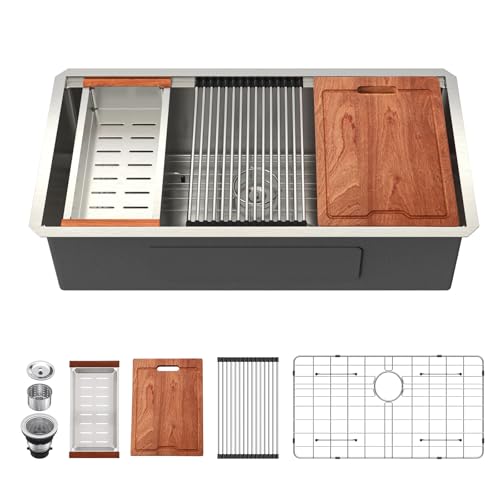
Lordear 36 Inch Undermount Workstation Kitchen Sink — Best Overall
A big family does not run out of sink space gradually — it runs out all at once, at 6:40 on a Tuesday, when the pasta pot, the sheet pan, two lunchboxes and a tower of cereal bowls arrive together. The Lordear 36 inch workstation is built for exactly that pile-up: a 36 inch wide, 10 inch deep single bowl with a ledge that lets a cutting board or drying rack work over the basin instead of stealing counter space.
Strengths
- Huge single bowl swallows sheet pans, stockpots and a day of family dishes at once
- Workstation ledge turns the sink into extra prep counter in a crowded kitchen
- 16 gauge steel and 10 inch depth, both stated in the verified listing title
Trade-offs
- Needs a wide cabinet and a serious countertop cutout — measure twice
- Single bowl means no separate soaking side unless you use a tub inside it
- Workstation accessories add to the total cost of the setup
| Key spec (from verified listing) |
|---|
| 36 x 19 x 10 inch undermount single bowl, 16 gauge stainless steel, handmade workstation basin with integrated ledge |
In daily family service the ledge is the feature that earns its keep, because prep and washing stop competing for the same square feet. The bowl is handmade with rounded corners that release stuck food better than sharp zero-radius corners, and the undermount install keeps the counter-to-bowl transition wipeable — important when the people wiping it are tired parents at 9 p.m.
Best for: households cooking for five or more people every day / Not suited for: small kitchens or anyone with a narrow sink cabinet
Check the current price on Amazon for the Lordear 36 Inch Undermount Workstation Kitchen Sink.

Sarlai 36 Inch Farmhouse Double Bowl 60/40 Sink — Best Double Bowl
Some big families do not want one giant bowl; they want two jobs happening at once. The Sarlai 36 inch farmhouse answers with a 60/40 split behind an apron front: the big side takes the casserole dish, the smaller side handles rinsing produce or stacking glassware, and nobody has to move a soaking pan to wash a single cup.
Strengths
- 60/40 split lets one side soak while the other stays free for rinsing and prep
- Apron front shortens the reach to the bowl — kinder on backs during long wash-ups
- 36 inch width suits the big cabinets common in family-size kitchens
Trade-offs
- Farmhouse apron changes the cabinet face — this is a remodel decision, not a swap
- Double bowl divides the space, so the very largest roasting pans may bridge awkwardly
- Stainless apron shows fingerprints in busy households
| Key spec (from verified listing) |
|---|
| 36 x 21 inch apron front farmhouse sink, 60/40 double bowl, 16 gauge stainless steel, round corners |
The round-corner interior is a practical family detail — corners that a sponge can actually sweep stay cleaner than crisp corners that collect grime. Because it is an apron-front design, plan the cabinet modification honestly: the payoff is a shorter reach into the bowl, which matters more the more loads of dishes your household generates.
Best for: families who soak and wash at the same time, every day / Not suited for: minimalist kitchens that cannot take an apron-front cabinet change
Check the current price on Amazon for the Sarlai 36 Inch Farmhouse Double Bowl 60/40 Sink.

Kraus KHF203-33 Standart Pro 33 Inch Farmhouse Sink — Best 60/40 Farmhouse
The Kraus Standart Pro KHF203-33 is the farmhouse pick for families whose kitchen is big in appetite but standard in cabinetry. At 33 inches it keeps the 60/40 double-bowl layout that makes family dish duty manageable, in a footprint that fits the far more common 36 inch sink cabinet without the extra width the 36 inch models demand.
Strengths
- Trusted mainstream brand with a long-running model line
- 60/40 bowls in a slightly smaller 33 inch footprint than the 36 inch options
- 16 gauge steel stated in the verified listing title
Trade-offs
- Apron front requires a farmhouse-ready cabinet
- 33 inches gives up some bowl volume versus the 36 inch picks
- Accessories such as grids are where the real-world cost creeps up
| Key spec (from verified listing) |
|---|
| 33 inch apron front farmhouse, 60/40 double bowl, 16 gauge stainless steel, Standart Pro series |
Kraus publishes its Standart Pro line as 16 gauge steel, and the verified listing title confirms the gauge rather than leaving you to guess from marketing copy. For a family sink that will be loaded, scraped and stacked in daily, that heavier steel is the difference between a bowl that shrugs off a dropped skillet and one that dents in the first month.
Best for: families who want the farmhouse workflow in a standard 36 inch cabinet run / Not suited for: households that need the absolute maximum bowl volume
Check the current price on Amazon for the Kraus KHF203-33 Standart Pro 33 Inch Farmhouse Sink.

Kraus KWU110-36 Kore Workstation 36 Inch Sink — Best Workstation
If your family kitchen runs like a small restaurant — one person chopping, one rinsing, one loading — the 36 inch Kore workstation is the sink that organises the chaos. The ledge system carries a cutting board and roll-up rack over the bowl, so vegetables can be chopped, rinsed and drained in a straight line while the bowl below stays free.
Strengths
- Largest workstation format here, with board and roll-up rack in the box
- NoiseDefend padding softens the clatter of a full family dish load
- Integrated ledge keeps prep over the sink and off the counter
Trade-offs
- Premium tier positioning — the accessories are built into the price
- 36 inch width demands a big cabinet and a confident template cut
- A single deep bowl can be a long reach down for shorter users
| Key spec (from verified listing) |
|---|
| 36 inch undermount single bowl workstation, 16-gauge TRU16 steel, integrated ledge, cutting board and roll-up rack included, NoiseDefend soundproofing |
Kraus includes the board and rack with this model rather than selling the workstation idea and then charging again for the parts, which matters when you are comparing it against cheaper bare bowls. NoiseDefend soundproofing is the other family-relevant detail: a deep steel bowl full of plates is loud, and padding under the bowl takes the edge off every single evening.
Best for: big families who prep and cook in overlapping shifts / Not suited for: budget-first remodels or compact kitchens
Check the current price on Amazon for the Kraus KWU110-36 Kore Workstation 36 Inch Sink.
Ruvati RVM4350 32 Inch 50/50 Double Bowl Sink — Best 50/50 Split
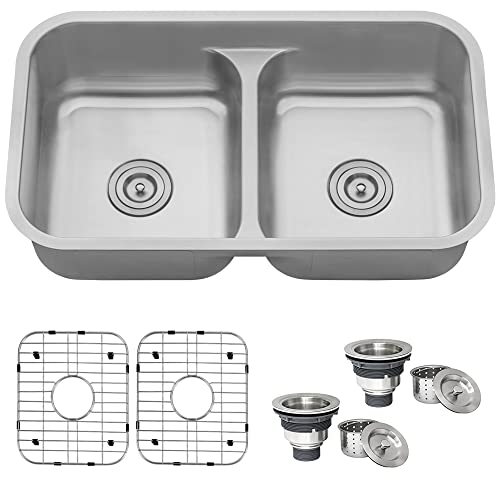
Plenty of big families work in pairs at the sink — one washing, one rinsing and stacking — and for that choreography a level 50/50 split beats a lopsided one. The Ruvati RVM4350 gives each person a real bowl in a 32 inch undermount footprint, with 16-gauge T-304 steel confirmed in the verified listing rather than implied.
Strengths
- True 50/50 split suits households that divide washing and rinsing evenly
- Brushed finish hides the scratch pattern of heavy daily use
- 32 inch size fits more existing cabinets than the 36 inch options
Trade-offs
- Each bowl is half of 32 inches — big sheet pans will not sit flat
- No workstation ledge for over-sink prep
- Undermount only, so countertop material must support it
| Key spec (from verified listing) |
|---|
| 32 inch undermount double bowl, 50/50 split, 16-gauge T-304 stainless steel, brushed finish |
The brushed finish is doing quiet work in a family kitchen: it breaks up the light so the inevitable scratch pattern from pans and cutlery reads as texture rather than damage. Be honest about the trade-off before ordering — a 50/50 bowl will not swallow a half-sheet pan flat, so if your household lives on sheet-pan dinners, a single bowl from this list will serve you better.
Best for: families who split tasks between two people at the sink / Not suited for: batch cooks who need one uninterrupted wide bowl
Check the current price on Amazon for the Ruvati RVM4350 32 Inch 50/50 Double Bowl Sink.

Kraus KHU100-32 Standart Pro 32 Inch Sink — Best Simple Large Single Bowl
Not every big family wants accessories, ledges and systems. Some just want the biggest honest bowl that fits the cabinet, and that is the KHU100-32: 32 inches of uninterrupted undermount single bowl in 16 gauge steel, with channel grooves in the floor that keep water moving toward the drain instead of pooling under stacked dishes.
Strengths
- Uninterrupted single bowl takes roasting pans and big pots without a divider fight
- 16-gauge TRU16 steel construction stated in the listing
- Straightforward undermount install with no workstation parts to store
Trade-offs
- No ledge or included prep accessories — it is a bowl, purely
- Single bowl means soaking blocks the whole sink
- 32 inches is the floor of ‘big’ — the largest households may still want 36
| Key spec (from verified listing) |
|---|
| 32 inch undermount single bowl, 16 gauge stainless steel, KHU100-32, channel grooves and NoiseDefend pads per the verified listing |
The simplicity is the point. There is nothing to misplace, no board to store, and the rounded corners wipe clean fast — a real consideration when the sink is cleaned by whoever lost the family argument that night. Pair it with a pull-down faucet and a bottom grid and you have the classic big-family setup that has worked for decades.
Best for: families who want maximum bowl and minimum fuss / Not suited for: cooks who rely on workstation accessories for prep space
Check the current price on Amazon for the Kraus KHU100-32 Standart Pro 32 Inch Sink.
Comparison Table
Read the key-spec column as ‘what the verified listing itself states’ — sizes, bowl splits and gauges are quoted from catalogue titles, not from review-roundup folklore.
| Pick | Badge | Key spec | Best for |
|---|---|---|---|
| Lordear 36 Inch Undermount Workstation Kitchen Sink | Best Overall | 36 x 19 x 10 inch undermount single bowl, 16 gauge stainless steel, handmade workstation basin with integrated ledge | households cooking for five or more people every day |
| Sarlai 36 Inch Farmhouse Double Bowl 60/40 Sink | Best Double Bowl | 36 x 21 inch apron front farmhouse sink, 60/40 double bowl, 16 gauge stainless steel, round corners | families who soak and wash at the same time, every day |
| Kraus KHF203-33 Standart Pro 33 Inch Farmhouse Sink | Best 60/40 Farmhouse | 33 inch apron front farmhouse, 60/40 double bowl, 16 gauge stainless steel, Standart Pro series | families who want the farmhouse workflow in a standard 36 inch cabinet run |
| Kraus KWU110-36 Kore Workstation 36 Inch Sink | Best Workstation | 36 inch undermount single bowl workstation, 16-gauge TRU16 steel, integrated ledge, cutting board and roll-up rack included, NoiseDefend soundproofing | big families who prep and cook in overlapping shifts |
| Ruvati RVM4350 32 Inch 50/50 Double Bowl Sink | Best 50/50 Split | 32 inch undermount double bowl, 50/50 split, 16-gauge T-304 stainless steel, brushed finish | families who split tasks between two people at the sink |
| Kraus KHU100-32 Standart Pro 32 Inch Sink | Best Simple Large Single Bowl | 32 inch undermount single bowl, 16 gauge stainless steel, KHU100-32, channel grooves and NoiseDefend pads per the verified listing | families who want maximum bowl and minimum fuss |
How to Choose a Kitchen Sink for a Big Family
Bowl layout: one big bowl, 60/40 or 50/50
A single bowl is the sheet-pan answer: nothing interrupts the floor, so the largest items your household owns sit flat and soak properly. The cost is that soaking blocks the whole sink, and in a big family something always needs rinsing while the big pot soaks. A plastic tub inside a single bowl is the classic workaround and honestly works well.
A 60/40 split is the family compromise most households land on: the large side takes pots and pans, the small side stays available for rinsing, produce and the constant drip of single cups and spoons. A true 50/50 suits two-person wash teams where both sides work equally hard. Whichever you choose, check the smaller bowl against your largest everyday item — a too-small second bowl becomes a decorative puddle.
Size and cabinet maths
Sink width is sold by the outside dimension, but your cabinet decides what fits. A 36 inch sink typically needs a cabinet at least as wide and often wider once mounting clips and the faucet are accounted for; a 33 inch sink commonly pairs with a 36 inch cabinet. Measure the cabinet interior, the countertop depth and the position of any disposal or water filter before falling in love with the biggest bowl.
Depth matters as much as width for families. Bowls around 9 to 10 inches deep hide a day’s dishes below the counter line and contain splashing from tall pots being filled. Deeper than that, shorter family members and anyone with back trouble will feel the reach on every wash.
Steel gauge, stated honestly
For stainless sinks, gauge is thickness: 16 gauge is thicker and more dent-resistant than 18 gauge, and it sounds less tinny under a running tap. In this guide a gauge is only claimed where the verified listing title states it — you will see 16 gauge attached to specific Kraus, Ruvati, Lordear and Sarlai models because their titles say so, and no gauge invented for models whose titles stay silent.
Heavier steel is not automatically the right family choice, though. It costs more and weighs more, which matters for undermount installs on weaker countertops. What a family genuinely needs is steel thick enough to survive a dropped skillet without denting — which is exactly the job 16 gauge does.
Sound, grids and the daily-clean test
A big steel bowl is a drum. Pads and coatings under the bowl — Kraus calls its system NoiseDefend in the verified listings — take the metallic ring out of dish duty. In an open-plan family home where the kitchen backs onto homework and television, that difference is felt every evening.
Bottom grids protect the bowl floor from pan scratches and lift dishes out of standing water, at the cost of one more thing to lift and scrub. For families, we rate a grid worth it: the bowl floor is where a family sink ages fastest. Whatever you buy, run the daily-clean test mentally — rounded corners, a floor that slopes to the drain, and no decorative grooves where family grime can set up home.
Faucet and disposal pairing for a family sink
A family sink works as a team with its faucet, and the pairing deserves a decision of its own. Tall stockpots and roasting tins need clearance, so a high-arc pull-down faucet is the near-universal family answer: it fills pots standing in the bowl, reaches every corner of a 36 inch basin, and rinses a stacked pile in one sweep instead of five. Check the faucet’s reach against the bowl’s width — a spout that lands mid-bowl in a 32 inch sink can leave the far corners of a 36 inch bowl to be rinsed by hand and hope.
The disposal decision interacts with depth: a disposal under a 10 inch bowl puts the bowl floor and the plumbing in a deep stack, and shorter family members feel every inch of it at the sink. If your household is tall-pot-heavy and disposal-loyal, a 9 inch bowl often serves better than the deepest option. None of this appears on the sink’s own listing, which is exactly why it belongs in a buying guide: the sink is a system, and the system is what your family will actually live with.
Accessories worth buying on day one
Three accessories earn their money immediately in a family sink. The fitted bottom grid, already discussed, protects the floor from the pan traffic that defines family use. A sink-side caddy or over-sink rack gives sponges and brushes a home that is not the bowl itself, which keeps the bowl free and the hygiene better. And a simple silicone mat for the drying overflow protects the counter beside the sink on the nights the dishwasher and the bowl are both full.
Buy the grid fitted to your exact model at the same time as the sink — ‘universal’ grids rock, slide and scratch, which is the opposite of their job. The rest can be added as the household’s habits reveal themselves. Accessories bought against observed behaviour get used; accessories bought against imagined behaviour fill a cupboard, and family kitchens have no cupboard to spare.
Ergonomics for the tallest and shortest in the house
Family kitchens serve a height range no commercial kitchen tolerates, from a grandparent to a tall teenager, and bowl depth is where that range negotiates. A useful rehearsal before ordering: stand at your current counter, mime washing a large pot, and note where your hands work relative to the counter surface. Add the new bowl’s depth to that picture. If the mime already strains your back, the deepest bowls on this list will tax it daily, and a 9 inch bowl with a workstation ledge will serve the household better than a 10 inch showpiece.
Faucet placement plays its part too — controls reachable without leaning across a wet bowl, a spray head that comes to the work instead of demanding the work come to it. None of these details appears in a specification table, and all of them decide whether the family’s tallest and shortest members experience the sink as theirs. A family sink, in the end, is a piece of shared furniture; buy it the way you would a dining table, for every person who will use it.
How a Big Family Actually Uses a Sink, Hour by Hour
Morning is volume: cereal bowls, smoothie jars, lunchbox parts. A wide single bowl or the big side of a 60/40 swallows it without stacking gymnastics, and a pull-down faucet rinses the pile in one pass. Midday is prep: this is where workstation ledges stop being a luxury, because the board over the bowl catches peels and trimmings that would otherwise colonise the counter.
Evening is the stress test — cooking vessels plus tableware plus the pan that needs to soak overnight. The households that stay calm at this hour are the ones whose sink lets soaking and washing coexist, either through a second bowl or through a tub-in-bowl habit. Late night is cleaning: the sink that wipes down in ninety seconds, with no grime traps, is the one still looking decent in year three. Choose for the evening peak and the late-night clean, not for the showroom.
Disposals, Dishwashers and the Family Sink Ecosystem
A garbage disposal eats bowl depth and cabinet space, and its flange must match the sink’s drain opening — standard on everything here, but confirm before ordering if your disposal is an unusual model. A deep bowl plus a disposal is the classic family pairing: scraps rinse straight down instead of being fished out by hand.
If your household runs the dishwasher twice a day, the sink’s job shifts toward prep and oversized items, and a workstation layout often beats a double bowl. If you hand-wash most things — big families with delicate pans and bottles often do — bowl layout matters more than accessories. Think of the sink as one station in a system, and buy the station your system is missing.
Teaching Kids the Sink: Safety and Habits at a Big Bowl
A family sink is where children learn kitchen competence, and its design quietly teaches. A bowl at comfortable depth lets a step-stooled eight-year-old rinse a plate without wearing the water; a divider at the right height becomes a natural boundary between ‘soaking side’ and ‘my side’. Deep 10 inch bowls, by contrast, put the tap and the bowl floor a long way from small arms — one more reason the depth decision in this guide is about the household’s actual members, not a specification contest.
Habits form around friction. A sink that is easy to wipe gets wiped by teenagers; a sink with grime-trap corners gets avoided by everyone and cleaned resentfully by one person. When you choose among these six picks, you are also choosing the cleaning experience your family will repeat thousands of times. Rounded corners and honest drainage are not luxuries in that light — they are how a chore stays shared instead of becoming one person’s grievance.
The Holiday Stress Test: When the Family Doubles
Ordinary weeks size a sink for five; holidays size it for fourteen. The cooks who stay serene in late December share a sink trait: surge capacity. A 36 inch single bowl becomes a drinks station, a defrosting basin and a washing bowl in rotation. A 60/40 double lets the turkey roaster soak while the second bowl runs a continuous rinse line for the cook. The workstation ledge becomes the extra counter that holiday cooking always, always needs.
You do not need to buy for the single busiest day of the year — that way lies a sink too big for February. But it is worth walking your worst realistic day through each candidate before ordering: where does the roaster soak, where do glasses stage, who stands where. The pick that survives that mental rehearsal without a traffic jam is the pick your future self will thank you for, loudly, while holding a gravy boat.
Resale, Relatives and the Sink That Stays
A family sink is one of the few kitchen purchases your relatives will have opinions about at gatherings, because everyone washes up at it eventually. The feedback loop is useful: the aunt who finds the bowl too deep, the grandfather who praises the apron front’s short reach, the teenager who discovers the workstation ledge is the perfect phone-safe prep zone. Listen to the pattern across a year of gatherings and you learn your own household’s truth better than any review can teach it — including ours.
If you are choosing partly with resale in mind, the family brief aligns well with the market’s: big, mainstream, honestly specified sinks photograph well and reassure buyers, while eccentric sizes and orphan brands raise questions. The mainstream model lines in this guide — Kraus, Ruvati, Elkay-class names with verified model numbers — are the ones a future buyer’s plumber will recognise. Buy for your family’s decade first; the reassurance to the next family comes free with the same decision.
The Second Sink Question: Prep Sink, Bar Sink or None
Growing families eventually flirt with a second sink — a small prep sink in the island or a utility sink near the garden door — and the main sink choice should anticipate it. If a second station is plausible within a few years, the main sink can lean toward pure washing capacity, because prep will migrate. If it is not, the workstation picks in this guide earn a second look: they are how a one-sink kitchen borrows the second sink’s benefits without the plumbing.
Either way, resist sizing the main sink for a hypothetical renovation that has no date. Kitchens evolve in stages, and the family standing at the sink tonight needs the bowl that fits tonight’s dishes, tonight’s pans and tonight’s homework-strewn counters. The picks here were sized for real households as they are — which is why, if a prep sink does arrive one day, every one of them still makes sense as the main event.
How to Measure for a Family-Size Sink Before You Order
More family sinks are returned for fit than for quality. Twenty minutes with a tape measure prevents the most expensive mistake in this whole category.
- Measure the inside width of the sink cabinet, wall to wall, and note any pipes, disposal or filter housings that intrude into that space.
- Measure the countertop depth front to back and check how much flat counter must remain in front of and behind the bowl for the faucet and for comfortable leaning.
- Check your largest pan — usually a sheet pan or roasting tin — against the bowl dimensions of the sink you are considering, including the diagonal if you soak it flat.
- Confirm the mount type your countertop supports: undermount needs a strong, sealed counter material; farmhouse apron models need a cabinet face that can be cut or a cabinet designed for an apron.
- Photograph the plumbing under the sink. Drain position (centre or offset) decides whether the new bowl’s drain lines up or whether the trap needs moving.
- Decide the layout question with the household: one big bowl, 60/40 or 50/50 — then order once, with the grid and any workstation accessories in the same basket so everything arrives together.
If the cabinet maths fails for a 36 inch model, step down to a 33 or 32 inch pick from this list rather than forcing a fit. A slightly smaller sink that installs cleanly beats a bigger one wedged in with compromised sealing.
One last measurement habit separates happy family installs from returns: photograph your current sink at its worst moment — full, mid-dinner, everything stacked — and measure the pile, not just the cabinet. The photograph tells you whether your household’s real problem is width, depth or layout, and it is a far better consultant than any showroom. Keep it on your phone while you shop this list. Finally, brief the household on day one: where the grid lifts, how the ledge accessories stack, and which bowl is the soaking bowl if you chose a split. Family systems fail at the briefing stage more often than at the hardware stage, and a sink everyone uses the same way stays cleaner, calmer and younger-looking than a better sink used six different ways.
Common Buying Mistakes
Buying width and forgetting depth. A 36 inch wide but shallow bowl still splashes like a small sink and cannot hide a family dinner’s worth of dishes. For family use, treat 9 inches of bowl depth as the working minimum.
Assuming the cabinet fits because the old sink ‘looked the same size’. Old and new sinks with the same headline width can need different cabinets. The template and the minimum cabinet size in the listing are the authority, not your memory of the old bowl.
Choosing a divider your pans cannot cross. A high fixed divider in a double bowl can block the very roasting pans a big family uses weekly. Low dividers and 60/40 splits exist precisely because of this mistake.
Skipping the bottom grid to save money. The grid is cheaper than the sink. In a household where pans land in the bowl hourly, an unprotected steel floor scratches and dulls fast.
Ignoring noise until the first family dinner. Thin, unpadded steel under a full dish load is genuinely loud in an open-plan home. Soundproofing pads are a quality-of-life feature, not a gimmick, at family volumes.
Ordering the sink before the faucet decision. Tall family pots need faucet clearance, and workstation sinks pair best with pull-down faucets. Decide both together so the deck holes and reach actually work.
Final Recommendation
The short version, with every pick in one place: the Lordear 36 Inch Undermount Workstation Kitchen Sink (best overall); the Sarlai 36 Inch Farmhouse Double Bowl 60/40 Sink (best double bowl); the Kraus KHF203-33 Standart Pro 33 Inch Farmhouse Sink (best 60/40 farmhouse); the Kraus KWU110-36 Kore Workstation 36 Inch Sink (best workstation); the Ruvati RVM4350 32 Inch 50/50 Double Bowl Sink (best 50/50 split); the Kraus KHU100-32 Standart Pro 32 Inch Sink (best simple large single bowl). Match that list against the way your household actually cooks and cleans, and the right choice usually names itself.
For most big families, start with the Lordear 36 inch workstation if your cabinet takes it: the bowl volume plus the ledge solves the two problems — capacity and counter space — that define family dish duty. If two people work the sink together, the Sarlai 60/40 farmhouse or the Ruvati 50/50 will feel more natural than any single bowl.
On a tighter remodel, the Kraus KHU100-32 is the honest workhorse: one big 16 gauge bowl, no systems to manage, verified specs. And if your household’s signature move is the sheet-pan dinner, let pan size make the final call — measure the pan, then pick the bowl it fits in, not the other way round.
Keep researching the cluster: Best Kitchen Sinks Double Best Kitchen Sinks Double Undermount Best Kitchen Sinks For A Granite Countertop Best Kitchen Sinks For Durability Best Kitchen Sinks For Hard Water
Frequently Asked Questions
How big should a kitchen sink be for a family of five or six?
Start at 32 inches wide with a bowl around 9 to 10 inches deep, and go to 36 inches if the cabinet allows it. Below 32 inches, large pans stop sitting flat and the sink becomes the bottleneck at dinner time, which is exactly what a family sink exists to prevent.
Is a single bowl or double bowl better for a big family?
It depends on your bottleneck. Single bowls fit the biggest pans and simplify soaking; double bowls let soaking and rinsing happen simultaneously. Households that cook big and wash as they go usually prefer a 60/40 double; sheet-pan and stockpot households usually prefer one large single bowl.
Does steel gauge really matter for a family sink?
Yes, at family volumes. Thicker 16 gauge steel — claimed in this guide only where the verified listing states it — resists dents from dropped skillets and sounds less harsh than thinner steel. It is one of the few specifications with a daily, audible payoff.
Are workstation sinks worth it for families?
When counter space is the constraint, yes: the ledge moves chopping and draining over the bowl and frees the counter for everything else a family kitchen juggles. If you have abundant counter space, a plain large bowl plus a separate drying rack delivers most of the benefit for less money.
What cabinet size do I need for a 36 inch sink?
Typically a cabinet at least 36 inches wide, and the listing’s stated minimum cabinet size is the number to trust for the specific model. Measure the cabinet interior and check for pipes and disposals that steal space before ordering.
How do I keep a big stainless sink looking decent with heavy use?
Rinse and wipe after the evening wash rather than letting acidic food sit, use a bottom grid to keep pans off the floor of the bowl, and dry the bowl when you can — brushed finishes and a quick towel pass hide most of what family life does to steel.
Should a big family sink have a garbage disposal?
It suits most: family food scraps are constant, and a disposal keeps the bowl clearer between washes. Budget the cabinet space and bowl depth together — a disposal under a very deep bowl makes a deep stack — and confirm the flange fits the sink’s standard drain opening before ordering.
How do I stop a big family sink smelling?
Smell is residue: food film in corners, a grid never lifted, a disposal splash guard never cleaned. Rounded corners, a weekly grid lift-and-rinse, and running the disposal with cold water after meals address nearly all of it. A sink that drains fully, as these picks are chosen to do, denies odour its standing-water home.
What faucet height works best over a deep family bowl?
Enough to fill your tallest pot standing in the bowl, without splashing the whole postcode when rinsing a spoon. High-arc pull-down models hit that balance for most households; measure your tallest stockpot and compare it with the faucet’s spout height over the bowl floor, not over the counter, before ordering the pair.
Should I get a sink with a low divider instead of a full double bowl?
A low divider is the peacemaker of this category: it keeps two zones for daily work while letting long pans lie across the top of the divider when needed. If your household is torn between the single-bowl and double-bowl camps, a low-divide model — or a 60/40 used flexibly — is often the argument-ending compromise.


