Disclosure: airfryerkitchensupply.com is reader-supported. When you buy through links on our site, we may earn an affiliate commission at no extra cost to you.
Where to buy
If you are shopping for the best kitchen mixers under 300 dollars, start with this verified shortlist. Every mixer in this guide was verified against Amazon’s own catalogue data before a link was attached, and every pick sits in the under-$300 tier at the time of checking. Prices in this category move with sales events, so use the links below to check the current price on Amazon rather than trusting any number printed in a roundup — including ours, which is why we do not print one.
- KitchenAid Classic Series 4.5 Quart Tilt-Head Stand Mixer K45SS — Best Overall: check price on Amazon.
- KitchenAid 5.5-Qt Bowl-Lift Stand Mixer KSM55 — Best Bowl-Lift Under the Cap: check price on Amazon.
- Cuisinart Stand Mixer SM-50 — Best Feature Set for the Money: check price on Amazon.
- Aucma Stand Mixer 6.5-QT — Best Big Bowl on a Budget: check price on Amazon.
- Hamilton Beach 4 Quart Electric Stand Mixer — Best for Small Households: check price on Amazon.
- Dash Everyday Stand Mixer — Best Compact Pick: check price on Amazon.
If a pick has drifted above the $300 line when you check, treat that as a pricing event rather than a different machine: the hardware does not change, only the deal does. The two KitchenAid models below were both inside the cap at verification, and the budget-leaning picks give you fallbacks that stay comfortably inside it.
The search for the best kitchen mixers under 300 dollars runs into one honest complication right away: $300 is exactly where the mixer market changes character. Below this line you get capable tilt-head machines, one genuine bowl-lift model, and a crowd of budget stand mixers with big bowls and modest motors. Above it, you mostly pay for finishes, extra accessories and heavier frames. So the real question in this guide is not which mixer is cheapest, but which machines give you the most actual mixing ability before the cap cuts you off.
That is why this list mixes categories deliberately. A serious home baker who kneads weekly will get more from the bowl-lift KitchenAid KSM55 than from any tilt-head at this price, while a casual baker who makes cake batter twice a month is better served by the lighter, simpler KitchenAid Classic or the feature-rich Cuisinart SM-50. Bowl size, drive design and attachment ecosystems matter more at this budget than raw speed counts, because every brand pads its speed dial; what differs is how the machine behaves under a stiff dough at minute four.
We also kept two honest budget picks in the line-up. The Aucma and Hamilton Beach models cannot match KitchenAid build quality, and we say so plainly in their reviews, but they put a genuinely large or genuinely convenient stand mixer within reach of buyers whose alternative is a hand mixer and a sore arm. If your budget is firm, they are defensible purchases; if you can stretch within the cap, the first three picks are where the long-term value sits.
In this guide
Quick Picks
Six mixers, six different reasons to buy. Read the badge first — it tells you the job each machine is actually best at — then read the full review before spending, because the trade-offs at this price are real and specific.
- Best Overall — KitchenAid Classic Series 4.5 Quart Tilt-Head Stand Mixer K45SS: the default answer under the cap — a metal-bodied 4.5-quart tilt-head with ten speeds and the full KitchenAid attachment ecosystem behind it.
- Best Bowl-Lift Under the Cap — KitchenAid 5.5-Qt Bowl-Lift Stand Mixer KSM55: the only genuine bowl-lift design in this guide — eleven speeds, a 5.5-quart stainless bowl and the stability heavy dough demands.
- Best Feature Set for the Money — Cuisinart Stand Mixer SM-50: twelve speeds, a 5.5-quart bowl and a splash guard with pour spout in the box — the most complete accessory bundle in this line-up.
- Best Big Bowl on a Budget — Aucma Stand Mixer 6.5-QT: a 6.5-quart bowl and a 660W motor for far less than the cap — capacity first, refinement second.
- Best for Small Households — Hamilton Beach 4 Quart Electric Stand Mixer: planetary mixing, a splash guard and a printed mixing guide in a compact 4-quart machine that is easy to store and easy to learn.
- Best Compact Pick — Dash Everyday Stand Mixer: a 3-quart, six-speed tilt-head that fits small counters and small budgets, and stores where full-size mixers cannot.
How These Picks Were Chosen
Each candidate was checked the same way. First, the model had to exist as a current Amazon listing, verified with the title matched word-for-word against the machine we intended to cover; only verified models received purchase links. Second, the model had to sit in the under-$300 tier at verification, using the API’s own price data internally to draw that line — we do not print the figures, because they will have changed by the time you read this, but the tier decision was made on real numbers, not on list-price folklore.
Third, we weighed the things that decide whether a mixer is still pleasant in year five: bowl capacity measured against real batch sizes, whether the head tilts or the bowl lifts, the availability of replacement beaters and attachments, and how the machine handles the two stress tests of home mixing — stiff bread dough and large volumes of whipped cream. Machines that only shine with light batter were marked down, however attractive their spec sheets look.
Finally, we deliberately spread the six picks across buyer types. A single ‘best’ mixer under $300 does not exist, because a sourdough household and a cupcake household are buying different tools. The badges are the short version of that thinking; the reviews are the long version.
The 6 Best Kitchen Mixers Under 300 Dollars
Reviews are ordered by how we would spend the money first, not by brand prestige. Where a pick has a real weakness — and at this price, every pick has at least one — it is stated in the trade-offs rather than buried.

KitchenAid Classic Series 4.5 Quart Tilt-Head Stand Mixer K45SS — Best Overall
This is the mixer for the home baker who wants one machine to last a decade of birthdays, holiday cookies and weekend loaves without drama. It suits cooks who value a proven platform over novelty: the Classic platform has been in production for years, parts and attachments are everywhere, and the tilt-head design is the easiest style to live with day to day.
Strengths
- Metal construction at a price where rivals are often plastic-bodied
- 59-point planetary mixing action reaches around the bowl thoroughly
- Full compatibility with the KitchenAid hub attachment range
Trade-offs
- 4.5-quart bowl is tight for double batches of dough
- No pouring shield in the box on this trim
- Heavier than budget rivals, so it tends to live on the counter
| Specification | Detail |
|---|---|
| Bowl capacity | 4.5 quart (from Amazon listing title) |
| Design | Tilt-head |
| Speeds | 10 |
| Construction | Metal, per Amazon listing title |
| Colour verified | Onyx Black |
The Classic’s appeal is mechanical honesty. The motor does not promise miracles; it delivers steady torque through a metal drivetrain, and the planetary action — where the beater spins on its own axis while orbiting the bowl — means fewer stops to scrape the sides than with twin-beater budget designs. For cake batter, cookie dough and mashed potatoes, it simply feels composed, and the ten speeds give a genuinely gentle first speed for folding flour without a dust cloud.
Where it earns the top badge is ownership. When a beater chips in year six, you can buy another anywhere. When you want a pasta roller or a meat grinder, the front hub accepts the same attachments as KitchenAid models costing far more. Under a $300 cap, that ecosystem access is the closest thing to future-proofing this category offers, and it is why we would spend our own money here first.
Best for: most home bakers who want one durable, do-everything tilt-head mixer / Not suited for: bakers who routinely double bread recipes or knead very stiff dough in bulk
Check the current price on Amazon for the KitchenAid Classic Series 4.5 Quart Tilt-Head Stand Mixer K45SS — our Best Overall pick in this guide.
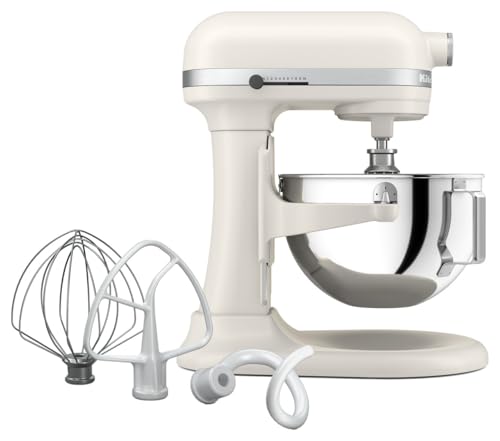
KitchenAid 5.5-Qt Bowl-Lift Stand Mixer KSM55 — Best Bowl-Lift Under the Cap
Buy this one if bread is the point. The bowl-lift design clamps the bowl between two arms and raises it into the head, which keeps the machine planted when a stiff dough tries to walk a lighter mixer across the counter. It suits regular bread bakers, pizza-night households and anyone who has watched a tilt-head nod under load and thought: never again.
Strengths
- Bowl-lift stability for dense, heavy doughs
- 11 speeds including a gentle folding pace
- Flat beater, dough hook and wire whip all included
Trade-offs
- Taller profile may not fit under low wall cabinets
- Bowl removal is a two-hand, lift-and-twist routine
- Costs close to the cap, leaving little room for accessories
| Specification | Detail |
|---|---|
| Bowl capacity | 5.5 quart stainless steel (from Amazon listing title) |
| Design | Bowl-lift |
| Speeds | 11 |
| Included tools | Flat beater, dough hook, wire whip |
Bowl-lift machines used to start well above this budget, which is what makes the KSM55 the most interesting mixer in this guide. At verification it sat just inside the $300 line — close enough that you should check the current price on Amazon before assuming it still does — and for that money it delivers the one capability tilt-heads struggle with: calm, sustained kneading. The head does not flex because there is no hinge; the bowl rises to meet fixed tools, and the whole frame works as one rigid structure.
The trade-off is ergonomic. Adding flour mid-mix means lowering the bowl or working around the head, and the machine’s height is a genuine issue in kitchens with low-hung cabinets. Measure your counter-to-cabinet clearance before ordering. If it fits, though, this is the pick that turns ‘under $300’ from a compromise into a legitimate long-term bread station.
Best for: bread and pizza dough bakers who need bowl-lift stability on a firm budget / Not suited for: kitchens with low wall cabinets or bakers who add ingredients constantly mid-mix
Check the current price on Amazon for the KitchenAid 5.5-Qt Bowl-Lift Stand Mixer KSM55 — our Best Bowl-Lift Under the Cap pick in this guide.
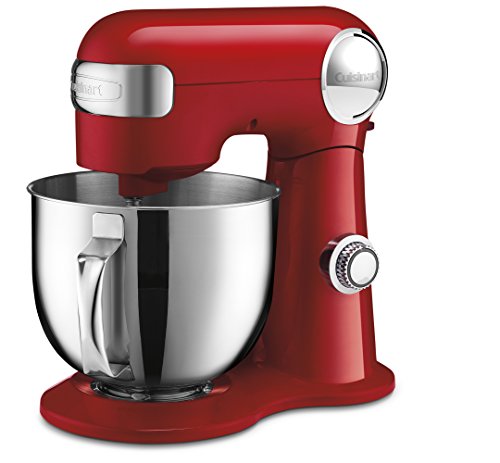
Cuisinart Stand Mixer SM-50 — Best Feature Set for the Money
The SM-50 suits bakers who read spec sheets and want maximum equipment per dollar: a big bowl, the widest speed range here, and the splash guard that KitchenAid makes you buy separately at this level. It is a particularly good fit for frosting, meringue and batter work, where fine low-speed control and a covered bowl pay off immediately.
Strengths
- 12 speeds for finer control at the gentle end
- Splash guard with pour spout included
- 5.5-quart bowl handles family-size batches
Trade-offs
- Lighter frame than the KitchenAid picks under heavy dough
- Accessory ecosystem is far smaller than KitchenAid’s
- Die-cast look, but more plastic in the trim than the badge suggests
| Specification | Detail |
|---|---|
| Bowl capacity | 5.5 quart stainless steel (from Amazon listing title) |
| Speeds | 12 |
| Included tools | Chef’s whisk, mixing paddle, dough hook, splash guard with pour spout |
| Colour verified | Ruby Red |
Cuisinart’s pitch is generosity. Where the Classic gives you a bowl and basic tools, the SM-50 adds the splash guard, a whisk worth the name, and two extra speeds that genuinely help when you are easing flour into a batter or starting a meringue without slinging egg white across the kitchen. The 5.5-quart bowl is the joint-largest among the branded picks here, and for sheet-pan bakers and big-family cookie sessions that extra quart is not a luxury.
The honest reservation is longevity under load. The machine is rated for home use and behaves like it: occasional bread is fine, but weekly stiff dough will age it faster than the bowl-lift KitchenAid. Buy it as a superb batter-and-cream machine with dough capability, not as a dough machine with batter capability, and it will not disappoint you.
Best for: bakers focused on cakes, frostings and big batter batches who want everything in the box / Not suited for: heavy weekly bread kneading or buyers who want a vast attachment ecosystem
Check the current price on Amazon for the Cuisinart Stand Mixer SM-50 — our Best Feature Set for the Money pick in this guide.

Aucma Stand Mixer 6.5-QT — Best Big Bowl on a Budget
The Aucma is for buyers whose problem is volume, not finesse: big families, bake-sale weekends, holiday batches where the bowl on a standard mixer overflows. If you regularly mix for a crowd and your budget cannot reach the branded machines, this is the pragmatic route to a genuinely large bowl.
Strengths
- Largest bowl among the budget-priced picks at 6.5 quarts
- Dough hook, wire whip and beater included
- Leaves most of the $300 budget unspent
Trade-offs
- Fit and finish are a clear step below KitchenAid and Cuisinart
- Can move on the counter under unbalanced loads
- Long-term parts availability is less certain than the big brands
| Specification | Detail |
|---|---|
| Bowl capacity | 6.5 quart (from Amazon listing title) |
| Motor | 660W, per Amazon listing title |
| Design | Tilt-head |
| Included tools | Dough hook, wire whip, beater |
| Colour verified | Black |
Judge the Aucma by what it replaces. For a household stepping up from a hand mixer, a 6.5-quart stand mixer that holds a full batch of rolls and whips a family-size bowl of cream is transformative, and it does so while leaving money in the budget for ingredients, pans and a second bowl. The planetary-style action covers the bowl reasonably, and the tilt-head makes scraping and bowl removal simple.
The compromises are the usual budget ones: more vibration, more noise, and a drive that prefers you to start doughs with the hook at low speed and let the flour hydrate before pushing on. Treat it as a capacity purchase rather than a lifetime purchase, keep heavy doughs moderate, and it earns its place as the value outlier in this guide.
Best for: large households and batch bakers who need bowl capacity above all / Not suited for: buyers expecting big-brand refinement or a decade of heavy dough service
Check the current price on Amazon for the Aucma Stand Mixer 6.5-QT — our Best Big Bowl on a Budget pick in this guide.

Hamilton Beach 4 Quart Electric Stand Mixer — Best for Small Households
This Hamilton Beach suits one-to-three-person households and newer bakers who want guidance as much as machinery — the included mixing guide maps speeds to tasks, which quietly prevents most beginner mistakes. Its smaller bowl is a feature if your batches are half-loaves, single cakes and small cookie runs.
Strengths
- True planetary mixing at a budget price
- Splash guard and full tool set included
- Mixing guide helps beginners choose speeds correctly
Trade-offs
- 4-quart bowl limits batch size
- 300W motor prefers moderate doughs
- Lighter body can creep on smooth counters at high speed
| Specification | Detail |
|---|---|
| Bowl capacity | 4 quart (from Amazon listing title) |
| Speeds | 7 |
| Motor | 300 watts, per Amazon listing title |
| Included tools | Whisk, flat beater, dough hook, splash guard, mixing guide |
| Colour verified | Black |
Hamilton Beach has sold affordable mixers for generations, and this model shows the experience: the planetary action is the same mixing geometry the premium brands advertise, the tools cover the three core jobs, and the speed guide printed for the machine removes the guesswork that ruins first attempts at whipped cream. For small households, the 4-quart bowl also means less bowl-scraping for small quantities — a half batch actually reaches the beater.
Keep expectations matched to the 300-watt motor and light frame. This is a batter, dough-for-one-loaf and whipped-topping machine. Ask it to knead a double batch of stiff bagel dough weekly and you are shopping outside its design brief; ask it to run a small kitchen’s baking with minimal storage fuss and it is one of the easiest recommendations in this guide.
Best for: small households, beginners and occasional bakers with limited storage / Not suited for: large batches or frequent heavy dough work
Check the current price on Amazon for the Hamilton Beach 4 Quart Electric Stand Mixer — our Best for Small Households pick in this guide.

Dash Everyday Stand Mixer — Best Compact Pick
The Dash is the apartment answer: a stand mixer for people whose kitchen cannot host a stand mixer. It suits dorm-adjacent kitchens, small flats, RV cooks and anyone whose mixing is dips, pancake batter, single cakes and the occasional small dough — and who would otherwise not own a stand mixer at all.
Strengths
- Compact footprint suits small counters and cupboards
- Stainless steel bowl rather than plastic at this size
- Simple six-speed control anyone can learn in a minute
Trade-offs
- 3-quart bowl rules out family batches
- Not built for bread dough beyond small, soft recipes
- Budget construction throughout
| Specification | Detail |
|---|---|
| Bowl capacity | 3 quart stainless steel (from Amazon listing title) |
| Speeds | 6 |
| Design | Compact tilt-head |
| Colour verified | Black |
Every guide like this needs one machine that answers the storage question honestly, and the Dash is it. A mixer that lives in a cupboard and comes out willingly gets used more than a superior machine that requires a counter-clearing ceremony, and for the everyday jobs — batter, whipped cream, frosting, mashed avocado dips — its six speeds and stainless bowl are entirely adequate.
Just do not mistake it for a small version of the KitchenAid. The bowl is a third smaller than the Classic’s, the drive is built for light work, and bread belongs in the ‘small and soft, occasionally’ category. As a first stand mixer or a small-space specialist, though, it spends the least of this budget to solve the most common problem: no room.
Best for: small kitchens, first-time owners and light everyday mixing / Not suited for: families, bread bakers or anyone mixing for a crowd
Check the current price on Amazon for the Dash Everyday Stand Mixer — our Best Compact Pick pick in this guide.
Comparison Table
The table compresses the decision to the four facts that matter most under this budget: what the machine is for, what it mixes in, and who should buy it.
| Pick | Badge | Key spec | Best for |
|---|---|---|---|
| KitchenAid Classic Series 4.5 Quart Tilt-Head Stand Mixer K45SS | Best Overall | 4.5-qt tilt-head, 10 speeds, metal body | most home bakers who want one durable, do-everything tilt-head mixer |
| KitchenAid 5.5-Qt Bowl-Lift Stand Mixer KSM55 | Best Bowl-Lift Under the Cap | 5.5-qt bowl-lift, 11 speeds | bread and pizza dough bakers who need bowl-lift stability on a firm budget |
| Cuisinart Stand Mixer SM-50 | Best Feature Set for the Money | 5.5-qt tilt-head, 12 speeds, splash guard included | bakers focused on cakes, frostings and big batter batches who want everything in the box |
| Aucma Stand Mixer 6.5-QT | Best Big Bowl on a Budget | 6.5-qt tilt-head, 660W | large households and batch bakers who need bowl capacity above all |
| Hamilton Beach 4 Quart Electric Stand Mixer | Best for Small Households | 4-qt planetary, 7 speeds, 300W | small households, beginners and occasional bakers with limited storage |
| Dash Everyday Stand Mixer | Best Compact Pick | 3-qt compact tilt-head, 6 speeds | small kitchens, first-time owners and light everyday mixing |
Read the bowl column against your real batch sizes, not your aspirational ones. Most home bakers overbuy capacity and underbuy stability; if your weekly reality is one loaf and one cake, the Classic or the Hamilton Beach will serve you better than a cavernous budget bowl.
How to Choose the Best Kitchen Mixers Under $300
Start with the head design, because it decides what the machine is good at. Tilt-head mixers swing the motor up and back, giving open access to the bowl for adding ingredients and scraping; they are the friendlier everyday design. Bowl-lift mixers raise the bowl into a fixed head on a crank or lever, trading easy access for a rigid frame that stays calm under heavy dough. Under $300, the KSM55 is the rare bowl-lift option, and it exists in this guide precisely because that rigidity is worth real money to bread bakers.
Next, size the bowl to your batches. A 4 to 4.5-quart bowl handles a standard cake, a dozen muffins and a single loaf comfortably. A 5.5-quart bowl adds double cookie batches and bigger doughs. Bowls beyond 6 quarts, like the Aucma’s, help only if you truly mix at that scale; an oversized bowl actually mixes small quantities worse, because the beater cannot reach a thin layer of batter spread across a wide base.
Finally, look past speed counts. Six honest speeds beat twelve decorative ones. What matters is a slow first speed that does not throw flour, a mid-range that creams butter properly, and enough top end to whip egg whites. Every pick here clears that bar; the differences are in torque under load and build quality, which is why the reviews dwell on dough behaviour rather than dial numbers.
Tilt-Head vs Bowl-Lift: Which Design Deserves Your Money?
Tilt-head machines dominate this budget because they are cheaper to build and nicer to use for the batter-and-cream work most people do most often. The hinge is their weakness: under a stiff dough the head can nod slightly with each rotation, which is harmless for occasional loaves but wears the mechanism over years of heavy use. If your baking is 80 percent cakes, cookies and frostings, a tilt-head is the right spend.
Bowl-lift machines answer a narrower question — how do I knead seriously without spending professional money? The fixed head and clamped bowl remove the flex point entirely, and the design also tends to come with stronger drives because manufacturers know why people buy them. The costs are height, a fussier bowl routine, and less graceful mid-mix access. Choose the lift if bread is a weekly ritual; choose the tilt if it is a monthly pleasure.
Attachments, Bowls and the Hidden Cost of a Cheap Mixer
A mixer’s purchase price is the start of its cost, not the end. Before buying, price the extras you will actually want: a second bowl for back-to-back batches, a flex-edge beater that scrapes as it mixes, and any hub attachments on your wish list. KitchenAid’s advantage in this guide is not snobbery — it is that every one of those extras exists, is easy to find, and fits across decades of machines. With budget brands, confirm a second bowl is even sold before you commit.
Also check what is in the box against what the photos imply. A splash guard, a whisk and a dough hook are included with some picks here and sold separately for others. The Cuisinart SM-50’s bundle looks generous because it is; the Classic’s shorter box list is part of how it holds its price. Neither is a trick — but the comparison table only stays fair if you count the cost of completing the kit you need.
What $300 Actually Buys in 2026: Reading This Tier Like an Insider
The under-$300 tier is best understood as three sub-tiers wearing one label. At the bottom sit the budget stand mixers — the Aucma and Hamilton Beach class — where the money buys capacity and convenience: big bowls, full tool sets, planetary badges, with frames and finishes built to a price. In the middle sits the Cuisinart SM-50 class, where the money buys features: more speeds, more included equipment, more polish, on a competent but not heirloom frame. At the top, hard against the cap, sit the two KitchenAids, where the money buys platform: metal construction, the attachment hub, and a parts pipeline that will outlive the purchase by decades. Knowing which sub-tier you are shopping in prevents the tier’s commonest disappointment — expecting platform behaviour from a features purchase, or features generosity from a platform one.
Sales events blur these lines constantly, which is why this guide was built on tier membership at verification rather than on printed figures. A platform machine discounted into the middle of the tier is the best purchase in this guide when it happens; a features machine at full price beside it is not suddenly a worse machine, merely a worse deal that week. The practical habit this creates is simple: decide your sub-tier first, pick the machine that wins it, and then let the live price on Amazon confirm the timing. Buyers who shop in that order — class, machine, timing — are the ones who end up satisfied with what this budget can do.
Dough Capacity, Decoded: What Each Pick Here Can Really Knead
Manufacturers express dough capacity in flour weight when they express it honestly at all, and the six picks in this guide span a wider practical range than their similar silhouettes suggest. The bowl-lift KSM55 is the only machine here engineered for repeated, confident kneading at family-loaf scale: its clamped bowl and fixed head let a full batch of sandwich or pizza dough develop without the frame participating in the motion. The Classic, a tilt-head, kneads the same standard loaf happily on an occasional basis, but its hinge is a hinge — under a stiff, low-hydration dough you can watch it work, and weekly repetition of that work is what ages tilt-heads.
The middle and budget picks ask for technique in place of structure. The Cuisinart handles moderate doughs well if flour is added gradually and the dough is allowed a rest midway; the Aucma’s large bowl tempts oversized batches its frame would rather you split in two; the Hamilton Beach and the Dash should be thought of as dough-capable for small, softer recipes — a single pizza base, a batch of rolls — rather than dough machines. None of this is hidden failure; it is the honest physics of price. Match the machine to the dough you actually make monthly, and every pick in this guide performs inside its design instead of at its edge.
The Second-Bowl Test and Other Ownership Questions to Ask Before You Buy
Here is a question almost no first-time buyer asks and almost every second-year owner wishes they had: can I buy a second bowl for this machine, and what does it cost? Back-to-back baking — dough proofing in one bowl while batter mixes in another, meringue waiting while ganache whips — is where stand mixers earn their counter space, and the second bowl is the accessory that unlocks it. For the KitchenAid picks, second bowls exist in several materials and are stocked everywhere. For the Cuisinart, they exist and take slightly more finding. For the budget picks, availability is patchier, and a model whose second bowl cannot be sourced is a model whose production ceiling is fixed at one bowl forever.
Ask the companion questions in the same breath. Is there a flex-edge beater for this model, or will you scrape by hand for a decade? Are replacement beaters and whisks listed by the manufacturer, or only by third parties of variable quality? Does the brand sell the splash guard separately if yours cracks? None of these questions appear on the box, and all of them decide whether a mixer at this price is a three-year appliance or a ten-year one. The picks in this guide were chosen partly on their answers — which is why the platform machines lead it, and why the budget machines are recommended for what they are rather than for what they might become.
A Final Word on Value: Cost Per Year, Not Cost Per Purchase
The fairest way to price any mixer in this guide is to divide its cost by the years it will serve, and that arithmetic rearranges the tier in instructive ways. A platform machine at the top of the budget, kept for a decade of regular baking, costs less per year than a budget machine replaced twice in the same period — before counting the second and third machines’ bowls, tools and learning curves, which are also purchases. This is not an argument that everyone should buy the most expensive pick; it is an argument that durability is a price feature, and that a buyer who will bake weekly for ten years is not being extravagant at the top of this tier but economical, while a buyer who bakes monthly is being economical at the bottom of it. Frequency, once again, is the variable that decides what value means.
The same arithmetic explains why this guide refuses to rank by price within the tier. The Dash and the KSM55 are not worse and better versions of one purchase; they are different purchases whose cost-per-year curves cross depending on who is buying. A small household that bakes lightly will never collect the KSM55’s durability dividend, because the dividend is paid in heavy years they will not have. A bread household will collect it in the first eighteen months. Read the reviews in this guide with your own frequency in hand, divide honestly, and the under-$300 tier stops being a compromise zone and becomes what it actually is: the most rationally priced territory in the entire mixer market, with a correct answer for almost every kind of baker hiding somewhere inside it.
Noise, Heat and Counter Manners: Living With a Mid-Priced Mixer
A mixer’s specification sheet says nothing about the three qualities you will notice most across years of ownership: how it sounds, how warm it runs and how it behaves on your particular counter. Sound is a load story before it is a motor story — every machine in this guide is civilised in batter and louder in dough, and the differences that matter are tonal rather than absolute: a composed, low note under strain versus a rising whine that tells you the drive is working at its edge. Learning your own machine’s healthy voice is a genuine skill, because a change in that voice — a new click, a surging rhythm, a grinding undertone — is the earliest maintenance warning any mixer gives, arriving weeks before performance visibly drops.
Heat is the second language. A motor housing that warms through a long knead is normal; one that becomes hot to the touch is asking for the rest this guide keeps recommending, and the dough-rest method is as much a cooling strategy as a gluten strategy. Counter manners complete the picture: machines walk when loads are unbalanced and surfaces are glossy, and the cures are embarrassingly simple — a level surface, a dense mat for the worst offenders, a hand resting on the machine for the first seconds of a heavy start. None of this is in the manual’s headlines, and all of it decides whether a mixer under $300 feels like a bargain or a compromise by its second year.
Gift-Buying and Household-Buying: Two Different Ways to Spend This Budget
A surprising share of mixers in this tier are bought for someone else, and gift logic inverts several of this guide’s rankings. For a gift, the Classic’s platform safety matters more than its specification: the recipient can buy any attachment, any second bowl, any replacement beater, forever, without discovering their generous gift was an ecosystem dead end. The Cuisinart’s complete box is the other great gift, because it arrives finished — no follow-up purchase required before the first cake. Budget picks make riskier gifts unless you know the recipient’s kitchen intimately, because capacity and colour preferences are personal in ways a giver cannot guess.
For your own household, invert the priorities: specification and fit first, platform second, because you know your batches, your cabinets and your ambitions in a way no giver can. The KSM55 for the dough household, the Aucma for the crowd-feeding one, the Dash for the small flat — these are fit decisions, and fit is information only the household has. Whichever way the money is being spent, the discipline is the same: decide what the machine is for before deciding which machine it is, and let the live price be the last check rather than the first attraction.
How to Use a Stand Mixer for Dough, Batter and Cream Without Wrecking It
Good mixer technique is mostly sequencing. The machine does the work; your job is to add ingredients in the order and at the speeds that keep the load gentle and the bowl contents moving. These steps apply to every pick in this guide.
- Start every mix at the lowest speed for the first 30 seconds, especially with flour in the bowl — this is the difference between incorporating and redecorating
- Cream butter and sugar for a full two to three minutes before adding eggs; pale and fluffy is a texture, not a suggestion
- Add flour in three additions, alternating with liquid, and stop the mixer the moment the last streak disappears
- For bread dough, mix on speed two only, let the dough rest ten minutes after it comes together, then knead — the rest does half the work and halves the strain
- Whip cream and egg whites in a clean, dry bowl, starting medium and finishing high, and stop early: both go from perfect to broken in under half a minute
- Lower the bowl or tilt the head back before removing tools, and scrape the bowl’s bottom dimple by hand — no beater reaches it fully
After mixing, wash tools promptly; dried dough sets like cement in whisk wires. Wipe the head and hinge area while the machine is unplugged, and never immerse the head unit. Once a month, check that the beater clearance still kisses the bowl bottom correctly — most mixers have an adjustment screw, and thirty seconds with it restores the thorough mixing you paid for.
Common Buying Mistakes
- Buying the biggest bowl in the budget and then mixing small batches badly in it
- Kneading on high speed — dough speeds are low by design, and high speed overheats motors and walks machines
- Treating the $300 cap as a quality guarantee and skipping the check of what tools are included
- Ignoring counter-to-cabinet height, then discovering a bowl-lift or tall tilt-head does not fit under the cupboards
- Adding all the flour at once and blaming the mixer for the dust cloud and the strained first minute
- Assuming a sale price is permanent — under-$300 status for the top picks here can change with promotions, so verify before you plan the purchase
The most expensive mistake is buying for the baker you plan to become rather than the one you are. A compact machine used weekly beats a flagship used twice. Match the pick to your last ten baking sessions, not your next ten ambitions, and this budget goes a very long way.
Final Recommendation
If you only read one line: buy the KitchenAid Classic if you want the safest all-round machine under the cap, and buy the KSM55 instead if bread is your main event and its height fits your kitchen. The Cuisinart SM-50 is the value play for cake and frosting bakers who want the fullest box, the Aucma is the capacity play, and the Hamilton Beach and Dash serve small households and small kitchens better than any flagship could.
Whichever you choose, check the current price on Amazon before you commit — the under-$300 membership of the top two picks is real but promotion-sensitive. For broader comparisons across the whole category, and for the neighbouring budget line, see the related guides below.
Short on time? Start with the KitchenAid Classic Series 4.5 Quart Tilt-Head Stand Mixer K45SS, KitchenAid 5.5-Qt Bowl-Lift Stand Mixer KSM55, Cuisinart Stand Mixer SM-50 — check price on Amazon for each and compare the current bundles before you decide.
Best Kitchen Stand Mixers Best Kitchen Stand Mixers Under $100 Best Kitchenaid Mixers For Cooks Best Large Bowl Mixers Best Large Mixers
Frequently Asked Questions
Is a mixer under $300 good enough for bread dough?
Yes, with the right design. The bowl-lift KitchenAid KSM55 in this guide kneads standard loaves comfortably, and the tilt-head picks handle occasional loaves well. Keep doughs to single or moderate double batches, knead on low speed, and let the dough rest mid-knead to reduce strain.
Why do you not print the exact prices?
Because they change constantly with promotions and would mislead you within weeks. Every pick was verified inside the under-$300 tier using current catalogue data at the time of writing; the links let you check the live price on Amazon in one click, which is the only number that matters.
Tilt-head or bowl-lift — which is better under $300?
Neither is universally better. Tilt-heads are easier to live with for batter, frosting and everyday baking. Bowl-lifts are more stable for regular bread dough. Under $300 the choice is essentially the KitchenAid Classic versus the KitchenAid KSM55, and your dough habits should decide it.
How big a bowl do I actually need?
For most households, 4.5 to 5.5 quarts covers cakes, cookies and single loaves. Go to 6.5 quarts only if you regularly mix for crowds or double batches; oversized bowls mix small quantities poorly because the beater cannot reach thin layers.
Can these mixers use attachments like pasta rollers and grinders?
The KitchenAid picks can — their front hub accepts the brand’s wide attachment range, which is a major reason they top this guide. The other brands offer far fewer attachments, so check availability before buying if attachments are part of your plan.
What is the first thing to check when my mixer arrives?
Measure it against your cabinets before unboxing fully, run it empty through all speeds to confirm smooth operation, and check the beater-to-bowl clearance with a sheet of paper. Catching a fit or clearance issue in the return window is far easier than living with it.

