Disclosure: airfryerkitchensupply.com is reader-supported. When you buy through links on our site, we may earn an affiliate commission at no extra cost to you.
The best houseboat toilets solve a problem land bathrooms never face: every flush must go somewhere that is not a sewer. On a houseboat that means a holding tank, a treatment system, or a portable cassette — and the toilet must tolerate motion, limited water, limited power, and pump-out day. This guide is honest about the shape of the market: true marine heads are a specialist category, sold substantially through marine dealers and chandlers, and Amazon’s confirmed listings cover the category unevenly. The linked picks below are the models Amazon listing data could verify — manual and electric marine heads from established marine brands, plus portable options that genuinely serve small houseboats and occasional-use heads. Where a category of marine toilet could not be confirmed as a listing, it is covered in prose with its real buying channel named, rather than padded with a land toilet wearing a sailor’s hat.
Where to buy
Marine sanitation is regulated and installation-specific, so treat Amazon as the source for the verified heads and portable units listed here, and expect some parts of a full system — holding tanks, hoses, vents, discharge pumps — to come from a marine chandler who can match them to your boat. Confirm voltage, bowl size and discharge arrangement on the listing against your boat’s system before ordering; marine returns are nobody’s idea of fun.
- Jabsco Twist ‘n’ Lock Manual Marine Toilet, Compact Bowl — Best Overall Marine Head: Check the current price on Amazon
- Jabsco Electric Marine Toilet, Regular Bowl, 12V — Best Electric Upgrade: Check the current price on Amazon
- SEAFLO 12V Electric Marine Toilet, Compact — Best Compact Electric Head: Check the current price on Amazon
- SEAFLO Quiet Flush Electric Marine Toilet, Fresh Water — Best Quiet Electric Head: Check the current price on Amazon
- Thetford Porta Potti 365 Portable Toilet — Best Portable for Small Houseboats: Check the current price on Amazon
- Dometic 976 Portable Toilet, 5.0 Gallon — Best High-Capacity Portable: Check the current price on Amazon
Always re-check the listing for the exact configuration you intend to order. Toilets in the same family often share a name across different rough-ins, bowl shapes, seat inclusions, voltages and flush volumes, and the wrong variant is a heavy, expensive mistake to return.
In this guide
Quick Picks
- Best Overall Marine Head: Jabsco Twist ‘n’ Lock Manual Marine Toilet, Compact Bowl — The classic manual marine head: hand-pumped, no power draw, with a twist-lock handle designed to prevent backflow — the dependable default for a houseboat head. Check price on Amazon
- Best Electric Upgrade: Jabsco Electric Marine Toilet, Regular Bowl, 12V — A 12-volt electric head with a regular-size bowl from the same marine stable — push-button flushing for houseboats with healthy battery banks. Check price on Amazon
- Best Compact Electric Head: SEAFLO 12V Electric Marine Toilet, Compact — A compact ceramic-bowl electric head with built-in macerator and switch-panel control, for small head compartments that still want electric flushing. Check price on Amazon
- Best Quiet Electric Head: SEAFLO Quiet Flush Electric Marine Toilet, Fresh Water — A fresh-water-rinse electric head with soft-close seat and macerator — the civilised option for houseboats plumbed with a freshwater supply to the head. Check price on Amazon
- Best Portable for Small Houseboats: Thetford Porta Potti 365 Portable Toilet — The established portable cassette toilet, explicitly listed for marine use — no plumbing, no wiring, just a sealed cassette emptied at a dump point. Check price on Amazon
- Best High-Capacity Portable: Dometic 976 Portable Toilet, 5.0 Gallon — A larger 5.0-gallon portable from a major marine and RV sanitation brand, for longer intervals between dump stations. Check price on Amazon
How These Picks Were Chosen
Selection started with a hard filter: the fixture must be a genuine marine or portable sanitation product, not a household toilet photographed near water. Household ceramic toilets do not belong in this guide — their traps, seals and water use assume a building. Within the genuine category we balanced the three real houseboat patterns: a manual head for simplicity and zero power draw, electric heads for push-button familiarity, and portable cassette units for small boats, guest heads and boats without a plumbed holding system.
We also weighted service reality. A marine head lives in a damp, moving environment and will need seals, valves and joker valves replaced on a schedule; brands with long marine heritage and obtainable service kits scored above anonymous imports for exactly that reason. Every linked pick was verified; the unlinked sections cover composting and treatment-system heads whose Amazon presence could not be confirmed to listing standard.
The 6 Best Houseboat Toilets

Jabsco Twist ‘n’ Lock Manual Marine Toilet, Compact Bowl — Best Overall Marine Head
Jabsco manual heads have been the default small-boat toilet for generations, and the verified listing for this compact-bowl model shows why the design persists: a hand pump anyone can understand, a twist-and-lock handle that closes off the bowl against backflow and sloshing, and no electrical system to fail at anchor. On a houseboat that spends time away from shore power, a toilet that works with the batteries flat is not nostalgia; it is resilience engineering.
Strengths
- Zero power draw — works regardless of battery state
- Twist ‘n’ Lock handle guards against backflow and spillage in motion
- Compact bowl fits the small head compartments typical of houseboats
Trade-offs
- Manual pumping is a guest-education moment every time
- Compact bowl is snug for larger adults on longer stays
- Requires periodic seal and joker-valve service to stay sweet-smelling
| Specification | Detail (from verified listing) |
|---|---|
| Type | Manual marine head, hand pump |
| Bowl | Compact bowl, per listing |
| Power | None — fully manual |
Living with a manual head is a rhythm: pump to wet, use, pump to clear, lock the handle. Households adapt within a weekend, and the reward is a system with almost nothing to fail — a handle, a pump and valves, all serviceable with a screwdriver and a kit that fits in a drawer. For a houseboat used by its owners rather than charter guests, that simplicity usually beats electric convenience across a season of real use.
Install it with sanitation hose in good condition and a vented loop where the layout requires one, and budget the small annual service before it announces itself. Marine heads rarely fail dramatically; they fade — a weaker pump, a whiff that lingers — and a season-start service kit restores them completely. Buy the kit when you buy the head and the maintenance becomes a diary entry instead of a research project.
Best for: Owner-operated houseboats wanting a simple, power-free, proven head / Not suited for: Charter or guest-heavy boats where every visitor needs push-button familiarity
Check on Amazon — check price on Amazon before ordering, and confirm rough-in, bowl shape and seat inclusion on the listing.

Jabsco Electric Marine Toilet, Regular Bowl, 12V — Best Electric Upgrade
Where the manual Jabsco is the resilience pick, this electric sibling is the comfort pick: a regular bowl, 12-volt operation, and a flush cycle guests understand instantly. The verified listing states the essentials — electric marine toilet, regular bowl, 12 volts — and on a houseboat with a proper house battery bank and charging routine, that convenience is sustainable rather than extravagant.
Strengths
- Push-button operation needs no guest instruction
- Regular bowl is more comfortable for liveaboard daily use
- 12V system matches standard houseboat house-bank electrics
Trade-offs
- Draws on the battery bank with every flush — power budget must include it
- More components to service than the manual head
- Electric heads are louder than a hand pump at night
| Specification | Detail (from verified listing) |
|---|---|
| Type | Electric marine head |
| Bowl | Regular bowl, per listing |
| Power | 12 volt, per listing |
The liveaboard calculation is about total system fit. An electric head pairs naturally with solar or generator-supported houseboats where the bank is cycled daily anyway; on a minimally-electrical boat it becomes the load that forces upgrades elsewhere. Noise is the second consideration — an electric flush at 2 a.m. announces itself through a quiet hull in a way a hand pump never does, and partners of light sleepers should weigh that honestly.
Service planning matters more here: keep the manufacturer’s recommended spares aboard, because an electric head failure away from a chandler is a bucket week. With spares aboard and a healthy bank, though, this is the head that makes a houseboat feel like a home rather than a camping arrangement — which, for full-time liveaboards, is precisely the point of the upgrade.
Best for: Liveaboard houseboats with robust 12V systems wanting home-like operation / Not suited for: Minimal-electrics boats or anchor-outs counting every amp-hour
Check on Amazon — check price on Amazon before ordering, and confirm rough-in, bowl shape and seat inclusion on the listing.

SEAFLO 12V Electric Marine Toilet, Compact — Best Compact Electric Head
Small head compartments usually force a choice between compact size and electric convenience; this SEAFLO’s verified listing declines the choice. It states a compact footprint, a ceramic bowl — unusual and welcome at this size — a self-priming macerator, and switch-panel control. The macerator matters on houseboats because it lets discharge plumbing run with more routing flexibility than a gravity-only design.
Strengths
- Compact electric format with a ceramic bowl per the listing
- Built-in macerator eases discharge routing to the holding tank
- Self-priming design with switch-panel control
Trade-offs
- Compact bowl trades seating room for footprint
- Macerator adds a wear component and some flush noise
- Brand’s marine dealer footprint is smaller than Jabsco’s
| Specification | Detail (from verified listing) |
|---|---|
| Type | Electric marine toilet, compact |
| Bowl | Ceramic bowl, per listing |
| Features | Macerator, self-priming, switch panel, per listing |
Ceramic deserves emphasis: in a damp marine head, a ceramic bowl cleans like a home toilet and resists the staining and odour absorption that age plastic bowls. Combined with macerated discharge, this is the small-head formula most likely to stay pleasant across seasons rather than merely tolerable. Check the listing’s stated warranty as part of your comparison; at this end of the marine market, written warranty terms are a useful proxy for maker confidence.
Measure the compartment’s service access, not just its footprint. A compact head still needs its pump and macerator reached for service, and an installation that boxes the unit in completely converts a one-hour job into a carpentry project. Leave the access the manual implies, and this head will reward the planning every time it needs routine attention.
Best for: Small houseboat heads wanting electric macerating flushing in a tight footprint / Not suited for: Owners who prize the absolute minimum of moving parts
Check on Amazon — check price on Amazon before ordering, and confirm rough-in, bowl shape and seat inclusion on the listing.

SEAFLO Quiet Flush Electric Marine Toilet, Fresh Water — Best Quiet Electric Head
Raw-water heads carry the smell of wherever you are moored; fresh-water rinse heads do not. This SEAFLO’s listing describes exactly that upgrade path: fresh-water rinse via solenoid valve, ceramic bowl, soft-close seat, macerator pump and a multi-way switch panel. For a liveaboard houseboat on a dock with water hookup, or with generous tanks, it is the closest a marine head comes to a home bathroom’s manners.
Strengths
- Fresh-water rinse avoids raw-water odours in the bowl
- Ceramic bowl and soft-close seat match home expectations
- Macerator pump with switch-panel control per the listing
Trade-offs
- Consumes fresh water from the boat’s supply with every flush
- Most complex installation in this roundup — solenoid, panel and pump
- Electric and macerator systems add service items versus a manual head
| Specification | Detail (from verified listing) |
|---|---|
| Rinse | Fresh water, solenoid valve, per listing |
| Bowl | Ceramic, soft-close seat |
| System | 12V, macerator pump, 3-way switch panel, per listing |
The fresh-water decision is really a tank-capacity decision. On a docked liveaboard with shore water, rinse supply is effectively unlimited and this head is an easy recommendation. On a travelling houseboat with modest tanks, every flush is drinking, cooking and showering water spent on sanitation, and a raw-water or manual head may be the wiser system citizen. Neither answer is wrong; the boat’s water budget decides.
Odour management is where this design earns its keep over years. Most marine head smell is not the toilet but raw water organisms dying in the rim and lines; removing raw water from the system removes the biology lesson. Pair it with a well-vented holding tank and the head compartment stays neutral in a way no amount of chemical dosing achieves on a raw-water system.
Best for: Docked liveaboards and freshwater-plumbed houseboats wanting the quietest, sweetest head / Not suited for: Off-grid boats where fresh water is the scarcest resource aboard
Check on Amazon — check price on Amazon before ordering, and confirm rough-in, bowl shape and seat inclusion on the listing.

Thetford Porta Potti 365 Portable Toilet — Best Portable for Small Houseboats
Not every houseboat has, or needs, a plumbed head. For day boats with a cabin, small liveaboards, and second heads for guests or children, a quality portable is the honest answer, and the Porta Potti line is the category’s reference point. The verified listing names marine use directly. The 365 format balances capacity against carry-ability: a cassette one person can lift to a marina dump station without drama.
Strengths
- No installation — no plumbing, wiring or through-hulls
- Explicitly listed for marine use among its applications
- Sealed cassette system contains odour between emptyings
Trade-offs
- Cassette capacity limits multi-day use with several people
- Emptying is a manual chore nobody volunteers for
- Sits lower than a fixed head; less comfortable for tall users
| Specification | Detail (from verified listing) |
|---|---|
| Type | Portable cassette toilet |
| Use | Marine listed among applications, per listing |
| Model | Porta Potti 365, per listing |
Judge portables on their emptying experience, because that is the ownership reality: a smooth pour spout, a vent button that prevents glugging, and a carry weight that stays manageable when full. This class of Thetford has been refined around exactly those details over many model years, which is why it remains the default recommendation while cheaper lookalikes disappoint by the second cassette. Secure it against motion underway — a portable that slides is a story nobody wants.
Chemical choice matters aboard: use treatments compatible with your marina’s pump-out and local rules, and never mix products casually. For occasional-use houseboats, the portable also solves winterisation completely — it comes home, gets cleaned, and stores dry, while plumbed heads need draining and care. Sometimes the simplest system is not the compromise; it is the correct engineering for the boat’s actual pattern of use.
Best for: Small houseboats, guest heads and boats without a plumbed holding system / Not suited for: Full-time multi-person liveaboards needing plumbed capacity
Check on Amazon — check price on Amazon before ordering, and confirm rough-in, bowl shape and seat inclusion on the listing.
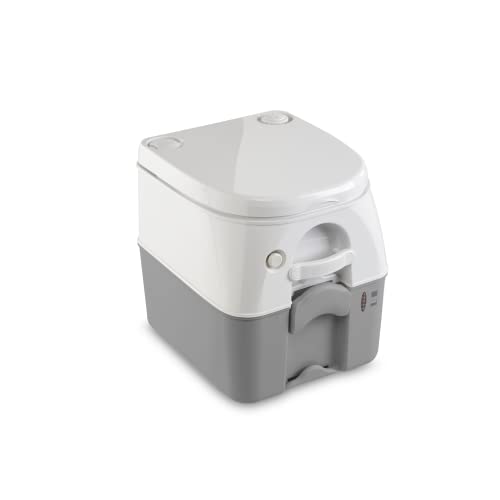
Dometic 976 Portable Toilet, 5.0 Gallon — Best High-Capacity Portable
The Dometic 976 answers the portable category’s main complaint — capacity — with a 5.0-gallon holding format stated in its verified listing. On a houseboat that hosts weekends with friends or travels between sparse pump-out points, those extra gallons are the difference between a system and an anxiety. Dometic’s sanitation heritage spans marine and RV, and the design language shows it: a unit meant to be carried, emptied and returned to service without fuss.
Strengths
- 5.0-gallon capacity extends intervals between emptyings
- Major sanitation brand with broad parts and chemical support
- Portable format needs no boat modification whatsoever
Trade-offs
- A full 5-gallon cassette is a genuinely heavy carry
- Larger footprint needs a dedicated spot in a small head or cabin
- Still a portable: no match for a plumbed head on a full-time liveaboard
| Specification | Detail (from verified listing) |
|---|---|
| Capacity | 5.0 gallon, per listing |
| Type | Portable toilet |
| Brand line | Dometic sanitation, per listing |
Capacity planning is the portable owner’s core skill: estimate users and days honestly, then choose the cassette size that keeps emptying a scheduled task rather than an emergency. This Dometic suits the upper end of portable use — a couple’s week aboard, a family weekend — where the smaller units would demand mid-trip attention. Pair it with a simple log or rhythm and the system disappears into the background of the trip, which is all anyone asks of a boat toilet.
Carry weight deserves respect rather than bravado. Five gallons of water alone is a substantial lift, plus the unit itself, often up a companionway and along a dock. If the person who will actually empty it finds that prospect daunting, choose the smaller Porta Potti and empty more often; the best portable is the one whose maintenance actually happens cheerfully.
Best for: Weekending houseboats and longer trips between dump points / Not suited for: Anyone who would struggle to carry a full large cassette up a companionway
Check on Amazon — check price on Amazon before ordering, and confirm rough-in, bowl shape and seat inclusion on the listing.
Comparison Table
| Pick | Badge | Key spec | Best for |
|---|---|---|---|
| Jabsco Twist ‘n’ Lock Manual Marine Toilet, Compact Bowl | Best Overall Marine Head | Manual marine head, hand pump | Owner-operated houseboats wanting a simple, power-free, proven head |
| Jabsco Electric Marine Toilet, Regular Bowl, 12V | Best Electric Upgrade | Electric marine head | Liveaboard houseboats with robust 12V systems wanting home-like operation |
| SEAFLO 12V Electric Marine Toilet, Compact | Best Compact Electric Head | Electric marine toilet, compact | Small houseboat heads wanting electric macerating flushing in a tight footprint |
| SEAFLO Quiet Flush Electric Marine Toilet, Fresh Water | Best Quiet Electric Head | Fresh water, solenoid valve, per listing | Docked liveaboards and freshwater-plumbed houseboats wanting the quietest, sweetest head |
| Thetford Porta Potti 365 Portable Toilet | Best Portable for Small Houseboats | Portable cassette toilet | Small houseboats, guest heads and boats without a plumbed holding system |
| Dometic 976 Portable Toilet, 5.0 Gallon | Best High-Capacity Portable | 5.0 gallon, per listing | Weekending houseboats and longer trips between dump points |
How Marine Sanitation Actually Works on a Houseboat
A houseboat head is a system, not a fixture: toilet, discharge plumbing, holding tank, vent, and pump-out or treatment route. In most regulated waters, waste goes to a holding tank and out through a deck pump-out fitting at a marina; direct discharge of untreated waste is prohibited in no-discharge zones and near shore generally. Any toilet decision that ignores the tank and vent is half a decision — an undersized or unvented tank will defeat the best head ever bolted down.
Venting deserves its own sentence, because most holding-tank odour is a venting failure: a properly vented tank supports the aerobic bacteria that keep contents comparatively neutral, while a starved tank turns anaerobic and announces itself through every fitting. When you upgrade a head, inspect the vent line and tank size in the same project; the toilet gets the credit or blame, but the system decides.
Manual, Electric, Portable or Composting: Choosing Your Pattern
Manual heads suit owner-operated boats that value independence from the battery bank. Electric heads suit boats with generous power and guests who need familiarity. Portables suit small boats, occasional use and second heads. Composting heads — covered in prose in this guide because confirmed Amazon listings to our standard could not be verified for them — suit boats whose owners accept a different maintenance rhythm in exchange for no holding tank and no pump-out dependence; they are sold mainly through marine dealers and the makers directly, which is the channel to use when researching them.
Match the pattern to the boat’s real calendar, not its imagined one. A boat used six weekends a year by its owners does not need the system a full-time liveaboard needs, and overbuilding sanitation is money and complexity spent ignoring the boat. Conversely, a liveaboard that skimps on the head will think about that decision every single day. Sanitation is the system where honesty about use pays the highest daily dividend.
Power, Water and Tank Budgets: The Three Numbers That Decide
Before ordering any electric head, add its draw to the boat’s power budget honestly: flushes per person per day, multiplied by the crew, at anchor with no engine or shore charging. Before choosing a fresh-water rinse head, run the same arithmetic on the water tanks. Before choosing any head, confirm the holding tank’s capacity gives a sane interval between pump-outs on your normal cruising pattern. These three multiplications, done on paper, predict ownership satisfaction better than any feature list.
If the numbers fail, change the system, not the arithmetic: a manual head fixes the power line, a raw-water rinse fixes the water line, a portable fixes the tank line for small boats. The picks in this guide were chosen to give a workable answer at each of those budget points, so a failed number is a routing decision, not a dead end.
Buying Channels for Marine Toilets, Honestly Explained
Marine sanitation is one of the categories where the specialist channel remains genuinely important. Complete treatment systems, composting heads, holding tanks and matched hose and vent components are stocked and — more importantly — understood by marine chandlers and the manufacturers’ dealer networks, who can confirm compatibility with your boat’s layout and local discharge rules. Amazon serves the verified heads and portables in this guide well; a full system refit deserves a chandler conversation as part of the purchase.
That split is not a flaw in either channel. Use each for what it does best: verified, standardised fixtures online; system design, tanks and local compliance guidance from the marine trade. A houseboat head installed as a system, with both channels used properly, is the one that never becomes a story told in marinas.
How to Install and Commission a Houseboat Head
Marine head installation rewards slowness: every hose run, clamp and vent decision is easier on the hard than underway. Work to the manufacturer’s instructions for your specific model; the sequence below is the general shape of a competent install.
- Confirm the discharge plan first: holding tank size, vent route and pump-out fitting, before the toilet is unboxed.
- Mount the head on a solid, level platform with service access preserved on the pump side.
- Run sanitation-grade hose in smooth runs, avoiding low sags where waste can sit, and double-clamp every connection below the waterline.
- Fit a vented loop where the layout places discharge plumbing below the waterline, per the maker’s instructions.
- Wire electric models to a properly fused circuit sized for the run, with connections sealed against the damp environment.
- Secure portable units against motion with a mounting kit or a dedicated, restrained stowage position.
- Commission with clean water first: flush repeatedly, inspect every clamp and joint dry, then check again after the first day afloat.
- Brief every regular crew member on what must never go into a marine head — wipes and sanitary products belong in a bin, always.
Keep the maker’s service kit aboard from day one, along with the one-page operating note for guests. Most marine head misery traces to two causes — foreign objects flushed by guests, and seals left to perish years past their service interval — and both are prevented by the briefing and the kit rather than by any purchase.
Common Buying Mistakes
- Fitting a household toilet on a boat. Domestic fixtures assume building plumbing, water and stability a boat does not offer.
- Ignoring the holding tank and vent. The head gets blamed for system failures; size and vent the tank properly.
- Skipping the power and water budgets. Electric and fresh-water heads must fit the boat’s actual resources at anchor.
- Using non-sanitation hose. Cheap hose permeates odour within a season; sanitation-grade hose is the only correct material.
- Letting guests guess. A one-minute briefing prevents the clogs that ruin weekends.
- Deferring seal service. Marine heads fade gradually; an annual kit keeps them sweet and strong.
Final Recommendation
For most owner-operated houseboats, the manual Jabsco remains the recommendation to beat: it asks nothing of the batteries, tolerates neglect better than any electric system, and will outlast several sets of its own seals. Boats with real power budgets should take the electric route — the Jabsco for a regular bowl, the compact SEAFLO for tight compartments, the fresh-water SEAFLO for docked liveaboard manners — and small or occasional-use boats should take a portable seriously rather than apologetically.
Whatever pattern you choose, commission it as a system: tank, vent, hoses and briefing included. A houseboat head done properly is invisible, and invisible is the highest praise sanitation ever earns.
Best Boat Toilets Best Camper Toilets Best House Toilets Best Household Toilets Best Inexpensive Toilets
Holding Tanks, Pump-Outs and the Etiquette of the Marina
The toilet is the visible tenth of a houseboat’s sanitation system; the holding tank is the rest, and its management is a rhythm every liveaboard learns. Pump-out stations at marinas are the fixed points of that rhythm — know the ones on your home waters, their hours and their fittings, and plan passages so the tank’s state is a decision rather than a surprise. A tank gauge that works is worth its modest cost many times over, because the alternative measurement method is an incident.
Venting, already flagged in this guide as the odour decider, deserves its practical detail: the vent line should run as straight and as wide as the installation allows, exit where moving air will carry it away from openings, and be checked each season for the insect nests and salt or scale restrictions that quietly strangle it. Most chronic tank odour on otherwise sound boats is a vent biography, and most of it is curable in an afternoon with the hose in hand. Chemicals promise to mask what venting prevents; experienced owners fix the vent and retire the chemicals to a supporting role.
Etiquette is the system’s social layer. Pump out where and when the marina intends, rinse the deck fitting, leave the station cleaner than the last user, and never let a sanitation task become the neighbouring boat’s problem. Houseboating is a close-quarters culture, and a boat’s reputation in a marina is built substantially from how invisibly its least glamorous system operates. The heads and habits in this guide are chosen to make that invisibility achievable.
Winterising and Lay-Up: Sanitation in the Off-Season
A plumbed marine head asks specific things of a boat being laid up. Water must leave the places freezing can reach: pump and bowl drained per the maker’s instructions, lines cleared, and the system left in the state its manual prescribes rather than the state optimism suggests. Seals that dry out completely over a long lay-up may need attention at recommissioning, which is normal and budgeted — a spring service kit and an hour, planned, rather than a first-weekend failure, unplanned.
Portable units write the simplest winter story in this guide, which is part of their genuine appeal for seasonal boats: emptied, cleaned, dried and stored ashore, they remove sanitation from the lay-up checklist entirely. Owners of trailerable and seasonally-used houseboats weight this more heavily with every passing autumn, and rightly — a system whose winterisation is carrying it into the garage has a real advantage over one whose winterisation is a procedure.
Recommissioning reverses the logic: fresh water through the system first, every clamp and joint inspected dry, the vent confirmed clear, and the service items — joker valve, seals, pump condition — assessed before the first cruise rather than during it. Boats reward owners who treat the head as machinery with a calendar, and the calendar has exactly two entries a year. Keep them, and the system this guide helped you choose will stay as invisible in year five as it was in week one.
Choosing for Your Waters: Discharge Rules and Local Reality
Marine sanitation is regulated water by water, and the wise houseboat buyer learns their home waters’ rules before choosing hardware, not after. No-discharge zones, distance-from-shore rules and the availability of pump-out facilities vary between lakes, rivers and coastal regions, and they shape the practical system: a boat cruising between well-served marinas lives differently from one anchored for weeks in a protected lake. The toilet choice sits downstream of that geography — holding capacity, treatment options and portable practicality all re-rank themselves once the local map is honest.
Treatment systems, which process waste for lawful discharge where rules permit them, belong to the dealer-specified end of the market for the same reason incinerating and composting systems do: their legality and correct installation are local facts, not product features. This guide has deliberately kept them in the prose-and-dealer category rather than attaching links to partial components, because a treatment system bought as a parcel, without the local rule check, is an expensive ornament. The chandler conversation is not a sales ritual; in regulated waters it is the compliance step.
Carry the same localism into chemicals and consumables. Products acceptable at one marina’s pump-out may be unwelcome at another’s, and formaldehyde-based treatments in particular have fallen out of favour and out of permission in many places. The boat that standardises on widely accepted, marina-friendly consumables never has the dockside conversation nobody wants. Sanitation is the system where being unremarkable is the entire goal — in the marina’s eyes as much as the crew’s.
Closing Perspective
Crew training is the final system aboard, and it is mostly about the bin. Every marine head in this guide, manual, electric or macerating, shares one rule: nothing enters that did not pass through a person, plus the toilet tissue the system is designed for. A small lined bin beside the head, emptied without ceremony, is the mark of a well-run boat, and a one-line note in the head compartment — kind, brief, unembarrassed — does more for the plumbing than any upgrade. Charter skippers learned this generations ago; private owners sometimes learn it via a Saturday spent with the pump disassembled, a curriculum nobody recommends.
There is a broader seamanship point underneath the plumbing: sanitation is the system where a boat’s self-sufficiency is most honestly tested, because it cannot be deferred, improvised or hidden when guests are aboard. Owners who choose their head by their real pattern of use, install it as a system with tank and vent, and keep its small calendar of services, discover that the subject simply leaves their mental inventory of the boat. That disappearance is the true product this category sells, and every pick and paragraph in this guide has been aimed at it.
One More Consideration
Spare parts aboard deserve the same realism as the head choice itself. A boat’s sanitation spares should match its cruising pattern: the full service kit and a spare joker valve for the manual head, the maker’s recommended electrical spares for the powered heads, seals and chemicals for the portables, all stored dry and findable in the dark. The test is practical — could the person aboard least fond of plumbing restore the head to service at anchor with what is in the locker? If not, the locker, not the toilet, is the unfinished purchase, and finishing it costs less than one marina call-out.
Consider, finally, the crew who did not choose the boat. Partners, children and guests experience a houseboat substantially through its head: its ease, its smell, its reliability at the moment of need. More boating enthusiasm has been quietly extinguished by one bad sanitation weekend than by weather, and more second invitations accepted because everything simply worked. The system chosen from this guide, installed as a system and kept on its small calendar, is how the subject never becomes the story of the trip — which is the whole art of the thing.
Putting It Into Practice
A final practical sequence for the buyer ready to act: start from the tank and the vent, not the toilet, and let their condition set the project’s true scope. Choose the head pattern by the boat’s calendar and its power and water ledgers, confirm voltage, bowl and discharge details against the listing and the boat in the same sitting, and order the service kit in the same transaction as the head. Commission on the hard or at the dock with clean water, brief the crew before the first cruise, and enter the two seasonal services in whatever calendar the boat’s other machinery already lives in. A head specified, installed and kept that way becomes part of the boat’s invisible competence — the quality guests feel without ever naming, and owners value more with every season.
Weights and measures aboard deserve the last practical word, because a head compartment forgives nothing: measure the mounting footprint, the bowl’s swing and stance room, the hose runs’ bend radii and the service side’s access with the boat in its working trim, stores aboard and crew moving as they actually move. A head that fits the brochure’s empty boat but crowds the lived-in one will be cursed daily in the smallest room aboard. The marine picks in this guide span the realistic sizes for houseboat heads; the tape measure, applied honestly in the real compartment, is what turns that span into the right single choice for your hull.
Keep, as the system’s final artefact, a one-page sanitation card in the boat’s documents: head model and its service-kit part names, tank capacity and its vent route, the pump-out fittings the home marina uses, and the dates of the last seal service and vent check. Boats change hands and crews rotate, and the card is what turns one owner’s hard-won system knowledge into the boat’s permanent property. It takes fifteen minutes to write at commissioning, it will be read with gratitude at every recommissioning and by every future owner, and it is the surest sign that the sanitation system was understood as what it is — part of the vessel, documented like the engine and the rig, and kept to the same standard.
And if the boat is bought rather than built — as most houseboats are — let the surveyor’s eye linger on the sanitation system a moment longer than feels polite. A head compartment that smells faintly on a still viewing day is reporting a vent, a hose or a tank that the purchase price should hear about, and a system documented with the card described above is reporting an owner who maintained everything else the same way. Boats confess through their smallest room; the buyer who listens there rarely regrets what the rest of the vessel turns out to be.
Frequently Asked Questions
Can I install a regular household toilet on a houseboat?
No — household toilets assume a building’s water supply, a sewer connection and a stable floor. Marine heads are designed for holding tanks, motion, limited water and boat electrical systems. Fitting a domestic toilet creates plumbing, odour and compliance problems that no adapter solves.
How often does a houseboat holding tank need pumping out?
It depends on tank size, crew size and toilet type — manual and water-saving heads extend intervals considerably. Estimate your crew’s daily use honestly and plan pump-outs as a scheduled rhythm on your cruising pattern rather than waiting for the gauge to insist.
Are composting toilets good on houseboats?
Many liveaboards swear by them: no holding tank, no pump-outs, minimal water and power. They require a different maintenance rhythm and are sold mainly through marine dealers and makers directly; we could not verify listings for them to this guide’s standard, so they are discussed in prose rather than linked.
Why does my boat head smell?
Usually the system, not the toilet: raw-water rinse organisms, permeated old hose, or an undersized or blocked holding-tank vent are the classic causes. Fresh-water rinse, sanitation hose replacement and proper venting cure most cases.
What must never be flushed in a marine head?
Wipes of any kind — including those labelled flushable — sanitary products, paper towels and food waste. Marine pumps and macerators handle toilet tissue designed for the purpose and nothing else; everything else belongs in a lined bin.
Manual or electric head for a liveaboard?
If the boat’s power budget is generous and guests are frequent, electric convenience wins daily. If the boat lives at anchor on a modest bank, manual reliability wins seasonally. Run the power arithmetic in this guide with your real crew numbers and let it decide.


