Disclosure: airfryerkitchensupply.com is reader-supported. When you buy through links on our site, we may earn an affiliate commission at no extra cost to you.
Where to buy
Every product below is sold on Amazon, and every model was matched against Amazon’s own catalog data before it earned a link. Portable toilet listings churn by season and seller, so use these links to check price on Amazon on the exact model named in each review.
- Thetford Porta Potti 365 Portable Toilet (Best Overall Flush Portable) — check price on Amazon
- YITAHOME 2.6 Gallon Portable Toilet (Best Compact Flush Portable) — check price on Amazon
- TRIPTIPS Retractable Portable Toilet (Best Packable for Actual Hiking Use) — check price on Amazon
- Reliance Products Luggable Loo Portable Toilet (Best Bucket System) — check price on Amazon
- Folding Camping Toilet with Carry Bag, Waste Bags & Poo Gel (Best Complete Folding Kit) — check price on Amazon
- Dometic 972 Portable Toilet, 2.6 Gallon (Best Small Flush Portable from a Major Brand) — check price on Amazon
Let us define the best hiking toilets honestly at the start, because the phrase misleads more shoppers than any other in this cluster. No one carries a flush toilet up a mountain in a backpack, and any guide implying otherwise is selling fantasy. What ‘hiking toilets’ really means — and what this guide covers — is the family of portable toilets used where hiking actually meets sanitation: trailhead and basecamp setups, car-camping sites at the end of a hike, dispersed camping near trails, and lightweight bag-based systems that a hiker can genuinely carry for group or emergency use. Every pick below is a real, orderable product verified through Amazon’s catalog data, chosen for one of those real jobs.
The category divides into three honest technologies. Flush portables — sealed two-tank units from Thetford, Dometic and others — rinse the bowl with water from a fresh tank into a detachable waste tank; they are the most civilized option and the heaviest, suited to car camps and basecamps. Bucket systems are a molded seat and lid on a sturdy bucket used with liner bags; they are simple, cheap and nearly indestructible. Folding and retractable designs collapse flat and work with waste bags and gelling powder; they are the only branch a hiker can actually pack. Choosing your branch is the real decision in this guide — the model within it is the easy part.
Weight and waste handling are the two currencies here. A flush portable’s waste tank, full, is a serious carry to a dump point; a bag system’s waste packs out in sealed bags, which is the required practice in many fragile areas anyway. We state each pick’s working format plainly, flag who should carry it and how far, and refuse to pretend a 5-gallon flush unit is ‘backpackable’ because its listing used the word hiking.
As everywhere on this site, we print no prices and no star ratings; each review positions its pick in a tier in words and links you to check price on Amazon today. What follows is product guidance only — capacities, mechanisms, weights of effort — not a travel guide, because the product is the assignment.
One more framing note: this guide deliberately excludes fixed and semi-fixed alternatives — RV toilets that plumb into a vehicle, and cabin composting units — not because they are lesser products but because they answer a different question. If your ‘hiking’ base is a van build or a cabin, those categories deserve their own research; our camper toilet coverage is the bridge from the portables here to the installed systems there.
In this guide
Quick Picks
Six portable toilets across the three real technologies — flush, bucket and folding — matched to how each is actually carried and used.
- Thetford Porta Potti 365 Portable Toilet — Best Overall Flush Portable. The reference flush portable: Thetford’s sealed two-tank design with a piston flush, sized for car camping, vans and basecamp use. — Check on Amazon
- YITAHOME 2.6 Gallon Portable Toilet — Best Compact Flush Portable. A smaller flush portable: 2.6-gallon format with a press flush pump and an anti-leak seal ring, sized for shorter trips and smaller vehicles. — Check on Amazon
- TRIPTIPS Retractable Portable Toilet — Best Packable for Actual Hiking Use. The genuinely carryable branch: a retractable, foldable toilet with adjustable height that packs flat and works with waste bags — for adults and kids, camp or car. — Check on Amazon
- Reliance Products Luggable Loo Portable Toilet — Best Bucket System. The classic bucket toilet: a 5-gallon bucket with a snap-on seat and cover and a metal carry handle — the simplest, toughest system in the guide. — Check on Amazon
- Folding Camping Toilet with Carry Bag, Waste Bags & Poo Gel — Best Complete Folding Kit. A folding toilet sold as a working kit: carry bag, 15 waste bags and 15 poo gel packs included — ready for road trips and trail use out of the box. — Check on Amazon
- Dometic 972 Portable Toilet, 2.6 Gallon — Best Small Flush Portable from a Major Brand. Dometic’s compact flush portable: 2.6 gallons in grey, from one of the biggest names in mobile sanitation — the small-tank pick with a major-brand support story. — Check on Amazon
How These Picks Were Chosen
We verified every candidate against Amazon’s catalog, requiring the listing title to confirm the product type, brand and format we describe — a flush portable’s tank arrangement, a bucket system’s capacity, a folding toilet’s carry kit. Listings that blurred product types, and books or guides about toilets rather than toilets themselves, were excluded; this category’s search results are full of both, plus accessories masquerading as units.
Selection then balanced the three technologies deliberately: two flush portables (a full-featured standard and a compact), two bag-based carryables (a folding frame and a kit with bags and gelling powder included), and two bucket systems (the established name and its peers’ format) — because a hiking-toilet buyer is really choosing a waste system first and a product second. Within each branch we favored brands with a track record in the RV and camping sanitation market, where sealing and durability claims get tested by real use.
We weighed four practical criteria across all picks: how the waste is contained and emptied, since that is the ownership experience; stability and seat realism, since a wobbling toilet at a dark campsite is a genuine misery; packed size and carry effort, stated honestly per branch; and consumables — whether the system needs bags, gelling powder or chemicals, and whether those are standard, replaceable supplies rather than proprietary lock-ins.
What we excluded: fixed RV toilets that require vehicle plumbing, composting toilets sized for cabins and vans (a different purchase, covered in our camper coverage), and novelty miniatures that cannot support an adult. The six below are the portable toilets we would actually pack, carry or set up for the jobs described.
The 6 Best Hiking Toilets (Portable and Camping Toilets)

Thetford Porta Potti 365 Portable Toilet — Best Overall Flush Portable
The Porta Potti line is the standard against which flush portables are judged, and the 365 is its mainstream camping form: a two-piece unit whose top half carries fresh water and a flushing mechanism, and whose detachable bottom tank seals waste away until you carry it to a dump point or household toilet. Thetford lists it for RV, marine, camping, van, truck and healthcare use — a breadth that tells you this is basecamp and vehicle equipment, not a backpack item. For car campers and trailhead basecamps, it is the most civilized portable sanitation most people will ever need.
Strengths
- Sealed, detachable waste tank keeps odor contained between empties
- Real flushing action — the closest experience to a home toilet in this guide
- Thetford’s long market presence means seals and parts have a support story
Trade-offs
- Heaviest branch of the category — this is car-and-basecamp gear, full stop
- Waste tank must be carried to a proper dump point or toilet for emptying
- Needs flush water carried or sourced at camp
| Type | Flush portable, two-tank (per Amazon listing title use cases) |
| Use cases (listing) | RV, marine, camping, vans, trucks, healthcare |
| Color | White |
| Model | Porta Potti 365 (92820) |
The two-tank architecture is the whole product. Fresh water in the top tank rinses the bowl with each flush; the sealed bottom tank receives waste and locks it behind a sliding seal, so the unit can sit in a tent vestibule, van or camp corner without announcing itself. When the tank fills, it detaches and carries — handle-first, spout-equipped — to wherever emptying is allowed. That sealed, civilized loop is what you are paying for over every bag system below.
The honest cost is logistics: you are hauling water in and waste out, and a full waste tank is a heavy, deliberate carry. Plan the dump point when you plan the campsite. For a family basecamp, a hunting camp or a van without plumbing, that planning is trivially worth it. For anything involving a backpack, it is disqualifying — read the folding picks instead. Judged in its own branch, the 365 is the default recommendation, and its decades-long production run is the market agreeing.
A note for family basecamps: the 365’s seat height and stability make it the most approachable unit here for children and older campers, which is not a small thing — the best camp toilet is the one every member of the party will actually use, at night, without negotiation.
Best for: car camping, basecamps, vans and campsites where comfort leads / Not suited for: backpackers or anyone who must carry their toilet any distance
Check on Amazon — check the current price on Amazon before you decide, because listings and finishes change.
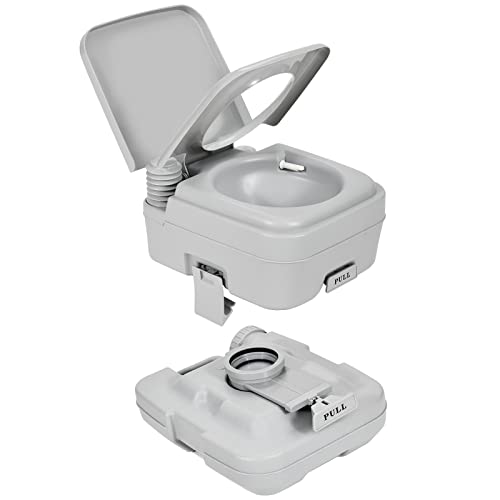
YITAHOME 2.6 Gallon Portable Toilet — Best Compact Flush Portable
Not every camp needs the biggest tank. YITAHOME’s 2.6-gallon portable shrinks the flush format for shorter trips, smaller vehicles and solo or couple use: a press flush pump rinses the bowl, and an anti-leak seal ring guards the joint between sections — the listing names travel, boating, hiking trips and RV use, which in practice means trailhead parking, boat cabins and one-to-three-night camps where a full-size tank is overkill and overweight.
Strengths
- Compact tank size suits short trips and small vehicles
- Press flush pump is simple and needs no power
- Anti-leak seal ring addresses the format’s classic weak point
Trade-offs
- 2.6-gallon waste capacity fills quickly with family use
- Smaller brand than Thetford or Dometic — thinner support story
- Still a flush unit: too heavy to be a true carried hiking toilet
| Type | Flush portable |
| Capacity | 2.6 gallon (per Amazon listing title) |
| Flush | Press flush pump |
| Sealing | Anti-leak seal ring |
Tank size is a trade, not a downgrade. A smaller waste tank empties more often but weighs far less when full — and since someone carries that tank to the dump point, a compact unit can be the more humane choice for a solo camper or an older user. The press pump keeps the mechanism purely manual, with nothing electrical to fail at a wet campsite.
The seal ring deserves its mention in the listing because leaks at the section joint are how cheap flush portables fail their owners; a named anti-leak feature is at least an acknowledgment of the engineering that matters. Set expectations at the branch level, though: this is the compact end of vehicle-and-basecamp equipment. It will ride in a car trunk happily and a backpack never. For short trips where a flush still matters, it is the right-sized pick.
Solo travelers in small cars will appreciate how the YITAHOME’s compact body shares trunk space: it leaves room for the rest of camp in vehicles where a full-size portable becomes the cargo decision. Small-format gear earns its place by what it lets you also bring.
Best for: solo and couple campers, boaters and short trips in small vehicles / Not suited for: families on long camps, or backpackers
Check on Amazon — check the current price on Amazon before you decide, because listings and finishes change.

TRIPTIPS Retractable Portable Toilet — Best Packable for Actual Hiking Use
This is the pick for the reader who meant ‘hiking’ literally. The TRIPTIPS design retracts and folds flat, adjusts in height, and works as a bag-based toilet — you line it, use it, seal the bag and pack the waste out, which is both the lightest system in this guide and the required practice in many sensitive areas. It suits group hikes where a designated system is carried, emergency kits, car kits for long drives with kids, and any camp where Leave No Trace rules govern.
Strengths
- Folds flat — the only format here that truly packs
- Adjustable height serves both adults and kids
- Bag-based waste handling matches pack-out requirements in fragile areas
Trade-offs
- Bag systems are a different experience from flushing — set expectations
- Consumable bags are an ongoing supply to carry and restock
- Frame stability is good for its class but no match for a rigid flush unit
| Type | Folding/retractable, bag-based |
| Height | Adjustable (per Amazon listing title) |
| Users | Adults and kids |
| Format | Foldable for camping/car use |
The engineering problem this product solves is packed volume. A rigid toilet — even a small one — is mostly air; a retractable frame collapses that air away, so the toilet can ride in a group gear pile, a car trunk corner or a camp kit without dominating it. Adjustable height matters more than it sounds: a toilet sized only for adults fails kids, and one sized only for kids fails everyone else, on exactly the trips where both are present.
Use it correctly and it is dignified: line with a proper waste bag, add gelling powder if your bags do not include it, seal, and pack out to a proper disposal point — never bury bagged waste where rules require pack-out, and never leave bags behind. Within the honest definition of a hiking toilet — the one a person can carry — this is the category’s most sensible design, and our pick for it.
Group leaders should note the TRIPTIPS’ spare-bag math: a shared system for a group consumes bags at a group rate. Buy consumables by the headcount and the day count, and appoint the kit’s carrier explicitly — shared gear without an owner is gear left behind.
Best for: group hikes, pack-out areas, car emergency kits and family camps / Not suited for: campers who want a flushing experience
Check on Amazon — check the current price on Amazon before you decide, because listings and finishes change.

Reliance Products Luggable Loo Portable Toilet — Best Bucket System
The Luggable Loo is the bucket toilet in its canonical form: a sturdy 5-gallon bucket, a snap-on lid fitted with a proper seat and cover, and a metal handle for transport, from Reliance Products — a brand that has made camp sanitation gear for decades. Used with liner bags, it is the system of choice for basecamps, hunting camps, job sites, emergency preparedness and anywhere simplicity and indestructibility outrank flushing. If a flush unit is a machine, this is a tool.
Strengths
- Nothing to break: no pumps, seals or mechanisms to fail in the field
- 5-gallon format is stable to sit on and doubles as gear storage in transit
- Metal handle and snap-on seat are the details that separate it from a plain bucket
Trade-offs
- Bag-based — no flush, and waste handling is entirely on you
- Bulky even empty; it is vehicle or basecamp gear, not pack gear
- You supply the liner bags and any gelling or cover material
| Type | Bucket style, bag-based |
| Capacity | 5 gallon (per Amazon listing title) |
| Seat | Snap-on lid with seat and cover |
| Carry | Metal handle |
The bucket system’s virtues compound over years: it cannot clog, its pump cannot fail because there is none, and when the trip ends it hoses out and stores — often carrying the camp’s small gear inside it on the next trip out. Reliance’s version earns its place over a hardware-store bucket purely on the seat: a snap-on, contoured, covered seat transforms the experience from improvisation to equipment, and the cover contains the system between uses.
Set it up like you mean it: line it before first use, keep spare bags and gelling powder in the bucket itself, and site it on level ground with the same privacy logic as any camp toilet. For emergency kits at home — the power-outage, plumbing-failure scenario — this is also the guide’s most sensible purchase: cheap, shelf-stable, and ready. In the bucket branch, this is the name to buy.
The Luggable Loo has one more second life worth knowing: as a camp storage bucket between trips and a seat in its own right at camp with the lid closed. Gear that works three jobs is gear that stays in the kit for decades.
Best for: basecamps, hunting camps, emergency kits and simplicity-first campers / Not suited for: anyone expecting a flush, or backpackers
Check on Amazon — check the current price on Amazon before you decide, because listings and finishes change.

Folding Camping Toilet with Carry Bag, Waste Bags & Poo Gel — Best Complete Folding Kit
Where the TRIPTIPS pick sells the frame, this folding toilet sells the system: a folding portable toilet for adults with a carry bag, and — the decisive detail — 15 waste bags and 15 poo gel packs in the box, so it works on day one without a second order. The listing names RV use, road trips and hiking among its cases, which maps to car-based travel and carried group kits. It suits buyers who want the packable branch with its consumables solved in advance.
Strengths
- Bags and gelling powder included — a complete kit, not a frame plus homework
- Carry bag keeps the folded unit clean and contained in a vehicle or pack
- Gelled waste is easier and less unpleasant to pack out and dispose of
Trade-offs
- Consumables run out — plan your resupply of bags and gel
- Unbranded listing; inspect the unit on arrival and test the fold at home
- Bag-based experience, like all folding systems
| Type | Folding, bag-based |
| Included | Carry bag, 15 waste bags, 15 poo gel (per Amazon listing title) |
| Users | Adults |
| Use cases (listing) | RV, road trips, hiking |
Poo gel is the unglamorous technology that makes bag systems civilized: it solidifies liquid waste, suppresses odor and turns a bag into a sealed, packable unit that can go out with ordinary refuse where local rules allow. A kit that includes matched bags and gel removes the beginner’s two failure modes — the wrong bag size and the forgotten gel — and that completeness is this pick’s entire, legitimate argument.
The discipline items: practice the fold at home, because a new frame at a dark campsite is nobody’s friend; count your consumables against your group size and trip length, then add margin; and confirm your destination’s rules, since gelled bag waste is pack-out waste in most jurisdictions that regulate it. As a ready-to-go folding kit for cars, camps and group hikes, this is the low-friction way into the branch.
For the folding kit, consider labeling the carry bag with its contents count — bags and gel remaining — updated after each trip. Consumable surprise is this branch’s only real failure mode, and it is entirely clerical.
Best for: first-time folding-toilet buyers and road-trip kits that must work immediately / Not suited for: long expeditions without a consumables resupply plan
Check on Amazon — check the current price on Amazon before you decide, because listings and finishes change.

Dometic 972 Portable Toilet, 2.6 Gallon — Best Small Flush Portable from a Major Brand
Dometic is a giant in mobile living — RVs, boats, camps — and the 972 is its compact portable: a 2.6-gallon flush unit in grey. It competes directly with the YITAHOME compact above, and the choice between them is a philosophy: Dometic brings the major brand’s distribution, documentation and parts ecosystem at the same compact format. It suits boaters, van users and campers who buy the support story as much as the product.
Strengths
- Major-brand backing: documentation, parts and retail presence
- Compact 2.6-gallon format suits boats, vans and short camps
- Grey finish hides camp grime better than white
Trade-offs
- Compact capacity means frequent emptying under family use
- Listing title is minimal — confirm the exact configuration on the page
- Flush-format weight, like all its branch: vehicle gear, not pack gear
| Type | Flush portable |
| Capacity | 2.6 gallon (per Amazon listing title) |
| Finish | Grey |
| Brand line | Dometic 970-series portable toilets |
In sanitation gear, the brand behind the seals matters disproportionately, because seals and valves are what age. Dometic’s scale means replacement parts and documentation exist in a way smaller labels cannot promise, and for a product whose failure mode is a leak, that ecosystem is a functional feature. The 972’s compact tank follows the same logic as our other small pick: less capacity, less full-tank weight, more frequent but lighter carries.
Choose between this and the YITAHOME by your priorities: features and price position on one side, brand infrastructure on the other. Choose either knowing the branch’s truth — these are superb small flush toilets for vehicles and basecamps, and neither belongs in a backpack. In the compact flush branch, Dometic is the conservative, defensible buy.
Dometic’s grey finish has a practical camp virtue beyond taste: it shows dust and road grime less than white between cleanings, which matters for gear that lives in garages and truck beds. Small honest advantages like that are what brand experience accumulates into.
Best for: boaters, van users and brand-first buyers wanting a compact flush unit / Not suited for: families needing big-tank capacity, or backpackers
Check on Amazon — check the current price on Amazon before you decide, because listings and finishes change.
Comparison Table
Read the table by technology first: flush portables (Thetford, YITAHOME, Dometic) trade weight for civilization; bag systems (TRIPTIPS, the folding kit) trade the flush for packability; the bucket (Reliance) trades everything for indestructibility.
| Pick | Badge | Key spec | Best for |
|---|---|---|---|
| Thetford Porta Potti 365 Portable Toilet | Best Overall Flush Portable | Flush portable, sealed detachable waste tank, Thetford Porta Potti line | car camping, basecamps, vans and campsites where comfort leads |
| YITAHOME 2.6 Gallon Portable Toilet | Best Compact Flush Portable | 2.6 gal flush portable, press pump, anti-leak seal | solo and couple campers, boaters and short trips in small vehicles |
| TRIPTIPS Retractable Portable Toilet | Best Packable for Actual Hiking Use | Retractable folding frame, adjustable height, bag-based | group hikes, pack-out areas, car emergency kits and family camps |
| Reliance Products Luggable Loo Portable Toilet | Best Bucket System | 5 gal bucket, snap-on seat and cover, metal handle | basecamps, hunting camps, emergency kits and simplicity-first campers |
| Folding Camping Toilet with Carry Bag, Waste Bags & Poo Gel | Best Complete Folding Kit | Folding toilet + carry bag + 15 bags + 15 gel packs | first-time folding-toilet buyers and road-trip kits that must work immediately |
| Dometic 972 Portable Toilet, 2.6 Gallon | Best Small Flush Portable from a Major Brand | 2.6 gal flush portable, grey, Dometic sanitation line | boaters, van users and brand-first buyers wanting a compact flush unit |
How to Choose the Best Hiking Toilets: Pick Your Technology First
Every mistake in this category comes from choosing a product before choosing a system. Ask instead: how will waste leave the site? If you camp beside a vehicle near facilities, a flush portable’s sealed tank, emptied at a dump point or home toilet, is the most comfortable answer. If rules or terrain require pack-out — as many trail systems and fragile areas do — a bag system with gelling powder is not the budget option, it is the compliant one. If the toilet lives at a basecamp or in an emergency closet, the bucket’s simplicity wins years-long arguments.
Then size honestly. Waste capacity is really carry weight in disguise: a big tank serves a family between empties but punishes the person who carries it full. Solo and couple campers consistently overbuy tank size; families consistently underbuy it. Match the tank to the group and the distance to the dump point, not to the best-case brochure scenario.
- Decide waste logistics first: dump-point, pack-out or basecamp
- Check your destination’s rules — many areas mandate pack-out systems
- Tank size = full-tank carry weight; size for the carrier, not the brochure
- Folding/bag systems are the only genuinely carryable branch
- Stock consumables (bags, gel, chemicals) as part of the purchase, not an afterthought
Flush Portables, Explained Without the Brochure
A flush portable is two tanks and a seal. The top section holds fresh water and the bowl; a manual pump or press mechanism rinses waste through a sliding seal into the detachable bottom tank, where it stays sealed until emptying. The experience is genuinely close to a home toilet, and the ownership is genuinely like owning a small septic errand: water in, tank out, rinse, repeat. Chemical additives — sold for these units — help control odor and break down waste in the tank, and most owners consider them part of the system.
The failure points are seals and valves, which is why this branch rewards established brands. A flush portable bought well lasts for years of camps; bought carelessly, it leaks once and is never trusted again. If you choose this branch, choose it from the names that have sold these units for decades, or accept the smaller brands’ trade-offs knowingly, as our compact picks describe.
Bag Systems and Pack-Out Ethics
Bag-based toilets — folding frames and buckets — work with purpose-made waste bags, ideally with gelling powder that solidifies liquid and suppresses odor. Used correctly, the sealed bag is packed out and disposed of with ordinary refuse where local rules permit, leaving the site exactly as found. This is the only system compatible with the strictest Leave No Trace areas, river corridors and winter or alpine terrain where burying waste is ineffective or prohibited.
Two disciplines make the system work. First, always double-check your destination’s current rules; requirements change, and some areas mandate specific approved bag systems. Second, never abandon bags — a bag system used lazily is worse than no system, because it concentrates waste in plastic and leaves it behind. The products in this guide make compliance easy; the ethics remain the user’s job, and on a hiking trip they are part of the product’s real cost.
Comfort, Stability and Night Use: The Human Factors
A portable toilet is used at dawn, in the dark, sometimes by children and older campers, and its human factors matter more than its spec sheet. Seat height and stability decide whether an older camper trusts it; a wide, rigid base decides whether anyone does at 3 a.m. Folding frames should be tested at home, on level ground, before they are trusted on a slope. A headlamp-friendly setup — toilet sited on flat ground, reachable, with supplies in reach — is a product decision as much as a camping one.
Privacy and placement complete the system: site any portable downwind and away from water sources according to local guidance, on the flattest ground available, with a small kit — bags, gel, sanitizer, light — stored with the unit itself. The best hiking toilet is the one whose whole system was thought through before the trip, not improvised during it.
Portable Toilets for Groups, Kids and Older Campers
A toilet bought for a group is a different purchase from one bought for a solo kit. Capacity math runs on person-days; stability requirements rise with the least confident user; and the consumables plan becomes a logistics line item someone must own. Adjustable-height folding designs serve mixed groups best on the carryable side, while a full-size flush portable serves them best at a vehicle basecamp — the two scenarios this guide’s picks divide between them.
For older campers, prioritize seat height, rigidity and a handhold-friendly siting — flat ground, a nearby support, a light left with the unit. For kids, prioritize a seat that does not wobble and a system whose rules are simple enough to follow half-asleep. The products matter less than the match: choose for your least confident user and everyone else will be fine.
Chemicals, Gels and Consumables: The Running Costs Nobody Mentions
Every portable system has a fuel, and honest budgeting includes it. Flush portables use tank treatments that control odor and aid breakdown; buy the format your unit’s maker supports and dose it as directed — under-dosing is the common cause of ‘this toilet smells’ reviews. Bag systems use bags and gelling powder; the gel is not optional garnish but the mechanism that makes bags sealable, carryable and disposable, so stock it as seriously as the bags themselves.
The good news is that none of these consumables is proprietary in practice: standard waste bags, gel packs and tank treatments are sold by multiple makers, including Reliance and Thetford in this guide. The running cost per trip is modest next to fuel and food, but it is recurring — factor it into the true price difference between a flush unit and a folding frame before deciding the frame ‘wins’ on cost.
How to Set Up and Use a Portable Toilet at Camp
Whatever branch you chose, correct setup on day one prevents every common failure. Work through these steps at home first, then at camp.
- Practice at home: assemble or unfold the unit, run the flush with plain water or fit a bag, and empty or seal it once in comfort. No mechanism should be first understood in the dark.
- Site the toilet on level ground, downwind of sleeping and cooking areas, away from water sources, following your destination’s rules and guidance.
- For flush portables: fill the fresh tank, add any tank treatment per its own directions, and confirm the seal slides freely before first use.
- For bag systems: fit the bag before it is needed, add gelling powder per the bag or gel instructions, and keep spare bags and gel stored with the unit.
- For buckets: line the bucket, seat the lid firmly, and store your consumables inside the bucket between uses so the system travels as one object.
- Empty and dispose by the book: flush tanks only at dump points or into household toilets; sealed bags only where local rules allow refuse disposal; never leave waste or bags at the site.
- Clean and dry the unit fully before storage — seals, tanks and frames all store better dry — and inspect seals and folds before the next trip, not during it.
Keep a small permanent kit with the toilet: spare bags or treatment, sanitizer, a light, and any tool the unit’s latches prefer. Systems fail socially when supplies scatter; a toilet whose kit lives with it gets used correctly every time.
Between trips, store consumables with the unit and note the count on a card in the kit — bags remaining, gel remaining, treatment remaining. Restocking then takes one minute at home instead of a discovery at the trailhead. Every experienced group leader we know runs some version of this card system; every frustrated one skipped it once and learned the lesson the uncomfortable way, usually at dusk, usually in the rain, usually with the whole group watching and offering cheerful, entirely useless advice from a safe, dry distance upwind.
Common Buying Mistakes
Buying a flush portable for a backpacking trip. It happens constantly, encouraged by loose listing language. Flush units are vehicle and basecamp equipment. If it must be carried on foot, the folding and bag branch is the whole category.
Ignoring your destination’s waste rules. Requirements vary from catholes to mandatory pack-out to approved-system-only. The right toilet is partly a legal question; check current rules before choosing the system.
Underbuying consumables. Bags, gel and treatments are the system’s fuel. Running out mid-trip converts a good product into an improvisation. Count by person-days, then add margin.
Oversizing the tank for a solo camper. Capacity is carry weight. A smaller tank emptied more often is kinder to the one person doing the carrying — usually you.
Skipping the home practice run. Folds, latches and seals all have a first-time learning curve. Pay it in your garage, not at a dark campsite.
Storing the unit unwashed or damp. Seals mildew, tanks sour and frames corrode in storage. A clean, dry store is the difference between a five-year product and a one-season one.
Final Recommendation
For car camping and basecamp comfort, the Thetford Porta Potti 365 remains the flush portable to beat. Compact flush needs split two ways: the YITAHOME 2.6-gallon for features at the size, the Dometic 972 for the major-brand support story. For genuine carry-in use, the TRIPTIPS retractable is the packable pick, with the folding kit as the ready-out-of-the-box alternative. And for basecamp simplicity that will outlast everything else in the gear pile, the Reliance Luggable Loo is the bucket to buy.
Check price on Amazon through the links above, confirming the model and format in the listing title — this category’s listings blur product types more than most. If your sanitation needs are actually vehicle-fixed rather than portable, our camper toilet coverage takes the next step up in permanence.
Our three first stops: Thetford Porta Potti 365 — the overall flush portable pick; TRIPTIPS Retractable Portable Toilet — the packable pick; Reliance Luggable Loo — the bucket-system pick.
Keep reading in this cluster:
- Best Camper Toilets
- Best And Easiest Portable Toilets
- Best Camping Toilets Under $200
- Best Home Toilets
- Best Cassette Toilets
Frequently Asked Questions
Can you really take a toilet hiking?
A portable one, in the right form. Flush portables belong to car camping and basecamps near trails. What a hiker can actually carry is a folding or retractable bag-based toilet — light, flat-packing and designed for pack-out — or, for groups, one shared system carried as group gear. This guide separates those jobs honestly rather than pretending one product does both.
What is the difference between a flush portable and a bag system?
A flush portable rinses the bowl with water into a sealed waste tank you later empty at a dump point or toilet — comfortable, heavy, vehicle-based. A bag system lines a frame or bucket with a waste bag, usually with gelling powder; you seal and pack out the bag. Comfort versus carryability is the trade.
How do you dispose of waste from a portable toilet?
Flush tanks empty only at designated dump points or into a household toilet — never onto ground or into storm drains. Sealed waste bags go into ordinary refuse where local rules allow. Your destination’s regulations govern; check them before the trip, not at the trailhead.
How much does a full waste tank weigh?
Enough to plan around: water weighs about eight pounds per gallon, so even a compact tank is a deliberate two-handed carry when full. This is why solo campers often choose smaller tanks and why the dump point’s location belongs in campsite selection.
Do portable toilets smell?
A sealed flush portable, maintained with its tank emptied on schedule, contains odor well between empties. Bag systems rely on gelling powder and prompt sealing. In both branches, odor is a maintenance outcome, not a product fate — the systems in this guide all control it when used as directed.
Are portable toilets allowed on all trails and campsites?
Rules vary widely: some areas require pack-out systems, some designate facilities, some restrict any device. The products here cover the main compliant options, but the current local rule is always the final word — verify it for your specific destination.
What should I buy first: the toilet or the consumables?
Buy them together, always. A flush portable without tank treatment and a folding frame without spare bags are both half-products. Every pick in this guide names its consumable system in its review — order a trip’s worth plus margin in the same basket, and restock the kit the week you get home, while the trip’s lessons are fresh.


