Disclosure: airfryerkitchensupply.com is reader-supported. When you buy through links on our site, we may earn an affiliate commission at no extra cost to you.
Where to buy
This guide to the best dual fuel cooktops is built only on listings verified. Terminology matters in this category, so read the intro’s honesty note before buying: on Amazon, ‘dual fuel cooktop’ overwhelmingly means a gas cooktop convertible between natural gas and LPG/propane. Every pick below was verified as exactly that — a convertible gas cooktop — and each listing is linked so you receive the model described, with its conversion kit and burner layout as listed.
- VEVOR Gas Cooktop 36 Inch, 5 Burners, LPG/NG Convertible Dual-Fuel — check price on Amazon
- 30 Inch Gas Cooktop, 5 Burners, LPG/NG Dual Fuel, DM527-SA02B — check price on Amazon
- 30-Inch 5 Burner Gas Cooktop, LPG/NG Dual Fuel, Tempered Glass Panel — check price on Amazon
- GASLAND 2 Burner Gas Cooktop, 12 Inch, LPG/NG Convertible — check price on Amazon
- ANHANE Gas Cooktop Stove, 2 Burner, 12 Inch, LPG/NG Dual Fuel — check price on Amazon
- GasOne 15,000 BTU Propane or Butane Dual Fuel Stove — check price on Amazon
Searching for the best dual fuel cooktops runs into a naming problem first, and this guide will not pretend otherwise. In range marketing, ‘dual fuel’ means a gas cooktop over an electric oven. But a cooktop on its own has no oven — and on Amazon, the dual fuel cooktops that actually exist and ship today are gas cooktops that run on either of two fuels: natural gas from a home line, or LPG/propane from a tank, converted with the jets and regulator setup supplied for the purpose. That is the honest meaning of the keyword in the cooktop aisle, and it is a genuinely useful one — it is what lets the same cooktop serve a plumbed kitchen, an RV, a cabin or an outdoor kitchen.
So this guide ranks verified LPG/NG convertible gas cooktops: compact 12-inch two-burners for RVs and small apartments, 30-inch five-burners for family kitchens, and a 36-inch five-burner for cooks who want width. A portable dual-fuel camping stove is included as the mobile option, because for many buyers ‘dual fuel’ starts with a propane-or-butane camp stove. True gas-plus-electric dual fuel exists in the market as full ranges — ZLINE’s Legacy dual fuel ranges are the familiar example — but those are ranges, not cooktops, they are not part of this cooktop ranking, and we flag them here without a link so nobody buys the wrong appliance class.
Conversion is the detail that decides satisfaction in this category. A convertible cooktop is only as good as its conversion path: the correct jets for both fuels, clear instructions, and a proper leak check after the swap. The picks below were chosen with that in mind, alongside burner layout, thermocouple protection where listed, and build honesty at each tier.
In this guide
Quick Picks
Best Overall — VEVOR Gas Cooktop 36 Inch, 5 Burners, LPG/NG Convertible Dual-Fuel. A 36-inch five-burner in stainless with SABAF dual-ring burner hardware and explicit LPG/NG dual-fuel design — the full-size convertible benchmark here.
Best 30-Inch — 30 Inch Gas Cooktop, 5 Burners, LPG/NG Dual Fuel, DM527-SA02B. The standard-cutout five-burner: stainless, thermocouple protection stated in the listing, and LPG/NG conversion in a 30-inch frame most kitchens already fit.
Best Glass-Top Design — 30-Inch 5 Burner Gas Cooktop, LPG/NG Dual Fuel, Tempered Glass Panel. A tempered glass panel over a stainless frame gives this 30-inch five-burner the easiest-cleaning deck in the list, with independent control knobs and LPG/NG conversion.
Best Compact Built-In — GASLAND 2 Burner Gas Cooktop, 12 Inch, LPG/NG Convertible. A 12-inch drop-in two-burner from a cooktop-focused brand, with thermocouple protection and LPG/NG conversion — the RV and apartment built-in done properly.
Best Portable-Style Compact — ANHANE Gas Cooktop Stove, 2 Burner, 12 Inch, LPG/NG Dual Fuel. A stainless 12-inch two-burner the listing pitches across portable, built-in, RV, apartment and outdoor use — the flexible budget compact in this category.
Best Portable Dual Fuel — GasOne 15,000 BTU Propane or Butane Dual Fuel Stove. The other meaning of dual fuel: a portable single-burner stove that runs on propane or butane canisters — the camping, tailgate and emergency-kit option.
How These Picks Were Chosen
We searched Amazon listing data specifically for convertible gas cooktops and ranked only listings whose verified titles confirm LPG/NG dual-fuel capability — that single filter removed most of the category’s noise. Ranking then weighed burner count and layout against the cooktop’s size class, because a 12-inch two-burner and a 36-inch five-burner are different tools sharing a keyword. Thermocouple flame-failure protection, where the listing states it, counted in a pick’s favour, as did sealed burners and cast iron grates for the larger built-ins.
We also weighed the conversion story each listing tells: dual-fuel labelling in the title itself, convertible design language, and burner hardware such as dual-ring burners that behave well on both fuels. Established hardware names — SABAF burners appear in the 36-inch pick’s listing — counted positively. Portable dual-fuel stoves were judged in their own lane as the mobile option. Listings that used ‘dual fuel’ loosely for single-fuel products were excluded, and the range-class dual fuel products were kept without a link by design, since this is a cooktop guide.
The 6 Best Dual Fuel Cooktops (LPG/NG Convertible Gas)

VEVOR Gas Cooktop 36 Inch, 5 Burners, LPG/NG Convertible Dual-Fuel — Best Overall
VEVOR’s 36-inch cooktop is the complete expression of this category: five burners across a stainless 36-inch deck, a stated total output in its listing, SABAF dual-ring burner hardware — SABAF being a genuine Italian burner maker whose components appear in far pricier cooktops — and an explicitly LPG/NG convertible dual-fuel design. For a household choosing between a plumbed natural gas line now and a propane future, or the reverse, this is the full-size answer.
Strengths
- SABAF dual-ring burner hardware at a value tier
- Explicit LPG/NG dual-fuel convertible design
- Five burners across a full 36-inch deck
Trade-offs
- 36-inch cutout excludes standard 30-inch openings
- Value-brand support network is thinner than legacy brands
- Conversion must be done carefully and leak-checked
| Spec | Detail (from verified listing) |
|---|---|
| Size | 36 inch, 5 burners (per Amazon title) |
| Fuel | LPG/NG convertible dual-fuel (per Amazon title) |
| Burners | SABAF dual-ring burner (per Amazon title) |
The dual-ring burner is the detail that matters most in daily convertible cooking: the ring-within-a-ring design gives a wide, even flame for large pans and a tight inner ring for gentle work, and it behaves predictably on both natural gas and propane once the correct jets are fitted. Five burners across 36 inches means the layout is not a compromise — a wok or stockpot on the centre burner leaves room for real pans on the corners, which 30-inch five-burners cannot honestly claim. Stainless construction keeps the deck easy to clean and neutral in any kitchen. The ownership caveats are the standard convertible ones, stated plainly: conversion is a jets-and-regulator job that must be leak-checked, and anyone unsure should hire it out. Within those terms, this is the most capable dual fuel cooktop in the guide.
Best for: larger kitchens wanting one convertible cooktop for either gas supply / Not suited for: 30-inch cutouts or buyers wanting a legacy-brand badge
Check on Amazon — check the current price on Amazon.

30 Inch Gas Cooktop, 5 Burners, LPG/NG Dual Fuel, DM527-SA02B — Best 30-Inch
Most kitchens are built around a 30-inch opening, and the DM527-SA02B is the dual fuel answer sized for it: five burners on a stainless built-in deck, thermocouple protection named in the verified listing — the flame-failure device that cuts gas if a burner blows out — and explicit LPG/NG convertible dual fuel design. It is the pragmatic centre of this category.
Strengths
- Fits the standard 30-inch cutout
- Thermocouple protection stated in the listing
- Five burners in stainless at a mid tier
Trade-offs
- Five burners in 30 inches is cosy for large pans
- Unbranded model — documentation quality varies
- Knob layout crowds the centre burner’s pan handle
| Spec | Detail (from verified listing) |
|---|---|
| Size | 30 inch, 5 burners (per Amazon title) |
| Safety | Thermocouple protection (per Amazon title) |
| Fuel | LPG/NG convertible dual fuel (per Amazon title) |
Five burners in thirty inches is an exercise in layout honesty: this deck fits five, and for the cooking most households do — a main, two sides, a kettle — the arrangement works, provided your largest skillet is a sensible size. The thermocouple protection is the feature we most like seeing at this tier, because convertible cooktops often live in RVs, cabins and rentals where an unnoticed flame-out matters more, not less. Conversion follows the category pattern: swap to the supplied jets for your fuel, set the regulator, leak-check every joint. As an unbranded model it asks you to keep the manual and the spare jets somewhere findable — do that, and it is a thoroughly capable dual fuel centrepiece for a standard kitchen at a mid tier.
Best for: standard kitchens wanting five burners and either fuel / Not suited for: cooks who regularly run several oversized pans at once
Check on Amazon — check the current price on Amazon.
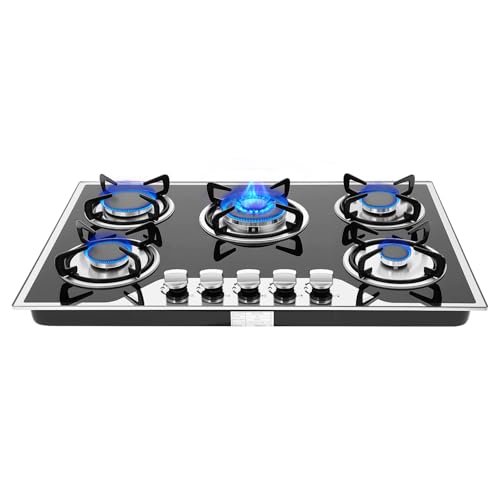
30-Inch 5 Burner Gas Cooktop, LPG/NG Dual Fuel, Tempered Glass Panel — Best Glass-Top Design
This 30-inch five-burner pairs the convertible gas hardware with the deck finish many buyers prefer: a tempered glass panel, which wipes clean in a way raw stainless never quite does, over a stainless built-in frame. The listing specifies independent control knobs for each burner and the same LPG/NG dual fuel convertibility as the rest of the guide, in a package the listing itself pitches at homes and small restaurants.
Strengths
- Tempered glass deck wipes clean easily
- Independent knob per burner
- LPG/NG convertible like the rest of the guide
Trade-offs
- Glass decks demand care with dropped cast iron
- Unbranded model with variable documentation
- Five burners in 30 inches remains a snug layout
| Spec | Detail (from verified listing) |
|---|---|
| Size | 30 inch, 5 burners (per Amazon title) |
| Deck | Tempered glass panel, stainless frame (per Amazon title) |
| Fuel | LPG/NG dual fuel convertible (per Amazon title) |
Choose this model for the cleaning experience and the control layout. A glass gas deck turns the worst part of gas cooking — the baked-on spill around burners — into a wipe, and independent knobs mean each burner’s setting is its own deliberate act, which matters when five are running. The convertible hardware underneath is the category standard: jets for both fuels, regulator conversion, leak check. The glass caveat is physical, not cosmetic: a cast iron pan dropped from height is a risk to any glass deck, so this cooktop suits cooks with a lift-and-place habit. In a home or small commercial kitchen that values a fast cleanup at close of service, it is a genuinely appealing dual fuel package at its tier.
Best for: cooks who prioritise an easy-clean deck and knob-per-burner control / Not suited for: heavy cast iron users prone to dropping pans
Check on Amazon — check the current price on Amazon.

GASLAND 2 Burner Gas Cooktop, 12 Inch, LPG/NG Convertible — Best Compact Built-In
GASLAND builds cooktops as its main business, and this 12-inch drop-in is the compact convertible for permanent small-space installs: two burners in a black drop-in deck, thermocouple protection stated in the listing, and LPG/NG conversion that lets the same unit run on an RV’s propane system or a small apartment’s natural gas line. For a tiny kitchen that wants a real installed cooktop rather than a portable, this is the reference pick.
Strengths
- Cooktop-specialist brand in the compact class
- Thermocouple protection at 12-inch size
- Drop-in install for a finished, built-in look
Trade-offs
- Two burners caps parallel cooking
- Drop-in needs a cutout — not a renter’s plug-and-play
- Black deck shows dust between cleans
| Spec | Detail (from verified listing) |
|---|---|
| Size | 12 inch, 2 burners, drop-in (per Amazon title) |
| Safety | Thermocouple protection (per Amazon title) |
| Fuel | LPG/NG convertible dual fuel (per Amazon title) |
In an RV or a studio, the cooktop decision is really about which two burners you will live with, and GASLAND’s are sensibly judged: one stronger burner for boiling and searing, one gentler for the sauce or the kettle, both protected by a thermocouple in a class of product where that safety feature is often skipped. The drop-in format is the point — it finishes like furniture rather than camping equipment, and the conversion hardware means a change of fuel supply does not orphan the install. The limits are the format’s own: two burners is two burners, and multi-dish cooks should look at the 30-inch picks or pair this with a portable induction unit for overflow. For its intended kitchens, it is the most complete compact dual fuel cooktop here.
Best for: RVs, studios and tiny kitchens wanting a real installed cooktop / Not suited for: renters who cannot cut a countertop
Check on Amazon — check the current price on Amazon.

ANHANE Gas Cooktop Stove, 2 Burner, 12 Inch, LPG/NG Dual Fuel — Best Portable-Style Compact
ANHANE’s 12-inch two-burner is the budget compact of the guide: stainless construction, LPG/NG dual fuel labelling in the verified listing, and a positioning that spans built-in and portable-style use across RVs, apartments and outdoor cooking. It covers the same small-space brief as the GASLAND at a lower tier, trading some refinement for flexibility and price position.
Strengths
- Budget tier in the convertible compact class
- Stainless deck is easy to maintain outdoors
- One unit spans RV, apartment and outdoor roles
Trade-offs
- Listing does not state thermocouple protection
- Budget-tier fit and finish
- Two burners, compact spacing for large pans
| Spec | Detail (from verified listing) |
|---|---|
| Size | 12 inch, 2 burners (per Amazon title) |
| Body | Stainless steel (per Amazon title) |
| Fuel | LPG/NG dual fuel (per Amazon title) |
The honest way to read this pick is as the flexible spare-and-starter convertible: the unit a cabin, a rental annex or an outdoor kitchen buys when the requirement is simply ‘two gas burners that run on whatever fuel is there’. Stainless suits those environments — weather-tolerant, wipe-clean, unbothered by being stored between seasons. The tier shows in the details the listing does not claim: no stated thermocouple protection, plainer finishing, and documentation you should read fully before converting fuels. None of that disqualifies it for its roles; it defines them. Buy it for flexibility at a budget tier, convert it carefully, leak-check it every time the fuel setup changes, and it will cook for years in places the bigger picks cannot go.
Best for: cabins, annexes and outdoor kitchens on a budget / Not suited for: buyers who want stated flame-failure protection
Check on Amazon — check the current price on Amazon.

GasOne 15,000 BTU Propane or Butane Dual Fuel Stove — Best Portable Dual Fuel
GasOne’s portable stove represents the second legitimate meaning of dual fuel in the cooktop aisle: not two plumbed gases, but two canister fuels — propane or butane — in a single-burner portable rated at 15,000 BTU in its product name. It is included deliberately, because a large share of ‘dual fuel cooktop’ shoppers are actually shopping for exactly this: a stove that takes whichever canister the store has, for camping, tailgating, hot-pot tables and power-outage cooking.
Strengths
- Runs on propane or butane canisters — true fuel flexibility
- 15,000 BTU output is strong for a portable single burner
- No install, no conversion jets — swap the canister type
Trade-offs
- Single burner only
- Canister fuels cost more per meal than a plumbed line
- Not a built-in kitchen cooktop in any sense
| Spec | Detail (from verified listing) |
|---|---|
| Output | 15,000 BTU (per product name in cache) |
| Fuel | Propane or butane dual fuel (per cache) |
| Format | Portable single-burner stove |
As a portable, this stove is judged on different terms and wins them: strong output for its class, instant setup, and the canister flexibility that is its whole point — butane for mild-weather convenience, propane for cold mornings when butane falters. It earns its place in this guide as the honest mobile answer, and as a reminder to read category labels carefully: if your dual fuel need is a kitchen install, the five convertible built-ins above are your list; if it is a stove that travels, this is the pick. Either way, canister stoves belong outdoors or in well-ventilated spaces, and the canister should be removed for storage. Matched to its real job, it is excellent at it.
Best for: camping, tailgating, hot-pot and emergency cooking / Not suited for: anyone needing a permanent kitchen cooktop
Check on Amazon — check the current price on Amazon.
Comparison Table
| Pick | Badge | Key spec | Best for |
|---|---|---|---|
| VEVOR Gas Cooktop 36 Inch, 5 Burners, LPG/NG Convertible Dual-Fuel | Best Overall | 36in 5-burner, SABAF, LPG/NG | larger kitchens wanting one convertible cooktop for either gas supply |
| 30 Inch Gas Cooktop, 5 Burners, LPG/NG Dual Fuel, DM527-SA02B | Best 30-Inch | 30in 5-burner, thermocouple, LPG/NG | standard kitchens wanting five burners and either fuel |
| 30-Inch 5 Burner Gas Cooktop, LPG/NG Dual Fuel, Tempered Glass Panel | Best Glass-Top Design | 30in 5-burner, glass deck, LPG/NG | cooks who prioritise an easy-clean deck and knob-per-burner control |
| GASLAND 2 Burner Gas Cooktop, 12 Inch, LPG/NG Convertible | Best Compact Built-In | 12in 2-burner drop-in, LPG/NG | RVs, studios and tiny kitchens wanting a real installed cooktop |
| ANHANE Gas Cooktop Stove, 2 Burner, 12 Inch, LPG/NG Dual Fuel | Best Portable-Style Compact | 12in 2-burner stainless, LPG/NG | cabins, annexes and outdoor kitchens on a budget |
| GasOne 15,000 BTU Propane or Butane Dual Fuel Stove | Best Portable Dual Fuel | 15,000 BTU portable, propane/butane | camping, tailgating, hot-pot and emergency cooking |
How to Choose a Dual Fuel Cooktop
First, confirm which dual fuel you mean. If you want a gas cooktop that runs on natural gas or propane — the cooktop meaning — your checklist is: explicit LPG/NG convertible labelling, the correct jets supplied for both fuels, a regulator that converts or is swapped, and thermocouple protection if the cooktop will live in an RV, cabin or rental. If you actually want a gas top over an electric oven, you are shopping for a dual fuel range, a different appliance class sold by range brands; no cooktop-only product delivers it.
Within convertible cooktops, size class decides next: 12-inch two-burners for RVs and studios, 30-inch five-burners for standard kitchens, 36-inch for width and pan room. Then burner hardware — dual-ring burners and named burner makers signal even, controllable flames on both fuels — and deck material, stainless for durability or tempered glass for cleaning. Finally, plan the conversion itself: it is a mechanical job with a leak check at the end, and budgeting for a professional to do the first conversion is money well spent if you have any doubt.
Converting Between Natural Gas and LPG: What Actually Changes
Natural gas and propane differ in pressure and energy density, so a burner jetted for one burns wrongly on the other — lazy yellow flames and soot in one direction, weak heat in the other. Conversion means fitting the orifice jets sized for your fuel at each burner, setting or swapping the pressure regulator, and then leak-checking every joint you touched with soapy water before the first lighting. Convertible cooktops are designed for exactly this swap and ship with the hardware for it; the jets for the fuel you are not using should be taped to the manual and stored with the cooktop, because a house move or a fuel change years later will need them.
Two habits make conversions safe rather than exciting. Work with the gas supply fully off and the area ventilated, and treat the leak check as part of the job, not an optional extra — bubbles at a joint mean the joint gets remade, full stop. If any step feels beyond you, a gas fitter’s single visit is cheap insurance; the cooktop category assumes conversion will happen, but it does not assume it will be improvised.
Budget Tiers for Dual Fuel Cooktops
Convertible cooktops price by size and hardware more than by brand theatre. The budget tier is the 12-inch compacts: two burners, honest stainless, conversion hardware, fewer stated safety features. The mid tier buys the standard 30-inch five-burner format with thermocouple protection and better finishing. The upper tier in this Amazon category is the 36-inch class with named burner hardware such as SABAF dual-ring burners — still far below legacy range-brand pricing, because these are cooktop specialists and value brands rather than heritage names.
What no tier buys you here is a famous badge: the legacy dual fuel story lives in ranges, not in convertible cooktops. Judge these products on jets, burners, protection and build — the things that decide whether the cooktop cooks well on both fuels — and the tier system makes sense.
How to Convert and Set Up a Dual Fuel Cooktop Safely
Step 1 — Confirm your fuel and find the matching jets. Identify whether the supply is natural gas or LPG/propane, and locate the jet set for that fuel supplied with the cooktop. Wrong jets are the root of nearly all convertible complaints.
Step 2 — Shut off the supply completely. Close the gas valve, ventilate the space, and keep flames and sparks away for the whole job.
Step 3 — Fit the jets and set the regulator. Swap each burner’s orifice for the correct-fuel jet and convert or replace the pressure regulator per the manual for your model. Keep the removed jets with the manual.
Step 4 — Leak-check every joint. Pressurise the line and brush soapy water on each connection. Bubbles mean remake the joint. Do not skip this step and do not light a burner to ‘test by flame’.
Step 5 — Light and read the flames. Correct flames are blue, steady and cone-shaped. Tall yellow, lifting or sooty flames mean the conversion needs revisiting before cooking.
Step 6 — Re-check after a day of use. Heat cycles settle fittings. A second soapy-water check after the first full cooking day is the professional habit worth copying.
Burner Layouts and Real Cooking on Convertible Cooktops
A convertible cooktop earns its keep in the layout of its flames. On the 36-inch class, five burners can be arranged honestly: a strong centre burner with room around it, four corner burners sized for the pans that actually exist. On a 30-inch five-burner, the same count is a negotiation — the centre burner is best treated as the kettle-and-sauce position while the four corners take the pans, and cooks who accept that choreography get along with the format well. The 12-inch two-burners make no pretence: one working burner and one supporting burner, which covers the genuine cooking of small households better than sceptics expect, especially paired with a kettle or a countertop oven.
Flame quality is the convertible-specific test. On the correct jets, both fuels should give blue, stable cones that wrap a pan base without licking up its sides. Natural gas burns a touch cooler and lazier; propane, correctly jetted, is fierce and precise — which is why dual-ring burners, with their inner low ring and outer power ring, are such an asset in this category: they give one burner both personalities. Simmer behaviour separates good convertibles from loud ones — a burner that cannot hold a low, steady flame without popping out makes rice and sauces a supervision job, and thermocouple protection, fitted to several picks here, is what makes a blown-out simmer an inconvenience instead of a hazard.
Where Convertible Cooktops Live: RVs, Cabins, Annexes and Outdoor Kitchens
The dual fuel cooktop’s natural habitats share one trait: the fuel supply is a decision, not a given. The RV runs on propane today and may sit at a plumbed site tomorrow; the cabin has a tank because the gas main never arrived; the annex apartment has a line but a landlord who may change it; the outdoor kitchen wants the tank it can swap on a Sunday. A convertible cooktop is the only built-in that shrugs at all four stories, and that shrug is the product. Buyers in these settings should weight the unglamorous features accordingly: thermocouple protection for spaces that are slept in, stainless that tolerates being stored cold and damp between seasons, and jets and manuals stored with the unit, because the conversion will happen away from any shop.
Installation discipline matters more in these habitats too. Clearances to combustible surfaces in an RV galley, ventilation in a cabin, and a regulator matched to a tank supply are not fine print — they are the installation. The cooktops in this guide are standard sizes with standard requirements, and a careful half-day install, leak-checked and flame-read at the end, sets them up for years of either-fuel service in the places they were bought for.
Revisit the picks: VEVOR 36-inch dual fuel cooktop · DM527-SA02B 30-inch dual fuel cooktop · GASLAND 12-inch dual fuel cooktop — check price on Amazon for each.
Ownership Costs and Upkeep of a Convertible Cooktop, in Plain Terms
A convertible gas cooktop is one of the cheapest appliances to own well. There are no elements to burn out and no glass panels whose electronics age; the moving parts are valves, igniters and burners, all of them cleanable and most of them replaceable with hand tools. The recurring upkeep is a burner’s-eye routine: lift the grates and caps monthly in a busy kitchen, clear the burner ports with a soft brush so flames burn blue and even, keep the igniter tips dry and clean, and wipe the deck before spills bake into archaeology. A cooktop treated this way cooks identically in year ten to year one, which cannot be said of most electric alternatives.
The fuel economics are equally plain. A plumbed natural gas line is the cheapest cooking energy in most homes; propane from a tank costs more per meal but buys independence from the main — which is the entire premise of the cabins, RVs and annexes these cooktops serve. The conversion hardware means a change in that equation never orphans the appliance: move house, change supply, swap the jets, and the same cooktop keeps working. Budget the one professional visit for a first conversion if you want it, keep the spare jets with the manual, and the lifetime cost of the dual fuel feature itself is effectively zero — a rare sentence in appliance ownership.
Pairing Cookware With a Dual Fuel Cooktop
Gas is the most forgiving heat ever made for cookware — flame wraps a base, so even a slightly imperfect pan cooks kindly — but a convertible cooktop still rewards the right kit. Flat, heavy bases steady a pan on grates and spread a fierce propane flame’s centre heat; responsive clad stainless suits the instant adjustments gas allows, changing temperature the second the knob moves in a way electric never matches. Cast iron is entirely at home here, weight and all, because grates — unlike glass — are built to be dragged on, though lifting remains the politer habit for the pan’s seasoning and the grate’s enamel alike.
Two pairings deserve specific mention. A wok wants the strongest burner and, on the dual-ring models in this guide, finds a flame pattern that wraps its base the way the technique assumes. And the Dutch oven — the sourdough pot elsewhere in this cluster — is never happier than on a gas burner for its stovetop work, searing and simmering with a responsiveness that makes braises easy to govern. Buyers equipping a dual fuel kitchen from zero should build around those two anchors — clad stainless for the daily work, one great heavy pot — and let the cooktop’s flexibility do the rest.
Reading the Flames: A Convertible Cooktop Health Check
Once a month, light every burner and read it like an instrument. Healthy flames on either fuel are blue, even in height around the ring, and steady when a pan lands. A burner burning yellow at the tips is telling you its ports are clogging or its jet is wrong for the fuel in use — clean first, question the jet second. A flame that lifts off the burner and roars is over-pressured for its jetting; one that will not stay lit at low settings wants its thermocouple and ports inspected before it wants replacing. These are five-minute observations that keep a convertible cooktop honest for a decade.
After any conversion, the flame read is the final exam: blue cones on every burner, at high and at simmer, on the new fuel, with the leak check already passed. A cooktop that passes both checks is not ‘probably fine’ — it is verified, in the only way gas appliances accept. Build the habit and the dual fuel feature stays what it was designed to be: boring, flexible and safe.
Questions From the Driveway: Answers for First-Time Convertible Buyers
Most first-time buyers ask the same three questions before the box is opened. Will it work out of the box? It will work on the fuel it is jetted for at the factory — which is why confirming your supply and the supplied jet set is step one of the setup guide, not an afterthought. Is the flame as good on propane as on natural gas? Correctly jetted, yes: the burner does not know which fuel it was born for, only whether its orifices match the pressure and energy arriving — which is the entire design premise of the convertible category. And is a value-brand cooktop a false economy? In this category the hardware is standardised — burners, valves, thermocouples from a small world of component makers, SABAF among them — so the honest answer is that upkeep and correct conversion decide lifespan far more than the badge does.
Ask those three, do the conversion properly, and a dual fuel cooktop becomes the least dramatic appliance in the house: it simply cooks, on whichever gas the house happens to have, for as many years as you keep its burners clean.
Winter, Outages and Other Times Dual Fuel Proves Itself
The convertible cooktop’s finest hours tend to arrive unplanned. A winter outage that kills an electric range leaves a gas cooktop’s burners lightable by match, and a household that can still cook hot food treats the event as weather rather than emergency. A holiday crowd that overwhelms the kitchen’s propane supply mid-service is a tank swap away from recovery, not a ruined dinner. A move from a plumbed house to a tank-served one — or the reverse, when the gas main finally reaches a rural road — is an afternoon’s jet swap rather than a new appliance. None of these moments appears in a specification table, and all of them are the lived meaning of the words dual fuel. Buyers who choose this category for the flexibility usually find, within the first year, that the flexibility has already paid for itself in one unglamorous, decisive moment.
It is worth closing the loop on the range question one final time, because readers will keep arriving with it. If, after reading this guide, you conclude that your heart is set on a gas flame above an electric oven, buy the range with a clear conscience — it is a fine appliance class, and the convertible cooktops ranked here will still be waiting if a cabin, an RV or an annex ever asks the other question. Categories exist to serve kitchens, not to win arguments, and the dual fuel label serves two kitchens at once. This guide simply insists on telling you which one you are standing in before you spend money in it.
Keep this guide open while you shop: the differences that matter in this category are written in behaviour and hardware, not in headline numbers, and they are exactly the differences the reviews above were organised to expose.
Common Buying Mistakes
Shopping for a dual fuel range and buying a cooktop. The naming overlap is the category’s biggest trap. A cooktop has no oven; if you need the electric-oven half of dual fuel, you need a range.
Skipping the jet swap. Running propane through natural-gas jets — or the reverse — gives soot, weak heat or dangerous flames. The jets are not optional accessories.
Skipping the leak check. A conversion without a soapy-water check is an unfinished conversion. It takes three minutes and it is the whole safety case.
Crowding a 30-inch five-burner with oversized pans. Five burners in thirty inches is a layout for standard pans. A giant skillet centred over one burner starves its neighbours; size pans to the deck.
Losing the spare jets. The unused fuel’s jets are a future conversion waiting to happen. Tape them to the manual and store both where the next owner — or future you — will find them.
Final Recommendation
For a full-size dual fuel cooktop, the VEVOR 36-inch is our recommendation — SABAF dual-ring hardware, explicit LPG/NG design and real pan room. Standard kitchens should take the DM527-SA02B 30-inch for its thermocouple protection and cutout fit, or the tempered-glass 30-inch if easy cleaning leads your priorities. Small spaces split by install style: the GASLAND 12-inch for a proper drop-in, the ANHANE for budget flexibility, and the GasOne portable if your dual fuel need travels. And if you arrived here wanting a gas top over an electric oven, the honest redirect stands: that is a dual fuel range, and it is a different purchase. For the electric alternatives in this cluster, see Best Double Induction Cooktops; for the pans these burners deserve, Best Cookware For Smooth Top Electric Cooktops covers flat bases (which gas forgives but still rewards), and Best Dutch Ovens For Sourdough covers the pot every gas cooktop should meet.
Frequently Asked Questions
What does dual fuel mean for a cooktop?
On a cooktop, dual fuel means the gas burners run on either natural gas or LPG/propane, converted by swapping burner jets and setting the regulator. The other meaning — gas burners over an electric oven — applies to dual fuel ranges, which are a separate appliance class and not sold as cooktops.
Is converting a cooktop between natural gas and propane difficult?
It is a defined mechanical job: fit the correct jets at each burner, convert the regulator, then leak-check every joint with soapy water. Convertible models ship with the hardware for both fuels. Competent DIYers do it routinely; anyone unsure should hire a gas fitter for the first conversion.
Can I run a dual fuel cooktop on propane in an RV?
Yes — that is one of the category’s main use cases. The 12-inch convertibles in this guide are sized for RV galleys and convert to LPG with their supplied jets. In an RV, thermocouple flame-failure protection is especially worth having, and ventilation rules for gas appliances apply as always.
What is thermocouple protection on a gas cooktop?
A thermocouple is a flame sensor: if the flame goes out, it cools and shuts the gas valve, so unburned gas does not keep flowing. On convertible cooktops used in RVs, cabins and rentals it is a meaningful safety feature, and this guide favours listings that state it.
Why are there no big-brand dual fuel cooktops in this list?
Because the legacy brands sell dual fuel as ranges, not as cooktop-only products, and Amazon’s convertible cooktop category is served by cooktop specialists and value brands. We ranked what verifiably exists as dual fuel cooktops rather than padding the list with ranges wearing the wrong label.
Do dual fuel cooktops need electricity?
The burners burn gas, but electronic ignition and any fans or controls need a standard electrical connection. In an outage, burners with electronic ignition can typically be lit manually with a match or lighter, following the manual — the gas side of the appliance does not depend on the grid.
Best Double Induction Cooktops Best Cookware For Smooth Top Electric Cooktops Best Cookware Sets For Glass Cooktops Best Cookware To Use On Ceramic Cooktops Best Dutch Ovens For Sourdough


