Disclosure: airfryerkitchensupply.com is reader-supported. When you buy through links on our site, we may earn an affiliate commission at no extra cost to you.
Where to buy
This guide to the best cookware to use on ceramic cooktops is built only on listings verified. Two different things share the word ceramic in this category — the glass-ceramic surface of your cooktop and the ceramic nonstick coating inside many modern pans — and this guide covers cookware that respects the first and, in most picks, uses the second. Every set was verified before inclusion. Buy from the linked Amazon listing so the coating system and base construction you receive are the ones described here; ceramic-coated lines are frequently imitated with thinner bases.
- SENSARTE Ceramic Cookware Set, 14-Piece, Induction — check price on Amazon
- KitchenAid Hard-Anodized Induction Ceramic Pots and Pans Set, 9-Piece — check price on Amazon
- CAROTE Ceramic Cookware Set, 25-Piece, Detachable Handle — check price on Amazon
- Farberware Forged Induction Ceramic Nonstick Cookware Set, 12-Piece — check price on Amazon
- SENSARTE Ceramic Pots and Pans Set, 18-Piece, White — check price on Amazon
- GOTHAM STEEL Hammered Titanium Ceramic Cookware Set, 13-Piece, Cream — check price on Amazon
The best cookware to use on ceramic cooktops has to satisfy two surfaces at once. The first is your cooktop itself: a glass-ceramic panel that wants flat, smooth, lightweight-to-moderate pans it can heat by contact and that will not score it when moved. The second is the cooking surface inside the pan, where ceramic nonstick coatings have become the default alternative to traditional nonstick — slick, easy-clean and free of the older coating chemistries many buyers now avoid. This guide is about cookware that gets both sides of that bargain right.
That framing is deliberately different from a general glass cooktop guide. Heavy clad stainless is excellent on glass-ceramic too, but the cookware most ceramic cooktop owners actually reach for daily is lighter: aluminium-bodied pans with ceramic coatings, flat induction-capable bases and a fraction of the wrist strain. Their weakness is equally specific — a ceramic coating is a consumable surface with a finite life, and radiant glass-ceramic elements, which cycle heat steadily and hold it after switch-off, reward cooks who use moderate heat and let the coating live its full span instead of burning through it in a year of maximum-heat searing.
So the picks below are ceramic-coated sets chosen for base flatness, coating credibility and honest tier positioning, plus the handling rules that make them last on this surface. If you understand going in that a ceramic coating is a two-to-four-year surface rather than a lifetime one, these sets deliver the easiest daily cooking a ceramic cooktop can offer.
In this guide
Quick Picks
Best Overall — SENSARTE Ceramic Cookware Set, 14-Piece, Induction. A fourteen-piece ceramic nonstick system with induction-ready flat bases and a complete daily piece mix — the balanced centre of this category.
Best Hard-Anodized Body — KitchenAid Hard-Anodized Induction Ceramic Pots and Pans Set, 9-Piece. A hard-anodized aluminium body under the ceramic coating gives this nine-piece KitchenAid set the flatness retention and heat spread the category often lacks.
Best Space-Saving Set — CAROTE Ceramic Cookware Set, 25-Piece, Detachable Handle. Detachable handles let this twenty-five-piece ceramic set nest into a fraction of the cabinet space — a real system advantage in compact ceramic-cooktop kitchens.
Best Forged Body on a Budget — Farberware Forged Induction Ceramic Nonstick Cookware Set, 12-Piece. Forged aluminium construction from a heritage budget brand — a thicker, flatter base than stamped rivals, in a twelve-piece ceramic set at a value tier.
Best Large Ceramic Set — SENSARTE Ceramic Pots and Pans Set, 18-Piece, White. Eighteen white-finished ceramic pieces with induction bases — the larger SENSARTE system for households that cook several dishes across the panel at once.
Best Presentation Set — GOTHAM STEEL Hammered Titanium Ceramic Cookware Set, 13-Piece, Cream. A hammered cream finish over a titanium-reinforced ceramic surface — the set bought as much for how it looks on the panel as how it cooks.
How These Picks Were Chosen
We ranked ceramic-coated sets on the criteria this surface imposes. First, the base: flat, smooth and preferably induction-capable, because a glass-ceramic panel heats by contact and a dished coated pan both cooks unevenly and rocks. Second, body construction — hard-anodized or forged aluminium bodies hold their flatness and spread heat far better than thin stamped shells, and they keep the pan light enough for the lift-and-place handling the cooktop wants. Third, coating credibility: established coating lines from known makers were favoured over unnamed coatings with miracle claims.
Fourth, we checked the practical system around the coating: whether the set includes lids, whether handles stay cool and oven tolerance is stated, and whether the piece mix covers a ceramic cooktop’s four elements in graduated sizes. Sets with rough or textured undersides were excluded regardless of coating quality, because the underside is what the cooktop lives with. Every listing was verified, and the finite life of ceramic coatings is stated openly in each review rather than glossed over.
The 6 Best Cookware Sets to Use on Ceramic Cooktops

SENSARTE Ceramic Cookware Set, 14-Piece, Induction — Best Overall
SENSARTE has built its name specifically on ceramic nonstick, and this fourteen-piece induction set is the line’s full expression: the daily saucepans, skillets and pots a ceramic cooktop household rotates, on flat bases that sit properly on the glass-ceramic panel. The pans are light in hand — a genuine virtue on this surface, where you lift rather than drag — and the coating is the slick, easy-release surface that makes ceramic cooktops feel effortless for eggs, fish and sauces.
Strengths
- Ceramic coating specialist brand with a complete piece mix
- Flat induction-ready bases sit stable on glass-ceramic
- Lightweight bodies suit lift-and-place handling
Trade-offs
- Ceramic coating is a finite-life surface, as with all such sets
- Not the tool for sustained maximum-heat searing
- Fourteen-piece count includes lids and accessories
| Spec | Detail (from verified listing) |
|---|---|
| Type | Ceramic nonstick cookware set (per cached Amazon title) |
| Pieces | 14-piece set |
| Compatibility | Induction-ready flat bases |
On a ceramic cooktop, this set’s daily rhythm is its argument: breakfast slides out of the skillet, a sauce that would cement itself to stainless rinses clean, and the pans are light enough that the careful handling the glass-ceramic panel asks for never feels like a chore. The flat bases matter as much as the coating — cheaper coated pans dish quickly and then rock on the panel, while these hold their contact and heat evenly at the moderate temperatures ceramic coatings prefer. That temperature discipline is the honest contract of the whole category: cook mostly in the low-to-medium-high band, preheat briefly, and the coating repays you with years of release; live on maximum heat and no ceramic surface, from any brand, will last. Within that contract, SENSARTE’s set is the most complete and credible package here.
Best for: everyday cooks who want easy-release cooking on a ceramic cooktop / Not suited for: cooks who sear at maximum heat as a daily habit
Check on Amazon — check the current price on Amazon.

KitchenAid Hard-Anodized Induction Ceramic Pots and Pans Set, 9-Piece — Best Hard-Anodized Body
KitchenAid’s entry pairs the ceramic coating with the body construction we most like to see under one: hard-anodized aluminium. The anodized body is harder and more warp-resistant than plain aluminium, so the base stays flat on the glass-ceramic panel through far more heating cycles, and heat spreads across the pan instead of printing the element’s ring onto your food. Nine pieces keeps the mix tight and daily.
Strengths
- Hard-anodized body resists warping and spreads heat
- Major-brand coating line with a tight nine-piece mix
- Induction-capable flat bases
Trade-offs
- Nine pieces is a focused mix, not a banquet kit
- Cardamom colourway will not suit every kitchen
- Ceramic coating still asks for moderate-heat discipline
| Spec | Detail (from verified listing) |
|---|---|
| Body | Hard-anodized aluminium (per cached Amazon title) |
| Pieces | 9-piece set |
| Compatibility | Induction ceramic cookware (per cached Amazon title) |
The hard-anodized body changes how this set ages on a ceramic cooktop. Where thin coated pans gradually dish and begin to rock on the panel, the KitchenAid pieces hold their plane, so contact — and therefore evenness — survives the year mark that humbles cheaper sets. Heat behaviour is equally composed: the body spreads the element’s output laterally, softening the hot-ring tendency of radiant glass-ceramic and making the set forgiving for pancakes, quesadillas and other flat, browning-sensitive foods. Nine pieces covers a small-to-mid household’s rotation without cabinet sprawl. If your priority is a ceramic-coated set that still sits dead flat in year two, this construction is the one to pay for.
Best for: buyers who want ceramic ease with a warp-resistant body / Not suited for: large households needing a deep piece count
Check on Amazon — check the current price on Amazon.
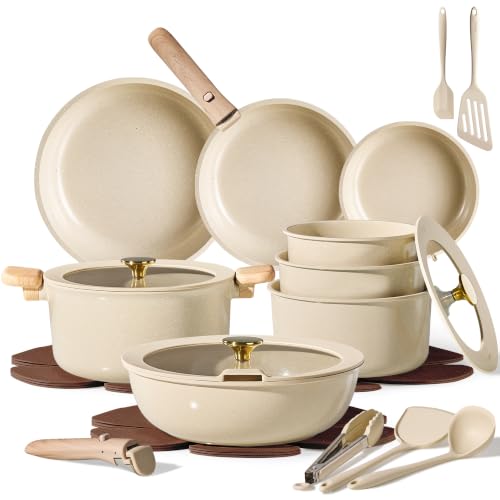
CAROTE Ceramic Cookware Set, 25-Piece, Detachable Handle — Best Space-Saving Set
CAROTE’s detachable-handle system is the cleverest storage idea in ceramic cookware: the handles clip off, the pans nest tightly, and the whole twenty-five-piece set occupies the cabinet footprint of a small one. On a ceramic cooktop the system has a second virtue — a pan carried by a freshly clipped handle is a pan you lift deliberately and place precisely, which is exactly the handling the glass-ceramic surface rewards. The ceramic coating covers the full daily range of pieces.
Strengths
- Detachable handles enable tight nesting storage
- Large piece count covers most cooking shapes
- Handles off means pans double as oven and serving dishes
Trade-offs
- Handle mechanism is a habit to learn and a part to keep track of
- Grip security depends on clipping the handle correctly
- Piece count includes handles and accessories
| Spec | Detail (from verified listing) |
|---|---|
| Type | Ceramic cookware set, detachable handle (per cached Amazon title) |
| Pieces | 25-piece set |
| System | Clip-off handles; nestable bodies |
Judge this set as a system and it wins its niche clearly. Ceramic cooktop kitchens are often compact kitchens — apartments, condos, smaller homes — where a conventional set’s handles dictate a whole cabinet. CAROTE’s nesting bodies hand that cabinet back. In cooking, the pans behave like competent ceramic nonstick: flat bases, easy release, gentle-heat manners. The detachable handle deserves honest framing: clipped on correctly it is secure and rated for the pan’s weight, but it is a mechanism, and cooks who absent-mindedly grab for a fixed handle will have an adjustment week. The payoff beyond storage is versatility — handle off, the pan is an oven dish and then a serving dish, so a ceramic cooktop dinner can go from panel to oven to table in one vessel. For space-pressed kitchens, no other set here offers that trade.
Best for: apartments and compact kitchens short on cabinet space / Not suited for: cooks who dislike detachable-handle systems on principle
Check on Amazon — check the current price on Amazon.

Farberware Forged Induction Ceramic Nonstick Cookware Set, 12-Piece — Best Forged Body on a Budget
Farberware’s forged line addresses the budget ceramic set’s usual weakness — the base — with forged aluminium, a body formed under pressure into a thicker, more stable pan than stamped alternatives. For a ceramic cooktop that means a base that starts flat and resists the dishing that makes cheap coated pans rock on the panel. Twelve pieces in a neutral taupe covers the standard household rotation at a value tier.
Strengths
- Forged body is thicker and flatter than stamped budget pans
- Heritage brand at a value tier
- Induction-capable bases suit glass-ceramic panels
Trade-offs
- Coating longevity still depends on moderate-heat use
- Taupe finish is a specific aesthetic commitment
- Heavier than the lightest coated sets
| Spec | Detail (from verified listing) |
|---|---|
| Body | Forged aluminium (per cached Amazon title) |
| Pieces | 12-piece set |
| Type | Ceramic nonstick, induction (per cached Amazon title) |
Forging is the detail that separates this set from the budget crowd it is priced with. A forged base carries more metal where the element’s heat lands, so the pan heats evenly on the glass-ceramic panel and — critically — keeps its flatness as months of cycles accumulate. Daily cooking is undemanding in the way ceramic converts love: eggs release, sauces rinse away, and the twelve-piece mix covers the weekday rotation without gaps. The set asks the standard ceramic discipline in return — wooden or silicone utensils, moderate heat, no aerosol sprays gumming the coating — and its taupe finish will either blend into your kitchen or not, which is a taste call we leave to you. As the value-tier ceramic set for a ceramic cooktop, it is the one whose base we trust most.
Best for: value buyers who still care about base flatness / Not suited for: cooks who want a bare-metal searing pan in the same box
Check on Amazon — check the current price on Amazon.

SENSARTE Ceramic Pots and Pans Set, 18-Piece, White — Best Large Ceramic Set
This eighteen-piece SENSARTE set extends the brand’s ceramic system for bigger households: more vessels in graduated sizes, so a ceramic cooktop’s four elements can all be working with a matched pan at once. The white finish is the aesthetic signature — bright, modern, and honest about its care needs, since light ceramic exteriors show cooking marks sooner and reward a wipe-down habit. Bases are flat and induction-ready like the smaller set’s.
Strengths
- Graduated sizes for running several elements at once
- Same credible ceramic system as the 14-piece set
- White finish suits bright, modern kitchens
Trade-offs
- White exteriors show marks and need wiping discipline
- Eighteen pieces want real storage space
- Coating care rules apply across a lot of pans
| Spec | Detail (from verified listing) |
|---|---|
| Type | Ceramic pots and pans set (per cached Amazon title) |
| Pieces | 18-piece set, white |
| Compatibility | Induction-ready bases |
The eighteen-piece set earns its place when the cooking is parallel: rice in the small saucepan on the rear element, a sauce in the medium, vegetables in the skillet, soup in the stockpot — each base matched to its ring, each surface releasing cleanly. That graduated coverage is what a set is for on a four-element ceramic panel, and SENSARTE’s spread delivers it without resorting to novelty shapes. The white finish is the honest trade: it looks superb in a light kitchen and it will record every splatter and scorch mark until wiped, so this set suits cooks who clean as they go. Coating care also scales with piece count — eighteen pans on a utensil-and-heat discipline is a household habit, not a one-time read of the manual. For a larger household committed to ceramic cooking, this is the complete version of the system.
Best for: larger households cooking several dishes in parallel / Not suited for: cooks who prefer finishes that hide marks between cleans
Check on Amazon — check the current price on Amazon.

GOTHAM STEEL Hammered Titanium Ceramic Cookware Set, 13-Piece, Cream — Best Presentation Set
Gotham Steel’s hammered set is the presentation pick: a cream, hammered-look exterior that photographs beautifully on a ceramic cooktop, over a titanium-ceramic cooking surface in a thirteen-piece mix. Looks are a legitimate criterion for cookware that lives visibly on a glass-ceramic panel in an open kitchen — provided the fundamentals hold, and here the bases are flat and the piece mix is a sensible daily thirteen.
Strengths
- Distinctive hammered cream finish for open kitchens
- Titanium-ceramic cooking surface across 13 pieces
- Complete daily piece mix
Trade-offs
- You pay a premium for the presentation finish
- As-seen-on-TV branding invites scepticism — judge the set, not the ads
- Light finish needs the same wipe-down discipline as white sets
| Spec | Detail (from verified listing) |
|---|---|
| Type | Titanium ceramic cookware set (per cached Amazon title) |
| Pieces | 13-piece set, cream |
| Finish | Hammered exterior (per cached Amazon title) |
Strip away the television heritage and this is a competent ceramic set with a finish nobody else in the guide offers. The cooking surface releases the way ceramic should at moderate heat, the pieces cover the daily rotation, and the flat bases sit properly on the glass-ceramic panel. The hammered cream exterior is the reason to choose it over the SENSARTE sets — and a fair reason if your cooktop is on display — but it is also the reason it costs a tier more than its cooking strictly justifies, and light finishes ask for prompt wiping to stay photogenic. We include it as the honest presentation option: buy it for the look with eyes open about the premium, and it will cook your weekday dinners perfectly well.
Best for: open-plan kitchens where cookware is part of the decor / Not suited for: buyers who refuse to pay anything for appearance
Check on Amazon — check the current price on Amazon.
Comparison Table
| Pick | Badge | Key spec | Best for |
|---|---|---|---|
| SENSARTE Ceramic Cookware Set, 14-Piece, Induction | Best Overall | Ceramic nonstick, induction-ready, 14 pieces | everyday cooks who want easy-release cooking on a ceramic cooktop |
| KitchenAid Hard-Anodized Induction Ceramic Pots and Pans Set, 9-Piece | Best Hard-Anodized Body | Hard-anodized ceramic, 9 pieces | buyers who want ceramic ease with a warp-resistant body |
| CAROTE Ceramic Cookware Set, 25-Piece, Detachable Handle | Best Space-Saving Set | Ceramic, detachable handle, 25 pieces | apartments and compact kitchens short on cabinet space |
| Farberware Forged Induction Ceramic Nonstick Cookware Set, 12-Piece | Best Forged Body on a Budget | Forged ceramic nonstick, 12 pieces | value buyers who still care about base flatness |
| SENSARTE Ceramic Pots and Pans Set, 18-Piece, White | Best Large Ceramic Set | Ceramic nonstick, white, 18 pieces | larger households cooking several dishes in parallel |
| GOTHAM STEEL Hammered Titanium Ceramic Cookware Set, 13-Piece, Cream | Best Presentation Set | Titanium ceramic, hammered cream, 13 pieces | open-plan kitchens where cookware is part of the decor |
How to Choose the Best Cookware to Use on Ceramic Cooktops
Begin by separating the two ceramics. Your cooktop’s glass-ceramic panel needs a flat, smooth, moderate-weight base — that requirement is non-negotiable and identical for every pan material. The cookware decision is what goes inside the pan. Ceramic nonstick coatings offer the easiest daily cooking and cleaning, at the price of a finite surface life; stainless offers permanence at the price of technique. This guide’s picks are ceramic-coated because that is what most ceramic cooktop owners are shopping for, but the base rules below apply to any pan you add later.
Within ceramic-coated cookware, shop the body before the coating. Hard-anodized and forged aluminium bodies hold flatness and spread heat; thin stamped bodies dish and rock within a season. Then check the system: lids included, handles that stay cool and are oven-tolerant to a stated degree, and a piece mix graduated to your elements. Finally, price the coating honestly — a ceramic set is a two-to-four-year purchase under daily use, so a sensible mid-tier set replaced on schedule beats a premium set nursed resentfully past its release life.
Making a Ceramic Coating Last on a Glass-Ceramic Panel
Ceramic coatings die from heat and abrasion, and a glass-ceramic cooktop can supply both if you let it. The panel’s elements hold heat after switch-off, so a pan left sitting on a cooling element keeps baking its coating; moving the pan off the element when cooking ends is a small habit with a real lifespan payoff. Preheat briefly and at moderate settings — a ceramic pan needs a minute, not a five-minute maximum-heat soak — and let the pan’s slickness, rather than extreme heat, do the releasing.
Utensils and cleaning complete the picture. Silicone and wooden tools only, no metal; no aerosol cooking sprays, whose additives bake into a gummy film that mimics coating failure; hand-washing where practical, with a soft sponge. Follow those rules and a mid-tier ceramic set delivers its full service life on this surface. Ignore them and the most expensive coating in this guide will behave like the cheapest — the surface is honest that way.
Budget Tiers for Ceramic Cookware, Priced Over Their Real Lifespan
Because ceramic coatings are consumable, tier math differs here: divide the tier by the years of release you will actually get. Budget forged and stamped sets serve gentle cooks for a couple of years and are rational purchases at their tier. The mid tier — hard-anodized bodies, credible coating lines, complete lidded mixes — stretches that life and adds flatness retention, and it is where most ceramic cooktop households should land. Premium ceramic sets buy presentation finishes and deeper piece counts more than longer coating life, so buy them for those reasons openly.
The false economy in this category is the ultra-cheap coated set with a thin base: it dishes on the panel within months, and a rocking, hot-spotting pan makes even a fresh coating cook badly. On a glass-ceramic surface, base quality is not a luxury tier feature — it is the entry ticket, at every budget.
How to Cook on a Ceramic Cooktop With Ceramic-Coated Pans
Step 1 — Preheat briefly on medium. Give the pan a minute on a medium element. Ceramic surfaces heat fast and need no long soak; the pan is ready when a flick of water skitters.
Step 2 — Add a little fat, even to nonstick. A teaspoon of oil or butter improves browning and is kinder to the coating than dry-frying at high heat.
Step 3 — Keep the heat in the low-to-medium-high band. That band covers everything ceramic pans are for — eggs, fish, pancakes, sautés, sauces. Searing at maximum is a job for a stainless or cast iron pan, used occasionally.
Step 4 — Move the pan off the element when done. Glass-ceramic holds heat after switch-off. Sliding the pan to a cool zone — lifting, not dragging — stops the cooking and spares the coating a long bake.
Step 5 — Let the pan cool before washing. Cold water on a hot coated pan is thermal shock that ages both coating and base flatness. A few minutes of patience, then a soft sponge and warm soapy water.
Step 6 — Store with protectors. Stack coated pans with a cloth between them. The pan stored above is the most common scratcher of the coating below.
Ceramic Coatings Compared: What the Labels Actually Mean
Ceramic nonstick is a family, not a single material, and the labels reward decoding. Nearly all of it is sol-gel technology — a silica-based coating sprayed and cured onto an aluminium body — which is why its virtues (slickness, easy cleaning, no fluoropolymer chemistry) and its limits (finite life, heat sensitivity) are shared across brands. ‘Titanium ceramic’ variants reinforce that coating with titanium plasma in the base layer for hardness; ‘forged’ and ‘hard-anodized’ describe the body beneath, and as this guide has argued, the body is where flatness and longevity are really decided. A famous coating name on a thin body is a worse purchase than a plain coating on a forged one, on a glass-ceramic panel most of all.
The honest comparison against the alternatives clarifies when ceramic is right. Against traditional fluoropolymer nonstick, ceramic starts slicker-feeling for many cooks and tolerates higher brief heat, but historically gives up its release sooner — it is a sprinter where the older chemistry is a miler. Against stainless, ceramic trades permanence for effortlessness: no preheat ritual, no soaking, no scrubbing, in exchange for a surface you will replace on a schedule of years. Against enamelled cast iron, ceramic is a featherweight daily driver where the iron is a lifetime anchor. Most well-run ceramic-cooktop kitchens end up hybrid: a ceramic set for the daily eighty per cent, one stainless or iron pan for the searing twenty. The sets in this guide were chosen to be that eighty per cent, superbly.
The Ceramic Cooktop Itself: Panel Care That Protects Your Cookware Too
Glass-ceramic panels and coated pans share enemies, so panel care and pan care turn out to be the same habits viewed from opposite sides. Sugary spills are the panel’s nemesis — melted sugar can bond to glass-ceramic and pit it as it cools — and they are equally the coating’s enemy when they bake onto a pan’s exterior and get scrubbed off with force. Move sweet spills off the hot zone promptly, clean the panel with a glass-ceramic cleaner and a soft pad once cool, and your pans’ exteriors will never need the aggressive cleaning that shortens their lives.
The panel also teaches the temperature lesson this guide keeps repeating. Glass-ceramic retains heat long after switch-off, glowing its warning until it is safe — and a coated pan left sitting on that retained heat is being cooked itself, its surface ageing at cooking temperature with no food to show for it. The lift-to-a-cool-zone habit protects panel, pan and food simultaneously. Finally, keep the panel scrupulously smooth: a raised, baked-on ring on the glass becomes an abrasive under the next pan’s base, rocking it and scratching its underside. A clean panel is not vanity — it is the flat foundation every pan in this guide assumes it is sitting on.
Revisit the picks: SENSARTE 14-piece ceramic set · KitchenAid hard-anodized ceramic 9-piece set · CAROTE 25-piece detachable-handle set — check price on Amazon for each.
A Day of Ceramic Cooking: Where the Coating Earns Its Keep
Breakfast is the ceramic set’s home ground. Eggs slide, pancakes release with intact lacy edges, and the pan rinses clean while the coffee brews — no soak, no scrub, no residue baked harder by the glass-ceramic panel’s retained heat because you moved the pan to a cool zone when the food came off. Lunch is a grilled sandwich or a quesadilla, the moderate steady heat browning evenly across the flat base. The afternoon might be a sauce — tomato, cheese, a pan gravy — each of them a dish that punishes stainless with sticking and punishes its owner with washing-up, and each of them a thirty-second rinse in a ceramic saucepan.
Dinner tests the system’s range rather than its release: a fish fillet with a delicate skin, which ceramic handles kindly at medium heat; a vegetable sauté that wants constant motion, which the light pans make effortless on a surface where pans are lifted and tilted rather than dragged; a pot of rice resting off the heat in its lidded saucepan. Across the whole day, the pattern is the same — the coating converts cooking’s small frictions into non-events, and the panel stays clean because nothing ever needed to be burned off anything. That is the honest case for ceramic on a ceramic cooktop, and it is a strong one for the way most households actually eat.
The day also shows the boundary plainly: the evening’s steak, if there is one, goes in the household’s one stainless or iron searing pan, without apology. A hybrid kitchen is not a failed ceramic kitchen; it is the correct one.
Knowing When a Ceramic Set Is Done — and Replacing It Well
A ceramic coating announces its retirement gradually: eggs that once slid begin to hesitate, then to hold at the edges; the surface needs more oil for the same release; a faint roughness appears where the favourite spatula lands. These are the signs of a surface consumed, not a pan abused, and they arrive on the schedule this guide described — years in, not months, if the care rules were kept. The retirement test is breakfast: when a properly preheated, lightly oiled pan will not release an egg, the coating’s working life is over, however handsome the pan still looks.
Replace by piece where the system allows it — the daily skillet dies years before the stockpot, which barely works its coating at all — and replace to the body standard, forged or hard-anodized, that this guide ranked by. The retired pan’s second life is oven and serving duty if its base is still flat, or recycling if it is not. Budgeting a ceramic set as a multi-year consumable, and replacing its hardest-worked piece on evidence rather than on a calendar, is how the category’s economics stay firmly in the cook’s favour.
Ceramic Cookware and Health Questions, Answered Plainly
Buyers often arrive at ceramic coatings through a health question, and it deserves a plain answer rather than a sales pitch. Ceramic nonstick coatings are silica-based and contain no fluoropolymer chemistry; that is a factual property of the material, and for buyers who prefer to avoid that chemistry it is a legitimate reason to choose this category. What ceramic is not is a medical intervention, and this guide makes no health claims beyond the material fact: it is a cooking surface with a defined composition, a defined lifespan and defined care needs, and it should be bought on those terms.
The practical safety habits are the ordinary ones of all cookware: do not overheat an empty coated pan for long periods, ventilate a hot kitchen as you would anyway, retire a coating that is flaking, and follow the maker’s stated temperature limits. Used that way, a ceramic set on a glass-ceramic cooktop is among the most undemanding cooking systems a home can run — which, more than any single claim, is why the category keeps growing.
Building the Hybrid Kitchen: What to Own Alongside a Ceramic Set
The ceramic set is the daily driver, not the whole fleet, and three companions complete a ceramic cooktop kitchen honestly. The first is one heavy searing pan — stainless or smooth-based cast iron — kept for the steaks, chops and skin-on chicken that want maximum heat without apology; it will be used twice a week and last decades, the perfect foil to the set’s consumable coating. The second is a kettle or a simple stainless saucepan for the boiling and reheating jobs that need no release at all, sparing the coated saucepans hundreds of pointless cycles a year. The third is a set of silicone utensils bought with the pans, not after the first metal spatula has already signed its name on the coating.
With those companions in place, the ceramic set’s workload becomes exactly the work it is best at — eggs, fish, sauces, sautés, pancakes, reheats — and its lifespan stretches toward the top of its range. This is the kitchen pattern the rankings assumed: buy the ceramic system for the eighty per cent, anchor the twenty per cent in permanent materials, and a glass-ceramic cooktop becomes the easiest surface in the house to cook on and to clean, every single day.
What to Cook First: A Gentle First Week With a New Ceramic Set
Break a ceramic set in with the foods it was born for, and the habits form themselves. Day one: eggs in the small skillet, at a honest medium, learning how little preheat this surface needs. Day two: a pan sauce in the saucepan, watching it release from a surface that behaves like it is helping you. Midweek: pancakes, whose browning maps the base’s evenness more truthfully than any specification sheet — an even golden face is a flat base’s signature. The weekend: a fish dinner and a vegetable sauté, the two dishes where light pans and instant release make a cook feel quietly competent. By the second week the disciplines — soft utensils, moderate heat, off the hot zone when done — stop being rules and become simply how this kitchen cooks, which is when a ceramic set stops being a purchase and becomes the house style.
One last piece of honest arithmetic belongs in this guide. A ceramic set used daily, cared for by the rules above, and replaced piece by piece as its hardest workers retire, costs a household less per year of easy cooking than almost any other cookware pattern — including the cheap stamped set replaced whole every year, and rivalling the premium set whose price is amortised across decades of technique-dependent cooking. Ease has a price, permanence has a price, and ceramic’s price, understood clearly at purchase, is the fairest of the three for the cooks it suits. That clarity — not any single pan — is what this guide most wants to sell you.
Common Buying Mistakes
Using aerosol cooking spray. The additives in spray cans bake into a sticky film that looks and behaves like a failed coating. Use a small amount of ordinary oil instead.
Treating ceramic like stainless. Maximum-heat preheats, metal utensils and steel wool are stainless habits. On ceramic they consume the surface in months.
Leaving the pan on the hot element to keep food warm. The panel’s retained heat keeps cooking the food and baking the coating. Move to a cool zone or a trivet.
Blaming the cooktop for a dished pan. If a coated pan rocks on the panel, its base has bowed from heat shock or thin construction. The fix is a better-bodied pan, not more heat.
Expecting a lifetime surface. Buying ceramic with stainless expectations guarantees disappointment. Budget it as a multi-year consumable and it will delight you for exactly as long as it should.
Final Recommendation
For most ceramic cooktop kitchens, the SENSARTE 14-piece set is the balanced buy: a credible ceramic system, flat induction-ready bases and a complete daily mix. KitchenAid’s hard-anodized nine-piece is the flatness-retention pick, CAROTE’s detachable-handle set wins compact kitchens outright, and Farberware’s forged twelve-piece is the value tier done properly. Bigger households should take the SENSARTE 18-piece, and open-plan kitchens that care about presentation have the Gotham Steel hammered set. Whichever you choose, the care rules in this guide — moderate heat, soft utensils, off the hot element when done — decide how long it serves you. For the other sides of this surface, see Best Cookware For Smooth Top Electric Cooktops on base science and Best Cookware Sets For Glass Cooktops on set-buying as a system; for cooktops themselves, Best Double Induction Cooktops and Best Dual Fuel Cooktops cover the alternatives, and Best Dutch Ovens For Sourdough covers the one heavy pot worth its place on the panel.
Related guides
Frequently Asked Questions
Is ceramic cookware the same as a ceramic cooktop?
No — the shared word causes real confusion. Your cooktop is glass-ceramic, a smooth panel material. Ceramic cookware usually means an aluminium pan with a ceramic-based nonstick coating inside. The cooktop cares about the pan’s flat, smooth base; the coating is about how food releases inside the pan.
How long does a ceramic coating last on a ceramic cooktop?
Under daily use with moderate heat and soft utensils, expect a few years of strong release before the surface gradually loses slickness. Heat abuse — long maximum-heat preheats, pans left baking on hot elements — can shorten that to months. No brand is exempt; the lifespan is a property of the coating type.
Can I use metal utensils in ceramic-coated pans?
You should not. Metal edges micro-scratch the coating, and the damage accumulates invisibly until release fails. Silicone and wooden utensils cost little and are the single easiest lifespan habit in this category.
Are ceramic-coated pans safe to use on high heat?
They tolerate brief higher heat, but their design centre is low to medium-high. Sustained maximum heat degrades the coating and can discolour it. For hard searing, keep one stainless or smooth-based cast iron pan alongside your ceramic set and use each for what it is good at.
Why does my ceramic pan rock on the cooktop?
Its aluminium base has bowed, usually from thin construction or thermal shock — cold water on a hot pan is the classic cause. A rocked pan makes poor contact with the glass-ceramic panel, so it cooks unevenly as well. Forged and hard-anodized bodies resist this far better than thin stamped ones.
Do ceramic pans work on induction as well as glass-ceramic?
Only if the base is induction-ready, with a magnetic layer — all six sets in this guide were chosen with induction-capable flat bases where the listing states it. A plain aluminium ceramic pan will not heat on induction at all, so check the base if a stove change is in your future.
Best Cookware For Smooth Top Electric Cooktops Best Cookware Sets For Glass Cooktops Best Double Induction Cooktops Best Dual Fuel Cooktops Best Dutch Ovens For Sourdough


