Disclosure: airfryerkitchensupply.com is reader-supported. When you buy through links on our site, we may earn an affiliate commission at no extra cost to you.
Where to buy
Shopping for the best bread making machines starts with your household’s loaf: how big, how often, and how much of the work you want the machine to carry. Every pick below is sold on Amazon, each model name links to its listing so you can check price on Amazon, and the range runs from a flagship that bakes like a bakery to a value machine that simply makes Tuesday’s sandwich loaf disappear as a problem.
- Zojirushi Home Bakery Virtuoso Plus BB-PDC20BA — check price on Amazon
- Panasonic SD-R2550 Bread Maker, 20 Presets — check price on Amazon
- Cuisinart Convection Bread Maker CBK-210 — check price on Amazon
- West Bend Hi-Rise Bread Maker, 3 Lb — check price on Amazon
- Hamilton Beach Digital Bread Maker 29987, 14 Settings — check price on Amazon
- KBS 17-in-1 Bread Maker, 710W, Dual Heaters — check price on Amazon
The best bread making machines share one promise: flour, water, yeast and salt go in, and bread — real bread, warm and sliceable and better than the supermarket’s — comes out, with the machine doing the kneading, rising and baking in between. It is an old promise, and modern machines keep it remarkably well. What separates the six machines on this list is not whether they make bread, but how good the loaf is, how big it can be, how much of your schedule it can absorb, and how gracefully the machine fits the kitchen it lives in.
This is the general guide in the cluster — the one for the reader who has not yet specialised into custom programs or paddle philosophy, and wants the honest overall picture. The picks span the category’s real range: a flagship with dual heaters for the baker chasing the perfect crust, a sensor-driven machine for the household that wants the same loaf every time, a three-pound family engine, and value machines that put fresh bread within reach of almost any budget.
A bread machine is also, quietly, a schedule machine. The delay timer is the feature owners praise most after a year: ingredients loaded at night, loaf finishing as the house wakes. Several picks here carry long timers, and the guide treats scheduling as a first-class virtue alongside crust and crumb, because bread that fits your life gets baked, and bread that does not becomes a cupboard monument.
Every product was verified by brand and model against the retailer’s catalog data before receiving a link, and the spec boxes quote only what those verified listings confirm. No prices and no ratings are printed, because both change too often to inform a purchase; loaf quality, capacity, programs and ownership effort are the currencies here.
Read the badges as household descriptions. Each pick is the best answer for a recognisable kitchen, and the reviews say plainly which kitchen that is — including the ones each machine would serve badly.
In this guide
Quick Picks
Six machines covering the whole category, from flagship to entry value. Badges are used identically in the full reviews, and each quick line names the household the pick was chosen for. If you read nothing else, read the badges against your own kitchen — the right machine is the one whose household sounds like yours, and it is rarely the one with the longest program list.
- Best Overall: Zojirushi Home Bakery Virtuoso Plus BB-PDC20BA — dual heaters, a 2 lb capacity, gluten-free and whole-wheat programs and a 13-hour timer — the most complete loaf this category produces.
- Best for Consistent Loaves: Panasonic SD-R2550 Bread Maker, 20 Presets — 20 presets and an advanced temperature sensor that adapts to your kitchen — the same loaf in January and July, with a raisin-and-nut dispenser for variety.
- Best for Variety and Crust: Cuisinart Convection Bread Maker CBK-210 — 16 programs including a sourdough starter cycle, a convection fan for artisan crust and an automatic mix-in dispenser in a 2 lb machine.
- Best for Big Families: West Bend Hi-Rise Bread Maker, 3 Lb — a traditionally shaped horizontal pan with dual knead blades and a 3 lb capacity — the family-size loaf, baked like a loaf.
- Best Value: Hamilton Beach Digital Bread Maker 29987, 14 Settings — 14 settings including artisan and gluten-free, a 2 lb capacity and delay start in a white-and-stainless machine at a value tier.
- Best Budget Features: KBS 17-in-1 Bread Maker, 710W, Dual Heaters — dual heaters, a ceramic pan, 17 programs, a nut dispenser and a 15-hour timer — the feature list of a flagship at a budget-friendly tier.
How These Picks Were Chosen
The first filter was the loaf itself: even baking from base to crown, a crust with some character, a crumb that slices without tearing. Machines were favoured for heating design — dual heaters, convection, temperature sensing — because in bread machines, heat architecture is destiny, and no program list compensates for a pale top and a scorched base.
The second filter was household fit: loaf-size range against family size, program maps against real repertoires — sandwich loaves, whole wheat, gluten-free, dough for the oven, the occasional jam or cake — and timers against real schedules. A machine was not penalised for lacking a feature its household would never use, nor forgiven for lacking one it would use weekly.
The third filter was ownership effort: pan and paddle cleaning, footprint on the counter, the legibility of the controls to a half-awake person loading a delay-timer loaf at midnight. Bread machines live or die by whether the tenth loaf is as easy as the first, and the picks were judged on the tenth.
Ingredient honesty ran underneath everything: these machines make the bread your ingredients describe. The reviews avoid implying that any machine rescues bad flour or old yeast, because the buyer’s disappointment, when it comes, is usually born there — and a guide that says so plainly serves its reader better than one that lets a machine take the blame.
Finally, verification: brand and model cross-checked against catalog data, links only for confirmed products, specs only from confirmed listing titles. Where bundle or configuration details vary, the reviews say what to confirm on the listing.
The 6 Best Bread Making Machines
The order runs from the flagship loaf downward through consistency, variety and capacity to the value picks — a map of the whole category rather than a single ladder, since the best machine for a family of six and the best for a couple are different machines that happen to share a name and a promise.

Zojirushi Home Bakery Virtuoso Plus BB-PDC20BA — Best Overall
The Virtuoso Plus is the machine this category is judged against, and the reason is in the crumb: its dual heaters — the second one in the lid — bake a 2 lb loaf evenly from base to crown, producing the deep, uniform colour and set crumb that single-element machines approximate and rarely match. Bread from it does not look like an apology for oven bread; it looks like the point of the exercise.
The program set serves the serious household repertoire: whole-wheat and gluten-free programs headline a map built for bakers whose bread life is varied and weekly, and the 13-hour timer folds the machine into real schedules — load at night, slice at breakfast. The build matches the ambition: this is a substantial, deliberate appliance that expects to anchor a counter for years.
Its costs are the premium tier and the commitment it implies. A household that bakes a white loaf twice a month will not extract its value, and small households may find the 2 lb format more loaf than their week consumes. But for the household that bakes constantly and judges critically, it is the complete answer — the machine against which the rest of this list is priced and compared.
Buy it as the decade machine: the one whose loaves set the family standard, whose programs cover the expanding repertoire, and whose even heat forgives the small timing errors every baker makes. In a category full of adequate, it is the pick that aims at excellent and hits it routinely.
One more audience should recognise itself here: the baker returning to bread after years away, whose hands no longer enjoy kneading. This machine restores the whole practice — the smell, the slice, the table — without the physical toll, and it does so at a quality that does not feel like a compromise for the concession. Appliances that give a craft back to its practitioner earn a loyalty beyond specifications, and this one collects it.
Strengths
- Dual heaters bake the most even, best-coloured loaves here
- Programs cover the demanding doughs: whole wheat and gluten-free
- 13-hour timer makes fresh breakfast bread a routine
Trade-offs
- Premium tier pricing and a substantial footprint
- 2 lb format exceeds small households’ weekly needs
- Capability is wasted on occasional bakers
| Specification | Detail |
|---|---|
| Capacity | 2 lb loaf |
| Heating | Dual heaters |
| Programs | Gluten-free and whole-wheat programs |
| Timer | 13-hour delay timer |
Best for: serious households baking varied loaves every week / Not suited for: occasional bakers or very small households
Check the current price on Amazon.
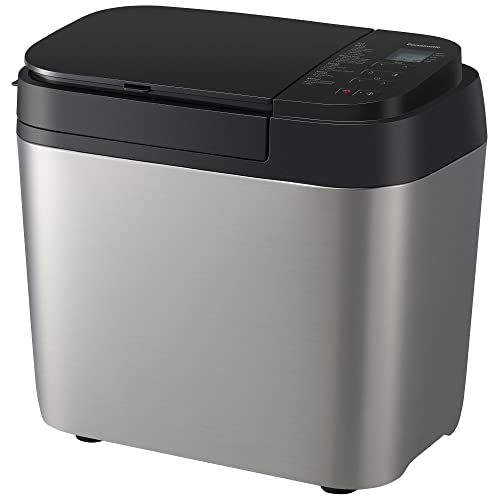
Panasonic SD-R2550 Bread Maker, 20 Presets — Best for Consistent Loaves
Consistency is an underrated baking virtue until you have eaten the same recipe baked three different ways by a machine that cannot feel the weather. The SD-R2550’s advanced temperature sensor exists to end that lottery: it reads the kitchen’s conditions and adapts, so the loaf that delighted in spring delights again in a cold January kitchen. For households whose bread is a standard — the same sandwich loaf, the same expectations — that steadiness is the product.
Twenty presets give the steadiness somewhere to go: breads across the repertoire, gluten-free baking, cake and pizza dough among the modes its listing confirms, and a raisin-and-nut dispenser that adds mix-ins at the right moment without opening the lid and dumping the heat. Panasonic’s loaf quality reputation — fine crumb, honest crust — is the foundation under all of it.
The trade-offs are a mid-premium tier and a feature philosophy that favours refinement over raw novelty: no headline gimmicks, just a machine that does the standard things at an unusually high standard. Bakers who want a programmable laboratory should look at the custom-programs guide in this cluster; bakers who want their loaf, perfected and repeated, are home.
It is the pick for the household that has found its bread and wants it forever — newlyweds standardising a kitchen, families whose lunchboxes run on one beloved loaf, anyone whose baking joy is reliability rather than experimentation.
There is an accessibility dividend to consistency, too: a machine that compensates for the kitchen’s temperature is a machine whose results a less experienced baker can reproduce, which makes it the kindest teacher on this list. Recipes learned on it transfer as written, because the machine quietly absorbs the variable — the cold kitchen — that makes beginners believe they cannot bake.
Strengths
- Temperature sensor delivers season-proof consistency
- 20 presets span breads, cake, pizza dough and gluten-free
- Dispenser automates fruit and nut additions
Trade-offs
- Mid-premium tier for refinement rather than novelty
- Less of a tinkering platform than custom-cycle rivals
- Preset depth takes a few bakes to learn fully
| Specification | Detail |
|---|---|
| Programs | 20 presets |
| Sensor | Advanced temperature sensor |
| Dispenser | Raisin and nut dispenser |
| Modes | Bread, cake, pizza dough, gluten-free baking |
Best for: households that want their standard loaf, identical every time / Not suited for: experimental bakers who reprogram every bake
Check the current price on Amazon.

Cuisinart Convection Bread Maker CBK-210 — Best for Variety and Crust
Most bread machines bake a soft, pale-topped loaf that tastes fine and looks like a compromise. The CBK-210’s convection fan exists to argue: moving hot air across the loaf produces the deeper colour and crisper crust that bring machine bread closer to the artisan loaf, and for bakers whose complaint about the category is the crust, this is the machine that answers it.
Sixteen programs include the connoisseur’s favourite — a sourdough starter program that tends the preferment — and the automatic mix-in dispenser handles the seeded, fruited and nut loaves that make a weekly repertoire feel varied rather than repetitive. Together they describe a machine for the baker who bakes many kinds of bread, often, and wants each kind to come out as itself.
The honest costs: a convection fan is a moving part in a hot box, and the machine asks the usual care of such things; the 2 lb format is the only size story here; and bakers whose repertoire is one white loaf will pay for variety they never use. Within its brief — variety with a better crust — it has no real rival on this list.
Choose it when the weekly bake rotates: starter loaf on Saturday, seeded loaf midweek, something fruited for the weekend. It turns a bread machine from a single-recipe appliance into the household’s bakery department, which is what its owners say they bought.
The crust point deserves a closing emphasis, because it decides gift-giving and dinner parties: a convection-kissed loaf is the one machine loaf you can put on a table beside oven bread without the small, apologetic speech. Bakers who entertain from their machines know exactly which pick in this list they are reading about, and they are right.
Strengths
- Convection fan produces the most artisan-style crust here
- Sourdough starter program tends preferments automatically
- Mix-in dispenser keeps the weekly repertoire varied and consistent
Trade-offs
- Fan is an extra moving part to keep clean
- Single 2 lb format
- Variety is wasted on one-loaf households
| Specification | Detail |
|---|---|
| Capacity | 2 lb |
| Programs | 16, including sourdough starter |
| Heating | Convection fan for artisan crust |
| Dispenser | Automatic mix-in dispenser |
Best for: variety bakers who rotate loaves and care about crust / Not suited for: one-recipe households or the fan-averse
Check the current price on Amazon.

West Bend Hi-Rise Bread Maker, 3 Lb — Best for Big Families
Size is a baking specification, and for a family of five the standard 2 lb loaf is a day and a half of bread. The West Bend Hi-Rise answers with a 3 lb capacity in a traditionally shaped horizontal pan — a loaf with the proportions of a bakery loaf, wide rather than tall — driven by dual knead blades that work a large dough mass the way a single small paddle cannot.
The dual blades matter more than the headline capacity: a big dough under-kneaded is a big disappointment, and the Hi-Rise’s paired blades keep the full pan working evenly. Twelve programs including gluten-free, three loaf sizes for the days the full capacity is not needed, and three crust colours complete a specification that reads like it was written by someone who feeds a crowd.
Its trade-offs are physical: this is a large machine that claims serious counter, and a 3 lb loaf is a commitment — bread stales, and a household that cannot finish the big loaf should use the smaller sizes it offers rather than baking monuments. The build is working-grade rather than luxurious, in keeping with its family-engine brief.
Choose it when the loaf count in your house is measured in sandwiches per day and the supermarket run for bread is a standing errand. It replaces that errand with a pan, a program and a timer — and for big families, that replacement is the entire case.
It also earns its keep at gatherings in a way smaller machines cannot: a single 3 lb loaf is a party’s bread, a holiday table’s centrepiece, a gift that arrives still warm. Hosts who bake know that one large, handsome loaf does social work that three small ones do not — and this is the only machine here that can produce it in one bake.
Strengths
- 3 lb horizontal loaves suit big families and batch bakers
- Dual knead blades handle large dough masses evenly
- Three loaf sizes keep it useful on smaller days
Trade-offs
- Large footprint on the counter
- Big loaves stale if the household cannot finish them
- Working-grade build rather than premium finish
| Specification | Detail |
|---|---|
| Capacity | Up to 3 lb, 3 loaf sizes |
| Pan | Traditionally shaped horizontal bread pan |
| Blades | Dual knead blades |
| Programs | 12, including gluten-free |
| Crust | 3 crust colours |
Best for: large families and sandwich-heavy households / Not suited for: small households or small counters
Check the current price on Amazon.

Hamilton Beach Digital Bread Maker 29987, 14 Settings — Best Value
The value pick in a category should not feel like a punishment, and the 29987 makes its case by including the settings households actually grow into: fourteen of them, with artisan and gluten-free programs named in its listing alongside the standards, a full 2 lb capacity, and the delay start that turns a bread machine from an appliance into a schedule. White and stainless, it also declines to look like the budget option, which matters on a counter it will occupy for years.
Its baking is the honest midfield: good, even loaves from the standard repertoire, without the flagship heaters’ last degree of crust authority. For the sandwich loaf, the whole-wheat staple and the weekend treat, that standard is not a compromise most families can taste — and the money saved against the flagships buys a great deal of flour.
The limits are the tier’s: lighter build, kneading that the heaviest seeded doughs will test, and a program map without the exotic residents — no starter-tending, no dispensers. What it never does is embarrass itself at the basics, which is the entire job description of a value pick.
Choose it as the household’s first bread machine or its replacement-in-kind: the purchase that makes fresh bread a weekly fact without a flagship decision. If the baking life deepens, it graduates gracefully to second-machine duty; if it does not, it has still paid for itself in loaves.
The artisan setting deserves a word of expectation-setting: it shapes the cycle toward the longer, slower profile that artisan-style doughs prefer, and within a machine’s limits it genuinely improves those loaves. It will not produce an open-crumb boule — no pan machine does — but as a value machine’s reach toward the serious repertoire, it is honestly aimed and pleasantly effective.
Strengths
- Artisan and gluten-free settings included at a value tier
- Delay start delivers the breakfast-loaf routine
- Full 2 lb capacity with a finish that suits the counter
Trade-offs
- Crust authority below the flagship heaters
- No dispenser or starter program
- Heavy seeded doughs test its kneading
| Specification | Detail |
|---|---|
| Capacity | 2 lb loaf |
| Settings | 14 programmable, including artisan and gluten-free |
| Timer | Delay start |
| Finish | White and stainless steel |
Best for: value buyers wanting the full household repertoire / Not suited for: crust perfectionists or heavy-dough specialists
Check the current price on Amazon.

KBS 17-in-1 Bread Maker, 710W, Dual Heaters — Best Budget Features
The KBS reads like a machine designed by someone who studied the flagships’ feature lists and resented their prices: dual heaters for even baking, a ceramic pan for bakers avoiding conventional nonstick, seventeen programs, an automatic nut dispenser, three loaf sizes, three crust colours and the longest delay timer on this list at fifteen hours — assembled at a tier far below the machines it imitates.
The dual heaters are the substantive item, because they change the loaf rather than the brochure: heat from above as well as below is how the flagships earn their colour, and the KBS brings that physics to a budget purchase. The ceramic pan is the second substantive item, releasing loaves cleanly and answering the coating question many bakers bring to this category.
The honest caveats match the tier: 710 watts is modest power for the heaviest whole-grain and seeded doughs, the touch panel’s elegance depends on your tolerance for touch panels, and a value brand’s long-term parts ecosystem is thinner than the established names’. None of these touch the standard repertoire, which the machine bakes evenly and on schedule.
Choose it when the feature list matters and the budget is real: the baker who wants dispensers, timers and even heat without the flagship conversation. It is the list’s argument that the category’s best ideas have begun to democratise — and its loaves make the argument persuasively.
Its fifteen-hour timer is worth a final practical note: it is the one here that comfortably spans the longest realistic gap — dinner cleared, breakfast tomorrow, with margin — which makes it the shift worker’s and the long-commute household’s quiet favourite. Scheduling is a specification, and on this one the budget machine beats the flagships outright.
Strengths
- Dual heaters deliver flagship-style even baking at its tier
- Ceramic pan suits nonstick-averse bakers
- 15-hour timer and nut dispenser complete a flagship-style feature set
Trade-offs
- 710W is modest for the heaviest doughs
- Value-brand parts ecosystem is thinner
- Touch panel will not suit every baker
| Specification | Detail |
|---|---|
| Power | 710W, dual heaters |
| Programs | 17-in-1 |
| Pan | Ceramic pan |
| Timer | 15-hour delay timer |
| Extras | Nut dispenser, touch panel, 3 loaf sizes, 3 crust colours |
Best for: feature hunters on a real budget / Not suited for: heavy-dough bakers or brand-loyal traditionalists
Check the current price on Amazon.
Comparison Table
| Pick | Badge | Key spec | Best for |
|---|---|---|---|
| Zojirushi Home Bakery Virtuoso Plus BB-PDC20BA | Best Overall | 2 lb loaf, dual heaters, gluten-free and whole-wheat programs, 13-hour timer | serious households baking varied loaves every week |
| Panasonic SD-R2550 Bread Maker, 20 Presets | Best for Consistent Loaves | 20 presets, advanced temperature sensor, raisin & nut dispenser, gluten-free baking | households that want their standard loaf, identical every time |
| Cuisinart Convection Bread Maker CBK-210 | Best for Variety and Crust | 16 programs including sourdough starter, convection fan, mix-in dispenser, 2 lb | variety bakers who rotate loaves and care about crust |
| West Bend Hi-Rise Bread Maker, 3 Lb | Best for Big Families | 3 lb capacity, horizontal pan, dual knead blades, 12 programs, 3 loaf sizes | large families and sandwich-heavy households |
| Hamilton Beach Digital Bread Maker 29987, 14 Settings | Best Value | 14 settings including artisan and gluten-free, 2 lb capacity, delay start | value buyers wanting the full household repertoire |
| KBS 17-in-1 Bread Maker, 710W, Dual Heaters | Best Budget Features | 17-in-1 programs, 710W dual heaters, ceramic pan, nut dispenser, 15-hour timer | feature hunters on a real budget |
How to Choose the Best Bread Making Machines
Start with loaf size and frequency
The two numbers that decide everything are how much bread your household eats and how often you will bake. A 2 lb loaf is the category’s standard unit and suits most families; the 3 lb West Bend exists for households that measure bread in days per loaf; smaller households should value machines whose size options include smaller loaves, because a stale giant loaf is worse than a fresh small one. Frequency cuts the other way: daily bakers should buy build quality and heaters, weekly bakers can let value lead.
Read heating before programs
Program counts are the category’s loudest number and its least informative. What decides the loaf is heat: dual heaters and convection produce colour and crust; single bottom elements produce the pale-topped loaf of bread-machine folklore. Every pick here was chosen with its heating architecture in view — when comparing any two machines, compare their heaters first and their menus second, and you will choose like a baker rather than a brochure.
Buy the timer, not just the machine
The delay timer transforms bread making from an event into a utility: load at night, wake to bread. Check that the timer’s length covers your actual gap — the machines here run from thirteen to fifteen hours — and apply ingredient sense: lean doughs delay beautifully, while egg- and milk-rich doughs should not sit at room temperature for the longest delays. A machine whose timer fits your schedule will be used ten times more than a technically better one whose does not.
What a Bread Machine Cannot Do (and Why That Is Fine)
It cannot brown onions, develop a sourdough starter from nothing in an afternoon, or rescue dead yeast. It kneads, proofs at controlled warmth, and bakes — three things, done tirelessly and consistently, which happen to be the three things that make home bread a chore. The bakers who love their machines are the ones who let the machine do its three things and keep the flavour work — good flour, lively yeast, the occasional hand-shaped oven loaf — for themselves.
It also cannot make bread faster than bread happens, whatever the express cycles promise. Quick modes have their place in an emergency, but the standard cycles’ hours are fermentation, and fermentation is flavour. Judge any machine by its standard loaves; treat express as the spare tyre — essential when needed, never the plan.
Finally, it cannot choose your recipes. The gap between a mediocre machine loaf and a magnificent one is mostly recipe and ingredients, and it closes with a notebook and a season of bakes on any pick here. Buy the machine for its heat, size and schedule; bring the baking yourself, and the partnership works.
Running Costs, Storage and the Life of the Machine
A bread machine’s running costs are ingredients and a little electricity, and both compare kindly with bought bread — though this guide prints no prices, because flour and energy costs move and the honest comparison is your own supermarket receipt against your own flour bag. What can be said without numbers: households that bake weekly recover a mid-range machine’s cost in bought loaves within a reasonable horizon, and daily bakers recover even a flagship’s, which is why the category survives every kitchen fashion cycle.
Storage is the other practical gate. These are counter appliances with real footprints, and the largest — the 3 lb family machine — should be measured against your counter and cabinets before purchase, not after delivery. A machine that lives out gets used; a machine that must be hauled from a cupboard gets used monthly, then seasonally. Measure the space, including the height with the lid open, and let the measurement vote.
Longevity follows care: pans and paddles washed gently and never scoured, the crumb tray or interior wiped after bakes, the machine kept dry. Treated so, the established platforms here serve for many years, and their manufacturers’ parts — pans, paddles, belts — remain findable, which is a quiet argument for buying a known platform over an unknown bargain.
Pans, Paddles and the Shape of a Loaf
Loaf shape is the category’s quiet divide: vertical pans bake tall, narrow loaves whose slices are small and whose crust-to-crumb ratio is high; horizontal pans — the West Bend’s traditional shape, the flagships’ proportions — bake loaves that look like loaves, with sandwich-sized slices. Neither is wrong; they suit different tables. If your bread life is sandwiches, weight the horizontal shapes; if it is toast and tearing, the verticals serve perfectly well.
The paddle leaves its mark on every loaf it bakes in — a hole in the base where it sat. This general guide’s picks bake fine loaves regardless, but bakers bothered by the hole should read this cluster’s removable-paddle guide, where the alert-assisted, collapsible and removable solutions are compared in full. It is the natural next read after this one, and it exists because the hole is the first thing new owners complain about.
How to Bake Your First Loaf: A Beginner’s Walkthrough
Every machine on this list will bake a good first loaf if the baker respects three things: ingredient order, accurate measuring, and patience at the finish. The walkthrough below is deliberately conservative — it produces the standard white or whole-wheat loaf that teaches you your machine’s character.
- Check the pan and paddle first, every time. Pan seated and locked, paddle firmly on its shaft. Half of all first-loaf failures are an unseated pan, discovered three hours later.
- Measure like a baker, not a cook. Weigh flour if you can; if you cannot, spoon it into the cup and level it — scooping packs the cup and dries the loaf. Bread is ratios, and ratios punish approximation.
- Load in the machine’s own order. Liquids first, then flour covering the liquid, then salt and sugar in separate corners, yeast last in a small well in the flour — kept dry and away from the salt until the machine starts. This order is the delay timer’s whole secret as well.
- Choose the standard program first. Basic or whole wheat to match your flour, your loaf size, a medium crust. Resist every interesting button for the first loaf; you are calibrating, not creating.
- Watch the first knead once, closely. Five minutes in, the dough should form a smooth ball that cleans the pan’s sides. A wet, sticky mass wants a spoon of flour; a dry, cracking one wants a spoon of water. This single check rescues more loaves than any other act in bread making.
- Let the machine finish — completely. Do not open the lid to admire the rise, and do not remove the loaf early because the crust looks right. The program’s timing is the recipe’s timing.
- Cool before slicing. Turn the loaf onto a rack and give it at least half an hour. The crumb is still setting; a loaf sliced hot seems gummy whatever the machine did, and more good loaves are misjudged in that half hour than in the entire bake.
Judge the loaf cold and write down three things: what you used, what you chose, what you would change. That notebook habit — three lines per loaf — is the entire difference between bakers whose tenth loaf is better than their first and bakers whose fiftieth is identical to it. Change one thing per bake and the notebook becomes a map.
If the first loaf disappoints, troubleshoot in this order: yeast freshness, flour measurement, the knead check you skipped, the program you chose. The machine itself is the last suspect, not the first — a truth this guide offers because it will save you a return, a replacement, and the discovery that the new machine behaves exactly like the old one.
A final habit separates contented owners from frustrated ones: bake the same loaf three times before varying anything. The first bake teaches the machine, the second teaches the recipe, and the third — with both known — is the first loaf you are actually entitled to judge. Most bread machines are abandoned at bake one by bakers who never gave the partnership its three loaves, and most ‘bad machine’ stories are, on inspection, one-loaf stories.
Common Buying Mistakes
Scooping flour from the bag. A scooped cup can hold a third more flour than a weighed one, and the loaf comes out dense enough to blame the machine. Weigh, or spoon and level — every time.
Old yeast, warm conclusions. Yeast dies quietly in cupboards. If the loaf does not rise, proof the yeast in warm water before blaming any program or machine.
Opening the lid to check. Every peek dumps the warm, moist air the rise depends on. The machine has a window or a schedule; trust one of them.
Slicing hot and judging. Hot crumb is gummy crumb, in the best loaf ever baked. Cool it fully, then judge — and only then adjust the recipe.
Buying by program count. Twenty programs you never use bake nothing. Heaters, size and timer decide the loaves you will actually eat.
Ignoring the knead check. Ninety seconds of attention five minutes in — a spoon of flour or water — is the cheapest loaf insurance in existence. Skipping it is how adjustable doughs become fixed disappointments.
Trusting printed prices or ratings in guides. Neither describes heat architecture, loaf size or timer length. Check price on Amazon when you buy, and shop the loaf first.
Final Recommendation
For most households ready to buy their long-term machine, the Zojirushi Virtuoso Plus is the answer: the evenest bake, the serious programs, the timer that makes it a routine. Households that prize sameness should take the Panasonic SD-R2550‘s sensor-driven consistency, and variety bakers the Cuisinart CBK-210’s convection crust and starter program.
Big families have their own champion in the West Bend Hi-Rise’s 3 lb horizontal loaves, while the value end is honestly served by the Hamilton Beach 29987 and the feature-rich KBS. Every pick here makes real bread, reliably; they differ in loaf ambition, household scale and tier, and matching those to your kitchen is the whole decision.
When you are ready to specialise, the cluster continues with Best Bread Machines With Custom Programs, Best Bread Machines With Removable Paddle, Best 2 Lb Bread Machines, Best Affordable Bread Machines and 10 Best Bread Machines — each takes one of this guide’s themes and gives it a full article of its own.
Frequently Asked Questions
Is bread from a machine actually good?
Yes — with the honest caveat that it is a different style from an artisan oven loaf: a tender, even crumb and a softer crust, shaped by the pan. Within that style, the flagships here produce loaves that most households prefer to supermarket bread by a wide margin, warm from the machine and free of preservatives. Bakers chasing a crackling sourdough boule should use the machine for dough and the oven for the bake — several picks support exactly that partnership.
How long does a loaf take?
A standard cycle runs roughly three to four hours, almost all of it unattended — the machine kneads, rises and bakes in sequence. Quick cycles shorten that at some cost to flavour and texture. The delay timer stretches the total across your schedule, so the practical answer for most owners is: the loaf is ready when you wake up, because it was loaded the night before.
Your hands-on time in that total is about ten minutes: measuring, loading, the knead check, and turning the loaf out to cool. That ratio — ten minutes of baker for hours of machine — is the entire economic and emotional case for the category, and it is why owners describe the machines as life-changing with a straight face.
What size machine should a family buy?
Match the loaf to the consumption: a 2 lb loaf serves most families for a day or two of sandwiches and toast, and machines with multiple size options let you bake smaller when needed. Households of five or more, or batch bakers, should look at the 3 lb West Bend. Small households should prioritise machines whose smaller sizes bake well, because freshness beats capacity in bread.
Can a bread machine handle gluten-free baking?
Several picks here carry dedicated gluten-free programs — the Zojirushi, West Bend, Hamilton Beach and Panasonic among them — and the dedicated program matters, because gluten-free dough behaves like a batter: it needs different kneading and a single rise. Results are best with recipes written for machines, and the removable-paddle guide in this cluster is worth reading too, since gluten-free loaves are fragile at the base.
Do I need to remove the paddle before baking?
No — the loaf bakes perfectly well around it, at the cost of a hole in the base where the paddle sat. Many bakers accept the hole for years; others remove the paddle after the final knead for an intact base, and one design in this cluster’s paddle guide collapses its paddle automatically. It is a preference about presentation and slicing, not a requirement for good bread.
Why did my loaf collapse or come out dense?
Work the checklist in order: yeast freshness first, then flour measurement — scooping is the commonest cause — then liquid temperature and the knead-stage dough check. A collapse usually means over-proofing or too much liquid; density usually means too much flour or tired yeast. The machine is the last suspect. Change one variable, bake again, and keep the notebook — the loaf is nearly always one adjustment away.


