Disclosure: airfryerkitchensupply.com is reader-supported. When you buy through links on our site, we may earn an affiliate commission at no extra cost to you.
Where to buy
Every machine in this guide to the best affordable bread machines is sold through Amazon, and that is where we recommend buying: listings show the current configuration and included accessories, and returns are straightforward if a pan or paddle arrives damaged. Start with our top pick, the Hamilton Beach Digital Bread Maker, or jump to the machine that matches your kitchen: the Amazon Basics Programmable Bread Maker if the budget is the whole story, the Hamilton Beach Digital 29987 for the fullest feature set in the tier, the KITCHENARM 29-in-1 Smart Bread Machine for recipe variety, the Cuisinart Compact CBK-110 for a small counter, and the KBS 17-in-1 Bread Maker for its ceramic pan and dual heaters. Check the current price on Amazon for the model you choose, because this tier’s prices move with promotions more than any other in the category.
One honest note before the list: ‘affordable’ in bread machines does not mean ‘toy.’ The machines below bake real 1 to 2 lb loaves with programmable cycles, delay timers, and crust control — the full bread-machine experience. What the affordable tier gives up versus premium machines is refinement: single heating elements instead of dual, less even top browning, lighter build, and fewer truly re-engineered programs for tricky doughs. For white, wheat, and everyday loaves — which is most of the bread most households bake — the gap is smaller than the price difference suggests, and this guide is precise about where it shows.
Introduction: What Affordable Buys You in a Bread Machine (and What It Does Not)
If you are shopping for the best affordable bread machines, the first reassurance is that the category’s core magic is not expensive. A bread machine is a small, well-understood appliance — a heating element, a motor, a pan, a paddle, and a timer running proven cycles — and the affordable tier executes that formula completely. Every pick in this guide mixes, kneads, rises, and bakes a full loaf unattended, offers multiple loaf sizes and crust shades, and runs a delay timer so the loaf can finish when you wake up. That is the whole promise of the category, delivered at the friendly end of the price ladder.
The differences appear at the margins, and margins matter differently to different bakers. Top crust color: premium machines with a second heater in the lid brown the top like an oven loaf; affordable single-element machines bake a paler crown unless you choose a darker crust setting. Program quality: an affordable ‘gluten-free’ setting is often a lightly modified basic cycle, while premium machines re-engineer the whole profile — which is why our gluten-free guidance below is careful. Build: affordable pans and paddles are thinner, coatings wear sooner, and the machines are louder kneaders. None of this stops an affordable machine from making very good everyday bread, which is the honest headline of this guide.
The second reassurance is economic. A bread machine’s cost per loaf is dominated by flour, not by the machine: even a premium machine amortizes to very little per loaf over years of weekly baking, and an affordable machine amortizes to almost nothing. The real risk at this tier is not the purchase price — it is buying a machine whose quirks make you stop baking. The picks below were chosen to avoid that fate: each one is a current, verifiable model from a seller or brand with a real presence, with the features that keep beginners succeeding.
Every product here was verified — searched by brand and model, matched to the returned listing title, ASIN taken from the listing response. No prices are printed in this guide; tier positions are described in words, and each pick links to its live listing where you can check the current price on Amazon.
In this guide
Quick Picks
Six affordable machines, badged by strength: the all-rounder, the budget floor, the feature set, the recipe library, the compact footprint, and the pan-and-heating overachiever. Notice what the badges have in common: none of them is ‘cheapest.’ At this tier the winning question is never which machine costs least but which machine’s particular compromises your household will never feel — and the reviews are written to make exactly that judgment easy, including the cases where we advise a different pick than the one you arrived expecting to buy.
- Best Overall Affordable: Hamilton Beach Digital Bread Maker (PFAS-Free Pan) — 12 settings including gluten-free, a 2 lb capacity, and a PFAS-free nonstick pan — the most complete affordable package, from the brand that defines this tier.
- Best Budget: Amazon Basics Programmable Bread Maker — 14 settings, an ExpressBake cycle, and a 2 lb nonstick pan at the floor of the tier — the least expensive route to a full-size, full-feature bread machine.
- Best Features for the Tier: Hamilton Beach Digital Bread Maker 29987 — 14 programmable settings including artisan and gluten-free cycles, delay start, and a white-and-stainless finish — the feature ceiling of the affordable tier.
- Best for Recipe Variety: KITCHENARM 29-in-1 Smart Bread Machine — 29 programs, a customizable homemade cycle, three loaf sizes, and recipes included — the affordable machine for bakers who want to experiment from week one.
- Best Compact Affordable: Cuisinart Compact Automatic Bread Maker CBK-110 — A compact footprint that still bakes up to 2 lb loaves, with 12 programs, three crust shades, a 13-hour delay, and a paddle-removal alert — Cuisinart polish at an affordable tier.
- Best Pan and Heating at This Tier: KBS 17-in-1 Bread Maker (Ceramic Pan, Dual Heaters) — Dual heaters, a ceramic pan, an automatic nut dispenser, and a 15-hour timer in a stainless 710W machine — premium hardware ideas at an affordable tier.
How These Picks Were Chosen
Every candidate was verified: searched by brand and model, the returned listing title matched against the machine we intended to recommend, and the ASIN taken from the listing response. The affordable tier is flooded with lookalike no-name machines whose listings could not be matched to a stable, identifiable product; those were excluded regardless of their spec sheets, because an affordable machine you cannot get a pan or paddle for in year two is not affordable.
We scored the survivors on the affordable tier’s deciding criteria. Everyday loaf quality first — white, wheat, and mixed-grain results with correct technique. Feature honesty second: settings that exist versus settings that work, with delay timers and crust control weighted as the conveniences that actually drive weekly use. Third, pan quality and coating choices, because the pan is the wear part that decides the machine’s lifespan. Fourth, support reality: brands and sellers with a findable presence. The six picks distribute those virtues differently — that distribution, not a single ranking, is the guide’s real content.
One category rule was enforced throughout: no machine earned a gluten-free badge on the strength of a button label. Where a pick’s GF cycle is an adaptation rather than a re-engineered program, the review says so, and the buying-guide section below explains what that means for celiac and GF households specifically.
The 6 Best Affordable Bread Machines, Reviewed
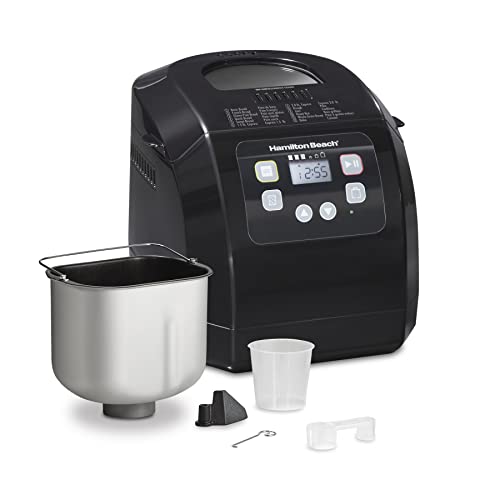
Hamilton Beach Digital Bread Maker (PFAS-Free Pan) — Best Overall Affordable
The Hamilton Beach Digital is the affordable bread machine we recommend first because it gets the whole checklist right at the tier’s center: 12 settings including a gluten-free program, a full 2 lb capacity for family loaves, a digital control panel that is genuinely easy to program, and — a detail health-conscious buyers increasingly ask about — a PFAS-free nonstick pan and paddle. Hamilton Beach has owned the value end of this category for years, and this model shows why: nothing essential is missing, nothing gimmicky is padded in. If you bake for one or two and counter space is tight, the Cuisinart Compact below is the better shape. For a household’s first or only bread machine on a budget, this is the default answer.
Strengths
- Complete core feature set: 12 settings with gluten-free, full 2 lb loaves, crust control, and straightforward digital controls anyone can learn.
- PFAS-free nonstick pan and paddle — a real differentiator for buyers avoiding forever-chemical coatings.
- Hamilton Beach’s parts and support presence at this tier: replacement pans and paddles are findable, which budget no-names cannot promise.
Trade-offs
- Single heating element: top crust runs paler than the sides unless you pick a darker crust setting.
- The gluten-free setting is a competent adaptation rather than a fully re-engineered cycle — serious GF bakers should read the guide section below.
- Kneading is audible through walls in a quiet house; overnight loaves are best scheduled so the knead phase lands before bedtime.
Key specs (verified)
- Settings: 12, including gluten-free
- Capacity: 2 lb loaf
- Pan: PFAS-free nonstick pan + kneading paddle
- Controls: digital, programmable
What makes this the tier’s benchmark is the absence of a fatal flaw. Budget bread machines usually cut one corner too deep — a pan that sheds its coating in a season, a timer that cannot be trusted overnight, a control panel that needs the manual every time. The Hamilton Beach instead spreads its compromises evenly and thinly: the crust crown is a shade pale, the knead is a bit loud, the case is light. In exchange, the loaves are consistently good across the everyday repertoire — sandwich white, whole wheat, French-style, dough cycles for pizza and rolls — and the machine asks nothing of its owner beyond ingredients in the right order. For the affordable tier, that evenness is the whole game, and it is why this machine anchors the guide.
The affordable all-rounder to buy first and regret least. Check the current price on Amazon — Hamilton Beach sells several digital models; confirm the PFAS-free pan configuration in black on the listing.
Best for: first-time buyers, families, PFAS-conscious households / Not suited for: artisan perfectionists, dedicated gluten-free specialists, tiny counters

Amazon Basics Programmable Bread Maker — Best Budget
The Amazon Basics bread maker is the pick when the budget is firm and the requirement is a real machine, not a compromise appliance. The specification is genuinely surprising at its tier position: 14 settings covering breads, doughs, and gluten-free options, an ExpressBake cycle for fast loaves, an LCD display, and a full 2 lb nonstick pan. Amazon Basics appliances are built to a checklist by contract manufacturers, and the checklist here was clearly written by someone who understood the category — nothing a beginner needs is absent. What you give up versus the Hamilton Beach is brand depth: a thinner support and parts story, and the sense of a platform refined over generations. If you are testing whether bread-machine life suits your household, this is the lowest-risk way to find out.
Strengths
- The tier’s floor position for a full 2 lb machine with a complete, genuinely useful 14-setting program list.
- ExpressBake is genuinely useful — a fresh loaf on a weeknight timeline changes how often the machine gets used.
- LCD display and a straightforward panel: the controls do not fight the beginner.
Trade-offs
- Support and replacement-part depth is thinner than Hamilton Beach or Cuisinart — a pan in year three may mean a new machine.
- Build and finish are functional; expect more plastic and less sound damping than the tier’s center.
- Program tuning is generic — whole-grain and GF results benefit from the recipe adjustments in this guide’s how-to section.
Key specs (verified)
- Settings: 14, including gluten-free options
- Capacity: 2 lb
- Feature: ExpressBake cycle
- Display: LCD
The rational case for this machine is experimentation economics. A large share of bread-machine regret is not about quality at all — it is households discovering that they bake twice and then store the machine forever. Buying the category’s floor model converts that discovery into a small lesson instead of an expensive one, while households that catch the baking habit get a machine that handles the everyday repertoire honestly in the meantime. Its ExpressBake cycle deserves a kind word: fast cycles trade some flavor development for time, but a same-evening loaf is the feature that turns a gadget into a habit, and habits are what make any bread machine — at any tier — worth its counter space.
The lowest-risk entry into bread machines, with a full feature checklist. Check the current price on Amazon — confirm the 2 lb black configuration on the listing, as Basics models vary by market.
Best for: budget-firm buyers, first-machine experimenters, weeknight ExpressBake users / Not suited for: decade-appliance expectations, heavy whole-grain specialists, support-first shoppers

Hamilton Beach Digital Bread Maker 29987 — Best Features for the Tier
The 29987 is the pick for the affordable buyer who reads spec sheets: it stretches the tier’s feature list furthest, with 14 programmable settings that include artisan and gluten-free cycles, a delay start for wake-up loaves, and a white-and-stainless finish that looks deliberate on a light kitchen counter. It shares its badge-mate’s brand strengths — real support, findable parts — while aiming at the baker who will actually use the extra programs: artisan-style doughs, varied grains, and scheduled baking as a weekly rhythm. If your baking is white and wheat on repeat, the Best Overall pick above covers you for less deliberation. If you want the affordable tier’s full program library in a finish that suits a bright kitchen, this is your machine.
Strengths
- 14 settings including a dedicated artisan cycle — the broadest and most thoughtfully chosen program library in this guide.
- Delay start makes the overnight-loaf routine dependable, the feature that turns owners into weekly bakers.
- White and stainless finish: the affordable machine that does not look like an apology on the counter.
Trade-offs
- It sits at the tier’s upper edge — close enough to mid-tier machines that promotion timing matters; compare before committing.
- Program abundance includes some you will never use; the panel rewards a read of the manual on day one.
- Single-element baking, like its sibling: expect a paler top crust on the lightest setting.
Key specs (verified)
- Settings: 14 programmable, including artisan and gluten-free
- Capacity: 2 lb loaf
- Feature: delay start
- Finish: white & stainless steel
The artisan setting is the interesting line on this machine’s spec sheet, because artisan-style baking — longer, slower fermentation profiles for crustier, more flavorful loaves — is where affordable machines usually fake it with a renamed basic cycle. Hamilton Beach’s implementation gives the dough extended rise time, which is the honest core of the style even in a pan-shaped loaf. Combined with delay start, the 29987 supports the two rhythms that define satisfied bread-machine ownership: the planned weekly loaf and the spontaneous same-day bake. It is the affordable machine for the baker who suspects — correctly, in our experience — that they will grow into their machine’s program list rather than out of it.
The affordable tier’s feature ceiling, in a finish that earns its counter space. Check the current price on Amazon — confirm the 29987 model and the white/stainless finish on the listing.
Best for: program explorers, artisan-curious bakers, bright kitchens, scheduled bakers / Not suited for: two-button minimalists, the firmest budgets, pale-crust perfectionists
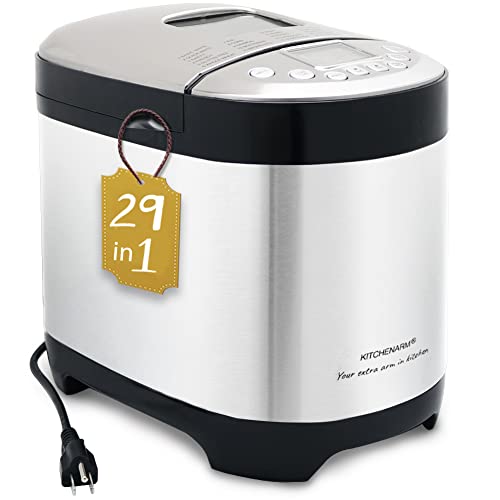
KITCHENARM 29-in-1 Smart Bread Machine — Best for Recipe Variety
The KITCHENARM 29-in-1 is the pick for the enthusiastic beginner: the baker who does not just want a loaf but wants to explore. Its 29 programs are the most in this guide by a wide margin, spanning the standard breads, whole wheat, gluten-free, doughs, and sweet cycles, and its homemade cycle lets you customize stage times once you start developing your own recipes — a feature usually reserved for premium machines. Three loaf sizes (2, 1.5, and 1 lb) suit households that bake small as often as large, the stainless housing looks the part, and recipes are included to start the experimentation immediately. If you want a machine to simply make the same loaf forever, this breadth is surplus. If variety is the point, no affordable machine offers more of it.
Strengths
- 29 programs plus a customizable homemade cycle — genuine room to grow and experiment, unique at this tier.
- Three loaf sizes down to 1 lb: small households and recipe tests waste less bread.
- Recipes included and a gluten-free setting: the experimentation starter kit is in the box.
Trade-offs
- Program abundance can overwhelm a true beginner for the first weeks — start with the basic cycles and expand deliberately.
- A newer brand than the household names here: support runs through the seller and brand channels rather than a deep retail network.
- With this many programs, some are inevitably variations on themes; the value is in the top dozen you will actually rotate.
Key specs (verified)
- Programs: 29-in-1, including gluten-free
- Loaf sizes: 2 lb / 1.5 lb / 1 lb
- Feature: homemade (custom) cycle
- Housing: stainless steel; recipes included
The homemade cycle is what elevates this machine from a long list to a real platform. Bread-machine mastery, such as it is, comes from adjusting knead, rise, and bake times to your flour, your kitchen’s temperature, and your taste — and on most affordable machines those times are locked. KITCHENARM lets you change them, which means the machine can be tuned to a stubborn whole-wheat recipe or a slow-ferment experiment instead of merely tolerating it. Combined with the 1 lb size for low-stakes tests, it is a learning machine in the best sense: cheap loaves, fast feedback, and a program library wide enough that a year of weekly baking will not exhaust it.
The affordable machine for bakers who experiment. Check the current price on Amazon — KITCHENARM sells several program-count variants, so confirm the 29-in-1 configuration on the listing.
Best for: recipe explorers, small-and-large mixed baking, gluten-free experimenters / Not suited for: set-and-forget minimalists, brand-support-first buyers

Cuisinart Compact Automatic Bread Maker CBK-110 — Best Compact Affordable
The CBK-110 is the pick for small counters that refuse small capability. Cuisinart engineered this machine around a compact footprint — it stores and sits where full-size machines cannot — while keeping a menu that embarrasses bigger rivals: 12 programs, three loaf sizes, three crust shades, a 13-hour delay start, and the detail that experienced bakers will appreciate most, a paddle-removal alert that tells you when to pull the kneading paddle before baking so the finished loaf has no paddle hole. If you bake maximum-size loaves for a crowd weekly, the full-size picks are your shape. If your kitchen is small, your household is one to three people, and you want a respected brand’s fit and finish at this tier, the Compact is the answer.
Strengths
- Compact footprint with up to 2 lb capacity — the clear space-efficiency champion of this entire guide.
- Paddle-removal alert: a thoughtful, baker-loved detail that eliminates the hole in the loaf’s bottom.
- Cuisinart’s controls, documentation, and support are a class above the budget field.
Trade-offs
- Compact means the largest loaves are tighter to the lid — very high-rising recipes need the smaller size setting.
- It sits above the tier’s floor on price; you are paying for engineering and brand, fairly but visibly.
- 12 programs is complete but not expansive — variety hunters should look at the KITCHENARM.
Key specs (verified)
- Programs: 12
- Loaf sizes: 3 sizes (up to 2 lb)
- Crust shades: 3
- Features: 13-hour delay start, paddle-removal alert
The paddle-removal alert deserves its own paragraph because it signals how Cuisinart thinks. The hole a kneading paddle leaves in a loaf’s bottom is the bread machine’s signature flaw, and the fix — removing the paddle after the final knead — is known to every experienced owner, who otherwise guesses at timing. Building an alert for that exact moment is a small feature with an outsized effect on finished-loaf quality, and it typifies the CBK-110: a machine whose spec sheet is shorter than the KITCHENARM’s but whose details are chosen by people who bake. Add the genuine compactness — this is the pick that fits the apartment, the small-house kitchen, and the counter with a coffee station already on it — and it is the most livable affordable machine here.
Small footprint, baker-grade details, a brand that answers the phone. Check the current price on Amazon — confirm the CBK-110NAS configuration on the listing.
Best for: small kitchens, couples and singles, detail-appreciating bakers / Not suited for: crowd-size weekly loaves, program maximalists, the firmest budgets

KBS 17-in-1 Bread Maker (Ceramic Pan, Dual Heaters) — Best Pan and Heating at This Tier
The KBS 17-in-1 is the pick for the buyer who reads premium spec sheets wistfully: it imports the two hardware ideas that define expensive bread machines — dual heaters for even browning and a ceramic pan instead of a coated one — into the affordable tier, then adds an automatic nut and fruit dispenser, a convection fan, a 15-hour timer, three loaf sizes up to a generous 2.2 lb class, and a touch panel in a stainless body. On paper it is the most ambitious machine in this guide. The honest counterweight is brand depth: KBS is a specialist value brand rather than a household name, so support and long-term parts run through the seller. If hardware per dollar is your metric and you accept that trade, this is the standout value in the affordable category.
Strengths
- Dual heaters plus convection: the most even browning hardware in this guide — the pale-crown problem is largely solved.
- Ceramic pan: the coating-alternative buyers ask for, with easy release and no nonstick layer to wear.
- Automatic nut dispenser and a 15-hour timer — premium conveniences, present and working at this tier.
Trade-offs
- Brand support and parts depth trail the household names; keep the seller’s information and buy with the returns window in mind.
- Feature density means a busier touch panel and more to learn in week one.
- Ceramic pans are durable but not immortal: avoid thermal shock (cold water on a hot pan) to keep it that way.
Key specs (verified)
- Programs: 17-in-1
- Heating: dual heaters + convection
- Pan: ceramic
- Features: nut dispenser, 15-hour timer, 3 loaf sizes, 3 crust colors
Dual heaters change the loaf in the way premium owners describe and budget owners doubt: with heat arriving from the lid as well as the base, the top crust sets and colors with the sides, and tall loaves bake through without a gummy crown line. Add convection to even out the chamber and the KBS produces the most oven-like loaf shape in this guide. The ceramic pan is the other half of the proposition — release performance without a polymer coating, and a surface that tolerates metal-free utensils and years of use without flaking anxiety. The package makes the KBS the guide’s hardware champion; its badge is deliberately about pan and heating, because brand infrastructure is where the Hamilton Beach and Cuisinart picks repay their own kind of value. Choose which currency you trust.
Premium hardware ideas at an affordable tier, with the brand trade-off stated plainly. Check the current price on Amazon — KBS sells several 17-in-1 variants, so confirm the dual-heater ceramic-pan configuration on the listing.
Best for: even-browning seekers, ceramic-pan preferrers, hardware value hunters / Not suited for: brand-support-first buyers, minimalists, thermal-shock careless owners
Comparison Table
| Pick | Badge | Key spec | Best for |
|---|---|---|---|
| Hamilton Beach Digital | Best Overall Affordable | 12 settings + GF, 2 lb, PFAS-free pan | Households buying one affordable all-rounder |
| Amazon Basics Bread Maker | Best Budget | 14 settings, 2 lb, ExpressBake | Firm budgets testing the bread-machine life |
| Hamilton Beach 29987 | Best Features for the Tier | 14 settings incl. artisan, delay start, 2 lb | Feature seekers and scheduled weekly bakers |
| KITCHENARM 29-in-1 | Best for Recipe Variety | 29 programs, homemade cycle, 3 loaf sizes | Experimenters and variety-driven bakers |
| Cuisinart Compact CBK-110 | Best Compact Affordable | Compact, 12 programs, paddle-removal alert | Small kitchens, one-to-three-person households |
| KBS 17-in-1 | Best Pan and Heating at This Tier | Dual heaters, ceramic pan, nut dispenser | Hardware-focused value hunters |
How to Choose an Affordable Bread Machine
Start with loaf size and household arithmetic. A 2 lb machine serves a family of four’s sandwich habit; a household of one or two is better served by a machine with a genuine 1 lb setting (the KITCHENARM or the Cuisinart Compact), because a small loaf eaten fresh beats a large loaf going stale. Then choose your compromise deliberately: every affordable machine trades something, and the picks above trade different things — features (KITCHENARM, KBS), footprint (Cuisinart), support depth (Hamilton Beach), or sheer price (Amazon Basics). The right purchase is the one whose trade-off you will never notice in your actual baking.
Then weigh the pan, because at this tier the pan is destiny. Nonstick pans are convenient and eventually wear; PFAS-free coatings answer the chemistry question; ceramic (the KBS) answers both wear and chemistry at the cost of thermal-shock care. Replacement availability matters as much as material: a machine whose pan you can reorder is a machine with a second life, which is the household brands’ quiet advantage.
- Delay timer: the single feature most correlated with weekly use — overnight loaves are the habit that justifies the machine.
- Crust control: three shades compensate for single-element paleness; dark settings are the budget baker’s browning tool.
- Dough cycle: even if you never bake in the machine, a dough cycle plus your oven covers pizza, rolls, and artisan shapes — check it is present (it is, on all six picks’ program lists or core cycles).
- Footprint and lid clearance: bread machines are tall with the lid open; measure under-cabinet space before the machine arrives.
- Noise: kneading carries. If the machine will run overnight near bedrooms, schedule the delay so kneading lands in the evening, not at 3 a.m.
Gluten-Free Baking on Affordable Machines: The Honest Version
Gluten-free bread is where the affordable tier’s limits are most real, and GF households deserve the unvarnished picture. GF dough is a batter: it needs thorough mixing, a single rise, and a bake without punch-downs. Premium machines run genuinely re-engineered cycles for this. Affordable machines’ GF settings — including on picks in this guide — are typically adaptations of standard cycles, and results with them are good-but-variable: expect to use a quality GF flour blend designed for bread machines, to scrape the pan corners mid-mix with a spatula (unmixed flour pockets are the classic affordable-GF flaw), and to accept a denser crumb than a premium cycle produces.
None of that makes affordable GF baking pointless — for many households it is the difference between fresh GF bread and none — but it does mean a household baking exclusively gluten-free for medical reasons should weigh the premium tier seriously, while a household baking occasional GF loaves for a mixed table will be well served here with the spatula trick and the right flour. Buy for your actual GF frequency, and let this guide’s flagship sibling (10 Best Bread Machines) show you what the premium cycles add if you outgrow this tier.
Making Affordable Machines Bake Above Their Tier
Three habits close most of the gap between affordable and premium results. First, weigh flour instead of scooping it: bread machines are ratio machines, and a kitchen scale removes the single largest source of loaf variability at any price. Second, use the delay timer’s flexibility in reverse — start a loaf so the bake finishes thirty minutes before you need it, and let the loaf rest in the pan briefly, then on a rack; affordable loaves eaten warm and fresh hide their tier completely. Third, learn your machine’s dark crust setting and use it without apology: it exists to compensate for single-element browning, and a well-colored affordable loaf beats a pale premium one at the table every time.
What Affordable Owners Actually Report After a Year
Patterns from long-term owners of this tier are consistent enough to shop by. The machines that stay in weekly use share three traits: a delay timer the owner trusts, a pan that still releases cleanly, and a footprint that earned permanent counter residence. The machines that migrate to cupboards share the opposite biography — an early disappointing loaf that was never diagnosed, a pan whose coating failed after aggressive washing, or a size mismatch (too big for the household’s appetite) that made every loaf feel like an obligation. None of those failure modes is about the purchase tier; all of them are addressed by the habits in this guide’s how-to and mistakes sections, which is why we weight them as heavily as the hardware.
The other consistent report is pleasant surprise at the dough cycle. Many buyers purchase for loaves and stay for dough — pizza bases, focaccia, cinnamon rolls, and naan all begin as an affordable machine’s dough program and finish in a hot oven with a quality no pan loaf matches. If you are deciding between two picks in this guide and one household member bakes shaped breads, let the dough cycle’s convenience break the tie; it is the feature that most expands what ‘affordable’ turns out to mean.
Budget Framing for the Affordable Tier
Within this tier, positions are best understood relatively. The Amazon Basics anchors the floor — the experimenter’s price. The Hamilton Beach Digital and the Cuisinart Compact occupy the center, spending their increment on support, finish, and details. The 29987, KITCHENARM, and KBS sit at the tier’s upper edge, each converting the increment into a different currency: programs, customization, or hardware. Because this entire category is promotion-prone, the practical advice is to choose by fit from this guide, then check the current price on Amazon and let a good week choose your moment — never let a discount talk you into the wrong feature set.
How to Bake Your First Loaf in an Affordable Bread Machine
First-loaf success is a procedure, not a talent. This sequence works in every machine in this guide and prevents the five classic beginner failures.
- Order matters — liquids first: water or milk, then oil or butter, then flour covering the liquid completely, then salt and sugar in separate corners, and yeast last in a small well in the flour, dry and untouched by liquid until the cycle starts.
- Weigh the flour: a cup of flour varies wildly by scooping; a scale does not. Use the recipe’s weight if given, or the flour maker’s standard conversion, and your loaves become repeatable.
- Choose the right program and size: match the cycle to the recipe (basic for white, whole wheat for grain-heavy), set the loaf size you actually loaded, and pick medium crust for your first loaves.
- Check the dough at ten minutes: peek during the first knead. The dough should form a smooth, slightly tacky ball. Too dry and shaggy — add water a teaspoon at a time. Too wet and soupy — add flour a tablespoon at a time. This one check rescues more loaves than any other habit.
- Resist opening the lid after the rise begins: heat and steam escape, and the loaf’s crown suffers. Watch through the window if your machine has one.
- Remove, rest, then slice: turn the loaf out promptly (shake it free; fish the paddle out with the hook tool if it baked in), rest it on a rack at least thirty minutes, and slice with a serrated knife. Cutting hot bread gums the crumb at every tier.
If the first loaf disappoints, diagnose before you despair: a collapsed top usually means slightly too much liquid or yeast for your kitchen’s warmth; a dense brick usually means old yeast or too little liquid; a floury corner means the dough-ball check was skipped. Every one of those is a one-variable fix, and the second loaf is where bread machines start paying rent.
Common Buying Mistakes
- Letting yeast touch liquid in a delay-timer loaf. Yeast that hydrates early starts fermenting hours before the cycle — the loaf over-rises and collapses. Yeast goes last, dry, in its flour well.
- Scooping flour from the bag. Compacted scoops can add a quarter more flour than the recipe intends. Weighing flour is the cheapest upgrade in all of baking.
- Judging the machine by the first loaf. First loaves carry beginner variables — old yeast, guessed flour, wrong size setting. Give any machine three loaves before a verdict.
- Ignoring the dough-ball check. Ten minutes into kneading, one look and a teaspoon adjustment prevents the dense brick and the soupy collapse alike.
- Washing the pan aggressively. Nonstick and ceramic pans want soaking and a soft sponge, never scouring or thermal shock. The pan’s surface is the machine’s lifespan.
- Buying features instead of fit. A 29-program machine for a white-loaf household is surplus; a basic machine for an experimenter is a ceiling. Match the machine to the baker you actually are today, with one eye on the baker you might become this year.
Final Recommendation
For most households, the answer is the Hamilton Beach Digital: the complete, supported, PFAS-free-pan all-rounder at the tier’s center. Buy the Amazon Basics if the budget is firm, the Hamilton Beach 29987 for the fullest feature set, the KITCHENARM 29-in-1 if you will experiment, the Cuisinart Compact for a small counter, and the KBS 17-in-1 for dual heaters and a ceramic pan. Check the current price on Amazon for whichever you choose.
Going deeper on the category? These guides in the same series cover the neighboring decisions: Best Amateur Bread Making Machines, Best 2 Lb Bread Machines, Best Bread Machines Under $100, 10 Best Bread Machines, Best Bread Machines For Sourdough, and Best American Made Bread Machines.
Frequently Asked Questions
Can an affordable bread machine really make good bread?
Yes — genuinely good everyday bread: sandwich loaves, whole wheat, French-style, and doughs for pizza and rolls. The affordable tier’s compromises show in top-crust color, program sophistication for tricky doughs, and long-term build, not in the basic ability to produce a fresh, well-risen loaf. Technique (weighed flour, the dough-ball check) closes most of the remaining gap.
How long will an affordable bread machine last?
With normal care — gentle pan washing, correct recipes, no chronic overloading — expect years of regular service from the branded picks in this guide. The pan’s coating is usually the first wear item, which is why replacement-pan availability (a household-brand strength) and pan material (the KBS’s ceramic) matter in the buying decision.
What size machine should I buy for a family of four?
A 2 lb machine is the family standard: it covers sandwiches and toast for a household without baking daily. Smaller households should prefer a machine with honest 1 and 1.5 lb settings so loaves are eaten fresh — stale bread is the real cost of oversizing.
Is the delay timer safe to use overnight?
Yes, with ingredient discipline: use recipes designed for delayed starts, keep perishables in mind (milk and eggs sitting at room temperature for many hours are a judgment call — many bakers use water and dried milk for overnight loaves), and keep yeast dry and separated from liquid until the cycle starts. Scheduled so kneading does not land at 3 a.m., it is the feature owners love most.
Why did my loaf collapse or come out dense?
Collapse usually means too much liquid or yeast for your conditions, or yeast that activated early on a delayed cycle. Density usually means too little liquid, old yeast, or flour measured by heavy scooping. Both are one-variable fixes — adjust liquid by a tablespoon, check your yeast’s freshness, and weigh flour — and the dough-ball check ten minutes into kneading catches most cases before they bake.
Can these machines make dough for pizza and rolls?
Yes — the dough cycle (present across these picks’ program sets) mixes, kneads, and proofs dough that you then shape and bake in your oven. For many owners this becomes the machine’s most-used function: pizza Fridays, cinnamon rolls, and dinner rolls all start as a dough cycle, and it is the easiest way to get artisan-shaped results from an affordable machine.


