Disclosure: airfryerkitchensupply.com is reader-supported. When you buy through links on our site, we may earn an affiliate commission at no extra cost to you.
Where to buy
Shopping for the best bread machines with custom programs starts with a distinction most listings blur: a machine with many presets is not the same as a machine with a true custom cycle, where you set the knead, rise and bake times yourself. Every pick below is sold on Amazon, each model name links to its listing so you can check price on Amazon, and the reviews state plainly which kind of ‘custom’ each machine actually offers you — because that difference is the entire point of this particular brief.
- KITCHENARM 29-in-1 Smart Bread Machine — check price on Amazon
- Breville Custom Loaf BBM800XL — check price on Amazon
- Zojirushi Home Bakery Virtuoso Plus BB-PDC20BA — check price on Amazon
- Cuisinart Convection Bread Maker CBK-210 — check price on Amazon
- KBS 17-in-1 Bread Maker, 710W, Dual Heaters — check price on Amazon
- Elite Gourmet Programmable Bread Maker EBM8103SS, 19 Presets — check price on Amazon
The best bread machines with custom programs exist for the moment a preset lets you down. It happens to every serious home baker eventually: the sourdough that needs a longer rise than the whole-wheat cycle allows, the enriched dough that proofs too fast on the standard program, the recipe from a grandmother or a forum that assumes you control the timing because, in an oven workflow, you do. Presets are averages; custom programs are authorship.
True customisation in a bread machine means a homemade or custom cycle where the stages — kneading time, rest, rising time, baking time, sometimes temperature behaviour — can be adjusted and, ideally, remembered. Some machines on this list offer exactly that. Others offer very deep preset libraries and partial adjustments, which serve many bakers just as well. This guide separates the two honestly, because buying a preset library when you needed a custom cycle — or the reverse — is the classic disappointment in this category.
The audience for this brief is specific: bakers who already make bread, already know which stage they want to change, and are shopping for control rather than convenience. If you are new to bread machines, read the final FAQ before buying anything here — a good preset machine may serve you better for the first year, and the guide says so without snobbery.
Every pick was verified by brand and model against the retailer’s catalog data before receiving a link, and the spec boxes quote only what those verified listings confirm: program counts, loaf sizes, timers and features named in the listing itself. No prices and no ratings are printed, because both change too often to matter; control, capacity and crust are what you are buying.
In this guide
Quick Picks
Six machines spanning true custom cycles, deep preset libraries and one premium control flagship. Badges match the full reviews, and each quick line states the kind of control on offer — read that phrase carefully, because it is the decision. If you finish this page and buy a machine whose control class matches the complaint in your baking notebook, the guide has done its entire job.
- Best Overall for Custom Programs: KITCHENARM 29-in-1 Smart Bread Machine — a 29-in-1 machine with a dedicated Homemade cycle for setting your own stage timing, across 1, 1.5 and 2 lb loaves.
- Best Premium Custom Control: Breville Custom Loaf BBM800XL — the flagship whose name is the brief — custom settings for the baker who wants to control every detail, with a collapsible kneading paddle and automatic fruit and nut dispenser.
- Best for Serious Bakers: Zojirushi Home Bakery Virtuoso Plus BB-PDC20BA — a 2 lb flagship with dual heaters, gluten-free and whole-wheat programs and a 13-hour timer — the even-bake choice for demanding doughs.
- Best Program Variety: Cuisinart Convection Bread Maker CBK-210 — 16 programs including a sourdough starter cycle, a convection fan for artisan crust and an automatic mix-in dispenser, in a 2 lb machine.
- Best Value with Dual Heaters: KBS 17-in-1 Bread Maker, 710W, Dual Heaters — 17 programs, dual heaters, a ceramic pan and a nut dispenser across three loaf sizes and three crust colours — flagship hardware ideas at a value tier.
- Best Budget Presets: Elite Gourmet Programmable Bread Maker EBM8103SS, 19 Presets — 19 presets across three loaf sizes with gluten-free, dough and jam cycles and a delay timer — the budget library for bakers exploring before they customise.
How These Picks Were Chosen
The first filter was the nature of the customisation itself. Machines were classified by what the baker can actually change: full stage-by-stage timing on a homemade cycle at the top, adjustable stages within cycles next, then deep preset libraries whose variety substitutes for customisation. Every review names its machine’s class plainly, so a buyer who needs to stretch a rise by forty minutes can see immediately which picks can do it.
The second filter was that the rest of the machine had to deserve the control: a custom cycle is wasted on a pan that bakes unevenly or a motor that struggles with whole-grain dough. Heating design, pan quality and kneading hardware were weighed alongside the electronics, because the loaf in the pan is the final judge of every program ever written.
The third filter was memory and repeatability. A custom program you must re-enter every bake is a preset with extra steps; the better machines remember your cycle, and that behaviour — confirmed in the verified listings where stated — scored heavily for bakers with a signature loaf.
Bread fundamentals were never traded away: loaf-size range, crust control, a delay timer for morning bread, and a keep-warm or equivalent finish all had to be present and credible. Custom control on a machine missing the basics is a laboratory instrument, not a kitchen appliance.
Finally, verification: brand and model cross-checked against catalog data, links only for confirmed products, specs only from confirmed listing titles. Where a listing’s language about customisation is vague, the review says so and tells you what to confirm — this category’s marketing needs that scepticism more than most.
The 6 Best Bread Machines with Custom Programs
The list opens with the true-custom machines, moves through the premium control flagship and the deep-preset alternatives, and closes with the honest budget route for learners. If you already know the stage timing you want to change, the first three picks are your shortlist; if you want variety without programming, start at pick four.
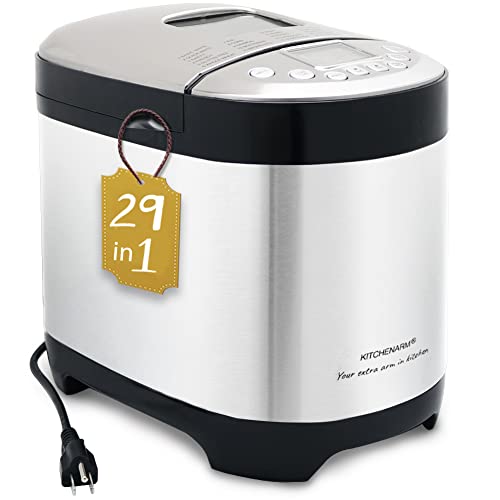
KITCHENARM 29-in-1 Smart Bread Machine — Best Overall for Custom Programs
The KITCHENARM earns the top badge by answering the brief most literally: alongside its 29 programs sits a Homemade cycle — the mode where the baker, not the factory, decides how long the dough kneads, rests, rises and bakes. That is the feature sourdough bakers, low-and-slow fermenters and recipe tinkerers are actually shopping for, and it is surprisingly rare at this machine’s mid-range tier, where most rivals offer presets and call it customisation.
The surrounding machine supports the ambition. Three loaf sizes — 1, 1.5 and 2 lb — mean the custom cycle serves a small experimental loaf and a family loaf alike, the gluten-free setting covers the other classic preset failure case, and the stainless build suits a machine that will live on the counter through a baker’s whole learning curve. Recipes are included to start from, which matters: a homemade cycle is only as good as the baseline timings you adapt.
Honesty about the learning curve: a custom cycle’s first loaves are experiments, and some will fail in instructive ways. The machine gives you the controls; it cannot give you the judgement, which comes from a notebook and a dozen bakes. Bakers who want the machine to simply know how bread works should look at the preset-rich picks below instead — this one’s promise is control, and control includes the freedom to be wrong.
For the tinkerer, though, nothing else at its tier comes close. Set the long rise your sourdough wants, save the short cycle your weekday sandwich loaf needs, and the machine becomes an instrument of your recipes rather than a vending machine for its own. That is what this search means, and this is the machine that means it back.
One more practical virtue: the 1 lb size is the experimenter’s friend. Custom baking is iteration, and iteration at 1 lb costs half the flour and half the disappointment of iteration at 2 lb. Machines that force full-size experiments tax the learning process itself; this one’s size range quietly subsidises it, and over a year of development that subsidy is worth real money and real morale.
Strengths
- Dedicated Homemade cycle with baker-set stage timing
- 29 programs cover the preset needs alongside the custom work
- Three loaf sizes make experiments and family loaves equally practical
Trade-offs
- Custom cycles demand baker judgement; early loaves are experiments
- Interface learning curve is steeper than preset-only machines
- Mid-range build rather than premium heft
| Specification | Detail |
|---|---|
| Programs | 29-in-1, including a Homemade cycle |
| Loaf sizes | 1 lb, 1.5 lb, 2 lb |
| Settings | Gluten-free setting included |
| Body | Stainless steel |
Best for: tinkerers and sourdough bakers who know which stage they want to change / Not suited for: beginners wanting the machine to decide everything
Check the current price on Amazon.

Breville Custom Loaf BBM800XL — Best Premium Custom Control
Breville built this machine around the exact promise in the search: control every detail. The Custom Loaf’s settings let the baker adjust the stages of the bake to their own recipes rather than the factory’s, and it wraps that control in the two hardware ideas bread-machine bakers ask for most — a collapsible kneading paddle that folds down before baking so the loaf’s base is not torn by a paddle hole, and an automatic fruit and nut dispenser that adds mix-ins at the right moment without a human hovering with a handful of raisins.
That dispenser deserves emphasis for custom bakers specifically, because experimental loaves are so often mix-in loaves: the olive bread, the seeded multigrain, the cinnamon-raisin that needs its fruit late and gentle. Automating the addition keeps the experiment reproducible — and reproducibility is the difference between a discovery and an anecdote.
The premium tier buys the rest of the flagship experience: brushed stainless build, crust settings to fine-tune the finish, and the general sense of an appliance engineered rather than assembled. Its honest costs are the price position itself and a footprint that assumes a serious baker’s counter. Casual bakers will not use half of what it offers, and this guide will not pretend otherwise.
Choose it when bread is a craft you practise weekly and the machine is a long-term instrument. Between this and the KITCHENARM, the decision is finish and hardware elegance versus value — both deliver real custom control, which is more than most of this category can say.
There is a teaching argument for it too: a machine whose every stage is visible and adjustable makes the baking process legible to a learner in a way a sealed preset never does. Bakers who develop on the Breville tend to understand why their loaves behave as they do — and that understanding transfers to oven baking, to other machines, to bread itself. Flagships are sometimes indulgences; this one is also an education.
Strengths
- Custom settings put stage control in the baker’s hands
- Collapsible paddle prevents the classic torn loaf base
- Automatic dispenser makes mix-in experiments reproducible
Trade-offs
- Premium tier pricing
- Capability exceeds what casual bakers will ever use
- Large footprint for a serious counter commitment
| Specification | Detail |
|---|---|
| Model | BBM800XL Custom Loaf |
| Paddle | Collapsible kneading paddle |
| Dispenser | Automatic fruit & nut dispenser |
| Finish | Brushed stainless steel |
Best for: serious weekly bakers wanting flagship control and hardware / Not suited for: occasional bakers, who pay for control they will not exercise
Check the current price on Amazon.

Zojirushi Home Bakery Virtuoso Plus BB-PDC20BA — Best for Serious Bakers
The Virtuoso Plus approaches custom baking from the hardware side: dual heaters — including a lid heater — produce the even, well-browned 2 lb loaf that single-element machines struggle to match, and even baking is the foundation every custom program stands on. A baker can perfect a rise schedule, but if the top of the loaf bakes pale while the base darkens, the experiment is ruined by physics, not timing.
Its program set is aimed at the demanding end of home baking: gluten-free and whole-wheat programs are named in its verified listing, and those are precisely the doughs whose behaviour varies most from recipe to recipe and baker to baker. Combined with the 13-hour timer, the machine suits a household whose bread life runs on schedules — dough set up at night, loaf ready at breakfast, experiments running while the house is at work.
Where this pick differs from the two above is emphasis: it is the choice for bakers whose customisation lives as much in recipe development — hydration, flour blends, timing around the machine’s strong programs — as in reprogramming the machine itself. Zojirushi’s reputation in this category is built on exactly that reliability, bake after bake, year after year.
The tier is premium and the machine is a substantial counter presence. Buy it when loaf quality is the obsession and control is the tool, rather than the other way round — and when a 2 lb family loaf is your standard unit, because this platform is sized for exactly that.
Its dual heaters also forgive the custom baker’s commonest timing sin: the slightly-too-long final rise. A loaf that enters the bake a touch over-proofed is rescued, in part, by heat arriving evenly from above and below at once, setting the structure before the weakness shows. No heater fixes a ruined dough — but even heat widens the window in which good dough becomes good bread, and experimental bakers live in that window.
Strengths
- Dual heaters bake the most even, well-browned loaves here
- Programs target the demanding doughs: gluten-free and whole wheat
- 13-hour timer fits bread around real schedules
Trade-offs
- Premium tier pricing and a substantial footprint
- Control emphasis is recipe-side more than full stage programming
- 2 lb format is more than small households need
| Specification | Detail |
|---|---|
| Capacity | 2 lb loaf |
| Heating | Dual heaters |
| Programs | Gluten-free and whole-wheat programs included |
| Timer | 13-hour delay timer |
Best for: quality-obsessed bakers of 2 lb loaves and demanding doughs / Not suited for: small households or buyers wanting the cheapest route to a custom cycle
Check the current price on Amazon.

Cuisinart Convection Bread Maker CBK-210 — Best Program Variety
The CBK-210 represents the other legitimate answer to this brief: not a programmable cycle, but a program library deep and thoughtful enough that the cycle you need probably already exists. Sixteen programs include the one that matters most to this audience — a sourdough starter program, the machine tending the preferment that home bakers otherwise babysit — and a convection fan works the crust toward the artisan finish that standard machines bake too soft.
The automatic mix-in dispenser repeats the Breville’s best trick at a lower tier: seeds, nuts and fruit added at the machine’s chosen moment, keeping experimental loaves reproducible. For many bakers, that combination — starter program, dispenser, convection crust, 2 lb capacity — covers every experiment they will actually run, without a single timing value ever being keyed in by hand.
The honest boundary is the one this guide draws for the whole category: if your recipe needs a rise of a specific length that no program offers, a library cannot invent it. Bakers with a known, non-negotiable custom timing should buy the KITCHENARM or the Breville. Bakers whose customisation is exploratory — trying the starter, the seeded loaf, the crust experiment — will find this machine’s variety the more enjoyable tool.
It is also the social pick: a machine a household can share, where one baker programmes nothing and still produces the sourdough, while another explores the library. Not every kitchen contains only tinkerers, and this machine respects that.
The starter program deserves a second word, because it changes a household routine beyond the loaf: a machine that tends a preferment frees the baker from the jar-on-the-counter, feed-it-twice-a-day discipline that makes sourdough feel like a pet. For bakers whose sourdough ambitions died of scheduling rather than skill, that single program can resurrect the whole practice.
Strengths
- Sourdough starter program tends preferments automatically
- Convection fan produces a more artisan-style crust
- Mix-in dispenser keeps seeded and fruited loaves consistent
Trade-offs
- A deep library, not a fully programmable cycle
- Convection fan adds a moving part to maintain
- 2 lb format only
| Specification | Detail |
|---|---|
| Capacity | 2 lb |
| Programs | 16, including sourdough starter |
| Heating | Convection fan for artisan crust |
| Dispenser | Automatic mix-in dispenser |
Best for: exploratory bakers who want variety without programming / Not suited for: bakers with one specific timing no preset offers
Check the current price on Amazon.

KBS 17-in-1 Bread Maker, 710W, Dual Heaters — Best Value with Dual Heaters
The KBS is the value engineer’s answer: take the hardware ideas that distinguish the flagships — dual heaters for even baking, a dispenser for mix-ins, multiple loaf sizes and crust colours — and deliver them in a 17-program machine at a far friendlier tier. Its ceramic pan will please bakers who prefer to avoid conventional nonstick surfaces, and the touch panel keeps the seventeen programs navigable rather than bewildering.
For the custom-minded, its case is breadth plus hardware: seventeen programs cover the standard map of home baking thoroughly, and the dual heaters mean the loaves those programs produce bake evenly enough to judge recipes by. A baker developing their own formulas needs, above all, a machine whose results are consistent enough to learn from — and consistency is what the second heater buys.
The boundaries match its tier: this is preset breadth, not a homemade cycle, and the long-term parts ecosystem of a value brand is thinner than Zojirushi’s or Breville’s. The 15-hour timer is the longest here, which schedulers will note. Judge it as the machine that brings flagship baking physics to a value purchase, and it is very easy to recommend.
It suits the baker whose customisation is recipe-side — flours, hydration, seeds, timing around the delay start — and who would rather spend the flagship difference on a year of good flour. That is not a compromise position; it is how most real baking development actually happens.
The ceramic pan deserves its own sentence in a custom context: experimental doughs — high-hydration, heavily seeded, sweetly enriched — release from ceramic forgivingly, and a pan that releases cleanly keeps experimental loaves intact for judging. A torn experimental loaf teaches nothing; the KBS’s pan is, in that small way, a learning tool.
Strengths
- Dual heaters deliver even bakes at a value tier
- Ceramic pan suits nonstick-averse bakers
- 17 programs, 3 loaf sizes, 3 crust colours and a 15-hour timer
Trade-offs
- Preset breadth rather than a true programmable cycle
- Value-brand parts and support ecosystem is thinner
- 710W is modest for the heaviest whole-grain doughs
| Specification | Detail |
|---|---|
| Power | 710W, dual heaters |
| Programs | 17-in-1 |
| Pan | Ceramic pan |
| Timer | 15-hour delay timer |
| Extras | Nut dispenser, touch panel, 3 loaf sizes, 3 crust colours |
Best for: recipe-developing bakers who want even bakes on a budget / Not suited for: bakers who specifically need to program stage timing
Check the current price on Amazon.

Elite Gourmet Programmable Bread Maker EBM8103SS, 19 Presets — Best Budget Presets
The EBM8103SS is the honest budget entry in this category: nineteen presets — a library as deep as machines costing far more — covering bread, gluten-free baking, dough for the oven and even jam, across three loaf sizes up to 2 lb, with a delay timer for the morning loaf. For a baker who suspects they will one day want custom control but is not yet sure which stage they would change, this is how you find out, cheaply.
That discovery function is its real value. A season with nineteen presets teaches a baker their own preferences — which rises feel short, which bakes feel long, which doughs the presets serve badly — and that knowledge is the entry requirement for using a custom cycle well. Bought in that spirit, the Elite Gourmet is not a compromise; it is tuition at a very reasonable rate.
Its limits are the budget tier’s usual ones: build and finish are functional rather than luxurious, the programs are fixed with no homemade cycle hiding in the menu, and the heaviest whole-grain doughs will test its kneading more than the flagships’. Within its library, though, the loaves are credible and the jam cycle is a small delight nobody expects.
Choose it as the explorer’s machine: first bread maker, second machine for the holiday house, or the discovery tool before a flagship purchase. Bakers who already know their custom timing should not stop here — but bakers still learning what they want will not waste a season with it.
Strengths
- 19 presets give flagship-depth variety at a budget tier
- Dough and jam cycles extend it beyond loaf duty
- Three loaf sizes and a delay timer cover household basics
Trade-offs
- No custom or homemade cycle — presets only
- Functional build rather than premium finish
- Heavy whole-grain doughs test its kneading limits
| Specification | Detail |
|---|---|
| Capacity | 2 lb, 3 loaf sizes |
| Programs | 19 presets including gluten-free, dough and jam |
| Timer | Delay timer |
| Finish | Stainless |
Best for: beginners and explorers learning what control they actually need / Not suited for: bakers who already know the exact timing they want to set
Check the current price on Amazon.
Comparison Table
| Pick | Badge | Key spec | Best for |
|---|---|---|---|
| KITCHENARM 29-in-1 Smart Bread Machine | Best Overall for Custom Programs | 29-in-1 programs with Homemade cycle, 1/1.5/2 lb loaf sizes, stainless steel | tinkerers and sourdough bakers who know which stage they want to change |
| Breville Custom Loaf BBM800XL | Best Premium Custom Control | Custom settings, collapsible kneading paddle, automatic fruit & nut dispenser, brushed stainless steel | serious weekly bakers wanting flagship control and hardware |
| Zojirushi Home Bakery Virtuoso Plus BB-PDC20BA | Best for Serious Bakers | 2 lb capacity, dual heaters, gluten-free and whole-wheat programs, 13-hour timer | quality-obsessed bakers of 2 lb loaves and demanding doughs |
| Cuisinart Convection Bread Maker CBK-210 | Best Program Variety | 16 programs including sourdough starter, convection fan, automatic mix-in dispenser, 2 lb | exploratory bakers who want variety without programming |
| KBS 17-in-1 Bread Maker, 710W, Dual Heaters | Best Value with Dual Heaters | 17-in-1 programs, 710W dual heaters, ceramic pan, nut dispenser, 15-hour timer | recipe-developing bakers who want even bakes on a budget |
| Elite Gourmet Programmable Bread Maker EBM8103SS, 19 Presets | Best Budget Presets | 19 presets, 2 lb capacity, 3 loaf sizes, delay timer, stainless finish | beginners and explorers learning what control they actually need |
How to Choose the Best Bread Machines with Custom Programs
Define ‘custom’ before you shop
The category’s central ambiguity is the word itself. True custom means a cycle whose stage timings you set: knead length, rise length, bake length. Partial custom means adjusting within a preset — a darker crust, a different size, occasionally a stage tweak. Preset depth means many fixed cycles. All three are sold under the same vocabulary, so the first act of choosing is deciding which one your baking actually requires. If you can name the stage and the minutes you want to change, you need the first. If you cannot, you almost certainly need the second or third, whatever the marketing implies.
Match control to your doughs
Sourdough and long-ferment doughs are the strongest argument for true custom cycles, because their rises vary with starter strength and kitchen temperature in ways no preset anticipates. Enriched doughs argue for gentler, adjustable kneading. Gluten-free doughs — which do not knead or rise like wheat at all — argue for a dedicated program from a maker who understands them, which several picks here provide. List your three most-baked loaves and check them against each machine’s control class before anything else.
Do not let control eclipse the loaf
A programmable cycle in a machine that bakes unevenly produces precisely-timed mediocrity. Heating design — the dual heaters and convection fans in this list — pan quality and kneading strength decide the loaf you actually eat. Weigh the hardware paragraphs of each review as heavily as the program counts; the best custom machines here earned their places on both.
Anatomy of a Bake: Where Custom Timing Actually Matters
A bread machine cycle is a sequence: knead, rest, knead again, rise, shape-down, rise again, bake. Presets fix each stage’s length from test-kitchen averages. Custom control matters where your dough departs from the average — and it departs in predictable places. Rise stages are the big one: a vigorous starter in a warm kitchen can over-proof on a standard rise, while a cold kitchen and a stiff whole-grain dough under-proof on the same setting. Bakers who adjust one thing adjust the rise.
Knead length is the second lever: fragile enriched doughs and gluten-free batters both suffer from standard kneading, one by overworking, the other by pointlessness. Bake length is the third — the difference between a pale, soft loaf and a deep, crisp one is often ten minutes and a crust setting. A custom cycle that exposes rise, knead and bake covers nearly every real adjustment home bakers make, which is why those three levers, not program count, are the specification to shop for.
Keep-warm and delay behaviour complete the picture: a custom loaf finished an hour before breakfast should hold gracefully, and a delay timer should work with your cycle, not just the factory’s. Confirm both on the listing of any machine you shortlist — they are the difference between a program that fits your life and one that fits a laboratory.
Loaf Sizes, Crusts and the Household Arithmetic
Custom control does not repeal household maths. A machine whose custom cycle only serves a 2 lb loaf forces experimental bakers to develop recipes at family scale — wasteful when the experiment fails, which experiments do. The picks with 1 lb options earn quiet praise here: a small test loaf is the custom baker’s unit of learning, and halving an experiment halves its cost in flour, time and pride.
Crust control deserves its paragraph, because it is the adjustment even preset loyalists use weekly. Light, medium and dark settings are crude compared with bake-time control, but they are honest: the same loaf, finished three ways, for three family members’ preferences. Machines that combine crust settings with genuine bake-time adjustment give the baker both the coarse and the fine tool, and the reviews note which picks do.
Finally, consider who else uses the machine. A custom flagship in a household of preset users needs its standard cycles to be as good as its custom ones — a point in favour of the deep-library machines for shared kitchens. The best machine is the one the whole household can operate on their own terms, with the custom cycle waiting, patiently, for the baker who needs it.
Presets Versus Programming: An Honest Truce
This guide refuses to declare a winner, because the two philosophies serve different bakers at different seasons. Presets encode other bakers’ experience: for standard loaves, they are usually right, and they are always effortless. Programming encodes yours: for your starter, your flour, your kitchen’s cold corner, it can be righter — after the experiments that make it so.
The practical path most serious bakers walk is sequential: a preset-rich machine first, a notebook always, and a custom-cycle machine when the notebook fills with the same complaint — ‘the rise is twenty minutes short’ — written a dozen times. If that sentence is already in your notebook, you have outgrown presets and this list’s first three picks are your destination. If it is not, buy the library, keep the notebook, and let the machine teach you what to want.
How to Set Up Your First Custom Bread Program, Step by Step
The method below works on any true custom or homemade cycle, including the KITCHENARM and Breville picks above. The principle is conservative: change one stage at a time, from a known-good baseline, and write everything down. Custom programs reward method and punish enthusiasm.
- Start from the closest preset available. Bake your recipe once on the nearest standard program and judge the loaf cold and honestly: crust, crumb, flavour, height. That loaf is your baseline; every change is measured against it.
- Diagnose one fault only, honestly. Dense and tight usually means under-proofed or under-kneaded. Collapsed or flying crust means over-proofed. Pale means under-baked. Pick the single fault that matters most — the custom cycle will fix them in order, not all at once.
- Adjust the matching stage by a small step. Rise changes of ten to fifteen minutes, bake changes of five to ten, knead changes of two to three. Small steps keep cause and effect legible; a loaf that improves tells you exactly why.
- Record absolutely everything. Flour, hydration, starter state, kitchen temperature, the timings you set, the result. The notebook is the real custom program — the machine merely executes it. Bakers who skip this step re-run the same experiments forever.
- Bake the identical loaf again. One success is weather; two is a program. When the same settings produce the same loaf twice, save or note the cycle as your standard for that recipe.
- Then, and only then, change the recipe. With the machine’s timing proven, flour blends and hydration become the variables. Separating machine experiments from recipe experiments is what makes home baking development feel like progress instead of roulette.
- Review monthly. Starters strengthen, kitchens warm and cool with seasons, flour varies by bag. A custom program is a living setting, and a five-minute monthly review keeps it calibrated to your actual kitchen.
Troubleshooting the common custom-cycle failures: a loaf that over-proofs on your longer rise wants less yeast, not a shorter rise — adjust the ingredient before surrendering the schedule. A crust that darkens too fast on a longer bake wants the bake split — full heat early, gentler finish if your machine allows, or a slightly lower hydration dough that colours slower. A dough that kneads to shreds on enriched recipes wants its butter added late, after the first knead has built the structure.
And a word on sourdough specifically: starter strength is the hidden variable in every custom program. Feed the starter on a schedule for a week before judging a new cycle, or you will calibrate the machine to a starter that no longer exists. Consistency upstream is what makes customisation downstream meaningful.
Common Buying Mistakes
Buying presets and calling them custom. Nineteen programs are nineteen opinions, not control. If you need a specific rise length, only a homemade or custom cycle provides it — check the class before the count.
Changing three stages at once. A loaf that changes tells you nothing about why. One stage, one small step, one bake, one notebook entry — that is the entire method.
Skipping the notebook. Custom programs without records are just presets you invented once and forgot. The notebook is the difference between development and wandering.
Judging the loaf warm. Crumb sets as bread cools; a loaf cut hot seems gummy whatever the program did. Judge cold, or at least cool, before adjusting anything.
Programming before learning the presets. A season on standard cycles teaches what normal looks like — without that baseline, custom settings have nothing to be measured against.
Ignoring the hardware for the software. Uneven baking ruins perfectly timed loaves. Heaters, pan and kneading strength are half the purchase; the program count is the other half.
Trusting printed prices or ratings in guides. Neither describes stage control, heater design or pan quality. Check price on Amazon when you buy, and shop the control class first.
Final Recommendation
If you know the stage you want to change, buy the control directly: the KITCHENARM 29-in-1 puts a genuine Homemade cycle at a mid-range tier, and the Breville Custom Loaf wraps the same philosophy in flagship hardware with the collapsible paddle and dispenser that bakers dream about. The Zojirushi Virtuoso Plus serves the baker whose customisation is recipe-deep and whose standard is the loaf itself.
If your customisation is exploratory, the Cuisinart CBK-210’s starter program and convection crust, the KBS’s dual-heater value, and the Elite Gourmet’s budget library each offer a season of discovery at their tiers. The only wrong purchase here is a mismatch of class — presets bought by a programmer, or programming bought by a beginner — and this guide has tried to make that mismatch impossible to commit accidentally.
The rest of the cluster sharpens the picture: Best Bread Making Machines, Best Bread Machines With Removable Paddle, Best 2 Lb Bread Machines, Best Affordable Bread Machines and 10 Best Bread Machines cover the general, hardware and budget angles of the same machines.
Frequently Asked Questions
What is a custom or homemade cycle on a bread machine?
It is a program whose stage timings — kneading, resting, rising, baking — are set by the baker instead of the factory. You use it when a recipe or a dough behaves differently from the preset averages: a sourdough needing a longer rise, an enriched dough needing gentler kneading, a bake that wants ten more minutes. Machines differ in which stages they expose, so check the listing and manual for the stages you specifically need.
Do I need custom programs as a beginner?
Almost certainly not yet — and that is said kindly, not dismissively. Beginners benefit from presets precisely because they encode experienced bakers’ timing while you learn what dough should look and feel like. After a season of regular baking, you will start noticing the same preset limitation repeatedly; that noticing is the signal that a custom cycle has become worth buying.
Can a custom program fix my sourdough?
It can fix the schedule, which is usually the problem: sourdough rises on the starter’s timetable, not the wheat preset’s, and a custom cycle lets the machine wait for the dough instead of the clock. It cannot fix a weak starter, cold kitchen or wrong hydration — those are ingredient and environment problems. Feed the starter consistently first, then calibrate the cycle to it.
What is the difference between 29 programs and a custom cycle?
Program count measures variety; a custom cycle measures authority. Twenty-nine presets are twenty-nine fixed opinions about timing, however excellent. One homemade cycle is a blank page. Many machines — the KITCHENARM here included — offer both, which is the complete toolkit: presets for the standard loaves, the blank page for yours.
Why does the paddle hole matter to custom bakers?
Because experimental loaves are judged critically, and a paddle baked into the base tears the crumb and ruins the slice. Collapsible paddles, like the Breville’s, fold away before baking; removable paddles let you take the paddle out after the final knead. Either solution protects the loaf your custom program worked to create — the sibling guide in the final section covers that hardware question in full.
Can I use a delay timer with a custom program?
On many machines, yes, but confirm it on the listing or manual for your specific model, because the combination of delay and custom cycles varies. Also apply ingredient judgement: delay works beautifully for lean doughs, cautiously for egg- and milk-rich ones that should not sit at room temperature for many hours. The timer is a tool; the recipe still has to suit it.
A related scheduling trick for custom bakers: use the dough-only cycle with your custom timings, then shape and bake in the oven. The machine does the kneading and controlled rising it is good at, and the oven provides the crust and shape it is good at. Many of the best loaves from machines on this list finish exactly that way.


