Disclosure: airfryerkitchensupply.com is reader-supported. When you buy through links on our site, we may earn an affiliate commission at no extra cost to you.
Where to buy
Shopping for the best blenders for smoothies and salsa starts with one question — pitcher only, or pitcher plus a processor bowl — because salsa texture is decided by the vessel as much as by the motor. Every pick below is sold on Amazon, each model name links to its listing so you can check price on Amazon, and the kitchen-system picks are worth a careful look at the listing photos so you can confirm exactly which bowls, blades and cups ship in the box you are ordering today.
- Ninja Kitchen System Pro BL770, 1500W, 72 oz + 8-Cup Processor — check price on Amazon
- Ninja UltraCrush Pro Kitchen System BP401, 1500W, 72 oz — check price on Amazon
- Vitamix Propel Series 510, 48 oz, Black — check price on Amazon
- KitchenAid K400 with Tamper KSB4028, Contour Silver — check price on Amazon
- Blendtec Total Blender Classic, FourSide Jar — check price on Amazon
- Hamilton Beach Blender and Food Processor Combo 58163, 700W Peak — check price on Amazon
The best blenders for smoothies and salsa have to master two opposite textures. A smoothie wants total liquefaction: frozen fruit, ice and fibrous greens reduced to something that pours like a milkshake. Salsa wants the opposite discipline — tomatoes, onion, jalapeño and cilantro chopped into distinct pieces and stopped there, seconds before the same machine would turn them into a pink soup. A blender that only knows how to liquefy will betray you on salsa night, every single time.
That is why this list is built around control rather than raw power. Pulse functions that fire in short, honest bursts; low speeds that chop instead of puree; and, on the kitchen-system picks, a separate food processor bowl whose wide, flat chopping geometry is simply better at salsa than any tall pitcher. Raw wattage still matters for the smoothie side of the brief — frozen mango does not care about your texture philosophy — so every pick here can also crush and liquefy properly.
Each machine below was verified by brand and model against the retailer’s catalog data before it earned a link, and the spec boxes quote only what those verified listings confirm. Read the trade-offs with salsa in mind: the most powerful smoothie machines are often the hardest to stop at chunky, and the picks are ordered by how gracefully they handle both ends of the texture dial.
One more thing worth saying plainly: nobody needs six blenders’ worth of features for these two jobs. You need one machine whose lowest, laziest setting still respects a tomato, and whose highest setting still respects a frozen strawberry. Everything else — cups, programs, finishes — is lifestyle, and this guide treats it that way.
It is also worth deciding, before the reviews, how often each job really happens in your kitchen. A household blending smoothies daily and salsa monthly should weight the rankings differently from a household doing the reverse — which is why each review below states its ratio plainly instead of pretending one machine is best at everything in equal measure.
In this guide
Quick Picks
Six machines that can liquefy a smoothie at full speed and still stop a salsa at chunky. The badges are used identically in the full reviews, so the pick that matches your kitchen here is the same pick waiting for you below. If you are in a hurry, the pattern to notice is simple: the two systems with processor bowls make salsa effortless, while the pitcher-only machines ask for a little technique and repay it with elegance, compactness or smoothie authority.
- Best Overall: Ninja Kitchen System Pro BL770, 1500W, 72 oz + 8-Cup Processor — a 1500W system whose 8-cup processor bowl makes chunky salsa almost foolproof while the 72 oz pitcher liquefies smoothies.
- Best for Chunky Salsa Lovers: Ninja UltraCrush Pro Kitchen System BP401, 1500W, 72 oz — the newer 1500W Ninja system with 72 oz blender, 8-cup processor and an 18 oz to-go cup for households that live on both textures.
- Best Pitcher-Only Texture Control: Vitamix Propel Series 510, 48 oz, Black — a 48 oz high-speed machine with pulse and full variable speed — the pitcher-only pick that stops at chunky most gracefully.
- Best for Small Batches: KitchenAid K400 with Tamper KSB4028, Contour Silver — a variable-speed blender with tamper and smoothie preset whose Intelli-Speed control keeps small salsa batches from over-processing.
- Best for Big Smoothie Batches: Blendtec Total Blender Classic, FourSide Jar — the long-running high-speed classic with a FourSide jar, ten speeds and six preprogrammed cycles for serious smoothie volume.
- Best Budget Combo: Hamilton Beach Blender and Food Processor Combo 58163, 700W Peak — a budget-tier combo with a 40 oz glass jar, 3-cup chopper and travel cup — salsa in the chopper, smoothies in the glass.
How These Picks Were Chosen
The first test was the stop test: can the machine produce a recognisably chunky salsa — separate pieces, no puree layer at the bottom — using its pulse or lowest speed? Machines whose lowest setting was already a vortex failed, however good their smoothies were. Pulse quality mattered as much as pulse existence: a pulse that ramps gently gives you control, while one that fires at full power gives you soup with extra steps.
The second test was the smoothie standard: frozen fruit and ice fully liquefied without tamping heroics or a burnt smell. Every pick here clears it, but they clear it differently — stacked blades, high-speed vortexes, preset cycles — and the reviews note which style suits which cook.
The third filter was vessel logic. Kitchen systems with an 8-cup processor bowl earned serious consideration because a wide bowl with a chopping blade is the most forgiving salsa tool ever attached to a blender base. Pitcher-only machines had to prove their low-speed manners instead.
Finally, verification: each product was cross-checked by brand and model against catalog data from the retailer, and only confirmed models carry purchase links. Spec boxes quote those verified listings only, and this guide prints no prices and no ratings, because both change too often to inform a decision made today.
Cleanup counted too. Salsa acids and smoothie sugars both punish a jar left sitting, and blades you cannot wipe safely slow the whole ritual down. Dishwasher-safe vessels and accessible blade assemblies scored quiet points throughout the selection.
We also discounted feature lists that solve problems this brief does not have. A dozen programs are worth little if none of them is a trustworthy pulse; a stable of extra cups is worth little if the salsa still turns to soup. Every pick below was chosen because its particular strengths map onto the two textures in the title — and where a strength maps onto neither, the review says so rather than padding the case.
The 6 Best Blenders for Smoothies and Salsa
The list opens with the two kitchen systems, because for this particular two-job brief a processor bowl is close to a cheat code for anyone who values weeknight salsa without concentration or cleanup drama. The pitcher-only machines that follow earn their places through genuinely good low-speed control, which is rarer than it should be.

Ninja Kitchen System Pro BL770, 1500W, 72 oz + 8-Cup Processor — Best Overall
The BL770 wins this brief the straightforward way: it refuses to make one vessel do both jobs. Salsa goes in the 8-cup processor bowl, where the wide, flat geometry and chopping blade dice tomato and onion into pieces instead of dragging them into a vortex. You pulse three or four times, look, pulse again — the texture is under your control in a way no pitcher, however clever, fully matches. For a household that makes salsa weekly, that bowl alone justifies the system.
The 72 oz pitcher handles the smoothie side with the stacked-blade design Ninja built its name on: blades at several heights pull frozen fruit and ice down together, so a full pitcher of frozen strawberries and banana liquefies without the tamping and shaking that tall single-blade jars demand. The two 16 oz cups cover the solo morning smoothie, blending and travelling in the same vessel.
Living with it means storing more pieces — pitcher, bowl, cups, two blade assemblies — and the stacked pitcher blade is sharp from several directions, so hand-washing deserves respect. In exchange you get the only setup on this list where neither job is a compromise, at a mid-range tier position that undercuts the premium pitcher-only machines it outperforms on salsa.
It is also the pick that ages best with a household’s ambitions. The same processor bowl that makes Friday salsa makes Saturday’s pizza dough toppings, Sunday’s coleslaw chop and a rough pesto, while the pitcher quietly handles everything drinkable. Systems ask for cupboard space up front and repay it in appliances you never have to buy separately.
Strengths
- Processor bowl produces genuinely chunky, controlled salsa
- Stacked-blade pitcher liquefies full loads of frozen fruit evenly
- Cups, bowl and pitcher cover nearly every blending job in one system
Trade-offs
- Most parts to store of any pick here
- Stacked blade assembly is awkward and sharp to hand-wash
- Base is powerful but the system look is utilitarian, not premium
| Specification | Detail |
|---|---|
| Power | 1500 watts |
| Pitcher | 72 oz |
| Processor bowl | 8-cup |
| Extras | Two 16 oz cups |
Best for: households making salsa weekly and smoothies daily / Not suited for: minimalists who want one vessel and nothing else to store
Check the current price on Amazon.

Ninja UltraCrush Pro Kitchen System BP401, 1500W, 72 oz — Best for Chunky Salsa Lovers
The BP401 is the same winning formula as the BL770 in a newer package: Total Crushing technology in a 72 oz pitcher for the smooth work, and an 8-cup processor bowl for the chopped work. If your salsa preference runs properly chunky — pico de gallo territory, where you can still identify every ingredient at a glance — the processor bowl is where that texture lives, and this system’s bowl-and-blade pairing is tuned exactly for it.
Smoothies from the pitcher are thoroughly liquefied, ice included, and the 18 oz to-go cup handles the single-serving end of the routine. The honest differences from the BL770 are packaging and cup count rather than capability: one travel cup here instead of two, a fresher design language there. Choose between them by which bundle your household will actually use, and by checking both listings on the day you buy.
The same storage caveat applies — a system is a commitment of cupboard space — and the processor bowl, while excellent for salsa, salsa verde and chunky guacamole bases, is not a dough or grating workstation. Within this brief, though, it does both named jobs at full quality, which is precisely what the badge promises.
Between the two Ninja systems, the deciding questions are small and practical: how many travel cups your household uses in a week, and which bundle is complete on the day you order. Capability is effectively tied, so do not agonise — check both listings, count the cups, and let that settle it.
Strengths
- 8-cup processor delivers pico-grade chunk with a few pulses
- 1500W pitcher crushes ice and frozen fruit without stalling
- To-go cup covers the single smoothie without dirtying the pitcher
Trade-offs
- One travel cup rather than two
- System footprint and parts count are substantial
- Processor bowl is a chopper, not a full food-processor replacement
| Specification | Detail |
|---|---|
| Power | 1500 watts |
| Pitcher | 72 oz |
| Processor bowl | 8-cup |
| Extras | 18 oz to-go cup |
Best for: chunky-salsa households that also blend big smoothie batches / Not suited for: small kitchens short on cupboard space
Check the current price on Amazon.

Vitamix Propel Series 510, 48 oz, Black — Best Pitcher-Only Texture Control
If you refuse to store a processor bowl, the Propel 510 is how you still get salsa right in a pitcher. The secret is the combination of a proper pulse and a genuinely slow low end on the variable dial: load the salsa ingredients, pulse in short bursts, and the pieces tumble and chop rather than liquefy. It takes more attention than a processor bowl — you are the texture sensor — but the control is real, and experienced users produce excellent restaurant-style salsa in it.
The 48 oz container is the right size for the way most households actually blend: big enough for a family smoothie round or a salsa batch for a gathering, small enough that modest loads circulate properly. Its three programs cover the set-and-forget jobs, and the self-cleaning cycle matters more than usual here, because salsa’s acid and onion punish a jar left unwashed on the counter.
The trade is capacity and price position. Big families will outgrow 48 oz at smoothie time, and the premium tier asks you to value finesse over volume. What you get for it is the best pitcher-only texture range on this list — silk at the top of the dial, honest chunks at the bottom — in a machine built to do it daily for years.
One technique worth learning if you buy it: chill the jar before salsa on hot days. A cold jar and cold ingredients keep tomato flesh firmer through the pulsing, and the difference between good and great pitcher salsa is often those few degrees. It costs nothing and this machine’s size makes it easy — the jar actually fits in a fridge door shelf.
Strengths
- Pulse plus true low speed gives real salsa control in a pitcher
- 48 oz size circulates everyday loads better than oversized jars
- Self-cleaning cycle suits acidic salsa residue perfectly
Trade-offs
- Premium tier pricing for a mid-size container
- Salsa texture depends on your pulsing discipline, not a program
- Capacity is tight for large households at smoothie time
| Specification | Detail |
|---|---|
| Container | 48 oz |
| Controls | 3 programs, pulse, variable speed |
| Cleaning | Self-cleaning |
Best for: pitcher-only purists who will pulse salsa by hand and eye / Not suited for: big families or anyone wanting a processor bowl to do the work
Check the current price on Amazon.

KitchenAid K400 with Tamper KSB4028, Contour Silver — Best for Small Batches
The K400’s party trick is Intelli-Speed motor control: the machine senses load and holds its chosen speed steady instead of surging. For salsa that steadiness is gold at the low end — short runs at a gentle speed chop tomato and onion predictably, and the result does not vary between a full jar and a half jar the way free-running motors make it vary. Small batches, where most home salsa actually happens, are this machine’s home ground.
For smoothies, the dedicated Smoothie preset and the included tamper cover the thick end of the repertoire: frozen fruit and nut butter mixtures that would air-pocket in lesser jars can be pushed down into the blades while running. The variable dial gives you the in-between speeds that salsa and sauces both appreciate, and the build quality feels a class above the budget picks.
Its limits are scale and specialization. This is not the biggest jar or the most powerful motor on the list, and batch salsa for a party will take two rounds. But for a couple or small family whose salsa is a Friday-night bowl rather than a catering tray, the K400’s control at small volumes is exactly the right trade.
It is also the most handsome machine in the middle of this list, which is not a trivial point for a blender that will live on the counter rather than in a cupboard. Appliances that stay out get used; appliances that get used justify themselves. The K400’s combination of looks, steadiness and small-batch manners makes it the pick most likely to still be blending daily a year after purchase.
Strengths
- Intelli-Speed holds low speeds steady for predictable chopping
- Tamper makes thick smoothies manageable without stopping
- Presets cover the frozen-drink jobs most households repeat
Trade-offs
- Modest capacity for party-size batches
- No processor bowl, so salsa is a pitcher technique
- Mid-premium tier pricing against bigger rivals
| Specification | Detail |
|---|---|
| Model | KSB4028, Contour Silver |
| Controls | 5-speed variable dial with Intelli-Speed motor control |
| Presets | Ice Crush, Icy Drinks, Smoothie |
| Accessory | Tamper included |
Best for: couples and small families making small, frequent batches / Not suited for: hosts blending salsa and smoothies for crowds
Check the current price on Amazon.

Blendtec Total Blender Classic, FourSide Jar — Best for Big Smoothie Batches
The Total Blender Classic has been liquefying smoothies since before most of its rivals existed, and its case here is smoothie authority: ten speeds, six preprogrammed cycles and a blunt blade that pulls a full FourSide jar of frozen ingredients into a uniform pour. If the smoothie side of your brief is the daily priority — big batches, green smoothies with fibrous kale, frozen fruit by the bag — this is a proven, unfussy answer.
Salsa is where honesty is required. The same blunt-blade, high-circulation design that pulverises so well wants to keep going past chunky, so salsa here is a pulse-and-watch exercise at the lowest speeds, best done in modest batches with the jar no more than half full. It can be done, and done well, but it asks for the cook’s attention in a way the Ninja systems’ processor bowls do not.
Choose it when the ratio of your life is eighty percent smoothies, twenty percent salsa, and when you value a machine with a long production history and simple, durable controls. The flat panel wipes clean in seconds — a small mercy after salsa — and the design has changed little over the years because the fundamentals were right early.
Green smoothies deserve a specific mention, because they are where this machine quietly outclasses pitcher rivals: fibrous kale stems and ginger disappear completely rather than surviving as flecks. If your smoothie order regularly includes the tough end of the produce drawer, that completeness is a real, repeatable advantage — and the salsa compromise is the price of it.
Strengths
- Proven high-speed smoothie performance across a full jar
- Six cycles and ten speeds cover nearly every drink texture
- Blunt blade is safe to wipe and the panel cleans instantly
Trade-offs
- Salsa needs careful low-speed pulsing; easy to overshoot
- Wide jar is less happy with very small batches
- Design and feature set are classic rather than modern
| Specification | Detail |
|---|---|
| Jar | FourSide jar |
| Controls | 10 speeds with pulse |
| Programs | Six preprogrammed cycles |
Best for: smoothie-first households that make salsa occasionally / Not suited for: salsa-first cooks who want chunk without concentration
Check the current price on Amazon.
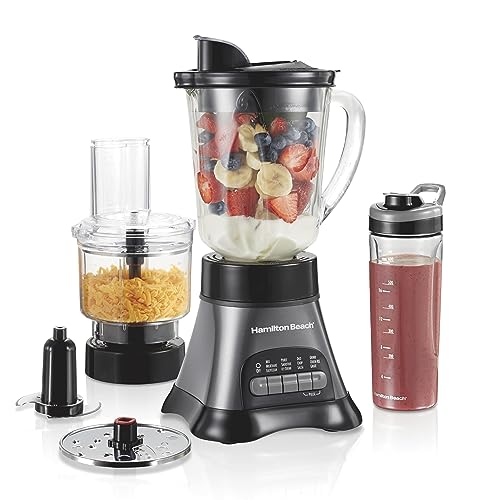
Hamilton Beach Blender and Food Processor Combo 58163, 700W Peak — Best Budget Combo
The budget route to this brief works because it copies the winning formula at a smaller scale: a chopper attachment for the salsa, a jar for the smoothies. The 3-cup chopper is honestly sized for home salsa — a few tomatoes, an onion, peppers and cilantro pulse into a chunky bowlful — and keeping salsa in the chopper means the texture never depends on pitcher technique at all.
The 40 oz glass jar handles everyday smoothies well: fresh fruit, yogurt, protein shakes and modest amounts of ice. Glass feels good in the hand, resists staining from berries and salsa acids alike, and pours cleanly. The travel cup covers the weekday single serving. Where the budget shows is frozen loads — a pitcher packed with frozen fruit and ice cubes asks more patience, smaller batches and a little liquid management than the 1500W systems need.
That is the correct trade for its tier, and this guide recommends it without apology to buyers whose blending is a few times a week rather than a daily ritual. If your household graduates to daily frozen smoothies for four, you will outgrow it and the Ninja systems will be waiting; until then, it does both jobs in the title competently and cheaply.
It also makes an unusually sensible first blender for a new kitchen: the chopper teaches salsa texture without any pitcher skill, the glass jar teaches smoothie building without any staining, and the whole set costs less than the replacement jar of some premium rivals. First kitchens have tighter budgets and more to learn; this combo respects both facts.
Strengths
- Chopper attachment makes salsa texture easy at a budget tier
- Glass jar resists stains and odours from both jobs
- Travel cup included for single-serve smoothies
Trade-offs
- 700 peak watts needs smaller, wetter frozen loads
- Chopper capacity suits home batches, not parties
- Build and controls are basic compared with mid-range picks
| Specification | Detail |
|---|---|
| Power | 700 peak watts |
| Jar | 40 oz glass jar |
| Chopper | 3-cup chopper attachment |
| Extras | Travel cup included |
Best for: budget buyers who blend a few times a week / Not suited for: daily frozen-smoothie households with big batches
Check the current price on Amazon.
Comparison Table
| Pick | Badge | Key spec | Best for |
|---|---|---|---|
| Ninja Kitchen System Pro BL770, 1500W, 72 oz + 8-Cup Processor | Best Overall | 1500W, 72 oz pitcher, 8-cup processor bowl, two 16 oz cups | households making salsa weekly and smoothies daily |
| Ninja UltraCrush Pro Kitchen System BP401, 1500W, 72 oz | Best for Chunky Salsa Lovers | 1500W, 72 oz blender, 8-cup processor, 18 oz to-go cup | chunky-salsa households that also blend big smoothie batches |
| Vitamix Propel Series 510, 48 oz, Black | Best Pitcher-Only Texture Control | 48 oz container, 3 programs, pulse, variable speed, self-cleaning | pitcher-only purists who will pulse salsa by hand and eye |
| KitchenAid K400 with Tamper KSB4028, Contour Silver | Best for Small Batches | Variable speed dial with tamper, preset programs for ice crush, icy drinks and smoothie | couples and small families making small, frequent batches |
| Blendtec Total Blender Classic, FourSide Jar | Best for Big Smoothie Batches | FourSide jar, 10 speeds with pulse, six preprogrammed cycles | smoothie-first households that make salsa occasionally |
| Hamilton Beach Blender and Food Processor Combo 58163, 700W Peak | Best Budget Combo | 700 peak watts, 40 oz glass jar, 3-cup chopper, travel cup | budget buyers who blend a few times a week |
How to Choose the Best Blenders for Smoothies and Salsa
Decide where your salsa will live
This is the fork in the road. Salsa made in a processor bowl or chopper is chopped: pieces stay pieces, liquid stays separate, and texture is nearly impossible to ruin. Salsa made in a pitcher is a technique: short pulses, low speed, a watchful eye, and a willingness to stop early and finish by hand. Neither is morally superior — restaurant kitchens use both — but they suit different cooks. If you want to press a button and walk away, buy a system with a bowl. If you enjoy the craft, a controlled pitcher like the Propel 510 rewards you.
Read pulse specifications like a sceptic
Every blender claims a pulse function; few pulses are equal. A useful pulse for salsa delivers a short burst at a moderate speed and stops dead. A useless one fires the motor at full power, so each press purees the bottom layer while the top waits its turn. Variable-speed machines with a true low end give you a second tool — a slow continuous chop — and between a good pulse and a good low speed, salsa texture stops being luck.
Match smoothie power to your freezer habits
Fresh-fruit smoothies forgive almost any motor. Frozen-fruit smoothies do not. If your freezer holds bags of frozen mango, berries and banana, you need the class of machine represented by the 1500W systems and the high-speed picks: enough torque to keep a frozen load moving until it liquefies. If your smoothies are mostly fresh with a handful of ice, the budget combo’s glass jar will serve you for years. Buy for the load you actually blend, not the load in the advertisement.
Salsa Texture, Explained Honestly
Chunky salsa is a race between chopping and liquefying, and the tomato is the traitor: its flesh breaks down fast and releases juice that then helps puree everything else. The defences are order and restraint. Chop the firm ingredients first — onion, peppers, jalapeño — then add tomato last and pulse the fewest times that bring it together. Cilantro goes in at the very end, ideally folded through by hand, because blades bruise it into a dark, bitter smear.
Draining matters as much as blending. Seeding juicy tomatoes, or letting the finished salsa rest ten minutes and pouring off the pooled liquid, keeps the texture you worked for. And salsa improves for an hour in the fridge as the salt draws flavours together — but it also softens, so if you are serving guests, blend it slightly chunkier than your target and let the rest do the finishing.
Finally, accept the division of labour this list is built on: the wider and flatter the vessel, the chunkier the easy result. That is why the systems lead the rankings, and why the pitcher-only picks are recommended with technique notes rather than apologies.
Neighbours of This Brief: Sauces, Dips and Frozen Drinks
The same control that makes salsa makes most of the blender’s savoury repertoire. Pesto wants the low end too — basil bruises and darkens under sustained high speed — while romesco and chimichurri sit happily at the texture salsa taught you. Hummus is the opposite lesson: it wants a long, patient blend and enough liquid, and it is where the high-speed picks pull away from the budget combo. Knowing which side of the dial a recipe lives on is most of blender literacy.
Frozen drinks extend the smoothie side rather than changing it. Margaritas and daiquiris ask for ice crushed finer and more completely than a breakfast smoothie does, which pushes you toward the 1500W systems and the high-speed machines, and away from budget jars that leave chips. If frozen drinks are a monthly habit rather than a yearly one, weight that in the decision — it is the one neighbouring job that genuinely re-ranks this list.
Baby food and soups, by contrast, are puree jobs that every pick here handles, so they should not drive the purchase. Buy for the two textures in the title, verify the machine does them both well, and the rest of the repertoire follows without drama.
The Budget Tiers for This Brief
At the budget tier, the Hamilton Beach combo shows the right priorities: a chopper for salsa, glass for the jar, and enough power for everyday smoothies. What you give up is frozen-load authority and refinement, not either job in the title. For occasional blenders, that is the smart money.
The mid-range tier is where the kitchen systems live, and for this brief it is the sweet spot: two vessels, real power, and no texture compromises. Most households asking this exact question should land here. The premium tier — the Propel 510’s class — buys pitcher-only finesse, build quality and longevity; it is the right spend for cooks who blend daily and hate storing extra bowls.
How to Make Chunky Salsa and a Smoothie in One Session
Order matters when one machine does both jobs in the same session: salsa first, smoothie second, wash once at the very end. Salsa flavours would haunt a smoothie, while a smoothie leaves the jar sweet and harmless for the next day. Work through the steps in order and the whole session takes about fifteen minutes.
- Prep the salsa firm ingredients. Roughly chop one onion, two jalapeños and a bell pepper into large chunks. In a processor bowl or chopper, pulse four to six times until the pieces are pea-sized. In a pitcher, use the lowest speed in two-second bursts.
- Add tomato last. Quarter ripe tomatoes, seed the wateriest ones, add them with salt and lime juice, and pulse only two to four more times. Stop while it still looks too chunky — it relaxes as it rests.
- Finish by hand. Stir through chopped cilantro with a spoon, taste for salt and acid, and refrigerate at least thirty minutes. Drain any pooled liquid before serving if you want it thick.
- Rinse, do not wash. A quick rinse of the jar or bowl is enough before the smoothie; a trace of lime is no threat to fruit. Save the full wash for the end of the session.
- Build the smoothie in order. Liquid first, then yogurt or soft fruit, then frozen fruit and ice on top. Blend on the smoothie cycle or ramp from low to high over forty-five to sixty seconds.
- Adjust once, briefly. Too thick: add liquid a splash at a time and blend five seconds. Too thin: add frozen fruit, not ice, which waters the flavour down.
- Wash once, properly. Warm water, a drop of soap, thirty seconds on medium for self-cleaning jars — or straight into the dishwasher for the systems’ parts. Salsa acid left overnight will perfume the jar for days.
Two failure modes cover nearly every complaint. Salsa that turned to soup was pulsed once too often or built with the tomato in from the start — rescue it by stirring in a freshly hand-chopped tomato and more onion rather than blending anything further. A smoothie that stalls with an air pocket needs the tamper, a splash of liquid, or a thirty-second rest and restart, in that order — not more power applied to a stuck load.
For make-ahead habits: salsa keeps three to four days refrigerated and tastes best on day two; smoothies are at their best within the hour. If mornings are rushed, portion smoothie ingredients into freezer bags on the weekend so the weekday job is bag, liquid, blend, go.
A word on roasted salsa, since it changes the technique: charred tomatoes, onions and peppers are softer and wetter than raw ones, so they need even fewer pulses and benefit from being drained before blending at all. Roasted salsa in a processor bowl is three pulses and done; in a pitcher, treat it like the tomato stage of the raw recipe and add the firm raw garnish — fresh onion and cilantro — afterwards for contrast.
And if your smoothie habit includes leafy greens, add them with the liquid at the very start and give them ten seconds alone before the frozen fruit goes in. Greens liquefy completely when they meet the blades first in a wet jar; added last, they can survive as flecks in an otherwise smooth drink, which is the single most common green-smoothie complaint.
Common Buying Mistakes
Blending salsa on a smoothie setting. A timed liquefaction cycle cannot stop at chunky. Salsa is manual work: pulse, look, decide. Any guide or salesperson who tells you otherwise is selling you soup.
Putting the tomatoes in first. Tomatoes liquefy fastest and then puree everything else in their juice. Firm ingredients first, tomatoes last, cilantro by hand at the end.
Judging a blender by peak wattage alone. Peak watts describe a moment, not a texture. For this brief, pulse quality, low-speed control and vessel shape decide more meals than the motor’s headline number.
Overfilling the pitcher for salsa. A full jar cannot tumble, so the bottom purees while the top stays raw. Half a jar, two batches, even texture.
Skipping the rest. Salsa served the second it is blended tastes raw and disjointed. Thirty minutes in the fridge is an ingredient, not a delay.
Washing the jar between jobs with detergent and not rinsing. Soap residue in a smoothie is unforgettable. Rinse-only between salsa and smoothie; save the proper wash for the end.
Believing printed prices or star ratings in buying guides. Both change constantly and neither measures texture control. Check price on Amazon when you buy, and judge machines by vessel and pulse, not by numbers in an article.
Final Recommendation
For most households the answer is a system: the Ninja BL770 makes salsa a non-event with its processor bowl and smoothies a certainty with its pitcher, and the BP401 offers the same formula in a newer bundle. Either one ends the texture compromise entirely, at a mid-range tier that undercuts premium pitcher-only machines.
If you would rather own one beautiful vessel, the Vitamix Propel 510 gives you the finest pitcher control here, the KitchenAid K400 is the small-batch specialist, and the Blendtec Total Classic is the smoothie-first veteran. On a budget, the Hamilton Beach combo does both jobs honestly with a chopper and a glass jar. Choose by where your salsa will live — bowl or pitcher — and the rest of the decision makes itself.
Whichever route you take, buy once for the texture you refuse to compromise. Salsa you have to rescue every week and smoothies you have to chew are both signs the machine, not the cook, got the decision wrong — and every pick above was chosen so that neither meal asks you to apologise for it.
Before you settle, compare the neighbouring questions in this cluster: Best Blenders For Salsa, Best Blenders For Sauces, Best Blenders For Smoothies And Food Processing, Best Blenders For Smoothies And Nut Milk and Best Blenders For Shakes And Smoothies each approach the same machines from a slightly different angle.
Frequently Asked Questions
Can a blender really make good salsa, or do I need a food processor?
A blender can make excellent salsa if it has a genuine pulse and a usable low speed, and the technique in this guide — firm ingredients first, tomato last — does the rest. A processor bowl makes the same result easier and more forgiving, which is why the two kitchen systems top this list. What a blender cannot do is rescue over-blending: once salsa becomes soup, no setting brings the chunks back.
Why does my salsa come out foamy or watery?
Foam comes from over-blending, which whips air into tomato juice; wateriness comes from the tomatoes themselves. Seed juicy tomatoes before blending, pulse the minimum number of times, and let the finished salsa rest and drain. Salting early also draws out liquid, so for a thick salsa, salt after the rest rather than before.
Variety matters too: paste tomatoes such as Roma carry far less water than slicing tomatoes and are the traditional salsa choice for a reason. If all you have is a watery variety, a spoonful of tomato paste stirred through at the end restores body without any further blending — a useful rescue that keeps the chunks you worked to preserve.
What is the best speed for salsa in a pitcher?
The lowest speed that moves the load, applied in bursts of one to two seconds. You are chopping by tumbling, not blending. If your machine’s lowest speed already forms a vortex, work in smaller batches and use pulse only — and accept that a processor-bowl system would suit your cooking better.
Can these blenders crush ice for smoothies properly?
The high-speed and 1500W picks crush ice as a matter of routine, and the KitchenAid has a dedicated ice-crush preset. The budget combo handles modest ice — a handful of cubes in a wet load — but a pitcher packed solid with ice and frozen fruit is beyond its comfortable work. Match the machine to your typical load and ice stops being a question.
How do I stop smoothie flavours lingering in the salsa, or the reverse?
Blend in the order this guide uses — salsa first, smoothie second, one wash at the end — and the problem mostly disappears. For a stubborn jar, the self-clean cycle with warm water and a drop of soap, or a paste of baking soda left for fifteen minutes, removes onion and garlic traces. Glass jars, like the budget pick’s, hold flavours least of all.
Is a tamper useful for salsa?
Rarely — a tamper pushes ingredients into the blades, which is exactly what salsa does not want beyond the first seconds. Tampers earn their keep on thick smoothies, where they collapse air pockets without stopping the machine. For salsa, patience and pulse are the tools; the tamper stays in the drawer.

