Disclosure: airfryerkitchensupply.com is reader-supported. When you buy through links on our site, we may earn an affiliate commission at no extra cost to you.
Where to buy
The best inexpensive rice cookers are light, standardised and easy to return, which makes Amazon the sensible place to buy one — all six picks below have confirmed listings ready to check today. One caution that applies to the whole category: check whether a listing counts capacity in cooked or uncooked cups before you compare sizes, because brands mix the two freely.
- AROMA ARC-914SBD Digital Rice Cooker — check the current price on Amazon.
- Dash Mini Rice Cooker — check the current price on Amazon.
- BLACK+DECKER 6-Cup Rice Cooker with Ceramic Nonstick Pot — check the current price on Amazon.
- AROMA ARC-363NG 6-Cup Cooked Rice Cooker — check the current price on Amazon.
- Hamilton Beach Digital Rice Cooker 37518 — check the current price on Amazon.
- AROMA 6-Cup One-Touch CoreCoat Rice Cooker — check the current price on Amazon.
The best inexpensive rice cookers prove that good rice is a solved problem at a modest price. A basic rice cooker is a heated pot with a thermostat that knows one trick — when the water is absorbed and the temperature climbs past boiling point, it clicks over to warm — and that one trick, executed reliably, produces rice that is better than most of us manage in a saucepan. Everything in this guide sits in the budget tier, where the real differences are capacity, pot coating and whether the controls are a single lever or a small digital panel.
All six picks have confirmed Amazon listings, and all six were chosen for households that cook rice a few times a week rather than for sushi chefs chasing perfection. If you cook rice daily and eat it as the centre of the meal, the premium Japanese fuzzy-logic machines are a genuine step up — but they are a different guide and a different budget. Here, the promise is narrower and kept easily: fluffy rice, on time, with one button, for budget-tier money. Check the current price on Amazon for each pick, since small-appliance prices drift with colour and season.
In this guide
Quick Picks
Six budget rice cookers, from a two-cup mini to an eight-cup digital. The short version first.
- Best Overall: AROMA ARC-914SBD Digital Rice Cooker — the budget all-rounder — digital programs, a steamer tray and an 8-cup cooked capacity.
- Best for One: Dash Mini Rice Cooker — a personal-size cooker — one cup uncooked, two cups cooked, with a ceramic pot.
- Best Simple Cooker: BLACK+DECKER 6-Cup Rice Cooker with Ceramic Nonstick Pot — one lever, a ceramic pot and a steaming basket — the classic design, updated.
- Best Budget: AROMA ARC-363NG 6-Cup Cooked Rice Cooker — the least expensive way into reliable rice — also cooks oatmeal and soup.
- Best Steamer Combo: Hamilton Beach Digital Rice Cooker 37518 — digital programs plus a rinse-and-steam basket — the meal-prep friendly budget pick.
- Best Ceramic Pot: AROMA 6-Cup One-Touch CoreCoat Rice Cooker — a one-touch cooker whose ceramic CoreCoat pot is the headline — PFAS-free and easy-clean.
How These Picks Were Chosen
We set the brief tightly: inexpensive models only, from brands with a real presence in the US market, each verified by brand and model against our product database before a link was added. Within that pool we ranked by cooking consistency first — the thermostat trick only works if the pot seals and heats evenly — then by the practicalities that decide whether a cheap appliance survives its second year: a pot coating that releases rice without tearing, a lid design that does not spit starchy water across the counter, and a keep-warm mode that holds rice pleasantly rather than drying it into a crust.
Capacity is quoted the way each brand quotes it, and we flag the cooked-versus-uncooked cup confusion wherever it appears, because it is the number one cause of disappointed purchases in this category. A ‘6-cup’ cooker from one brand holds six cups of cooked rice; from another, six cups of raw rice — a threefold difference in the pot you actually receive.
The 6 Best Inexpensive Rice Cookers

AROMA ARC-914SBD Digital Rice Cooker — Best Overall
The ARC-914SBD is the inexpensive rice cooker we would hand to most households without asking follow-up questions. It cooks four cups of raw rice into eight cups cooked — the right size for a family dinner with leftovers — and its digital panel adds proper settings for white and brown rice plus a steamer tray that cooks vegetables or dumplings over the rice. The stainless exterior wipes clean and survives counter life better than the all-plastic shells at the very bottom of the market.
Strengths
- Digital white/brown settings handle brown rice without guesswork
- Steamer tray turns it into a small two-part meal machine
- 8-cup cooked capacity is the family sweet spot
Trade-offs
- Nonstick pot needs gentle utensils to stay nonstick
- Digital panel is more to go wrong than a single lever, years from now
- Too big to be the right choice for a solo cook making one cup
| Capacity | 4-cup uncooked / 8-cup cooked, 2 Qt |
| Controls | Digital, white and brown rice programs |
| Extras | Steamer tray included |
| Exterior | Stainless steel |
Brown rice is where cheap cookers separate. A simple lever cooker can do it with extra water and patience, but the ARC-914SBD’s brown setting runs the longer, hotter soak-cook cycle brown rice actually wants, and the results are tender rather than chalky-centred. White rice — jasmine, basmati, standard long grain — comes out fluffy and separate, and the keep-warm holds it in good condition through a normal evening rather than turning the bottom layer to cracker.
The steamer tray deserves its good reputation: broccoli, green beans, frozen dumplings and fish fillets all cook in the rice’s steam, which makes this a genuine one-pot dinner appliance for two to four people. Ownership is undemanding — the pot and tray wash easily, the lid’s condensation is manageable if you open it away from you — and Aroma’s ubiquity means replacement pots and cups are easy to find, which at this price is a real form of longevity.
Best for: families of three to five who cook white and brown rice weekly / Not suited for: solo cooks, or households that only ever cook one cup at a time
Check on Amazon — check the current price on Amazon before you decide, because trim, finish and bundle options change between listings.

Dash Mini Rice Cooker — Best for One
Most rice cookers are sized for families and punish solo cooks with a crusty, dried-out single portion. The Dash Mini inverts that: it is built around one cup of uncooked rice making two cups cooked, in a removable ceramic nonstick pot, with a keep-warm function for the second helping. For one person — or two modest appetites — it produces a properly cooked small batch instead of a sad fraction of a big pot.
Strengths
- Correctly sized for one — small batches cook properly, not as an afterthought
- Ceramic nonstick pot lifts out and rinses clean in seconds
- Handles oatmeal and quinoa as happily as rice
Trade-offs
- Hard ceiling: guests mean cooking in shifts or using a saucepan
- No steamer tray and no brown-rice program
- Tiny water measurements need care — a tablespoon off is proportionally large
| Capacity | 1-cup uncooked / 2-cup cooked |
| Pot | Removable ceramic nonstick |
| Functions | Cook, keep warm; suits oatmeal and quinoa |
Small-batch rice is a real technical problem — too little water in a big pot evaporates before the rice hydrates — and the Mini solves it by shrinking the pot until the proportions work again. The ceramic pot is the other quiet win: rice releases without the scraping that ages Teflon-style coatings, and the whole pot goes to the sink rather than the cooker body following it. Oatmeal made in it overnight-style, on keep warm for a short hold, is the breakfast trick owners end up using most.
The limits are the brief itself. This is a personal appliance with a personal capacity, and its simplicity means no delayed-start timer and no special grain programs. Buy it as the right tool for one person’s daily rice and it is close to perfect; buy it hoping it will stretch to dinner parties and it will spend its life disappointing you.
Best for: solo cooks, students and small households cooking a cup at a time / Not suited for: families, batch cookers or anyone feeding more than two
Check on Amazon — check the current price on Amazon before you decide, because trim, finish and bundle options change between listings.

BLACK+DECKER 6-Cup Rice Cooker with Ceramic Nonstick Pot — Best Simple Cooker
This is the rice cooker design that has fed households for decades — a lever, a pot, a lid — with the two updates that matter: a ceramic nonstick pot instead of the old thin coatings, and a steaming basket in the box. Six cups cooked suits couples and small families, automatic keep warm holds the rice until the rest of dinner is ready, and there is nothing on it to program, configure or misunderstand.
Strengths
- Dead-simple lever operation anyone can use first try
- Ceramic pot releases rice cleanly and is easy to wash
- Steaming basket included for vegetables and dumplings
Trade-offs
- No brown-rice program — brown rice needs the extra-water workaround
- Single set-and-forget cycle gives you no control to adjust
- 6-cup cooked is too small for big-batch meal prep
| Capacity | 6-cup (cooked) |
| Pot | Ceramic nonstick |
| Extras | Steaming basket |
| Controls | Lever, automatic keep warm |
There is a strong argument that this, not the digital models, is the correct inexpensive rice cooker for most people. Rice cooking is a solved, single-cycle process, and the lever design has the fewest possible failure points: no panel to die, no programs to mis-select, nothing between you and dinner but a click. The ceramic pot genuinely improves on the classic design — rice lifts out in a clean sheet, and the pot survives the washing-up without the coating anxiety of older nonstick.
Brown rice is the honest caveat. Without a dedicated program you add extra water and accept a longer, less predictable cook; occasional brown-rice households will not mind, daily brown-rice households should buy the Aroma digital above. Steam-basket dinners — rice below, vegetables above — are this cooker’s party trick and a legitimate weeknight strategy for two.
Best for: couples and small families who want one-lever simplicity / Not suited for: daily brown-rice eaters or large-batch cooks
Check on Amazon — check the current price on Amazon before you decide, because trim, finish and bundle options change between listings.

AROMA ARC-363NG 6-Cup Cooked Rice Cooker — Best Budget
The ARC-363NG is the cooker that defines the floor of this category: the least you can spend while still getting a proper appliance from a specialist brand. It cooks three cups of raw rice into six cooked, keeps it warm automatically, and doubles — honestly, at this size — as an oatmeal cooker and a small soup maker. It has been in Aroma’s catalogue for years, which at this price is a feature: the design is debugged and the replacement parts exist.
Strengths
- The budget benchmark — proper rice for the least money here
- Compact 1.5 Qt footprint suits small kitchens and dorms
- One-touch operation with automatic keep warm
Trade-offs
- Basic nonstick pot demands gentle handling to last
- No steamer tray, no digital programs, no frills of any kind
- White finish shows turmeric and tomato stains over time
| Capacity | 3-cup uncooked / 6-cup cooked, 1.5 Qt |
| Controls | One-touch, auto keep warm |
| Also cooks | Oatmeal, soup |
Judged as a rice machine, the ARC-363NG does the essential thing well: the thermostat cycle is the same proven mechanism as every simple cooker, the pot seals adequately, and white rice emerges fluffy and consistent. The compromises live in the materials and the margins — the pot coating is the kind that rewards plastic and wooden utensils and punishes forks, and the lid design vents steam in a way that asks for a clear few inches of counter behind it.
Its second life as an oatmeal and soup cooker is real but small-scale: a litre and a half is breakfast for two or soup for one generous bowl. Students, first flats and office kitchens are its natural homes. Households cooking rice daily for four or more should treat it as what it is — the excellent cheap option — and size up to the ARC-914SBD instead.
Best for: students, first kitchens and anyone minimising spend / Not suited for: families of four-plus or metal-utensil households
Check on Amazon — check the current price on Amazon before you decide, because trim, finish and bundle options change between listings.

Hamilton Beach Digital Rice Cooker 37518 — Best Steamer Combo
Hamilton Beach’s 37518 brings two ideas to the budget tier that punch above it: a genuinely programmable digital panel, and a basket that serves first as a rice rinser and then as the steamer tray. Eight cups cooked capacity matches the Aroma digital, and the rinse basket is smarter than it sounds — rinsing rice in the same basket you steam in removes a step and a colander from the process every single time you cook.
Strengths
- Rinse-and-steam basket is a small design idea you feel daily
- Programmable settings cover white, brown and grains with a delay option
- 8-cup cooked capacity suits family dinners and leftovers
Trade-offs
- Panel and programs are more than rice strictly needs
- Basket adds a part to wash every cook
- Stainless exterior shows fingerprints readily
| Capacity | 8 cups cooked (4 uncooked) |
| Controls | Digital programmable |
| Extras | Steam and rinse basket |
| Exterior | Stainless steel |
Rinsing rice is the step home cooks skip and then wonder about gummy results; building the rinse into the steaming basket is the kind of friction-removal that changes habits. The digital programs handle brown rice and mixed grains competently, and the delay timer — set in the morning, rice ready at dinner — is the feature owners cite most after the basket. Keep-warm performance is solid through an evening without the bottom crisping that plagues the cheapest lever cookers.
Against the Aroma ARC-914SBD, this is a photo finish decided by taste: Hamilton Beach’s basket and timer against Aroma’s slightly simpler panel and wider service footprint. Either serves a family well. The 37518’s extra parts and programs are only worth it if you will use them — rinse your rice and set timers, and it pulls ahead; ignore both and the simpler cooker is the smarter buy.
Best for: meal-preppers and families who rinse rice and use delay timers / Not suited for: minimalists who want a lever and nothing else
Check on Amazon — check the current price on Amazon before you decide, because trim, finish and bundle options change between listings.
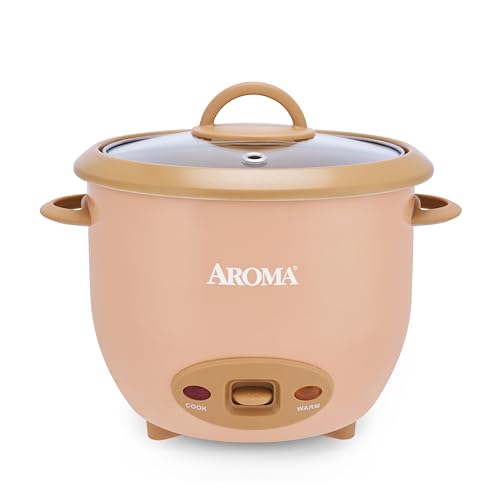
AROMA 6-Cup One-Touch CoreCoat Rice Cooker — Best Ceramic Pot
Plenty of buyers shopping this category have one specific question: which inexpensive cooker avoids a conventional nonstick coating? The CoreCoat Aroma is the answer in this guide — a simple one-touch, pot-style cooker whose inner pot uses Aroma’s CoreCoat ceramic nonstick surface, described by the brand as PFAS-free. Capacity is six cups cooked in a 1.5-quart pot, which suits couples and small families, and operation is a single touch with automatic keep warm.
Strengths
- Ceramic CoreCoat pot for buyers avoiding conventional nonstick
- One-touch simplicity — no programs to learn
- Compact pot-style design stores easily
Trade-offs
- Ceramic coatings need gentle utensils and no thermal shock to stay slick
- No steamer tray or brown-rice program
- Six cups cooked caps its usefulness for bigger households
| Capacity | 6-cup cooked, 1.5 Qt |
| Pot | CoreCoat ceramic nonstick, PFAS-free |
| Controls | One-touch, auto keep warm |
Ceramic nonstick behaves differently from the classic coatings and it is worth knowing how before you buy. It releases rice beautifully when new and asks for two habits in return: no metal utensils, and no plunging the hot pot into cold water. Keep those habits and it stays slick for a long service life; break them and any ceramic surface ages faster than the conventional alternative. For the buyers this cooker is aimed at, that trade is gladly made.
As a cooker it is deliberately basic — one touch, one cycle, keep warm — which puts it in direct competition with the BLACK+DECKER above. The choice between them is really about the pot: the BLACK+DECKER adds a steaming basket, this Aroma puts its money into the coating. Pick the feature you will touch every day; for most people that is the pot, which is why this one earns its badge.
Best for: buyers who specifically want a ceramic, PFAS-free pot in a simple cooker / Not suited for: households wanting steamer trays or digital grain programs
Check on Amazon — check the current price on Amazon before you decide, because trim, finish and bundle options change between listings.
Comparison Table
The six budget cookers compared. Watch the capacity column carefully — cooked and uncooked cup counts are both in play, and they are not interchangeable.
| Pick | Badge | Key spec | Best for |
|---|---|---|---|
| AROMA ARC-914SBD Digital Rice Cooker | Best Overall | 4-cup uncooked / 8-cup cooked, digital, steamer tray, 2 Qt | families of three to five who cook white and brown rice weekly |
| Dash Mini Rice Cooker | Best for One | 2-cup cooked, removable ceramic nonstick pot, keep warm | solo cooks, students and small households cooking a cup at a time |
| BLACK+DECKER 6-Cup Rice Cooker with Ceramic Nonstick Pot | Best Simple Cooker | 6-cup, ceramic nonstick pot, steaming basket, auto keep warm | couples and small families who want one-lever simplicity |
| AROMA ARC-363NG 6-Cup Cooked Rice Cooker | Best Budget | 3-cup uncooked / 6-cup cooked, 1.5 Qt, auto keep warm | students, first kitchens and anyone minimising spend |
| Hamilton Beach Digital Rice Cooker 37518 | Best Steamer Combo | 8 cups cooked, digital programmable, steam and rinse basket | meal-preppers and families who rinse rice and use delay timers |
| AROMA 6-Cup One-Touch CoreCoat Rice Cooker | Best Ceramic Pot | 6-cup cooked, CoreCoat ceramic PFAS-free pot, one-touch, 1.5 Qt | buyers who specifically want a ceramic, PFAS-free pot in a simple cooker |
How to Choose an Inexpensive Rice Cooker
Size first, and size honestly. Rice cookers are rated by the cups of rice they hold, but brands split between cooked and uncooked cups. As a rule of thumb, one uncooked cup feeds two people as a side or one person as a main. A solo cook needs the Dash Mini’s class; a couple, the 6-cup cooked models; a family with leftovers in mind, the 8-cup cooked digitals. Oversizing is the common error — a big pot cooking a small amount of rice dries it out and crusts the base.
Then decide lever or digital. A lever cooker does white rice perfectly and costs the least, with the fewest parts to fail. A digital cooker earns its small premium if you cook brown rice often (the dedicated program genuinely improves it), want a delay timer, or cook varied grains. Finally, look at the pot: ceramic coatings release rice beautifully and suit buyers avoiding conventional nonstick; classic nonstick is tougher against casual utensil abuse. Both need the same respect — no metal forks in the pot, ever.
- Match capacity to your real batch, quoted in the same cup standard
- Brown rice more than twice a week = get a digital with a brown program
- A steamer tray doubles the cooker as a one-pot dinner machine
- Removable inner lid or easy-wipe lid design saves daily annoyance
- Check that replacement pots are sold — a worn pot should not orphan the cooker
The Water Ratio Question, Settled for Budget Cookers
Every inexpensive cooker in this guide ships with a measuring cup and lines inside the pot, and the first rule is to use them together: the included cup is smaller than a standard US cup, and the pot lines assume that cup. Fill rice to a line, water to the matching line, and the cooker does the rest. The finger method — water to the first knuckle above the rice — works as a backup and is what most of the world’s rice cooks actually use.
Adjust for the rice, not the cooker. Jasmine wants a touch less water than the line; basmati wants a soak and standard water; brown rice wants meaningfully more water and the brown program or a longer rest. Resting matters everywhere: ten minutes on warm after the click, lid closed, then fluff with a paddle. That rest is the difference between rice that is merely cooked and rice with distinct, glossy grains — and it costs nothing but patience.
What Inexpensive Leaves Out (and When to Care)
Premium rice cookers add fuzzy-logic chips that adjust mid-cook, induction heating that surrounds the pot, and thick multi-layer pots that hold heat like a Dutch oven. The honest assessment: those things make rice measurably better — more even, more forgiving of water errors — and most people eating rice as a side dish will never notice the difference at the table. People who eat rice as the centre of the meal, daily, eventually do notice, and for them the premium tier is a legitimate upgrade rather than a luxury.
What the budget tier should never leave out, and none of these six do, is a competent keep-warm that does not desiccate the rice, a pot that releases without tearing, and a lid that does not redecorate your counter with starchy condensate. If a listing outside this guide is dramatically cheaper than all six picks, those three are where the money went missing.
Rice Cooker Safety and Food Hygiene, Briefly
Rice cookers are among the safest appliances in the kitchen — enclosed heat, no open flame, automatic warm — but cooked rice itself deserves respect. Cooked rice left warm and damp is a friendly environment for bacteria, including Bacillus cereus, whose spores survive cooking and multiply in rice held too long at lukewarm temperatures. The practical rules are simple: serve rice promptly or hold it properly hot on keep-warm for the evening only, refrigerate leftovers within a couple of hours in a shallow container, and reheat until steaming throughout. Fried rice made from properly chilled, day-old rice is both the tastiest and the safest use of leftovers.
The appliance side asks little: keep the steam vent clear, wipe the lid’s condensation collector if your model has one, and descale the heating plate occasionally if your water is hard and the plate starts to look chalky. A cooker that clicks to warm suspiciously early is usually telling you about scale or a warped pot base, not about its electronics — check those two physical causes first.
A Week of Rice: Getting Real Value From a Budget Cooker
The economics of a rice cooker only work if it runs often, so plan for it. Cook double batches deliberately: tonight’s side dish is tomorrow’s fried rice, the next day’s rice pudding or the base of a grain bowl. Brown rice on Sunday becomes weekday lunches; a steamer tray of vegetables over Friday’s rice closes the week without a second pan. Owners who build this rhythm find the cooker pays for itself in displaced takeaway within a couple of months; owners who cook rice twice a month own a cupboard ornament. If your household is deciding whether the category is worth it at all, that frequency question — honestly answered — is the whole decision.
Beyond White Rice: Brown, Mixed Grains and Congee in a Budget Cooker
Brown rice is the gateway grain: once a household trusts the cooker with it, the repertoire widens fast. The method that works in every pick here is soak-and-extend — brown rice soaked in the pot for thirty minutes before the cycle, with water a finger’s width above the digital brown-program line if you are using a lever cooker, then a full fifteen-minute rest before opening. The result is not identical to a premium fuzzy-logic machine’s brown rice, but it is tender, separate and entirely weeknight-worthy, which is the standard that matters.
Mixed grains — rice with quinoa, barley, lentils or wild rice blends — cook best when you respect the slowest ingredient. Pre-soak anything with a husk, keep total water slightly generous, and let the rest do the finishing work; the cooker’s keep-warm rest is effectively a gentle second steaming that evens out mixed textures. Congee and rice porridge are the budget cooker’s secret talent: a small amount of rice in abundant water, cooked on the standard cycle and left on warm, breaks down into the silky breakfast porridge that stovetop cooks have to stir for an hour to match. Add ginger and a century egg if you are traditional, or honey and fruit if you are not — the machine does not care, and that indifference is its charm.
Troubleshooting: a Symptom-by-Symptom Field Guide
Mushy rice: too much water or too little rest. Cut water by a tablespoon per cup next batch, and never skip the ten-minute rest — the grains are still drinking steam when the click sounds. Crunchy-centred rice: too little water, or the lid was lifted mid-cook and the steam escaped; add a splash, close the lid, and give it ten more minutes on warm. Scorched or deeply crusted bottom: a small amount of golden crust is normal and prized in some cuisines, but a burnt layer means the pot sat on warm too long or the batch was too small for the pot — size the batch to the cooker, not the other way round.
Boil-over and starchy puddles under the lid: the batch was too big, the rice was unrinsed, or oatmeal-style foaming grains were involved. Rinse, respect the maximum line (which is lower for foaming foods), and wipe the lid’s underside and vent after every cook so residue does not build into a permanent vent blockage. Sour or off-smelling rice from the pot itself: yesterday’s rice film is the culprit — wash the pot, lid and steam vent properly, and never store cooked rice in the cooker at room temperature. Nearly every rice cooker complaint ever filed reduces to water, rest, batch size or washing-up — all free to fix, none requiring a more expensive machine.
The Steamer Tray Dinner: Three Templates That Actually Work
The steamer tray is the difference between a rice cooker and a dinner system, and it works best with templates rather than recipes. Template one — rice below, protein above: a fish fillet or chicken thigh portions on the tray, added for the last fifteen minutes of the rice cycle, emerging steamed and ready for a sauce from a jar or a pan. Template two — rice below, vegetables above: broccoli, green beans, carrots or frozen dumplings, added for the last ten to fifteen minutes, seasoned at the table. Template three — the grain bowl: rice below, tray loaded with a mixed vegetable medley, everything tipped into bowls over a dressing while the rice rests. Each template scales from the BLACK+DECKER’s six cups to the digitals’ eight without changing a single judgement call.
Two rules keep tray dinners honest. Season after steaming, not before — steam washes seasoning off, and salted-at-the-table food tastes seasoned rather than diluted. And mind the drip direction: strongly flavoured proteins (curried chicken, garlicky prawns) will perfume the rice below them, which is either a feature or a surprise depending on whether you planned it. Plan it once and it becomes a technique; discover it accidentally and it becomes a story. Either way, the tray turns the cheapest appliance in the kitchen into the one that produces a complete dinner with one button and one washing-up bowl — the real reason these cookers survive in small kitchens long after fancier gadgets are given away.
When to Replace the Pot, the Cooker, or Neither
Budget rice cookers rarely die dramatically; they fade. The fade has a signature order, and reading it correctly saves money in both directions. If rice starts sticking in patches and releasing unevenly while the cooking itself stays consistent, the pot’s coating is tired — replace the pot if the brand sells one (Aroma and BLACK+DECKER both have wide parts availability) and the cooker lives on. If batches come out unevenly cooked with a working pot — scorched in one spot, underdone in another — suspect the heating plate or a warped pot base breaking contact, and check the cheap cause first: set the empty pot on a flat counter and see whether it rocks. If the cooker clicks to warm almost immediately or not at all, the thermostat mechanism itself is failing, and on a budget model that is the honest end — thermostats are not a user part, and replacement is the economical answer.
What almost never justifies replacement is fashion. A lever cooker from five years ago cooks rice exactly as well as this year’s lever cooker, because the underlying mechanism has not changed in decades. Replace parts when parts wear, replace the cooker when the mechanism fails, and let the rest of the kitchen budget go somewhere it can actually be tasted.
One more fade deserves naming because owners misread it constantly: the lid seal. On older cookers the lid stops sitting quite flat, steam escapes at the rim, and rice emerges slightly drier at the edges than it used to. Before condemning the cooker, check for a warped pot rim, a dented lid or a hinge clogged with old starch — all three are common, two are free to fix, and the third (a gentle rim true-up by hand) often restores a cooker that was one annoying batch away from the bin.
Finally, keep the box dimensions in mind before any replacement: budget cookers are bought for small kitchens, and a like-for-like swap that grows by an inch in every direction can quietly stop fitting the cupboard the old one lived in. Measure the shelf, not just the counter, and the new cooker will slide neatly into the old cooker’s daily life without any rearrangement project attached to it at all.
How to Cook Perfect Rice in a Budget Rice Cooker
The cooker does the timing; you control the inputs. This sequence works for every model in the guide.
- Step 1 — Rinse. Rinse rice in the pot or basket until the water runs mostly clear. This removes surface starch and is the difference between fluffy grains and a gummy block.
- Step 2 — Measure with the included cup. Rice first, then water to the matching line in the pot. Ignore standard measuring cups — the included cup and the lines are calibrated together.
- Step 3 — Level and wipe. Level the rice so it cooks evenly, and wipe the outside of the pot dry before it goes in — a wet base spits and stains the heating plate.
- Step 4 — Cook undisturbed. Lid on, lever down or program set. Lifting the lid mid-cook dumps the steam the rice is counting on.
- Step 5 — Rest ten minutes. When it clicks to warm, leave it closed for ten minutes. The grains finish steaming and firm up.
- Step 6 — Fluff and serve. Fluff with the paddle using a cutting, folding motion — never stir in circles, which mashes the grains.
- Step 7 — Hold or refrigerate properly. Keep-warm is for hours, not overnight. Refrigerate leftovers promptly and reheat them thoroughly — cooked rice is a food-safety item, not a counter ornament.
For steamer-tray dinners, add the vegetables or dumplings partway through the rice cycle rather than at the start — most vegetables need ten to fifteen minutes of steam, not the full rice cycle — and season them after cooking, when the rice paddle is already in your hand.
Common Buying Mistakes
Comparing cup sizes across brands. Six cups cooked and six cups uncooked describe pots three times different in size. Read the full listing title, not the headline number, before you decide a cooker is too big or too small.
Using a standard measuring cup. The included cup is deliberately smaller and the pot lines assume it. Swapping cups throws the water ratio off and produces the mush new owners blame on the cooker.
Skipping the rinse and the rest. Unrinsed rice turns gummy; unrested rice turns wet. The two free steps — rinse before, rest after — do more for quality than any upgrade in this category.
Scraping the pot with metal. One fork can start the coating damage that ends a budget pot. Serve with the paddle, wash with a soft sponge, and the pot outlives the cooker around it.
Leaving rice on warm overnight. Keep-warm holds rice for an evening, not a day. Texture dies first, then food safety becomes the real issue. Refrigerate leftovers and reheat them properly.
Final Recommendation
The AROMA ARC-914SBD is the inexpensive rice cooker to buy for most kitchens: family-sized, digitally competent with brown rice, and equipped with the steamer tray that turns it into a dinner machine. The Hamilton Beach 37518 runs it close and wins if you rinse rice religiously and love a delay timer. Below those two, the choice is about shape of life: the BLACK+DECKER for lever-and-done simplicity, the CoreCoat Aroma for its ceramic pot, the ARC-363NG for the smallest spend, and the Dash Mini — the pick we would give every solo cook — for getting a single portion right.
Whichever lands in your kitchen, do the two free things: rinse the rice and let it rest. A budget cooker plus those two habits produces rice that most dinner guests will simply call good rice, which is the entire point.
The shortlist one more time: AROMA ARC-914SBD Digital Rice Cooker (best overall); Dash Mini Rice Cooker (best for one); Hamilton Beach Digital Rice Cooker 37518 (best steamer combo) — check the current price on Amazon for each before you order.
Related reading on this site: Best Inexpensive Egg Cookers; Best Japanese Pressure Cookers; Best Insta Pot Cookers; Best Cookware Sets For Home Cooks.
Frequently Asked Questions
How long do inexpensive rice cookers last?
The cooker body usually outlasts the pot. Expect years of service from the appliance itself, with the inner pot’s coating as the wear item — which is why replaceable pots matter. Treat the coating gently and a budget cooker is a long-term appliance, not a disposable one.
Can a cheap rice cooker cook brown rice properly?
Yes, with the right model or method. Digitals with a brown program (the Aroma and Hamilton Beach here) handle it natively. In a lever cooker, add extra water, let the rice soak in the pot for half an hour before cooking, and rest it longer after — the results are good, if less hands-off.
Why is my rice mushy or gummy?
Too much water, unrinsed rice, or the wrong measuring cup — usually all three trace back to measurement. Use the included cup and pot lines, rinse until the water runs mostly clear, and let the rice rest ten minutes before fluffing.
Can I cook other grains and oatmeal in a rice cooker?
Yes — quinoa, oatmeal, barley and most grains cook happily in any model here, and the Dash Mini is a particular oatmeal favourite. Watch foaming grains like oatmeal on the first run and keep batches modest until you know your cooker.
Is keep-warm safe to use all day?
It holds rice at a safe, serving temperature for an evening comfortably. Beyond that, texture and then safety decline. For longer holds, refrigerate the rice and reheat portions — reheated day-old rice also happens to be the correct starting point for fried rice.
What size rice cooker does a family of four need?
An 8-cup cooked model — four cups uncooked — covers dinner plus leftovers for most families of four. If rice is the centrepiece rather than a side, or teenagers are involved, treat that as the minimum rather than the target.


