Disclosure: airfryerkitchensupply.com is reader-supported. When you buy through links on our site, we may earn an affiliate commission at no extra cost to you.
Where to buy
The best cookware sets for home cooks are heavy, so buy from a seller whose returns process you trust if the pans do not suit your hob — every pick below has a confirmed Amazon listing. Before ordering, count the pieces the way manufacturers do: lids count as pieces, so a ’12-piece set’ is typically six vessels and their lids plus utensils. The reviews below translate each count into actual pans.
- Cuisinart MultiClad Pro 12-Piece Stainless Steel Cookware Set — check the current price on Amazon.
- T-fal Ultimate Hard Anodized Nonstick Cookware Set, 12 Piece — check the current price on Amazon.
- Tramontina Tri-Ply Clad Stainless Steel 12-Piece Cookware Set — check the current price on Amazon.
- All-Clad D3 Stainless Steel 10-Piece Cookware Set — check the current price on Amazon.
- Ninja Foodi NeverStick Professional 12-Piece Cookware Set C39800 — check the current price on Amazon.
- GreenLife 16-Piece Ceramic Nonstick Cookware Set — check the current price on Amazon.
The best cookware sets for home cooks are not the biggest sets or the shiniest ones — they are the sets whose pieces match the way a household actually cooks: a workhorse skillet, a saucepan that fits the eggs and the grains, a big pot for pasta and soup, and materials chosen for your hob and your patience. Home cooks, unlike professionals, need pans that forgive — that heat evenly without hot spots, clean without ceremony, and survive the dishwasher-and-metal-spatula reality of a family kitchen.
This guide compares six sets across the three material schools that matter — clad stainless steel, hard-anodized nonstick and ceramic nonstick — all verified by brand and model against our product database with confirmed listings. No prices are printed, because cookware pricing is promotional by nature; check the current price on Amazon for the set you choose, and judge it per pan you will actually use, not per piece in the box.
In this guide
Quick Picks
Six sets, three materials, one right answer per cooking style. The short version first.
- Best Overall: Cuisinart MultiClad Pro 12-Piece Stainless Steel Cookware Set — fully clad tri-ply at a fair price — the stainless set most home cooks should buy.
- Best Budget: T-fal Ultimate Hard Anodized Nonstick Cookware Set, 12 Piece — the weeknight warrior — hard-anodized nonstick with a Dutch oven, at budget money.
- Best Value Stainless: Tramontina Tri-Ply Clad Stainless Steel 12-Piece Cookware Set — the connoisseur’s value pick — clad stainless performance that embarrasses pricier sets.
- Best Premium: All-Clad D3 Stainless Steel 10-Piece Cookware Set — the benchmark itself — American-made tri-ply with the best finish and resale in the business.
- Best Nonstick: Ninja Foodi NeverStick Professional 12-Piece Cookware Set C39800 — the toughest nonstick in the guide — 500F oven tolerance and a coating built to be used hard.
- Best Ceramic: GreenLife 16-Piece Ceramic Nonstick Cookware Set — the ceramic option — a big, gentle, easy-clean fleet for low-and-medium-heat cooking.
How These Picks Were Chosen
We selected sets the way a home cook should: by the pans in the box, not the piece count on it. Every set below was verified by brand and model against our product database before linking, and each was assessed on its core four — the skillet you will use daily, the saucepans, the stockpot or Dutch oven, and the sauté capacity — plus the questions home cooks actually live with: induction compatibility, oven limits, dishwasher tolerance, and whether the set’s material matches the food you cook most.
Material honesty runs through the rankings. Clad stainless is the buy-it-for-decades school: it sears best and asks for technique. Hard-anodized nonstick is the weeknight school: release and easy cleaning, with a coating lifespan as the accepted tax. Ceramic nonstick is the low-heat, gentle school for buyers avoiding conventional coatings. None is ‘best’ in the abstract — the badges below assign each set to the cook it serves, which is the only ranking a home kitchen should trust.
The 6 Best Cookware Sets for Home Cooks

Cuisinart MultiClad Pro 12-Piece Stainless Steel Cookware Set — Best Overall
The MultiClad Pro is the set that has quietly won the ‘which stainless set?’ argument for years: genuine tri-ply construction — an aluminium core clad in stainless, running up the pan walls, not just a disc on the base — at a price that undercuts the famous names while cooking like them. The 12 pieces resolve into a genuinely useful fleet: skillets, saucepans, a sauté pan, a stockpot and a steamer insert, with tight-fitting lids. For a home cook ready for stainless, this is the default recommendation.
Strengths
- True fully-clad tri-ply heats evenly up the walls, not just the base
- Useful piece selection with a steamer insert most sets omit
- Induction compatible, oven safe and dishwasher tolerant
Trade-offs
- Stainless technique applies: food sticks until you learn heat management
- Polished finish shows every fingerprint and water spot
- Heavier than nonstick sets — feel the skillet weight before committing arthritic wrists
| Construction | Tri-ply clad stainless steel |
| Pieces | 12 (vessels, lids, steamer insert) |
| Compatibility | All hobs including induction |
| Care | Dishwasher safe |
The cooking difference of full cladding is easiest to feel in a sauce: a disc-base pan heats the bottom and leaves the walls cool, so sauces scorch at the base while barely warming at the edges; the MultiClad’s walls carry heat, the sauce moves as one, and the scorch line disappears. Searing is equally honest — preheat the skillet properly, add oil, and protein releases when its crust is ready, the stainless ritual that becomes second nature within a fortnight. The set’s handles stay comparatively cool on the hob and the rims are rolled for drip-free pouring, details that sound like brochure copy until you have poured soup from a rim that was not.
Against its famous rival, the All-Clad D3 below, the MultiClad concedes finish, handle comfort at the margin, and brand gravity — and keeps the change. For a first serious set, or a household equipping a kitchen from scratch, that trade is the correct one so often that this set holds the Best Overall badge against more expensive competition.
Best for: home cooks ready for stainless who want clad performance without flagship pricing / Not suited for: cooks who want food to release itself regardless of technique
Check on Amazon — check the current price on Amazon before you decide, because trim, finish and bundle options change between listings.

T-fal Ultimate Hard Anodized Nonstick Cookware Set, 12 Piece — Best Budget
T-fal’s Ultimate set is the budget benchmark for nonstick: hard-anodized aluminium bodies that heat evenly and resist warping better than the thin pans at the category’s floor, a durable nonstick interior, and a piece selection that includes the Dutch oven weeknight cooking actually revolves around. T-fal’s heat indicator — the centre spot that signals preheat — is a small teaching tool built into every fry pan. For households that cook nightly and clean quickly, this is the sensible spend.
Strengths
- Hard-anodized bodies heat evenly and resist the warping of cheap pans
- Piece mix includes a Dutch oven — the most-used big pot in most kitchens
- Thermo-Spot indicator teaches preheat timing to newer cooks
Trade-offs
- Nonstick is a wear item — plan on years, not decades
- Oven ceiling of 400F (lids 350F) limits high-heat finishing
- Not induction compatible — a hard stop for induction households
| Construction | Hard-anodized aluminium, nonstick interior |
| Pieces | 12 including Dutch oven |
| Oven safe | 400F (lids 350F) |
| Compatibility | Gas, electric, ceramic — not induction |
The Ultimate’s virtues are the virtues of its tier executed properly. Eggs slide, fish releases, sauces wipe out with a sponge, and the anodized base keeps the pans flat and responsive on gas and radiant hobs. The Dutch oven earns special mention because budget sets often substitute a tall, thin stockpot that boils pasta and does nothing else; a Dutch oven braises, soups, and goes to the table, which is why it becomes the most-reached-for piece in the box within a month.
The discipline of nonstick ownership applies in full: medium heat as the default, no aerosol sprays (their additives bake onto coatings), wooden or silicone tools, and hand-washing if you want the coating’s best years. Accept those terms and the T-fal delivers the easiest weeknight cooking in this guide. Reject them — or cook on induction — and the stainless sets above and below are your honest alternatives.
Best for: busy households on gas or electric hobs who prioritise easy release and easy cleaning / Not suited for: induction owners or high-heat searing devotees
Check on Amazon — check the current price on Amazon before you decide, because trim, finish and bundle options change between listings.

Tramontina Tri-Ply Clad Stainless Steel 12-Piece Cookware Set — Best Value Stainless
Tramontina’s Tri-Ply Clad set is the worst-kept secret in cookware: fully clad construction, performance in test after test that embarrasses sets at multiples of its price, and a 12-piece selection covering the home fleet. It goes head-to-head with the Cuisinart MultiClad above for the value-stainless crown, and the honest difference is in the details — handle shape, lid fit, the exact piece mix — more than in the cooking, where both are excellent.
Strengths
- Fully clad tri-ply performance at the category’s value tier
- Induction compatible and oven safe for finishing
- A long track record — this set has been the value answer for years
Trade-offs
- Glass lids (on many configurations) versus Cuisinart’s steel — preference, but check the listing
- Mirror finish demands the same fingerprint tolerance as all polished stainless
- Availability and piece mix vary by season — verify the exact box contents
| Construction | Tri-ply clad stainless steel |
| Pieces | 12 |
| Compatibility | All hobs including induction |
| Care | Dishwasher safe |
Cooking with the Tramontina makes the value case physically: water boils evenly, sauces behave, skillets sear with the same release-when-ready honesty as the premium names, and the pans’ weight sits in the confident middle — substantial without being a workout. Brazilian-made Tramontina has built its reputation exactly here, in clad cookware that prioritises the metal over the marketing, and the set’s longevity in ‘best value’ conversations across a decade of reviews is itself evidence.
Choose between this and the Cuisinart on the tangible details: which handle shape suits your grip, whether you prefer steel or glass lids, and which piece mix matches your cooking (one set’s extra saucepan is another household’s clutter). Either way you are buying the same idea — clad stainless, honestly priced — and it remains the idea we recommend most warmly to home cooks equipping a serious kitchen on a real budget.
Best for: value-hunting cooks who want clad stainless performance per dollar maximised / Not suited for: shoppers who want a single famous brand across their whole kitchen
Check on Amazon — check the current price on Amazon before you decide, because trim, finish and bundle options change between listings.
All-Clad D3 Stainless Steel 10-Piece Cookware Set — Best Premium
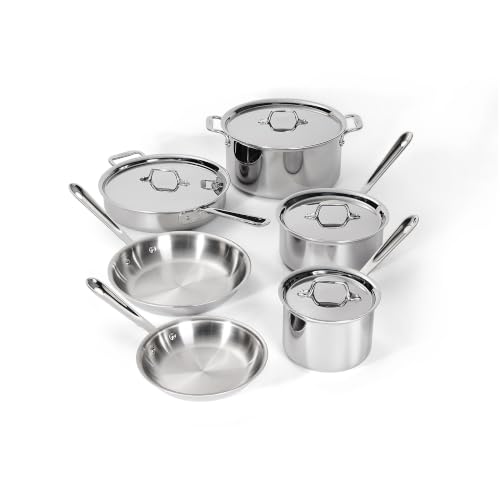
The D3 is the set the others are measured against: All-Clad’s original tri-ply bonded construction, made in the USA, with the fit, finish and handle design that defined premium home cookware. Ten pieces — fewer than rivals’ counts, because All-Clad counts honestly and equips deliberately — cover the professional core fleet. It is the premium pick not because it cooks rings around the Cuisinart (it does not) but because everything about owning it, from the rim pour to the decades-deep support, is the benchmark experience.
Strengths
- Benchmark build quality, finish and handle ergonomics
- Made in USA with lifetime-support gravity and strong resale
- Oven and broiler tolerance to 600F — the highest ceiling here
Trade-offs
- Premium pricing for refinements, not for a different class of cooking
- Ten pieces means no steamer insert or extra saucepan in the box
- The famous handles divide opinion — love them or find them awkward
| Construction | Tri-ply bonded stainless steel |
| Pieces | 10 |
| Origin | Made in USA |
| Oven safe | Up to 600F |
What the premium buys, itemised: pans that sit dead flat and stay that way, lids that seat with a machined finality, handles shaped by decades of feedback, and a surface finish that shrugs off the staining lesser stainless keeps. In the cooking itself the D3 is superb in the same way its clad rivals are superb — even heat, honest searing, sauces that behave — with an edge in responsiveness that experienced cooks feel and newer cooks will grow into. The 600F oven ceiling matters to the cook who finishes steaks and gratins under a fierce broiler.
The rational buyer’s question is whether refinements at this altitude are worth their price when the MultiClad cooks this closely. For a set bought once and used for thirty years, many households answer yes and never think about cookware again — which is, in the end, the D3’s actual product: not better sauce, but the end of shopping. Buy it as a lifetime fixture and it is fairly priced; buy it expecting a different class of cooking and it will feel like an expensive echo of the sets above.
Best for: buy-it-for-life cooks who want the benchmark set and an end to shopping / Not suited for: budget-conscious households — the value clad sets cook nearly as well
Check on Amazon — check the current price on Amazon before you decide, because trim, finish and bundle options change between listings.
Ninja Foodi NeverStick Professional 12-Piece Cookware Set C39800 — Best Nonstick
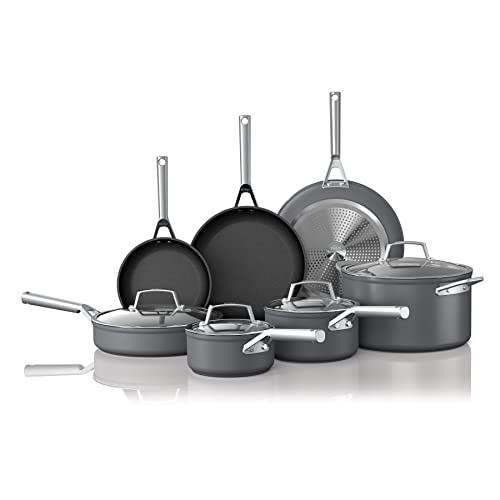
Ninja’s NeverStick line attacks nonstick’s reputation for fragility head-on: a hard-anodized body, a coating applied at very high temperature for durability, and an oven tolerance of 500F that shames the 350–400F ceilings of ordinary nonstick. The Professional 12-piece set equips the full home fleet in slate grey, and it is the nonstick set for cooks who sear, finish in the oven, and do not want to baby their pans — within the honest limits that it is still, in the end, a coating.
Strengths
- 500F oven safe — sear on the hob, finish in the oven, no pan swap
- The most abrasion-tolerant nonstick philosophy in this guide
- Hard-anodized bodies heat evenly and feel reassuringly solid
Trade-offs
- Heavier than typical nonstick — the skillet has real heft
- Premium nonstick pricing approaches entry clad stainless
- Still a coating: a decade of daily service is a hope, not a structure
| Construction | Hard-anodized aluminium, NeverStick coating |
| Pieces | 12 |
| Oven safe | Up to 500F |
| Model | C39800, slate grey |
The 500F figure is the review in one number. It converts the nonstick skillet from a gentle-heat specialist into a genuine all-rounder: chicken thighs seared on the hob and finished in a hot oven, frittatas started and completed in one pan, gratins under a real broiler’s neighbourhood. Ninja’s coating process — bonding the nonstick at extreme temperature — produces a surface that tolerates metal utensils in the brand’s own testing and shrugs off the dishwasher, though hand-washing remains the longevity play for any coating.
Position it against the T-fal honestly: the Ninja costs more and returns durability, oven range and heft; the T-fal costs less and returns lightness and simplicity. Against clad stainless, the NeverStick trades the decades horizon for release-anything convenience at near-clad money. Households that have killed gentle nonstick before and refuse to change their habits are exactly who this set was engineered for.
Best for: hard-using cooks who want nonstick convenience with near-stainless versatility / Not suited for: gentle cooks served equally by the cheaper T-fal, or decade-horizon buyers
Check on Amazon — check the current price on Amazon before you decide, because trim, finish and bundle options change between listings.

GreenLife 16-Piece Ceramic Nonstick Cookware Set — Best Ceramic
GreenLife’s 16-piece set is the ceramic school’s representative: aluminium pans with a ceramic nonstick surface, in the guide’s largest piece count, aimed at buyers who want easy release without a conventional nonstick coating. Ceramic’s personality is specific — slick and delightful at low and medium heat, happiest with gentle utensils and gentle washing — and this set delivers that personality across a full fleet at an accessible tier.
Strengths
- Ceramic surface for buyers avoiding conventional nonstick coatings
- The largest fleet here — pieces for every small job in the kitchen
- Light, easy-handling pans that suit newer and older cooks alike
Trade-offs
- Ceramic coatings age faster than hard-anodized nonstick — expect a few good years
- Low-and-medium heat is its home; high-heat searing is not
- Not the induction answer — check your hob before falling for the piece count
| Construction | Aluminium, ceramic nonstick surface |
| Pieces | 16 |
| Style | Soft-grip handles, black |
Ceramic nonstick asks for a fair trial on its own terms. Cook eggs, pancakes, vegetables, fish and reheats at low-to-medium heat and the GreenLife pans release beautifully and rinse clean in seconds, with a lightness that makes them the set arthritic hands and young cooks reach for. Push them into screaming-hot searing duty and the coating ages in months — the same physics every ceramic set obeys, stated plainly so the set is judged by the cooking it is for.
The 16-piece count deserves the usual translation: it includes lids and utensils, but even translated, the fleet is generous — small pans for single eggs, saucepans in useful sizes, the big pot for pasta night. As a first set for a gentle cook, or a second set alongside a stainless skillet kept for searing, it makes real sense. As the only armoury of a high-heat household, it would be a mismatch — and matching set to cook is this guide’s entire thesis.
Best for: gentle-heat cooks who want ceramic nonstick and a complete starter fleet / Not suited for: high-heat searing households or induction owners
Check on Amazon — check the current price on Amazon before you decide, because trim, finish and bundle options change between listings.
Comparison Table
Six sets, three material schools. Read the construction column first — it predicts the next ten years of your cooking more than the piece count does.
| Pick | Badge | Key spec | Best for |
|---|---|---|---|
| Cuisinart MultiClad Pro 12-Piece Stainless Steel Cookware Set | Best Overall | Tri-ply clad stainless, 12-piece, induction compatible | home cooks ready for stainless who want clad performance without flagship pricing |
| T-fal Ultimate Hard Anodized Nonstick Cookware Set, 12 Piece | Best Budget | Hard-anodized nonstick, 12-piece, oven safe to 400F | busy households on gas or electric hobs who prioritise easy release and easy cleaning |
| Tramontina Tri-Ply Clad Stainless Steel 12-Piece Cookware Set | Best Value Stainless | Tri-ply clad stainless, 12-piece, induction compatible | value-hunting cooks who want clad stainless performance per dollar maximised |
| All-Clad D3 Stainless Steel 10-Piece Cookware Set | Best Premium | Tri-ply bonded stainless, made in USA, oven safe to 600F | buy-it-for-life cooks who want the benchmark set and an end to shopping |
| Ninja Foodi NeverStick Professional 12-Piece Cookware Set C39800 | Best Nonstick | Hard-anodized NeverStick, 12-piece, oven safe to 500F | hard-using cooks who want nonstick convenience with near-stainless versatility |
| GreenLife 16-Piece Ceramic Nonstick Cookware Set | Best Ceramic | Ceramic nonstick, 16-piece, aluminium bodies | gentle-heat cooks who want ceramic nonstick and a complete starter fleet |
How to Choose a Cookware Set as a Home Cook
Start with your hob, because it vetoes sets outright. Induction requires magnetic pans: the clad stainless sets here qualify; most nonstick aluminium sets do not (check any set’s induction claim against a magnet if you shop beyond this guide). Gas forgives everything; glass-ceramic hobs prefer flat, stable bases. Then choose your material school by cooking style, not by fashion: sear-and-deglaze cooks belong in stainless; egg-and-easy-clean households belong in nonstick; gentle-heat cooks avoiding conventional coatings belong in ceramic.
Finally, audit the box like a cook, not a marketer. Translate the piece count into vessels: you need a 10–12 inch skillet, a small and a medium saucepan, a stockpot or Dutch oven in the 5–8 quart range, and ideally a sauté pan — everything beyond that core is either a bonus or ballast. Lids that fit multiple pans are worth more than a sixth vessel. And weigh the skillet in your hand if you can: a pan you cannot lift one-handed, full, is a pan you will stop using.
- Hob first: induction vetoes most aluminium nonstick sets
- Core fleet: skillet, two saucepans, big pot — everything else is secondary
- Lids count as pieces; translate before you compare counts
- Oven ceilings matter: 350F lids limit more recipes than you expect
- Handles and weight are daily ergonomics, not showroom details
Stainless Technique: the Two Weeks That Change Everything
Most ‘stainless sticks’ complaints are really ‘stainless, week one’ complaints, because the material asks for one technique and rewards it forever. Preheat the pan until a flicked water droplet dances as a single bead; then add oil; then add food — and then leave the food alone. Protein releases when its sear is complete, and the cook who pokes it early tears the crust and blames the pan. Liquids deglaze the browned fond into sauce, which is stainless’s reward: flavours nonstick never develops because its surface never browns the same way.
Cleaning follows the same logic. Soak, do not scour; a paste of bicarbonate handles rainbow heat tints and stubborn films; the dishwasher is permitted by every stainless maker here and used by most owners without drama. Two weeks of deliberate technique converts most households permanently — which is why this guide keeps recommending clad sets to cooks who describe themselves, on day one, as ‘not really technique people’. You become one, briefly, and then it is just how pans work.
Sets vs Open Stock: When the Box Is the Wrong Buy
A set is a bundle, and bundles reward households whose needs match the bundle’s assumptions. If your cooking is narrow and deep — the baker who needs two perfect saucepans, the stir-fry household built around one wok and one pot — open-stock buying (individual pans, chosen one by one) equips you better and wastes nothing on pieces that will hold kitchen towels. Most general households, though, genuinely cook across the core fleet, and for them a set’s per-pan price beats open stock decisively, with matched lids and handles as the quiet bonus.
The hybrid most experienced cooks end with: a set for the core, then individual heroes added over years — the cast iron skillet, the enamelled Dutch oven, the carbon steel pan. Read this guide in that spirit. The badge winners are starting fleets, not finished kitchens, and the best set is the one whose core you will use weekly while your heroes accumulate around it.
Caring for Each Material: Three Short Rulebooks
Stainless asks for soaking over scouring, bicarbonate paste for films and tints, and tolerance for the honest patina of use — a working stainless pan develops faint rainbows and marks that affect nothing. It forgives metal tools, dishwashers and high heat, which is why it is the material of households that cook hard and clean fast. Hard-anodized nonstick asks for the opposite temperament: medium heat, soft tools, no aerosol sprays (their propellant additives bake into a sticky film that owners mistake for coating failure), and hand-washing when you can, because dishwasher detergents are the coating’s slow enemy even when the maker permits the machine.
Ceramic asks for the gentlest regime of all — low-to-medium heat, soft tools, no thermal shocks from oven to cold water — and repays it with the easiest release in the kitchen for its first years. Across all three schools, one rule is universal: store pans so their cooking surfaces do not grind against each other. A towel or pan protector between stacked pans prevents more coating and finish damage than any washing-up technique ever will, and it costs nothing but the habit.
The Pieces Nobody Uses (and What to Do About Them)
Every set carries a passenger — the tiny saucepan that fits one egg’s worth of sauce, the steamer basket in a household that never steams, the second skillet a hand too similar to the first. Passengers are not a reason to reject a set whose core is strong; the bundle’s economics usually survive them. But they are a reason to be deliberate on day one: assign each passenger a job (the tiny pan melts butter and reheats single portions beautifully; the spare skillet becomes the garlic-and-egg pan that never needs washing between) or give it away immediately to a student kitchen where it will be a hero. A piece with an assigned job gets used; a piece stored ‘just in case’ becomes cupboard rent paid forever.
The reverse discipline applies when you shop: a set should never be chosen for its passenger. The extra piece that tips a comparison — the bonus griddle, the novelty pan — is marketing’s favourite lever precisely because it photographs well and cooks rarely. Choose on the core four, let the passengers fall where they may, and your cupboards will fill with tools instead of inventory.
Reading Cookware Listings Like a Skeptic
Cookware listings reward the same structured scepticism as any specification game. Find the construction first — ‘tri-ply clad’ means layers through the whole pan, while ‘tri-ply base’ or a ‘bonded bottom’ means a disc where it matters least; the listings for the stainless sets in this guide use the honest form of the words, and rivals that hide behind the vague form are telling you something. Find the oven limits second, and read the lid’s number, not the pan’s — the gap between them is where casseroles go to be ruined. Find the piece translation third: vessels, lids, utensils, in that order of importance, whatever order the listing presents them in.
Then apply the two reality checks. Weight: a set whose skillet you cannot imagine lifting full, one-handed, will quietly leave your rotation. Warranty language: ‘lifetime’ warranties in cookware cover manufacturing defects, not worn coatings, and reading one paragraph of the actual terms recalibrates every promise on the box. None of this requires expertise — it requires reading the listing in the order a cook would, construction before cosmetics, which is precisely the order the marketing hopes you will reverse.
The Second-Year Audit: Is Your Set Still the Right Set?
A year or two into owning any set in this guide, run the audit that separates keepers from clutter. Which three pieces did you use this week? Which piece has not left the cupboard in a season? Where did you improvise — the roasting tin pressed into service as a sauté pan, the borrowed Dutch oven that never went home? The answers describe your real cooking, which has usually drifted from the cooking you imagined when you bought the set. The used-daily core confirms the purchase; the untouched passenger is a gift waiting for a student kitchen; the improvisation points at the single open-stock purchase that will improve your cooking more than any second set could.
The audit also catches wear while it is still information rather than failure: a nonstick skillet whose release is fading is telling you its remaining lifespan, and planning its replacement (or your graduation to stainless for that job) beats discovering it mid-omelette. Sets are not marriages. They are equipment decisions that deserve a yearly review, and the households that run the audit cook better in year three than year one — not because they bought more, but because they finally know what they use.
Cookware and the Rest of the Kitchen: Hobs, Ovens and Storage
A set does not live alone, and three compatibilities beyond the hob decide whether it thrives. Oven dimensions first: the biggest skillet and the stockpot, with lids and handles, must fit your oven with the door closed — a measurement that surprises one household in ten, usually at a holiday. Storage second: measure the cupboard or drawer the set will actually live in, including lid storage, because a set that must be unstacked piece by piece at every meal is a set whose lower half retires early. Sink third: the largest pan should fit your sink flat enough to soak; a stockpot that can only be washed at an angle gets washed reluctantly, and reluctance compounds into neglect.
None of these checks appears on any listing, and all of them are free. Run them before purchase with a tape measure and the set’s published dimensions, and the pans that arrive will fit the kitchen you have — not the showroom kitchen the photography assumed. It is the least glamorous advice in this guide and, across a decade of dinners, possibly the most valuable.
The same realism applies to the household’s second cookware chapter — the pieces this guide deliberately did not try to sell you. Once the core set is running, let your cooking file its own requests: the month you make three curries is the month a Dutch oven earns its audition; the winter of weekly stir-fries is the wok’s. Bought in that order — core set first, specialists in response to evidence — a kitchen accumulates tools the way a workshop does, each one answering a demonstrated need. Bought in the reverse order, it accumulates the showroom’s guesses instead, and the difference shows at dinner.
There is a quiet satisfaction available here that no unboxing provides: the year-three kitchen, where every pan has a job, every job has a pan, and nothing in the cupboard is an apology. The sets in this guide are six different first drafts of that kitchen. Choose the draft written in your material, for your hob, at your budget — then edit it, meal by meal, into the final version only your cooking could have specified. That editing never really ends, and it is not supposed to: a home cook’s kitchen is a working draft for life, revised by every season’s appetite and every year’s new obsession, and the right first set is simply the draft that starts the story well from the very first dinner onward.
How to Set Up a New Cookware Set: First-Week Routine
A new set deserves a deliberate first week — it sets the habits that decide whether the pans last two years or twenty.
- Step 1 — Wash and inspect. Hot soapy water for every piece, then check bases for flatness on your hob and lids for seat. Manufacturing or shipping flaws are returnable now, not in month three.
- Step 2 — Run the magnet test (induction owners). Confirm every vessel your hob must drive. Surprises belong to the returns window.
- Step 3 — Learn your skillet’s preheat. Stainless: the dancing water bead. Nonstick and ceramic: medium heat, a minute, no empty-pan blasting on high — ever.
- Step 4 — Cook the forgiving four. Eggs (in nonstick), onions, a pan sauce, and a pot of pasta. Four ordinary dishes teach you more about a set than any test recipe.
- Step 5 — Assign storage properly. Stack with protectors or towels between coated pans; hang the daily skillet where your hand expects it. Storage damage kills more coatings than cooking does.
- Step 6 — Set the utensil rule. Wood and silicone in coated pans, anything you like in stainless. Put the metal spatula where the stainless lives, not beside the ceramic.
- Step 7 — Note the oven ceilings. Write the set’s oven limit (and the lower lid limit) on a card inside the cupboard door. One forgotten 500F broiler moment can end a lid’s life.
By the end of the week the set should feel less like a purchase and more like the kitchen’s furniture — which is the correct relationship between a home cook and the pans that will make a thousand dinners.
Common Buying Mistakes
Counting pieces instead of pans. Sixteen pieces can hide four actual vessels. Translate every set into skillets, saucepans and pots before comparing it with a rival’s twelve.
Buying nonstick for an induction hob. Most aluminium nonstick sets are not induction compatible, and no adapter plate fixes that happily. Hob first, material second, brand third.
Blasting coated pans on high heat. Empty-pan high heat is how coatings die young. Preheat on medium, cook on medium, and let stainless — not nonstick — take the searing shifts.
Expecting one set to be the forever answer for every dish. Sets are core fleets. The wok, the cast iron, the giant stockpot are individual purchases across a cooking life — a set that tries to include them all includes them badly.
Ignoring the lid limits. Pans rated to 500F wear lids rated to 350F in several sets here. The casserole that goes under the broiler with its lid on is a mistake made exactly once.
Final Recommendation
For most home cooks the Cuisinart MultiClad Pro is the set to buy: clad stainless that cooks like the benchmark, at a price that respects a household budget, in a piece mix with no passengers. The Tramontina runs it so close that handle shape and lid preference may fairly decide between them, and the All-Clad D3 waits at the top of the ladder for the buyer purchasing a lifetime fixture. On the nonstick side, the T-fal Ultimate owns the budget tier outright, the Ninja NeverStick serves hard users who need 500F of oven freedom, and the GreenLife gives gentle cooks a complete ceramic fleet.
Whichever set lands in your cupboards, run the first-week routine in this guide and learn the one technique your material asks for. A well-matched set, honestly used, disappears into the cooking — and that disappearance, repeated across a thousand dinners, is what ‘best’ actually means in a home kitchen.
The shortlist one more time: Cuisinart MultiClad Pro 12-Piece Stainless Steel Cookware Set (best overall); All-Clad D3 Stainless Steel 10-Piece Cookware Set (best premium); T-fal Ultimate Hard Anodized Nonstick Cookware Set, 12 Piece (best budget) — check the current price on Amazon for each before you order.
Related reading on this site: Best Cookware Sets For Home Use; Best Cookware Sets For Kitchens; Best Cookware Sets For Induction Ranges; Best Induction Range Cookers.
Frequently Asked Questions
How many pieces does a home cook actually need?
Four vessels cover most cooking: a 10–12 inch skillet, a small saucepan, a medium saucepan and a 5–8 quart pot or Dutch oven — plus lids. Sets translate to that core plus extras; judge every set by whether its core is strong, and treat the remaining pieces as bonuses rather than the reason to buy.
Is stainless steel really better than nonstick?
Better at searing, deglazing, oven tolerance and lifespan; worse at releasing eggs and at forgiving inattention. Most serious home kitchens end up owning both — a stainless core for cooking and one nonstick skillet for eggs and fish. The sets in this guide are starting points for that evolution, not rival religions.
Can I use metal utensils in these sets?
In the stainless sets, yes, freely. In the Ninja NeverStick, the brand rates the coating for it, though wood and silicone still extend its life. In the T-fal and GreenLife, no — metal is how coatings accumulate the scratches that end them. Match the utensil to the pan and every set here lasts longer.
Are these sets induction compatible?
The three clad stainless sets — Cuisinart, Tramontina and All-Clad — are induction compatible. The aluminium nonstick and ceramic sets generally are not; if you cook on induction, that single fact should steer you to the stainless school or to an induction-rated nonstick line bought deliberately.
How long should a cookware set last?
Clad stainless: decades — effectively buy-it-for-life with ordinary care. Hard-anodized nonstick: several years of daily service before the coating tires, with the Ninja aiming longest. Ceramic nonstick: a few good years. Price the sets across those horizons and the apparent bargains and extravagances reorder themselves.
Should I buy a set or individual pans?
A set, if your cooking spans the core fleet — the per-pan price and matched lids win. Individual pans, if your cooking is specialised or you are upgrading one weak piece at a time. Many cooks do both in sequence: a set first, then heroes added as their cooking declares its specialities.

