Disclosure: airfryerkitchensupply.com is reader-supported. When you buy through links on our site, we may earn an affiliate commission at no extra cost to you.
Where to Buy
This guide covers the best cookware for convection ovens — what actually exists, what we verified, and which picks fit which rooms and budgets. Every set in this guide was verified against Amazon’s product data, and every one is oven-safe with the rating stated in its spec box — because for convection oven duty, the oven-safe rating and the lid’s separate limit are the specifications that matter most. Use the links to check the current price on Amazon, and confirm the oven-safe temperatures on the listing before buying: in this category the difference between a pan’s rating and its lid’s rating is where cookware goes to die.
- All-Clad D3 Stainless Steel Cookware Set, 10-Piece (Best Overall) — Check on Amazon
- All-Clad D3 Stainless Steel Cookware Set, 7-Piece (Best for Smaller Households) — Check on Amazon
- All-Clad HA1 Hard Anodized Nonstick Cookware Set, 10 Piece (Best Nonstick) — Check on Amazon
- CAROTE 25pcs Ceramic Cookware Set with Detachable Handle (Best Space-Saving) — Check on Amazon
- SENSARTE Ceramic Cookware Set, 14 Piece (Best Ceramic Family Set) — Check on Amazon
- KitchenAid Hard-Anodized Induction Cookware Set, 9-Piece (Best Mid-Range) — Check on Amazon
The best cookware for convection ovens is not a separate species of pot — it is ordinary good cookware that satisfies three convection-specific demands. First, it must be genuinely oven-safe at roasting and baking temperatures, handles and lids included, because a convection oven is where stovetop cooking goes to finish: the seared chop, the braise, the skillet cornbread. Second, it must respond well to moving air — convection’s fan rewards pans that heat evenly and punishes thin, warping bases that rock on the rack and cook in stripes. Third, its materials must tolerate convection’s efficiency: food browns and cooks faster in moving air, so cookware that heats evenly and predictably matters more, not less, than in a still oven.
The six sets below span the material spectrum a convection cook actually chooses among: tri-ply stainless at two sizes, hard-anodized nonstick from the same premium maker, a detachable-handle ceramic set built for small kitchens, a ceramic nonstick set at family scale, and a mid-range hard-anodized set with glass lids. Each review states its oven-safe rating from the verified listing — and where the lid’s rating is lower than the pan’s, that difference is called out in the trade-offs, because it is the single most ignored specification in cookware.
A word on what convection does not require: it does not require special ‘convection cookware’, induction compatibility, or any particular brand’s ecosystem. It requires honest oven ratings, flat stable bases, and materials matched to your cooking. Buy those three things and the fan will do the rest.
In this guide
Quick Picks
Six verified sets, all oven-safe, spanning stainless, hard-anodized nonstick, and ceramic — organized by material and household size. Badges repeat in the reviews.
- Best Overall: All-Clad D3 Stainless Steel Cookware Set, 10-Piece — the tri-ply benchmark: 10 pieces, made in the USA, oven safe to 600F, with the searing and durability that make stainless the convection oven’s natural partner. — Check on Amazon
- Best for Smaller Households: All-Clad D3 Stainless Steel Cookware Set, 7-Piece — the same tri-ply construction and 600F oven rating in a tighter seven-piece composition — the D3 experience for couples, small kitchens, and focused cooks. — Check on Amazon
- Best Nonstick: All-Clad HA1 Hard Anodized Nonstick Cookware Set, 10 Piece — All-Clad’s hard-anodized nonstick line: oven and broiler safe to 500F for the pans, 350F for the lids — the nonstick set that can actually live in a convection oven. — Check on Amazon
- Best Space-Saving: CAROTE 25pcs Ceramic Cookware Set with Detachable Handle — 25 pieces built around detachable handles: pots and pans that nest, go oven-safe without handle limits, and move from cooktop to oven to table to fridge. — Check on Amazon
- Best Ceramic Family Set: SENSARTE Ceramic Cookware Set, 14 Piece — a 14-piece ceramic nonstick family set — pots, pans, and frying pans in a PFAS/PTFE/PFOA-free formulation, induction-ready for the modern kitchen. — Check on Amazon
- Best Mid-Range: KitchenAid Hard-Anodized Induction Cookware Set, 9-Piece — KitchenAid’s hard-anodized nine-piece in porcelain white: ceramic nonstick, tempered glass lids, dishwasher safe, and oven safe — the mainstream middle of the guide. — Check on Amazon
How These Picks Were Chosen
Verification followed the program rule: every set was cross-checked against its live Amazon listing, and the spec boxes quote only listing-stated facts — piece count, material, and crucially the oven-safe temperatures where the listing publishes them. Sets whose listings did not support an oven-safety claim were excluded from this guide entirely, however good their stovetop reputations: for a convection-oven brief, an unverifiable oven rating is a disqualification, not a footnote.
Selection then balanced the material triangle. Stainless steel for searing and durability, hard-anodized nonstick for release and easy cleanup, ceramic nonstick for buyers avoiding conventional coatings — each with at least one strong representative, and the premium maker present in both its steel and nonstick lines so the comparison shoppers actually make is available inside one guide.
Within materials, we weighed the convection-specific virtues: base stability at temperature, handle designs that work with oven mitts, lid ratings stated separately from pan ratings, and piece compositions that cover the oven’s real workload — skillets for finishing, saucepans for braises, a stockpot or Dutch-oven role for the big jobs.
The 6 Best Cookware for Convection Ovens, Reviewed and Verified
Read the oven-safe line in each spec box first, and the lid line second. Together they define what each set can actually do in your convection oven.
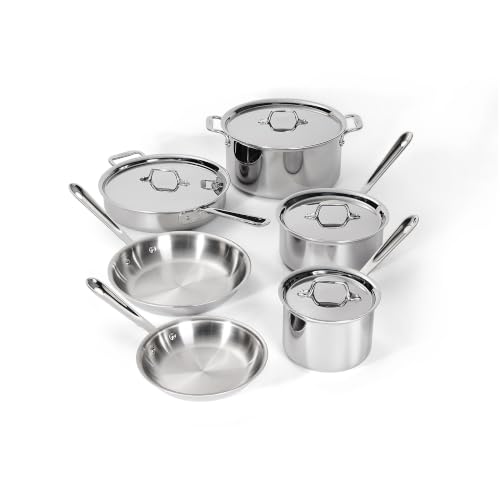
All-Clad D3 Stainless Steel Cookware Set, 10-Piece — Best Overall
The D3 is the set against which convection-oven cookware is measured, and its verified listing states why in one line: oven safe to 600 degrees Fahrenheit. That rating — higher than most home ovens can reach — removes the ceiling from the pan’s life: sear on the cooktop, finish in a hot convection oven, broil to finish, without a moment’s arithmetic about whether the cookware consents. Tri-ply construction, with an aluminum core bonded between stainless layers, delivers the even heating that convection’s moving air amplifies: no hot ring, no striped browning, no warped rocking on the rack.
Ten pieces is the considered composition for a household that cooks: fry pans for finishing proteins, saucepans for grains and sauces that become braises, a stockpot for the big liquid jobs, and lids that interchange across more vessels than their nominal assignments. It is the set that ends the cookware search for most buyers, at a premium price that amortizes across decades — D3 sets are routinely inherited, which is a durability claim no laboratory can fake.
Strengths
- 600F oven rating removes all practical temperature anxiety
- Tri-ply evenness is exactly what convection air rewards
- Made in the USA with a multi-decade service reputation
Trade-offs
- Premium tier pricing — check price on Amazon
- Stainless is not nonstick: eggs and delicate fish demand technique or a stablemate pan
- Heavier than nonstick sets, and shows water spots without bar-keeper discipline
| Pieces | 10-piece set (listing title) |
| Material | D3 stainless steel, tri-ply bonded (listing title) |
| Oven safe | Up to 600F (listing title) |
| Origin | Made in the USA (listing title) |
The convection synergy deserves spelling out. A fan oven’s weakness is its enthusiasm: moving air browns surfaces fast, which punishes pans with uneven bases by finishing the thin spots early. The D3’s bonded core spreads heat laterally, so the pan presents the fan with an even surface to work on — the combination produces the roasting and finishing results that make people describe convection as a revelation. In a thin pan, the same fan is merely a faster route to uneven food.
Buy it as the kitchen’s foundation. Add a nonstick skillet later for the egg work if your household needs one; the D3 will still be the set doing the oven’s serious work in twenty years.
Best for: households buying one foundation set for a convection kitchen, for decades / Not suited for: nonstick-dependent cooks, or buyers furnishing a whole kitchen on a tight budget
Check the current price on Amazon
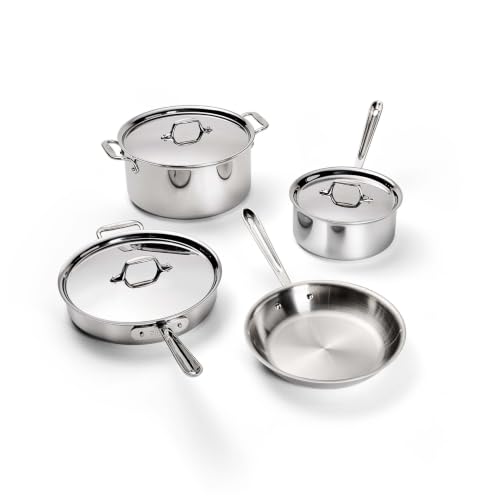
All-Clad D3 Stainless Steel Cookware Set, 7-Piece — Best for Smaller Households
Not every kitchen needs ten pieces, and the 7-piece D3 exists for the households honest about that. It keeps everything that makes the line the benchmark — tri-ply bonded construction, the 600-degree oven rating, American manufacture — and trims the composition to the core vessels: the fry pan, the saucepans, the stockpot role, and their lids. For a couple, a small household, or a cook who owns a beloved Dutch oven already and needs the D3 to cover the rest, the smaller set is not a lesser set; it is the same set with the duplicates removed.
The storage math matters in real kitchens. Cookware sets are bought by the piece and stored by the cubic foot, and the three pieces trimmed here are the three that would have lived at the back of the cabinet. A new-home kitchen with a convection wall oven — the context of this whole program — usually has better uses for that cabinet.
Strengths
- Identical construction and oven rating to the 10-piece benchmark
- Composition trimmed to the vessels that get used weekly
- Lower total commitment in both price and cabinet space
Trade-offs
- Fewer specialty pieces — big-batch and two-pan nights may want reinforcements
- Same stainless learning curve as its big sibling
- Premium per-piece pricing remains premium
| Pieces | 7-piece set (listing title) |
| Material | D3 stainless steel, tri-ply bonded (listing title) |
| Oven safe | Up to 600F (listing title) |
| Origin | Made in the USA (listing title) |
Choose between the two D3 sets by cooking pattern, not by aspiration. Households that cook two proteins at once, host regularly, or run a stockpot and a saucepan in parallel will feel the 7-piece’s limits within a month. Households that cook a protein, a sauce, and a pot of grains will never meet them. The quality of mercy in the smaller set is that its limits announce themselves as ‘I could use one more fry pan’ — a solvable, single-pan problem — rather than as a quality regret.
Either D3 is a lifetime purchase; the only wrong choice is buying the big set for a small kitchen’s storage or the small set for a big household’s appetite. Measure both honestly.
Best for: couples, small households, and focused cooks who want benchmark quality without bulk / Not suited for: large families, frequent hosts, or two-pan-at-once cooking styles
Check the current price on Amazon

All-Clad HA1 Hard Anodized Nonstick Cookware Set, 10 Piece — Best Nonstick
Most nonstick cookware is exiled from serious oven work by its temperature ceiling, which is why the HA1’s verified listing matters: the pans are oven and broiler safe to 500 degrees, a rating that covers the overwhelming majority of convection finishing and roasting. Hard-anodized construction gives the set a rigid, warp-resistant body under the coating — the base stability convection rewards — and All-Clad’s execution of the category brings the fit and handle quality of its steel lines to a nonstick set.
The lid line is the review’s mandatory honesty: the lids are rated to 350 degrees, well below the pans. That split rating is common and legitimate — glass and its fittings are the weak link — but it must be cooked with, not discovered. Above 350, the pans go in lidless or under foil. Every convection cook should know their set’s two numbers; this guide prints both wherever the listing states them, and this set is the model of how the information should be presented.
Strengths
- 500F pan rating makes it a genuine convection-oven nonstick
- Hard-anodized body resists the warping that ruins fan-oven results
- All-Clad handle design and balance in a nonstick line
Trade-offs
- Lids limited to 350F — the split rating must be respected
- Nonstick coatings are consumables on a multi-year horizon, unlike stainless
- No metal-utensil carelessness: the coating’s life is set by its treatment
| Pieces | 10-piece set (listing title) |
| Material | HA1 hard anodized nonstick (listing title) |
| Oven safe | Pans oven and broiler safe to 500F (listing title) |
| Lid limit | Lids safe to 350F (listing title) |
Who is the nonstick set actually for, in a convection kitchen? The household whose oven work is weeknight-shaped: sheet-pan-adjacent skillet dinners, frittatas, roasted vegetables that release without a soak, fish that must not stick. For that cooking, release beats sear, cleanup speed beats heirloom durability, and the HA1’s rating makes it the rare nonstick set that does not have to sit out the oven’s best work.
Pair it mentally with the D3 rather than against it: the steel for searing and decades, the HA1 for release and weeknights. Households that can only choose one should choose by their dominant cooking — and re-read the lid line before the first 450-degree roast either way.
Best for: weeknight convection cooking where release and cleanup speed lead / Not suited for: high-heat broiling with lids on, or buyers wanting a buy-it-for-life single set
CAROTE 25pcs Ceramic Cookware Set with Detachable Handle — Best Space-Saving
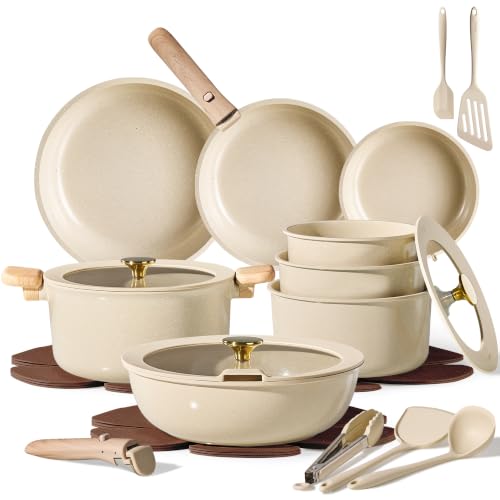
The detachable-handle concept solves three problems at once, and convection ovens are one of them. Without a fixed handle, a pan fits the oven in any orientation, nests inside its siblings for storage, and — most subtly — removes the handle material from the oven-safety equation entirely: the vessel that enters the fan oven is all pan, rated as a pan, with no phenolic handle quietly imposing a ceiling the cook forgot. CAROTE’s 25-piece ceramic set is the fullest expression of the idea in this guide, with the count swollen, as these sets’ counts are, by lids and accessories among the vessels.
Ceramic nonstick is the coating proposition: a PFAS-free surface with strong initial release, positioned for buyers who want nonstick behavior without conventional coatings. Its honest trade-off is longevity — ceramic surfaces typically lose their slickness faster than quality conventional nonstick — and the review prices that in below rather than discovering it in your kitchen in year two.
Strengths
- Detachable handles: nesting storage and no handle temperature ceiling in the oven
- Ceramic PFAS-free surface for coating-conscious buyers
- Vessels multi-task as bakeware, serving pieces, and storage
Trade-offs
- Ceramic release fades faster than premium conventional nonstick
- The handle mechanism is a moving part — one more thing to keep clean and seated
- Piece count includes lids and accessories; count vessels, not pieces
| Pieces | 25-piece set (listing title) |
| Material | Ceramic nonstick, PFAS free (listing title) |
| Handles | Detachable handle system (listing title) |
| Compatibility | Induction compatible, dishwasher and oven safe (listing title) |
The storage argument is decisive in the kitchens that need it: small homes, RVs, and the wall-oven kitchens of this program where cabinet runs are precious. A nested stack that occupies one shelf where fixed-handle sets occupy three is not a gimmick; it is a floor-plan feature. The oven argument is nearly as strong — a skillet that becomes a baking dish by removing its handle earns double duty in a convection oven, where it can roast, bake, and gratin without a transfer.
Buy it for the system, maintain the coating gently — no thermal shock, no abrasive pads, moderate heat for longevity — and expect to refresh the hardest-working skillet first. The set’s economics assume exactly that pattern.
Best for: small kitchens, RVs, and buyers who want cookware that doubles as bakeware / Not suited for: buyers wanting maximum coating lifespan, or cooks who dislike any mechanism in a pan
Check the current price on Amazon

SENSARTE Ceramic Cookware Set, 14 Piece — Best Ceramic Family Set
SENSARTE’s 14-piece set is the fixed-handle counterpart to the CAROTE’s system play: a conventional family composition — frying pans, saucepans, the stockpot role — in a ceramic nonstick formulation whose verified listing leads with what it excludes: PFAS, PTFE, PFOA, PFOS. For the buyer whose first filter is coating chemistry, this is the set in the guide that answers in its title, and its induction compatibility future-proofs it for the cooktop half of the kitchen even though this guide’s brief is the oven.
On oven duty, the guidance is the standing one for ceramic sets: treat the listing’s oven-safe specification as the authority — confirm it on the listing before purchase, respect it in use, and remember that ceramic’s release is at its best in the moderate-temperature work that makes up most family oven cooking: casseroles, baked pastas, skillet bakes, and gentle roasting.
Strengths
- Coating chemistry stated plainly — the set for formulation-first buyers
- Full family composition in a single purchase
- Induction compatibility covers the modern cooktop as a bonus
Trade-offs
- Confirm the oven-safe rating on the listing — this guide does not invent figures
- Ceramic release has a shorter prime than conventional nonstick
- Fixed handles mean conventional storage and handle material limits apply
| Pieces | 14-piece set (listing title) |
| Material | Ceramic nonstick, PFAS/PTFE/PFOA free (listing title) |
| Compatibility | Induction cookware (listing title) |
Set the two ceramic picks side by side and the choice is architectural: CAROTE’s detachable system for the space-constrained and the oven-centric, SENSARTE’s fixed-handle family set for the conventional kitchen that wants ceramic chemistry in familiar shapes. Neither is the durability champion of this guide — that is stainless, at stainless prices — and both are best understood as excellent mid-horizon sets whose coatings should be treated as the consumables they are.
Within those terms, the SENSARTE is the straightforward family answer: enough pieces, the right exclusions, no mechanisms to learn. For a household equipping a convection kitchen without heirloom ambitions, straightforward is a compliment.
Best for: families prioritizing ceramic coating chemistry in a conventional full set / Not suited for: maximum oven temperatures, or buy-it-for-life shoppers
Check the current price on Amazon

KitchenAid Hard-Anodized Induction Cookware Set, 9-Piece — Best Mid-Range
KitchenAid’s entry occupies the guide’s sensible middle: hard-anodized bodies — rigid, even-heating, warp-resistant — with a ceramic nonstick surface, tempered glass lids you can see a braise through, and dishwasher-safe, oven-safe positioning in a porcelain white finish that suits the new kitchens this program keeps furnishing. Nine pieces is the honest family composition without count inflation, and the brand brings the mainstream virtues: availability, support, and a design language that matches the mixers and appliances already on the counter.
Glass lids deserve their sentence in a convection context: monitoring a braise or a bake without lifting the lid keeps the oven’s carefully circulated heat where it belongs, and in a fan oven — whose whole proposition is managed airflow — the discipline of looking instead of opening is worth real cooking quality. The glass’s temperature limit, as with the HA1, is the number to confirm on the listing and respect in the roast.
Strengths
- Hard-anodized evenness with ceramic release — the balanced material compromise
- Glass lids suit convection cooking’s keep-it-closed discipline
- Mainstream brand support and a finish that suits designed kitchens
Trade-offs
- Confirm the specific oven-safe ceiling on the listing before high-heat work
- Ceramic surface longevity trails stainless by design
- Nine pieces may want a supplementary skillet in large households
| Pieces | 9-piece set (listing title) |
| Material | Hard-anodized with ceramic nonstick (listing title) |
| Lids | Shatter-resistant tempered glass lids (listing title) |
| Care | Dishwasher safe, oven safe (listing title) |
The mid-range pick earns its place by having no disqualifying weakness: the bodies are rigid, the coating is the modern ceramic kind, the lids are practical, the brand will answer the phone. Against the CAROTE it trades the detachable-handle system for conventional solidity; against the HA1 it trades the premium rating for a friendlier tier; against the D3 it trades decades for release and price. Most family kitchens, asked honestly, live in exactly this trade space.
Buy it as the kitchen’s working set and spend the savings against the D3 on the one thing this guide keeps recommending: a single stainless skillet for the searing the nonstick sets should not be asked to do at full blast.
Best for: families wanting one balanced, mainstream set for everyday convection cooking / Not suited for: high-heat specialists, or buyers seeking heirloom durability
Check the current price on Amazon
Comparison Table
| Pick | Badge | Key Spec | Best For |
|---|---|---|---|
| All-Clad D3 Stainless Steel Cookware Set, 10-Piece Check on Amazon | Best Overall | 10-piece tri-ply stainless, oven safe 600F, made in USA | households buying one foundation set for a convection kitchen, for decades |
| All-Clad D3 Stainless Steel Cookware Set, 7-Piece Check on Amazon | Best for Smaller Households | 7-piece tri-ply stainless, oven safe 600F, made in USA | couples, small households, and focused cooks who want benchmark quality without bulk |
| All-Clad HA1 Hard Anodized Nonstick Cookware Set, 10 Piece Check on Amazon | Best Nonstick | 10-piece hard-anodized nonstick, pans oven/broiler safe 500F, lids 350F | weeknight convection cooking where release and cleanup speed lead |
| CAROTE 25pcs Ceramic Cookware Set with Detachable Handle Check on Amazon | Best Space-Saving | 25-piece ceramic nonstick, detachable handle, induction compatible, oven safe | small kitchens, RVs, and buyers who want cookware that doubles as bakeware |
| SENSARTE Ceramic Cookware Set, 14 Piece Check on Amazon | Best Ceramic Family Set | 14-piece ceramic nonstick, induction cookware, non-toxic formulation | families prioritizing ceramic coating chemistry in a conventional full set |
| KitchenAid Hard-Anodized Induction Cookware Set, 9-Piece Check on Amazon | Best Mid-Range | 9-piece hard-anodized, ceramic nonstick, glass lids, oven safe | families wanting one balanced, mainstream set for everyday convection cooking |
How to Choose Cookware for Convection Ovens
Read two temperature ratings, not one
Every cookware set has two oven ceilings: the pan’s and the lid’s. Pan bodies in this guide reach as high as a verified 600 degrees in stainless; lids — glass, or fitted with phenolic parts — commonly cap far lower, at 350 in the HA1’s honestly stated case. Convection cooking lives at 325–450 degrees for most roasting and baking, which means the lid’s number, not the pan’s, is the one that governs covered cooking. Before any set earns your money, find both numbers on its listing; if the listing will not state them, the set has told you something about itself.
Handles are the third rating in disguise. Stainless handles inherit the pan’s ceiling; synthetic handles impose their own, often the lowest in the set. The detachable-handle design sidesteps the issue by removing the handle from the oven entirely — one reason that system pick earns its place in a convection-specific guide rather than merely a storage one.
Materials under moving air
Convection’s fan is an amplifier: it amplifies even heating into superb browning, and it amplifies uneven heating into striped, scorched disappointment. That is why base construction outranks almost everything in this brief. Bonded tri-ply stainless and quality hard-anodized aluminum spread heat laterally and stay flat at temperature; thin, single-ply pans warp, rock on the rack, and cook in rings. Run a straightedge across any pan you already own — a visible dome or dish at room temperature becomes a wobble at roasting temperature.
On coatings, be clear-eyed. Stainless is forever and sticks; conventional nonstick releases beautifully and ages in years; ceramic releases beautifully, excludes the chemistries some buyers avoid, and ages fastest of the three. None of those is a scandal — they are engineering trades, and the right answer is the one matched to your cooking’s temperature profile and your household’s replacement tolerance.
Build the set around the oven’s actual jobs
A convection oven’s cookware workload is specific: skillets that sear and finish, a braising vessel with a lid that fits its rating, roasting capacity for vegetables and proteins, and baking-adjacent pieces — the skillet cornbread, the gratin, the cobbler. Audit any set’s composition against that list rather than its piece count, which counts lids and accessories as pieces and rewards sets for arithmetic rather than coverage.
Most households are best served by a foundation-plus-specialist structure: one set that covers the daily work, plus individual pieces for the extremes — a large roaster for the holidays, a small nonstick for eggs. The sets in this guide are chosen to be foundations; buy the composition that matches your week, and let the extremes arrive one honest piece at a time.
Convection Cooking Adjustments Every Cookware Owner Should Know
The cookware is only half the system; the other half is calibration. The standard convection adjustment is to reduce the recipe temperature by about 25 degrees Fahrenheit, or shorten the time, because moving air transfers heat more efficiently than still air. Dark and heavy pans — including the hard-anodized sets in this guide — absorb and radiate more heat than bright stainless, and will brown bottoms faster; light-colored stainless is the gentler baking surface. Knowing your set’s personality is worth more than any single recipe conversion.
Airflow needs room to work. Crowding pans against the oven walls or each other blocks the circulation the fan exists to create, and stacking sheet pans on every rack converts your convection oven back into a still one with a noise problem. Leave gaps, rotate positions at the halfway point on big loads, and prefer low-sided vessels when browning is the goal — the fan can only crisp what the air can reach.
Matching Cookware to Convection Cooktop and Oven Workflows
Most cookware in a modern kitchen lives a double life — started on the cooktop, finished in the oven — and the convection kitchen sharpens that pattern, because the fan oven finishes so well that recipes increasingly assume the transfer. Planning a set around the double life changes what ‘complete’ means: the skillet must sear at full cooktop blast and then tolerate the oven’s ceiling; the saucepan must reduce on the burner and braise under its lid at the lid’s own rating; the stockpot must boil pasta on Saturday and slow-cook sauce on Sunday. The sets in this guide were chosen against exactly that workflow audit, which is why bonded construction and stated ratings recur in every review.
The cooktop half of the audit has its own quiet demand: flatness. On induction and glass-ceramic cooktops — the surfaces this program’s kitchens increasingly pair with convection wall ovens — a warped base does not merely cook unevenly, it couples badly with the element and can rock, spin, and scratch. The same straightedge test that predicts convection performance predicts cooktop manners, because both are really tests of whether the pan was built to stay flat at temperature. Bonded tri-ply and quality hard-anodized bodies pass it for decades; thin stamped pans pass it until their first thermal shock.
One workflow piece deserves deliberate purchase outside any set: the large roasting pan or sheet-pan system for the oven’s biggest jobs. Sets stop at the stockpot; holidays do not. A heavy roaster bought once, in the same material family as your foundation set, completes the convection kitchen more honestly than any set’s extra saucepan ever will — and it is the piece guests will assume came with the house.
How to Use Cookware in a Convection Oven: Searing, Roasting, and Braising
Three techniques cover most of what convection cookware is for. Each follows the same logic: the cooktop starts it, the oven finishes it, and the pan must be rated for both halves of the journey.
- For sear-and-finish proteins: preheat the skillet on the cooktop until it is properly hot, sear undisturbed for the crust, then move the pan — with oven mitts, and a dry towel over the handle as a warning flag — into a preheated convection oven to finish. Confirm the pan’s rating exceeds the oven temperature before the first attempt, not during it.
- For roasting vegetables and proteins: use a low-sided, heavy vessel, preheat it with the oven for maximum browning, and spread the food in a single uncrowded layer. Convection rewards space; a crowded pan steams, whatever the dial says.
- For braises: sear in the lidded vessel, add liquid and aromatics, cover, and cook low and slow — checking the lid’s temperature rating against the braise temperature, which is the one occasion the lid’s ceiling, not the pan’s, runs the kitchen.
- For skillet baking — cornbread, cobblers, gratins: preheat the empty vessel for crisp edges, or use it cold for delicate batters, and reduce the recipe temperature by roughly 25 degrees as the convection adjustment.
- After cooking, let hot cookware cool before it meets water. Thermal shock warps bases and stresses coatings; the five minutes of patience is the cheapest flatness insurance in the kitchen.
- Maintain by material: stainless takes abrasives and bar-keeper’s remedies; nonstick and ceramic take soft sponges and moderate heat; every set takes a dry storage habit, because stacked wet pans age coatings and finishes alike.
Master those patterns and the distinction between ‘cookware’ and ‘convection cookware’ dissolves — what remains is good cookware, honestly rated, used with the fan in mind.
Storage deserves the last word, because more cookware dies in cabinets than in ovens. Stacked pans grind coatings against each other; lids stored on their vessels trap moisture against finishes; a heavy stack’s bottom pan bears a load its base was never shaped for. Pan protectors, a lid organizer, or simply hanging the two hardest-working skillets will extend every set in this guide — stainless included, whose cooking surface scratches cosmetically under careless stacking. The convection oven will ask a great deal of these pans at temperature; the cabinet should ask as little as possible of them at rest. Treat storage as part of the purchase and the set you chose will look and cook like itself for far longer.
Common Buying Mistakes
Reading only the pan’s oven rating. The lid’s ceiling is lower in almost every set and governs covered cooking. Two numbers, every time — the HA1’s 500F pans and 350F lids are the standing example.
Putting a cold pan into a screaming-hot oven, or a hot pan under cold water. Thermal shock warps bases and crazes coatings. Warped bases then cook unevenly under convection air for the rest of the pan’s life.
Crowding the oven and blaming the cookware. Blocked airflow defeats convection regardless of the vessel. Space the pans, use low sides for browning, and rotate on big loads.
Using nonstick at searing temperatures as a habit. Coatings age fastest at high heat. Keep a stainless skillet for the blast work and the nonstick sets will live their full span.
Counting pieces instead of vessels. A 25-piece set and a 10-piece set may contain the same number of actual pots. Count lidded vessels and compare compositions, not arithmetic.
Final Recommendation
If the budget allows one set to anchor a convection kitchen, it is the All-Clad D3 10-piece: the 600-degree rating, the tri-ply evenness, and the decades-long horizon make it the foundation everything else supplements. Smaller households take the same quality in the 7-piece. Nonstick households take the HA1 — with its lid limit respected — and space-constrained or oven-centric cooks take the CAROTE’s detachable system. The SENSARTE serves formulation-first families, and the KitchenAid is the balanced mainstream middle.
Whichever set you choose, do the two things this guide has repeated because they are the whole game: confirm both temperature ratings on the listing, and match the material to the cooking you actually do. Convection will handle the rest — it is very good at its job, given cookware that lets it work.
- All-Clad D3 Stainless Steel Cookware Set, 10-Piece — Check on Amazon
- All-Clad HA1 Hard Anodized Nonstick Cookware Set, 10 Piece — Check on Amazon
- KitchenAid Hard-Anodized Induction Cookware Set, 9-Piece — Check on Amazon
Best Convection Wall Ovens For New Home Best Cookware Sets For Induction Cooktop Best Cooktops Induction 30 Inch With Bridge Best Cooktops Stainless Best Cooktops Under $500
Frequently Asked Questions
Does convection require special cookware?
No — it requires honestly rated cookware. Any set that is oven-safe at your cooking temperatures, with a flat stable base and a lid rating you respect, works in a convection oven. What convection punishes is warping, thin bases, and ignored temperature ceilings, because moving air amplifies both good and bad heat behavior.
Why do lids have lower oven ratings than pans?
Because lids contain the set’s most heat-sensitive components — glass, and the fittings and knobs attached to it. A pan body rated to 600F with a lid rated to 350F is a normal, honest specification; the failure mode is not the split rating but the cook who never reads the second number.
Is stainless or nonstick better for convection ovens?
They excel at different jobs. Stainless sears harder, lasts decades, and shrugs off any temperature your oven can make. Nonstick releases delicate foods and cleans in seconds, within a lower temperature ceiling and a finite coating life. Most serious kitchens run stainless as the foundation with one nonstick skillet in support.
Should I reduce temperature when cooking with convection?
Generally yes — about 25 degrees Fahrenheit below the conventional recipe temperature, or a modestly shorter time, because moving air transfers heat more efficiently. Heavy dark pans brown faster still. Learn your set’s personality with a few calibration cooks and the adjustment becomes instinct.
Are ceramic nonstick sets safe for convection ovens?
The ceramic sets in this guide are positioned as oven-safe by their makers, with the specific ceiling to be confirmed on each listing — ceramic lines vary more than stainless in their ratings. Treat the listing’s number as law, favor moderate temperatures where ceramic release performs best, and expect the coating’s prime to be measured in years rather than decades.
Can detachable-handle cookware really go in the oven?
Yes — and the design is arguably made for it. With the handle removed, the vessel is all pan: no handle material imposing a hidden ceiling, no long handle fighting the oven door or the neighboring pan, and a skillet that becomes a baking and serving dish. Keep the mechanism clean and fully seated for stovetop use, where the handle does its work.
Can I put a pan with plastic handles in a convection oven?
Only within the handle’s own temperature rating, which is usually the lowest in the set and often lower than typical roasting temperatures. If the listing does not state the handle’s rating, treat the pan as stovetop-only. This is one of the quiet advantages of stainless handles and of detachable-handle designs: the question disappears.
How many pieces do I actually need in a set?
Count vessels, not pieces, and audit against your week: most households live in one skillet, one saucepan, one lidded braiser or Dutch-oven role, and one stockpot, with lids shared among them. A set whose composition covers those four roles well beats a larger count padded with duplicate saucepans and counted lids. Buy the composition that matches the cooking calendar, then add specialty pieces singly as real needs announce themselves.
Is tri-ply stainless worth it over simpler stainless pans?
For convection work, generally yes. Single-ply stainless is a poor heat conductor on its own, so it cooks with hot spots that the fan then amplifies into uneven browning; the bonded aluminum core in tri-ply spreads heat laterally and keeps the base flat and predictable. The difference is most visible in the oven’s signature jobs — sear-and-finish proteins and skillet bakes — where the pan’s evenness is quite literally the crust’s evenness. Simpler stainless remains fine for boiling and steaming, where water does the evening-out for free.
Should lids be interchangeable between pieces?
It is a quiet mark of a well-composed set when they are: a stockpot lid that also fits the skillet turns the skillet into a braiser, and a saucepan lid that fits the small fry pan covers the egg work. When comparing sets, check the diameter logic across pieces rather than counting lids — one shared, well-fitting lid is worth more in daily cooking than two dedicated ones, and it is one less lid to store in a cabinet that is already negotiating for space.
Can I use metal utensils on stainless cookware in a convection oven?
Yes — that is one of stainless steel’s structural advantages over every coated set in this guide. Metal utensils, high heat, and abrasive cleaning are all within its design envelope, which is precisely why it anchors professional kitchens and why this guide positions it as the foundation material: it is the only surface here whose rules get simpler, not stricter, the harder you cook.