Disclosure: airfryerkitchensupply.com is reader-supported. When you buy through links on our site, we may earn an affiliate commission at no extra cost to you.
Where to buy
For best bread machines under 100, Amazon is the practical place to buy: listings show the current configuration, included accessories, and return terms in one place, and stock on popular models turns over quickly. Our top recommendation is the Hamilton Beach Digital Bread Maker, 2 lb, PFAS-Free Pan (Black). Also consider the Hamilton Beach Digital Bread Maker 29987, 14 Settings, White & Stainless and the Amazon Basics Programmable Bread Maker, 2 Pound, Black for the needs described below, the Elite Gourmet Programmable Bread Maker EBM8103SS, 19 Presets, Stainless as a strong alternative, the Elite Gourmet Bread Maker EBM8103B, Ceramic Pan, 19 Presets for its specific strength, and the Cuisinart Compact Automatic Bread Maker CBK-110 to round out the list. Check the current price on Amazon for whichever model you choose, and confirm the exact bundle, size, and finish on the listing before ordering, because manufacturers revise bundles more often than they revise model names.
An honest warning shapes this entire guide: the under $100 tier in bread machines is thin. Most full-featured machines from the major brands sit above that line, and what remains at or near it is a small set of budget models — plus listings that drift above and below the line as bundles change. Every pick below is a real, verified budget-tier machine, framed honestly by tier rather than by a promised sticker, because a price printed in a guide goes stale while a tier does not. Check price on Amazon on the day you buy; that is the only price that counts.
Introduction
Looking for the best bread machines under 100 dollars means accepting a trade before you start: at this tier you are buying the core job — mix, knead, proof, bake, on a timer — without the refinements that make premium loaves prettier. No dual heaters, no convection fans, no collapsible paddles, no dispensers. What you should still demand is a full-size loaf, a genuine gluten-free or whole-wheat option if you need one, a pan that releases cleanly, and a brand that will still sell you a replacement paddle in three years. The six machines below are the budget field that meets that standard, verified as current listings.
It is also worth saying plainly what this tier is for. A budget bread machine is the right first machine: bake with it for a season and you will know whether you are a twice-a-week baker who should eventually step up, or a twice-a-month baker for whom this was the correct purchase all along. It is also the right only machine for dough duty — many households use a budget model mostly on its dough cycle for pizza and rolls, finishing loaves in the oven, and for that job the expensive refinements barely matter. Judge this list by that realistic standard and it will not disappoint you.
A final note on the number in the search. Prices on these models move with sales, bundles, and seller changes, and a model that sits under the line this month may sit above it next month, while a mid-range model on promotion drops in. We therefore recommend by tier and value rather than by a captured price, and we say so openly instead of pretending a guide can freeze a market. Use the list to choose the machine; use the live listing to confirm it fits your budget on the day you order.
In this guide
Quick Picks
- Best Overall Under $100: Hamilton Beach Digital Bread Maker, 2 lb, PFAS-Free Pan (Black) — 12 settings plus gluten-free, a full 2 lb loaf, and a PFAS-free nonstick pan — the most complete budget machine here.
- Best for Program Variety on a Budget: Hamilton Beach Digital Bread Maker 29987, 14 Settings, White & Stainless — 14 settings including artisan and gluten-free, delay start, and 2 lb capacity — the broadest budget program list here.
- Best Simple Budget Pick: Amazon Basics Programmable Bread Maker, 2 Pound, Black — 14 settings, gluten-free options, ExpressBake, and an LCD display — the straightforward house-brand budget machine.
- Best for Loaf-Size Flexibility: Elite Gourmet Programmable Bread Maker EBM8103SS, 19 Presets, Stainless — 19 presets, three loaf sizes, gluten-free, dough and jam cycles, and a delay timer in a stainless budget housing.
- Best Ceramic Pan on a Budget: Elite Gourmet Bread Maker EBM8103B, Ceramic Pan, 19 Presets — A CERALAST ceramic pan, 19 presets, three sizes, a 15-hour delay, keep-warm, and three crust shades — the coating-conscious budget pick.
- Best Compact Budget Option: Cuisinart Compact Automatic Bread Maker CBK-110 — A compact footprint with 2 lb results, 12 programs, three sizes and crust shades, a 13-hour delay, and a paddle-removal alert.
How These Picks Were Chosen
We verified every candidate against Amazon product data, keeping only current listings. We then applied budget-tier criteria, which differ from our premium guides. First, core competence: does the machine mix, knead, proof, and bake a full loaf reliably, with loaf sizes that suit real households? Second, program honesty: a dozen sensible programs including a dough cycle and, where claimed, a genuine gluten-free cycle. Third, pan and paddle quality, because at this tier the coating is the machine’s lifespan. Fourth, brand support: replacement pans and paddles that actually exist. Fifth, value within the tier — the strongest machine at budget level, not merely the cheapest listing we could find.
Several familiar names were excluded, and the reasons matter. Some well-known models have drifted permanently above this tier; recommending them here would break the promise of the guide. Some ultra-cheap listings could not be verified as current, supported models with available parts. And some machines duplicate each other so closely that listing both would pad the count without informing the choice. What remains is six genuinely distinct budget machines — including two loaf-size philosophies, a ceramic-pan option, and a compact option — each reviewed with three strengths and three trade-offs, because budget buyers deserve the same honesty as premium buyers.
The 6 Best bread machines under 100
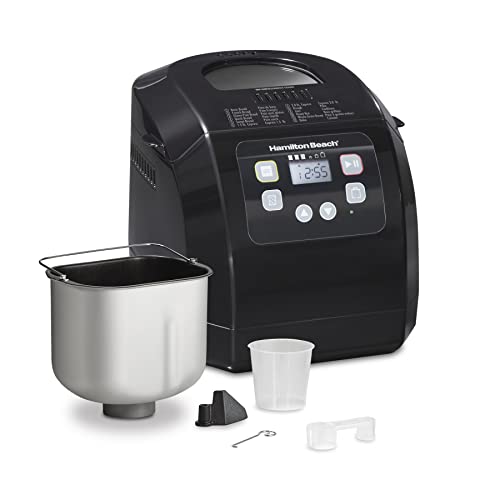
Hamilton Beach Digital Bread Maker, 2 lb, PFAS-Free Pan (Black) — Best Overall Under $100
This Hamilton Beach is the budget pick we would buy first: 12 settings including a gluten-free cycle, a full 2 lb capacity with no size penalty for spending less, and — a detail we did not expect at this tier — a PFAS-free nonstick pan and kneading paddle, for buyers actively avoiding conventional nonstick coatings. It does not have dual heaters or a dispenser, and its top crust will run paler than premium machines. What it has is the complete core job from a mainstream brand with real support, at a budget tier. For a first machine, that is exactly the right trade.
Strengths
- PFAS-free nonstick pan and paddle answer a concern few budget machines address
- 12 settings plus gluten-free cover the everyday repertoire, including dough
- Full 2 lb capacity at a budget tier — no capacity compromise
Trade-offs
- Single heating arrangement means a paler top crust than premium machines
- No mix-in dispenser: seeded and raisin loaves need you at the add-in beep
- Fit, finish, and control feel are a clear step below premium models
Key specs (verified)
- Capacity: 2 lb
- Programs: 12 settings plus gluten-free
- Pan and paddle: PFAS-free nonstick
- Controls: digital, programmable
Think of this machine as the question-answerer. Unsure whether bread-machine baking fits your life? Bake with it for a season. The loaves will be good — slightly paler on top, with a standard paddle hole — and for toast, sandwiches, and dough duty, good is usually enough. The dough cycle alone justifies it for many households: pizza night with machine-made dough is a genuine weekly upgrade, and it costs you ten minutes. What you should not do is buy this tier expecting premium results and then blame the category; the gap upward is real, visible, and entirely optional.
Check the current price on Amazon for the Hamilton Beach Digital Bread Maker, 2 lb, PFAS-Free Pan (Black).
Best for: first-time buyers, PFAS-averse buyers, dough-cycle households / Not suited for: crust perfectionists, heavy whole-grain bakers, dispenser seekers

Hamilton Beach Digital Bread Maker 29987, 14 Settings, White & Stainless — Best for Program Variety on a Budget
The 29987 is the sibling to our top pick with a different emphasis: 14 programmable settings, including an artisan-style cycle and gluten-free, plus delay start for morning bread, in a white and stainless finish. Choose it over the black model if program variety within the budget tier is your priority, or if the lighter finish suits your kitchen. The underlying proposition is the same — a mainstream brand, a full 2 lb loaf, and the complete core job — with the trade-offs of the tier: one heater, no dispenser, and a standard paddle hole in every loaf.
Strengths
- 14 settings, the broadest budget list here, including artisan and gluten-free
- Delay start supports overnight and morning baking routines
- Full 2 lb capacity from a mainstream, supported brand
Trade-offs
- More programs do not change the single-heater crust — tops still run pale
- No automatic dispenser for mix-ins
- White finish shows flour dust and requires a wipe-down habit
Key specs (verified)
- Capacity: 2 lb
- Programs: 14, including artisan and gluten-free
- Feature: delay start
- Finish: white and stainless steel
A word about that artisan setting, because budget marketing leans on it. No bread machine at any tier produces a true artisan loaf — the crust and crumb of a Dutch-oven boule need heat and steam a countertop box cannot deliver. What an artisan-style cycle usefully does is adjust timing toward longer, slower fermentation flavors in a machine loaf, which is a real, if modest, improvement for everyday bread. Buy this model for its variety, timer, and capacity, treat the artisan label as a timing profile rather than a promise, and you will be judging it fairly — which is more than its own box does.
Check the current price on Amazon for the Hamilton Beach Digital Bread Maker 29987, 14 Settings, White & Stainless.
Best for: program explorers on a budget, overnight bakers, light-finish kitchens / Not suited for: buyers expecting true artisan results, dark-finish minimalists

Amazon Basics Programmable Bread Maker, 2 Pound, Black — Best Simple Budget Pick
The Amazon Basics machine is the no-drama budget option: 14 settings covering breads, doughs, and gluten-free options, an ExpressBake cycle for same-afternoon bread, and a clear LCD display, in a 2 pound non-stick format. Its appeal is simplicity and availability — a house brand machine with a standard feature set and nothing exotic to learn. It suits buyers who want the category’s core job at a budget tier without researching sub-brands, and who accept the tier’s standard compromises on crust and finish.
Strengths
- 14 settings including gluten-free options and an ExpressBake fast cycle
- Clear LCD display and a simple, learnable control layout
- Full 2 pound capacity — the standard family loaf size
Trade-offs
- Single-heater baking with the pale top crust typical of the tier
- House-brand support is functional but thinner than legacy appliance brands
- No dispenser, and the paddle hole is standard size
Key specs (verified)
- Capacity: 2 pound
- Programs: 14 settings
- Features: ExpressBake, gluten-free options, LCD display
- Pan: non-stick
ExpressBake deserves the same honest framing as every fast cycle: bread in a hurry is bread with compromises. A shortened rise gives a denser, less developed loaf, and that is physics, not a flaw in this machine. Used occasionally — guests coming, sandwiches needed today — it is genuinely handy. Used daily, it teaches you the wrong lesson about what machine bread can be, because the standard cycles on this same machine produce a noticeably better loaf for the price of patience. Buy the Amazon Basics for its standard repertoire, keep ExpressBake for emergencies, and it is a sound budget purchase.
Check the current price on Amazon for the Amazon Basics Programmable Bread Maker, 2 Pound, Black.
Best for: simplicity-first buyers, occasional fast-loaf needs, first machines / Not suited for: crust-focused bakers, buyers wanting premium brand support depth

Elite Gourmet Programmable Bread Maker EBM8103SS, 19 Presets, Stainless — Best for Loaf-Size Flexibility
The Elite Gourmet EBM8103SS competes on flexibility: three loaf sizes from a 2 lb platform, so a small household can bake small and a family can bake full-size in the same machine, plus 19 presets spanning gluten-free, dough, and jam, and a delay timer. The stainless finish lifts it visually above most of the budget tier. Its program count should be read the way we advise everywhere — count the ones you will use monthly — but the size flexibility is a real, structural advantage that most budget rivals, fixed at one or two sizes, do not offer.
Strengths
- Three loaf sizes suit both small households and families in one machine
- 19 presets include gluten-free, dough, and jam with a delay timer
- Stainless finish looks a tier above most budget machines
Trade-offs
- Preset breadth includes novelty settings most owners rarely use
- Support and parts depth trail the Hamilton Beach picks
- Standard single-heater crust limitations of the tier apply
Key specs (verified)
- Capacity: 2 lb, 3 loaf sizes
- Programs: 19 presets
- Includes: gluten-free, dough and jam, delay timer
- Model: EBM8103SS, stainless
Loaf-size flexibility sounds minor until you live with a fixed-size machine. Bread stales in days, and a two-person household with a 2 lb-only machine either eats a lot of toast or wastes a lot of loaf. Baking a smaller loaf twice a week instead is the fresher rhythm, and this machine builds it in. The jam setting, by contrast, is the classic box-padding program — pleasant once, rarely a routine — and we mention it only so you can discount it properly. Judge the Elite Gourmet on sizes, timer, and its core bread cycles, and it earns its slot in a budget list where genuine structural differences are rare.
Check the current price on Amazon for the Elite Gourmet Programmable Bread Maker EBM8103SS, 19 Presets, Stainless.
Best for: mixed-size households, small households that also bake for guests, stainless fans / Not suited for: buyers who want the deepest brand support, program minimalists
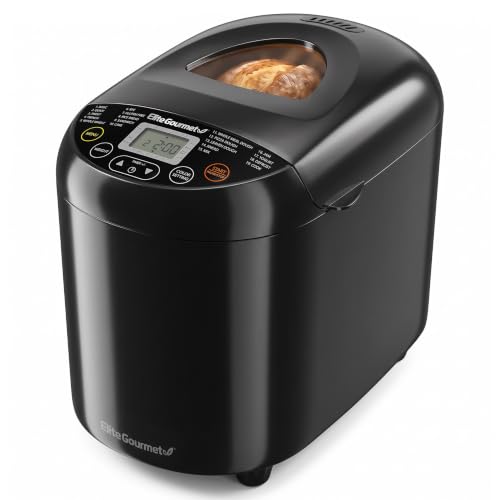
Elite Gourmet Bread Maker EBM8103B, Ceramic Pan, 19 Presets — Best Ceramic Pan on a Budget
This Elite Gourmet variant exists for one buyer: the one who wants a ceramic pan without leaving the budget tier. Its CERALAST ceramic pan answers the same coating concern as our top pick’s PFAS-free pan, by a different route, and around it sits a full budget feature set — 19 presets, three loaf sizes, gluten-free, a 15-hour delay timer, a 60-minute keep-warm, and three crust shades, with a recipe book included. For coating-conscious buyers, the choice between this and the Hamilton Beach PFAS-free model is the most interesting decision in this guide.
Strengths
- Ceramic pan at a budget tier — rare, and the reason this model is here
- 15-hour delay timer and 60-minute keep-warm suit morning-bread routines
- Three loaf sizes and three crust shades give real everyday flexibility
Trade-offs
- Ceramic coatings need gentle handling — no metal utensils in the pan
- Keep-warm beyond a short window softens crust; do not treat it as storage
- Brand support depth is thinner than the legacy brands in this list
Key specs (verified)
- Pan: CERALAST ceramic
- Programs: 19 presets, 3 loaf sizes
- Timer: 15-hour delay, 60-minute keep warm
- Crust: 3 adjustable shades
Ceramic versus PFAS-free nonstick is a genuine fork, not a ranking. Ceramic pans release well, tolerate the coating concern completely, and ask for gentler treatment — wooden or silicone tools, no soaking with abrasives. Modern PFAS-free nonstick is tougher against casual handling and equally addresses the chemical concern for most buyers. Neither changes the loaf itself. Decide by how your household treats pans: careful kitchens will keep ceramic pristine for years; busy, utensil-happy kitchens should take the Hamilton Beach route. Either way, this tier now offers a real choice, which it did not a few years ago.
Check the current price on Amazon for the Elite Gourmet Bread Maker EBM8103B, Ceramic Pan, 19 Presets.
Best for: ceramic-pan buyers, coating-conscious households, delay-timer routines / Not suited for: rough-and-tumble pan handling, buyers wanting legacy-brand support

Cuisinart Compact Automatic Bread Maker CBK-110 — Best Compact Budget Option
The CBK-110 is the budget list’s compact answer: a smaller countertop footprint that still produces a 2 lb loaf, with 12 programs, three loaf sizes, three crust shades, and a 13-hour delay start. Its most thoughtful feature is the paddle-removal alert, which signals the point at which you can take the paddle out before baking and eliminate the paddle hole — a refinement rarely seen at this tier. It regularly sits near the top of the budget band and sometimes above it, so treat it as the stretch pick: the one to grab when its listing lands within your budget, for small kitchens that refuse small loaves.
Strengths
- Compact footprint with a full 2 lb loaf — no capacity penalty for small kitchens
- Paddle-removal alert lets you eliminate the paddle hole before baking
- 12 programs, three sizes, three crust shades, and a 13-hour delay cover the essentials
Trade-offs
- Its listing price moves around the top of this tier — verify it fits your budget when you order
- Compact body means a snug fit for the pan and less working room around it
- No dispenser; mix-ins are added by hand at the signal
Key specs (verified)
- Capacity: 2 lb, 3 loaf sizes, compact body
- Programs: 12
- Features: 13-hour delay start, paddle-removal alert
- Crust: 3 shades
The paddle-removal alert deserves explanation, because it solves the complaint every bread-machine owner eventually makes. The paddle must knead, but it does not have to bake: remove it after the final knead and the loaf bakes without a hole torn in its base. Most machines make you guess that moment; this one tells you. It is a small feature with an outsized effect on how finished the loaf looks, and combined with the compact body it makes the CBK-110 the most considered design in this budget list. If counter space is your binding constraint — as it is in most small kitchens — this is where your budget does the most work.
Check the current price on Amazon for the Cuisinart Compact Automatic Bread Maker CBK-110.
Best for: small kitchens, apartment bakers, paddle-hole haters on a budget / Not suited for: buyers who need the absolute lowest tier price every day, dispenser seekers
Comparison Table
| Pick | Badge | Key spec | Best for |
|---|---|---|---|
| Hamilton Beach Digital Bread Maker, 2 lb, PFAS-Free Pan (Black) | Best Overall Under $100 | Capacity: 2 lb | first-time buyers, PFAS-averse buyers, dough-cycle households |
| Hamilton Beach Digital Bread Maker 29987, 14 Settings, White & Stainless | Best for Program Variety on a Budget | Capacity: 2 lb | program explorers on a budget, overnight bakers, light-finish kitchens |
| Amazon Basics Programmable Bread Maker, 2 Pound, Black | Best Simple Budget Pick | Capacity: 2 pound | simplicity-first buyers, occasional fast-loaf needs, first machines |
| Elite Gourmet Programmable Bread Maker EBM8103SS, 19 Presets, Stainless | Best for Loaf-Size Flexibility | Capacity: 2 lb, 3 loaf sizes | mixed-size households, small households that also bake for guests, stainless fans |
| Elite Gourmet Bread Maker EBM8103B, Ceramic Pan, 19 Presets | Best Ceramic Pan on a Budget | Pan: CERALAST ceramic | ceramic-pan buyers, coating-conscious households, delay-timer routines |
| Cuisinart Compact Automatic Bread Maker CBK-110 | Best Compact Budget Option | Capacity: 2 lb, 3 loaf sizes, compact body | small kitchens, apartment bakers, paddle-hole haters on a budget |
How to Choose the Best Bread Machines Under 100 Dollars
At this tier, choose on structure, not features. The structural questions are: Does it bake a full 2 lb loaf, or at least offer sizes that match your household? Is the pan coating one you are comfortable with — standard nonstick, PFAS-free, or ceramic, all three of which appear in this guide? Does the brand sell replacement pans and paddles, because the pan is the machine’s lifespan? And is there a real dough cycle, which for many budget owners becomes the most-used program of all? A machine that answers those four well and offers twelve programs beats a machine that answers them poorly and offers nineteen, every single week you own it.
Then be realistic about crust. Every machine in this guide uses a single heating arrangement, and every one will give you a paler, softer top crust than a dual-heater premium machine. That is the tier, not a defect in any individual model. If pale tops bother you, the fixes are free: brush the top with milk before the bake phase if your model allows opening, finish a dough-cycle loaf in your oven, or simply toast slices, which is what most machine bread becomes anyway. Do not let the one thing this tier cannot do talk you out of the many things it does well for very little money.
What the Budget Tier Gives Up — and What It Does Not
It does not give up the fundamentals. Mixing, kneading, proofing, and baking on a timer, with a delay start for morning bread, work the same in principle at this tier as at any other, and a well-measured recipe in a budget machine produces a genuinely good everyday loaf. Whole-wheat and gluten-free programs exist here too, though they are simpler versions of the premium cycles — adequate for standard recipes, less forgiving of improvisation. The dough cycle, notably, loses almost nothing in translation: dough does not care about heaters at all, which is why budget machines are such good pizza-night tools.
What it gives up is margin and finish. Margin: less power and simpler timing mean budget machines punish sloppy measuring more — weigh your flour, at this tier especially. Finish: paler tops, a standard paddle hole, lighter build, and controls that feel functional rather than delightful. None of those affect whether the bread is good. They affect whether it is beautiful and whether the machine forgives you. Knowing that in advance is the whole secret to being happy with a budget purchase: buy it for the bread, not for the brochure, and it will earn its counter space.
Getting Premium Results from a Budget Machine
Three habits close most of the gap between this tier and the premium one, and all three are free. First, weigh ingredients — a scale costs little and removes the largest variable in all machine baking, which budget timing tolerates worst. Second, do the first-knead check described in the how-to below: look at the dough ball five to ten minutes in and adjust water or flour a tablespoon at a time. Third, use the dough cycle plus your oven for the loaves you show off — weekend bread — and let the machine’s own bake handle weekday sandwich loaves. That division of labor is what experienced owners at every tier actually do.
A fourth habit protects the machine itself: treat the pan gently. At this tier the pan coating is the difference between a two-year and a six-year appliance. Soak, never scour; use soft tools; dry the paddle shaft area fully. Replacement pans exist for the brands in this guide, but a cared-for original will outlast the machine’s electronics in most kitchens. Budget buying is not cheap buying when it is done this way — it is buying the core job once, at the lowest sensible tier, and operating it well.
How to Bake a Great First Loaf on a Budget Machine
Step 1: Measure by weight if you can. Flour is the biggest variable in machine baking, and budget timing is the least forgiving of it. Spoon flour into the cup and level it if you have no scale; scoop directly and you will quietly add too much, and the loaf will be dense for reasons that look like machine failure.
Step 2: Load liquids first, flour second, yeast last. Liquids into the pan, flour over them, yeast in a small well in the flour, away from direct contact with salt and liquid until the cycle starts. On a delay timer this order is essential — early contact starts fermentation hours too soon and the loaf over-rises and collapses.
Step 3: Match recipe weight to the size setting. Choose the loaf size that matches your recipe’s total weight, select the program for your flour type, and set the crust one shade lighter than you think you want for a first bake. Budget heaters brown unevenly enough that starting light is cheap insurance.
Step 4: Watch the first knead and adjust. Five to ten minutes in, open the lid. The dough should form a smooth, slightly tacky ball cleaning the pan sides. Dry and shaggy means add water a tablespoon at a time; slack and puddly means add flour the same way. This one check prevents most budget-machine disappointments.
Step 5: Cool fully before slicing. Shake the loaf from the pan promptly, remove the paddle from the base if it came away with the loaf, and cool on a rack for at least half an hour. Hot bread slices gummy no matter what machine baked it, and budget loaves are judged unfairly often for exactly this reason.
Step 6: Write down what worked. When a loaf comes out right, note the recipe weights, program, size, and crust setting on the recipe itself. Budget machines reward a proven routine repeated exactly far more than constant experimentation.
On the delay timer — the feature that sells many of these machines — one safety note matters: use it for plain breads, not for recipes containing fresh milk, eggs, or other perishables that would sit at room temperature for hours before baking. Water-based loaves with dry yeast are the timer’s home ground, and waking to a finished loaf, safely made, is the experience the feature exists for.
Cleaning and Care on a Budget: Protect the Pan
Everything in the care routine for premium machines applies here, with one emphasis doubled: at this tier, the pan is the machine. Let it cool after a bake, fill it with warm water, and soak ten minutes so dough lifts away without scrubbing; wash by hand with a soft sponge and dry fully, especially around the paddle shaft and the pan’s drive socket, where moisture lingers and grit accumulates. Never use metal utensils in the pan — doubly true for the ceramic Elite Gourmet pick — and never scour a coating that your next hundred loaves depend on.
Monthly, wipe the baking chamber and the area around the heating element with a barely damp cloth once the machine is cool and unplugged, because flour dust builds up and can smoke faintly on hot bakes. Wiggle the paddle every few bakes; a gritty or stiff feel means dough residue is baking onto the shaft, and a longer soak plus a soft brush restores it. Keep the manual together with your one proven basic recipe, and confirm the replacement pan and paddle for your model while the machine is new, not when the coating fails. Treated this way, a budget machine is not a disposable appliance — it is a five-to-ten-year one, and at two loaves a week that is hundreds of bakes from a very small purchase.
The Recipes That Flatter a Budget Machine
A budget machine is not equally good at everything, and choosing its repertoire wisely is the difference between an owner who loves it and an owner who lists it for sale. Its home ground is the straightforward loaf: white and mixed-grain sandwich bread, standard whole-wheat recipes written for machines, soft enriched loaves like brioche-style and milk bread at standard settings, and above all dough — pizza, rolls, focaccia, and flatbreads finished in the oven, where the machine’s heaters never enter the story at all. These recipes ask for exactly what a budget machine does well: reliable kneading, a warm and patient proof, and a competent bake. Build your first month around them and the machine will feel like a triumph, because on this repertoire, it genuinely is one.
The repertoire to approach carefully is the one that stresses the tier’s known limits. Very high proportions of whole grain — a loaf that is nearly all whole wheat with seeds and grains — kneads stiffly and rises slowly, and a budget machine’s simpler timing and single heater will produce a denser result than the same recipe in a premium machine; it will still be good bread, but set the expectation. Very wet, slack doughs can climb and stick in smaller pans. And recipes that depend on a dark, crisp crust for their identity — a lean, crusty country loaf — belong on the dough cycle plus a hot oven or Dutch oven, which is not a workaround but the method experienced owners at every tier actually use for those loaves. None of this is a reason to avoid the recipes; it is a reason to sequence them after the machine’s home ground, with the first-knead check as your guide.
One more repertoire note, because budget owners discover it with delight: the dough cycle makes a budget machine the hardest-working tool in a small kitchen. Pizza night, cinnamon rolls on a weekend, dinner rolls for a holiday, flatbreads for a curry night — all of them are ten minutes of loading and a timer, with the shaping and baking in your hands where they belong. Households that bought a budget machine for sandwich bread and kept it for dough duty are the norm in owner communities, and it reframes the purchase entirely: at this tier you are not buying a lesser bread bakery, you are buying a tireless dough assistant that also bakes a perfectly good everyday loaf. Judged on that complete job, the machines in this guide are not compromises. They are bargains, and the recipes above are how to collect on them.
When to Upgrade From a Budget Machine — and When Not To
Upgrade when the machine’s limits, not its marketing, are what you feel. The honest signals are specific: you bake whole-grain loaves weekly and want a less dense crumb than the budget whole-wheat cycle gives you; you bake for a household that has outgrown a 2 lb loaf; the pale top crust has stopped being a shrug and started being the thing you notice at every breakfast; or you have worn out a pan and face the replace-versus-upgrade decision with real data about your habits. In each case the premium features map to a felt problem — dual heaters to the crust, a genuine gluten-free cycle to the dense loaf, a larger horizontal pan to the household — and that mapping is what makes an upgrade satisfying rather than merely expensive.
Do not upgrade when the problem is actually recipe, measurement, or freshness, because a premium machine will faithfully reproduce those problems at a higher tier. A dense loaf from old yeast is dense in any machine. A collapsed loaf from a mismatched size setting collapses by the same physics everywhere. And do not upgrade out of the dough cycle: if your budget machine’s main job has become pizza and rolls, it is already doing that job at a professional standard, and there is nothing above it to buy. The owners who get the most from this tier are the ones who treat the upgrade question as a diagnosis, not a desire — and many of them, having run the diagnosis honestly, keep the budget machine for years. That outcome is a success of this guide, not a failure of it.
Common Buying Mistakes
Expecting premium crust at a budget tier. Single heaters give paler tops. That is the tier’s physics, not a broken machine. Toast the slices, finish special loaves in the oven on the dough cycle, or save for a dual-heater model — but do not return a working budget machine for doing what its tier does.
Buying the cheapest listing instead of the best budget machine. An unverifiable no-name listing with no replacement parts is more expensive over three years than a supported budget brand. The pan will wear; the question is whether a new one exists.
Judging by program count. Nineteen presets with novelty settings are not better than twelve honest ones. Count the programs you will use monthly — basic, whole wheat, dough, gluten-free if needed — and let pan, size, and support decide.
Skipping the scale and the first-knead check. Budget timing forgives sloppy measuring least. Weighing flour and glancing at the dough ball once are free, and together they prevent most dense, collapsed, or overflowing loaves at this tier.
Using the delay timer with perishable ingredients. Milk- and egg-rich doughs should not sit at room temperature for hours before baking. Keep timer loaves to water-based recipes with dry ingredients, and bake enriched doughs when you are home.
Scouring the pan clean. Every scrub shortens the coating’s life, and at this tier the coating is the machine’s life. Soak first, use a soft sponge, and let water do the work — ten patient minutes beat one aggressive minute every time.
Final Recommendation
For most first-time buyers, the Hamilton Beach Digital with the PFAS-free pan is the budget machine to buy: the complete core job, a full-size loaf, and a coating choice that answers a real concern, all at this tier. Start with the Hamilton Beach Digital Bread Maker, 2 lb, PFAS-Free Pan (Black) if you want the safest all-round choice, consider the Hamilton Beach Digital Bread Maker 29987, 14 Settings, White & Stainless for the alternative strength described above, and look at the Cuisinart Compact Automatic Bread Maker CBK-110 if your priority is value within this category. Check price on Amazon for the model that matches your routine, and re-check the included accessories on the listing on the day you order.
Related guides on this site: Best Bread Machines Best Bread Machines Horizontal Loaves Best 2 Lb Bread Machines Best Bread Machines For Beginners Best Bread Machines For Home Use.
Frequently Asked Questions
Are bread machines under $100 actually worth buying?
Yes, for the job they are built for: everyday loaves, sandwich bread, and dough duty, on a timer, with about ten minutes of your attention. They will not match premium machines on crust evenness or finish, and we say so throughout this guide. As a first machine or a dough workhorse, the tier is genuinely good value; as a would-be artisan bakery, no tier of bread machine qualifies.
Why do prices on these models keep changing?
Bundles, sellers, and promotions move budget listings above and below round-number lines constantly. That is why this guide recommends by tier and tells you to check price on Amazon when you order, rather than printing prices that would be wrong within weeks. Choose the machine here; confirm the number there.
Can a budget machine handle whole wheat and gluten-free bread?
The picks here include whole-wheat-capable programs and, on most, a gluten-free cycle. Budget versions of these programs are simpler than premium ones — they handle standard recipes well and forgive improvisation less. Weigh ingredients carefully, use recipes written for machine baking, and results are reliably good.
What size loaf should a small household choose?
Look for a machine with multiple loaf sizes, like the Elite Gourmet and Cuisinart picks here, so you can bake a small loaf fresh twice a week instead of a large loaf that stales. If a machine is fixed at 2 lb, plan to slice and freeze half the loaf on baking day.
Is the dough cycle on a budget machine any good?
It is arguably the best value in this entire guide. Dough needs mixing, kneading, and a warm proof — none of which depend on expensive heaters. Pizza dough, rolls, and oven-finished loaves from a budget machine’s dough cycle are effectively identical to those from a premium machine.
How long will a budget bread machine last?
With the pan cared for — soaked, never scoured, dried fully — the brands in this guide routinely serve five years and well beyond. The pan coating is the wear item; replacement pans and paddles are available for these models, and replacing a pan in year four is far cheaper than replacing the machine.


