Disclosure: airfryerkitchensupply.com is reader-supported. When you buy through links on our site, we may earn an affiliate commission at no extra cost to you.
Where to buy
Shoppers comparing the best blenders for protein shakes will find every pick in this guide on Amazon. A protein shake is a specific drink — powder, liquid, usually ice or frozen fruit, drunk immediately — and it rewards blenders designed around single servings and fast cleanup. Every pick below is a cup-based or combo system verified for exactly that job, and all are sold on Amazon, where you can confirm cup sizes and lid types before buying.
The six machines in this guide are: Ninja Professional Plus DUO BN751, nutribullet Ultra NB50500BR, nutribullet Pro+ N12-1001MK, Ninja Nutri-Blender Pro BN401, nutribullet SmartSense Blender Combo NBF50700, Ninja Fit QB3001SS. Check the current price on Amazon for the model you choose, and check price on Amazon again before ordering if you are comparing configurations, because jar sizes, included cups and colors vary by listing.
Introduction: The Shake Is a Daily Habit, So the Blender Must Be One Too
The best blenders for protein shakes succeed or fail on a single criterion: whether you still enjoy using them on the two-hundredth morning. A protein shake is not an occasional recipe; it is a daily ritual performed half-awake, and every friction point — a cup too small, a lid that leaks in a gym bag, a blade assembly that takes five minutes to wash — compounds until the habit breaks. This guide grades for the ritual, not the demo.
Technically, the job has three demands. The powder must hydrate completely, with no chalky pockets or wall plaster. The cold load — ice, frozen banana, frozen berries — must disappear into the texture rather than survive as shards. And the result must pour or drink smoothly at a real serving size, which for most adults means a cup in the 24 oz class, not a thimble. Every pick here meets those demands at a different price and personality, and each was verified by brand and model.
Format note: this guide is deliberately cup-first. Pitcher machines appear in the sibling protein guide; here, even the combo pick earns its place through its single-serve performance. If your shake is a solo, daily, out-the-door drink, you are in the right list.
This guide also assumes the shake is usually a solo production. Couples and families who shake together should read it alongside the general protein guide, where the pitcher systems live; here, the unit of analysis is one person, one cup, one morning. That focus is deliberate — optimizing for the group when you blend alone buys you a bigger washing load and nothing else.
In this guide
Quick Picks
Six cup-first machines for the daily shake, from the complete DUO system to a budget base that fits in a locker-room lifestyle.
- Ninja Professional Plus DUO BN751 — Best Overall: Two 24 oz cups for the daily shake plus a 72 oz pitcher for weekends — the system that covers a protein habit and a household. Check the current price on Amazon.
- nutribullet Ultra NB50500BR — Best Quiet Personal Pick: Listed as the quietest single-serve blender in its line, with titanium-coated blades and three cups — the early-morning considerate pick. Check the current price on Amazon.
- nutribullet Pro+ N12-1001MK — Best for Big Shakes: 1200 watts and a 32 oz cup for the genuinely big post-workout shake that overflows lesser personal blenders. Check the current price on Amazon.
- Ninja Nutri-Blender Pro BN401 — Best One-Button Pick: Two Auto-iQ programs run the pulse-and-blend pattern for you — the set-and-forget shake, identical every morning. Check the current price on Amazon.
- nutribullet SmartSense Blender Combo NBF50700 — Best Smart-Cycle Combo: A 1400W combo whose smart auto cycle adjusts speed and time itself, for shakes and full-size blends alike. Check the current price on Amazon.
- Ninja Fit QB3001SS — Best Budget Pick: 700 watts, two 16 oz cups, almost no footprint — the budget shake station for dorms, desks and small kitchens. Check the current price on Amazon.
How These Picks Were Chosen
Candidates were judged on the shake ritual end to end: cup working size against a loaded recipe, powder behavior in the first five seconds, ice and frozen-fruit finishing, lid quality for transport, and cleanup time. Machines that blended beautifully but washed terribly were marked down, because the ritual is daily.
All six products were verified by brand-and-model search with title matching before any ASIN was used here. Spec boxes quote only those verified listings, and wattage is described as the listing describes it — peak where the listing says peak.
We included one deliberate budget pick and one smart-cycle combo to bracket the range, but the center of this list is the strong personal blender: roughly the 1100 to 1200 watt class, a 24 oz or larger cup, and parts that rinse in seconds. That is where most shake drinkers will be happiest.
Noise was logged as a real criterion for this list, unusual as that may sound. Shakes are blended at the edges of the day — dawn workouts, late shifts — and a machine the household dreads hearing is a machine that quietly stops being used. It is why the quiet-positioned pick earned its badge, and why we note sound honestly in every review rather than treating it as someone else’s problem.
The 6 Best Blenders for Protein Shakes — Reviewed in Detail

Ninja Professional Plus DUO BN751 — Best Overall
The Ninja BN751 DUO earns Best Overall for protein shakes by solving the two-cup problem and the weekend problem in one box: two 24 oz single-serve cups handle the daily shake with room for a full recipe, and the 72 oz pitcher waits for the days you blend for more than one.
Strengths
- Two 24 oz cups sized for real loaded shakes, with travel lids
- 1400 peak watts finish ice and frozen fruit smoothly in the cups
- Auto-iQ programs give a consistent cycle without monitoring
Trade-offs
- More parts and counter presence than a pure personal blender
- Pitcher goes unused in strictly solo households
- Peak wattage is burst power; the cups are the star, not the number
| Specification | Detail (as listed) |
|---|---|
| Motor | 1400 peak watts |
| Pitcher | 72 oz |
| Extras | (2) 24-oz single-serve cups |
| Programs | 3 Auto-iQ programs |
In the cups, the extraction action pulls powder down into liquid quickly, and the programmed cycles pulse before they run — the exact sequence that prevents the chalk ring at the cup’s shoulder. Load liquid first anyway; good machines reward good habits rather than replacing them.
The DUO is the pick for the shake drinker whose life is not only shakes: partners, kids, weekend guests. Buy the system once and every blending format in the house is covered, with the daily shake as its home turf.
DUO cup discipline: the two 24 oz cups invite a household system — one per person, or one in use and one clean — and the routine works best when each cup keeps its role. The pitcher also rescues the DUO’s shake credentials on prep day: blend a double batch of a base shake, refrigerate in the cups, and two mornings are pre-solved, with a quick hand-shake before drinking to restore the texture.
Best for: Shake drinkers who also need a full household blender / Not suited for: Minimalists who want one cup, one base, nothing else
Check on Amazon — check the current price on Amazon at the listing.

nutribullet Ultra NB50500BR — Best Quiet Personal Pick
The nutribullet Ultra is the considerate roommate of this list: its listing calls it the quietest single-serve blender in the range, and for shakes blended at 5:30 a.m. in a shared house, that is not a luxury feature — it is the feature.
Strengths
- Positioned as the quietest single-serve option in its line, ideal for early shakes
- Titanium-coated blades as listed, built for durability through frozen loads
- Three BPA-free cups with to-go lids cover rotation and washing cycles
Trade-offs
- Personal format only, with no pitcher path
- Quiet is relative — it still sounds like a blender, just a calmer one
- Brass finish is a style choice you will either love or not
| Specification | Detail (as listed) |
|---|---|
| Motor | 1200 watts |
| Blades | Titanium-coated blades (as listed) |
| Cups | 3 BPA-free cups with to-go lids |
| Cleaning | Dishwasher safe |
Beyond the noise story, the Ultra is a strong shake machine on the fundamentals: 1200 watts, cups that fit a full recipe, and extraction blending that hydrates powder cleanly. The three-cup rotation matters more than it sounds — one in use, one in the wash, one ready — and daily rituals run on exactly that kind of slack.
Choose it if your shake happens while others sleep, or if you simply prefer appliances that do not shout. The performance penalty for the quiet design is, for shake purposes, effectively zero.
The Ultra’s three-cup rotation deserves emphasis because it changes the economics of the morning: a cup is never the reason the shake does not happen. Its titanium-coated blades, as listed, also suit the user whose shake includes a daily handful of hard frozen berries — the coating story is about durability through exactly that repetitive impact work.
Best for: Early-morning shake drinkers in shared homes / Not suited for: Users who need any batch or pitcher capability
Check on Amazon — check the current price on Amazon at the listing.

nutribullet Pro+ N12-1001MK — Best for Big Shakes
The nutribullet Pro+ answers the most common personal-blender complaint — my shake does not fit — with a 32 oz cup alongside the standard 24 oz, driven by 1200 watts. Double scoops, a whole banana, oats and ice all fit in one blend.
Strengths
- 32 oz cup fits genuinely large, loaded post-workout shakes
- 1200 watts with a pulse button for thick, dense recipes
- Travel lids on both cups keep the routine portable
Trade-offs
- The big cup is tall — check cabinet and car-holder fit
- No programmed cycles; you run the blend manually
- Personal-only format, like the Ultra
| Specification | Detail (as listed) |
|---|---|
| Motor | 1200 watts |
| Cups | 32 oz and 24 oz to-go cups with travel lids |
| Controls | Pulse button |
| Cleaning | Dishwasher safe |
Size sounds trivial until you live with a too-small cup: recipes get edited, blends get split, and the ritual gains friction. The Pro+ removes the edit. Its pulse control also helps with the thick end of the shake spectrum — the peanut-butter-and-oats blends that stall lesser personal machines get worked through in pulses, then finished smooth.
If your shake is closer to a meal than a drink, this is your pick in this guide. Everyone else can trade down in size; you cannot trade up from a cup that overflows.
Pro+ technique for the thickest shakes: pulse in short bursts to crack the frozen load before any sustained run, because a 32 oz cup of dense ingredients needs the load broken up before a vortex can form. Once it forms, this machine’s power finishes the job faster than any other personal pick here — big shakes are its home turf, not its stretch goal.
Best for: Big-shake drinkers and meal-replacement recipes / Not suited for: Small-recipe users who prefer the smallest possible kit
Check on Amazon — check the current price on Amazon at the listing.
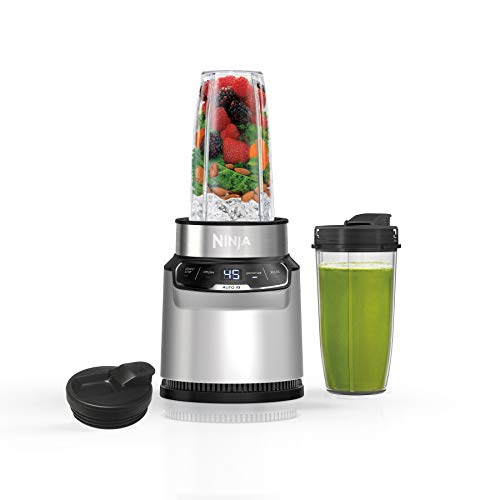
Ninja Nutri-Blender Pro BN401 — Best One-Button Pick
The Ninja BN401 is the automation pick: two Auto-iQ programs that pulse, pause and blend in a designed pattern, so the shake you get on a distracted Tuesday matches the one you got on a focused Monday. Two 24 oz cups complete the routine.
Strengths
- Auto-iQ programs automate the ideal shake sequence
- 1100 peak watts handle frozen fruit and moderate ice confidently
- Two 24 oz cups with dishwasher-safe cleanup
Trade-offs
- Fixed programs offer less manual finesse than a pulse button
- Cups top out at 24 oz — the biggest recipes need the Pro+
- No pitcher or batch option
| Specification | Detail (as listed) |
|---|---|
| Motor | 1100 peak watts |
| Cups | (2) 24-oz to-go cups |
| Programs | 2 Auto-iQ programs |
| Cleaning | Dishwasher safe |
The programmed pattern deserves respect: initial pulses wet the powder, pauses let frozen pieces settle into the blade path, and the final run polishes the texture. It is the sequence an experienced user performs manually, encoded. For a habit performed before coffee, encoding is kindness.
Pick the BN401 if your recipe is stable and your mornings are not. It trades a little control for a lot of consistency, and for protein shakes that is usually the right trade.
BN401 owners should treat the first week as calibration: the two programs differ in pulse pattern, and your recipe — its frozen weight, its powder type — will clearly prefer one. Mark the winner on the base with a dot of tape if you must; from then on, the morning requires one button and no judgment, which at 6 a.m. is the highest form of product design.
Best for: Routine shake drinkers who value one-button consistency / Not suited for: Constant recipe tinkerers
Check on Amazon — check the current price on Amazon at the listing.

nutribullet SmartSense Blender Combo NBF50700 — Best Smart-Cycle Combo
The nutribullet SmartSense Combo is the tech-forward option: a 1400W system whose smart auto cycle senses and adjusts speed, time and function during the blend. For shakes, that means the machine compensates when you add more ice or a denser scoop than yesterday.
Strengths
- 1400 watts is the strongest motor in this guide
- Smart auto cycle adjusts the blend as load conditions change
- Combo format bridges single shakes and full-size blending
Trade-offs
- Smart features add complexity some users will never use
- Combo footprint is the largest of the cup-first picks here
- Those who want a dial and total manual control should look elsewhere in this list
| Specification | Detail (as listed) |
|---|---|
| Motor | 1400 watts |
| Cycle | Smart auto cycle adjusts speed, time and function |
Variable loads are the reality of shakes: the banana is bigger, the berries are icier, the scoop is heaped. A cycle that adjusts mid-blend smooths out those variables, and the result is a narrower range between your best and worst morning shake — which, over a year of mornings, is the outcome that matters.
As a combo, it also future-proofs the purchase: today’s shake habit can grow into weekend smoothie batches without a second machine. Buy it if you like appliances that think a little on your behalf.
The SmartSense earns a specific shake compliment: it handles the heaped scoop gracefully. Everyone over-scoops sometimes, and a cycle that senses the denser load and extends itself saves the shake that a fixed timer would leave gritty. If your measuring style is approximate and your mornings are variable, adaptive blending is not a gimmick — it is forgiveness, automated.
Best for: Users who want adaptive, full-power blending in one system / Not suited for: Purists who prefer fully manual control
Check on Amazon — check the current price on Amazon at the listing.

Ninja Fit QB3001SS — Best Budget Pick
The Ninja Fit is the budget shake station and proud of it: 700 watts, two 16 oz cups with spout lids, and a base small enough for a dorm shelf. For powder, milk, a banana and a modest handful of ice, it simply works.
Strengths
- Smallest footprint and simplest operation in this guide
- Two 16 oz cups with spout lids suit shake-and-go directly
- Lowest commitment here — a sensible first protein blender
Trade-offs
- 16 oz cups will not fit loaded meal-style shakes
- 700 watts labors with heavy ice and dense frozen loads
- No programs, no pitcher, no expansion path
| Specification | Detail (as listed) |
|---|---|
| Motor | 700 watts |
| Cups | (2) 16-oz to-go cups with spout lids |
| Cleaning | Dishwasher safe |
The Fit’s virtue is presence: it lives where the shake happens, takes ten seconds to rinse, and costs little enough that a student or beginner can start the habit now instead of researching for a month. Habits beat specifications.
Respect its envelope — crushed ice over cubes, frozen fruit in modest amounts, recipes sized to the cup — and it will not disappoint you. Outgrow it later with full knowledge of what you actually use, which is the smartest upgrade path there is.
Fit expectations, managed well, produce a happy owner: this is the machine for the standard shake — powder, milk, banana, a little ice — made in a small space at a small commitment. Owners who respect that envelope report the same satisfaction as premium owners, because the drink in the cup is the same. The envelope is the whole review; stay inside it and the Fit delivers.
Best for: Students, beginners and tight spaces starting a shake habit / Not suited for: Big-recipe or heavy-ice shake drinkers
Check on Amazon — check the current price on Amazon at the listing.
Comparison Table
Cup size and cycle style separate these six more than raw power does. All finish a standard shake; they differ in how big, how automatic and how quiet the ritual feels.
| Pick | Badge | Key spec | Best for |
|---|---|---|---|
| Ninja Professional Plus DUO BN751 | Best Overall | 1400 peak watts | Shake drinkers who also need a full household blender |
| nutribullet Ultra NB50500BR | Best Quiet Personal Pick | 1200 watts | Early-morning shake drinkers in shared homes |
| nutribullet Pro+ N12-1001MK | Best for Big Shakes | 1200 watts | Big-shake drinkers and meal-replacement recipes |
| Ninja Nutri-Blender Pro BN401 | Best One-Button Pick | 1100 peak watts | Routine shake drinkers who value one-button consistency |
| nutribullet SmartSense Blender Combo NBF50700 | Best Smart-Cycle Combo | 1400 watts | Users who want adaptive, full-power blending in one system |
| Ninja Fit QB3001SS | Best Budget Pick | 700 watts | Students, beginners and tight spaces starting a shake habit |
How to Choose the Best Blenders for Protein Shakes
Start with your serving. Measure your actual shake — most adults land between 16 and 24 oz, and meal-style shakes go beyond. Your cup must hold the recipe with headroom, because an overfilled cup blends badly and leaks enthusiastically. Then decide your control style: programmed cycles for consistency, a pulse button for hands-on control, or a smart cycle if your recipes vary day to day.
Then audit the unglamorous details that decide year-two satisfaction: Are lids genuinely leak-resistant for a gym bag? Do cups fit your car holder and dishwasher? Are replacement cups and blades easy to get? The shake blender is a consumable-adjacent appliance — parts availability is a real feature.
Powder Science: Hydration, Foam and Texture
Protein powder hydrates in stages: the particles must first be wetted, then dispersed, then sheared fine enough that the drink reads as smooth rather than gritty. Blenders that pulse first excel because the initial gentle motion wets without whipping in air; a sustained run then disperses. Going straight to a long maximum blend often creates the opposite problem — a foamy, aerated shake with powder still clinging above the liquid line.
Foam control is partly ingredient physics: whey foams more than plant blends, and milk foams more than water. If foam bothers you, blend the base and powder first, add ice and fruit second, and let the finished shake stand for a minute before drinking — the texture settles noticeably.
Budget Tiers for Shake Blenders, in Plain Terms
The budget tier buys the habit: a compact personal blender that handles standard shakes honestly, like the Fit in this guide. The mid tier buys headroom — bigger cups, real frozen-fruit power, programmed or pulse control — and is where most daily drinkers should land. The upper tier buys systems and smarts: pitcher-plus-cup combos, adaptive cycles, quieter operation.
Because the shake is daily, cost-per-use math favors buying one tier up from your instinct. A machine used three hundred times a year earns its upgrade quickly; a machine used monthly does not.
Travel, Gym Bags and Leak Reality
A shake blender’s second job is transport, and transport is where cheap lids confess. Look for lids that seal on a gasket rather than friction alone, test any new cup over the sink with water before trusting it in a bag, and carry the cup upright in a side pocket when you can. The picks in this guide all ship with travel or spout lids designed for the purpose, but the sink test is free insurance.
For gym use specifically, consider blending at home and drinking within the hour, or carrying powder dry in the cup and adding liquid at the gym — the second approach keeps texture perfect and removes the leak question from the commute entirely.
Shake Timing: Before, After and Between
When you drink the shake changes what the blender must do. A pre-workout shake is usually light and fast — powder, liquid, maybe fruit — and any pick here excels. A post-workout shake tends to be the big one, with the full recipe, and it is the load your machine should be sized for. A meal-replacement shake is the thickest of all and pushes toward the Pro+ and the pitcher-capable systems.
The practical advice is to size your purchase to your largest regular shake, not your average one. Machines loaf through smaller loads happily; they cannot invent capacity or power for the big day. One honest look at your week’s largest recipe settles the cup-size question better than any review, including this one.
Powder Storage and Scoop Sanity
The blender gets blamed for texture problems that begin in the tub: powder stored open in a humid kitchen clumps before it ever meets liquid, and clumped powder hydrates unevenly in any machine. Keep the tub sealed, use a dry scoop, and add a fresh silica discipline of your own — lid on, immediately, every time. The shake you make from dry, free-flowing powder blends measurably smoother.
Scoop consistency matters for texture too: a level standard scoop hydrates predictably, while heaped scoops thicken the shake and strain smaller cups. If your shakes vary mysteriously in thickness, weigh the scoop once — the mystery usually ends there, and your chosen machine’s consistency can finally show itself.
The Office and Travel Shake
A second shake station is a legitimate strategy for people whose days split between home and office: the budget pick in this guide exists partly for the desk-drawer role, blending a simple afternoon shake where a premium machine would be wasted. Powder travels dry in the cup; liquid comes from the office kitchen; the blend happens at need rather than at dawn.
For travel days, the discipline is dry transport: powder in the sealed cup, machine borrowed or a shaker bottle as the honest fallback. Not every shake needs a blender — but the ones at home, where the blender lives, should get the blender’s texture. That division of labor keeps expectations sane in both places.
Reading Your Shake: A Texture Troubleshooting Table in Words
Gritty usually means under-hydrated powder — extend the wetting pulses or add liquid. Foamy means over-aerated — shorten the final run and let the shake stand a minute. Thin means the frozen fraction was low or the ice melted into the liquid — increase frozen fruit rather than ice for body with flavor. Thick-to-stall means the cup is overloaded or under-liquided — split the recipe or add liquid in a stream.
Each fault maps to one adjustment, and the discipline of changing one variable at a time finds your fix within two or three shakes. The machines in this guide are consistent enough that your adjustments, not their variability, will explain the results — which is exactly what you want from a daily tool.
Sweetness Without Sugar Bombs: Flavoring the Shake
Most protein shakes that taste ‘off’ are not under-sweetened but unbalanced: powder sweetness alone reads flat and artificial. Ripe fruit is the first fix, adding flavor compounds sugar cannot imitate. A pinch of salt — genuinely a pinch — sharpens every other flavor in the cup and is the oldest shake-shop trick there is. Vanilla, cinnamon and cocoa each steer a shake’s profile without adding meaningful sweetness, and a squeeze of citrus can rescue a shake that tastes muddy.
Build a small house repertoire — three or four flavor directions you rotate — rather than improvising daily. Rotation prevents palate fatigue, which is a real cause of abandoned shake habits, and a repertoire means every morning’s shake is a known good drink rather than an experiment conducted before coffee.
Texture Preferences: Thin, Classic and Spoonable
Shake drinkers divide by texture more than by flavor. Thin-shake drinkers want the drink fast and cold through a straw, with ice kept modest and liquid generous. Classic-shake drinkers want the milkshake register — the majority, and the target every pick in this guide hits by default. Spoonable-shake drinkers are really making soft-serve with protein in it, and they should weight the strong personal picks and keep liquid minimal, accepting a slower, pulse-heavy blend.
Knowing your register settles arguments the spec sheet cannot: a thin-shake drinker in a small kitchen is perfectly served by the budget pick, while a spoonable devotee will fight a light machine every single morning. Buy for the texture you actually drink, not the one that sounds impressive.
The Shake Habit Across a Year: Seasons and Slumps
Shake routines have seasons. Summer shakes lean frozen and fruity; winter shakes drift toward oats, nut butter, coffee and spice. A machine bought in June for berry shakes must survive January’s oatmeal-cookie experiments, which is an argument for the mid-tier headroom in this guide even when the current recipe is simple. Recipes evolve toward the machine’s limits with surprising reliability.
Slumps are also seasonal and normal: the answer is rarely a new machine and usually a new repertoire — three fresh recipes, a different powder flavor, a changed ritual time. The blenders here were chosen to outlast recipe boredom; give them the chance by varying what goes into them before blaming what they are.
Sharing a Shake Blender: Household Diplomacy
A personal blender in a shared kitchen raises small questions that deserve quick, explicit answers: whose cup is whose, whether the machine gets rinsed by the user or the next user, and where it lives. The multi-cup picks in this guide exist partly as diplomacy — a cup per person ends the morning negotiation — and the rinse-immediately norm, agreed once, prevents the only genuinely unpleasant part of shared shake equipment.
Households that settle these micro-rules keep the habit; households that relitigate them at 6 a.m. do not. It is a trivial paragraph in a buying guide and, in practice, one of the most predictive factors in whether the machine is still in daily use at Christmas.
From Shakes to More: What Else These Cups Do
The personal format moonlights well: salad dressings emulsify beautifully in a shake cup, marinades blend in seconds, pancake batter for one or two is a natural, and breadcrumbs, spice rubs and coffee-adjacent grinding happen in short pulses in the stronger models. A machine bought for shakes that also absorbs the kitchen’s small blending jobs earns its counter space several times over.
Respect the format’s limits in reverse, too: hot soups, large doughs and family batches belong to other tools. The shake cup’s kingdom is the cold, the small and the quick — and within that kingdom, the picks in this guide rule competently and daily.
The Shaker Bottle Question, Answered Honestly
Every shake drinker owns or considers the manual shaker bottle, and the honest comparison is this: for powder and liquid alone, shaken fresh, the bottle is adequate and unbeatable on washing. The blender earns its place the moment the recipe grows — ice, frozen fruit, oats, nut butter, greens — and on texture even in simple drinks, where a blended shake is uniformly smoother than a shaken one. Most households end with both: bottle for travel and emergencies, blender for home.
That division is not a failure of the blender purchase; it is the correct allocation of tools. This guide’s machines were chosen for the home ritual, where their texture advantage is enjoyed daily, and a ten-dollar bottle in the gym bag completes the system rather than competing with it.
Keeping Count: What a Daily Shake Actually Costs in Effort
New drinkers overestimate the daily effort and quit in week two; veterans know the true budget: about ninety seconds to build and blend, ten seconds to rinse, and a weekly dishwasher cycle for the parts. The machines in this guide were selected to hold that budget — cups that load fast, cycles that run unattended, parts that rinse clean. If your current routine costs five minutes of fiddling, the friction is in the tool, not in you, and an upgrade pays for itself in mornings within a month.
Protect the budget jealously once achieved: keep powder, cups and frozen portions staged together, resist recipes that add three minutes of prep, and let the shake stay the easiest healthy thing in your day. Ease is the entire product category’s promise, and the picks here deliver it at every tier.
One Last Thing: Protect the Morning
The protein shake lives or dies in the first ten minutes of the day, and everything in this guide — cup sizes, programs, quiet designs, rotations — is ultimately in service of protecting those ten minutes from friction. Set the station up the night before where you can: cup on the base, powder beside it, frozen portion in its bag at the freezer’s front. The morning self who finds that staging will blend the shake; the one who must hunt for parts will make toast instead. Buy the machine that fits your ritual, then stage the ritual like you mean it, and the habit will carry itself.
A Final Word on Consistency
Stand back from the details and the pattern of this guide is simple: a protein shake is a small daily promise you make to yourself, and the blender is the promise’s machinery. The six machines here keep that promise in six different styles — systematic, quiet, capacious, automatic, adaptive and minimal — and the right choice is the style that matches the life around your mornings rather than the specifications on a box. Choose it, stage it, memorize your recipe, and then stop thinking about blenders entirely. That is what success looks like in this category: a drink that happens, every day, without a decision.
Before You Buy: A Ten-Second Checklist
Run this checklist against your life, not the marketing: Does the cup hold your real recipe with headroom? Does the lid survive your bag? Can every part be rinsed in ten seconds and dishwashed without drama? Does the footprint fit the counter where the shake actually happens? Will the cycle still please you when you are tired, rushed and pre-coffee? Five yes answers mean you have found your machine in this guide, whatever its badge or tier — and a single honest no is worth more than any review, including this one.
How to Make a Lump-Free Protein Shake Every Time
Five minutes of habit design beats any single machine feature. This is the sequence our picks were graded against.
- Chill your liquid or use cold ingredients — a shake blended cold tastes better and foams less than one blended warm and iced after.
- Pour liquid into the cup first, to the level your recipe needs, leaving headroom for powder, fruit and ice.
- Add powder onto the liquid’s surface, centered, so none sticks to dry walls.
- Add soft ingredients: banana, yogurt, nut butter, oats.
- Add frozen fruit and ice last, keeping total fill below the cup’s maximum line.
- Pulse two or three times to wet the powder and crack the ice, or start the programmed shake cycle.
- Blend sustained until the vortex is smooth and the sound is even, usually well under a minute in this guide’s machines.
- Check the shoulder of the cup for powder residue; if present, tap it down and pulse twice more.
- Fit the drinking or travel lid promptly — shakes are best fresh and cold.
- Rinse cup and blade at once, even if the dishwasher will finish the job later.
If a shake still disappoints, change one variable at a time: liquid level first, then loading order, then blend length. Systematic tweaks find your recipe’s sweet spot within a few mornings, and then the ritual runs itself.
Common Buying Mistakes
Filling past the max line. Overfilled cups cannot form a vortex, so powder stays dry and ice stays whole. Headroom is an ingredient — leave it.
Adding powder first. Powder under the blades cakes into a paste plug that never disperses. Liquid first is the oldest rule in this guide because it works.
Judging by wattage alone. Cup geometry, blade design and cycle pattern shape shake texture as much as power does. The number is a starting point, not the verdict.
Skipping the sink test on a new lid. Trusting an untested travel lid in a gym bag is a laundry decision. Ten seconds with water first.
Letting the cup sit unrinsed. Protein residue dries into a film that resists casual washing and smells stale. Rinse now, wash properly later.
Final Recommendation
Most shake drinkers should choose between the Ninja BN751 DUO for system coverage, the nutribullet Pro+ for big personal shakes, and the BN401 for one-button consistency — with the Ultra for quiet mornings, the SmartSense for adaptive power, and the Fit for a first, small-footprint start. All six sit comfortably among the best blenders for protein shakes because each was matched to a real ritual rather than a spec sheet.
Keep comparing inside the cluster before you buy: Best Blenders For Protein, Best Blenders For Protein Smoothies, Best Blenders For Protein Shakes With Ice, Best Blenders For Athletes, Best Blenders For Crushing Ice.
Start here: Ninja Professional Plus DUO BN751, nutribullet Ultra NB50500BR, nutribullet Pro+ N12-1001MK. Check the current price on Amazon for each before you decide.
Best Blenders For Protein Best Blenders For Protein Smoothies Best Blenders For Protein Shakes With Ice Best Blenders For Athletes Best Blenders For Crushing Ice
Frequently Asked Questions
What size cup do I need for a protein shake?
Most standard shakes fit a 24 oz cup with headroom; smaller 16 oz cups suit powder-and-liquid shakes with light additions; meal-style shakes with oats, banana and ice want 32 oz. Measure your usual recipe in a measuring jug once — the number ends the guessing.
Do I need Auto-iQ or smart cycles for shakes?
No — a manual pulse and a short run make an excellent shake. Programs earn their place through consistency and convenience on distracted mornings. If your recipe never changes, a programmed cycle is a genuine quality-of-life upgrade; if you improvise daily, manual control serves you better.
Why does my shake taste chalky even when it looks smooth?
Chalkiness usually means the powder dispersed but did not fully hydrate, or the ratio of powder to liquid is simply high. Blend a few seconds longer, add a splash more liquid, and let the shake stand a minute before drinking. Some powders also hydrate better when added to liquid that is cold rather than room temperature.
Can I prep protein shakes the night before?
You can, with texture caveats: blend, refrigerate sealed, and re-shake vigorously in the morning. Ice-based shakes suffer most from sitting; fruit- and yogurt-based shakes hold up best. For peak texture, carry the powder dry and blend fresh — but a prepped shake you drink beats a perfect shake you skip.
Are personal blenders strong enough for frozen fruit?
The mid and upper personal blenders in this guide — the 1100 to 1200 watt class — handle frozen fruit confidently in cup-sized loads. Budget models around 700 watts manage modest amounts, especially if the fruit is slightly thawed or cut small. Load size, not fruit alone, is the deciding factor.
How long should I blend a protein shake?
In the machines here, a standard shake typically needs a few pulses plus a sustained run measured in tens of seconds, not minutes. Over-blending whips in air and warms the drink through friction. Stop when the vortex runs smooth and even — that sound change is your timer.


