Disclosure: airfryerkitchensupply.com is reader-supported. When you buy through links on our site, we may earn an affiliate commission at no extra cost to you.
Where to buy
Shoppers comparing the best blenders for protein will find every pick in this guide on Amazon. Protein blending looks easy — powder and liquid — until you add the things that make protein drinks worth drinking: frozen fruit, ice, nut butters, oats, greens. Every pick below was chosen for lump-free powder incorporation plus the strength to handle those additions, and all are sold on Amazon, where you can confirm cup counts and pitcher sizes before buying.
The six machines in this guide are: Ninja Professional Plus DUO BN751, nutribullet Pro+ N12-1001MK, Ninja Nutri-Blender Pro BN401, nutribullet Full-Size Blender Combo NBF50500, Ninja Professional Plus Blender BN701, Ninja Fit QB3001SS. Check the current price on Amazon for the model you choose, and check price on Amazon again before ordering if you are comparing configurations, because jar sizes, included cups and colors vary by listing.
Introduction: Powder Is Easy. Everything You Add to It Is Not
The best blenders for protein are not really tested by protein powder — any blender can stir powder into milk. They are tested by the real recipe: powder plus frozen berries, a handful of ice, a spoon of peanut butter, maybe oats or spinach, blended at 6 a.m. by someone who wants it smooth, cold and drinkable through a straw without a single chalky lump. That is the standard this guide grades against.
Two formats dominate this job, and choosing between them is the first real decision. Personal blenders blend in the cup you drink from — fast, minimal washing, perfectly portioned for one. Full-size pitchers handle doubles, family rounds and thicker, more ambitious recipes, at the cost of more cleanup. This guide includes the strongest examples of both, every one verified by brand and model before earning its link.
What matters, in order: enough power to crush ice and frozen fruit without leaving shards, a blade and cup geometry that pulls dry powder down into the liquid instead of plastering it to the walls, and a workflow you will actually repeat daily. The best protein blender is the one still in use in month six, and every pick below was chosen with that daily-grind reality in mind.
A word on what this guide does not do: it does not grade protein powders, recommend supplements, or make any claim about what a protein drink does for your body. Those are nutrition questions for labels and professionals. This guide grades machines — on whether the drink comes out smooth, cold, lump-free and repeatable — because that is the part of the protein routine a blender is actually responsible for.
In this guide
Quick Picks
Three personal-cup machines, two full-size systems and one budget favorite — matched to how you actually make protein drinks.
- Ninja Professional Plus DUO BN751 — Best Overall: The complete answer: a 72 oz pitcher for batches plus two 24 oz cups for daily singles, with Auto-iQ programs that run the cycle for you. Check the current price on Amazon.
- nutribullet Pro+ N12-1001MK — Best Personal Blender: 1200 watts in a personal format with 32 oz and 24 oz cups — the strongest single-serve powder-and-ice performance here. Check the current price on Amazon.
- Ninja Nutri-Blender Pro BN401 — Best Auto-iQ Personal Pick: 1100 peak watts and two Auto-iQ programs in a two-cup personal system that handles frozen fruit without babysitting. Check the current price on Amazon.
- nutribullet Full-Size Blender Combo NBF50500 — Best Full-Size Combo: A 1200W full-size combo that splits the difference: 64 oz pitcher for sharing, tumbler cup for the weekday solo shake. Check the current price on Amazon.
- Ninja Professional Plus Blender BN701 — Best for Family Batches: 1400 peak watts and a big pitcher for households blending multiple protein drinks at once, plus ice cream and frozen drinks on the side. Check the current price on Amazon.
- Ninja Fit QB3001SS — Best Budget Personal Pick: The budget personal pick: 700 watts, two 16 oz cups, and a footprint small enough for a dorm, desk or gym bag corner. Check the current price on Amazon.
How These Picks Were Chosen
We graded candidates for this list on the complete protein workflow, not a powder-and-water demo. That meant ice and frozen-fruit capacity, powder incorporation without wall-plastering, cup and pitcher sizes matched to real servings, and cleanup simple enough to survive a weekday morning. Machines that only shine with liquid loads did not make the cut.
Every product here was verified — searched by brand and model, title matched — before any ASIN was used, and the spec boxes quote only those verified listings. Where a listing states peak watts rather than continuous watts, we say so, because honest numbers matter more than big ones.
We also weighed format honestly. A household blending for three needs a pitcher; a solo commuter needs a cup system; a student needs small and cheap. Rather than crown one format, the badges below name the best execution of each, so you can match the pick to your actual routine.
We also screened for a mundane but decisive factor: how the machines behave at partial attention. Protein blending happens while you find your keys, feed a pet or read a message, so presets that finish a cycle safely, cups that seal properly, and bases that stay planted on the counter all counted. The six picks are the ones we would trust at 6 a.m. with one eye open.
The 6 Best Blenders for Protein — Reviewed in Detail

Ninja Professional Plus DUO BN751 — Best Overall
The Ninja BN751 DUO is the best overall protein blender here because it refuses to make you choose a format. The 72 oz pitcher handles family rounds and thick batch recipes, while the two 24 oz single-serve cups cover the daily solo shake — blend, swap the blade lid for a travel lid, and go.
Strengths
- Pitcher plus two 24 oz cups covers batch and single-serve in one system
- 1400 peak watts crush ice and frozen fruit in either vessel
- Three Auto-iQ programs run consistent cycles without guesswork
Trade-offs
- Two-vessel system means more parts to store than a simple personal blender
- Peak-watt rating describes burst power, not continuous output
- Pitcher is more washing than a cup on solo days — use the cups instead
| Specification | Detail (as listed) |
|---|---|
| Motor | 1400 peak watts |
| Pitcher | 72 oz |
| Extras | (2) 24-oz single-serve cups |
| Programs | 3 Auto-iQ programs |
Powder incorporation is where the DUO quietly excels: in the single-serve cups, the extractor blades pull powder down through the liquid as the cycle runs, so the chalky wall-coating that plagues cheap personal blenders is largely avoided — especially if you add liquid first, powder second, frozen ingredients last.
For households where one person blends a post-workout shake at dawn and another blends smoothies for kids at breakfast, this is the single purchase that ends the argument. It is a system, priced and sized like one, and it earns both descriptions.
A DUO ownership tip: dedicate one cup to strong flavors. Protein powders with assertive flavorings — coffee, chocolate-peanut, matcha — can perfume a cup over time, and households that keep a ‘strong flavors’ cup find the vanilla shake in the other cup tastes cleaner. The pitcher, meanwhile, is the right vessel for protein smoothie bowls: blend thick in the pitcher, spoon into a bowl, and the cups stay out of the washing queue entirely.
Best for: Households that need both daily single shakes and regular batches / Not suited for: Solo users in tiny kitchens who will never touch the pitcher
Check on Amazon — check the current price on Amazon at the listing.

nutribullet Pro+ N12-1001MK — Best Personal Blender
The nutribullet Pro+ is the personal-blender benchmark for protein: 1200 watts driving a compact extraction system, with a 32 oz cup for big post-workout blends and a 24 oz cup for standard shakes. If your protein routine is solo and daily, start your shortlist here.
Strengths
- 1200 watts is serious power in a personal format — ice and frozen fruit included
- 32 oz and 24 oz cups with travel lids cover large and standard servings
- Pulse control helps knock down powder and break up thick additions
Trade-offs
- Personal format only — no pitcher for family batches
- Cups are sized for drinks, not for thick spoonable recipes
- Power this strong in a small cup means a short, loud cycle
| Specification | Detail (as listed) |
|---|---|
| Motor | 1200 watts |
| Cups | 32 oz and 24 oz to-go cups with travel lids |
| Controls | Pulse button |
| Cleaning | Dishwasher safe |
The Pro+ workflow is the weekday ideal: liquid, powder, frozen fruit, twist, blend, lid, out the door. The 32 oz cup deserves special mention — many personal blenders top out at sizes that force you to choose between the full scoop, the banana and the ice. Here, the generous recipe fits, and the motor has the strength to finish it smooth.
Cleanup is the other half of its appeal: cup and blade rinse in seconds, and the parts are dishwasher safe for the days you cannot be bothered. Daily habits survive on exactly this kind of friction-free design.
Pro+ users blending daily should know the two-cup rotation trick: while one cup is in the dishwasher, the other is tomorrow’s vessel, so the routine never waits on washing. The 32 oz cup also earns a second job as the household’s small-batch smoothie maker — two modest smoothies fit it — which extends the machine well past its protein brief on weekends.
Best for: Solo daily protein drinkers who want maximum personal-blender power / Not suited for: Families blending multiple servings at once
Check on Amazon — check the current price on Amazon at the listing.
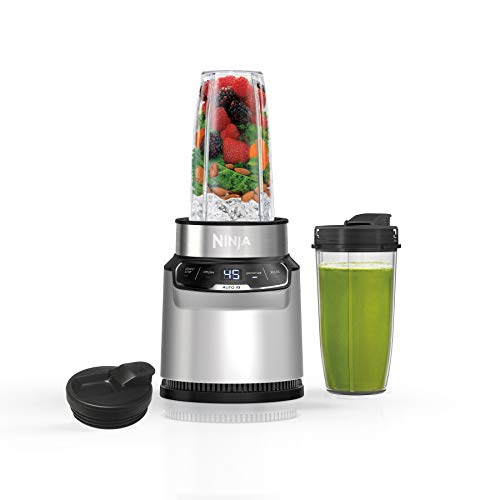
Ninja Nutri-Blender Pro BN401 — Best Auto-iQ Personal Pick
The Ninja BN401 Nutri-Blender Pro takes the personal format and adds Auto-iQ: two preset programs that pulse and pause in a programmed pattern, which turns out to be exactly what powder-plus-frozen-fruit needs — the pauses let ingredients settle back onto the blades between bursts.
Strengths
- 1100 peak watts handle ice and frozen fruit in a personal cup
- Two Auto-iQ programs automate the pulse-pause rhythm protein blends want
- Two 24 oz cups with dishwasher-safe cleanup keep mornings simple
Trade-offs
- Programs are convenient but fixed — manual control freaks may prefer the Pro+ pulse
- 24 oz maximum cup size will not fit the most loaded recipes
- No pitcher option for batch work
| Specification | Detail (as listed) |
|---|---|
| Motor | 1100 peak watts |
| Cups | (2) 24-oz to-go cups |
| Programs | 2 Auto-iQ programs |
| Cleaning | Dishwasher safe |
The programmed pulse-pause cycle is not a gimmick for this use case. Protein powder needs an initial wetting phase, frozen fruit needs shattering bursts, and a final sustained run smooths the whole — the Auto-iQ pattern approximates that sequence without you standing over the button at 6 a.m.
Choose the BN401 if your mornings run on autopilot and your recipes are consistent: same scoop, same fruit, same result, one button. Consistency is an underrated feature in a habit you repeat three hundred times a year.
The BN401’s programs have a learning curve of exactly one morning: run your standard recipe once on each program and note which texture you prefer, because the difference between them is the pulse pattern, and your recipe’s frozen load decides the winner. After that single experiment, the machine’s consistency does the rest — which is the entire argument for programmed personal blending.
Best for: Routine-driven solo users who want one-button repeatable shakes / Not suited for: Recipe experimenters who constantly change ingredients and volumes
Check on Amazon — check the current price on Amazon at the listing.

nutribullet Full-Size Blender Combo NBF50500 — Best Full-Size Combo
The nutribullet Full-Size Blender Combo is the middle path: a proper 64 oz, 1200W pitcher for shared smoothies and batches, plus a 24 oz tumbler cup for the solo protein shake. It suits the household that is mostly solo on weekdays and social on weekends.
Strengths
- 64 oz pitcher plus tumbler cup covers solo and shared blending
- 1200 watts handle ice and frozen ingredients in both vessels
- Dishwasher-safe parts keep the two-format system manageable
Trade-offs
- Jack of two formats; the pitcher is smaller than the Ninja systems here
- Fewer programmed cycles than the Auto-iQ machines
- Counter footprint grows once both vessels live out
| Specification | Detail (as listed) |
|---|---|
| Motor | 1200 watts |
| Pitcher | 64 oz |
| Extras | 24-oz tumbler cup |
| Cleaning | Dishwasher safe |
What this combo understands is the rhythm of a real week. Monday’s protein shake happens in the tumbler in ninety seconds; Saturday’s smoothie round for four happens in the pitcher. Neither job forces the wrong vessel, and neither requires owning two separate machines.
Powder behavior in the pitcher is good provided you respect loading order — liquid first, powder into the liquid, solids last — and in the tumbler it is excellent, because the extraction geometry was designed for exactly this drink.
Combo owners should treat the tumbler cup as the protein vessel and the pitcher as the smoothie vessel, even though both can do both jobs. The tumbler’s extraction geometry hydrates powder fastest, while the pitcher’s volume suits the fruit-heavy recipes. Assigning each vessel its specialty makes both jobs better and simplifies the morning decision to zero.
Best for: Mostly-solo users who also blend for others on weekends / Not suited for: Large families who need a true 72 oz batch pitcher
Check on Amazon — check the current price on Amazon at the listing.

Ninja Professional Plus Blender BN701 — Best for Family Batches
The Ninja BN701 is the batch specialist: 1400 peak watts, a 72 oz pitcher and a stacked Total Crushing blade assembly that turns a pitcher full of ice, frozen fruit and multiple scoops into smooth protein drinks for a household in one cycle.
Strengths
- Largest pitcher here, sized for multi-serving protein rounds
- Stacked blades process the full height of a loaded pitcher
- Three Auto-iQ presets include smoothie and frozen drink cycles
Trade-offs
- No single-serve cups in this configuration — solo shakes mean washing the pitcher
- Stacked blade assembly is sharp and needs careful handling
- Overkill for a one-person, one-shake household
| Specification | Detail (as listed) |
|---|---|
| Motor | 1400 peak watts |
| Pitcher | 72 oz |
| Programs | 3 Auto-iQ presets |
| Cleaning | Dishwasher-safe parts |
Blending protein for several people exposes weak pitchers quickly: the bottom blends, the top rides, and someone gets the lumpy glass. The stacked blades and the BN701’s power keep a full load circulating, so the third glass matches the first — the actual test of a family machine.
It also covers the fun jobs: the same presets handle frozen drinks and ice cream-style desserts, which makes it the household appliance rather than the personal appliance. Buy it as the family’s blender and let the protein routine ride along.
For the BN701, the protein-specific technique is batch staging: blend the liquid, powder and soft ingredients first across the whole pitcher, then add the frozen load in two additions. A full pitcher of everything-at-once can stratify — powder pocket at the top, ice at the bottom — while staging takes ten extra seconds and produces a uniform round where every glass tastes the same.
Best for: Families and households blending several protein drinks at once / Not suited for: Solo users who value a blend-and-go cup above all
Check on Amazon — check the current price on Amazon at the listing.

Ninja Fit QB3001SS — Best Budget Personal Pick
The Ninja Fit QB3001SS is the honest budget answer: 700 watts, two 16 oz cups, and a compact base that fits the dorm room, the small apartment and the office corner. It handles powder, milk, soft fruit and modest ice without pretending to be a full-size machine.
Strengths
- Compact footprint and simple operation suit small spaces
- Two 16 oz cups with spout lids cover the daily shake-and-go routine
- Dishwasher-safe parts and the lowest commitment in this guide
Trade-offs
- 700 watts will struggle with heavy ice loads and dense frozen fruit
- 16 oz cups cap recipe size — big loaded shakes will not fit
- No pulse programs or pitcher; this is a single-purpose tool
| Specification | Detail (as listed) |
|---|---|
| Motor | 700 watts |
| Cups | (2) 16-oz to-go cups with spout lids |
| Cleaning | Dishwasher safe |
Judge the Fit by its actual job: a scoop of powder, milk or water, a banana or a handful of berries, blended smooth in under a minute, in a cup you carry out. At that job it is genuinely good, and its size means it lives on the counter where the habit happens instead of in a cupboard where habits go to die.
Its limits are equally clear, and we state them plainly: load it with a cup of ice cubes and frozen mango and it will labor. Keep loads sensible, use crushed ice or smaller frozen pieces, and it will serve a student or beginner for years.
Fit owners can extend the machine’s range with two cheap habits: pre-crush ice in a bag with a rolling pin, and let frozen fruit sit out for five minutes while you dress. Both reduce the peak load on the 700W motor dramatically, and the resulting shakes are indistinguishable from ones made with far more expensive hardware — a good reminder that technique is a feature.
Best for: Students, beginners and small-space solo protein drinkers on a budget / Not suited for: Heavy ice users and big-recipe smoothie makers
Check on Amazon — check the current price on Amazon at the listing.
Comparison Table
Format is the real dividing line: personal cups for solo speed, pitchers for batches, combos for both. Power and cup sizes below are as listed in the verified listings.
| Pick | Badge | Key spec | Best for |
|---|---|---|---|
| Ninja Professional Plus DUO BN751 | Best Overall | 1400 peak watts | Households that need both daily single shakes and regular batches |
| nutribullet Pro+ N12-1001MK | Best Personal Blender | 1200 watts | Solo daily protein drinkers who want maximum personal-blender power |
| Ninja Nutri-Blender Pro BN401 | Best Auto-iQ Personal Pick | 1100 peak watts | Routine-driven solo users who want one-button repeatable shakes |
| nutribullet Full-Size Blender Combo NBF50500 | Best Full-Size Combo | 1200 watts | Mostly-solo users who also blend for others on weekends |
| Ninja Professional Plus Blender BN701 | Best for Family Batches | 1400 peak watts | Families and households blending several protein drinks at once |
| Ninja Fit QB3001SS | Best Budget Personal Pick | 700 watts | Students, beginners and small-space solo protein drinkers on a budget |
How to Choose the Best Blenders for Protein Drinks
Decide your format first, because it decides your daily experience. Personal blenders win on speed and cleanup for one person; pitchers win on volume and versatility; combos cost a little more and end the debate. Then check power against your hardest ingredient — for most protein drinkers that is ice or frozen fruit, and it is the load that separates the machines in this guide from the ones that will disappoint you.
Cup size is the quiet spec that matters daily. A standard loaded shake — liquid, powder, fruit, ice — often wants 20 to 24 oz of working room, and a big post-workout blend wants more. Undersized cups force you to blend in two rounds or leave ingredients out; the 24 and 32 oz cups in this guide exist precisely because that frustration is so common.
Getting Powder Smooth: Loading Order and Technique
Most lumpy protein shakes are technique failures, not machine failures. Load liquid first, add powder onto the liquid — never onto dry cup walls — then soft ingredients, and frozen items last, on top. Blend, and if your machine has a pulse or a programmed cycle, let the first pulses wet the powder before the sustained run. The powder hydrates instead of plastering, and the texture difference is immediate.
Thickeners need sequencing too. Oats blend smoothest when they go in with the liquid at the start; nut butters blend best added after the first few seconds, once a vortex exists to pull them down; greens disappear best when blended with the liquid before frozen fruit joins. Small habits, dramatically better shakes.
Budget Tiers for Protein Blenders, in Plain Terms
The budget tier buys a competent solo shake machine — enough for powder, liquid, soft fruit and light ice — and the Ninja Fit in this guide proves that tier can be honest. The mid tier buys real frozen-fruit and ice power in a personal format, or an entry full-size combo. The upper tier buys systems: pitcher plus cups, programmed cycles, and the headroom to make protein drinks a household routine rather than a personal one.
Spend according to frequency. A daily shake habit justifies the mid tier quickly, because the machine earns its keep three hundred mornings a year; an occasional user is better served by the budget pick and an honest recipe.
Protein Shakes vs Protein Smoothies: A Practical Distinction
A protein shake is powder-forward: liquid, powder, ice, done — speed and lump-free texture are the whole game, and any pick here excels. A protein smoothie is a meal that happens to contain powder: frozen fruit, greens, oats, nut butter, seeds. The smoothie is the harder job and the one that should drive your choice if it is your usual. If your drink has a ingredient list, buy for the smoothie standard; if it has three ingredients, buy for speed.
Thick, spoonable protein bowls sit at the far end of the same spectrum: they want pitcher power and a tamper-friendly design, and they are the one protein format where personal cups genuinely run out of road. Match the machine to the thickest thing you make weekly, and everything thinner takes care of itself.
Protein Drink Recipes That Blend Well: Ratios That Work
A reliable starting architecture for a single shake is a generous cup of liquid, one standard serving of powder as its label directs, a handful of frozen fruit, and a small handful of ice — then adjust one variable at a time. Too thick usually means the frozen fraction is high relative to liquid; too thin means the reverse. Oats, yogurt and nut butter each add body at roughly a spoonful per noticeable step, which makes them useful tuning tools rather than just ingredients.
Write your winning ratio on the cupboard door. Protein routines succeed on repetition, and the household that has its ratio memorized blends in ninety seconds while the household that improvises blends in six minutes with two texture failures. The machines in this guide reward the memorized routine with total consistency.
Cleaning and Hygiene for Daily Protein Blending
Protein residue is a hygiene topic, not just a washing one: milk- and yogurt-based drinks leave films that sour quickly in a warm kitchen. The daily standard is simple — rinse immediately, wash with hot soapy water or the dishwasher the same day, and dry cups open rather than sealed. Blade assemblies deserve a brush around the gasket, where residue hides, at least weekly for daily users.
Travel cups need the same discipline on the road: rinse at the gym or office sink rather than sealing a dirty cup in a hot bag for eight hours. Every pick in this guide uses dishwasher-safe parts precisely because the manufacturers understand the routine — use that feature without guilt on the days it keeps the habit alive.
When to Upgrade: Signs Your Blender Is the Bottleneck
Upgrade when the failures repeat: powder pockets that survive correct loading order, frozen fruit that needs three cycles, a cup that forces you to split every recipe, or a motor that smells hot on a standard load. Those are machine limits, not technique limits, and no amount of habit adjustment fixes them. The tier structure in this guide maps the upgrade path — budget to personal-power to system — so you can step exactly one level and stop.
Conversely, if your current machine makes your actual drink well, the best purchase is no purchase. Protein blending is a solved problem at several levels of this list, and the routine you keep beats the specification you admire.
Plant-Based and Dairy Proteins: Blending Differences
Different protein bases behave differently under blades, and a week of varied shakes teaches it quickly. Whey-style dairy powders hydrate fast and foam readily, rewarding the pulse-first technique. Plant blends — pea, soy, rice and mixed sources — tend to be denser and grittier by nature, rewarding a longer hydration stage and a little more liquid. Egg-white and collagen-style powders dissolve almost invisibly but can froth. None of this changes which machine to buy; it changes the settings you will favor, which is why the variable and programmed picks in this guide earn their keep across a varied pantry.
The practical habit is a per-powder note: liquid amount, program or pulse pattern, and any addition that fixed the texture. Two lines per powder, kept once, and the household’s entire rotation blends correctly forever — a small system that makes the machine’s consistency actually reachable.
Adding Vegetables to Protein Drinks Without Regret
Greens are the most common protein-drink upgrade and the most common disappointment, usually for sequencing reasons. Spinach disappears when blended with the liquid first; kale needs its stems stripped and the same head start. Frozen greens blend finer than fresh in most machines here because the freezing breaks their structure. Carrots and beets are pitcher work — fibrous and dense — and belong in the full-size picks rather than personal cups.
Flavor balance follows a simple rule: the greener the drink, the more it needs a sweet, ripe fruit anchor and a bright note — citrus or ginger — to taste intentional rather than virtuous. Build the vegetable fraction gradually over a week of drinks rather than debuting a maximal recipe that convinces you vegetables were a mistake.
The Second-Drink Problem: Batches, Fridges and Texture Decay
Protein drinks are at their best in the first minutes, and any routine that blends ahead should plan around decay honestly. Ice-based drinks decay fastest as meltwater thins them; fruit- and yogurt-based drinks hold for hours refrigerated with a vigorous re-shake. Powder-only drinks in milk hold acceptably; drinks with banana brown and thicken. Knowing your recipe’s decay curve tells you whether your household is a blend-fresh household or a blend-and-chill one.
The systems in this guide serve the blend-fresh pattern best — cups ready, cycle under a minute — but the pitcher picks support a middle path: blend a base without ice, refrigerate, and finish individual servings with a short cup blend and fresh ice. Two-stage routines sound fussy and are, in practice, the difference between a drink you look forward to and one you tolerate.
Protein Blending for Two Different Appetites
Households often split on the protein drink itself: one person wants a lean, light shake; the other wants the loaded meal version. The efficient pattern is a shared base — liquid, powder, greens — blended once in a pitcher or the larger vessel, then finished separately: the light glass poured as-is, the loaded glass returned to a cup with fruit, oats and nut butter for a ten-second second blend. The combo and DUO systems in this guide are built for precisely this choreography.
The alternative — two entirely separate productions — doubles washing and quietly kills the shared routine. Base-plus-finish keeps one production, two drinks, and both drinkers loyal to the habit, which is the actual goal of every purchase in this category.
What the Numbers on the Box Actually Mean
Wattage figures in this category mix two dialects: continuous watts, which describe sustained output, and peak watts, which describe a momentary maximum. This guide reports each machine’s figure as its listing states it and flags peak figures as peak, because comparing one brand’s peak against another’s continuous number is how buyers mislead themselves with arithmetic. In practice, cup and pitcher geometry, blade design and cycle pattern move texture as much as the wattage line does.
The honest use of the numbers is as a class indicator: they sort machines into light, standard and heavy-duty company. Within a class, the reviews’ texture notes are the better guide. Across classes, buy the class that matches your hardest regular load — frozen fruit and ice for most protein drinkers — and let the number merely confirm the decision your recipes already made.
Glass, Plastic and Steel: Vessel Materials for Protein Use
Personal cups and pitchers in this category are overwhelmingly modern plastic, chosen for lightness and impact resistance — the right priorities for a vessel carried to gyms and knocked around sinks. The care rules are simple: avoid abrasive scrubbing that clouds the surface, wash strong-flavored drinks promptly so pigments and flavors do not settle in, and replace a cup that has gone cloudy or crazed rather than nursing it. A fresh cup restores both hygiene confidence and the drink’s appearance, which matters more to appetite than most of us admit.
Where glass appears in the wider cluster’s pitchers, it trades that portability for odor neutrality and a heavier, planted feel on the counter. For protein specifically — a drink made daily, carried often, and flavored assertively — the cup systems’ plastic is the practical material, and the picks in this guide reflect that reality without apology.
A Note on Noise, Neighbors and Early Hours
Protein blending happens at antisocial hours more than any other blending in this cluster, so sound deserves its final word. Short cycles help: every pick here finishes a standard drink in well under a minute, and the loudest phase — the first seconds of frozen impact — is also the briefest. A folded towel under the base, a closed kitchen door, and blending before the household’s agreed quiet deadline are the social technologies that accompany the mechanical one.
If your routine is permanently set at dawn in a thin-walled home, weight the quiet-positioned pick in the sibling shakes guide and the general principle that larger, heavier bases transmit less vibration than light ones. The best protein blender is the one nobody in the house resents, because resentment is a habit-killer as surely as a leaking lid.
One Last Thing: The Blender You Keep Is the Best One
Every guide in this cluster ends at the same place, and this one is no exception: the best protein blender is the one integrated into your kitchen’s geography and your morning’s choreography so completely that using it requires no decision. Place it where the shake happens, keep its cups staged, memorize your ratio, and the machine’s specifications — however carefully this guide weighed them — fade into the background where they belong. What remains is the drink, the habit, and the quiet satisfaction of a routine that simply works, three hundred mornings a year.
How to Blend a Perfect Protein Shake, Step by Step
This sequence works in every pick in this guide, cup or pitcher, and fixes the three classic faults — lumps, foam and ice shards — in one routine.
- Add liquid first: milk, water or your preferred alternative, at least enough to cover the blades once the cup or pitcher is inverted or seated.
- Add the protein powder directly onto the liquid, aiming for the center so none coats the dry walls above the liquid line.
- Add soft ingredients next: banana, yogurt, nut butter, oats or greens.
- Add frozen fruit and ice last, on top, so the early blend starts with the easy load and the vortex forms before the hard work arrives.
- Pulse two or three times, or start the programmed cycle, to wet the powder and crack the largest frozen pieces.
- Run a full sustained blend until the sound evens out and the surface moves as one smooth vortex.
- Stop and check texture: a proper shake pours in a continuous ribbon without lumps or floating shards.
- If powder clings to the walls, stop, tap or scrape it down into the liquid, and give it one short final blend.
- Drink or serve promptly — protein drinks separate and foam settles as they sit.
- Rinse the cup, pitcher and blade immediately; protein residue that dries is far harder to clean than residue rinsed at once.
Two final habits: keep frozen fruit in portioned bags so the morning build takes seconds, and taste before you sweeten — ripe fruit and flavored powders often make added sweeteners unnecessary. The routine above becomes automatic within a week.
Common Buying Mistakes
Dumping powder in first. Powder on a dry cup bottom cakes under the blades and never fully hydrates. Liquid first, powder onto liquid — the order is the fix.
Buying a pitcher for a solo cup habit. A big pitcher used for one small shake means maximum washing for minimum drink, and the habit quietly dies. Match format to routine.
Ignoring cup size. A loaded shake needs working room. Cups that force you to leave out the fruit or blend in two rounds are the wrong cups, however powerful the base.
Overloading ice in a light machine. Budget personal blenders handle modest ice; a cup of hard cubes will stall them and dull the blades. Use crushed ice or smaller loads.
Letting protein residue dry. Dried protein film is stubborn and smells. A ten-second rinse immediately after blending is the cheapest maintenance there is.
Final Recommendation
For most readers the choice is between the two formats done best: the Ninja BN751 DUO if your household blends both solo shakes and batches, or the nutribullet Pro+ if your protein routine is personal and daily. The BN401 is the one-button alternative, the nutribullet Combo the middle path, the BN701 the family-batch machine, and the Ninja Fit the small-space budget answer.
Pick the format that matches your real mornings and the rest follows. Continue comparing within the cluster: Best Blenders For Protein Shakes, Best Blenders For Protein Smoothies, Best Blenders For Protein Shakes With Ice, Best Blenders For Athletes, Best Blenders For Bodybuilding.
Start here: Ninja Professional Plus DUO BN751, nutribullet Pro+ N12-1001MK, Ninja Nutri-Blender Pro BN401. Check the current price on Amazon for each before you decide.
Best Blenders For Protein Shakes Best Blenders For Protein Smoothies Best Blenders For Protein Shakes With Ice Best Blenders For Athletes Best Blenders For Bodybuilding
Frequently Asked Questions
How much power does a protein blender actually need?
For powder and liquid alone, very little. The requirement comes from your additions: frozen fruit and ice want a strong motor — the 1100 to 1400 peak-watt personal and full-size machines in this guide handle them confidently, while a 700-watt budget model manages lighter loads. Buy power for your hardest regular ingredient, not for the powder.
Why is my protein shake always lumpy?
Almost always loading order: powder added first or onto dry walls cakes before it hydrates. Load liquid first, powder onto the liquid, frozen items last, then pulse to wet the powder before the full blend. If lumps persist, your machine may be underpowered for the frozen load you are asking of it.
Are personal blenders or pitchers better for protein?
For one person, personal blenders win on speed, portioning and cleanup — you drink from the blending cup. For multiple servings, thick recipes or spoonable bowls, pitchers win. Households that do both are exactly who the combo and DUO systems in this guide exist for.
Can I blend hot liquids with protein powder in these machines?
Protein drinks are a cold job in this guide, and you should follow each manufacturer’s guidance on hot liquids, since cup and pitcher designs differ in venting. As a rule, blend your shake cold; if you make warm protein drinks, let the liquid cool somewhat and never seal a personal cup over hot liquid.
Can these blenders handle oats, seeds and nut butter in a shake?
Yes — the mid and upper picks here handle all three. Sequence matters: oats in with the liquid at the start, nut butter once a vortex forms, small seeds anywhere. Very thick additions in quantity are pitcher work; personal cups handle spoonful-scale additions best.
How do I stop my shake from separating in the fridge?
Protein drinks are best fresh, but a short chill is fine: blend a little thicker than you want, store sealed, and give it a vigorous shake or a three-second re-blend before drinking. Ice-heavy shakes separate fastest; fruit- and yogurt-based ones hold together longest.


