Disclosure: airfryerkitchensupply.com is reader-supported. When you buy through links on our site, we may earn an affiliate commission at no extra cost to you.
Where to buy
If you are shopping for best hand stand mixers, Amazon is the most practical place to compare the current versions of the models in this guide, because hand and stand mixers are sold in several colors, bundle configurations, and model-year revisions that look nearly identical in photos. Every linked pick below was matched to a verified listing before this guide was written, and each one is presented with a live price check instead of a fixed number, because mixer pricing shifts with color, season, and seller.
Hand stand mixers — the 2-in-1 designs whose hand unit lifts off a powered stand — are listed inconsistently: some listings show the full kit, others show a similar-looking hand mixer alone. Before ordering any pick below, confirm on the listing that the stand, the bowl, and the hand unit are all in the box, and note whether the bowl rotates on the stand or is turned by the mixer’s offset position, because that detail changes how hands-free the machine really is. Every pick below was verified against its listing before writing.
- Hamilton Beach Classic Stand and Hand Mixer (4 Quart) (Best Overall Hand Stand Mixer) — check price on Amazon
- West Bend Two Sweet 2-in-1 Hand & Stand Mixer (4.4 Quart, White) (Best Capacity and Speed Range — True 2-in-1) — check price on Amazon
- bella 3.5 Qt Hand & Stand Mixer (2-in-1) (Best Budget Hand Stand Mixer) — check price on Amazon
- KitchenAid 9 Speed Hand Mixer (KHM926) (Best Hand-Only Alternative) — check price on Amazon
- Dash Everyday Stand Mixer (3-Quart) (Best Fixed Mini Stand Alternative) — check price on Amazon
- Kitchen in the box Stand Mixer (3.2 Quart) (Best Compact Fixed Stand With Full Attachments) — check price on Amazon
The best hand stand mixers answer a storage question as much as a mixing question. A full stand mixer is the better tool and a permanent counter commitment; a hand mixer is no commitment and no help on long jobs. The hand stand design — a hand mixer that docks onto a stand with its own bowl — splits the difference: docked, it creams, whips, and mixes hands-free while you measure the next ingredient; lifted off, it is a hand mixer again for the bowl on the stove, the pot of potatoes, or the quick job that does not justify the stand. Then the whole thing goes back in a cupboard.
This guide approaches the category from the angle that decides satisfaction after the novelty fades: the stand itself. How stable is it under a thick batter? Does the bowl rotate or rely on the mixer’s offset? How much counter and cupboard volume does the kit actually occupy, and how large a batch can the bowl honestly handle before the hand unit is working harder docked than it would freehand? Those are the questions the reviews below answer pick by pick, because the hand units themselves are close cousins of mixers covered elsewhere in this series.
Three true detachable 2-in-1 models lead the guide, each verified. They are followed by three honestly labeled alternatives — a hand-only flagship and two compact fixed stands — for readers who discover, reading the trade-offs, that what they actually want is one end of the compromise rather than the middle. That structure is deliberate: the best hand stand purchase is sometimes a decision not to buy one.
In this guide
Quick Picks
The Hamilton Beach Classic is the balanced 2-in-1: proven format, four-quart bowl, and a hand unit that works properly off the stand. The West Bend offers the largest bowl and widest speed range of the true 2-in-1s, and the bella is the budget entry. The alternatives cover readers who would rather have a superb hand mixer or a small fixed stand than a compromise.
- Hamilton Beach Classic Stand and Hand Mixer (4 Quart) — Best Overall Hand Stand Mixer: the reference 2-in-1: six speeds with QuickBurst, 290 watts peak power, a four-quart bowl, and a hand unit that detaches for freehand work. Check on Amazon
- West Bend Two Sweet 2-in-1 Hand & Stand Mixer (4.4 Quart, White) — Best Capacity and Speed Range — True 2-in-1: the biggest verified 2-in-1 here: 4.4-quart rotating bowl, eleven speeds with turbo boost, and beaters, dough hooks, and a whisk in the box. Check on Amazon
- bella 3.5 Qt Hand & Stand Mixer (2-in-1) — Best Budget Hand Stand Mixer: a 3.5-quart 2-in-1 with bowl included at the budget end — the lowest-cost verified route into the detachable format. Check on Amazon
- KitchenAid 9 Speed Hand Mixer (KHM926) — Best Hand-Only Alternative: no stand at all — included because many hand stand shoppers actually want this: a superb hand mixer and total storage freedom. Check on Amazon
- Dash Everyday Stand Mixer (3-Quart) — Best Fixed Mini Stand Alternative: the opposite compromise: a compact tilt-head stand mixer with a 3-quart stainless bowl and six speeds that never detaches — and never needs to be held. Check on Amazon
- Kitchen in the box Stand Mixer (3.2 Quart) — Best Compact Fixed Stand With Full Attachments: a lightweight 3.2-quart fixed stand with six speeds and a whisk, dough hook, and flat beater included for daily use. Check on Amazon
How These Picks Were Chosen
Verification for this category carried an extra step: beyond matching each product to its Amazon listing for this site, the listing had to describe the complete 2-in-1 configuration — hand unit, stand, and bowl — for a model to be badged as a true hand stand mixer. Models that could not be verified in that configuration were not promoted into the category on the strength of a brand name; the two fixed-stand compacts and the hand-only model below are labeled as alternatives precisely because their listings describe different formats.
Judging criteria were stand-first: stability under load, bowl size versus realistic batch size, whether the design keeps the beaters positioned over the bowl’s working area, and total stored volume. Hand-unit criteria followed: speed range, attachments included, and whether the unit is genuinely pleasant freehand — because a 2-in-1 whose hand unit is an afterthought fails at half its job.
Dough honesty was enforced throughout. A docked hand mixer is still a hand mixer motor; these stands help with batters, creams, and light doughs, and the reviews say where each one’s dough ceiling sits rather than repeating box copy.
The 6 Best Hand Stand Mixers: 2-in-1 Models That Detach, Plus the Alternatives
Read the badges literally: the first three picks detach; the last three do not, and say so. Within the true 2-in-1s, the contest is bowl size and speed range against price and stored volume — there is no bad pick here, only mismatched ones.
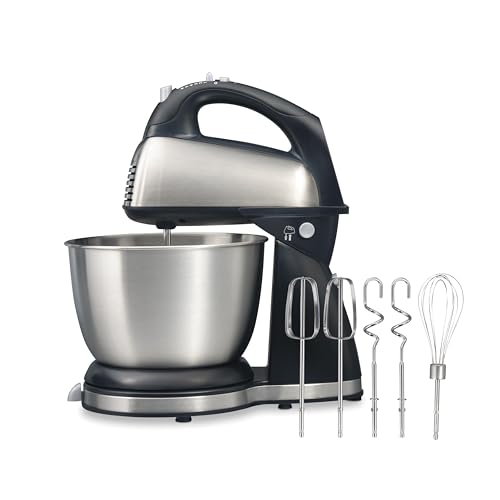
Hamilton Beach Classic Stand and Hand Mixer (4 Quart) — Best Overall Hand Stand Mixer
This is the format’s reference design and the safest buy in the category. Docked, the Hamilton Beach Classic works through cake batters, cookie doughs of moderate stiffness, whipped cream, and frostings while your hands stay free; undocked, the same unit — with its bowl-rest shoulder — handles mashed potatoes in the pot and quick batters in any bowl you own. Six speeds with QuickBurst cover the realistic range, and 290 watts of peak power is the honest ceiling of the design: plenty for its brief, not a bread machine.
Strengths
- True detachable design that works convincingly in both modes, not just on paper
- Four-quart bowl matches the batch sizes home bakers actually make most often
- Bowl-rest hand unit remains useful freehand, so the stand is a bonus rather than a crutch
Trade-offs
- Peak-power rating describes bursts, not sustained dough torque; stiff dough still belongs to a full stand mixer
- Six speeds are adequate rather than fine; delicate folding is a low-gear-and-patience exercise
- The kit stores as several pieces; it is cupboard-friendly, not drawer-friendly
Key specs (from the verified listing)
- Bowl (verified listing): 4 quarts
- Speeds: 6 with QuickBurst
- Power (verified listing): 290 watts peak
- Format: hand unit detaches from stand; bowl-rest feature on hand unit
Stability is where this design earns its keep. The stand’s job is to hold the mixer at the right height and angle while the bowl does its slow work beneath it, and in batter-weight mixtures the Classic stays composed instead of walking or chattering — the failure mode of flimsier 2-in-1s. Keep batches inside the bowl’s honest working volume, roughly two-thirds full for anything that will be whipped or creamed upward, and the machine feels unhurried.
Storage math favors it more than photos suggest. The stand and bowl nest into a cupboard footprint far smaller than any true stand mixer’s, and the hand unit alone is drawer-sized for the weeks when baking is just mashed potatoes and a boxed cake. For apartment kitchens and first homes, that reversibility — full commitment never required — is the actual product being bought.
Best for: Most buyers in this category: regular bakers with limited counter space who want both modes done properly / Not suited for: Bread bakers and anyone whose typical batch is a double or triple recipe
Check on Amazon — check price on Amazon for the current configuration and color.

West Bend Two Sweet 2-in-1 Hand & Stand Mixer (4.4 Quart, White) — Best Capacity and Speed Range — True 2-in-1
The West Bend Two Sweet is the maximalist’s 2-in-1, and its verified listing reads like it was written to win comparisons: an 4.4-quart rotating bowl — the largest among the true detachable picks — eleven speeds with turbo boost, a tilt-head design, and beaters, dough hooks, and a whisk all included. The rotating bowl matters more than the headline numbers: a bowl that turns under the beaters covers its own walls, which is the closest a hand stand design gets to the planetary coverage of a full stand mixer.
Strengths
- Rotating 4.4-quart bowl gives the best mixture coverage of any 2-in-1 in this guide
- Eleven speeds plus turbo is the widest range in the category, from folding to firm whipping
- Complete attachment set in the box, including the whisk many rivals sell separately
Trade-offs
- Largest kit here; the capacity advantage costs cupboard volume
- Peak-wattage headline should be read as burst power, as with all hand stand models
- More speeds and a rotating bowl are moving parts that reward owners who clean and store carefully
Key specs (from the verified listing)
- Bowl (verified listing): 4.4 quarts, rotating
- Speeds: 11 with turbo boost
- Power (verified listing): 550 peak watts
- Attachments (verified listing): dough hooks, beaters, whisk; tilt-head design
The rotating bowl changes the docked experience in a way worth describing concretely: instead of a fixed ring of unmixed batter clinging to the wall — the classic hand stand flaw — the mixture continually presents new material to the beaters, so creaming evens out faster and scraping breaks get shorter. Combined with the low end of an eleven-speed ladder, delicate batters survive docked mixing that would punish them in a six-speed.
Off the stand, the hand unit carries the same wide range, which makes it the best freehand unit among the 2-in-1s for whipping work. The honest ceiling remains the category ceiling: enriched doughs in modest batches, yes; a stiff sandwich loaf’s worth of dough, no. Within that ceiling, this is the 2-in-1 that asks for the fewest apologies.
Best for: Bakers who want the most capable true 2-in-1 and have the cupboard to store it / Not suited for: Minimalists and very small kitchens, where the smaller kits below fit better
Check on Amazon — check price on Amazon for the current configuration and color.

bella 3.5 Qt Hand & Stand Mixer (2-in-1) — Best Budget Hand Stand Mixer
The bella is the budget doorway into the category: a 3.5-quart hand and stand mixer, sold with its bowl, in a soft Oatmilk finish that suits the small, design-conscious kitchens it is aimed at. Its listing is concise, so this review is correspondingly plain about what is being bought: the format itself — docked hands-free mixing for everyday batters and creams, undocked hand mixing anywhere — at the lowest tier in this guide, for batch sizes a 3.5-quart bowl honestly holds.
Strengths
- Lowest-cost verified true 2-in-1 in this guide
- 3.5-quart size suits the single cakes, small cookie batches, and creams that dominate real home baking
- Compact kit stores more easily than the larger 2-in-1s
Trade-offs
- Smallest bowl here; double batches and big holiday jobs outgrow it quickly
- Verified listing is brief on speeds and attachments — confirm the current configuration on the listing before ordering
- Budget tier expectations apply to power and finish
Key specs (from the verified listing)
- Bowl (verified listing): 3.5 quarts
- Format: 2-in-1 hand and stand mixer with bowl included
- Finish (verified listing): Oatmilk
Judge this pick by the counterfactual: without it, a budget buyer chooses between a hand mixer alone (no hands-free mode, ever) and saving for months toward a stand mixer they may not have room for. The bella collapses that dilemma for everyday baking. Creaming butter and sugar for a single cake while you crack eggs and measure flour is a genuinely better workflow, and it is available here at the tier where most first kitchens actually shop.
Its limits are the honest kind — capacity and headroom — and both announce themselves clearly rather than failing mysteriously. When your baking outgrows 3.5 quarts, you will know exactly which larger machine to buy and why, which makes this a rational first purchase rather than a compromise you resent.
Best for: First kitchens, small households, and budget buyers who want the 2-in-1 format now / Not suited for: High-volume bakers and anyone whose standard batch is a double recipe
Check on Amazon — check price on Amazon for the current configuration and color.

KitchenAid 9 Speed Hand Mixer (KHM926) — Best Hand-Only Alternative
This pick has no stand, and it is in the guide because a honest fraction of hand stand shoppers are really storage shoppers: they want good mixing without dedicating any fixed footprint to it. The KHM926 is the hand mixer those readers should buy — nine speeds, a pro whisk, dough hooks, dishwasher-safe accessories — and it stores in a drawer, full stop. What you give up is hands-free operation; what you gain is the best hand unit in this guide and zero kit to house.
Strengths
- Finest hand unit here: nine speeds, complete attachments, proven format
- Smallest possible storage footprint — a drawer, not a cupboard shelf
- No stand compromises: every design dollar went into the mixer itself
Trade-offs
- No hands-free mode; long creaming and whipping sessions are held, not parked
- Premium tier for a hand-only tool
- Thick mixtures still need your arm as the stand, with the fatigue that implies
Key specs (from the verified listing)
- Speeds: 9
- Attachments (verified listing): Pro whisk, Turbo Beater II beaters, dough hook
- Format: hand-only (no stand) — alternative pick
The decision test is simple: picture your three most common mixing jobs. If they are short — batters, creams, potatoes, dressings — the stand in a 2-in-1 would spend its life as storage overhead, and this hand mixer is the better buy. If one of them is a long, frequent job — big frostings, double cookie batches, anything you currently dread holding through — the stand earns its shelf, and the picks above are your list.
Many households eventually own both formats across a decade of kitchens; the order matters less than the honesty. Buying this first, as the alternative, is not a failed hand stand purchase. It is the category working as a decision aid, which is what a buying guide is for.
Best for: Storage-first buyers whose mixing jobs are short and varied / Not suited for: Anyone who specifically wants to stop holding a mixer during long jobs
Check on Amazon — check price on Amazon for the current configuration and color.

Dash Everyday Stand Mixer (3-Quart) — Best Fixed Mini Stand Alternative
The Dash Everyday is the mirror-image alternative: instead of a hand mixer that sometimes stands, it is a small stand mixer, full time. A compact tilt-head body, a 3-quart stainless steel bowl, and six speeds cover everyday recipes — the listing’s own framing — in a footprint closer to a kettle’s than to a classic stand mixer’s. If your real wish was hands-free mixing in a small kitchen, and freehand work barely features in your cooking, this fixed design serves the wish more directly than any 2-in-1.
Strengths
- Always docked, always hands-free; no mode decisions, no detached parts to store
- Compact footprint suits counters that cannot host a classic stand mixer
- Stainless bowl is light, durable, and easy to wash
Trade-offs
- Cannot leave its bowl: no mixing in the serving bowl, the pot, or the big batch bowl
- Three quarts caps batch size firmly
- Six speeds and a compact motor keep it in everyday-recipe territory, as its name admits
Key specs (from the verified listing)
- Bowl (verified listing): 3-quart stainless steel
- Speeds: 6
- Format: compact tilt-head stand mixer (fixed; does not detach) — alternative pick
Fixed mini stands have a quiet advantage nobody lists: everything is always aligned. The beaters meet the bowl the same way every time, the head locks the same way, and the learning curve is one session long. For a newer baker building confidence, that repeatability beats flexibility. The trade — never mixing outside the bowl — only bites cooks who regularly work in other vessels, and they already know who they are.
Consider counter economics honestly: this machine asks for a small permanent home, unlike the 2-in-1s that vanish into cupboards. Kitchens with one clear corner can pay that rent happily for always-ready hands-free mixing. Kitchens where every appliance must earn its place weekly should look back up the list.
Best for: Small kitchens that want permanent, simple, hands-free mixing for everyday recipes / Not suited for: Cooks who mix in many different bowls and pots
Check on Amazon — check price on Amazon for the current configuration and color.
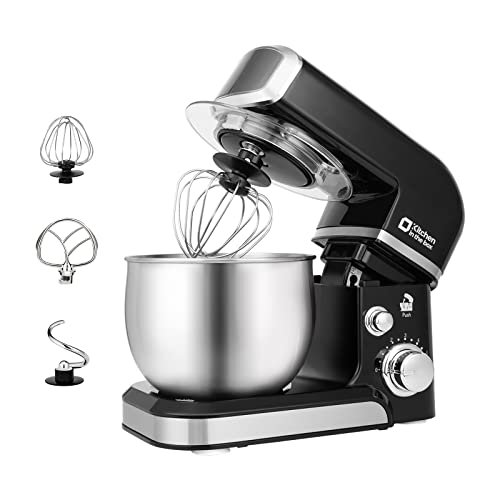
Kitchen in the box Stand Mixer (3.2 Quart) — Best Compact Fixed Stand With Full Attachments
The second fixed-stand alternative earns its slot on completeness: where the Dash sells simplicity, this Kitchen in the box model ships the full classic attachment trio — egg whisk, dough hook, and flat beater — in a lightweight 3.2-quart, six-speed package aimed at daily use. That makes it the compact fixed stand for the baker who already knows they will use a dough hook for small soft doughs and a whisk for creams, and wants both in the box from day one.
Strengths
- Full attachment trio included at a compact size and tier
- Lightweight body is easy to move between cupboard and counter
- Six speeds cover the daily-use brief the model is designed around
Trade-offs
- Fixed format: no freehand mode, ever
- 3.2 quarts is a small-batch ceiling, and the dough hook’s honest ceiling is small soft doughs
- Lightweight construction trades the planted feel of heavier stands for portability
Key specs (from the verified listing)
- Bowl (verified listing): 3.2 quarts
- Speeds: 6
- Attachments (verified listing): egg whisk, dough hook, flat beater
- Format: fixed compact stand mixer — alternative pick
The attachment trio changes what a compact stand is for. With a flat beater, creaming and batter work are standard; with the whisk, creams and egg whites are proper jobs rather than improvisations; with the hook, a small batch of dinner-roll dough becomes a weeknight possibility instead of a project. None of that requires a large machine — it requires the right three tools, which is this pick’s whole argument.
As with every compact in this guide, the discipline is batch size: work within the bowl, split double recipes, and the machine stays in its happy zone for years. The readers who love these small stands are the ones who cook for two to four people daily; the readers who outgrow them cook for gatherings, and they graduate with clear requirements rather than regrets.
Best for: Small households wanting a complete compact stand kit for daily baking / Not suited for: Anyone who needs a detachable hand unit or large batches
Check on Amazon — check price on Amazon for the current configuration and color.
Comparison Table
| Pick | Badge | Key spec | Best for |
|---|---|---|---|
| Hamilton Beach Classic Stand and Hand Mixer (4 Quart) | Best Overall Hand Stand Mixer | 4-quart bowl; 6 speeds with QuickBurst; 290 watts peak power; detachable hand unit | Most buyers in this category: regular bakers with limited counter space who want both modes done properly |
| West Bend Two Sweet 2-in-1 Hand & Stand Mixer (4.4 Quart, White) | Best Capacity and Speed Range — True 2-in-1 | 4.4-quart rotating bowl; 11 speeds with turbo boost; 550 peak watts | Bakers who want the most capable true 2-in-1 and have the cupboard to store it |
| bella 3.5 Qt Hand & Stand Mixer (2-in-1) | Best Budget Hand Stand Mixer | 3.5-quart bowl; 2-in-1 detachable format | First kitchens, small households, and budget buyers who want the 2-in-1 format now |
| KitchenAid 9 Speed Hand Mixer (KHM926) | Best Hand-Only Alternative | 9 speeds; whisk, beaters, and dough hooks; no stand (hand-only) | Storage-first buyers whose mixing jobs are short and varied |
| Dash Everyday Stand Mixer (3-Quart) | Best Fixed Mini Stand Alternative | 3-quart stainless bowl; 6 speeds; compact tilt-head fixed stand | Small kitchens that want permanent, simple, hands-free mixing for everyday recipes |
| Kitchen in the box Stand Mixer (3.2 Quart) | Best Compact Fixed Stand With Full Attachments | 3.2-quart bowl; 6 speeds; whisk, dough hook, and flat beater included | Small households wanting a complete compact stand kit for daily baking |
How to Choose the Best Hand Stand Mixer: Stand First, Motor Second
Reverse the usual shopping order for this category. Motors across these picks are variations on the same hand-mixer class, while stands differ in the ways that decide daily satisfaction: stability under a thick batter, bowl coverage, and stored size. Ask first whether the bowl rotates or the design relies on manual bowl turning, because that determines scraping breaks. Ask second how the head locks and releases, because you will do it with floury hands. Ask third where the kit will actually live, measured, not imagined.
Batch honesty comes next. A four-quart bowl mixes a working volume well below four quarts once whipping and rising enter the picture. Match the bowl to your standard batch — the cake you make monthly, not the feast you make yearly — and rent or borrow capacity for the feast instead of storing it all year.
Finally, the dough ceiling. Every hand stand mixer in this guide is a batter-and-cream machine with light-dough privileges. If bread is a weekly practice rather than an occasional experiment, the correct purchase is a true stand mixer, and the heavy-duty guide in this series is the right next read. Buying a 2-in-1 for bread is how good mixers get burned out and good bakers get discouraged.
Hand Stand vs Hand-Only vs Compact Stand: Placing the Three Formats
The three formats in this guide are three answers to one question: where should the effort live? In a 2-in-1, effort lives in setup — docking, undocking, storing pieces — and buys flexibility. In a hand-only mixer, effort lives in your arm during long jobs and buys zero storage. In a compact fixed stand, effort lives in a small permanent counter footprint and buys total simplicity.
None is the correct answer in general; each is correct for a kitchen. Small kitchens with varied cooking tend toward the hand-only flagship. Regular bakers with cupboards but no counter tend toward the 2-in-1. Newer bakers with one free corner tend toward the compact stand. The reviews above are written so that each format’s real cost is visible before the money moves, which is the only fair way to sell a compromise.
How to Use a Hand Stand Mixer Docked and Freehand
A 2-in-1 has two correct techniques, and mixing them up — freehand habits on the stand, stand expectations freehand — is where most disappointment comes from. This sequence covers a standard cake batter in both modes.
- Dock deliberately. Seat the hand unit on the stand until it locks, fit the beaters, and set the bowl in place before any ingredient goes in. A docked mixer discovered to be unseated mid-recipe is a mess with a motor.
- Load the bowl in mixing order. Fats and sugar first for creaming; the stand’s hands-free time is best spent on this longest stage while you measure what comes next.
- Start at the lowest speed docked, too. Slow-start discipline does not retire because a stand is holding the mixer. Flour still leaves bowls that start fast.
- Scrape on a schedule. Stop at each addition stage, scrape the bowl wall and bottom, and resume. Rotating bowls need less of this; fixed bowls need it religiously.
- Undock for the jobs the stand cannot do. Finish a batter in a larger bowl, mash potatoes in their pot, or whip a small amount in a measuring jug — freehand is the format’s superpower, so use it rather than apologizing for it.
- Store the kit as a kit. Bowl, stand, unit, and attachments go back together. A 2-in-1 stored in four places is a hand mixer with regrets.
Used this way, the format delivers exactly its promise: stand-mixer workflow for the long stages, hand-mixer freedom for everything else, and a cupboard instead of a counter commitment at the end of the day.
Measuring Your Kitchen for a 2-in-1: The Numbers That Decide Fit
Fit failures in this category are almost never about the mixer and almost always about unmeasured storage. Before choosing, take three measurements. First, the cupboard shelf where the kit will live: height for the stand with the hand unit docked, since storing it assembled is what makes the format effortless, and depth for the bowl stored with it. Second, the counter working zone where it will run: a 2-in-1 needs elbow room on the bowl side for scraping and additions, not merely its own footprint. Third, your largest regular mixing bowl’s diameter, because the freehand mode will be used in it and beater reach is a real constraint with deep vessels.
Compare those numbers against the kits honestly. The West Bend’s rotating 4.4-quart bowl is the capacity champion and the storage heavyweight; the bella’s 3.5-quart kit is the compact answer; the Hamilton Beach sits between, which is part of why it headlines. None of these is a fact you can learn from a product photograph, and all of them decide whether the machine is used weekly or exiled to the high shelf by spring. Measure first, and the reviews above become a shortlist instead of a gamble.
While measuring, count your long jobs. A 2-in-1’s stand earns its shelf only if something in your month involves several minutes of continuous mixing — frostings, big cookie batches, whipped components — during which your hands have other work. If your honest count is zero, the stand is storage overhead wearing a costume, and the hand-only alternative in this guide is your pick. The category rewards self-knowledge more than any other in the mixer aisle.
Docked Technique: Getting Stand-Mixer Results From a Hand Stand Design
Docked mixing has its own craft, distinct from both freehand and true stand-mixer technique. Begin every docked job with a manual first pass: a spatula fold of the bowl’s contents before power, which eliminates the dry pockets at the bottom that a fixed-position beater pair can orbit without ever touching. Then start at the lowest speed — the stand does not repeal flour physics — and let the first stage run longer than feels necessary; creaming, in particular, is where docked patience pays in crumb.
Scraping is the docked cook’s scheduled duty. Plan stops at each addition: power off, scrape wall and bottom in one circuit, rotate a fixed bowl a quarter turn, resume. Rotating-bowl owners scrape half as often, which is the rotating design’s real dividend. Finally, finish by hand more often than pride suggests: the last few folds of a delicate batter, done with a spatula after undocking the unit or removing the bowl, protect texture that no motor setting can restore once surrendered.
Owners who adopt docked technique report the same surprise: the 2-in-1 they nearly returned in week one becomes the appliance they defend in year three. The format’s ceiling is real — capacity and dough torque — but its floor is set by technique, and technique, unlike torque, is free.
Two Kitchens, Two Answers: A Worked Example
Consider two readers who both arrived at this search, because their divergence shows how the category should be shopped. The first cooks in a small apartment: bakes a cake or cookies most weekends, makes mashed potatoes weekly, owns one deep cupboard and no spare counter. Her long jobs are real but modest, her storage is measured in centimeters, and her bowls are many. The Hamilton Beach 2-in-1 is her machine — docked for the weekend bake, freehand for the potatoes, cupboard for the week — and the alternatives would each take something she uses: the fixed stands take her cupboard’s flexibility, the hand-only flagship takes her free hands during frosting.
The second reader bakes for a family of six in a kitchen with one permanently clear corner and a new sourdough habit forming. His batches already strain four quarts, his long jobs are weekly, and his trajectory points toward bread. For him this entire category is a waystation: the honest advice is the compact fixed stand only if the corner is truly all he has — and otherwise to skip the 2-in-1 tier entirely and put the money toward the bowl-lift class in this series’ bread guide, where his future batches already live. A buying guide earns its keep on the second reader: the one it talks out of the keyword.
Most readers sit between these two, and the reviews are written for them — but locating yourself nearer one pole or the other is the fastest route through this guide. The formats are compromises; the skill is knowing which compromise your kitchen was already making before you went shopping.
Key Takeaways on Hand Stand Mixers
The category in four sentences. A hand stand mixer buys workflow, not power: docked hands-free mixing for batters and creams, freehand freedom for everything else, and a cupboard instead of a counter as its home. The stand’s design details — bowl rotation, stability, stored size — decide satisfaction more than the motor, which is a hand-mixer motor in every model here. Dough ceilings are real and low compared with true stand mixers, and respecting them is the difference between a beloved 2-in-1 and a burned-out regret. And the alternatives are genuine: for some kitchens the best hand stand purchase is a superb hand mixer or a small fixed stand, and this guide would rather sell you that truth than a compromise.
Measure your cupboard, count your long jobs, name your standard batch — then choose. The Hamilton Beach for balance, the West Bend for capacity, the bella for budget, and the alternatives for the kitchens they describe. That is the whole decision, and it is a pleasant one when the measurements come first.
Common Buying Mistakes
- Buying a 2-in-1 for bread. The stand does not upgrade the motor. Weekly bread means a true stand mixer; see the heavy-duty bread guide in this series.
- Judging by peak wattage headlines. Peak figures describe bursts. Batter behavior, bowl coverage, and stability are the real specifications in this category.
- Overfilling the bowl because it fits. Fits and mixes are different volumes. Two-thirds full is the working ceiling for anything that grows under the beaters.
- Never using the freehand mode. Owners who treat the unit as docked-only paid for flexibility they refuse; undock for pots, jugs, and big bowls.
- Storing the kit scattered. The format’s storage advantage exists only if the pieces live together.
Final Recommendation
Buy the Hamilton Beach Classic (B07VJSSDV9) if you want the category’s balanced answer: a real 2-in-1, a four-quart bowl, and a hand unit worth using on its own. Buy the West Bend (B0H6CFC7R5) if your batches and your ambitions run larger within the format, and the bella (B0DPNKPWK2) if the budget is the binding constraint. Then read the alternatives one more time before checkout: if the KitchenAid hand-only flagship or one of the compact fixed stands describes your kitchen more accurately, buying that instead is this guide succeeding, not failing.
The hand stand category rewards buyers who know their kitchen’s habits. You now know the formats’ real costs; the right pick is the one whose costs your kitchen was already paying.
Start your comparison with the top picks from this guide: Hamilton Beach Classic Stand and Hand Mixer (4 Quart), West Bend Two Sweet 2-in-1 Hand & Stand Mixer (4.4 Quart, White), bella 3.5 Qt Hand & Stand Mixer (2-in-1) — check price on Amazon for each before deciding.
Related guides in this series: Best Hand Mixers Oster; Best Handheld Mixers For Baking; Best Heavy Duty Bread Mixers; Best Hand Mixers With Slow Start; Best Handheld Food Mixers.
Frequently Asked Questions
What is a hand stand mixer, exactly?
It is a two-in-one design: a hand mixer that docks onto a stand with its own bowl. Docked, it mixes hands-free like a small stand mixer while you prepare the next ingredient; lifted off the stand, it works as an ordinary hand mixer in any bowl or pot. The category exists for kitchens that want stand-mixer workflow without a stand mixer’s permanent counter footprint — the whole kit stores in a cupboard. In this guide, only models whose verified listings describe the complete hand-unit-plus-stand-plus-bowl configuration are badged as true hand stand mixers.
Is a hand stand mixer as powerful as a regular stand mixer?
No, and it should not be bought as if it were. The motor is a hand-mixer motor; the stand adds workflow, not torque. Batters, creams, frostings, whipped toppings, and light doughs in modest batches are its honest territory — the same territory as the hand unit alone, performed hands-free. Stiff bread dough, double and triple batches, and sustained heavy work belong to true stand mixers, whose motors, gearing, and weight are built for them. Buying a 2-in-1 for bread is the category’s most common and most expensive misunderstanding.
Does the bowl rotate on a hand stand mixer?
It depends on the design, and the difference matters. The West Bend Two Sweet in this guide has a rotating bowl, which continually presents new mixture to the beaters and reduces scraping. Other designs hold the bowl still and rely on the mixer’s offset position plus your scraping at each stage. Neither is a defect, but they produce different workflows: rotating bowls forgive inattention, fixed bowls demand a scrape schedule. Check which design a listing describes before buying, because photographs rarely make the distinction obvious.
How much space does a hand stand mixer actually save?
Substantially, if stored as a kit. The stand, bowl, and hand unit together occupy a modest cupboard footprint — far less counter commitment than a true stand mixer, which effectively lives where it stands. The saving evaporates if the pieces scatter across four storage spots, which is why this guide’s how-to section insists on storing the kit together. Buyers whose kitchens have one free counter corner and no cupboard depth may actually prefer a compact fixed stand, two of which are included here as labeled alternatives.
Can I buy just the stand for a hand mixer I already own?
Generally, no. Hand stand systems are designed as matched kits — the hand unit’s shape, locking points, and beater height are engineered for their own stand and bowl. Stands are not standardized across brands or even across a brand’s models, and a hand mixer perched on an unmatched stand is unstable in exactly the way that matters under load. If you own a hand mixer you love, the realistic routes to hands-free mixing are a true stand mixer or a matched 2-in-1 kit like the ones verified in this guide.
Who should buy a hand-only or fixed-stand alternative instead?
Choose hand-only — like the KitchenAid 9 Speed alternative here — if your mixing jobs are short and varied and storage is your binding constraint; you give up hands-free operation and gain a drawer-sized tool. Choose a compact fixed stand — the Dash or Kitchen in the box alternatives — if you want permanent, simple, hands-free mixing for everyday recipes and never mix outside one bowl. The 2-in-1 wins when you genuinely do both kinds of work and have a cupboard, rather than a counter corner, to give it.


