Disclosure: airfryerkitchensupply.com is reader-supported. When you buy through links on our site, we may earn an affiliate commission at no extra cost to you.
Where to buy
Every linked pick in this guide to the best german egg cookers was checked against a live Amazon listing before publication, and only models with a confirmed listing carry a buy link. Prices on appliances move constantly, so we never print a fixed price here — use the links to check the current price on Amazon and confirm the exact configuration before you order. Picks marked as unlinked are real, relevant products that did not have a confidently matched Amazon listing at review time; we explain where they are normally sold instead of inventing a link.
Severin Egg Cooker Line (EK Series) — unlinked pick: sold in the US mainly through importers, the brands’ own channels and specialist kitchen retailers; no confidently matched Amazon listing was verified for this guide, so no link is printed rather than a guessed one.
WMF Egg Cooker Lines (Including the Stelio Kitchen Range) — unlinked pick: sold in the US mainly through importers, the brands’ own channels and specialist kitchen retailers; no confidently matched Amazon listing was verified for this guide, so no link is printed rather than a guessed one.
Rommelsbacher Egg Cooker Line — unlinked pick: sold in the US mainly through importers, the brands’ own channels and specialist kitchen retailers; no confidently matched Amazon listing was verified for this guide, so no link is printed rather than a guessed one.
Cuisinart 10-Egg Cooker (CEC-10) — Check the current price on Amazon
Dash Deluxe Egg Cooker, 12 Egg Capacity — Check the current price on Amazon
Hamilton Beach 3-in-1 Electric Egg Cooker (25507) — Check the current price on Amazon
The best german egg cookers come from the one country that turned the electric egg cooker into a standard kitchen appliance. In Germany the Eierkocher is not a novelty gadget; it is a fixture, sold by serious appliance houses — Severin, WMF and Rommelsbacher among them — and used daily to produce eggs at a repeatable, dialled-in doneness that a saucepan of boiling water genuinely struggles to match. This guide covers that German tradition, and it does so under the strictest honesty rule in this batch: no German pick below carries a buy link, because none could be verified, and the guide explains exactly why and what to do instead.
First, how an egg cooker works, because the mechanism explains the appeal. The eggs sit over a measured amount of water; the machine turns that water to steam; and because the amount of water is fixed by your measuring cup, the cooking time is fixed too — more water, firmer eggs. Doneness becomes a measurement rather than a judgement call, the eggs cook identically every morning, and the machine switches off or signals when the water is gone. It is a very German solution: a small appliance that removes variance from breakfast.
The US reality, stated plainly: German-brand egg cookers reach America mainly through importers, the brands’ own channels and specialist retailers, in small numbers, sometimes in European specification. On the day of writing, none could be confidently verified against a live listing for this site — so the three German houses appear as a pick without a link, described properly, with the buying route explained. The second half of the picks is the practical counterweight: three egg cookers that were verified and can be bought today, from Cuisinart, Dash and Hamilton Beach, for readers whose priority is perfect eggs this week rather than a German badge on the appliance.
In this guide
Quick Picks
If you only read one section, read this one. These are the six best german egg cookers we would shortlist first, each with a clear job. The detailed reviews below explain who each one suits, where it compromises, and which buyers should walk past it.
- Best German Original: Severin Egg Cooker Line (EK Series) — the home-market benchmark — Severin’s long-running egg cooker line is what the category looks like in Germany. — unlinked (see the review for where to buy it)
- Best German Premium Design: WMF Egg Cooker Lines (Including the Stelio Kitchen Range) — WMF’s design-led take — egg cookers within its premium kitchen ranges, for buyers who want the appliance to look like WMF. — unlinked (see the review for where to buy it)
- Best German Specialist: Rommelsbacher Egg Cooker Line — the Dinkelsbühl specialist’s version — a family German appliance maker whose egg cookers are a home-market staple. — unlinked (see the review for where to buy it)
- Best Verified for Families: Cuisinart 10-Egg Cooker (CEC-10) — the buy-it-today family answer — 10 eggs on two tiers, poach and omelette trays, water-measure control and an audible alert. — Check the current price on Amazon
- Best Verified Capacity Value: Dash Deluxe Egg Cooker, 12 Egg Capacity — the double-decker value pick — up to 12 eggs, poacher, steamer and omelette functions with auto shut-off. — Check the current price on Amazon
- Best Verified for Poaching: Hamilton Beach 3-in-1 Electric Egg Cooker (25507) — the versatile seven — hard-boiled, poached, omelettes and vegetable steaming in one compact verified machine. — Check the current price on Amazon
How These Picks Were Chosen
The origin gate came first and was not negotiable. A pick could be presented as a German egg cooker only if the brand is genuinely German and known for the category in its home market — Severin, WMF and Rommelsbacher all pass that test easily. But a buy link required a verified listing, and none of the three produced one that this program could confirm: the API cache built across this whole program contains no German-brand egg cooker, and live API checks on the day of writing were defeated by repeated connection failures. Under this program’s rules, that combination means unlinked — the same treatment the german-made stand mixer guide received when its category could not be verified — and the picks say so openly.
For the verified alternatives, the gates were the usual ones: a confident Amazon listing data match for this site, which is where their ASINs and titles come from, plus a distinct job for each — capacity, value, and poaching versatility — so the three form a real shortlist rather than three copies of the same machine.
Across all six picks we judged the things that decide egg-cooker satisfaction: how doneness is controlled (a marked measuring cup, a dial, or a timer — they are not equivalent), how many eggs cook at once, whether poaching and omelette trays are included for the breakfasts beyond boiled, and how the machine signals the finish, because an egg cooker you cannot hear from the next room is a cooker whose eggs overcook while you make toast.
The 6 Best German Egg Cookers
Severin Egg Cooker Line (EK Series) — Best German Original
Severin, from Sundern in North Rhine-Westphalia, is the name to start with because in Germany the electric egg cooker is substantially Severin’s category: the company’s EK-series egg cookers have been a standard wedding-registry, first-flat, office-kitchen appliance for decades. The formula the line is known for is the classic one — a compact base, a measured-water system with the doneness markings on the cup, an egg tray with a piercing pin for the shells, and a signal when the eggs are done — executed with the plain, durable seriousness of a German appliance house.
Why does it lead a guide it cannot sell you anything in? Because a buyer searching ‘german egg cooker’ is searching for this: the original article, from the market that perfected it. If you buy through an importer or the brand’s channels, the Severin pattern is the reference the others are judged against — capacity for a family round of eggs, poaching inserts in many configurations, and a measuring system that makes doneness a repeatable measurement.
Strengths
- The defining home-market line from a genuine German appliance house
- Measured-water doneness system in its classic, proven form
- A design tradition built for daily use over years, not novelty
Trade-offs
- No verified US listing for this guide — purchase runs through import channels
- Check voltage and plug specification carefully on any imported unit
- US warranty and support depend entirely on the selling channel
The import cautions in the trade-offs deserve emphasis, because they are the real content of buying German small appliances in America. Germany runs on 230 volts; a unit built for the European market is not a US appliance with a plug adapter, and any Severin offered for the US should state its electrical specification for this market in plain terms. A seller who cannot state it is a seller to walk away from, whatever the badge.
Buy the Severin route if the German original is the point and you are willing to shop channels carefully. Buy the verified picks below if breakfast is the point — they cook the same eggs, this week, with a US plug and a US warranty.
Best for: buyers who want the authentic German home-market appliance and will shop import channels carefully / Not suited for: anyone who needs a verified US listing, US voltage certainty and a domestic warranty today
Unlinked pick — no verified Amazon link for this model at review time. sold in the US mainly through importers, the brands’ own channels and specialist kitchen retailers; no confidently matched Amazon listing was verified for this guide, so no link is printed rather than a guessed one.
WMF Egg Cooker Lines (Including the Stelio Kitchen Range) — Best German Premium Design
WMF approaches the egg cooker the way it approaches everything in its premium kitchen ranges: as a designed object. Its egg cookers — sold within lines such as the Stelio kitchen range — wrap the same measured-water mechanism as every machine in this guide in the brushed-steel, clean-lined aesthetic that makes WMF the default ‘good German kitchen’ gift. The eggs do not know the difference; the kitchen, and the person who has to look at the counter every morning, do.
That is a legitimate buying reason and this guide treats it as one. Small appliances live on counters, not in cupboards, and the premium German houses understand that an egg cooker bought for a decade should be pleasant to live with. WMF’s version of the category is for the buyer already furnishing a kitchen in that idiom, for whom a matching, well-finished machine is worth a channel hunt.
Strengths
- Premium German design and finish in a category usually sold as plastic novelty
- The proven measured-water mechanism in a counter-worthy body
- Sits naturally within a WMF-equipped kitchen
Trade-offs
- Unlinked here — brand and specialist channels, with the usual import checks
- You pay for design in a category where the mechanism is simple
- US availability is the thinnest of the three German houses in this guide
The diligence from the Severin review applies with interest: confirm the unit is specified for the US market electrically, confirm who stands behind the warranty on this side of the Atlantic, and get both in writing. WMF’s own channels are the safest route; marketplace imports of European-specification units are the risk this guide keeps pointing at because it is the risk that actually bites buyers.
Choose WMF if the German purchase is happening anyway and design leads your list. Choose Severin for the category’s purest home-market form, and Rommelsbacher — next — for the specialist’s version.
Best for: design-led German kitchens and buyers already shopping WMF’s channels / Not suited for: value buyers, or anyone unwilling to verify US specification before importing
Unlinked pick — no verified Amazon link for this model at review time. sold in the US mainly through importers, the brands’ own channels and specialist kitchen retailers; no confidently matched Amazon listing was verified for this guide, so no link is printed rather than a guessed one.
Rommelsbacher Egg Cooker Line — Best German Specialist
Rommelsbacher is the connoisseur’s name in this category: a family-run German appliance maker from Dinkelsbühl that specialises in exactly this class of small, single-purpose kitchen machines — and makes its egg cookers with the seriousness of a company whose whole reputation rides on them. In the German market its egg cookers are a staple recommendation, the kind of appliance bought once and used until the measuring cup’s markings are memorised.
The specialist’s difference is focus. A generalist’s egg cooker is a sideline; Rommelsbacher’s is a core product, refined across generations of the same basic, correct idea — measured water, steam, a clear signal, parts that come apart for washing. Buyers who enjoy owning the definitive version of a simple thing will recognise the appeal immediately.
Strengths
- A specialist German maker’s core product, not a sideline
- Home-market staple with a long, settled design
- The connoisseur’s route into the genuine German category
Trade-offs
- The least-known name outside Germany — research the channel thoroughly
- No verified US listing for this guide
- Support in the US depends on the importer entirely
Rommelsbacher is also the pick that best illustrates this guide’s whole dilemma: the more authentically German the appliance, the thinner its American distribution. That is not a reason to pretend otherwise with an invented link; it is a reason to shop like an importer — specification, voltage, warranty, in writing — or to accept the verified alternatives below with a clear conscience.
If you do import one, you will own the thing the keyword actually describes. If you do not, the eggs from the next three picks will taste exactly the same, and only the badge will know the difference.
Best for: connoisseurs who want the specialist German original and accept import diligence / Not suited for: mainstream buyers who want domestic availability and support
Unlinked pick — no verified Amazon link for this model at review time. sold in the US mainly through importers, the brands’ own channels and specialist kitchen retailers; no confidently matched Amazon listing was verified for this guide, so no link is printed rather than a guessed one.

Cuisinart 10-Egg Cooker (CEC-10) — Best Verified for Families
The Cuisinart CEC-10 is what the German idea becomes in a verified American listing: a two-tier cooker that handles ten eggs at once, with poaching and omelette trays in the box, doneness set by the measured water, and — the detail experienced owners ask for first — an audible alert when the eggs are done. The brushed stainless finish even nods toward the German aesthetic this guide began with.
Ten eggs changes the appliance’s job. This is not a two-egg novelty; it is a family breakfast machine and a meal-prep tool — a full tier of eggs for the week’s salads, sandwiches and ramen, cooked in one measured batch while the cook does everything else. The two-tier layout keeps the footprint countertop-sane while doing it.
Strengths
- Largest verified capacity here — 10 eggs across two tiers
- Poach and omelette trays cover the full breakfast repertoire
- Audible alert means eggs finish when you are in the next room
Trade-offs
- Not a German appliance — it is the verified alternative, honestly labelled
- Two tiers mean slightly more washing than a single-layer cooker
- Family capacity is wasted on a one-egg household
| Capacity | 10 eggs, two-tier |
| Controls | Water-measure doneness control |
| Features | Poaching tray, omelette tray, audible alert |
| Finish | Brushed stainless steel |
The water-measure system is the classic mechanism, and it rewards one habit: use the included measuring cup and its markings, not a guess from the tap. The difference between soft and medium in these machines is a few millilitres; the cup exists so that difference is repeatable, which is the entire philosophy the German originals established.
Choose the Cuisinart if you want this category’s benefits at family scale, from a verified listing, today. It is the pick most readers of this guide should actually buy, and the guide is comfortable saying so.
Best for: families and meal-preppers who want maximum verified capacity and the full tray set / Not suited for: badge-led buyers, or single-egg households
Check the current price on Amazon

Dash Deluxe Egg Cooker, 12 Egg Capacity — Best Verified Capacity Value
Dash built its name on making the egg cooker a cheerful American countertop staple, and the Deluxe double-decker is its capacity play: up to a dozen hard-boiled eggs, with poaching, steaming and omelette functions and an auto shut-off for the mornings when breakfast is interrupted. The listing’s own description covers soft and poached eggs alongside the hard-boiled dozen, which is the full repertoire most households ever ask of the format.
Auto shut-off deserves its line, because it changes who the machine suits. A cooker that signals and waits demands a listener; a cooker that switches itself off forgives a distracted household. For families with children, and for anyone whose mornings are a relay race, that forgiveness is a feature on the same level as capacity.
Strengths
- Biggest egg count in this guide at a value-leaning tier
- Auto shut-off suits busy, interruptible mornings
- Poacher, steamer and omelette functions included
Trade-offs
- Plastic-forward build is a long way from the German houses’ finish
- Double-decker batches take a little longer to steam through
- Doneness precision is good, not instrument-grade
| Capacity | 12 hard boiled eggs (per verified listing) |
| Format | Double-decker electric egg cooker |
| Functions | Poacher, steamer and omelette maker |
| Safety | Auto shut-off |
Judge the Dash by cost per perfect egg and it is close to unbeatable in this lineup. It is the cooker bought for dorm-adjacent flats, big families and office kitchens — places where eggs are fuel and volume matters more than ceremony.
Choose it over the Cuisinart if capacity and shut-off outrank finish and the alert. Choose the Hamilton Beach below if poaching and omelettes, rather than boiled volume, are your centre of gravity.
Best for: large households and value buyers who cook eggs in dozen-sized batches / Not suited for: buyers seeking premium materials or the German original
Check the current price on Amazon
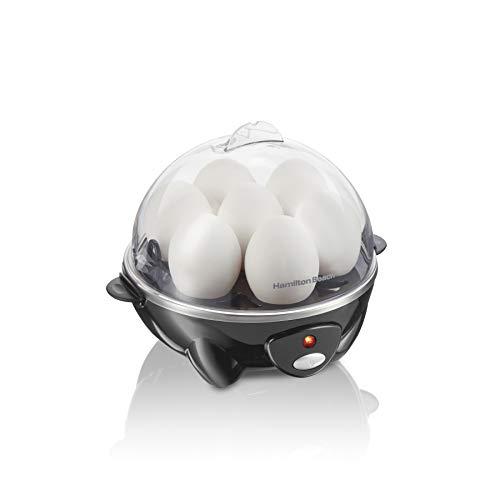
Hamilton Beach 3-in-1 Electric Egg Cooker (25507) — Best Verified for Poaching
Hamilton Beach’s 3-in-1 is the pick for the cook whose egg life is not mostly boiled. It holds seven eggs for boiling, and its trays make it a poacher, an omelette maker and a small vegetable steamer — the breakfast-station version of the format, in a compact body from one of America’s most serviceable appliance brands. Poached eggs are the test that matters here: they are the style a saucepan makes hardest and a tray over steam makes nearly automatic, with the whites set around runny yolks on a timer instead of a prayer.
Seven is also the honest household size for most couples and small families — a full round of eggs with a couple spare, without a double-decker machine colonising the counter. The appliance earns its space by covering weekday breakfasts completely rather than by winning a capacity contest.
Strengths
- Poaching and omelette trays make it a complete breakfast station
- Right-sized seven-egg capacity for most households
- Hamilton Beach service and parts are easy in the US
Trade-offs
- Seven eggs caps batch cooking for big families
- Not German — a verified alternative, as labelled throughout
- Compact trays mean omelettes are individual-sized
| Capacity | Holds 7 eggs |
| Functions | Hard boiled, poached, omelette maker and vegetable steamer |
| Model | Hamilton Beach 25507 |
The vegetable steamer function quietly extends the machine past breakfast — a portion of broccoli or dumplings steamed while eggs cook below is the kind of two-level efficiency small kitchens thrive on. It is the most ‘one appliance, many mornings’ pick in the guide.
Choose the Hamilton Beach if poached and omelette mornings are your centre of gravity. Choose the Cuisinart for boiled-egg volume with the same tray versatility at a larger scale.
Best for: couples and small families whose egg cooking centres on poached eggs and omelettes / Not suited for: dozen-at-a-time batch cooks, or German-badge seekers
Check the current price on Amazon
Comparison Table
| Pick | Badge | Key spec | Best for |
|---|---|---|---|
| Severin Egg Cooker Line (EK Series) | Best German Original | German brand; home-market egg cooker line via import channels | buyers who want the authentic German home-market appliance and will shop import channels carefully |
| WMF Egg Cooker Lines (Including the Stelio Kitchen Range) | Best German Premium Design | German brand; premium kitchen-range egg cookers via brand channels | design-led German kitchens and buyers already shopping WMF’s channels |
| Rommelsbacher Egg Cooker Line | Best German Specialist | German family brand; egg cooker line via specialist/import channels | connoisseurs who want the specialist German original and accept import diligence |
| Cuisinart 10-Egg Cooker (CEC-10) | Best Verified for Families | 10-egg two-tier, poach & omelette trays, audible alert | families and meal-preppers who want maximum verified capacity and the full tray set |
| Dash Deluxe Egg Cooker, 12 Egg Capacity | Best Verified Capacity Value | Up to 12 eggs, double-decker, auto shut-off | large households and value buyers who cook eggs in dozen-sized batches |
| Hamilton Beach 3-in-1 Electric Egg Cooker (25507) | Best Verified for Poaching | Holds 7 eggs, 3-in-1 with omelette and steamer functions | couples and small families whose egg cooking centres on poached eggs and omelettes |
How to Choose the Best German Egg Cookers (and When to Choose the Alternative)
Start by deciding which purchase you are actually making, because this search contains two. The first is the artefact purchase: a genuine German egg cooker, from Severin, WMF or Rommelsbacher, bought through an import or brand channel, with the diligence that requires. The second is the breakfast purchase: an egg cooker that produces perfect eggs daily, bought from a verified US listing. Neither is the ‘wrong’ purchase — but they have different costs, timelines and risks, and confusing them is how buyers end up with a European-voltage appliance and a lesson.
If you are making the artefact purchase, the checklist is short and strict. Confirm the unit is specified for the US electrical system, in writing — not ‘works with an adapter’, but built or certified for 120 volts. Confirm who provides warranty service in the US and how a claim would actually proceed. Confirm the delivered figure including shipping and any duties. A seller who answers all three cleanly is a channel; a seller who answers none is a gamble wearing a German badge.
If you are making the breakfast purchase, shop the verified features instead: capacity against your household, doneness control you can repeat (a marked measuring cup is the classic system), an alert or auto shut-off matched to your mornings, and the trays for the styles you actually cook. The three verified picks in this guide were chosen to make that shortlist one decision, not thirty listings.
How Egg Cookers Work: Measured Water, Steam and Repeatable Doneness
Every machine in this guide, German or otherwise, runs on the same elegant mechanism. Eggs rest on a tray above a small heating plate. You add a measured amount of water — the measuring cup is marked by doneness and egg count — and the machine heats that water to steam. The eggs cook in the steam, and when the water is gone, the cook ends: a thermostat or the dry plate triggers the signal or shut-off. Because the water amount sets the time, and the time sets the doneness, soft, medium and hard become measurements instead of guesses.
Two details separate good results from erratic ones. The first is the piercing pin, included with most cookers, which pricks the wide end of each shell before cooking; this releases the air cell’s pressure as the egg heats and is the difference between smooth shells and the occasional crack. The second is egg temperature and size: fridge-cold large eggs are the assumption behind most measuring cups, and a batch of room-temperature medium eggs will cook a shade firmer on the same water — a difference one trial batch teaches you permanently.
Peeling, the eternal boiled-egg complaint, improves with the method rather than the machine: steam-cooked eggs are widely found to peel more cleanly than boiled ones, especially when cooled promptly in cold water after the signal. Older eggs peel easier than farm-fresh ones in any method — a fact worth knowing before blaming a cooker for a stubborn batch.
The German Eierkocher Tradition: Why Germany Perfected This Appliance
To understand why the German versions of this small appliance are the reference, it helps to know the breakfast they serve. The German Frühstücksei — a soft or medium egg, in its cup, at a set table — is a daily ritual with a defined ideal texture, and rituals with defined ideals create demand for repeatability. A saucepan gives you a different egg every day unless you time it like a laboratory; an egg cooker gives you your egg, the one you chose, every day. Severin, WMF and Rommelsbacher built their lines for a market that noticed the difference.
That market also explains the category’s engineering tone. German small appliances are expected to be repaired rather than replaced, to have their markings survive a decade of washing, and to do one job without a menu of novelty functions. The egg cookers in this guide’s German half embody that: measured water, a signal, a tray that comes apart for the sink. Nothing about them is smart, connected or reinvented, and their buyers consider that the highest available praise.
The tradition also produced the category’s vocabulary of doneness — soft, medium, hard as calibrated settings rather than vibes — which the American market adopted wholesale. When a Dash or a Cuisinart marks its measuring cup by doneness, it is speaking the Eierkocher’s native language, which is why this guide can recommend the verified alternatives without irony: the idea is German even where the appliance is not.
Boiled, Poached, Omelette: Getting the Most From the Trays
Most cookers above the basic tier include poaching and omelette trays, and most owners underuse them. Poaching in a tray over steam is the gentlest version of the technique: the eggs hold their shape, the whites set without the vinegar-and-whirlpool theatre of the saucepan method, and the timing is the machine’s problem, not yours. A light oiling of the tray is the one habit that matters — poached eggs release cleanly from a prepared tray and sulk in a dry one.
Omelettes in a divided tray come out as neat, individual, folded-style portions — not a French chef’s omelette, and not pretending to be, but a reliable weekday version that cooks while the toast toasts. Vegetables, cheese and herbs go in with the eggs; the steam does the rest. For households with children, the omelette tray is often the most-used accessory in the box, because it turns ‘make me an egg’ into a task a ten-year-old can run.
The steamer function on models like the Hamilton Beach extends the same tray logic to vegetables and dumplings, and the two-level trick — eggs below, vegetables above — is the small-kitchen efficiency this format quietly excels at. Explore the trays in your first week and the appliance doubles its value; leave them in the box and it remains a one-trick machine, however good the trick.
Egg Cooker Care: Descaling and the Two-Minute Routine
An egg cooker’s only real enemy is limescale. The heating plate boils a small amount of water dry at every use, which concentrates minerals exactly where the heat is, and in hard-water areas a brown, crusty plate develops within weeks. The fix is the classic one: periodically run or wipe the plate with a vinegar solution as the manual directs, and the scale dissolves. Owners who descale monthly never meet the problem; owners who never descale eventually meet a plate that heats unevenly and eggs that drift from their settings.
The daily routine is smaller: rinse the tray and lid, wipe the plate once cool, and store the measuring cup with the machine so the doneness system stays calibrated to the cup it was designed around. A lost cup replaced by guesswork is the hidden cause of many ‘this cooker is inconsistent’ verdicts — the measurement is the mechanism, and it lives in that little cup.
One more small habit protects the mechanism itself: dry the heating plate after the last batch of the day rather than leaving the final puddle to evaporate overnight, because that standing mineral water is where scale starts. It takes five seconds with a cloth, and in hard-water homes it halves the descaling the section above describes.
Shells and storage need one sentence each: pierce eggs over the sink, because an occasional crack leaks where it leaks; and store the cooker dry, because a sealed, damp small appliance develops the stale smell that ruins the next batch’s first impression.
Budget Tiers for Egg Cookers
No prices are printed in this program — they change too often to print honestly — but the tiers here are simple. The verified American machines occupy the accessible tiers, with value rising by capacity and tray sets rather than by cooking quality, which is remarkably even across them. The German route occupies a different kind of tier altogether: the appliance itself is modestly priced in its home market, and the American figure is set by the channel — importing, specification and support — which is why this guide insists on the complete delivered figure, in writing, before any comparison is made.
The value logic follows the familiar rule of this program: frequency decides. A household cooking eggs daily gets its money’s worth from any pick here within a season of breakfasts. The German artefact purchase is justified by wanting the artefact — a reason this guide respects and refuses to dress up as economics.
How to Cook Perfect Eggs in an Egg Cooker: Soft, Medium and Hard
Set up by the cup, not by feel. Put the eggs — fridge-cold, the size your cooker’s markings assume — onto the tray, pierce each shell’s wide end with the pin on the cup or tray, and add water to the marking for your egg count and chosen doneness. The markings are the recipe; the most common egg-cooker disappointment is a cook who ‘knows better’ than the cup in week one.
Close the lid and start the machine, then leave it alone. The steam cycle is timed by the water you measured; lifting the lid to check releases steam, cools the chamber and quietly rewrites the timing you so carefully measured. Trust the signal — this appliance’s entire purpose is that you can.
At the signal, move promptly. For boiled eggs, transfer them to cold water for a few minutes: the chill stops the cooking at your chosen doneness, keeps the yolks bright rather than grey-ringed, and makes peeling cleaner. For poached eggs and omelettes, serve straight from the tray while they are at their brief best.
Note your result against the marking you used. If your soft is your family’s medium, your personal calibration is simply one marking over — write it on the cup with a marker if you must. Two batches in, the machine will be producing your household’s exact eggs on demand, which is the entire promise of the format, German or otherwise.
Common Buying Mistakes
Importing a European-specification unit for a US kitchen. 230-volt appliances are not cured by a plug adapter. Confirm US electrical specification, in writing, before any German small appliance crosses the ocean for you.
Guessing the water instead of using the marked cup. The measurement is the mechanism. A lost or ignored cup turns a repeatable appliance into a random one.
Lifting the lid mid-cycle to check. Steam escapes, timing drifts, doneness wanders. The signal exists so you do not have to look.
Skipping the shell piercing. The pin prevents most cracks and the occasional exploded mess. Ten seconds, every batch.
Leaving eggs sitting in the hot cooker after the signal. Residual heat keeps cooking. Move boiled eggs to cold water; serve poached eggs and omelettes at once.
Blaming the cooker for hard peeling. Very fresh eggs peel stubbornly in every method. Use eggs a few days old for boiled batches you plan to peel, and cool them promptly.
Final Recommendation
The honest summary of this category fits in two sentences. The genuine German article — Severin for the classic home-market form, WMF for design, Rommelsbacher for the specialist’s version — is real, worthwhile and bought through channels, with import diligence, not through a verified listing this guide can hand you. The verified alternatives — the Cuisinart for family capacity, the Dash Deluxe for dozen-sized value, the Hamilton Beach for poaching versatility — deliver the same measured-water magic this week, with US plugs and US warranties.
Decide which purchase you are making, and either is a good one. If it is the breakfast purchase, check the current price on Amazon for the verified picks and start with the Cuisinart unless capacity or poaching points you elsewhere. If it is the artefact purchase, take the checklist from the buying guide to a reputable channel and enjoy owning the original.
Cuisinart 10-Egg Cooker (CEC-10) — Check the current price on Amazon
Dash Deluxe Egg Cooker, 12 Egg Capacity — Check the current price on Amazon
Hamilton Beach 3-in-1 Electric Egg Cooker (25507) — Check the current price on Amazon
Best German Pressure Cookers Best Healthy Rice Cookers Best Freestanding Electric Cookers Best Electric Top Cookers And Ovens Best Egg Cookers
Frequently Asked Questions
Why are the German egg cookers in this guide unlinked?
Because this program only prints buy links it has verified against live listings, and no Severin, WMF or Rommelsbacher egg cooker could be confidently verified for this site on the day of writing — their US distribution runs through importers and brand channels rather than standard listings. Rather than invent an ASIN, the guide describes them properly and explains the buying route, following the same precedent as other unverifiable categories in this program.
Are German egg cookers better than American ones?
They cook eggs by the identical mechanism — measured water and steam — so the eggs themselves are equivalent. What the German houses offer is build tradition, finish, and the artefact itself: the original appliance from the market that perfected it. Whether that is ‘better’ depends on whether you are buying breakfast or buying the object, and this guide supports both decisions honestly.
Can I use a German egg cooker in the US?
Only if the specific unit is built or certified for the US 120-volt system. European-market units are 230-volt appliances; a travel plug adapter does not change voltage and is not a safe solution for a heating appliance. Any reputable channel selling German small appliances into the US will state the electrical specification clearly — if it does not, do not buy that unit.
How does an egg cooker know when eggs are soft or hard?
It does not know — it measures. You add water to the cup’s marking for the doneness and number of eggs; the machine boils that water into steam, and when the water is gone the cook ends. More water means a longer steam and a firmer egg. The system is repeatable because the measurement, not a timer or a sensor, controls the cook.
Why do my egg-cooker eggs sometimes crack?
Usually a skipped piercing step or a very cold egg meeting fast steam. Pierce the wide end of each shell with the provided pin, which vents the air cell as the egg expands, and let exceptionally cold eggs sit out for a few minutes before cooking. An occasional crack still happens — it is an egg, not an engineering component — but the pin makes it rare.
Do egg cookers use much electricity compared with a saucepan?
Very little — they heat only the small measured amount of water rather than a panful, and switch off or signal when it is gone. For a daily egg habit, the egg cooker is one of the most frugal appliances in the kitchen, which is part of why the format became a fixture in energy-conscious German households.


