Disclosure: airfryerkitchensupply.com is reader-supported. When you buy through links on our site, we may earn an affiliate commission at no extra cost to you.
Where to buy
‘For home’ changes the ranking: the best espresso coffee machines for home are the ones that fit a real kitchen counter, heat up while you find a mug, and do not demand a plumber, a 40-centimetre depth of worktop or a saint’s patience with refills. Every pick below was confirmed through the site’s Amazon verification step, and the two that define the category are the Breville Bambino for the smallest footprint with real espresso, and the De’Longhi Dedica Arte for the slimmest body of all.
Check the current price on Amazon through the links in this guide. Measure your counter before ordering — height under wall cabinets is the dimension that actually rejects machines — and the buying guide below gives you the clearances each style needs.
Introduction
The best espresso coffee machines for home are chosen under constraints no café faces: a counter shared with cooking, cabinets hanging above the worktop, housemates asleep during the first coffee of the day, and no staff to descale anything. A machine can be superb and still be wrong for home if it is too tall for the cabinet gap, too slow for a weekday, or too deep to leave out — because a machine that gets put away gets used less every week until it is furniture.
This guide therefore ranks by home fit first: footprint and height, heat-up speed, tank access (front or top fill matters when a machine lives under cabinets), noise, and how much daily attention each design asks from a household rather than a hobbyist.
Six verified machines cover the realistic home spectrum — two slim semi-automatics, a compact automatic, and three small-footprint value machines — with the trade-offs of each size class stated plainly. Home espresso is a space decision before it is a taste decision, and this guide treats it that way.
Home also means something specific about who cleans, and this guide has scored accordingly: in a café, a machine’s mess is a job; at home, it is your evening. The picks below were favoured when their mess stayed in one tray, their milk parts rinsed in one motion, and their drips landed where a cloth already lives. A machine can win a taste test and lose a kitchen, and the rankings here are honest about which contest they are judging.
In this guide
Quick Picks
Six machines sized and paced for real home kitchens:
- Best Compact for Home: Breville Bambino Espresso Machine (BES450) — a narrow, fast-heating semi-automatic that leaves counter room for cooking.
- Best Slim Design: De’Longhi Dedica Arte Espresso Machine (EC885) — the slimmest serious home machine, with a My LatteArt wand and 3-level temperature control.
- Best Automatic for Home: Philips 3300 Series Fully Automatic Espresso Machine with LatteGo (EP3341/50) — five hot and iced presets with LatteGo milk — one-touch drinks for the whole home.
- Best Budget for Home: De’Longhi Stilosa Espresso Machine (EC260) — a compact manual machine with a milk frother at the friendliest tier in the guide.
- Best Small-Footprint Value: CASABREWS 3700 Essential Espresso Machine — stainless body, a powerful steam wand and a compact home footprint.
- Best for Tiny Counters: Gevi 20 Bar Compact Espresso Machine — a compact home machine with a 34oz tank and built-in pressure gauge.
How These Picks Were Chosen
Each machine was verified on the airfry storefront — model matched to listing before ranking — and the home-specific facts quoted here (tank sizes, pump and temperature features) come only from those verified listings.
Home-fit scoring then applied four tests. Will it live on the counter permanently, given its footprint and height? How fast is it from cold to first drink on a weekday? Can the tank be refilled without dragging the machine out from under a cabinet? And how much noise and cleanup does a normal household routine involve? Machines that failed the ‘lives out permanently’ test were excluded regardless of cup quality, because unused quality is zero quality.
A deliberate spread of budgets was kept, because home buyers range from first-machine shoppers to upgraders — but no machine here requires plumbing, a separate grinder budget is flagged wherever it applies, and every pick suits a standard home counter depth.
The home-fit scoring included one more test that showrooms never run: the delivery test. Every pick here arrives as a single box a person can carry through a front door and set up on a counter alone, with no plumbing, no installer and no second pair of hands for the first rinse cycle. Home appliances that need logistics get returned; these need a kettle’s worth of counter and an hour of your afternoon, which is the correct threshold for the category.
It is also worth recording what did not make the cut and why: several larger semi-automatics with excellent reputations were excluded because their working footprint or cabinet height fails in ordinary kitchens, and two ultra-budget machines were excluded because their pumps and build do not survive daily home use long enough to be a bargain. A home guide that ignores the room the machine lives in is only half a guide, and this one has tried to be the whole thing.
The 6 Best Espresso Coffee Machines for Home
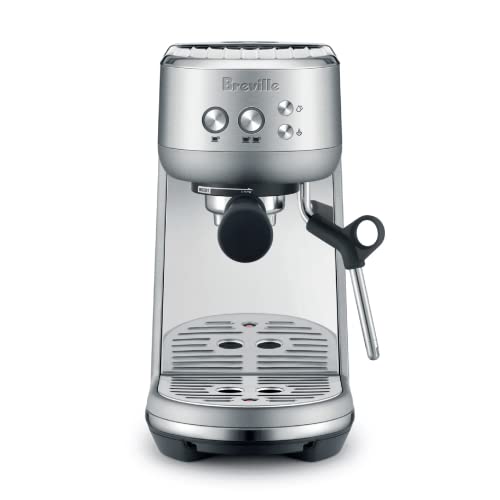
Breville Bambino Espresso Machine (BES450) — Best Compact for Home
Breville Bambino Espresso Machine (BES450) — check price on Amazon.
The Bambino is the home pick because it respects the counter. Its narrow body leaves room for a chopping board beside it — a sentence you cannot write about full-size machines — while its fast-heating system means the first drink of the day does not wait on a boiler. You grind and tamp yourself, so the espresso is real, and the steam wand handles lattes and cappuccinos with a short learning curve.
It needs a separate grinder, which in a small kitchen sounds like a problem and is actually a flexibility: a compact grinder can live in a cupboard and come out for drinks, while the Bambino stays out permanently. That division of labour suits home counters better than one wide machine.
Apartment-specific praise: the Bambino’s drip tray and tank are sized for a household of one or two, which means they get emptied and rinsed often by necessity — and that forced rhythm keeps the machine fresher than oversized reservoirs that sit for a week. Small capacity, in a small home, is a hygiene feature disguised as a limitation.
Strengths
- Slim footprint that genuinely fits shared home counters
- Very fast heat-up suits weekday mornings
- Real manual espresso and a capable steam wand
Trade-offs
- Separate grinder required — plan its home too
- Manual steaming takes practice for latte-quality foam
- Compact tank means refills in multi-drinker homes
| Specification | Detail |
|---|---|
| Style | Compact semi-automatic |
| Finish | Brushed stainless steel |
| Model | BES450 (Bambino) |
Home test that matters: can you still cook dinner with it on the counter? The Bambino passes — it occupies roughly a kettle’s worth of frontage — and that is why owners keep it out and use it daily instead of rotating it into storage.
Pair it with fresh beans and a modest grinder and the drinks are honestly café-comparable. For apartments, first homes and any kitchen where space is the binding constraint, this is the machine this guide would buy first.
A home-specific tip: because the Bambino heats so fast, it suits the ‘one drink, machine off’ pattern that dominates real home use, unlike boiler machines that reward being left on. That pattern saves energy and, more importantly, removes the psychological barrier of a warm-up wait — the drink happens because it is easy, which is the whole point of a home machine.
Best for: apartments and small kitchens wanting real espresso daily / Not suited for: households wanting one-touch automatic drinks
Check on Amazon — check the current price on Amazon before you decide.

De’Longhi Dedica Arte Espresso Machine (EC885) — Best Slim Design
De’Longhi Dedica Arte Espresso Machine (EC885) — check price on Amazon.
The Dedica line exists for one reason: width. The Dedica Arte is built for the sliver of counter between the kettle and the wall that most kitchens actually have free, and the Arte version adds the My LatteArt steam wand, which makes proper milk texturing noticeably easier than the panarello wands of cheaper slim machines.
Three-level temperature control — a feature the verified listing calls out — is unusual at this size and helps with different roasts: lighter beans like the hotter setting, darker beans the cooler one. For a machine this small, that is real espresso thinking, not a toy specification.
The Dedica Arte also suits a home pattern the others do not: the machine that comes out for weekend brunch and lives in a slim gap all week, using almost no visual space in a design-led kitchen. If your kitchen is photographed more than it is cooked in — no judgement — this is the espresso machine that does not spoil the picture.
Strengths
- Slimmest footprint of any pick here
- My LatteArt wand makes genuine microfoam achievable
- 3-level temperature control helps across roast styles
Trade-offs
- Uses pressurised baskets — forgiving, but caps ultimate shot quality
- Small drip tray and tank suit its size class
- Separate grinder still recommended for best results
| Specification | Detail |
|---|---|
| Style | Slim semi-automatic |
| Pump | 15-bar pump per listing |
| Temperature | 3-level temperature control per listing |
| Milk | My LatteArt steam wand |
The Dedica Arte is the machine for the home cook who refuses to surrender counter to coffee but still wants a proper cappuccino on Sunday. Weekdays it is fast and unobtrusive; weekends it rewards a little wand practice with drinks that look the part.
If your kitchen has exactly one narrow gap and a household that drinks one or two milk drinks at a time, nothing else in this guide fits the brief as literally as this machine does.
Living with the Dedica teaches a useful home lesson: slim machines ask you to refill more often, and the owners who stay happy are the ones who make refilling part of the drink ritual — top up while the cup warms — rather than a separate chore. Set that expectation and the Arte’s size stops being a compromise and becomes what it was designed to be: espresso that fits a real kitchen.
Best for: the narrowest counters and design-conscious kitchens / Not suited for: back-to-back drinks for a crowd
Check on Amazon — check the current price on Amazon before you decide.

Philips 3300 Series Fully Automatic Espresso Machine with LatteGo (EP3341/50) — Best Automatic for Home
Philips 3300 Series Fully Automatic Espresso Machine with LatteGo (EP3341/50) — check price on Amazon.
Some homes do not want a hobby; they want coffee. The Philips 3300 is the home automatic pick: five hot and iced presets at one touch, a ceramic grinder inside, customisable strength and milk settings once you have dialled in your defaults, and the LatteGo milk container that rinses clean in seconds — the milk system least likely to be neglected by a busy household.
It is sized and priced for real homes rather than show kitchens, and its hot water function quietly covers tea drinkers too, which matters in mixed households deciding whether a machine earns its counter space.
For homes where the machine will be used by visiting family — the adult children, the in-laws, the house-sitters — the 3300’s labelled presets are a form of hospitality: nobody has to be taught, nobody has to ask, and nobody can really get it wrong. Machines that require the owner’s presence ration coffee to the owner’s schedule; this one serves the house.
Strengths
- One-touch drinks including iced presets
- LatteGo milk cleanup takes seconds
- Ceramic grinder and customisable strength per drink
Trade-offs
- Five presets is a focused, not exhaustive, menu
- Fully automatic footprint is bigger than the slim picks
- No manual mode for tinkerers
| Specification | Detail |
|---|---|
| Style | Fully automatic bean-to-cup |
| Menu | 5 hot & iced coffee pre-sets per listing |
| Grinder | Ceramic grinder |
| Milk | LatteGo milk system |
The 3300’s home virtue is democratic: anyone in the house can make a good drink, including guests, without a lesson. Machines that only one person can operate become one person’s chore; this one becomes household infrastructure, like the kettle.
If your home wants espresso drinks woven into daily life with the least possible friction — school mornings, work calls, grandparents visiting — this is the most livable machine in the guide.
For homes with children old enough to make drinks, the 3300’s preset logic is a quiet blessing: a hot water function for cocoa and tea, consistent milk drinks without a steam wand anywhere near small hands, and no portafilter of near-boiling metal to knock off the counter. Family-safety is rarely listed in espresso specifications, but households feel it, and this machine is the easiest in the guide to live around.
Best for: busy households wanting one-touch drinks for everyone / Not suited for: solo hobbyists seeking manual control
Check on Amazon — check the current price on Amazon before you decide.
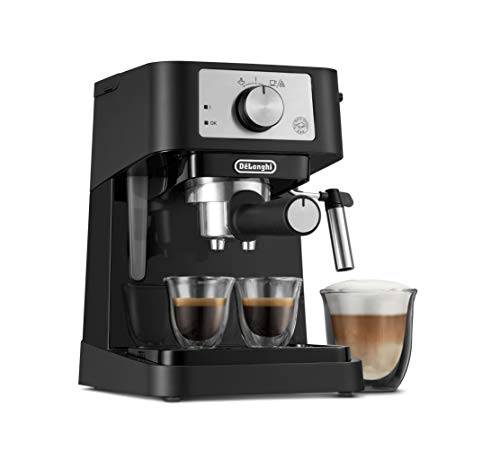
De’Longhi Stilosa Espresso Machine (EC260) — Best Budget for Home
De’Longhi Stilosa Espresso Machine (EC260) — check price on Amazon.
The Stilosa is the honest budget answer for home use: a compact manual machine from the category’s biggest maker, with a manual milk frother for cappuccinos and lattes, in a body small enough for a starter kitchen. You dose ground coffee, the pump does the extraction, and you froth milk with a simple wand that forgives beginners.
It will not match the refinement of the Breville or Dedica picks — pressurised baskets and a frother wand set its ceiling — but it makes recognisable, enjoyable espresso drinks at home for the least money in this guide, and it takes up the least room doing it.
The Stilosa’s simplicity has one more home virtue: it is the easiest machine here to lend, gift onward or demote to a second location when you upgrade. Appliances with a graceful second life get bought more happily the first time, and the Stilosa’s entire design — light, compact, obvious — is a second life waiting to happen.
Strengths
- Lowest tier in the guide with a real pump machine
- Compact body suits first kitchens and small counters
- Manual frother covers cappuccino and latte duties
Trade-offs
- Pressurised baskets limit ultimate espresso quality
- Frother produces foamier milk than true microfoam
- Plastic construction reflects the tier
| Specification | Detail |
|---|---|
| Style | Compact manual espresso machine |
| Pump | 15 bar pump per listing |
| Milk | Manual milk frother |
As a first home machine, the Stilosa’s job is to answer a question cheaply: does this household actually make espresso drinks when the machine is right there? If the answer becomes yes daily, you will upgrade with knowledge; if no, you have spent the least to learn it.
It also suits second locations — a home office desk corner, a holiday let, a caravan kitchen — anywhere a real drink matters more than a perfect one.
One more home role suits the Stilosa well: the guest-room or granny-flat machine. It is cheap enough to dedicate to a second location, simple enough that a visitor can run it from the printed drink logic, and small enough not to dominate a spare counter. Categories have room for the humble machine that just works where it is put, and this is that machine in this guide.
Best for: first home espresso machine on a tight budget / Not suited for: drinkers chasing café-level nuance
Check on Amazon — check the current price on Amazon before you decide.

CASABREWS 3700 Essential Espresso Machine — Best Small-Footprint Value
CASABREWS 3700 Essential Espresso Machine — check price on Amazon.
CASABREWS has built its name on giving small home kitchens more machine per inch of counter, and the 3700 Essential is the formula: a stainless steel body where rivals use plastic, a proper steam wand rather than a frothing aid, and a footprint that fits the same narrow home slots as the Dedica.
The listing’s pump headline should be read the way this guide reads all such numbers — as a maximum rating, not a brewing recipe — but the machine underneath it is a legitimate home semi-automatic that takes ground coffee or pods in many configurations and behaves well with a simple, consistent routine.
A note on expectations for the 3700’s steam wand: it produces satisfying cappuccino foam quickly and true latte microfoam with practice, which is the correct order for a home machine — the drink a beginner wants first should be the drink the machine makes easiest. Judge it by month two’s cappuccinos, not day one’s, and it will not disappoint.
Strengths
- Stainless body at a value tier
- Real steam wand for learning milk texture
- Compact dimensions for tight home counters
Trade-offs
- Brand support network is thinner than De’Longhi or Breville
- Accessories and finish are a step below the big brands
- Grinder still a separate purchase for best results
| Specification | Detail |
|---|---|
| Style | Compact semi-automatic |
| Pump | 20-bar Italian pump per listing |
| Milk | Steam wand per listing |
| Body | Stainless steel |
For a home buyer whose budget sits between the Stilosa and the Dedica, the 3700 is the value argument: metal where it shows, a wand that teaches a real skill, and no counter-space drama. It is the machine most likely to be bought for a first flat and still be in daily use at the second.
Keep expectations aligned with its tier — it is a capable home appliance, not a prosumer instrument — and it returns solid drinks and a tidy footprint for years of mornings.
Home buyers should know the 3700’s baskets accept the routine most homes actually follow — supermarket espresso-ground coffee works, fresh-ground works better — and its wand froths in a jug without drama. It does not demand a new lifestyle to produce a decent cappuccino, which at its tier is a design achievement worth crediting alongside the stainless body.
Best for: value-focused home buyers wanting a metal, compact machine / Not suited for: buyers who prioritise big-brand service networks
Check on Amazon — check the current price on Amazon before you decide.

Gevi 20 Bar Compact Espresso Machine — Best for Tiny Counters
Gevi 20 Bar Compact Espresso Machine — check price on Amazon.
The Gevi compact is built around the smallest home scenarios: studio flats, desk-side coffee corners, and kitchens where the machine shares space with everything else. Its verified listing highlights a 34oz tank — respectable for the class — and a built-in pressure gauge, a learning aid most compact machines skip, which helps new owners see whether their shot is running in a sensible zone.
Like the CASABREWS, treat the headline pump number as a rating rather than a recipe; what matters at home is that the machine is small, quick to live with, and honest about being a compact appliance rather than a café instrument.
The Gevi also fits a growing home category the others address less directly: the single-person household that drinks one excellent coffee a day. For that reader, capacity, profiles and menus are noise, and a compact, gauge-guided machine that makes one drink well and then disappears into a small kitchen is not a budget compromise — it is the brief, met exactly.
Strengths
- Pressure gauge helps beginners learn extraction
- 34oz tank is generous for a compact machine
- Small footprint for studios and office corners
Trade-offs
- Newer brand with a smaller support footprint
- Compact class limits back-to-back drink pace
- Finish and accessories are budget-grade
| Specification | Detail |
|---|---|
| Style | Compact espresso machine for home |
| Tank | 34oz water tank per listing |
| Gauge | Built-in pressure gauge per listing |
| Materials | BPA-free per listing |
The gauge is the quietly smart inclusion: new home baristas cannot fix what they cannot see, and a visible pressure readout turns guesswork into adjustment. Paired with consistent dose and fresh coffee, it shortens the frustrating first month considerably.
If your home constraint is truly space — a galley kitchen, a shared house, a work-from-home nook — the Gevi earns its place by being the machine that fits, heats and teaches, all at once.
The Gevi’s gauge also protects it in a specific home scenario: shared houses and family kitchens where several people use the machine with different coffees. A glance at the needle tells the next user whether the last person’s settings are in range, turning what is usually a mystery (‘why does it taste off today?’) into a ten-second adjustment. Small feedback loops like that are disproportionately valuable in shared homes.
Best for: studios, small flats and desk-side coffee corners / Not suited for: households making drinks for several people at once
Check on Amazon — check the current price on Amazon before you decide.
Comparison Table
| Pick | Badge | Key spec | Best for |
|---|---|---|---|
| Breville Bambino Espresso Machine (BES450) | Best Compact for Home | Compact semi-automatic, brushed stainless | apartments and small kitchens wanting real espresso daily |
| De’Longhi Dedica Arte Espresso Machine (EC885) | Best Slim Design | Slim semi-automatic, 15-bar pump, 3-level temp control | the narrowest counters and design-conscious kitchens |
| Philips 3300 Series Fully Automatic Espresso Machine with LatteGo (EP3341/50) | Best Automatic for Home | Fully automatic, 5 hot & iced presets, LatteGo | busy households wanting one-touch drinks for everyone |
| De’Longhi Stilosa Espresso Machine (EC260) | Best Budget for Home | Compact manual espresso machine, manual frother | first home espresso machine on a tight budget |
| CASABREWS 3700 Essential Espresso Machine | Best Small-Footprint Value | Compact semi-automatic, steam wand, stainless steel | value-focused home buyers wanting a metal, compact machine |
| Gevi 20 Bar Compact Espresso Machine | Best for Tiny Counters | Compact, 34oz tank, built-in pressure gauge | studios, small flats and desk-side coffee corners |
Home fit in one view: the Dedica is the narrowest, the Bambino the best balance of size and craft, the Philips 3300 the only true one-touch option, and the three value compacts trade refinement for price while keeping footprints small. Measure your cabinet height against whichever row you choose — that single number eliminates more home purchases than any other.
How to Choose the Best Espresso Coffee Machines for Home Use and Space
Measure three things before reading another review: the width of the counter slot the machine will occupy, the height from counter to the underside of your wall cabinets, and the depth you can spare without the machine hanging over the edge. Home machines fail on these numbers more than on any question of taste, and a machine returned for size teaches nothing.
Then think about access. If the machine will live under cabinets, a front-filling or easily slid-out tank matters; a top-fill tank under a low cabinet means dragging the machine forward every refill, a small friction that quietly reduces how much a household uses it. The same logic applies to drip trays and grounds containers on automatics.
- Narrow slot only: De’Longhi Dedica Arte
- Small but serious: Breville Bambino plus compact grinder
- Whole household, one touch: Philips 3300 LatteGo
- Tightest budget: De’Longhi Stilosa
- Value in stainless: CASABREWS 3700; tiniest footprint with a gauge: Gevi
Noise deserves one thought in homes with thin walls or early risers: grinders are the loud part of espresso, and they live inside automatics. If your first coffee happens at 5:30 a.m. beside a sleeping household, a semi-automatic with a separate, quick grinder — or pre-measured doses — can be the kinder design.
Heat-Up Time and the Weekday Test
Café machines are left on; home machines are switched on for a drink and off again, which makes heat-up time a daily tax. Fast-heating compact designs are ready in under a minute, traditional boilers can take many minutes to stabilise, and automatics sit in between with a rinse cycle on waking. Multiply your machine’s start-up by 365 mornings before deciding the difference is trivial.
The weekday test is the honest filter for this whole category: at 7 a.m., half-awake, can you make your drink in under five minutes including cleanup? Every pick in this guide passes for its intended style — but a big manual machine with a separate grinder ritual may not pass for you, and it is better to know that from a guide than from a return label.
Water, Tanks and Living Under Cabinets
Home water decides both taste and maintenance. Very hard water scales machines quickly and mutes flavour; very soft water can taste flat. Most households do well with filtered tap water, a machine filter where offered, and descaling on the machine’s schedule rather than by guesswork.
Tank size trades against footprint everywhere in this guide: compact machines hold less and ask for refills, automatics hold more and occupy more counter. There is no free capacity — only the right compromise for how many drinks your home makes between breakfast and dinner.
Counter Space Maths: What These Machines Really Occupy
Manufacturers quote a machine’s footprint; homes experience its working footprint — the machine plus the space to swing a portafilter, stand a milk jug, open a hopper lid and pull out a drip tray. As a rule, add roughly a hand’s width on the wand side and a cup’s depth in front of any quoted figure before you commit a counter slot to it. The slim picks in this guide were chosen partly because their working footprint stays close to their quoted one: the Dedica works in a slot barely wider than itself, and the Bambino needs only modest elbow room.
Height deserves the same realism: measure to the underside of your cabinets, then check what needs to open upward — bean hopper lids on automatics are the classic casualty, turning a perfect fit into a daily drag-the-machine-out ritual. If your chosen machine’s hopper opens upward and your cabinets are low, plan for the machine to live on an open stretch of counter instead; a home machine’s address matters as much as its specifications.
Home Espresso and Noise: Keeping the Peace at 6 A.M.
Every espresso machine is loud in one specific moment: grinding. Pumps hum and steam hisses, but the grinder is the sound that travels through a flat. Integrated automatics grind inside the machine for a few seconds per drink; semi-automatics with separate grinders let you choose a quieter grinder or grind the evening before into a sealed dose — a compromise in freshness that many early-rising households happily make.
If your home has a light sleeper, thin walls or a baby, factor noise into the choice as seriously as taste: the best home espresso machine is partly the one that does not start a domestic negotiation every morning. Compact machines with fast heat-up also shorten the total noise window, another quiet advantage of the Bambino and Dedica class beyond their size.
Renting, Moving and Second Homes: Portability as a Feature
Home is not always permanent, and espresso machines differ hugely in how they travel. The compact semi-automatics in this guide — Bambino, Dedica, Stilosa, the value compacts — can be drained, boxed and reinstalled in a new kitchen in minutes, with no plumbing and no service visit. Larger automatics travel too, but their brew groups and water systems prefer a careful descale-and-dry routine before a move.
For renters and serial movers, that portability is a genuine buying criterion that café-style buying guides ignore. A machine that moves with you gets used for a decade across four kitchens; a machine that is a project to move gets sold at the second move. If your next few years are mobile, weight the compact end of this guide accordingly.
Espresso Machines for Homes With Children and Pets
Household composition changes machine safety in ways spec sheets ignore. Steam wands are the main hazard: they are hot, they are at counter height, and they invite curiosity — homes with small children should favour either an automatic with an enclosed milk system like the Philips 3300, or a disciplined wand routine where the wand is never left hot and unattended. Hot water spouts deserve the same respect, and machines whose hot surfaces are mostly enclosed score better in family kitchens than exposed-boiler designs.
Pets contribute a different variable: fur and machines with open bean hoppers are unhappy companions, and a hopper lid that seals — or a canister routine that keeps beans off the counter — keeps both the coffee and the cat’s dignity intact. None of this disqualifies any pick here; it simply argues that the right home machine is chosen for the whole household, including its smallest and furriest members.
First-Week Troubleshooting for New Home Machines
Nearly every new home machine produces the same three complaints in week one, and all three are settings, not faults. Shots that run too fast and taste sour: the grind is too coarse or the dose too light — adjust finer in small steps. Shots that drip and taste bitter: the reverse — coarser, or a touch less coffee. Milk that comes out as big bubbles rather than foam: the jug is too full, the milk too warm before starting, or the wand tip is too deep at the start — begin with cold milk, tip just under the surface, and let the machine or your hand add air early rather than late. Work that short list before concluding anything about the machine itself; in the overwhelming majority of home setups, one of those adjustments is the whole story, and the second week tastes like a different, better purchase.
How to Set Up a Home Espresso Corner That Stays Tidy
A home espresso setup succeeds when it is a small, self-contained station rather than a machine plus scattered accessories. This layout works in the space of a cutting board and keeps daily mess near zero.
- Place the machine where its tank can be refilled without moving it — beside the sink if possible — and leave the steam wand side clear for a milk jug.
- Park a small knock box or use a dedicated container for spent pucks next to the machine; grounds wandering to the bin across the kitchen are how counters get filthy.
- Keep beans in a sealed canister beside the machine, filled for a few days at a time, with a scoop or scale in the same spot so dosing takes seconds.
- Add a folded bar towel that lives under the wand and portafilter area; wiping the wand and drip zone after every drink is a ten-second habit that prevents every bad smell this category is known for.
- Store cups on top of the machine only if the manual allows the cup warmer surface — otherwise a small shelf above keeps cups handy without scratching the machine.
- Once a week, empty and wash the drip tray, rinse the tank, and wipe the whole station down; a five-minute weekly reset keeps a home coffee corner from becoming the kitchen’s grubbiest square foot.
- Place a small mat or tray under the whole station: it catches the drips every machine produces, protects the worktop, and lifts out for a weekly rinse — the cheapest tidiness upgrade in home espresso.
- If your machine lives under cabinets, slide it forward on small furniture pads for refills rather than dragging it; pads protect both the counter and the machine’s feet, and make the refill routine effortless enough to actually happen.
Set up this way, even the smallest machine in this guide runs like a tidy little café station — and a tidy station is the one a household keeps using, which is the whole point of buying for home.
Common Buying Mistakes
Measuring width but not cabinet height. Height is the dimension that rejects home machines. Measure counter-to-cabinet clearance before ordering anything.
Buying a machine that must be stored away. If it lives in a cupboard, usage collapses within a month. Choose the size that can stay out permanently.
Ignoring tank access under cabinets. A top-fill tank you cannot reach without moving the machine becomes a daily annoyance and a spill source.
Forgetting the grinder’s footprint. Semi-automatics need a grinder beside them. Budget counter space for both, or choose the automatic.
Placing the machine far from water and a bin. Every extra step in the refill-and-clean loop reduces how often the machine gets used and cleaned.
Changing three settings at once. Grind, dose and temperature all at once makes results unreadable. Change one variable, taste, then decide — the discipline that makes home espresso improve instead of wander.
Final Recommendation
For most homes, the Breville Bambino is the best espresso coffee machine for home: small enough to live on the counter forever, fast enough for weekdays, and honest espresso that rewards a little practice. If even the Bambino is too wide, the De’Longhi Dedica Arte is the slimmest serious option, and its latte-art wand makes the most of the space it takes.
Homes that want drinks for everyone at one touch should buy the Philips 3300 and never think about tamping again. On a budget, the Stilosa answers the first-machine question cheaply, the CASABREWS 3700 adds a stainless body and real wand, and the Gevi fits the tiniest corners while teaching you pressure with its gauge. Measure first, and any of the six will serve your home well.
Measure the counter, pick the machine whose size and style match the home you actually live in, and give it a tidy corner and a fair first week. Do that, and any of the six machines here will pay rent on its counter space every single day — which, for a home appliance, is the highest verdict there is.
Homes change — people move, families grow, counters shrink and expand — and the machines above were partly chosen for how gracefully they survive those changes: light enough to move, standard enough to service, simple enough to hand on. Buy the machine that fits your home today and can follow your home tomorrow, and the purchase will still look wise in five years.
Keep researching with these related guides from the same program: Best Espresso Machines Best Espresso Coffee Machines Best Espresso Coffee Machines For Home Use Best Espresso Drip Combo Machines Best Espresso Machines 1000 Best Coffee And Espresso Combo Machines
Frequently Asked Questions
What size espresso machine is best for a home kitchen?
The one that fits your measured slot with room to refill the tank — for most homes that means a compact semi-automatic like the Bambino or a slim design like the Dedica. Standard counters are about 60cm deep; every pick here sits comfortably within that.
Can I put an espresso machine under wall cabinets?
Yes, if the machine’s height clears the cabinet underside and you can still access the tank and bean hopper. Measure the gap first; automatics with top-loading beans need the most clearance.
How fast should a home espresso machine heat up?
For weekday use, under a couple of minutes is the practical target. The compact picks here heat fastest; larger boiler machines trade that speed for back-to-back capacity most homes rarely need.
Do home espresso machines need plumbing?
None of the machines in this guide do — all run from refillable tanks. Plumb-in machines exist at the prosumer tier but are unnecessary for home drink volumes.
Is a fully automatic or a semi-automatic better for home?
Automatics suit households where several people make drinks and nobody wants a ritual. Semi-automatics suit one or two enthusiasts who enjoy the process and want better milk texture and shot control in less counter space.
How do I keep a home espresso machine from smelling stale?
Wipe the steam wand after every use, empty the drip tray and puck container before they sit full, rinse the tank weekly, and descale on schedule. Ninety percent of ‘machine smell’ is old milk and standing tray water.
Can an espresso machine live in a bedroom or home office?
Yes — the compact picks here, especially the Stilosa, Gevi and CASABREWS, suit a desk-side or bedroom-corner setup, needing only a socket and water refills. Keep a small tray under the station for drips and a sealed canister for beans, and the setup stays tidy anywhere in the home.
How much counter depth does a home espresso machine need?
All six picks fit within a standard 60cm-deep counter with working room to spare; the slim Dedica needs the least. The binding dimension is usually height under cabinets and width of the free slot, so measure those two first.


