Disclosure: airfryerkitchensupply.com is reader-supported. When you buy through links on our site, we may earn an affiliate commission at no extra cost to you.
Where to buy
An espresso coffee machine is the bean-to-cup middle ground: one appliance that grinds fresh beans and serves everything from a straight espresso to a long coffee to a latte, without asking you to learn a portafilter. Every machine below was confirmed through the site’s Amazon verification step, and the natural starting point is the Philips 3200 Series with LatteGo — the milk system with the easiest cleanup in the category — or the De’Longhi Dinamica if your household drinks mostly black coffee.
Check the current price on Amazon through the links in this guide. One warning before you shop: ‘espresso coffee machine’ is also used loosely for semi-automatic machines with built-in grinders, so this guide separates true one-touch bean-to-cup machines from the one hands-on pick, and labels each clearly.
Introduction
The best espresso coffee machines solve a specific household problem: several people, several different drinks, one machine, no barista. One person wants a double espresso, another a long morning coffee, a third a cappuccino — and nobody wants to grind, tamp, steam and clean between each one. Bean-to-cup machines exist for exactly that kitchen, grinding per cup and serving the whole menu from one button panel.
This guide concentrates on that fully automatic category, where Philips, De’Longhi, Jura-adjacent designs and KitchenAid compete on milk systems, drink menus and how painless the weekly cleaning is. One semi-automatic with a built-in grinder is included at the end for buyers who discover, reading this, that they actually want some craft in the process.
All six machines were verified against their Amazon listings through a listing check; drink counts, grinder details and tank sizes below come from those listings only. Where brands within the category differ most — milk handling — the reviews are deliberately specific, because that is what you will live with daily.
It is worth pausing on the phrase itself, because search language and shop language differ. Many buyers typing ‘espresso coffee machine’ picture exactly what this guide covers — one machine, fresh beans, every coffee drink — while some shops use the same words for any espresso maker at all. If what you picture is a portafilter and a separate grinder, the flagship espresso guide in this programme is your list; if you picture pressing a button and receiving a latte, you are in the right place and can read on with confidence.
In this guide
Quick Picks
Six bean-to-cup machines (plus one hands-on alternative), ranked by how well they run a whole household’s coffee:
- Best Overall: Philips 3200 Series Fully Automatic Espresso Machine with LatteGo (EP3241/54) — five coffee varieties, a ceramic grinder and the easiest milk system to clean.
- Best for Variety: Philips 5500 Series Fully Automatic Espresso Machine with LatteGo (EP5544/94) — twenty hot and iced presets with LatteGo milk and QuickStart brewing.
- Best for Black Coffee: De’Longhi Dinamica Espresso Machine (ECAM35020B) — steel burr grinder and a manual frother, tuned for espresso and long coffee.
- Best Value Automatic: De’Longhi Magnifica Start Automatic Espresso Machine — five one-touch recipes and 13 grind settings at the entry tier of the line.
- Best Premium: KitchenAid Fully Automatic Espresso Machine KF8 (KES8558) — 40+ recipes, smart dosing, a 2.2L tank and a removable bean hopper.
- Best Budget Hands-On: Mr. Coffee Café Barista Espresso Machine — a semi-automatic with automatic milk frothing and three drink options.
How These Picks Were Chosen
Verification came first: each machine’s model and listing were confirmed before it could be ranked, and the specs in this article — the Philips 5500’s twenty presets, the KitchenAid KF8’s 2.2-litre tank — are quoted only where the verified listing states them.
Ranking then weighed the things that decide satisfaction with an automatic: how the milk system works and cleans, how many genuinely distinct drinks the menu holds (not recipe-count padding), grinder quality and noise, water tank and drip tray practicality, and how the machine asks for maintenance. An automatic that nags clearly and rinses easily outlasts a cleverer one that hides its chores.
One style boundary was enforced: pod and capsule machines were excluded from this guide entirely. Espresso coffee machines here use fresh beans, because grinding per cup is the entire point of the category.
The guide also applied a household-noise test that rarely appears in specifications: grinder and pump volume in a real kitchen at dawn. None of these machines is silent — grinding coffee is inherently a loud five seconds — but the ceramic-grinder Philips models were noted as the gentler sound in the field, and that quality-of-life detail is recorded in their reviews because 6 a.m. is when this category is actually used.
The guide’s bias, stated once and plainly: it favours machines whose tenth drink of the day is as good as their first, and whose fiftieth week is as calm as their first. Bean-to-cup buyers are purchasing a routine as much as a beverage, and every ranking here was made by imagining the routine — the filling, the rinsing, the prompting, the Sunday-morning queue of family orders — rather than by imagining a single perfect cup in a silent showroom.
The 6 Best Espresso Coffee Machines

Philips 3200 Series Fully Automatic Espresso Machine with LatteGo (EP3241/54) — Best Overall
Philips 3200 Series Fully Automatic Espresso Machine with LatteGo (EP3241/54) — check price on Amazon.
The Philips 3200 with LatteGo is the espresso coffee machine most households should buy, because it attacks the category’s real enemy: milk cleanup. The LatteGo system froths into the cup from a small two-part container with no tubes to flush, and those parts rinse clean in seconds or go in the dishwasher. Every other automatic makes you choose between milk drinks and chores; this one largely removes the choice.
The rest of the machine is sensibly judged: five coffee varieties adjusted through the My Coffee Choice menu, a ceramic grinder that runs cooler and quieter than steel, and AquaClean filtration that stretches the time between descaling when you replace the filter on schedule.
A scenario that captures the 3200: a parent making a cappuccino with one hand while supervising breakfast with the other, then rinsing the LatteGo under the tap in the same motion as rinsing a mug. Machines are usually reviewed as if their users have two free hands and no audience; this one was designed for the opposite reality, and it shows in every detail that matters.
Strengths
- LatteGo milk system is the easiest in the category to clean
- Ceramic grinder is durable and comparatively quiet
- AquaClean filter reduces descaling frequency
Trade-offs
- Five base varieties is a shorter menu than newer Philips models
- Touch display is functional rather than luxurious
- Plastic-heavy exterior at this tier
| Specification | Detail |
|---|---|
| Style | Fully automatic bean-to-cup |
| Menu | 5 coffee varieties per listing |
| Grinder | 100% ceramic grinder per listing |
| Milk | LatteGo milk frother |
| Water care | AquaClean filter support |
In a family kitchen the 3200’s virtue compounds: because milk cleanup is trivial, people actually make milk drinks, and because the machine is simple, guests and teenagers use it without training. Utilisation is the hidden metric of this category, and this machine maximises it.
If you later want iced recipes and a bigger menu, the Philips 5500 below is the same idea grown up. But for most homes, the 3200 is the point where spending more buys variety, not better daily coffee.
One ownership detail worth knowing before you buy: the 3200’s brew group removes for rinsing under a tap, a weekly two-minute job that keeps an automatic tasting clean for years. Philips designs its machines around that owner-serviceable routine rather than sealed mystery, and for a household appliance that lives on coffee oils and water, that serviceability is a genuine long-term advantage.
Best for: households wanting milk drinks without milk-system chores / Not suited for: buyers who want a long menu of iced and specialty presets
Check on Amazon — check the current price on Amazon before you decide.

Philips 5500 Series Fully Automatic Espresso Machine with LatteGo (EP5544/94) — Best for Variety
Philips 5500 Series Fully Automatic Espresso Machine with LatteGo (EP5544/94) — check price on Amazon.
The Philips 5500 is the maximalist version of the LatteGo idea: twenty hot and iced presets, so the machine covers the summer iced-coffee season as well as winter lattes, with strength, milk and cup size adjustable per drink. QuickStart shortens the wait from switching on to drinking, which sounds minor and matters every single morning.
It keeps the two things that made the 3200 the top pick — the tube-free LatteGo milk container and the ceramic grinder — and adds the menu depth a varied household eventually asks for. If your family’s drinks range from espresso to iced lattes, this is the one-box answer.
The 5500’s QuickStart deserves its sentence: automatics traditionally ask for a rinse-and-warm wait on waking, and shaving that wait changes whether the machine gets used before the school run or after it. Small time savings at the exact bottleneck of the morning are worth more than large ones at leisure, and Philips has aimed this model precisely at that bottleneck.
Strengths
- 20 hot and iced presets — the broadest menu here
- Same easy-clean LatteGo milk system as the 3200
- Per-drink customisation of strength, milk and size
Trade-offs
- Higher tier than the 3200 for what is mainly menu breadth
- Iced drinks still need good ice and fresh beans to shine
- Larger menu means a slightly busier interface
| Specification | Detail |
|---|---|
| Style | Fully automatic bean-to-cup |
| Menu | 20 hot & iced coffee pre-sets per listing |
| Grinder | Ceramic grinder |
| Milk | LatteGo milk system |
| Start | QuickStart per listing |
The honest way to choose between the Philips siblings: count how many of the twenty presets your household will use weekly. If the answer is most of them — especially the iced ones — the 5500 earns its tier every summer afternoon. If the answer is four, buy the 3200 and spend the difference on better beans.
Either way, the LatteGo cleaning advantage is the platform’s core strength, and it is fully present here. Variety without added chores is a rare combination in this category.
The 5500 also rewards a household habit: because its presets remember per-drink adjustments, it pays to spend one evening dialling in each family member’s favourite properly — strength, milk, size — rather than accepting defaults forever. After that evening, the machine’s breadth stops being a menu you browse and becomes a set of personal buttons, which is when the premium over the 3200 starts earning its keep daily.
Best for: varied households that drink hot and iced coffee drinks year-round / Not suited for: two-drink households who will never open most of the menu
Check on Amazon — check the current price on Amazon before you decide.

De’Longhi Dinamica Espresso Machine (ECAM35020B) — Best for Black Coffee
De’Longhi Dinamica Espresso Machine (ECAM35020B) — check price on Amazon.
The Dinamica is the espresso coffee machine for people whose drink is coffee, not a milk delivery system. Its built-in steel burr grinder and De’Longhi’s bean-to-cup brewing produce a notably good long coffee and espresso, and the manual frother is there when a cappuccino is wanted — with the texture control that automatic frothers cannot match, once you learn a simple wand routine.
That manual wand is also the honest caveat: milk drinks take a minute of your attention and a wipe of the wand afterwards. Black-coffee households will never care; latte households should look at the LatteGo machines above or the Dinamica’s own automatic-milk sibling.
Dinamica owners develop one characteristic habit worth copying from day one: they keep two bean types — a house espresso blend and a decaf — and swap by the cup using the ground-coffee chute most automatics provide for a single dose. It is the civilised way to serve a decaf drinker from a bean-to-cup machine without dedicating the hopper, and it makes the Dinamica a better host than its menu suggests.
Strengths
- Excellent espresso and long coffee from fresh beans
- Steel burr grinder built in
- Manual wand gives real milk texture control
Trade-offs
- Milk drinks are a manual process, not one-touch
- Black finish shows dust and fingerprints
- Menu depth is smaller than the Philips 5500
| Specification | Detail |
|---|---|
| Style | Fully automatic bean-to-cup |
| Grinder | Built-in steel burr grinder per listing |
| Milk | Manual frother |
| Model | ECAM35020B |
De’Longhi’s automatics have a reputation for durability in this class, and the Dinamica’s straightforward layout — front-access water and grounds — suits kitchens where the machine lives under a cabinet and gets serviced from the front. Small practicalities like that decide whether a machine is still loved in year four.
If your household drinks Americanos, espressos and long blacks with the occasional cappuccino, this is the most focused machine in the guide: everything it does well is exactly what you drink.
A note for households splitting the difference: if some drinkers want one-touch milk and others want the Dinamica’s black coffee, De’Longhi sells this platform in a LatteCrema automatic-milk variant as well. The guide ranks the manual-frother original for black-coffee households, but the family’s existence means the Dinamica’s brewing quality is available in whichever milk format your home prefers.
Best for: espresso and long-coffee drinkers who froth milk occasionally / Not suited for: one-touch latte households
Check on Amazon — check the current price on Amazon before you decide.

De’Longhi Magnifica Start Automatic Espresso Machine — Best Value Automatic
De’Longhi Magnifica Start Automatic Espresso Machine — check price on Amazon.
The Magnifica Start is where De’Longhi’s automatic range begins, and it is a smarter starting point than most: five one-touch recipes covering the drinks households actually make, a built-in grinder with thirteen settings to dial in a new bag of beans, and both hot and iced drinks on the menu.
It trims the personalisation and menu depth of the bigger Magnifica models, not the core brewing. For a first bean-to-cup machine — or a second one for an office corner or holiday home — that is the right place to save.
For the gift-giver reading this guide: the Start is the safest machine here to give. Its five recipes map onto what non-specialists actually order, its prompts speak plainly, and its size suits kitchens you have not measured. Premium machines make impressive gifts and complicated ones; the Start makes a used-daily one, which is the only kind that counts by February.
Strengths
- Genuine one-touch recipes at the entry tier
- 13 grind settings give real adjustment for different beans
- Hot and iced drinks included
Trade-offs
- Less personalisation than the Evo and Dinamica lines
- Milk handling is simpler than LatteGo-style systems
- Finishes and display are basic
| Specification | Detail |
|---|---|
| Style | Fully automatic bean-to-cup |
| Menu | 5 one-touch recipes per listing |
| Grinder | Built-in grinder, 13 grind settings per listing |
| Drinks | Hot and iced per listing |
First-time automatic buyers often overbuy menu and underbuy beans. The Magnifica Start reverses that budget correctly: the machine covers the core drinks properly, and the money saved buys months of fresh beans, which you will taste far more than a sixth recipe preset.
It also makes a sensible gift machine for parents or a household upgrading from pods — the operation is genuinely one-touch, and the maintenance prompts are clear enough for non-technical owners.
The Start also makes a quietly excellent second machine — for a home office, a workshop studio or a holiday property — where a full-size flagship would be wasted but pod coffee has worn out its welcome. Its one-touch core and modest footprint travel well between those roles, and its maintenance prompts keep it healthy even where it is used by many hands.
Best for: first-time bean-to-cup buyers and smaller households / Not suited for: drinkers wanting deep per-user profiles and big menus
Check on Amazon — check the current price on Amazon before you decide.

KitchenAid Fully Automatic Espresso Machine KF8 (KES8558) — Best Premium
KitchenAid Fully Automatic Espresso Machine KF8 (KES8558) — check price on Amazon.
The KitchenAid KF8 is the design-led premium entry in this category: stainless steel body, an LCD touch screen, more than forty recipe options, and two practical ideas rivals should copy — a removable bean hopper, so swapping beans or cleaning the hopper is not a scoop-and-pray exercise, and smart dosing that adjusts the dose for the drink selected.
The 2.2-litre tank is the other daily luxury: in a busy household it halves the refill trips that make smaller automatics feel needy. Auto milk frothing covers the milk menu without wand work.
The KF8’s stainless body has a practical consequence beyond looks: it wipes clean of the coffee splashes and milk spots that accumulate around any machine’s dispensing area without staining or clouding, where pale plastics slowly take on a tired tint. In a machine designed to live on display for years, that durability of appearance is part of the product.
Strengths
- Removable bean hopper makes bean swaps and cleaning easy
- Large 2.2L tank suits heavy-use households
- 40+ recipes with smart dosing and a proper touch screen
Trade-offs
- Premium tier — the most expensive machine in this guide
- Big menu is wasted on espresso-only drinkers
- Newer platform than the long-running De’Longhi lines
| Specification | Detail |
|---|---|
| Style | Fully automatic bean-to-cup |
| Menu | 40+ recipe options per listing |
| Tank | 2.2L water tank per listing |
| Grinder | Built-in grinder with smart dosing |
| Hopper | Removable bean hopper per listing |
The KF8’s appeal is to the household that hosts: brunch guests can be offered almost any coffee drink, the tank survives the session, and the machine looks like it belongs next to other serious appliances rather than hiding a plastic appliance aesthetic.
If your priority is the broadest menu with the least refilling and the nicest object on the counter, this is the pick. If your priority is the lowest cost per reliable cup, the De’Longhi and Philips machines above argue their case strongly.
The removable bean hopper deserves a second mention because it changes a real behaviour: households actually swap beans. Decaf in the evening, a special bag on weekends — with a fixed hopper those are faff involving scoops and vacuuming stray beans; with the KF8’s hopper they are a lift and a click. Small mechanical kindnesses like that are what premium tiers are supposed to buy.
Best for: premium households that entertain and drink everything / Not suited for: minimalists who drink one style of coffee
Check on Amazon — check the current price on Amazon before you decide.
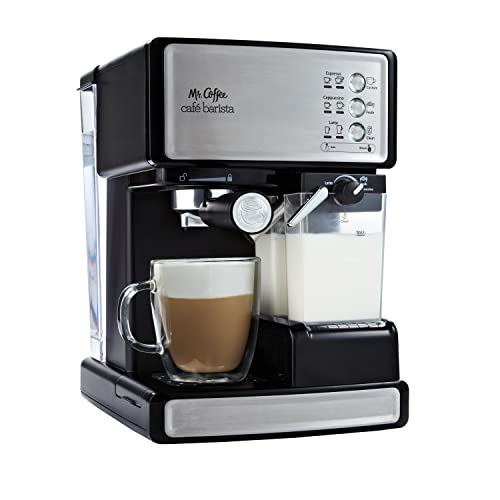
Mr. Coffee Café Barista Espresso Machine — Best Budget Hands-On
Mr. Coffee Café Barista Espresso Machine — check price on Amazon.
Not every ‘espresso coffee machine’ shopper wants a bean-to-cup computer, and the Mr. Coffee Café Barista is the budget bridge between the worlds: a semi-automatic portafilter machine — you dose the coffee, it handles the pressure — paired with an automatic milk frother that turns milk into foam without wand technique, across three drink options.
It uses ground coffee rather than grinding beans, so pair it with fresh-ground coffee from a shop or a small home grinder. Within that honest limit, it produces recognisable espresso drinks at the lowest tier in this guide, which is exactly its job.
The Café Barista also earns a place in a specific modern setting: the home office. Its footprint fits a desk-side credenza, its automatic frother removes the skill barrier on a workday, and its drink quality clears the ‘better than the office kitchen’ bar by a wide margin. Not every machine in this guide needs to be a household’s flagship; some just need to rescue a workday.
Strengths
- Automatic milk frother removes the hardest beginner skill
- Lowest-cost route to espresso, cappuccino and latte at home
- Removable reservoir is easy to fill and clean
Trade-offs
- No built-in grinder — coffee must be bought ground or ground separately
- Build and longevity are budget-tier
- Three drink options is a short menu by design
| Specification | Detail |
|---|---|
| Style | Semi-automatic 3-in-1 espresso maker |
| Milk | Automatic milk frother per listing |
| Drinks | 3 drink options per listing |
| Tank | Removable water reservoir |
This machine suits the pod-machine graduate: someone who wants fresher coffee and real milk drinks, is not ready for bean-to-cup money, and does not want to learn to steam milk. It is also a sensible first machine for a student or rental kitchen.
Manage expectations on lifespan and refinement and it is a fair deal. Demand café nuance from it and you will be shopping again within the year — in which case, start with the Philips 3200 instead.
Set the Café Barista up for success with two cheap habits: buy ground coffee in small bags and store it sealed, since pre-ground stales in days once opened, and rinse the milk frother’s parts the same day, every day. Owners who keep those two habits report a machine that punches at its tier for years; owners who do not meet the stale-coffee and old-milk ceiling that no budget machine can break.
Best for: budget buyers wanting espresso drinks without new skills / Not suited for: fresh-bean purists or heavy daily use
Check on Amazon — check the current price on Amazon before you decide.
Comparison Table
| Pick | Badge | Key spec | Best for |
|---|---|---|---|
| Philips 3200 Series Fully Automatic Espresso Machine with LatteGo (EP3241/54) | Best Overall | Fully automatic, LatteGo milk, ceramic grinder, AquaClean | households wanting milk drinks without milk-system chores |
| Philips 5500 Series Fully Automatic Espresso Machine with LatteGo (EP5544/94) | Best for Variety | 20 hot & iced presets, LatteGo, ceramic grinder | varied households that drink hot and iced coffee drinks year-round |
| De’Longhi Dinamica Espresso Machine (ECAM35020B) | Best for Black Coffee | Fully automatic, steel burr grinder, manual frother | espresso and long-coffee drinkers who froth milk occasionally |
| De’Longhi Magnifica Start Automatic Espresso Machine | Best Value Automatic | Fully automatic, 5 one-touch recipes, 13 grind settings | first-time bean-to-cup buyers and smaller households |
| KitchenAid Fully Automatic Espresso Machine KF8 (KES8558) | Best Premium | 40+ recipes, 2.2L tank, removable bean hopper | premium households that entertain and drink everything |
| Mr. Coffee Café Barista Espresso Machine | Best Budget Hands-On | Semi-automatic 3-in-1, automatic milk frother | budget buyers wanting espresso drinks without new skills |
Notice the pattern: milk system and menu breadth separate these machines more than espresso quality, which is competent across the bean-to-cup field. Choose by the drinks your household actually orders and by whose cleaning routine you prefer — LatteGo’s rinse-and-done container, De’Longhi’s wand or carafe, or KitchenAid’s big-tank convenience.
How to Choose the Best Espresso Coffee Machines
Write down your household’s actual drink order for a week. If milk drinks are half the list, the milk system is your first filter: tube-free containers like LatteGo clean in seconds, automatic carafes need fridge space and rinsing, and manual wands give the best texture with the most effort. If black coffee dominates, grinder and brewing quality matter more and the Dinamica-style layout wins.
Then size the machine to your volume. Tank capacity, drip tray depth and grounds container size decide how often the machine interrupts you. A 2.2-litre tank sounds like a spec-sheet detail until a smaller machine asks for water mid-brunch for the third time.
- Mostly milk drinks: Philips LatteGo models
- Mostly black coffee: De’Longhi Dinamica
- First automatic on a budget: Magnifica Start
- Big menu and big tank: KitchenAid KF8
- Tightest budget, ground coffee: Mr. Coffee Café Barista
Finally, check the maintenance story before the feature list: how descaling is prompted, whether the brew group rinses or removes, and what the filter programme costs per year in real money. Automatics reward owners who follow prompts and punish those who ignore them — choose the routine you will actually keep.
Ceramic vs Steel Grinders in Bean-to-Cup Machines
Philips uses ceramic burrs across these picks; De’Longhi’s Dinamica uses steel. Ceramic runs cooler and is often quieter, and it does not rust — a genuine point in a machine full of steam and water. Steel is the traditional espresso choice, typically a touch faster and long-proven in café grinders. In a sealed automatic, honestly, both outlast the machine’s other components when fed normal beans.
What matters more than material is how you treat either: avoid very oily, dark-roasted beans that gum up burrs and brew groups, adjust the grind only while the grinder runs, and expect to re-dial when you change beans. Those habits, not burr chemistry, decide whether your automatic tastes great in year three.
Why Fresh Beans Beat Every Feature on the Box
An automatic grinds per cup, which is its superpower — but only if the hopper holds fresh beans. Beans stale in a warm hopper above a boiler faster than in a sealed bag in a cupboard, so fill for a few days, not a few weeks. Medium roasts are the sweet spot for most automatics: dark, oily roasts clog and taste ashy at automatic doses, while very light roasts can taste thin without the extraction control of a manual machine.
If your drinks taste flat, change the beans before you blame the machine. In this category, beans are the cheapest component and the largest flavour variable — the reverse of the semi-automatic world, where the grinder holds that role.
Bean-to-Cup vs Semi-Automatic: Which Espresso Coffee Machine Style Fits Your Home?
The deciding question is who makes the drinks and how they feel about process. Bean-to-cup machines — five of this guide’s six picks — put a competent barista inside the box: anyone can walk up and get a good drink, and the machine manages dose, tamp and timing. Semi-automatics put the barista in you: higher ceiling, real skill, and drinks only as good as the operator’s morning. Households with several drinkers and no aspiring barista should buy bean-to-cup without a flicker of doubt; the quality gap to a well-run semi-automatic is smaller than the gap between a used machine and an unused one.
There is also a middle truth worth hearing: a bean-to-cup machine’s espresso is a different style — softer, more forgiving, tuned for milk drinks and long coffees — rather than a failed copy of café espresso. Judged on what households actually drink, that style wins most mornings, which is why this category keeps growing while purists keep objecting.
Milk Systems Compared: LatteGo, Carafes, Wands and Frothers
Milk is where automatics diverge most, and the systems rank differently on quality and effort. Manual wands (the Dinamica) give the best texture and demand the most skill and a wipe after every use. Automatic carafes give one-touch milk and ask for fridge space and a weekly deep clean. Philips’ LatteGo gives one-touch milk from a tube-free container that rinses in seconds — slightly less silky than a good wand, dramatically easier to live with. Simple frothers (the Mr. Coffee) make foam generously and texture coarsely, at the lowest cost.
Choose by your household’s honesty: the system you will clean without resentment is the best system, full stop. A wand household that loves the ritual should not buy LatteGo; a busy family should not buy a wand and pretend. The reviews in this guide score each machine’s milk against its own system’s promise, not against an absolute ideal.
What Bean-to-Cup Machines Cost to Run (Beyond the Purchase)
Running an automatic is mostly beans: a household drinking four coffee drinks a day uses roughly a bag of beans every week or so, and the quality of those beans is the single largest running decision you make — the machine will faithfully express whatever you feed it. Add water filters on their replacement cycle and descaler a few times a year, and the per-cup cost still lands far below café prices and below pod systems, which is the economic engine of the whole category.
The cost owners forget is neglect. A brew group never rinsed, a milk system never cleaned and a descale prompt ignored for months convert cheap maintenance into a service bill. Every machine in this guide prompts and rinses in ways designed to be painless; the running cost of an automatic is therefore best understood as a few minutes a week, paid gladly, instead of a repair later.
Programming Your Household’s Drinks: Profiles, Presets and Defaults
The hidden craft of owning an automatic is not making one great drink — it is making the machine repeat it. Spend an early evening with each machine’s adjustment logic: brew your usual drink, adjust one variable (strength first, then volume, then milk), taste, and save or note the result as the household default. On profile machines like the KitchenAid and the Dinamica Plus elsewhere in this programme, save per person; on preset machines, agree the house settings and leave them alone.
That one evening of standardisation is the difference between an automatic that feels like a café and one that feels like a vending machine. It is also the step most owners skip, and then blame the hardware for inconsistency that was really six people improvising on shared settings. The machines in this guide all provide the tools; this paragraph exists to make sure somebody uses them in week one.
Two Machines or One? When a Separate Setup Beats Bean-to-Cup
Fairness requires naming the alternative this guide competes with: a standalone espresso machine plus a simple drip brewer or kettle setup. That two-device route wins when one household member is a genuine espresso hobbyist — no automatic’s ceiling survives contact with a dedicated learner — or when the household’s coffee is mostly filter coffee with espresso as a rare guest appearance, where a small manual machine covers the exception more cheaply. It loses on counter space, on shared maintenance, and on the democratic point this category exists for: everyone in the house making every drink. If your home has an espresso hobbyist, buy for the hobbyist and let the household borrow the results; if it has only drinkers, the bean-to-cup machines above are the honest answer, and the two-device route is a romantic detour.
How to Set Up a Bean-to-Cup Machine for the First Week
Automatics reward a careful first week: the settings you dial in now become the one-touch drinks you live with. This setup sequence works for every machine in this guide.
- Rinse the water tank, fill with fresh water, fit the water filter if your model supplies one, and run the machine’s first-run rinse cycle exactly as the manual directs.
- Fill the hopper with a medium-roast bean you already like as filter coffee — familiar beans make changes in the cup easier to read.
- Set the grinder to the middle of its range and pull three espressos, discarding or tasting as you go; adjust one step finer or coarser between drinks, only while the grinder is running.
- Set your default cup sizes and strength for the two drinks your household makes most, so one-touch actually means one touch.
- Run the milk system once and clean it the same day, learning the routine while it is easy — LatteGo parts under the tap, wands wiped and purged, carafes rinsed and refrigerated.
- Empty the drip tray and grounds container before the machine asks, twice in the first week, to learn how fast your household fills them.
- Note the descale prompt system and put the filter-change date in your calendar; automatics stay reliable when maintenance is scheduled, not remembered.
- After the first week, write your household’s final settings on a card kept with the beans — grind step, strength, cup size per drink — so a reset, a descale or a curious guest cannot silently unmake your dialling-in.
- Keep a small brush by the machine for the grinder chute and drip area; ten seconds of brushing weekly prevents the stale-coffee dust build-up that slowly dulls every automatic’s flavour.
After that first week, the machine should disappear into your routine — which is the entire promise of the category. If it still demands attention daily, the settings, not the concept, are what to revisit.
Common Buying Mistakes
Filling the hopper for a month. Beans stale fast in a warm hopper. Fill for days, store the rest sealed and cool.
Buying very oily dark beans. Oils coat burrs and brew groups in automatics and are the top cause of ‘it tastes off and clogs’. Choose medium roasts.
Ignoring the milk system until it smells. Milk residue is the category’s number-one hygiene failure. Same-day rinsing is non-negotiable, whichever system you choose.
Paying for menu you will never open. Twenty presets help varied households; two-drink households should buy the simpler machine and better beans.
Skipping the water filter programme. Filters stretch descale intervals and protect the boiler. Track replacement dates or scale will collect the debt later.
Running the machine dry or on an empty hopper. Automatics protect themselves imperfectly. A weekly glance at water and beans — ideally while making the first drink of the day — prevents the mid-shot stalls that owners misread as faults.
Final Recommendation
Buy the Philips 3200 with LatteGo if you want the best espresso coffee machine for a normal household: it makes the full drink range, grinds fresh with a quiet ceramic burr, and its milk system is the one people actually keep clean. Step up to the Philips 5500 if iced drinks and a twenty-preset menu will genuinely be used, or to the KitchenAid KF8 if you want the premium object with the big tank and the broadest menu of all.
Black-coffee households should choose the De’Longhi Dinamica and enjoy the best long coffee in the guide, first-time buyers on a budget should start with the Magnifica Start, and the Mr. Coffee Café Barista covers the ground-coffee, tightest-budget corner honestly. Match the machine to your drink order and the category delivers exactly what it promises.
Whichever machine you choose from this list, the purchase succeeds the same way: fresh beans, settings agreed once and left alone, milk cleaned the day it is used, and prompts answered when they appear. Do those four things and any of these six will quietly become the most-used appliance in your kitchen — which is the only ranking that finally matters.
One sentence of buying advice survives every comparison in this guide: decide your milk system first, because you will clean it a thousand times, and let the rest of the machine be chosen by the drinks your household actually orders. Readers who do exactly that, and nothing more, will still land on the right machine from this list.
Keep researching with these related guides from the same program: Best Espresso Machines Best Espresso Coffee Machines For Home Best Espresso Coffee Machines For Home Use Best Espresso Drip Combo Machines Best Espresso Machines 1000 Best Coffee Makers
Frequently Asked Questions
What is the difference between an espresso coffee machine and an espresso machine?
In this guide, an espresso coffee machine is a bean-to-cup automatic that grinds fresh beans and serves espresso, long coffee and milk drinks at one touch. A plain espresso machine usually means a semi-automatic where you grind, tamp and extract manually.
Are bean-to-cup machines better than pod machines?
For flavour and running cost per cup, generally yes: fresh-ground beans beat pre-packed pods, and there is no pod waste. Pods win on absolute convenience and consistency with zero cleanup of grounds.
How often does an automatic espresso machine need descaling?
It depends on water hardness and filter use; the machines here prompt you. Using the maker’s water filter and replacing it on schedule stretches the interval considerably. Never ignore the prompt — scale damage is cumulative.
Can these machines make regular coffee, not just espresso?
Yes — that is the point of the category. Every bean-to-cup pick here serves a long coffee or Americano-style drink alongside espresso, which is why households choose them over dedicated espresso-only machines.
Why do my drinks taste weak from a new automatic?
Usually the beans or the grind setting. Set the grinder a step finer (adjusting only while it runs), increase the strength setting, and use fresh medium-roast beans before concluding the machine is at fault.
Which milk system is easiest to live with?
Philips LatteGo, in this guide’s judgement: it has no tubes, froths from a small two-part container, and rinses clean in seconds. Manual wands give better texture but demand technique and immediate wiping.
Can a bean-to-cup machine make decaf drinks?
Yes — most automatics, including the De’Longhi and Philips designs here, accept a single dose of pre-ground decaf through a ground-coffee chute, so the hopper can stay filled with regular beans. It is the standard way mixed households serve both from one machine.
Do automatic espresso machines need special beans?
No special beans — but medium roasts suit them best. Very dark, oily beans coat the grinder and brew group over time, and very light roasts can taste thin at automatic extraction settings. Fresh, medium-roast, espresso-labelled beans are the sweet spot.


