Disclosure: airfryerkitchensupply.com is reader-supported. When you buy through links on our site, we may earn an affiliate commission at no extra cost to you.
Where to buy
The best electric natural wood smokers are the machines that burn real, recognisable wood, chips, chunks or pellets made from actual hardwood, while electricity handles the heat and the control. That distinction matters, because natural wood smoking is a spectrum: loose chips in a tray, chunks that smoulder for hours, compressed bisquettes, and pellets each deliver wood smoke differently. Every pick below was verified against this site’s listing data, and each review states plainly which form of natural wood the machine burns, so you can choose by smoke character, not by slogan.
- Masterbuilt 30-Inch Digital Electric Smoker MB20071117 — Check the current price on Amazon
- Bradley Smoker 4-Rack Digital Smoker BTDS76P — Check the current price on Amazon
- Masterbuilt 30-Inch Analog Electric Smoker MB20070210 — Check the current price on Amazon
- EAST OAK 30-Inch Electric Smoker with Probe and Window — Check the current price on Amazon
- Ninja Woodfire Outdoor Grill & Smoker OG701 (7-in-1) — Check the current price on Amazon
- recteq Bullseye RT-B380 Pellet Grill and Smoker — Check the current price on Amazon
In this guide
Quick Picks
Six machines, four forms of natural wood. If you want the traditional chip-and-chunk experience with electric steadiness, start at the top; if you want wood smoke with the least handling, the pellet and bisquette picks further down burn real wood in a more managed form.
Masterbuilt 30-Inch Digital Electric Smoker MB20071117 — Best Overall Natural Wood: This is the reference design for natural wood electric smoking: an electric element holds the temperature, a tray of real hardwood chips smoulders beside it, and the cook chooses the species, the amount and the timing. — Check price on Amazon
Bradley Smoker 4-Rack Digital Smoker BTDS76P — Best Consistent Wood Smoke: The Bradley’s bisquettes provoke an argument worth settling: is compressed hardwood still natural wood? It is real wood, ground and pressed without the cook adding anything else, in named species. — Check price on Amazon
Masterbuilt 30-Inch Analog Electric Smoker MB20070210 — Best Simple Chip Smoker: Strip natural wood electric smoking to its essentials and this is what remains: electricity for heat, a tray of chips for smoke, a dial for intent and a cook for judgement. — Check price on Amazon
EAST OAK 30-Inch Electric Smoker with Probe and Window — Best Long Chip Loads: Chip management is the tax on natural wood smoking, and this EAST OAK pays less of it: its verified listing positions the side loader for up to six times longer uninterrupted smoking on a load. — Check price on Amazon
Ninja Woodfire Outdoor Grill & Smoker OG701 (7-in-1) — Best Pellet-Wood Tabletop: The Ninja Woodfire represents the pellet branch of natural wood smoking in its most compact form: real wood pellets, electric management, and a tabletop machine that smokes a brisket-sized load or grills dinner on the same footprint. — Check price on Amazon
recteq Bullseye RT-B380 Pellet Grill and Smoker — Best 100% Wood Pellet: The recteq Bullseye closes the guide with the pellet argument stated at full strength: its verified listing says 100% wood pellets, and the machine burns them for both heat and smoke under electric control. — Check price on Amazon
How These Picks Were Chosen
The first selection filter was the wood itself. Eligible machines had to burn natural wood in a form a cook can identify and choose by species: chips, chunks, bisquettes pressed from hardwood, or pellets milled from hardwood. That species choice, oak versus apple versus hickory, is the soul of natural wood smoking, and any system that hides it behind proprietary flavour blends was marked down.
The second filter separated heat from smoke honestly. In chip and bisquette cabinets, electricity makes the heat and the wood makes only the smoke, which gives the cook independent control of both. In pellet machines, the wood does both jobs under electric management. Neither is more natural than the other; they are different crafts, and the reviews keep the distinction visible so you buy the one you actually want to practise.
Verification followed the usual rule for this programme: every linked model was cross-checked against Amazon listing data for this site, and specifications in the mini boxes come from those verified titles. Where a machine’s wood form is its defining trait, the listing evidence for that trait is quoted in the review.
The 6 Best Electric Natural Wood Smokers

Masterbuilt 30-Inch Digital Electric Smoker MB20071117 — Best Overall Natural Wood
This is the reference design for natural wood electric smoking: an electric element holds the temperature, a tray of real hardwood chips smoulders beside it, and the cook chooses the species, the amount and the timing. If your idea of natural wood smoking is a bag of oak or apple chips and your own judgement, start here.
Strengths
- Burns loose wood chips, so species choice stays entirely in your hands
- Side loader adds chips without opening the cabinet or losing heat
- Digital electric heat stays steady while the wood does the flavour work
Trade-offs
- Chips burn faster than chunks, so long cooks need loader refills
- Smoke intensity is gentler than a charcoal fire burning the same wood
- No pellet-style automation; the cook still manages the smoke
| Specification | Detail |
|---|---|
| Cooking area | 710 sq in (from listing title) |
| Format | 30-inch vertical cabinet, 4 chrome racks |
| Smoke source | Side wood chip loader |
| Control | Digital |
The side loader is what elevates the design from adequate to right. Natural wood smoke is a resource you spend across a cook, strongest early when the meat is cool and receptive, and the loader lets you spend it in measured refills without dumping the chamber’s heat. Pair that with digital steadiness and the result is the closest electric equivalent of tending a small, well-behaved wood fire, with the tending reduced to a calm routine instead of a second job.
Best for: cooks who want loose-chip species control with electric steadiness / Not suited for: cooks wanting fully automatic fuel handling

Bradley Smoker 4-Rack Digital Smoker BTDS76P — Best Consistent Wood Smoke
The Bradley’s bisquettes provoke an argument worth settling: is compressed hardwood still natural wood? It is real wood, ground and pressed without the cook adding anything else, in named species. What changes is not the material but the management: the machine feeds it, so the smoke curve flattens from a campfire’s surge-and-fade into a steady, hours-long line.
Strengths
- Bisquettes are compressed natural hardwood, fed automatically on a cycle
- Smoke production stays even for hours instead of peaking and fading
- Species are available in bisquette form for deliberate flavour pairing
Trade-offs
- Bisquettes are proprietary; your wood comes from one supplier’s catalogue
- Cannot burn loose chips, chunks or found wood at all
- Per-cook consumable cost is part of the system’s honest price
| Specification | Detail |
|---|---|
| Format | 4-rack vertical cabinet |
| Smoke source | Automatic bisquette feed (Bradley system) |
| Control | Digital |
For flavour, that steadiness is a genuine style, not a compromise. Delicate and long foods, fish, cheese-adjacent work, sausages, long shoulders, take smoke gradually and evenly, and the bisquette system delivers exactly that profile with almost no intervention. The cost is freedom: no experimenting with a neighbour’s apple prunings, no chunks from the firewood pile. Cooks who value consistency over improvisation will call that a fair trade every time.
Best for: cooks who prize even, unattended wood smoke above improvisation / Not suited for: cooks who want to burn their own chips, chunks or cut wood
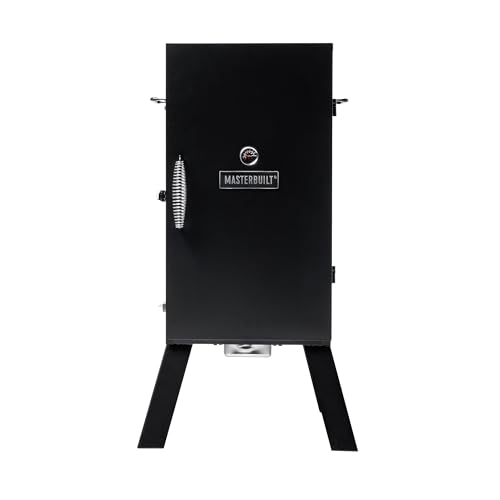
Masterbuilt 30-Inch Analog Electric Smoker MB20070210 — Best Simple Chip Smoker
Strip natural wood electric smoking to its essentials and this is what remains: electricity for heat, a tray of chips for smoke, a dial for intent and a cook for judgement. The Masterbuilt analog is the pick for traditionalists who distrust automation precisely because they want to learn smoke by doing it.
Strengths
- A basic chip tray and a dial: the least mediated natural wood setup
- 535 sq in vertical cabinet suits the classic chip-smoking repertoire
- Nothing electronic stands between the cook and the smoke routine
Trade-offs
- Analog control asks the cook to monitor the temperature band
- Tray reloads mean opening the cabinet and losing heat
- Chips alone, in tray-sized portions, limit smoke duration per load
| Specification | Detail |
|---|---|
| Cooking area | 535 sq in (from listing title) |
| Format | 30-inch vertical cabinet, chrome racks |
| Control | Analog dial |
| Smoke source | Wood chip tray |
There is real educational value in the simplicity. You will learn how chip size changes burn time, how a tray load maps to an hour of smoke, and how species read on finished food, because the machine automates none of it away. The tuition is attention: tray reloads and dial checks are part of every cook. For shorter sessions and hands-on cooks, that is not a drawback at all; it is the hobby itself, at the lowest complexity the craft allows.
Best for: hands-on traditionalists and learners of smoke craft / Not suited for: cooks wanting long unattended cooks

EAST OAK 30-Inch Electric Smoker with Probe and Window — Best Long Chip Loads
Chip management is the tax on natural wood smoking, and this EAST OAK pays less of it: its verified listing positions the side loader for up to six times longer uninterrupted smoking on a load. Fewer refills means fewer door openings, steadier heat and a smoke curve closer to the pellet machines’ calm, while still burning loose chips you choose yourself.
Strengths
- Side chip loader is listed for far longer uninterrupted smoking per load
- 725 sq in with a window and probe for monitored natural wood cooks
- Digital control keeps heat steady while chips do their slow work
Trade-offs
- Longer loads still end; overnight cooks need a plan, not a hope
- Window maintenance is part of owning the viewing design
- Single built-in probe limits multi-cut monitoring
| Specification | Detail |
|---|---|
| Cooking area | 725 sq in (from listing title) |
| Format | 30-inch vertical cabinet, viewing window |
| Probe | Built-in meat probe (in listing title) |
| Smoke source | Side chip loader |
The window and probe complete the low-intervention picture. Watch bark colour develop, confirm the meat’s progress, and let the loader stretch each chip charge across hours instead of minutes. For brisket and shoulder, the cuts where natural wood flavour matters most and cook times run longest, this combination of loose-wood freedom and managed convenience is the most balanced offer in the guide.
Best for: long-cook chip smokers who hate refilling / Not suited for: cooks wanting pellet-style automation without pellets

Ninja Woodfire Outdoor Grill & Smoker OG701 (7-in-1) — Best Pellet-Wood Tabletop
The Ninja Woodfire represents the pellet branch of natural wood smoking in its most compact form: real wood pellets, electric management, and a tabletop machine that smokes a brisket-sized load or grills dinner on the same footprint. For small households, it may be the only smoker that earns its storage space.
Strengths
- Burns real wood pellets with electric power, per the verified listing
- 7-in-1 format smokes, grills and air fries on one small footprint
- Tabletop scale suits balconies and small households
Trade-offs
- Small capacity caps the size and number of cuts per cook
- Pellet smoke character is milder than loose chips at low settings
- It is a grill that smokes, not a cabinet that only smokes
| Specification | Detail |
|---|---|
| Format | Tabletop grill and smoker, 7-in-1 |
| Fuel | Real wood pellets with electric power (in listing title) |
Pellet smoke deserves an honest description. Because pellets burn in a managed fire pot, the smoke is clean and consistent, excellent for poultry, fish and weeknight cuts, and milder than the smoulder of loose chips. Cooks chasing the deepest traditional smoke will feel the difference on brisket; cooks who smoke twice a week in a small space will feel the convenience far more. Judge by your calendar and your patio, and this little machine’s case makes itself.
Best for: small households and balconies wanting real wood smoke in miniature / Not suited for: cooks regularly smoking for crowds or whole packers

recteq Bullseye RT-B380 Pellet Grill and Smoker — Best 100% Wood Pellet
The recteq Bullseye closes the guide with the pellet argument stated at full strength: its verified listing says 100% wood pellets, and the machine burns them for both heat and smoke under electric control. If your definition of natural wood smoking centres on the fuel being entirely wood, with no element doing the heating, this is your pick.
Strengths
- Verified listing states it uses 100% wood pellets
- Kettle format sears as well as smokes, covering the full cook
- Pellet feed automates the wood supply for long sessions
Trade-offs
- Pellet flavour, while real wood, is cleaner and lighter than chip smoulder
- A grill-smoker hybrid, not a dedicated vertical cabinet
- Pellet storage and quality become part of your routine
| Specification | Detail |
|---|---|
| Format | Kettle-style pellet grill and smoker |
| Fuel | 100% wood pellets (in listing title) |
The kettle format adds the finish that cabinets cannot: genuine searing heat for steaks and burgers alongside the low smoking work. That versatility is why pellet grills have become the default natural-wood machine for many households. Accept the pellet smoke’s cleaner profile as the style it is, keep pellets dry and fresh, and the Bullseye covers more of a household’s outdoor cooking than any cabinet in this guide, while never burning anything but wood.
Best for: households wanting one wood-fired machine for smoking and grilling / Not suited for: cabinet smokers who need stacked vertical capacity
Comparison Table
| Pick | Badge | Key spec | Best for |
|---|---|---|---|
| Masterbuilt 30-Inch Digital Electric Smoker MB20071117 — Check price on Amazon | Best Overall Natural Wood | 710 sq in, side chip loader, digital control | cooks who want loose-chip species control with electric steadiness |
| Bradley Smoker 4-Rack Digital Smoker BTDS76P — Check price on Amazon | Best Consistent Wood Smoke | 4 racks, automatic bisquette feed, digital control | cooks who prize even, unattended wood smoke above improvisation |
| Masterbuilt 30-Inch Analog Electric Smoker MB20070210 — Check price on Amazon | Best Simple Chip Smoker | 535 sq in, analog dial, chip tray | hands-on traditionalists and learners of smoke craft |
| EAST OAK 30-Inch Electric Smoker with Probe and Window — Check price on Amazon | Best Long Chip Loads | 725 sq in, extended-load chip loader, probe and window | long-cook chip smokers who hate refilling |
| Ninja Woodfire Outdoor Grill & Smoker OG701 (7-in-1) — Check price on Amazon | Best Pellet-Wood Tabletop | Tabletop format, real wood pellets, 7-in-1 | small households and balconies wanting real wood smoke in miniature |
| recteq Bullseye RT-B380 Pellet Grill and Smoker — Check price on Amazon | Best 100% Wood Pellet | Kettle pellet grill, 100% wood pellets | households wanting one wood-fired machine for smoking and grilling |
Chips, Chunks, Bisquettes and Pellets: The Four Forms of Natural Wood
Chips are the fastest form: small pieces with large surface area that ignite quickly, smoke generously and burn out soonest. In an electric tray or loader, chips suit cooks up to a few hours and any cook where smoke is wanted in defined sessions rather than continuously. Their speed is also their discipline: too many chips at once makes harsh smoke, so little and often is the chip cook’s rule.
Chunks are the slow form, fist-sized pieces that smoulder for hours. Most electric cabinets are built around chips rather than chunks, because their trays and loaders are sized for the smaller fuel, and forcing chunks into a chip system is a common beginner error. Where a machine accepts them, chunks reward long cooks with the steadiest loose-wood smoke of all.
Bisquettes are wood engineered for a machine: hardwood compressed into uniform pucks that a feeder advances on a timer. The smoke is the most consistent of any form and the least customisable, a deliberate trade of freedom for repeatability. Pellets are wood engineered for combustion: milled, compressed and fed by an auger into a fire pot, where they provide heat as well as smoke, burning cleaner and lighter than any smouldering form.
None of these is the one true natural wood. They are four points on a line from improvisation to automation, and the right point is the one matching how you cook. This guide’s picks are arranged along that line deliberately, so choosing among them is really choosing your position on it.
Choosing Wood Species for Electric Smoking
Species choice survives the move to electric intact, because the smoke chemistry is the wood’s own. Oak remains the dependable centre, strong enough for brisket, polite enough for almost everything. Hickory is the bold traditionalist for pork and beef, powerful enough to punish excess. Mesquite is the strongest common species and the easiest to overdo, best in small proportions and short exposures, especially in the concentrated environment of an electric cabinet.
Fruit and nut woods fill the gentler half of the shelf. Apple and cherry give sweet, mild smoke that flatters poultry, fish and pork, and cherry adds a prized dark colour to skins and bark. Pecan sits between oak and hickory in strength and suits nearly everything. In electric smokers, where smoke builds slowly in a sealed space, the gentler species are more versatile than beginners expect, and the strong species need more restraint than charcoal experience teaches.
Whatever the species, the wood must be dry, clean and untreated. Painted, glued or pressure-treated wood has no place in any smoker, and green wood smoulders bitter. Buy smoking wood as a food ingredient, from suppliers who sell it for that purpose, and store it dry: the flavour of your barbecue begins in that bag, not at the smoker.
How to Smoke with Natural Wood in an Electric Cabinet, Step by Step
Begin with the wood staged before the meat is touched: chips measured for the cook’s first smoke session, the loader or tray filled, and a refill portion set aside where you can reach it without a search. Preheat the cabinet empty, with the water pan in place for long cooks, and let the temperature settle completely before loading, because chips added to a hunting, overshooting cabinet burn harshly.
Load the meat, close the door, and start the smoke. Early smoke matters most: the meat’s surface is cool and moist, and smoke compounds settle and set in those first hours. Feed refills through the loader on schedule, or accept a brief, planned opening for a tray machine, and keep the smoke thin and steady rather than thick and white. The goal is a wisp you can barely see, maintained, not a fog you can photograph.
As the cook matures, let the wood recede. Most classic cuts take their smoke early and simply cook thereafter, and continuing heavy smoke into the final hours adds surface bitterness without depth. Finish to tenderness, rest properly, and record the species, amount and schedule you used. Natural wood smoking is a craft of small variables, and the notebook is how those variables become your style.
Smoke Chemistry in Plain Language: Why Wood Species Taste Different
Wood smoke is a delivery system for chemistry the wood already contains. As hardwood smoulders, its lignin breaks down into the aromatic compounds, guaiacol and syringol chief among them, that the human palate reads as smoke flavour, while its cellulose and hemicellulose contribute sweeter, lighter notes. Species differ in their lignin structure and their extractives, which is why oak tastes like oak and apple like apple even when both are burned in the same cabinet at the same temperature. The smoker does not create the flavour; it releases the wood’s own, which is the deepest sense in which natural wood smoking is natural.
Combustion conditions edit that chemistry, which is where the cook’s craft enters. A clean, well-aerated smoulder produces the balanced compound mix that reads as good smoke. A starved, choking burn produces acrid fractions and creosote-like bitterness, the ashtray note that ruins barbecue and that beginners misattribute to the species. In electric cabinets, where the wood smoulders at the element’s pace rather than a fire’s, the burn is naturally gentle, which is why electric smoke reads cleaner, and why overloading the tray, the one way to force a choking burn, is the craft’s cardinal error.
Temperature completes the picture. Smoke compounds settle best on cool, moist surfaces, which is why the early hours of a cook, meat cold from the refrigerator, surface tacky with seasoning, do most of the flavour work. Later, as the surface dries and the bark sets, additional smoke contributes progressively less and eventually subtracts. The species library in the earlier section is therefore only half the education; the other half is timing, and the cooks who master both are the ones whose barbecue tastes deliberate rather than accidental.
Building a Wood Library: Buying, Storing and Blending
A wood library sounds grand and is, in practice, a dry shelf with four or five labelled bags: oak for the centre, hickory for emphasis, apple and cherry for the gentle work, and pecan or a second fruit wood for variety. Buy smoking wood from suppliers who sell it as a food ingredient, in the form your machine uses, chips for cabinets, pellets for pellet machines, bisquettes for the Bradley, and buy in quantities your cooking rate will actually consume, because wood stored for years in a damp garage loses the aromatics you bought it for.
Storage is the library’s whole discipline: dry, ventilated, off the ground, and protected from the mould that ruins flavour and the contaminants that ruin more than flavour. Keep species separate and labelled, because unlabeled chips are a mystery ingredient, and mystery is the enemy of repeatable barbecue. Note the supplier and the season if you are serious; wood varies, and the notebook that records which bag produced the great brisket in June is worth more than another gadget.
Blending is the library’s pleasure, practised after the singles are known. Oak under cherry gives beef a dark, handsome bark with a sweeter top note. Hickory cut with apple lets pork take hickory’s authority without its occasional harshness. Pellet machines blend by the bag or the hopper; bisquette users blend by alternating species in the feed stack. The rule that governs all of it is the taster’s rule: change one thing, cook, record, and let your own table, not tradition or this guide, arbitrate what your library is for.
Cold Smoking and Low Work: Where Natural Wood Electrics Excel
Below the barbecue band lies the territory where natural wood electrics quietly outclass most other equipment: the very low work of smoking fish, cheese-adjacent projects, cured meats and delicate ingredients that want smoke as a seasoning rather than as a cooking medium. An electric cabinet’s ability to hold a low, steady temperature while a small charge of wood smoulders is precisely the combination this work requires, and it is no accident that the low-range specialist in this programme’s wider guides, the cabinet with a verified range beginning far below barbecue temperatures, is so often chosen for it.
The technique inverts barbecue habits. Smoke is applied in sessions, sometimes with the food resting between them, because delicate flesh takes flavour quickly and punishes excess. The wood of choice is the gentle end of the library, fruit woods above all, burned in small amounts with the chamber’s humidity managed lightly or not at all. Temperature discipline follows the specific food’s safety requirements exactly, because low smoking is preservation territory, where recipes are systems and improvisation is a hazard rather than a style.
For the cook whose interests run this way, the buying emphasis shifts accordingly: the verified low floor and the smoke system’s gentleness outrank capacity and ceiling, and a machine that seems underpowered for barbecue may be exactly powered for this craft. It is one more illustration of this guide’s recurring argument, that natural wood smoking is a spectrum of crafts sharing a material, and the right machine is the one whose strengths sit where your cooking actually lives.
Sustainability and Sourcing: The Wood Behind the Smoke
Natural wood smoking invites an honest word about the wood itself. Smoking consumes small quantities, handfuls of chips or a hopper of pellets at a time, but the sourcing still matters to many cooks, and the market answers better than it once did. Smoking woods are commonly produced from orchard prunings, furniture and barrel industry offcuts, and managed hardwood thinnings, streams that turn existing wood into flavour rather than felling for the smoker. Buying from suppliers who describe their sourcing is a reasonable preference, easily exercised in a category where the product is inexpensive and the suppliers are proud of the story.
Pellets deserve their specific note, because their manufacture, milling and compressing hardwood residues into a uniform fuel, is an efficient use of material that might otherwise be waste, and their consistency is a by-product of that industrial tidiness. Bisquettes make the same argument in another form. The loose-chip cook’s version of the virtue is the garden: prunings from your own fruit trees, properly dried and identified, are as local as sourcing gets, provided the species is suitable and the wood is untreated, conditions this guide has stated before and states again because they are safety conditions, not etiquette.
None of this should become a burden on a Saturday cook. The quantities are small, the mainstream suppliers are generally responsible, and the main environmental decision in smoking remains the one this programme makes everywhere: buy a machine you will use for a decade, maintain it, and let its long service, rather than any single cook’s footprint, be the measure of the purchase.
Matching the Machine to the Wood: A Buyer’s Decision Path
The decision this guide ultimately asks for can be walked as a short path of honest questions. First: do you want to choose your wood by the bag, species by species, from any supplier, including your own garden’s prunings? If yes, your machines are the chip cabinets, and the only remaining questions are control, loader or tray, digital or analog, and size, the questions the Masterbuilt and EAST OAK picks divide among themselves. If the freedom matters less than the consistency, continue down the path.
Second: is your cooking mostly smoking, or smoking within a wider outdoor repertoire? The pellet branch answers the wider repertoire, with the Ninja compressing it onto a tabletop and the recteq opening it to full kettle versatility, at the price of the pellet smoke’s cleaner, milder accent. The bisquette branch answers the smoking-only repertoire with the most consistent smoke of all, at the price of a single supplier’s catalogue. Neither price is hidden in this guide, because both are fair trades when chosen knowingly and bitter ones when discovered later.
Third, and finally: how do you actually cook across a year, in sessions per month and hours per session? The machine that matches that calendar, not the calendar of your most ambitious imagined weekend, is the machine that will be seasoned, understood and loved in year three. Natural wood smoking rewards the matched purchase more than any other category in this programme, because the craft’s pleasure is in the repetition, and repetition only happens when the machine fits the life around it.
Maintaining Smoke Quality: Cleaning for Flavour, Not Just Hygiene
An electric smoker’s interior is a flavour instrument, and its cleaning is therefore a culinary act. The working coating, the thin, dark seasoning that builds on a cabinet’s walls, is part of the machine’s character and should be preserved; the thick, flaking, greasy deposits that build beyond it are stale smoke waiting to happen, and should not. The distinction is tactile and visual: a smooth, hard, dark surface is seasoning, while soft, rough, peeling accumulation is residue, and the cook’s scraper and brush should be fluent in the difference.
The components that govern smoke quality get specific attention. The chip tray or loader path must stay clear, because yesterday’s ash in today’s tray chokes the smoulder into bitterness. The temperature sensor must stay clean, because a coated sensor lies, and a lying sensor makes the controller drive the wood at the wrong pace all day. The door seal must stay sound, because smoke that escapes at the seal is smoke the meat never meets, and heat lost with it makes the element cycle harder and the burn harsher.
None of this is heavy labour, and that is the point of scheduling it lightly and often rather than heroically and rarely. Ten minutes after a cook, a brush and a wipe at the tray and sensor monthly, and a seal check each season: that is the whole liturgy. Natural wood provides the flavour compounds; cleanliness decides whether they arrive as the wood intended or as the residue’s opinion of them, and the difference is detectable in the first slice of every brisket you will ever serve.
A Beginner’s First Season with Natural Wood: Species by Species
The first season with a natural wood smoker should be structured like a syllabus, because the wood library is learned one species at a time or not at all. Begin with oak on a pork shoulder: the centre species on the most forgiving cut, cooked plainly, teaches the machine’s smoke rhythm and the species’ character in a single afternoon. Follow with apple on chicken, where the gentle species and the quick cook let you compare, within a week, how differently two woods write on two meats.
Mid-season belongs to emphasis: hickory, in a modest proportion blended with oak, on ribs, where its authority can be judged against the oak baseline your palate now owns. Then cherry on fish or poultry, for colour as much as flavour, and a first deliberate blend of your own design, recorded like an experiment and judged at the table without mercy. Each cook changes one variable, which is what makes the season an education rather than a series of anecdotes.
By the season’s end, the beginner owns the only credential this craft issues: a palate that can name what it is tasting and a notebook that can reproduce it. The machine, whichever pick in this guide was chosen, will have become almost invisible, a reliable condition rather than a topic, and the wood, its species, its forms, its timing, will have become the cook’s real subject. That inversion, tools fading as materials come forward, is the sign that natural wood smoking has been learned in the only sense that matters.
The Question of Smoke Rings in Natural Wood Electrics
Natural wood electrics inherit the smoke ring question from all electric smoking, and it deserves a direct answer in a guide about wood. The ring is formed when combustion gases, chiefly nitric oxide from a vigorous fire, react with the meat’s surface pigments. A smouldering chip tray or a managed pellet fire produces those gases in far smaller quantities than a charcoal bed, so even machines burning nothing but real hardwood usually show a faint ring or none. The flavour compounds, the guaiacol and syringol that make wood taste like wood, arrive by a different route and in full measure. A natural wood electric therefore delivers the substance of wood smoking without its most photographed side effect, and cooks who learn to judge by aroma, bark and bite rather than by the band will find nothing missing from the plate that was ever really there.
Storing Wood and Machine Together: The Smoking Corner
Natural wood smoking organises a small corner of a home, and organising it deliberately pays in every cook. The machine stands or stores in its place; the wood library sits beside it, dry, labelled and off the ground; the probes, gloves and notebook live in one box that travels between kitchen and cabinet. That corner is the craft’s physical form, and its tidiness is not fussiness but readiness: the cook who can lay hands on the right species, the right probe and the last cook’s notes without a search is a cook whose sessions start calmly, and calm starts, in smoking, are half the result. Build the corner once, keep it with the light discipline this guide has described for the machine itself, and the whole practice, wood, fire’s electric heir and all, settles into the household’s rhythm the way a well-kept pantry does: unnoticed, until the moment it makes a dinner possible.
Common Buying Mistakes
The commonest mistake is using the wrong form of wood for the machine: chunks forced into a chip tray, chips heaped where a loader meters them, or improvised fuel in a bisquette feeder. Each system in this guide is built around its form, and fighting the form produces bad smoke and, occasionally, a jammed or overheated machine.
Second is equating more smoke with more flavour. In a sealed electric cabinet, oversmoking is the easiest error in the craft: bitter bark, acrid edges and food that tastes of a bonfire rather than of itself. Thin, steady smoke over the early hours beats density every time.
Third is using wood that was never meant for food: treated timber, painted offcuts, glued boards or mouldy firewood. Natural wood smoking means clean, dry, food-appropriate hardwood, and anything else is a safety issue, not a flavour experiment.
Fourth is ignoring species strength in a sealed space. Mesquite and heavy hickory loads that a breezy offset dilutes will concentrate in an electric cabinet. Scale strong woods down, blend them with oak, and learn each species gently before using it boldly.
Final Recommendation
For loose-wood freedom with electric steadiness, the Masterbuilt digital is the guide’s centre, its analog sibling the simple route, and the EAST OAK the long-load refinement. Choose the Bradley for the most consistent unattended wood smoke, accepting its proprietary fuel, and the Ninja or the recteq if your natural wood craft is the pellet branch, at tabletop or full kettle scale respectively.
Whichever machine you choose, the craft is the same and older than all of them: clean dry hardwood, chosen by species, burned gently, and given time. Electricity has only removed the fire-tending. The wood still does the talking.
Check the Masterbuilt 30-Inch Digital Electric Smoker MB20071117 on Amazon · Check the Bradley Smoker 4-Rack Digital Smoker BTDS76P on Amazon · Check the Masterbuilt 30-Inch Analog Electric Smoker MB20070210 on Amazon
Best Electric Barbecue Smokers Best Electric Smokers Best Electric Sausage Smokers Best Electric Outdoor Smokers Best Accessories For Smokers
Frequently Asked Questions
Is pellet smoking really natural wood smoking?
Yes. Pellets are milled hardwood compressed into fuel, and pellet machines burn nothing else for heat and smoke. The smoke character is cleaner and milder than smouldering chips, which is a style difference, not a difference in naturalness.
What is the difference between chips and chunks in an electric smoker?
Chips burn quickly and suit shorter smoke sessions and loader or tray systems. Chunks smoulder for hours but are sized for charcoal fires and some larger trays. Most electric cabinets are designed for chips, and their loaders and trays should be fed accordingly.
Are Bradley bisquettes natural wood?
They are compressed hardwood in named species, fed automatically. The material is natural wood; the trade is that the form is proprietary, so your species choices come from one supplier’s range rather than any bag of chips.
Which wood species should a beginner start with?
Oak for beef and general use, apple or cherry for poultry, pork and fish. All three are forgiving. Learn them individually before blending, and approach mesquite and heavy hickory with restraint, especially in a sealed electric cabinet.
Do I soak wood chips before using them in an electric smoker?
Opinions divide, but in electric trays and loaders dry chips generally ignite and smoulder more predictably, while soaked chips mostly delay smoke with steam. If you experiment with soaking, compare honestly over two cooks and keep the method that gives you steadier smoke.
Can I use wood from my garden or firewood pile?
Only if you can identify it as a suitable untreated hardwood species, fully dry and clean. Never use treated, painted or glued wood, and never use a species you cannot name. Purpose-sold smoking wood removes the guesswork and is inexpensive insurance.


