Disclosure: airfryerkitchensupply.com is reader-supported. When you buy through links on our site, we may earn an affiliate commission at no extra cost to you.
Where to buy
This search combines three things that almost never ship in one box, so the best electric bullet smokers with lava rocks deserve an honest explanation before any picks. Lava rock is a heat-diffuser medium, a bed of porous volcanic stone that spreads heat and catches drips, used for decades in gas grills and as a custom diffuser layer in bullet smokers. Electric bullets are already rare, and no verified model ships from the factory with a lava rock bed. What follows is therefore the practical version of this search: verified electric vertical smokers that suit a lava-rock diffuser setup, plus a full guide to doing that setup safely and well.
- Masterbuilt 30-Inch Analog Electric Smoker MB20070210 — Check the current price on Amazon
- Char-Broil Analog Electric Smoker 18202077 — Check the current price on Amazon
- Masterbuilt 30-Inch Digital Electric Smoker MB20071117 — Check the current price on Amazon
- EAST OAK 30-Inch Electric Smoker with Probe and Window — Check the current price on Amazon
- CLIVIA Electric Smoker, 4-Rack Digital Commercial — Check the current price on Amazon
- Masterbuilt 30-Inch Digital Electric Smoker with Leg Kit MB20070421 — Check the current price on Amazon
In this guide
Quick Picks
Each pick below is a verified electric vertical judged on diffuser-friendly traits: a stable base level for a rock bed or tray, room above the heat source, and the kind of steady low cooking that lava rock improves. The rock itself is an accessory you add, and the guide sections explain exactly how.
Masterbuilt 30-Inch Analog Electric Smoker MB20070210 — Best Base for a Lava Rock Setup: If you intend to run lava rock, start with the machine that interferes least. — Check price on Amazon
Char-Broil Analog Electric Smoker 18202077 — Best Compact Diffuser Project: Char-Broil’s charcoal bullets are where many cooks first met the lava rock idea, a bed of stone in the base instead of, or above, the water pan. — Check price on Amazon
Masterbuilt 30-Inch Digital Electric Smoker MB20071117 — Best Digital Cabinet for Diffusion: Pairing lava rock with digital control sounds contradictory, craft stone and electronics, but the combination is genuinely effective: the controller holds the set point, the rock smooths the cycles between the element’s pulses, and the result at the racks is some of the calmest heat an electric cabinet can produce.. — Check price on Amazon
EAST OAK 30-Inch Electric Smoker with Probe and Window — Best for Watching the Experiment: Experimentation improves with observation, and this EAST OAK is the observation pick: a clear window to watch how food responds over a diffuser bed, a built-in probe for the meat, and a side loader so that watching never requires opening. — Check price on Amazon
CLIVIA Electric Smoker, 4-Rack Digital Commercial — Best Low-and-Gentle Diffusion: Lava rock’s natural territory is the low and gentle end of smoking, and the CLIVIA is this guide’s low-temperature specialist, with a verified range beginning at temperatures most cabinets cannot reach. — Check price on Amazon
Masterbuilt 30-Inch Digital Electric Smoker with Leg Kit MB20070421 — Best Raised Project Cabinet: A lava rock setup involves more handling than standard smoking: fitting the tray, levelling the stone, removing the bed for cleaning, checking it between cooks. — Check price on Amazon
How These Picks Were Chosen
Because no factory model matching this exact keyword could be verified, selection worked from the diffuser outward. A lava rock bed needs three things from its host smoker: a level, stable surface low in the chamber where a tray of rock can sit, enough vertical clearance that the bed does not crowd the first rack, and steady low-temperature cooking, because diffusion is a long-cook tool, not a searing tool.
Every linked pick was verified against Amazon listing data for this site and is a genuine electric vertical smoker. Lava rock products themselves are discussed in prose, because the rock is a generic accessory rather than a model with a specification worth linking, and because the honest headline of this niche is that the combination is a customisation, not a catalogue item.
The picks are ordered by how naturally each cabinet accepts the modification. Analog simplicity scores highly here, because diffuser cooking is an attended, tactile style; digital cabinets earn their places through the temperature steadiness that lets a rock bed do its slow, even work undisturbed.
The 6 Best Electric Bullet Smokers with Lava Rocks
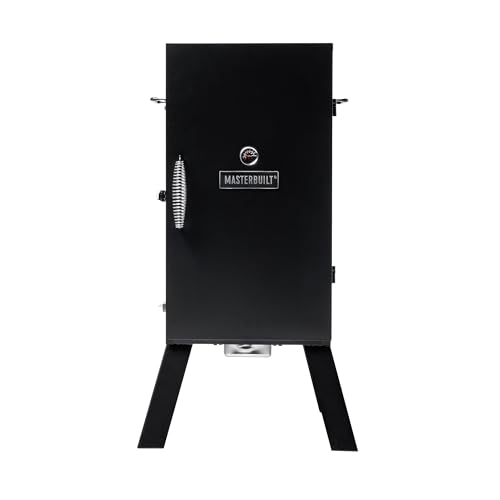
Masterbuilt 30-Inch Analog Electric Smoker MB20070210 — Best Base for a Lava Rock Setup
If you intend to run lava rock, start with the machine that interferes least. This analog Masterbuilt gives you a compact vertical chamber, a straightforward heat source low in the cabinet, and a dial: the ideal test bed for a diffuser tray, because every change in behaviour is attributable to the rock, not to electronics compensating invisibly.
Strengths
- Simple analog layout leaves the cook in charge of the diffuser experiment
- 535 sq in of vertical space stacks food above a low rock tray
- Chip tray smoke plus rock diffusion combines two classic techniques
Trade-offs
- You supply and fit the lava rock yourself; nothing here is factory-fitted
- Analog control plus a rock bed means two variables to learn at once
- Smaller chamber leaves less spare height for a deep rock layer
| Specification | Detail |
|---|---|
| Cooking area | 535 sq in (from listing title) |
| Format | 30-inch vertical cabinet, chrome racks |
| Control | Analog dial |
| Smoke source | Wood chip tray |
Fit the rock as a shallow, level layer in a sturdy tray at the chamber’s base, keep it clear of direct contact with the element itself, and run your first cooks with forgiving food while you learn the new thermal personality. Expect slower recovery after door openings, the rock stores heat but also absorbs it, and gentler, more even cooking at the racks. That trade is the entire point of the modification, and on sausages, chicken and ribs it shows up as fewer scorched edges and calmer temperature behaviour.
Best for: hands-on cooks building a custom diffuser setup / Not suited for: buyers wanting a factory-fitted lava rock product, which this niche does not offer
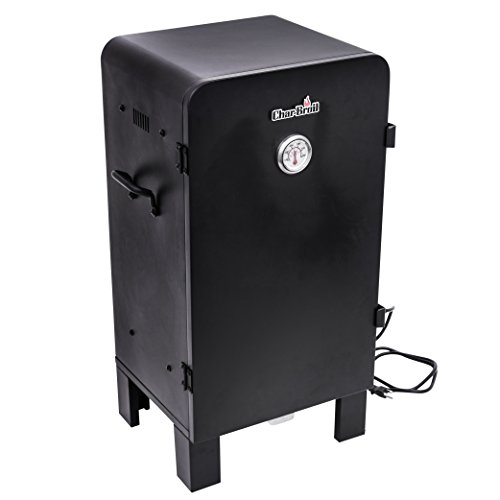
Char-Broil Analog Electric Smoker 18202077 — Best Compact Diffuser Project
Char-Broil’s charcoal bullets are where many cooks first met the lava rock idea, a bed of stone in the base instead of, or above, the water pan. This analog electric cabinet is the same brand’s electric host for that tradition, and for tinkerers it is the most sympathetic starting point in the guide.
Strengths
- Char-Broil’s bullet heritage makes its electric cabinet the natural project host
- Compact vertical format suits a modest rock tray without crowding
- Analog simplicity keeps the experiment readable
Trade-offs
- Listing states fewer details, so measure the chamber before buying rock or trays
- No digital safety net while you learn the setup
- Tray reloading opens the cabinet and disturbs the diffuser’s steady state
| Specification | Detail |
|---|---|
| Format | Vertical analog electric smoker |
| Control | Analog dial |
Work in small steps: a shallow layer first, never a deep bed that chokes airflow or crowds the element, and judge each change over a full cook rather than a thermometer glance. Lava rock in an electric cabinet is a craft project with delicious results, not an upgrade with guaranteed numbers, and the cooks who enjoy it are the ones who treat the first month as calibration. Keep notes, change one variable at a time, and the setup will teach you more about heat than any feature list could.
Best for: tinkerers continuing the charcoal-bullet lava rock tradition electrically / Not suited for: cooks who want results without experimentation

Masterbuilt 30-Inch Digital Electric Smoker MB20071117 — Best Digital Cabinet for Diffusion
Pairing lava rock with digital control sounds contradictory, craft stone and electronics, but the combination is genuinely effective: the controller holds the set point, the rock smooths the cycles between the element’s pulses, and the result at the racks is some of the calmest heat an electric cabinet can produce.
Strengths
- Digital steadiness lets a rock bed stabilise an already calm chamber
- 710 sq in leaves vertical room for a diffuser layer and full racks
- Side loader feeds smoke without disturbing the bed or the heat
Trade-offs
- Cabinet format gives the rock project more volume to tame
- Digital control can mask the rock’s effect, making learning slower
- Costs more than the analog hosts most tinkerers start with
| Specification | Detail |
|---|---|
| Cooking area | 710 sq in (from listing title) |
| Format | 30-inch vertical cabinet, 4 chrome racks |
| Smoke source | Side wood chip loader |
| Control | Digital |
The side loader is the detail that protects the experiment. Every door opening dumps the chamber’s carefully diffused heat; feeding chips through the side keeps the system sealed while the rock does its slow work. If your goal is the best final food rather than the purest tinkering experience, this is the host to choose: brisket and shoulder cooked over a diffused, digitally steadied heat source are this setup’s home ground, and the 710 square inches mean the project scales to real barbecue loads.
Best for: cooks who want diffuser benefits with digital reliability / Not suited for: purist tinkerers who want every variable manual

EAST OAK 30-Inch Electric Smoker with Probe and Window — Best for Watching the Experiment
Experimentation improves with observation, and this EAST OAK is the observation pick: a clear window to watch how food responds over a diffuser bed, a built-in probe for the meat, and a side loader so that watching never requires opening. For cooks who learn visually, it shortens the lava rock learning curve more than any other feature could.
Strengths
- Window and built-in probe let you observe diffuser behaviour without opening up
- 725 sq in provides headroom above a rock tray for full loads
- Side chip loader preserves the sealed system diffusion needs
Trade-offs
- Window films over on long cooks and needs wiping between sessions
- Probe tells meat temperature, not the rock bed’s, so keep expectations straight
- A bigger cabinet than the minimal project requires
| Specification | Detail |
|---|---|
| Cooking area | 725 sq in (from listing title) |
| Format | 30-inch vertical cabinet, viewing window |
| Probe | Built-in meat probe (in listing title) |
| Smoke source | Side chip loader |
Use the first cooks deliberately. Watch how bark forms compared with your non-diffuser cooks, note where the racks’ hot spots used to be and whether they have softened, and let the probe data build the comparison honestly. Diffusion’s gains are real but subtle, evenness, gentleness, forgiveness, and a window plus data is how subtle gains get noticed, trusted and repeated instead of imagined.
Best for: visual, data-minded cooks calibrating a diffuser setup / Not suited for: minimalists who want the smallest possible project cabinet

CLIVIA Electric Smoker, 4-Rack Digital Commercial — Best Low-and-Gentle Diffusion
Lava rock’s natural territory is the low and gentle end of smoking, and the CLIVIA is this guide’s low-temperature specialist, with a verified range beginning at temperatures most cabinets cannot reach. Fish, sausage and delicate loads over a diffusing bed of stone is a coherent, almost traditional cooking system: radiant, even, patient heat from below, cool smoke from the side.
Strengths
- Verified low range from 86°F suits the gentlest diffuser cooking
- Four stainless racks stack delicate loads above the bed
- Timer and auto shutoff fit the shorter cooks diffusion serves best here
Trade-offs
- Low ceiling rules out hot finishing over the rock
- Less familiar brand; confirm seller support first
- Digital interface adds learning on top of the diffuser learning
| Specification | Detail |
|---|---|
| Temperature range | 86–248°F (from listing title) |
| Format | 4-rack stainless steel cabinet |
| Timer | 0–12H timer with auto shutoff (in listing title) |
| Control | Digital |
The stainless cabinet and four racks suit stacked delicate work, and the timer with auto shutoff matches sessions measured in a few hours rather than overnight. Treat the rock layer here as a heat smoother rather than a heat store: shallow, level, and kept scrupulously clean, because at low temperatures the bed’s job is purely to spread the element’s output evenly across the chamber floor.
Best for: fish, sausage and delicate low-temperature cooking over diffusion / Not suited for: cooks wanting one machine for both gentle smoking and hot finishing

Masterbuilt 30-Inch Digital Electric Smoker with Leg Kit MB20070421 — Best Raised Project Cabinet
A lava rock setup involves more handling than standard smoking: fitting the tray, levelling the stone, removing the bed for cleaning, checking it between cooks. The leg-kit Masterbuilt puts all of that work at standing height, which is why it earns the project’s comfort pick despite being the same cooking system as its legless sibling.
Strengths
- Leg kit puts the project at working height for fitting and cleaning the bed
- Same 710 sq in and side loader as the proven digital standard
- Digital control steadies long diffuser cooks
Trade-offs
- Legs fix the cabinet in one spot, while projects sometimes want mobility
- Highest effort setup here: legs, bed, and digital learning together
- Costs more than the legless host with identical cooking hardware
| Specification | Detail |
|---|---|
| Cooking area | 710 sq in (from listing title) |
| Format | 30-inch vertical cabinet with leg kit |
| Smoke source | Side wood chip loader |
| Control | Digital |
Choose it if the smoker has a permanent home and your back has opinions. The raised stance also improves airflow clearance beneath and around the cabinet, a small but real consideration when a stone bed is storing heat low in the chamber. Everything else, the side loader, the digital steadiness, the 710 square inches, matches the guide’s digital recommendation, simply presented at the height a hands-on diffuser cook will appreciate by the third cleaning session.
Best for: permanent setups and hands-on cooks who value working height / Not suited for: renters or movers who need the smoker to pack away small
Comparison Table
| Pick | Badge | Key spec | Best for |
|---|---|---|---|
| Masterbuilt 30-Inch Analog Electric Smoker MB20070210 — Check price on Amazon | Best Base for a Lava Rock Setup | 535 sq in, analog dial, vertical cabinet | hands-on cooks building a custom diffuser setup |
| Char-Broil Analog Electric Smoker 18202077 — Check price on Amazon | Best Compact Diffuser Project | Analog control, compact vertical cabinet | tinkerers continuing the charcoal-bullet lava rock tradition electrically |
| Masterbuilt 30-Inch Digital Electric Smoker MB20071117 — Check price on Amazon | Best Digital Cabinet for Diffusion | 710 sq in, side loader, digital control | cooks who want diffuser benefits with digital reliability |
| EAST OAK 30-Inch Electric Smoker with Probe and Window — Check price on Amazon | Best for Watching the Experiment | 725 sq in, window, built-in probe | visual, data-minded cooks calibrating a diffuser setup |
| CLIVIA Electric Smoker, 4-Rack Digital Commercial — Check price on Amazon | Best Low-and-Gentle Diffusion | 86–248°F range, 4 racks, stainless cabinet | fish, sausage and delicate low-temperature cooking over diffusion |
| Masterbuilt 30-Inch Digital Electric Smoker with Leg Kit MB20070421 — Check price on Amazon | Best Raised Project Cabinet | 710 sq in, leg kit, side loader | permanent setups and hands-on cooks who value working height |
How Lava Rock Actually Works in a Smoker
Lava rock is porous volcanic stone, and its value in a smoker is thermal, not mystical. A bed of rock between the heat source and the food absorbs direct radiant heat and re-radiates it evenly, softening hot spots. It also catches drips, which then sizzle on the hot stone instead of pooling or flaring, and its mass stabilises temperature: the bed stores heat while the source cycles and releases it while the source rests.
In gas grills, that bed sits above the burners as original equipment, which is where most cooks meet the idea. In bullet smokers, enthusiasts adopted it as a water-pan alternative or addition, trading the pan’s humidity for the rock’s dry, steady diffusion. In electric cabinets, the logic carries over with one caution: the element is a smaller, more delicate heat source than a gas burner or charcoal bed, so the rock layer must be shallow, level and never packed against the element itself.
What lava rock does not do matters as much. It adds no flavour of its own; any sizzle character comes from your food’s own drips. It does not replace the water pan’s humidity, so long cooks may still want the pan, or a spray routine, alongside it. And it does not fix a bad smoker: diffusion polishes a decent heat source, it cannot rescue an erratic one. Bought with those expectations, a bag of rock is one of the cheapest genuine improvements in smoking.
How to Fit and Run a Lava Rock Bed in an Electric Smoker, Safely
Choose the host and the tray first. The rock sits in a sturdy, heat-proof tray or on a robust grate low in the chamber, below the lowest cooking rack, with clear space between the bed and the heating element: never rest rock directly on or against an electric element, and never block the element’s airflow or the cabinet’s vents. If your cabinet offers no safe clearance for a tray, the correct decision is to skip the modification on that machine.
Prepare the rock properly. New lava rock should be rinsed to remove dust, dried thoroughly, and heated gradually on its first run, because trapped moisture in porous stone can crack or pop when heated hard. Spread a shallow, level layer, one stone deep is a sensible start, rather than a deep bed that chokes the chamber and crowds the first rack.
Run the first cooks as calibration: forgiving food, notes taken, one variable changed at a time. Expect slower preheats and slower recovery after openings, because the bed absorbs heat before the chamber sees it. Clean the bed between greasy cooks by removing and shaking out the tray, replacing stones that have become saturated, since rock choked with old grease smokes badly and can flare. Treat the whole setup as what it is, a considered customisation, and it will reward the care.
Lava Rock Versus Water Pan Versus Sand: Choosing Your Diffuser
The water pan is the diffuser most bullet and cabinet smokers ship with, and its bargain is humidity plus moderation: it softens heat swings while keeping the chamber moist, at the cost of refills and a ceiling on bark dryness. Lava rock offers the opposite bargain: dry, radiant evenness and drip sizzle, with no humidity contribution and no refills, at the cost of fitting, cleaning and the safety homework described above.
Sand in the pan is the third tradition, a dry thermal mass like rock but contained and disposable, popular with bullet owners who want stability without humidity. It lacks the rock’s drip-sizzle surface and eventually needs replacing, but it asks nothing of the cabinet’s clearances, which makes it the cautious first step for cooks curious about dry diffusion in a machine not obviously suited to a rock tray.
Many experienced cooks combine rather than choose: rock or sand for diffusion below, a small water pan or a spritz routine for humidity above. The right answer is the one matched to your food. Bark-driven brisket often prefers the drier systems; poultry and ribs frequently prefer the pan’s moisture. Your smoker, your climate and your cuts decide, and the experiment is cheap enough to run honestly in both directions.
A Short History of Lava Rock in Outdoor Cooking
Lava rock entered outdoor cooking through the gas grill, where manufacturers needed something between the burner and the grate to spread flame heat, catch drips and imitate, however loosely, the radiant character of charcoal. Through the gas-grill decades, a bed of volcanic stone became standard equipment, and a generation of cooks absorbed the idea that rock under food means even heat and fewer flare-ups, an intuition they later carried into other formats.
Bullet smokers adopted the rock from the other direction. Charcoal bullet owners, forever tuning the space between fire and food, experimented with replacing the water pan with sand, with clay saucers, and with lava rock, each medium trading the pan’s humidity for a different thermal personality. The rock’s version of the bargain, dry radiant evenness plus a surface that sizzles drips into aroma, developed a loyal following precisely because it changed the food in ways cooks could taste and describe.
The electric chapter of that history is the one this guide documents, and it is necessarily the most careful. An electric element is not a gas burner or a charcoal bed: it is smaller, more localised and less forgiving of obstruction. The rock’s benefits survive the translation, evenness, stability, drip behaviour, but its placement rules tighten, which is why this guide repeats its clearance discipline in several sections. Traditions earn their keep by adapting honestly, and the lava rock tradition adapts to electric heat by becoming shallower, cleaner and more deliberate.
Calibrating a Diffuser Bed: A Four-Cook Method
Treat the first cook as measurement, not dinner theatre. Run a forgiving load, chicken thighs or sausages, with a shallow bed in place, and place a probe at grate level in two positions if your equipment allows it. The numbers you are collecting are the cabinet’s new personality: how long preheat takes with the bed absorbing heat, how far apart the grate positions run, and how the chamber recovers after a door opening. Write them down, because the second cook is where memory starts lying.
The second cook changes one variable: bed depth or bed position, never both. A slightly deeper layer or a tray raised or lowered by a small increment teaches you the direction of the effect in your cabinet, which no generic guide can predict, because diffuser behaviour is a property of the specific chamber, element and load. Cooks who change two variables learn that something changed; cooks who change one learn what did it.
By the third cook, run the food the project exists for, ribs or a shoulder, and judge the result on the plate against your non-diffuser memory of the same cut: edge scorching reduced, surfaces more uniform, bark where you wanted it. The fourth cook repeats the third exactly, because repeatability is the difference between a modification and a superstition. A setup that produces the same improvement twice is a system you own; anything less is a story you tell, and the distinction is the whole method.
Drips, Sizzle and Flavour: What the Rock Surface Really Adds
The most romantic claim made for lava rock is flavour: drips landing on hot stone vaporise instantly, returning aromatic compounds to the food in a way a water pan, which catches drips silently, never can. The claim is real but should be sized honestly. The effect is a background note, a savoury depth at the surfaces nearest the bed, not a transformation, and it depends on the drips actually reaching hot, clean stone rather than a grease-saturated bed that smokes stale instead of sizzling fresh.
That dependence is why bed maintenance is a flavour practice and not merely hygiene. A clean bed sizzles; a neglected bed smoulders old fat, and the difference is detectable in the first bite of the next cook. Experienced diffuser cooks therefore treat the bed like a cast-iron pan: used often, cleaned by heat and shaking, and replaced without sentimentality when its pores are more grease than stone. The rock is cheap; the food is not, and the arithmetic of replacement should always favour the food.
There is also a placement corollary worth stating. Foods whose drips you want, fatty ribs, chicken thighs, sausages, benefit most from cooking directly above the bed, while delicate foods, fish above all, are better racked higher, where the bed’s service is purely its even heat and its sizzle cannot overwhelm a mild flesh. Arranging the cabinet with the bed’s two services in mind, flavour below, evenness everywhere, is the final skill of the diffuser cook, and it is learned, like everything in this guide, one honest cook at a time.
When Not to Use Lava Rock: The Cases Against the Bed
A guide that only praises its subject is an advertisement, so the cases against the bed belong here in full. Do not fit lava rock when the cabinet’s clearance cannot host it safely, a condition this guide has repeated because it is absolute. Do not fit it when your cooking is dominated by long, humidity-hungry brisket cooks and your water pan routine already produces the bark you want, because the bed solves problems you do not have while removing humidity you use.
Do not fit it as a first-week project in a new cabinet. A diffuser changes the machine’s personality, and a cook who has not learned the unmodified personality cannot tell what the bed improved, what it cost, or whether the cabinet itself has a fault the bed is masking. Season the cabinet, run the standard cooks, build the baseline, and then modify from knowledge. The rock will keep; it has, after all, kept for some millennia already.
And do not fit it expecting the factory product this search imagines to appear by effort. The setup is a customisation with real benefits and real duties, and its honest framing, a good electric vertical, a bag of stone, a cook who understands both, is not a disappointment to be hidden but the actual tradition of barbecue, which has always advanced by owners improving standard equipment in standard-defying ways. The bed earns its place the same way everything in this craft does: on the plate, repeatedly.
Choosing and Sourcing Lava Rock for Smoking Use
Not all lava rock is sold equal, and the smoking cook should buy it as a food-adjacent material rather than as landscaping. Rock sold for grills and smokers is sized for the purpose, roughly uniform pieces that form a level bed without large voids, and it arrives cleaner than decorative stone. Garden-centre lava rock can work after thorough rinsing and sorting, but the savings are small against the labour, and the grill-grade product’s consistency is worth its modest premium for a bed you will calibrate once and rely on for a season.
Quantity is a shallow layer’s worth, not a sack’s ambition: enough to cover your tray one stone deep, plus a reserve for replacing saturated pieces through the season. Judge pieces by hand as you lay them: crumbly stones that shed grit belong in the reserve bag or the bin, because grit migrates upward into food and downward into the cabinet’s workings. Dense, hard pieces with a clean fracture are the bed’s citizens, and a bed laid stone by stone, level and deliberate, performs visibly better than one poured and shaken.
Sourcing has one more rule, and it is the safety rule in commercial form: never use rock of unknown origin, and never use stone collected from decorative or industrial settings where it may carry treatments or contaminants. The bed sits under your food at temperature for hours, in the steam of dripping fat, and it should be exactly as trustworthy as every other surface in the cooking chamber. Bought properly, it is also nearly free across a season of cooks, which makes any economising on its provenance the falsest economy in this entire guide.
Diffusion and the Water Pan Together: Hybrid Setups That Work
The rivalry between rock and water pan is a false one, and experienced diffuser cooks often run both, assigning each the job it does best. The bed sits low, doing the thermal work: evening the heat, storing it, sizzling the drips that reach it. A smaller water pan, placed above the bed or on a low rack, contributes the humidity that long cuts want, in a quantity the cook can tune by the pan’s size and fill rather than by the either-or choice the rivalry imagines.
The hybrid asks for the same calibration discipline as the bed alone: establish the setup with forgiving food, change one variable at a time, and record the results against your single-system baselines. The cooks who benefit most are the brisket and shoulder specialists, whose long sessions want both even heat and chamber moisture, and whose bark standards are exacting enough to notice what each component contributes. Ribs and chicken, shorter and more forgiving, rarely need the full apparatus, and running it for them is ceremony rather than cooking.
There is a maintenance corollary: two systems mean two cleaning duties, and the hybrid cook accepts the bed’s shake-out and the pan’s scrub as one combined ritual at the cook’s end. Done faithfully, the hybrid is the most capable configuration an electric vertical can field, the closest the format comes to the carefully buffered chambers of professional pits. Done casually, it is two neglected systems under one lid. The difference, as everywhere in this guide, is not the equipment but the cook’s willingness to keep the records and the routines that make equipment honest.
The Diffuser Cook’s Year: Maintaining the Setup Across Seasons
A lava rock setup has a calendar, and keeping it is the difference between a system and an experiment that faded. In the first month, the calendar is calibration: the four-cook method in this guide, notes kept, the bed’s depth and position settled, and a baseline established against which everything later is judged. Resist improving the setup during this month; the month’s product is knowledge, and knowledge compounds longer than any single cook.
Across the working season, the calendar is rhythm: shake out the bed after greasy cooks, inspect it monthly for saturated or crumbling stones, replace pieces without sentimentality, and keep the reserve bag dry and labelled. The bed’s enemies are grease saturation and damp storage, both slow, both preventable, and both fatal to the clean sizzle that is half the bed’s value. A bed that smells of old fat when heated is a bed asking, in the only language it has, to be renewed.
At the season’s turn, the calendar is storage: bed removed, cleaned or replaced, tray scrubbed, cabinet dried and covered, with a note of the setup’s final configuration, depth, position, tray, left where the spring’s first cook will find it. That note is the season’s gift to its successor, because a diffuser setup’s personality lives in details no memory holds across a winter. The rock itself, patient volcanic stone, will wait without complaint; it is the cook’s system that needs the calendar, and the cooks who keep it find that their second season with the bed begins where the first one ended, which is the definition of a craft maturing.
What Success Looks Like: Recognising a Working Diffuser Setup
A working diffuser setup announces itself in small, consistent signs rather than in any single triumph. The lowest rack’s food stops showing its scorched stripe. The cabinet’s temperature, watched across a long cook, swings in a narrower, calmer band than the same machine showed unmodified. Chicken and ribs emerge with their undersides as considered as their tops, and the cook’s notes, kept honestly across the calibration cooks, show the same improvements twice, which is the signature of a system rather than a mood. When those signs accumulate, the project is finished and the cooking can begin: the bed becomes part of the machine, maintained like the machine, and the guide’s last advice is simply to cook on it often, because a diffuser setup, like every barbecue skill, stays true only in regular use.
A Final Safety Restatement Before You Build
Because this guide encourages a modification, it closes its advice by restating the modification’s boundaries in one place, plainly. The rock sits in a proper tray, shallow and level, never touching the heating element and never blocking vents or airflow. The rock is rinsed, fully dried and heated gradually before its first cook, and replaced when it is grease-saturated or crumbling. The cabinet’s own instructions remain in force wherever they speak, and a cabinet whose maker prohibits internal modifications, or whose layout offers no safe clearance, is a cabinet to cook in as it was built. Within those boundaries, the setup in this guide is a long tradition practised carefully; outside them, it is not the setup in this guide at all. Build inside the lines, calibrate honestly, and the stone will do its quiet, even work for seasons.
Common Buying Mistakes
The dangerous mistake is packing lava rock against or over an electric element, or blocking vents and airflow to fit a deeper bed. Clearance is the whole safety case for this modification. If the cabinet cannot host a shallow tray with space around it, do not force the project onto that machine.
Second is using wet or unwashed rock. Dust fouls food, and moisture trapped in porous stone can crack it violently on heating. Rinse, dry fully, and heat gradually the first time, every time you replace the bed.
Third is expecting lava rock to add flavour or replace smoke. The stone is a heat tool. Your wood still makes the smoke, your seasoning still makes the crust, and a cook who credits the rock for the wood’s work will misdiagnose every problem that follows.
Fourth is neglecting the bed once fitted. Grease-saturated rock smokes stale, smells old and can flare under drips. Shake out, clean or replace the stones as part of normal smoker maintenance, not as an annual event.
Final Recommendation
Build the setup on the host that matches your style: the analog Masterbuilt or Char-Broil for a readable, hands-on project, the digital Masterbuilt for steadiness, the EAST OAK for observation, the CLIVIA for low and gentle work, and the leg-kit model if the project will live at standing height. Fit a shallow, rinsed, fully dried bed with proper clearance from the element, calibrate with forgiving cooks, and maintain the stone like the cooking surface it becomes.
And keep the headline honest in your own notes: there is no factory electric bullet with lava rocks waiting to be found. There is a good electric vertical, a bag of volcanic stone, and a cook who understands both, which has always been how the best smoking setups were actually built.
Check the Masterbuilt 30-Inch Analog Electric Smoker MB20070210 on Amazon · Check the Char-Broil Analog Electric Smoker 18202077 on Amazon · Check the Masterbuilt 30-Inch Digital Electric Smoker MB20071117 on Amazon
Best Electric Bullet Smokers Best Electric Barbecue Smokers Best Electric Smokers Best Electric Outdoor Smokers Best Accessories For Smokers
Frequently Asked Questions
Can I buy an electric bullet smoker that comes with lava rocks?
No verified model ships that way. Lava rock is a diffuser accessory, factory-fitted on many gas grills and added by owners to bullet and cabinet smokers as a customisation. This guide ranks electric verticals that host the setup well, and explains the fitting honestly.
What does lava rock do in a smoker?
It diffuses heat: absorbing direct radiation, re-radiating it evenly, storing heat to smooth temperature cycles, and sizzling drips that land on it. It adds no flavour of its own and does not replace the water pan’s humidity.
Is lava rock safe in an electric smoker?
Only with discipline: a shallow layer in a proper tray, clear of direct contact with the element, vents unblocked, rock rinsed and fully dried before use. If a cabinet has no safe clearance for that arrangement, the modification should not be attempted on it.
Lava rock or water pan: which is better?
They do different jobs. The pan adds humidity and moderation; the rock adds dry radiant evenness and drip sizzle. Many cooks use diffusion below and a small amount of moisture above, choosing per cut rather than by loyalty.
How do I clean lava rock?
Remove the tray, shake out debris, and replace stones that are saturated with grease or crumbling. A bed that smokes stale when heated is a bed due for replacement; the rock is a consumable on a long enough timeline.
Does lava rock help with hot spots?
Yes, that is its clearest benefit. By intercepting direct radiation from the heat source and re-radiating across its whole surface, a level bed softens the hot stripe or hot centre that many vertical cabinets show on their lowest rack.


