Disclosure: airfryerkitchensupply.com is reader-supported. When you buy through links on our site, we may earn an affiliate commission at no extra cost to you.
Where to buy
If you are shopping for the best economy smokers, start with the shortlist below. Economy in this guide is judged honestly: not the cheapest objects with a lid, but the lowest total cost of real smoking — purchase tier, fuel appetite, durability and the capacity to cook for a family without buying twice. Every model was checked against its current listing data, and no fixed prices are printed anywhere, because budget models are exactly where prices move most; instead each pick is positioned by tier in words. Start with the Weber Smokey Mountain 14-inch for the smallest honest entry, or the Masterbuilt analog cabinet for family capacity at a budget tier. Check the current price on Amazon for each pick before deciding.
- Weber Smokey Mountain Cooker 14-inch — Best Small Economy. Check the current price on Amazon.
- Weber Smokey Mountain Cooker 18-inch — Best Economy Overall. Check the current price on Amazon.
- Cuisinart 18-inch Vertical Charcoal Smoker COS-118 — Best Budget Bullet Alternative. Check the current price on Amazon.
- Char-Broil Analog Electric Smoker 18202077 — Best Economy Electric. Check the current price on Amazon.
- Masterbuilt 30-inch Analog Electric Smoker MB20070210 — Best Family Capacity on a Budget. Check the current price on Amazon.
- Smokehouse Little Chief Front Load Smoker — Best Economy for Fish and Jerky. Check the current price on Amazon.
The best economy smokers prove that real barbecue is a technique purchase, not a price tier. The cheapest way to smoke well is not the flimsiest box on the shelf — thin metal that leaks heat burns extra fuel on every cook and rusts into a second purchase within two seasons. True economy is a smoker with honest construction, modest fuel appetite and enough capacity for family cooks, bought once and used for years. The six machines here are that definition made metal: two sizes of the legendary Weber bullet, two analog electric cabinets, a vertical charcoal smoker and the little cold-smoke specialist that has outlived smokers costing five times more.
Notice what economy excludes: automation. Digital controls, WiFi and pellet augers all cost money, so this guide’s machines ask a little more of the cook — a dial to learn, vents to understand, a fire to light — and repay that attention with purchase tiers and running costs the automated machines cannot match. Charcoal and electric heat are both cheap to run; the cook’s small extra effort is the subsidy that makes the whole tier work. Each review states plainly what that effort is, so you can decide whether the trade suits you before you save the money.
Every pick was verified against current listing data for size, cooking area and configuration. Because budget-tier prices are the most volatile in the category, this guide prints none — check price on Amazon for each pick, and judge the tiers against each other using the framework in the guide sections: cost per year of real use, not cost per purchase.
In this guide
Quick Picks
Six smokers that deliver genuine barbecue at budget tiers — charcoal bullets, analog electric cabinets and a cold-smoke specialist — with badges matching the full reviews.
- Weber Smokey Mountain Cooker 14-inch — Best Small Economy: The baby bullet: dual grates, water pan temperature stability and Weber build — the smallest honest entry into real charcoal smoking. See it: check price on Amazon.
- Weber Smokey Mountain Cooker 18-inch — Best Economy Overall: The classic bullet at family size: dual grates that fit brisket and butts, water-pan stability, and a decades-long service record. See it: check price on Amazon.
- Cuisinart 18-inch Vertical Charcoal Smoker COS-118 — Best Budget Bullet Alternative: An 18-inch vertical charcoal smoker with integrated thermometer, water bowl and dual vents — the bullet formula at a friendlier tier. See it: check price on Amazon.
- Char-Broil Analog Electric Smoker 18202077 — Best Economy Electric: The analog electric cabinet from a mainstream brand: plug in, set the dial, add chips — electric ease at the economy tier. See it: check price on Amazon.
- Masterbuilt 30-inch Analog Electric Smoker MB20070210 — Best Family Capacity on a Budget: A full 30-inch cabinet with 535 square inches and chrome racks in analog form — family capacity from the reference brand, budget tier. See it: check price on Amazon.
- Smokehouse Little Chief Front Load Smoker — Best Economy for Fish and Jerky: The low-temperature specialist that has smoked fish and jerky for decades at the lowest running cost in the guide. See it: check price on Amazon.
How These Picks Were Chosen
Economy selection started with a durability floor: steel gauge, grate quality, seal behaviour and brand parts support sufficient for a multi-year life. Below that floor, cheap becomes expensive. Above it, candidates were scored on fuel appetite (a leaky smoker taxes every cook), capacity per tier (the budget machine must still fit a family’s chicken, ribs or butt), and learning cost — the technique a model demands was counted as part of its price, and stated in its review rather than hidden.
Models were cut when their low price depended on construction that would not survive two seasons outdoors, when capacity was toy-sized, or when fuel consumption was notoriously heavy for their class. The survivors are the category’s known value anchors: machines with long production runs, deep owner knowledge and second-hand markets — all signs of genuine economy. One deliberate inclusion, the Little Chief, is a specialist: it is the economy champion of fish and jerky, and its review says exactly where its brief ends.
The 6 Best Economy Smokers, Reviewed
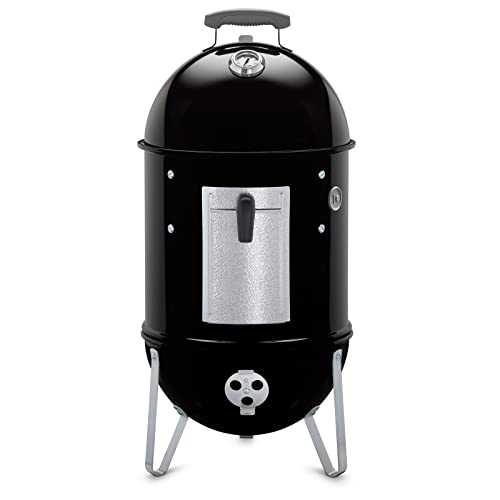
Weber Smokey Mountain Cooker 14-inch — Best Small Economy
Check the current price on Amazon for the current listing, configuration and included attachments before you buy.
The 14-inch Smokey Mountain is the economy benchmark because it teaches real charcoal smoking — fire, vents, water pan and all — in a machine built to Weber’s standard rather than to a price. The bullet format is a small masterpiece of thermal design: charcoal below, a water pan buffering the heat, two cooking grates above, and a domed lid that circulates smoke around the food. Learn temperature control here and you understand every charcoal smoker ever made.
Scale it honestly: the 14-inch grate takes a chicken, a small butt, a couple of rib racks cut or rolled, and fish and sides beautifully. It is the smoker for one- to three-person households, small patios and learners whose practice cooks are modest — and its fuel appetite is as small as its footprint, sipping charcoal where big cookers gulp it. For small-batch smoking, nothing in this guide is cheaper to run per delicious hour.
Its economy has a second face: longevity. Weber bullets are famous for decade-plus service with nothing more than grate replacements, and the resale market for used ones is brisk — the market’s own verdict on cost per year. If your household outgrows it, it becomes the fish-and-sides smoker beside its bigger sibling rather than landfill. That is what buying once actually looks like.
Strengths
- Real charcoal craft in a durable, compact bullet
- Tiny fuel appetite — cheapest long cooks here
- Weber longevity and parts support protect the purchase
Trade-offs
- 14-inch grates limit brisket and crowd cooks
- Charcoal technique must be learned — vents and fire
- No automation of any kind
| Specification | Detail |
|---|---|
| Size | 14-inch charcoal smoker |
| Grates | Dual cooking grates |
| Type | Vertical water smoker (bullet) |
Best for: small households and learners wanting real charcoal smoking at the lowest honest tier / Not suited for: brisket-first or crowd-feeding cooks — step up a size
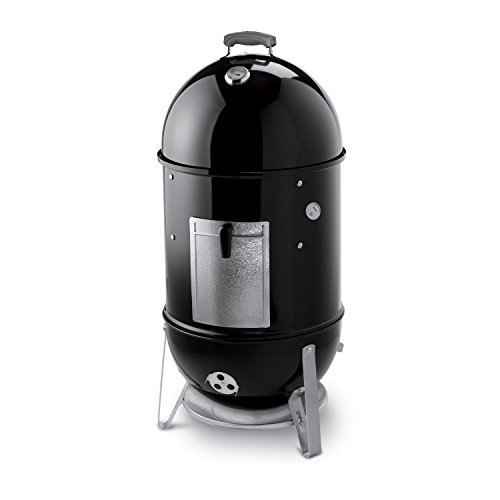
Weber Smokey Mountain Cooker 18-inch — Best Economy Overall
Check the current price on Amazon for the current listing, configuration and included attachments before you buy.
If one economy smoker deserves the word definitive, it is the 18-inch Smokey Mountain. The size is the sweet spot of the bullet range: a full brisket fits, two pork butts ride the two grates, rib racks lay or stand in proper numbers, and yet the cooker stays compact enough for an ordinary patio and frugal enough with charcoal to make weekly smoking a cheap habit rather than an event budget.
The water pan is the beginner’s silent partner, absorbing temperature spikes and forgiving vent mistakes while you learn — which is why so many competition cooks started on this exact cooker and why the technique literature around it is deeper than for any rival. Vent control becomes a calm, learnable skill: set the bottom vents, watch the thermometer settle, and the bullet holds its line for hours with the steadiness that made its reputation.
Economy arithmetic favours it at every horizon: purchase tier below any automated machine of similar capacity, charcoal running costs in pennies per hour, parts available essentially forever, and a service life measured in decades. The labour it asks — lighting charcoal, learning vents, emptying ash — is the honest subsidy of the whole economy tier, and on this machine that labour is as light as charcoal smoking ever gets.
Strengths
- Family capacity including brisket, at a budget tier
- Water pan forgives beginner vent mistakes
- Decades-long life and universal parts support
Trade-offs
- Manual charcoal control — no thermostat
- Ash and fire chores are part of every cook
- Two-grate access means lifting the top stack for the lower grate
| Specification | Detail |
|---|---|
| Size | 18-inch charcoal smoker |
| Grates | Dual cooking grates |
| Type | Vertical water smoker (bullet) |
Best for: families wanting the definitive low-cost route to real barbecue / Not suited for: cooks who want to set a temperature and walk indoors

Cuisinart 18-inch Vertical Charcoal Smoker COS-118 — Best Budget Bullet Alternative
Check the current price on Amazon for the current listing, configuration and included attachments before you buy.
The COS-118 takes the proven vertical formula — charcoal base, water bowl, stacked cooking space, dual vents for control — and delivers it at a tier below the Weber, with the integrated lid thermometer included rather than assumed. For the budget buyer, that completeness matters: the box contains a working smoking system, and the first cook needs nothing but charcoal, wood and food.
In use it teaches the same charcoal curriculum as its famous rival: fire management through the vents, the water bowl steadying the temperature, smoke wrapping the food in the vertical chamber. Brisket is in its brief by design, and the chrome-plated grates handle the standard family repertoire — butts, chickens, ribs — across its two levels. As a camping and tailgate-capable cooker it also travels in a way cabinet smokers never will.
The tier difference shows in the honest places: thinner long-term finish expectations than the Weber, a thermometer you should verify against a probe (true of nearly all lid thermometers), and a shorter track record. What it does not compromise is the cooking itself. For a buyer whose budget is firm and whose ambitions are real barbecue, it is the alternative that respects both.
Strengths
- Complete vertical system at a friendlier tier
- Integrated thermometer and dual-vent control included
- Portable enough for camping and tailgates
Trade-offs
- Finish and longevity expectations below Weber
- Lid thermometer should be verified with a probe
- Smaller owner community and knowledge base
| Specification | Detail |
|---|---|
| Size | 18-inch vertical charcoal smoker |
| Thermometer | Integrated thermometer |
| Vents | Dual vents |
| Grates | Chrome plated grates |
Best for: firm budgets wanting the full vertical charcoal experience / Not suited for: buyers optimising for decade-plus heirloom durability
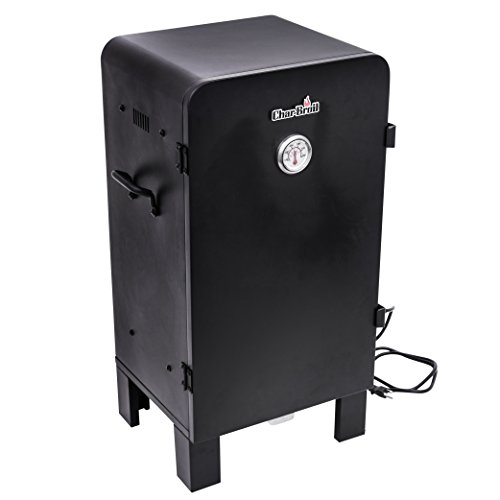
Char-Broil Analog Electric Smoker 18202077 — Best Economy Electric
Check the current price on Amazon for the current listing, configuration and included attachments before you buy.
Electric smoking is already the cheapest way to run a smoker — a heating element sips power where charcoal and pellets burn money — and this Char-Broil brings that running economy at an analog purchase tier. The proposition is simple: a vertical electric cabinet, a temperature dial, a chip system, and a mainstream brand’s distribution and support behind it, for the cook who wants smoked food on weeknights without fire craft or digital prices.
Operation teaches itself in one cook. The dial sets the neighbourhood of temperature, the element holds it with electric steadiness, and the cook’s attention goes to the food and the smoke rather than to a fire. For poultry, ribs, sausages and fish — the weeknight repertoire — that is exactly the right allocation of effort, and the cabinet format keeps chips, water and grease in the standard, easily cleaned arrangement.
Analog discipline applies: verify the dial’s real temperatures with a probe thermometer across your first cooks, and expect a range rather than a digital point. Within those honest terms, this is the lowest-effort economy in the guide — no charcoal to buy or light, no pellets to store, just electricity and chips. Households that will smoke often and cheaply should start their comparison here.
Strengths
- Lowest running effort and cost — electricity and chips
- Mainstream brand support at an analog tier
- Cabinet format cleans and loads simply
Trade-offs
- Analog dial holds a range, not a set point
- Gentle electric smoke character
- No digital or connected features at this tier
| Specification | Detail |
|---|---|
| Model | 18202077 |
| Control | Analog temperature control |
| Type | Vertical electric smoker |
Best for: weeknight smokers wanting electric ease at a budget tier / Not suited for: precision cooks or charcoal flavour seekers
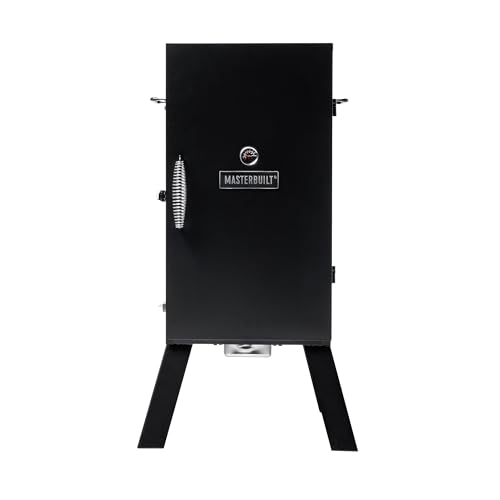
Masterbuilt 30-inch Analog Electric Smoker MB20070210 — Best Family Capacity on a Budget
Check the current price on Amazon for the current listing, configuration and included attachments before you buy.
Capacity is where budget smokers usually cheat — small boxes at small prices that cannot cook a family’s dinner. This analog Masterbuilt refuses that trade: a full 30-inch vertical cabinet with 535 square inches across chrome racks, enough for whole chickens, rib racks and pork butts in real combinations, from the brand whose cabinets define the category. The economy is in the controls — one analog dial — not in the cooking space.
The analog dial is a known quantity by now in this guide: learn its real positions with a probe thermometer over your first cooks, and it becomes a perfectly serviceable instrument with nothing electronic to fail, update or replace. Electric heat underneath it is steady and cheap to run, and the cabinet’s chip and water systems follow the standard Masterbuilt logic that a generation of owners has documented exhaustively — a hidden economy, since free community knowledge is worth money to a beginner.
Against its digital sibling you give up set-point precision and some capacity; against the charcoal bullets you give up smoke depth and gain weeknight ease. As the family-sized budget cabinet — the smoker that feeds everyone without feeding a payment plan — it is the most proportionate purchase in this guide.
Strengths
- True family capacity at an analog budget tier
- Reference-brand cabinet with deep community knowledge
- Cheap electric running costs, nothing electronic to fail
Trade-offs
- Analog range rather than digital precision
- Gentle electric smoke profile
- No window or probe included
| Specification | Detail |
|---|---|
| Cooking area | 535 sq. in. |
| Racks | Chrome smoking racks |
| Control | Analog temperature control |
| Format | 30-inch vertical electric cabinet |
Best for: families wanting maximum cabinet per budget unit / Not suited for: single small-batch cooks or precision-focused buyers

Smokehouse Little Chief Front Load Smoker — Best Economy for Fish and Jerky
Check the current price on Amazon for the current listing, configuration and included attachments before you buy.
Some economy is about buying less machine than the marketing wants to sell you. If your smoking is fish, jerky, cheese, sausage and nuts — the low-temperature repertoire — then every dollar spent on brisket capacity and high heat is wasted, and the Little Chief is the correct, minimal tool: a front-loading electric smoker that runs at low-to-mid temperatures, sips electricity and chips, and has been doing exactly this job for decades.
Its running economy is unmatched here. Small chamber, small element, small chip pan: a batch of jerky or a rack of salmon costs very little to produce, and the front-load racks make arranging strips and fillets a quick, tidy job. Anglers and hunters measure this machine’s value in seasons, not cooks, and its second-hand longevity is a standing joke — they simply keep working.
The boundary is absolute and stated on its own listing: low-to-mid temperatures for its named foods. It will not cook your brisket, and this guide will not pretend a workaround exists. Inside its brief, it is the economy champion of the entire category; outside it, choose from the five generalists above. Knowing which smoker your menu actually needs is the first economy of all.
Strengths
- Lowest purchase and running cost for its repertoire
- Decades-proven simplicity — almost nothing to wear out
- Front loading suits jerky and fish perfectly
Trade-offs
- Low-to-mid temperatures only
- Small capacity by design
- Not a general barbecue smoker
| Specification | Detail |
|---|---|
| Type | Front load electric smoker |
| Temperature profile | Low to mid temperature |
| Best uses | Fish, jerky, cheese, sausage |
| Footprint | 24.5 x 11.5 in class |
Best for: fish, jerky, cheese and sausage smokers on any budget / Not suited for: brisket, ribs and general barbecue cooking
Comparison Table
| Pick | Badge | Key spec | Best for |
|---|---|---|---|
| Weber Smokey Mountain Cooker 14-inch | Best Small Economy | 14-inch bullet, dual grates, water smoker | small households and learners wanting real charcoal smoking at the lowest honest tier |
| Weber Smokey Mountain Cooker 18-inch | Best Economy Overall | 18-inch bullet, dual grates, water smoker | families wanting the definitive low-cost route to real barbecue |
| Cuisinart 18-inch Vertical Charcoal Smoker COS-118 | Best Budget Bullet Alternative | 18-inch vertical, integrated thermometer, dual vents | firm budgets wanting the full vertical charcoal experience |
| Char-Broil Analog Electric Smoker 18202077 | Best Economy Electric | Analog electric cabinet, mainstream brand value | weeknight smokers wanting electric ease at a budget tier |
| Masterbuilt 30-inch Analog Electric Smoker MB20070210 | Best Family Capacity on a Budget | 535 sq in, analog, 30-inch cabinet | families wanting maximum cabinet per budget unit |
| Smokehouse Little Chief Front Load Smoker | Best Economy for Fish and Jerky | Low-to-mid temp specialist, minimal running cost | fish, jerky, cheese and sausage smokers on any budget |
Compare on cost per year, not cost per purchase: the table’s capacity and fuel columns tell you what each machine will ask of your wallet every season you own it, which is where economy is actually decided.
How to Choose an Economy Smoker Without Buying Twice
The economy equation has three terms: purchase tier, running cost per cook, and years of service. A smoker that wins the first term and loses the third is the most expensive object in this guide’s wider category. Judge construction before features — steel that holds its shape, grates that will not sag, seals that keep heat (and therefore fuel) inside — because every leak is a tax on every cook you will ever run. Then judge fuel: charcoal and electric heat are the cheap fuels; a frugal cooker using them beats a hungry one at any purchase price within a single season of weekly smoking.
- Buy the size your family eats: capacity you never use still burns fuel to heat. The 18-inch bullet and 30-inch cabinet are the family sweet spots here.
- Count the technique as part of the price: economy machines trade your attention for money. If you will not tend vents, buy the analog electric and spend the saving gladly.
- Prefer long production runs: models sold for years have cheap parts, deep knowledge and resale value — all forms of economy.
- Protect the purchase: a cover and dry storage double the life of budget steel. The cheapest accessory is the one that prevents the second smoker.
- Beware the false floor: below the durability floor, smokers leak, rust and warp. The picks here sit at or above it; go lower and you are renting, not buying.
Tiers in words, since prices in this class move fastest of all: the entry tier buys the 14-inch bullet, the Cuisinart vertical or the Little Chief’s specialism. The heartland tier buys the 18-inch Weber or the analog Masterbuilt cabinet — the two best cost-per-year propositions in smoking. Everything above those tiers is buying automation and convenience, which are legitimate purchases — but they are not economy, and this guide will not call them so.
Running Costs: The Second Price Tag
Charcoal smokers burn a modest load per long cook, and the frugal bullets here sit at the low end of that appetite; lump charcoal costs more per bag than briquettes and repays it in cleaner flavour and less ash. Electric cabinets are the cheapest heat in barbecue — an element holding 225°F draws little, and chips are pennies per cook. Wood for smoke is a minor cost in every format here when bought as chips or chunks rather than novelty packaging. The real running-cost villain is leakage: a warped door or failed seal can double fuel use while halving cook quality, which is why the durability floor in the selection criteria is an economy feature, not a luxury one.
Making a Budget Smoker Last
Economy machines reward the same fifteen-minute rhythm as premium ones, plus two protections. Keep the cooker covered or under shelter — budget steel’s enemy is weather, not work. Empty ash promptly: ash plus moisture becomes a corrosive paste that eats fire bowls from inside, the classic early death of cheap charcoal smokers. Touch up exterior rust spots early with high-heat paint, keep grates oiled and seasoned, and store cabinets dry with doors ajar. Do these things and the machines in this guide routinely outlive the buyer’s first car; skip them and no purchase tier would have saved you.
How to Run a Bullet Smoker on a Budget, Step by Step
The bullet smoker is the economy champion’s classroom. This sequence — written for the Weber and Cuisinart verticals in this guide — produces a steady, frugal, hours-long cook from a single charcoal load.
- Fill the charcoal ring most of the way with unlit briquettes and a few wood chunks buried among them. Buried chunks smoke across the whole cook instead of burning off in the first hour.
- Light a small chimney of briquettes — a coffee-can-sized amount, not a full chimney. A small lit load on a large unlit bed is the Minion method, and it is the secret of both steadiness and frugality.
- Pour the lit coals into a small hollow in the centre of the ring, assemble the cooker with the water pan filled, and open all vents fully while the temperature climbs toward your target.
- As the temperature approaches roughly 25 degrees below target, close the bottom vents to about a third open. Bullets respond slowly; small early adjustments beat large late corrections, in temperature and in fuel bills.
- Load the food, close the lid, and leave the vents alone for the first hour. Note the settled temperature — that is your cooker’s natural cruising point with this vent setting, and it is the number you will reproduce forever.
- Adjust in small moves, one vent at a time, waiting fifteen minutes between changes. Chasing the thermometer with constant vent work wastes fuel and destabilises the cook.
- For long cooks, expect one water pan refill and possibly a small charcoal addition through the door — both are normal bullet operations, done briskly to keep heat in.
- At the end, close all vents fully. A sealed bullet starves its fire and saves the unburned charcoal for next time — the final economy of a frugal design, and a habit worth more than any coupon.
Master the Minion method and the vent discipline and your cost per cook drops to its floor while your barbecue quality climbs to the bullet’s considerable ceiling. Economy, done right, is a skill discount — and skills do not depreciate.
The Minion Method and Other Free Upgrades
The cheapest performance upgrades in smoking are techniques, and the Minion method leads them: a small lit load of charcoal placed on a large unlit bed, so the fire spreads slowly through its own fuel for hours. It converts an ordinary bullet into a long, steady, frugal cooker with no purchased parts, and it is the reason the Weber bullets in this guide can run a brisket cook on a modest bag of briquettes. Its companions are equally free: preheating the water for the pan so the fire does not spend its first hour boiling, and banking the day’s charcoal plan — full ring, small light — as a fixed habit rather than a per-cook improvisation.
Two more free upgrades deserve their fame. The first is vent discipline recorded in a notebook: which bottom-vent setting held 225°F on a calm day, which on a windy one. A season of notes turns a budget smoker into a precision instrument that happens to have cost little. The second is the rest: holding cooked meat wrapped in a cooler for an hour or two, which costs a towel and transforms texture more reliably than any accessory. Economy smokers reward cooks who invest attention; these techniques are where the investment pays its highest interest.
Buying Wood and Charcoal Without Overpaying
Fuel is the running cost you control most. Briquettes bought in twin packs on seasonal sales are the bullet smoker’s cheapest steady diet, and stored dry they keep indefinitely — the economy cook’s pantry logic applied to the garage. Lump charcoal costs more and earns it for shorter, hotter cooks; for long smoking, quality briquettes’ consistency is a feature, not a compromise. Wood should be bought as chunks for charcoal smokers and chips for cabinets, in the species you actually use — hickory, oak, apple, cherry cover nearly all home smoking — rather than as novelty variety packs whose exotic thirds expire unused in the bag.
For the electric cabinets, the arithmetic is simpler still: chips are pennies per cook, and the element’s draw at smoking temperatures is modest enough that the electricity line in a season’s budget disappears next to the meat bill. That is the quiet truth under this whole guide: in economy smoking, the food is the expense. The machine and its fuel, bought and run with the discipline described here, are rounding errors beside a year’s worth of briskets — which is exactly how it should be.
Second-Hand Smokers: A Field Guide
The long production runs in this guide create a healthy second-hand market, and a sound used bullet or cabinet can be the single best purchase in barbecue. Inspect in a fixed order. Structure first: legs and mounts solid, body free of rust-through — surface rust is cosmetic, perforated steel at the fire bowl is terminal. Seals second: doors and lids should close true; a warped door is a fuel leak you cannot tune out. Grates third: heavy rust and sagging are replaceable at known cost, so price them into the negotiation rather than walking away. On electrics, plug it in if you possibly can — an element that heats and a control that responds are the whole machine.
Price the unknowns honestly: a used smoker plus new grates and a cover should still land well under the new price, or the new machine’s warranty and certainty win. Clean any used cooker thoroughly and run a hot empty burn before food. And remember the market’s compliment to this guide’s picks: the models listed here are the ones that appear second-hand at all, because they survive long enough to be sold. Flimsy smokers do not have a used market; they have a disposal problem.
When to Spend More: The Honest Upgrade Triggers
Economy discipline includes knowing the moment it stops applying. Three triggers justify spending above this guide’s tiers, and they are all about changed circumstances rather than changed desires. The first is frequency: when smoking becomes a twice-weekly rhythm year-round, automation’s labour saving compounds into real hours, and a digital cabinet or pellet grill starts paying for itself in time. The second is production: when you cook for money — a market stall, a catering sideline — duty cycle and capacity become business equipment questions, and commercial thinking replaces household economy. The third is physical: tending charcoal is light work, but it is work, and the cook whose knees or schedule no longer allow it should buy the thermostat without a flicker of guilt. Economy is a means to barbecue, never a moral position.
Notice what is absent from the trigger list: boredom, neighbours’ equipment, and the new model year. Budget smokers do not become worse when shinier machines launch; the 18-inch Weber cooks exactly as well as it did a decade ago, which is the entire point of buying proven designs. The upgrade market depends on owners replacing good machines for novelty; the economy cook’s countermove is to let the second-hand listings of the impatient subsidise their patience.
Until a trigger fires, the best use of the next smoker dollar is almost never a new smoker. It is a cover, a good probe thermometer, a second grate, a stock of fuel bought on sale — the small capital that makes the machine you own perform at its ceiling. Economy, practised properly, is not the absence of spending; it is spending in the order that barbecue quality actually notices.
The Economy Pantry: Seasonings, Foil and Patience
A budget smoker surrounded by expensive habits is a leaking bucket, so the economy discipline extends to the consumables around the cook. Rubs are the first place money evaporates: the classic barbecue seasonings are salt, pepper, paprika, garlic and sugar in varying ratios, and a cook who mixes a house rub by the jar spends a fraction of the boutique-bottle cost for a product tuned to their own palate — which is, not coincidentally, how the great barbecue joints do it. Foil, butcher paper and pans follow the same logic bought in bulk and stored dry: the wrap is part of the method, not a luxury line item.
Patience is the pantry item that cannot be bought at all, and it is the economy smoker’s native advantage. Cheap cuts — butt, chuck, whole chicken, turkey legs — are the glory of barbecue precisely because time and smoke convert them, and time is the one input the budget cook has in unlimited supply. The expensive shortcut cuts exist for people buying back hours; the economy cook sells hours gladly and pockets the difference at the table. Run the whole system this way — frugal machine, frugal fuel, house rub, cheap cuts, long cooks — and a season of excellent barbecue costs less than a single month of takeaway. That is the complete argument of this guide, and it is airtight.
The First Season on a Budget Smoker: What to Expect
Set expectations correctly and the first season delights; set them by competition television and it disappoints unfairly. Your first cooks will run long or short against their recipes, because every individual smoker has a personality — the dial position that means 225°F on yours, the vent setting your bullet cruises at — and learning that personality is the season’s real curriculum. Temperatures will wander while you learn, and the food will mostly be good anyway, because low-and-slow cooking forgives in hours what grilling punishes in minutes. Keep the notebook from the first cook: fuel load, vent or dial setting, weather, result. By the sixth cook it reads like an owner’s manual written for an audience of one, which is the most valuable document in barbecue.
Expect also to become, mildly, a person who talks about smoke. The economy route teaches the craft rather than renting it from electronics, and crafts produce opinions: about briquettes versus lump, about water pans, about whether the butt should be wrapped. Those opinions, earned over a season of inexpensive cooks, are the hidden yield of the budget tier — the automation buyer purchases convenience, and fairly; the economy buyer purchases understanding, and keeps it forever, transferable to every cooker they will ever own.
Common Buying Mistakes
Buying below the durability floor. The thinnest, cheapest box leaks heat, burns double fuel and rusts in two seasons — then you buy the Weber anyway. The floor exists; the picks here sit on it or above it.
Judging cost by the sticker only. Running cost and service life dominate the real arithmetic within a year of weekly cooking. A frugal, durable smoker at a higher tier is the cheaper machine by every honest measure.
Oversizing and overheating empty space. A big cooker smoking one chicken burns fuel to heat air. Match capacity to your table and the savings compound on every single cook.
Leaving ash in the cooker. Ash and moisture form a corrosive paste that eats fire bowls — the classic premature death of budget charcoal smokers. Empty it after every cook, once cool.
Skipping the cover to save money. Weather, not cooking, kills budget steel. A cover is the highest-return accessory in this entire guide; going without one is the most expensive saving available.
Expecting automation at an economy tier. These machines trade your small attention for their low cost. Buying one while wanting thermostat hands-off cooking leads to a dusty smoker and a second, dearer purchase — the costliest outcome of all.
Final Recommendation
For most families, the economy decision lands on one of two anchors: the Weber Smokey Mountain 18-inch for real charcoal barbecue with a decades-long horizon, or the Masterbuilt analog cabinet for family capacity with electric ease. Smaller households start beautifully on the 14-inch Weber; firm budgets are respected by the Cuisinart vertical; weeknight cooks save most with the Char-Broil electric; and fish-and-jerky devotees should buy the Little Chief and never think about brisket capacity again. Every pick here was chosen to be bought once — which is the only economy that has ever mattered in a smoker.
Confirm the tier logic against your own menu and patience using the companion guides below — automation and fuel comparisons live there, at their honest prices.
Start with the three safest first looks: Weber Smokey Mountain Cooker 14-inch, Weber Smokey Mountain Cooker 18-inch, Cuisinart 18-inch Vertical Charcoal Smoker COS-118.
Keep reading in this series: Best Easy Smokers Best Easy To Use Smokers Best Electric And Gas Smokers Best Charcoal Smokers Best Smokers For Beginners
Frequently Asked Questions
What is the cheapest way to smoke meat well?
A durable charcoal bullet like the Weber Smokey Mountain, run with the Minion method, or an analog electric cabinet. Both pair a budget purchase tier with very low running costs. The truly expensive route is a flimsy smoker replaced in two years — buy once, at or above the durability floor.
Are cheap smokers a false economy?
Below the durability floor, yes: thin steel leaks heat, doubles fuel use and rusts early. At the floor — the class of every pick in this guide — no: long production runs, simple construction and cheap fuel make these machines the best cost-per-year propositions in smoking.
Charcoal or electric: which is cheaper to run?
Electric cabinets are marginally cheapest per cook, with chips costing pennies. Charcoal bullets are close behind and frugal by design, especially with vents closed after cooking to save unburned fuel. Both undercut pellet and offset running costs comfortably.
Can a budget smoker cook a brisket properly?
Yes — the 18-inch Weber and the Cuisinart vertical in this guide are brisket-capable by design, and the analog Masterbuilt cabinet handles brisket with electric ease. Brisket quality comes from temperature steadiness and patience, not from the price tier of the box.
How long will an economy smoker last?
With a cover, prompt ash removal and dry storage, the bullets and cabinets here routinely serve for many years — Weber bullets are famous for decade-plus lives. Neglect, especially ash left in a charcoal cooker, is what shortens them.
Should I buy a used smoker to save more?
Used examples of the long-running models in this guide can be excellent value — inspect for rust-through at the fire bowl, warped doors and grate condition. A sound used bullet at a fair price is one of the best purchases in barbecue.


