Disclosure: airfryerkitchensupply.com is reader-supported. When you buy through links on our site, we may earn an affiliate commission at no extra cost to you.
Where to buy
Every product named in this guide to the best home meat grinders was checked against Amazon listing data before it earned a place here, and the links below go to the exact verified listings. Prices change constantly, so each pick is linked with a live price check instead of a printed number:
- LEM BigBite #8 Meat Grinder, 0.5 HP — Check the current price on Amazon
- STX International Turboforce 3000 Series 6-in-1 Electric Meat Grinder — Check the current price on Amazon
- Sunmile SM-G50 ETL Electric Meat Grinder — Check the current price on Amazon
- LEM #8 Countertop Meat Grinder, 575 Watt — Check the current price on Amazon
- Cuisinart Electric Meat Grinder, Stainless Steel — Check the current price on Amazon
- KitchenAid KSMMGA Metal Food Grinder Attachment — Check the current price on Amazon
The best home meat grinders turn a supermarket errand into a kitchen capability: burgers blended to your ratio, mince you trust because you watched it happen, sausage that starts as a Saturday idea and ends as a family tradition. This guide compares six verified machines and attachments for domestic life — family batches, monthly rituals and growing hobbies — each verified connection, with every motor and format figure taken from its verified listing. If your sessions run to tens of pounds, our high-volume companion guide takes over from here; this list is deliberately, proudly domestic.
The six split by philosophy. LEM’s pair (the BigBite flagship and the compact countertop #8) serve cooks who want specialist machines in two sizes. The STX Turboforce 3000 serves the experimenter with the deepest accessory box in home grinding. The Sunmile SM-G50 is the durable mid-range centre — metal gears, reverse, a circuit breaker — that most households will never need to replace. The Cuisinart serves appliance-brand kitchens that grind occasionally, and the KitchenAid attachment serves the mixer-owning majority with no new appliance at all.
One honesty note that runs through the reviews: home-class listings quote power in peak conventions (max watts, max HP) that flatter every brand equally. This guide quotes each listing’s own figures, flags the convention where it appears, and ranks on the durable evidence — head size, drive construction, cutting parts, included kit and the maker’s ecosystem — because those are what your tenth year with the machine will actually be made of.
In this guide
Quick Picks
- LEM BigBite #8 Meat Grinder, 0.5 HP — Best Overall for Home: the home-class flagship: LEM’s BigBite feeding design and 0.5 HP in stainless #8 form — the grinder keen home cooks graduate to — Check the current price on Amazon
- STX International Turboforce 3000 Series 6-in-1 Electric Meat Grinder — Best Accessory Kit: the maximalist’s home grinder: a 3-speed 6-in-1 system with five grinding dies, three blades, sausage stuffer, kubbe maker and even a juicer function — Check the current price on Amazon
- Sunmile SM-G50 ETL Electric Meat Grinder — Best Mid-Range All-Rounder: the sensible centre of home grinding: metal gears, reverse, a circuit breaker, stainless blade and plates, and ETL listing in one established package — Check the current price on Amazon
- LEM #8 Countertop Meat Grinder, 575 Watt — Best Compact LEM: LEM quality in a smaller body: a 575-watt #8 aluminium countertop grinder for kitchens that grind seriously but store small — Check the current price on Amazon
- Cuisinart Electric Meat Grinder, Stainless Steel — Best Simple Countertop: the appliance-brand answer: a stainless steel countertop grinder from Cuisinart for cooks who want grinding inside a familiar kitchen ecosystem — Check the current price on Amazon
- KitchenAid KSMMGA Metal Food Grinder Attachment — Best for KitchenAid Owners: the attachment route: an all-metal grinder head for KitchenAid stand mixers, with tray, pusher, plates and sausage tubes — no second motor to store — Check the current price on Amazon
How These Picks Were Chosen
Selection required a genuine home fit: #8-class heads or the attachment equivalent, formats a domestic kitchen can store, and listings whose contents could be verified. We weighted drive durability (metal gearing, overload protection), jam management (reverse functions), cutting-part quality (stainless blades and plates), and the realism of each machine’s ecosystem for plates, knives and tubes in later years. Peak power figures were recorded as listed and deliberately not used as ranking currency.
The result is a ladder rather than a duel: an attachment for mixer owners, an appliance for occasional grinders, a mid-range all-rounder for most households, a maximalist kit for experimenters, and two LEMs for the keen — compact and flagship. Every rung is a defensible purchase for its household, which is what a home guide owes its readers: not one winner, but no wrong doors.
The 6 Best Home Meat Grinders for Family Kitchens

LEM BigBite #8 Meat Grinder, 0.5 HP — Best Overall for Home
The home grinder market splits into appliances that mince and machines that grind, and the LEM BigBite #8 is where the second category starts. Its verified listing describes a 0.5 HP stainless steel electric grinder in the #8 format with LEM’s BigBite technology — an auger and head design that pulls meat through with notably less pusher work. In home terms that means family burger batches, a sausage-making hobby and the occasional big shop all run at a pace that feels like equipment, not effort.
Why does this take Best Overall in a guide that also lists cheaper paths to ground meat? Because home grinding is a habit, and habits survive on machines that make the work pleasant: feeding that does not fight you, a motor that does not whine down under a fatty batch, stainless that washes clean and a maker whose replacement knife is a click away in year six. The BigBite #8 is the smallest machine in this guide’s world that delivers all four without apology — the connoisseur’s home grinder, sized for a kitchen rather than a processing shed.
Buy it if grinding is a monthly-or-more ritual and sausage is on the horizon. If your grinding is a twice-a-year experiment, the honest picks further down this list will serve you for less — and this LEM will be waiting, unbought and unresented, for the day the hobby takes hold.
Strengths
- BigBite auger design feeds meat with less pushing — the daily-use difference owners actually feel
- A real 0.5 HP motor in the #8 class, from the maker whose name anchors the category
- LEM’s plate, tube and parts ecosystem makes it a decade-scale purchase
Trade-offs
- Premium positioning within the home class; casual grinders pay for capacity they may not use
- #8 format still asks for counter or cupboard space planning
- Heavier than the compact picks — a considered lift, not a casual one
| Specification | Verified detail |
|---|---|
| Size class | #8 grinding head |
| Motor | 0.5 HP, per the verified listing |
| Build | Stainless steel; BigBite technology per listing |
Check the current price on Amazon
Best for: keen home cooks and sausage hobbyists wanting the definitive #8 machine / Not suited for: twice-a-year grinders, for whom the compact picks below are the honest spend

STX International Turboforce 3000 Series 6-in-1 Electric Meat Grinder — Best Accessory Kit
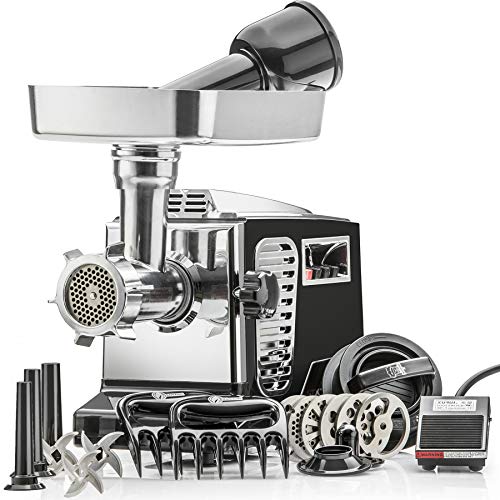
Some buyers want a grinder; STX sells a grinding department. The Turboforce 3000’s verified listing describes a 6-in-1 electric system — 3 speeds, five grinding dies, three stainless steel blades, a sausage stuffer, a kubbe maker and a juicer function — around a motor the listing rates at 3000W max. That wattage figure follows the peak-rating convention common in this class, and this guide flags it as such: the machine’s real credentials are its versatility and its kit, which together equip a home cook to attempt almost any ground-meat recipe from a single box.
The three speeds are the substantive feature hiding behind the attachments. Grinding wants pace; stuffing wants control; delicate mixtures want a gentler hand. A speed range serves all three tempers, and for a household discovering sausage-making, that control is the difference between burst casings and a new family tradition. The five-die spread similarly turns texture from a compromise into a choice — coarse chilli grind on Saturday, fine frankfurter ambitions on Sunday.
Choose the STX if your grinding future is unwritten and you want every door open. Choose the LEM above if your future is clearly grinding-first and often. Either way, keep the parts organised from day one — a kit this generous rewards a labelled box and punishes a junk drawer.
Strengths
- The most complete box in home grinding: dies, blades and attachments for nearly every recipe direction
- Three speeds give stuffing and delicate work a control basic grinders lack
- A single purchase that equips a beginner for years of experimentation
Trade-offs
- Peak-wattage headline (3000W max) describes a rating convention, not sustained draw — judge it by its work, not its number
- Many attachments mean many parts to wash, dry and store
- Jack-of-all-trades design will not match a dedicated LEM for pure grinding feel
| Specification | Verified detail |
|---|---|
| Power | 3000W max as stated in the verified listing (peak rating convention) |
| Speeds | 3-speed operation |
| Kit | 5 grinding dies, 3 stainless steel blades, sausage stuffer, kubbe maker and juicer function per listing |
Check the current price on Amazon
Best for: experimenting home cooks who want every attachment and texture option in one purchase / Not suited for: grinding purists who want a dedicated machine’s feel and a short parts list

Sunmile SM-G50 ETL Electric Meat Grinder — Best Mid-Range All-Rounder
The Sunmile SM-G50 has been the recommendation-resistant centre of home grinding for years, and its verified listing shows why: metal gears instead of plastic, a reverse function, a circuit breaker, stainless steel cutting blade and plates, ETL listing, and power the listing states as max 1.3 HP / 1000W — the class’s peak-rating language, which this guide notes rather than repeats as gospel. Strip the numbers to their meaning and you get a machine specified at every point where home grinders actually fail: the drive, the jam, the electrics, the cutting set.
Reverse deserves its sentence. Sinew wraps the knife in every grinder’s life; on machines without reverse, clearing it means stopping, opening the head and losing the session’s rhythm. A reverse jog unwinds the problem in seconds. Combined with the breaker — which turns an overload from a burnt motor into a reset — the SM-G50 is engineered for the unglamorous realities of home use, by cooks who will occasionally feed it meat that is too warm or too tough and need the machine to forgive them.
Buy it as the household’s one grinder when the programme is burgers, mince and learning sausage, a few times a month, for years. It is the pick least likely to be regretted by the widest range of homes in this entire guide.
Strengths
- Metal gears and a circuit breaker: the durability-and-safety pairing this class often skips
- Reverse function clears the inevitable sinew wrap without dismantling the head
- Stainless blade and plates where grind quality is decided, at a mid-range position
Trade-offs
- Peak-style power ratings (max HP) follow the class’s optimistic convention — judge by the package
- One sausage attachment set rather than the STX’s department store
- Design is functional rather than handsome; it earns cupboard space, not counter display
| Specification | Verified detail |
|---|---|
| Power | Max 1.3 HP, 1000W as stated in the verified listing |
| Drive | Metal gears, per listing |
| Features | Reverse function and circuit breaker; stainless steel cutting blade and plates; ETL listed |
Check the current price on Amazon
Best for: most households: regular burgers, mince and sausage learning in a forgiving, durable package / Not suited for: attachment collectors (STX) or flagship seekers (LEM) at either pole

LEM #8 Countertop Meat Grinder, 575 Watt — Best Compact LEM
Not every keen grinder has flagship storage, and LEM knows it: this countertop #8’s verified listing describes a 575-watt aluminium electric grinder positioned squarely for home use — grinding, sausage stuffing and cooking prep in a compact appliance body. What it keeps from the flagship line matters most: the #8 standard, so plates and accessories live in LEM’s deep ecosystem, and the maker’s understanding of what home grinding actually involves.
The honest differences are build and headroom. Aluminium keeps the machine light and movable — a real virtue when the grinder lives in a cupboard — at the cost of the stainless flagship’s heft and feel. The 575-watt motor handles family batches with composure and asks only for sensible pacing on the biggest, fattiest runs: feed steadily, keep meat cold, and it will not embarrass itself. Kitchens that grind weekly in modest batches will never find its ceiling; kitchens approaching high-volume territory should step up to the BigBite or across to our high-volume guide.
Choose it for LEM ownership in a small kitchen, or as the second grinder in a two-machine household. It is the compact pick that does not apologise — it simply specialises.
Strengths
- The LEM name, ecosystem and #8 plate standard in a genuinely compact machine
- 575 watts is honest home-class power for family batches
- Aluminium build keeps it light enough for cupboard-to-counter living
Trade-offs
- Aluminium rather than the BigBite’s stainless flagship build
- 575W will pace itself on the largest, fattiest batches where the 0.5 HP sibling cruises
- Fewer included luxuries than the flagship; the ecosystem sells the extras
| Specification | Verified detail |
|---|---|
| Size class | #8 grinding head |
| Motor | 575 watt, per the verified listing |
| Build | Aluminium countertop format for home use |
Check the current price on Amazon
Best for: small kitchens wanting LEM’s #8 ecosystem in a light, storable machine / Not suited for: large fatty batches run back-to-back, where the BigBite’s headroom earns its size

Cuisinart Electric Meat Grinder, Stainless Steel — Best Simple Countertop
Some kitchens run on appliance brands, and for those kitchens the Cuisinart is the natural grinder: its verified listing describes a stainless steel electric meat grinder in the brand’s countertop appliance line (the MG-100). The value proposition is familiarity — a manual written for humans, a support channel that answers, a machine whose look and logic match the food processor already on the counter. For the household that grinds for meatloaf night, burger blends and the occasional sausage experiment, that ecosystem comfort is a legitimate specification.
Judge it in its class honestly. It is not built for the sausage hobbyist’s monthly production or the hunter’s autumn; the LEMs and the STX exist for those callings, and this guide says so in their reviews. What the Cuisinart offers is competent, tidy grinding for ordinary domestic quantities, from a name that will still be answering the phone in five years — which, in the home-class market of evaporating brands, is worth more than a heroic wattage claim.
Buy it if your grinding is monthly-or-less and your kitchen loyalty is to appliances that simply work. Run the full-listing check for its included plates before ordering, keep meat cold and batches modest, and it will do its quiet job for years.
Strengths
- A mainstream appliance brand’s support, manuals and retail presence behind the machine
- Stainless steel presentation that sits comfortably among countertop appliances
- Straightforward operation for cooks who grind occasionally and value simplicity
Trade-offs
- Occasional-use positioning: keen weekly grinders will outgrow it toward LEM or STX
- Accessory and plate ecosystem is shallower than the specialist makers’
- Listing detail is leaner than the specialists’ — confirm plates and attachments in full specs
| Specification | Verified detail |
|---|---|
| Format | Countertop electric meat grinder |
| Build | Stainless steel, per the verified listing |
| Line | Cuisinart kitchen appliance range (MG-100) |
Check the current price on Amazon
Best for: occasional home grinding inside a mainstream appliance kitchen / Not suited for: weekly grinders and sausage hobbyists, who should buy specialist machines
KitchenAid KSMMGA Metal Food Grinder Attachment — Best for KitchenAid Owners
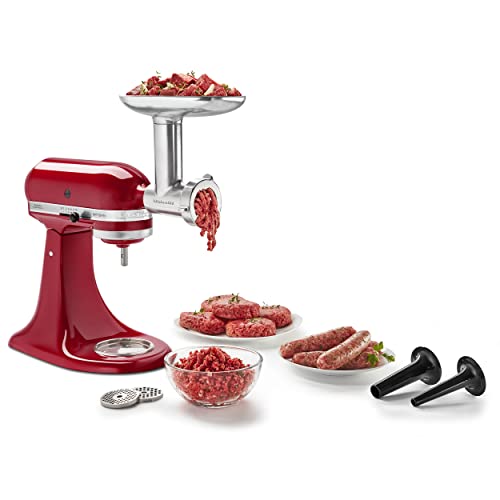
The smartest grinder in this guide might be the one that is not a grinder at all. The KitchenAid KSMMGA’s verified listing describes a metal food grinder attachment for all KitchenAid stand mixers, supplied with a food tray, pusher, grinding plates and sausage stuffer tubes and plate. If a KitchenAid already anchors your counter — as it does in a remarkable share of serious home kitchens — this attachment converts its motor into a grinder with no second appliance to buy, store or maintain.
The metal construction is the deciding detail: KitchenAid’s grinder history includes lighter builds, and the all-metal head is the version that grinds with the solidity the task deserves and cleans without anxiety. The included kit is complete enough for a sausage first season, and the workflow — mixer-height grinding, tray-fed — suits the family batches that are this format’s home turf. Long production sessions expose the format’s terms: the mixer is committed, the working height is fixed, and the pace is home-class. Within those terms, it is excellent.
Buy it if you own the mixer. It is the highest-value entry in this guide for that household — flagship-adjacent grinding for the price of an attachment. If you do not own a KitchenAid, do not buy one to justify it; the standalone machines above start exactly where you are.
Strengths
- Uses the powerful mixer motor you already own — zero extra appliance storage
- All-metal head, the durable version of the attachment idea
- Complete kit: tray, pusher, plates and stuffing tubes for grinding and sausage from day one
Trade-offs
- Grinding height and workflow follow the mixer’s shape, which some cooks find awkward over long sessions
- Your mixer is occupied while grinding — no simultaneous mixing marathons
- Throughput is home-class; production ambitions belong in the high-volume guide
| Specification | Verified detail |
|---|---|
| Format | Attachment for all KitchenAid stand mixers, per the verified listing |
| Build | Metal food grinder attachment (KSMMGA) |
| Kit | Food tray, pusher, grinding plates, sausage stuffer tubes and plate per listing |
Check the current price on Amazon
Best for: KitchenAid owners wanting real grinding and sausage capability with zero new appliance storage / Not suited for: non-owners, and production-volume grinders who need a dedicated machine
Comparison Table
| Pick | Badge | Key spec | Best for |
|---|---|---|---|
| LEM BigBite #8 Meat Grinder, 0.5 HP | Best Overall for Home | #8 grinder, 0.5 HP motor, stainless steel, BigBite technology | keen home cooks and sausage hobbyists wanting the definitive #8 machine |
| STX International Turboforce 3000 Series 6-in-1 Electric Meat Grinder | Best Accessory Kit | Electric grinder, 3000W max per listing, 3-speed, 5 grinding dies, 3 stainless blades | experimenting home cooks who want every attachment and texture option in one purchase |
| Sunmile SM-G50 ETL Electric Meat Grinder | Best Mid-Range All-Rounder | Electric grinder, max 1.3 HP / 1000W per listing, metal gears, reverse function, ETL | most households: regular burgers, mince and sausage learning in a forgiving, durable package |
| LEM #8 Countertop Meat Grinder, 575 Watt | Best Compact LEM | #8 grinder, 575 watt motor, aluminium construction, countertop format | small kitchens wanting LEM’s #8 ecosystem in a light, storable machine |
| Cuisinart Electric Meat Grinder, Stainless Steel | Best Simple Countertop | Electric meat grinder, stainless steel, countertop appliance format (MG-100) | occasional home grinding inside a mainstream appliance kitchen |
| KitchenAid KSMMGA Metal Food Grinder Attachment | Best for KitchenAid Owners | Metal food grinder attachment for all KitchenAid stand mixers; tray, pusher, plates and stuffer tubes included | KitchenAid owners wanting real grinding and sausage capability with zero new appliance storage |
How to Choose the Best Home Meat Grinders
Dedicated grinder or mixer attachment: the first fork
If a KitchenAid stand mixer already lives on your counter, the attachment question comes first, and our KSMMGA pick shows why: a metal head, a complete kit and the mixer’s own motor deliver real grinding with zero storage cost. Attachments lose on workflow height, session length and the mixer’s availability — you cannot grind and mix at once — and they win on everything else for family-scale work. Households without the mixer should skip the fork entirely: a dedicated machine is cheaper than a mixer bought as a grinder stand.
Dedicated machines then split by commitment. Occasional grinders (monthly or less) are served by appliance-class machines like the Cuisinart. Regular grinders (weekly to monthly, with sausage ambitions) belong in the Sunmile-to-LEM band, where drives, cutting parts and ecosystems are built for repetition. The test is honesty about the calendar: count last year’s grinding occasions, double the number if a hobby is blooming, and buy for that figure — not for the fantasy season, and not for the fear of one.
Power figures, translated
Home grinder listings speak three dialects: honest watts (LEM’s 575W countertop), rated horsepower (the BigBite’s 0.5 HP), and peak conventions (the STX’s 3000W max, the Sunmile’s max 1.3 HP). Peak figures describe a momentary ceiling under laboratory kindness, not the sustained draw that grinds your batch; they are comparable to each other only loosely and to honest watts barely at all. This guide quotes each as listed and refuses to rank by them — a policy your own shopping should copy.
What actually predicts grinding feel: head size (the #8 standard across our dedicated picks), drive construction (metal gears forgive; the Sunmile’s breaker protects), knife and plate sharpness, and your meat’s temperature. A modest motor behind a sharp knife and near-frozen meat out-grinds a hero number behind a dull knife and warm meat every single time. Buy the machine by its build, then run it by the cold rules, and the power question mostly answers itself.
Plates, textures and the sausage path
Two plates — coarse and fine — cover the founding repertoire: coarse for chilli and rustic sausage, fine for burgers and smooth blends, both together for the classic two-pass sausage grind. Most picks include the pair; the attachment includes plates and stuffing tubes outright; the STX includes five dies and turns texture into a playground. Before buying, list your first five recipes and check their plates and tubes against the box contents — the cheapest accessory is the one included on day one.
Sausage ambition should steer the purchase more than burger ambition, because stuffing is where home machines differentiate: speed control (the STX’s three speeds), tube range, and the option to graduate to a dedicated stuffer while keeping the grinder for grinding. If sausage is a maybe, buy a machine whose ecosystem sells the tubes later (LEM, STX). If sausage is a never, the Cuisinart’s simplicity is not a compromise at all — it is the correct specialisation.
Cleaning, storage and the ten-year view
Grinders are washed in pieces, every time, and the pieces are sharp, fatty and numerous. Judge a machine by its teardown: how fast the head opens, whether parts are stainless where washing is harshest, and whether the manual’s cleaning page reads like a ritual or a paragraph. Machines that clean easily get used; machines that clean painfully become cupboard monuments, and the difference is visible in the listing’s parts diagram before you spend anything.
Storage is the other silent specification. Attachments vanish into a drawer; compact countertop machines (the small LEM, the Cuisinart) cupboard politely; the STX’s department needs a box and a system; the BigBite earns a semi-permanent home. Measure your intended storage before ordering, buy a labelled parts box the same week, and stock the spare knife early. Ten-year ownership is mostly these small logistics, done once, done right.
How to Grind Meat at Home: The Cold, Sharp, Steady Method
Every machine in this guide performs at its best under the same discipline. Learn it once and it serves every grinder you will ever own:
- Start colder than feels reasonable. Cube the meat, spread it on a tray and chill until the pieces are firm and just shy of freezing at the edges. Chill the head, knife and plate too — a cold cutting set is the cheapest performance upgrade in grinding.
- Cut to the throat, not against it. Long strips or cubes sized for your head’s throat feed smoothly and keep hands clear. Use the pusher as a guide only; if you are pushing hard, the meat is too warm, too big or the knife is asking for retirement.
- Grind into a chilled bowl, in a single layer’s rhythm. Catch the grind in a cold bowl set over ice for big batches, and return finished grind to the fridge promptly. Texture is set at the plate; temperature is what protects it afterwards.
- For sausage texture, respect the two passes. Coarse pass first, then a genuine re-chill until firm again, then the fine pass. Skipping the middle chill is the difference between sausage and spread — every machine in this guide will prove it if you let it.
- Season after a test fry. Mix seasoning through the grind, fry a teaspoon-sized patty, taste, and adjust before stuffing or packing. The grinder’s work ends at the plate; the cook’s judgement starts at the pan.
- Wash hot, dry completely, store ready. Wash parts promptly in hot soapy water, dry them fully — blades and plates rust from damp storage, not from use — and reassemble or box the set so the next session starts in one motion.
The First Five Grinds: A Starter Programme for New Owners
New grinders deserve a curriculum, because the first five sessions teach more than any manual. Grind one: plain beef burgers, a single coarse-to-medium plate, seasoned after grinding and cooked the same day — the session that teaches feeding rhythm, the pusher’s light touch and the machine’s sounds when it is happy. Grind two: a beef-and-pork blend for meatballs or meatloaf, where ratios become real and the test-fry habit begins. Grind three: chicken or turkey mince for a household staple, with its stricter chill discipline and thorough cleaning between species — the session that builds the hygiene reflexes.
Grind four is the two-pass lesson: a coarse grind, a proper re-chill, a fine grind, and a side-by-side tasting against a single-pass batch of the same meat. Nothing else teaches what texture actually is. Grind five is the owner’s choice — a first sausage with the included tubes, a pet-food batch, a freezer stock-up — chosen because the confidence now exists to attempt the recipe that justified the purchase. By the end of the programme the machine is seasoned, the parts box is organised, the spare knife question has answered itself, and grinding has become what it should be: a normal thing your kitchen does.
Storage, spares and the drawer that decides everything
Home grinders live or die in a drawer — or fail to live anywhere at all. Give the machine and its kit one home: the head and attachments in a single labelled box or bin, plates and knives in a divided insert where edges cannot meet, tubes nested, the manual photographed into the house file. The attachment owners have the easiest version of this discipline (one drawer, done), and the STX owners the most demanding, which is why its review insists on the labelled box from day one. A grinder that takes ten minutes to assemble from scattered parts gets used monthly; one that assembles in two gets used weekly, and usage — not specification — is what turns a purchase into a capability.
Close the loop with the two spares that matter: a knife, because dullness arrives gradually and announces itself as smearing on the worst possible day, and the plate you use most, because it is the other half of the cutting pair. Buy them while the model is current and the ecosystem is stocked. Future sessions will never know how close they came to being cancelled — which is exactly how good logistics should feel.
When to Upgrade, When to Hold: Reading Your Own Grinding Life
Home grinders are outgrown in recognisable ways, and naming them saves both premature upgrades and stubborn under-buying. You have outgrown an appliance-class machine when sessions regularly pause for motor rest, when the sausage hobby has moved from annual to monthly, or when the parts box contains workarounds — a secondhand plate, a borrowed tube — for a machine whose ecosystem cannot supply them. You have outgrown the #8 class itself when the calendar shows production days rather than batches: whole animals, hundredweight seasons, a freezer economy that runs on your grinding. That is the high-volume guide’s doorway, and walking through it with a season of #8 experience behind you makes the flagship choice easy, because you will know exactly which specification your sessions keep demanding.
Holding is equally a skill. A household grinding monthly for burgers and meatloaf, well served by a Sunmile or a compact LEM, gains nothing from flagship envy except storage loss; the correct upgrade for that kitchen is a sharper knife and a better recipe, both cheap. The ladder in this guide is not a status staircase — it is a set of honest fits, and the best home meat grinder is permanently defined as the one whose capacity matches your calendar, whose kit matches your recipes, and whose cleaning ritual you will still be performing cheerfully in year five.
A note on noise, neighbours and counter space
Home grinders are honest machines with honest voices, and the household context deserves a sentence in any complete guide. Grinding is a minutes-long activity, not an afternoon of noise, but it is a vigorous sound while it lasts — plan sessions for sociable hours in flats and shared houses, set the machine on a folded towel to spare the counter’s resonance, and let housemates know the burger night schedule in advance. Counter space follows the same practical logic: the attachment and compact picks exist because many kitchens cannot host a flagship’s footprint mid-recipe, and a grinder that must be excavated from storage will be used exactly as often as the excavation is worth. Choose the format your kitchen can welcome weekly, and the welcome — not the wattage — will decide your grinding life.
Common Buying Mistakes
- Grinding warm meat because the recipe cannot wait. Warm meat smears into paste and defeats every machine equally. The chill is not a suggestion in any recipe that involves a grinder; it is the first ingredient.
- Ranking machines by peak wattage. Max-watt and max-HP figures are marketing ceilings. Head size, drive build, cutting parts and ecosystem decide ownership; this guide’s rankings deliberately ignore the big numbers.
- Buying attachments for a mixer you do not own. The KitchenAid route is brilliant for owners and nonsense for everyone else. Price the standalone machines from where you actually stand.
- Forgetting the spare knife. Knives dull gradually and announce it as smearing, mid-batch, on the worst day. A spare bought with the machine is the cheapest insurance in home grinding.
- Letting the parts scatter. Plates in one drawer, tubes in another, knife in a third: the STX’s department and every kit here deserve one labelled box. Sessions die of missing parts more often than of broken motors.
- Stuffing at grinding speed. Casings want control, not pace. Use the slow speed where offered, keep the mixture cold, and consider a dedicated stuffer when sausage becomes the main event.
Beyond Beef: The Home Grinder’s Wider Repertoire
Owners consistently report the same surprise: the grinder bought for burgers becomes the kitchen’s quiet generalist. Pork shoulder becomes breakfast sausage, then Italian sausage, then the filling for dumplings whose texture no food processor has ever matched — processors chop and smear, grinders cut and extrude, and dumpling filling knows the difference. Chicken thighs become the mince for patties and meatballs that stay juicy because the fat ratio was chosen by the cook, not by a packing plant’s economics. Lamb meets mint and cumin for koftes; leftover roast becomes the base of a proper shepherd’s pie filling; firm fish, ground cold with care, becomes fishcakes with actual structure.
The repertoire extends past meat in directions the attachments in this guide anticipate. The STX’s juicer function and kubbe maker point at the machine’s second life in a household that cooks widely; the KitchenAid attachment joins an ecosystem where pasta rollers and grain mills share the same hub, turning one motor into a processing bench. Even the humble second grind has a repertoire role: vegetables for relishes, soaked bread for panades, and the cooked-meat regrinds of traditional charcuterie all pass through the same plates. A home grinder is not a single-recipe appliance; it is a texture factory, and texture is half of cooking.
Pet food deserves its honest paragraph, because for many households it becomes the grinder’s weekly work: raw blends ground at home, with ingredients the owner selected and ratios the owner controls, under the same cold and cleaning discipline as food for the table — with species separation and scrupulous washing between pet and human batches as the standing rule. It is one more reason the mid-range and flagship picks in this guide justify themselves across a year: a machine used weekly for the dog and monthly for the family earns its cupboard in a way a twice-a-year appliance never can.
Final Recommendation
For most keen homes, the ladder’s top is the LEM BigBite #8: the feeding design, the motor and the ecosystem that make grinding a pleasure for a decade. Its compact countertop sibling brings the same standard to small kitchens. The Sunmile SM-G50 remains the mid-range answer for the widest range of households — durable drive, reverse, protection, honest kit — while the STX Turboforce 3000 equips the experimenter with every texture and attachment at once. The Cuisinart keeps occasional grinding simple inside an appliance kitchen, and the KitchenAid KSMMGA is the automatic first choice for the mixer-owning household.
When your sessions outgrow this guide — and good hobbies do — Best High End Meat Grinders For High Volume At Home continues the ladder into #12 and #22 territory. Until then, keep the meat cold, the knife sharp and the parts in one box, and the machine you chose here will repay you in burgers that taste like decisions, not defaults.
Households still placing themselves on the ladder will find Best Electric Meat Grinders For Home Use a useful wider survey, Best Kitchenaid Meat Grinders the deep dive for attachment deciders, and Best Affordable Meat Grinders the honest map of what the class below this guide can and cannot do.
Shortlist for convenience — LEM BigBite #8 Meat Grinder, 0.5 HP, STX International Turboforce 3000 Series 6-in-1 Electric Meat Grinder, Sunmile SM-G50 ETL Electric Meat Grinder: check price on Amazon, check price on Amazon, check price on Amazon.
Frequently Asked Questions
What size grinder is best for home use?
The #8 class is the home standard: big enough for family batches and sausage learning, small enough to store. It is the format of our dedicated top picks. Smaller novelty grinders frustrate quickly, and #12-plus machines belong to the high-volume guide unless your sessions genuinely grow there.
Is a meat grinder attachment as good as a dedicated grinder?
For KitchenAid owners doing family-scale grinding, the metal KSMMGA attachment is genuinely good — real plates, real tubes, a strong motor. Dedicated machines win on workflow, session length and independence from the mixer. Owners should start with the attachment; non-owners should start with a machine.
Why does my ground meat come out mushy?
Almost always temperature and sharpness: meat too warm, a head that was not chilled, or a dull knife smearing instead of cutting. Chill meat until firm at the edges, chill the cutting set, feed steadily without forcing, and replace or sharpen the knife — the machine is rarely the problem.
What plates do I need to start?
A coarse and a fine plate, which most picks here include, plus the stuffing tubes if sausage is planned. That kit covers burgers, mince, chilli grind and classic two-pass sausage. Add specialist plates only when a recipe you actually cook demands one.
How hard is a grinder to clean?
Honest answer: it is a parts wash, every time — head, auger, knife, plate, tray. Stainless parts and simple teardowns (the specialists’ machines) make it a five-minute ritual; it is the non-negotiable price of grinding at home, and machines that make it easy get used more.
Can I grind chicken and other meats, not just beef?
Yes — home grinders handle poultry, pork, lamb and game with the same cold discipline, and many owners grind for raw pet food blends as well. Keep species separated in your workflow, clean thoroughly between them, and follow your usual food-safety practice for raw meats throughout.