Disclosure: airfryerkitchensupply.com is reader-supported. When you buy through links on our site, we may earn an affiliate commission at no extra cost to you.
Where to buy
Every pick in this guide is sold on Amazon, and availability shifts between colors and bundle variants, so use the links below to check the current listing for each model. Prices move too often to print responsibly, which is why each pick simply says to check price on Amazon rather than quoting a number that could be stale tomorrow.
- KitchenAid 5 Cup Food Chopper KFC0516 — our Best Overall pick for two-person households.
- Hamilton Beach 3-Cup Stack & Press Chopper — the Best Budget option.
- Cuisinart Mini-Prep Plus 4-Cup DLC-4CHB — Best for Grinding Herbs and Spices.
- KitchenAid 3.5 Cup Food Chopper KFC3516 — Best for the Smallest Counters.
- Cuisinart 5-Cup Chop & Shred FP-5 — Best Step-Up with a Feed Tube.
- Hamilton Beach Stack & Snap 4-Cup 70510 — Best for Dips and Purees.
Why Two-Person Cooking Changes the Food Processor You Should Buy
Finding the best food processors for 2 persons is mostly an exercise in resisting the urge to buy big. A full-size 14-cup processor is a wonderful tool for a family that meal-preps on Sundays, but in a two-person kitchen it spends most of its life as a very large, very dusty monument on the counter. Worse, big bowls genuinely perform worse on small jobs: a single onion rattles around a 14-cup bowl instead of being cut, a small batch of pesto smears up the walls where the blade cannot reach, and two cloves of garlic can hide under the blade entirely. When the bowl is sized to the batch, the food stays in the blade path, chopping is faster and more even, and cleanup shrinks from a sink-filling event to a thirty-second rinse.
The sweet spot for two people is a work bowl between 3 and 5 cups. That range covers the jobs a couple actually does every week: chopping an onion and a couple of carrots for a soup base, making a cup or two of salsa, grinding nuts for a salad topping, pureeing a small batch of hummus, whipping a modest amount of cream, or blitzing breadcrumbs from the end of a loaf. Every machine in this guide sits in that window, and each one earned its place for a different reason, because two-person households are not all the same. Some cook elaborate dinners nightly and need a whisk and a shredding disc; others just want garlic and onions handled without tears and a machine that disappears into a drawer.
One honest note before the picks: none of these compact machines kneads bread dough or shreds a whole block of cheese gracefully, and none of them should be asked to. They are choppers first. If your two-person household regularly makes pizza dough or processes food for a freezer stock-up day, treat the step-up pick in this list as your floor, or look at the mid-size machines covered in our companion guide to the best food processors for 4 people. For the everyday reality of cooking for two, though, the six machines below are the ones worth your money and your limited counter space.
In this guide
Quick Picks
- Best Overall: KitchenAid 5 Cup Food Chopper KFC0516 — a 5-cup bowl that handles two-person batches generously, two speeds plus pulse, and a whisk accessory for whipped cream and emulsified dressings. Check the current price on Amazon.
- Best Budget: Hamilton Beach 3-Cup Stack & Press Chopper — a 350-watt, press-to-chop mini that handles garlic, onions, and nuts with almost no learning curve and dishwasher-safe parts. Check the current price on Amazon.
- Best for Grinding Herbs and Spices: Cuisinart Mini-Prep Plus 4-Cup DLC-4CHB — the auto-reversing SmartPower blade chops in one direction and grinds in the other, which is exactly what herbs, spices, and hard cheese want. Check the current price on Amazon.
- Best for the Smallest Counters: KitchenAid 3.5 Cup Food Chopper KFC3516 — a compact footprint, easy cord wrap for storage, and a drizzle basin in the lid for making mayonnaise and vinaigrettes for two. Check the current price on Amazon.
- Best Step-Up with a Feed Tube: Cuisinart 5-Cup Chop & Shred FP-5 — the only pick here with a wide-mouth feed tube and reversible disc, so it slices and shreds like a true processor, not just a chopper. Check the current price on Amazon.
- Best for Dips and Purees: Hamilton Beach Stack & Snap 4-Cup 70510 — a leak-proof bowl, a quad blade that works at two levels, and slice, shred, and puree functions in a 4-cup footprint. Check the current price on Amazon.
How These Picks Were Chosen
We started with the constraint that actually matters for this search: batch size. Every candidate had to have a work bowl of 5 cups or less, because anything larger defeats the purpose of shopping for two. From there we verified each product against Amazon’s own catalog data, confirming the exact model, its capacity, its motor rating where the manufacturer publishes one, and the accessories the listing title actually promises.
Within that verified shortlist, we ranked on the criteria two-person cooks feel most: chopping evenness on small loads (a half onion, not four), whether the bowl and blade are dishwasher-safe, how the machine stores in a small kitchen, and whether it does anything beyond basic chopping — a whisk, a grinding mode, or a slicing disc can be the difference between one appliance on the counter and three. We deliberately included a spread of approaches: a press-top budget chopper, two KitchenAid choppers at different sizes, two Cuisinart minis with different specialties, and one true mini processor with a feed tube for households ready to step up. We did not print prices or ratings anywhere in this guide, because both change constantly; the links let you check the live numbers yourself.
The 6 Best Food Processors for 2 Persons

KitchenAid 5 Cup Food Chopper KFC0516 — Best Overall
If a two-person household buys one compact processor and never thinks about the category again, this is the one. The 5-cup bowl is the largest in this guide, which sounds like a contradiction for a two-person pick until you cook with it: 5 cups is still small enough that a single onion chops evenly, yet big enough for a double batch of hummus, a full recipe of salsa, or cauliflower rice for two generous servings. The stainless multi-purpose blade handles chopping and pureeing, and the included whisk accessory — unusual at this size — whips cream and emulsifies dressings, which quietly replaces a hand mixer for small jobs.
Strengths
- Two speeds plus pulse give real control: low for a chunky salsa, high for a smooth puree, pulse for not obliterating herbs.
- The whisk accessory whips and emulsifies, so vinaigrettes, aioli, and whipped cream for two do not need a second appliance.
- The bowl, lid, and blade are dishwasher-safe, and the whole unit is light enough to lift in and out of a cabinet one-handed.
Trade-offs
- There is no slicing or shredding disc, so cheese and cabbage still need a knife or a box grater.
- The 5-cup bowl is the bulkiest here; truly tiny kitchens may prefer the 3.5-cup sibling below.
- Like all choppers in this class, it is not built for dough — the motor and bowl are sized for chopping, not kneading.
| Mini spec box — verified from the manufacturer’s listing | |
|---|---|
| Capacity | 5 cups |
| Controls | 2 speeds plus pulse |
| Blade | Stainless steel multi-purpose blade |
| Included accessory | Whisk accessory |
The detail that sells this machine in daily use is the lid’s drizzle basin: you can pour oil in a slow stream while the blade runs, which is the entire secret to mayonnaise and stable vinaigrettes, and it is a feature usually reserved for full-size processors. For couples who cook most nights — a chopped salad here, a curry paste there, whipped cream on Sunday — the KFC0516 covers the widest range of two-person jobs of any pick in this guide, and it does the common ones without fuss. It is the machine we would hand to a newlywed couple or a downsizing retiree pair without a second thought.
Best for: couples who cook most nights and want one compact machine that chops, purees, whips, and emulsifies. / Not suited for: cooks who need slicing and shredding discs, or anyone planning to knead dough.
Check on Amazon — check the current price on Amazon before you buy, since color variants are often priced differently.
Hamilton Beach 3-Cup Stack & Press Chopper — Best Budget
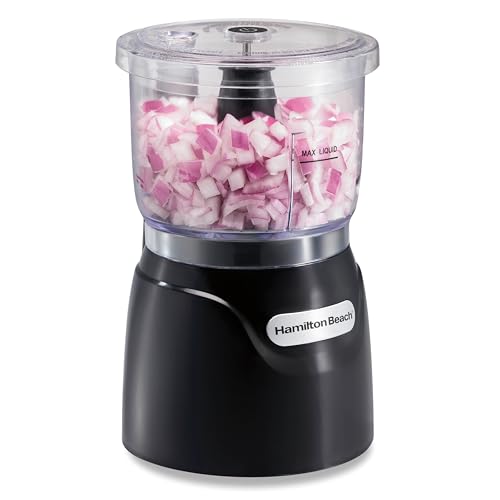
The Stack & Press is the simplest machine in this guide, and for a lot of two-person kitchens simple is exactly right. There are no dials and no programs: you stack the bowl, blade, and lid, then press down on the lid to chop and release to stop. That press-to-run design is a genuine pulse control — short presses for a coarse chop, a held press for a puree — and it makes the machine nearly impossible to use wrong. The 350-watt motor is honest power for a 3-cup bowl, enough for onions, carrots, nuts, and cooked chicken for a salad.
Strengths
- Press-top operation is intuitive pulse control; there is nothing to program and nothing to mis-set.
- At 3 cups, the bowl is perfectly sized for the smallest two-person jobs — a half batch of pesto, one onion, a handful of nuts.
- The bowl, lid, and blades go in the dishwasher, and the compact body stores in a drawer or a low cabinet.
Trade-offs
- No speeds, no whisk, no discs — chopping, mincing, and pureeing are the whole repertoire.
- The 3-cup bowl means hummus and salsa happen in two batches if you like leftovers.
- You have to hold the lid down to run it, so it is not a set-and-walk-away machine.
| Mini spec box — verified from the manufacturer’s listing | |
|---|---|
| Capacity | 3 cups |
| Motor | 350 watts |
| Operation | Stack & press (press lid to run) |
| Cleanup | Dishwasher-safe parts |
Think of this as the garlic-and-onion specialist. Two-person recipes constantly call for one onion, two cloves of garlic, a small piece of ginger, a handful of parsley — jobs that take longer to hand-mince than to load, press three times, and rinse. Apartment couples, RV cooks, and anyone whose “cooking for two” mostly means weeknight stir-fries and salads will get their money’s worth out of this chopper within the first month. It is a budget-tier machine and feels like one in the hand, but the job it does, it does without drama.
Best for: budget shoppers and small kitchens that mainly need fast, small chopping jobs done. / Not suited for: cooks who want discs, a whisk, or batches bigger than 3 cups at a time.
Check on Amazon — check the current price on Amazon; this model sits firmly in the budget tier.

Cuisinart Mini-Prep Plus 4-Cup DLC-4CHB — Best for Grinding Herbs and Spices
The Mini-Prep Plus has been a two-person kitchen staple for years because of one clever idea: its SmartPower blade is auto-reversing. Run it one way and the sharp edge chops; run it the other way and the blunt edge grinds. That second mode is what most mini choppers fake badly. For grinding small amounts of spices, coffee-adjacent tasks like cracking peppercorns, turning a handful of almonds into meal, or reducing hard cheese to a fluffy pile, the grind direction keeps material moving through the blade instead of plastering it to the bowl wall. The 250-watt motor and 4-cup bowl are sized exactly for couples.
Strengths
- Auto-reversing blade with distinct chop and grind directions — genuinely better for spices, nuts, and hard cheese than chop-only minis.
- The 4-cup bowl hits the two-person middle ground: big enough for a salsa batch, small enough for a tablespoon of spice blend.
- The bowl and lid are dishwasher-safe, and the touchpad controls wipe clean with no crevices for garlic paste to hide in.
Trade-offs
- 250 watts is modest; dense loads like thick nut butter are beyond it, and it will tell you so by slowing down.
- No discs, no whisk, no feed tube — it is a chopper and grinder, full stop.
- The touchpad offers less tactile pulse finesse than a press-top design for very coarse chops.
| Mini spec box — verified from the manufacturer’s listing | |
|---|---|
| Capacity | 4 cups |
| Motor | 250 watts |
| Blade | Auto-reversing stainless steel SmartPower blade (chop/grind) |
| Cleanup | Dishwasher-safe bowl and lid |
Couples who cook from scratch — grinding a garam masala for two, making a small jar of herb oil, blitzing breadcrumbs and parmesan for a pasta night — will use the grind mode weekly. It is also the pick we would give a two-person household that makes a lot of Thai, Indian, or Mexican food, where small quantities of aromatics and spices are constant. If your cooking is more about slicing vegetables for roasting, look at the FP-5 below instead; if it is about flavor bases, this is your machine.
Best for: scratch cooks for two who grind spices, herbs, nuts, and hard cheese in small amounts. / Not suited for: anyone wanting slicing discs or the power for thick nut butters.
Check on Amazon — check the current price on Amazon; it sits in the mid-range tier for mini processors.

KitchenAid 3.5 Cup Food Chopper KFC3516 — Best for the Smallest Counters
The KFC3516 is what the KFC0516 above grows down from: same design language, smaller 3.5-cup bowl, and an easy cord wrap that makes it the most cabinet-friendly machine in this guide. For a studio apartment couple, a galley kitchen, or a two-person household where the processor lives in a cupboard and comes out for dinner prep, that storage story matters as much as chopping performance. It keeps the two speeds plus pulse and the dishwasher-safe bowl, and the lid has the same drizzle basin for emulsifying small amounts of dressing.
Strengths
- The smallest footprint here, with a cord wrap that keeps it tidy in a drawer or cabinet between uses.
- Two speeds plus pulse — real control that the budget press-top machines do not offer.
- The drizzle basin in the lid makes small-batch mayonnaise and vinaigrette practical for two.
Trade-offs
- At 3.5 cups it is the second-smallest bowl here; a full hummus recipe needs two runs.
- No whisk accessory in the box, unlike its 5-cup sibling.
- No discs — slicing and shredding are out of scope by design.
| Mini spec box — verified from the manufacturer’s listing | |
|---|---|
| Capacity | 3.5 cups |
| Controls | 2 speeds plus pulse |
| Blade | Stainless steel multi-purpose blade |
| Storage | Easy cord wrap; dishwasher-safe work bowl |
The honest way to choose between this and the 5-cup KitchenAid is to look at your storage, not your cooking. If the machine will live on the counter, the bigger bowl is worth it. If it will live in a cabinet — which is where most two-person processors honestly live — the 3.5-cup model’s smaller body and cord management win, and the chopping performance on everyday two-person loads is effectively identical. It comes in a wide range of colors, which matters more than it should when a machine does sit out.
Best for: couples in small kitchens who store the processor away between uses. / Not suited for: cooks who regularly make full-size dip and salsa batches in one run.
Check on Amazon — check the current price on Amazon; it sits in the mid-range tier.

Cuisinart 5-Cup Chop & Shred FP-5 — Best Step-Up with a Feed Tube
The FP-5 is the only machine in this guide that is a true food processor rather than a chopper: it adds a wide-mouth feed tube and a reversible disc, so it slices cucumbers, shreds cheese and cabbage, and juliennes-style jobs that every other pick here simply cannot do. Cuisinart pitches it as a two-job machine — chopping and shredding — and for a two-person household that cooks vegetables seriously, those two jobs cover most of a week. The 5-cup bowl keeps it compact, and the reversible disc means one piece of hardware does both slicing and shredding, which keeps storage sane.
Strengths
- The wide-mouth feed tube and reversible disc add slicing and shredding — capabilities no other pick in this guide offers.
- Still a compact 5-cup machine, so small two-person loads chop evenly instead of rattling around.
- One reversible disc instead of a stack of separate discs keeps the parts count and storage burden low.
Trade-offs
- The feed tube is wide for its class but still requires trimming large vegetables to fit.
- More parts than a chopper — tube, pusher, disc, blade — means a slightly longer cleanup.
- It is a step up in price tier from the choppers here; check the current price on Amazon to judge the gap.
| Mini spec box — verified from the manufacturer’s listing | |
|---|---|
| Capacity | 5 cups |
| Disc | Reversible slicing/shredding disc |
| Feed tube | Wide-mouth feed tube |
| Style | Compact two-job chop & shred processor |
Choose this one if your two-person cooking involves a lot of salads, slaws, gratins, and stir-fries — the meals where slicing and shredding, not chopping, eat the prep time. A couple that makes a big chopped salad twice a week will feel the difference immediately: cucumbers, radishes, carrots, and cheese all go through the tube in seconds, evenly, with no knife work. It is the natural upgrade path if you have outgrown a mini chopper but a 10-cup machine would be absurd for your household size.
Best for: vegetable-heavy two-person cooking that needs real slicing and shredding in a compact body. / Not suited for: minimalists who only chop, or anyone who wants the absolute smallest storage footprint.
Check on Amazon — check the current price on Amazon; it sits in the upper tier of this compact group.

Hamilton Beach Stack & Snap 4-Cup 70510 — Best for Dips and Purees
The Stack & Snap 70510 solves the two annoyances of mini processors: assembly and leaks. The parts stack and snap together with no twisting or aligning, and the bowl is leak-proof — a detail anyone who has watched salsa liquid escape under a lid will appreciate. Its stainless quad blade works at two levels in the bowl, which helps purees come out smooth instead of layered, and the function set is broader than most minis: slicing, shredding, and pureeing are all on the menu alongside chopping, powered by a 250-watt motor.
Strengths
- Leak-proof, easy-assembly bowl — no twist-lock wrestling, and wet dips stay in the bowl.
- The quad blade processes at two heights, giving smoother hummus, dips, and purees than a single-level blade.
- Slice and shred functions at a 4-cup size make it one of the most versatile minis here.
Trade-offs
- 250 watts is fine for dips and vegetables but modest for dense, frozen, or very hard loads.
- The disc functions are light-duty — fine for a cucumber or a small block of cheese, not a catering tray.
- Stack & Snap parts are model-specific; keep the parts together so nothing gets separated in a drawer.
| Mini spec box — verified from the manufacturer’s listing | |
|---|---|
| Capacity | 4 cups |
| Motor | 250 watts |
| Blade | Stainless steel quad blade |
| Functions | Slice, shred, puree, chop; leak-proof bowl |
This is the pick for the couple whose processor use is 80 percent dips: hummus for two, a small batch of white bean dip, salsa, pesto, a pureed soup for tonight. The leak-proof seal means you can blend a wet dip to full smoothness without mopping the counter, and the two-level blade pulls the top of the mixture down instead of leaving a chunky layer floating above a smooth one. If that sounds like your cooking, it is a better fit than the more powerful but chop-focused picks above it.
Best for: couples who make dips, salsas, and purees constantly and hate leaky mini bowls. / Not suited for: heavy-duty grinding or anyone who needs high wattage for dense loads.
Check on Amazon — check the current price on Amazon; it sits in the budget-to-mid tier.
Comparison Table
| Pick | Badge | Key spec | Best for |
|---|---|---|---|
| KitchenAid 5 Cup Food Chopper KFC0516 | Best Overall | 5-cup bowl, 2 speeds + pulse, whisk accessory | All-round two-person cooking |
| Hamilton Beach 3-Cup Stack & Press | Best Budget | 3-cup bowl, 350W, press-to-chop | Fast small chopping jobs |
| Cuisinart Mini-Prep Plus DLC-4CHB | Best for Grinding Herbs and Spices | 4-cup bowl, 250W, auto-reversing chop/grind blade | Spices, herbs, nuts, hard cheese |
| KitchenAid 3.5 Cup Food Chopper KFC3516 | Best for the Smallest Counters | 3.5-cup bowl, 2 speeds + pulse, cord wrap | Storage in small kitchens |
| Cuisinart 5-Cup Chop & Shred FP-5 | Best Step-Up with a Feed Tube | 5-cup bowl, reversible disc, wide-mouth tube | Slicing and shredding for two |
| Hamilton Beach Stack & Snap 70510 | Best for Dips and Purees | 4-cup bowl, 250W, quad blade, leak-proof | Hummus, salsa, dips, purees |
How to Choose a Food Processor for a Two-Person Household
Start with the bowl, because bowl size is destiny in this category. For two people, 3 to 5 cups is the honest working range. Below 3 cups you are in garnish territory — fine for garlic, frustrating for salsa. Above 5 cups, small loads stop circulating and you start scraping the bowl walls with a spatula, which is the machine telling you it is too big for the job. A useful test: think of your three most common processing jobs and their actual volumes. If two of the three are under 2 cups, buy a 3- to 4-cup machine. If you regularly make dips or soups that yield leftovers for lunch, a 5-cup bowl earns its space.
Next, decide honestly whether you need discs. Choppers — five of the six picks here — chop, mince, and puree. Only machines with a feed tube and disc, like the Cuisinart FP-5 and, in lighter-duty form, the Hamilton Beach 70510, can slice and shred. Discs are transformative if you make salads and slaws weekly and pointless if you do not, and they add parts to wash and store. Many two-person households are happiest with a chopper plus a knife, because two cucumbers take a minute by hand; households that meal-prep vegetables in quantity feel the opposite.
Controls matter more than wattage at this size. Two speeds plus pulse, as on both KitchenAid models, gives you a coarse chop without liquefying — the difference between salsa and soup is about four pulses. Press-top designs like the Hamilton Beach Stack & Press give you pulse control through your hand, which many cooks find even more intuitive. Pure on/off machines with no pulse are the ones to avoid; they turn everything to mush or leave it chunky, with nothing in between. Wattage in this class runs from about 250 to 400 watts, and within that range bowl geometry and blade design matter more than the number on the box.
Finally, plan for storage and cleanup before you fall for features. Measure the cabinet or counter corner the machine will live in. Check that the bowl, lid, and blade are dishwasher-safe — all six picks here qualify — because a two-person household runs smaller dishwasher loads more often, and hand-washing a blade every night is how processors end up abandoned. Cord wraps, in-bowl storage, and stackable parts sound trivial in a listing and decisive in a 40-square-foot kitchen.
Matching the Machine to How Two People Actually Cook
It helps to sort two-person households into a few honest profiles. The weeknight minimalists cook three or four simple dinners a week — stir-fries, salads, pasta with a quick sauce — and need onion, garlic, and herb chopping to stop being a chore. The Stack & Press or the 3.5-cup KitchenAid serves them best: small, fast, gone into a cabinet. The scratch-cooking couple makes spice blends, curry pastes, and nut-based sauces; they should weight grinding ability heavily, which points to the Cuisinart Mini-Prep Plus and its reversing blade. The entertainers-for-two cook elaborate weekend meals and make dips, whipped creams, and emulsified sauces; the 5-cup KitchenAid with its whisk covers that repertoire in one footprint. And the vegetable-forward household, slicing something every day, should skip choppers entirely and start at the FP-5.
Also consider the second cook. In many two-person homes one partner cooks and the other cleans, and the cleaning partner’s opinion of a machine determines whether it survives. Machines with four or fewer parts, all dishwasher-safe, all stacking together, get used. Machines with a parts diagram get returned to the box. Every pick in this guide was chosen partly on that test: none has more than a bowl, a lid (or tube assembly), a blade or disc, and a base.
How to Use a Mini Food Processor Well for Two-Person Batches
Small processors reward good technique more than big ones, because there is less room for error. First, cut food into roughly even 1-inch pieces before it goes in the bowl; a mini blade cannot level a whole onion half the way a 14-cup machine can. Second, respect the fill line — for chopping, fill the bowl no more than about two-thirds, and for liquids stay lower, since small bowls splash. Two batches done right beat one overloaded batch that chops unevenly and strains the motor.
Third, pulse with intent. For a two-person salsa: five one-second pulses, scrape, then two more pulses and stop — check early and often, because the distance between chopped and pureed in a small bowl is about three seconds. For herbs, make sure the leaves are dry; wet herbs bruise and turn dark in any processor, and small bowls concentrate the effect. For nuts and spices on a reversing-blade machine like the Mini-Prep Plus, use the grind direction and work in short bursts, shaking the bowl between bursts so the fine meal does not pack under the blade.
Fourth, use the machine for the prep sequence, not just single ingredients. A two-person soup base — onion, carrot, celery — can go through one ingredient at a time with a quick wipe between, and the whole mise en place for dinner takes four minutes. Finally, wash or at least rinse the bowl and blade immediately. Dried garlic paste and hummus cement are the enemies of small kitchens, and a thirty-second rinse now beats a soaking session later. Store the blade inside the bowl, wrapped or seated as the manufacturer intends, so the sharp edge is never loose in a drawer with your fingers.
Common Buying Mistakes
The classic mistake is buying the big processor “just in case” — for the holiday, the party, the hypothetical freezer day. In practice the big machine makes the everyday jobs worse and the rare jobs slightly better, which is a bad trade for a two-person kitchen. If a genuine big-batch day arrives twice a year, a mid-size machine borrowed, rented, or simply doing two batches in your mini covers it. The second mistake is the opposite: buying an ultra-mini 1.5-cup garnish chopper as your only machine, then discovering that salsa, hummus, and soup bases all overflow it. Three cups is the practical floor for a primary two-person processor.
Third, shoppers fixate on wattage. A 250-watt mini with a well-shaped bowl out-chops a higher-wattage machine with a flat bowl and a lazy blade path, every time, on the loads these machines actually see. Fourth, people ignore the lid. A drizzle opening sounds like a gimmick until you try to make mayonnaise without one, dribbling oil over a running blade with the lid off and wearing half of it. Fifth, buyers forget to check what is in the box: whisk accessories, discs, and second bowls are sometimes separate purchases, and the listing title is the only reliable statement of what a given variant includes — which is why every pick here was verified against its actual listing.
The last mistake is storing the machine assembled with the blade loose and the cord dangling, then blaming the machine for a cluttered counter. Two minutes spent on the cord wrap and in-bowl storage is the difference between a tool that lives happily in a small kitchen and one that gets donated in a year.
What Two-Person Batches Actually Look Like, in Cups
Cup ratings are abstract until you translate them into dinner. A medium onion, chopped, is roughly 1 to 1.5 cups — so even the 3-cup Stack & Press handles a two-onion soup base in one load with room for the food to move. A standard hummus recipe built on one can of chickpeas comes to about 1.5 to 2 cups finished, which fits every bowl in this guide, though the 3-cup models will want the chickpeas added in two stages so the blade can establish the vortex. A two-person salsa — four tomatoes, half an onion, a jalapeño, cilantro — lands near 2 cups, comfortably inside a 4- or 5-cup bowl and a tight squeeze in a 3-cup one. Pesto for two servings of pasta is barely a cup; cauliflower rice from half a head is about 3 cups before cooking and is the one everyday job where the 5-cup bowls clearly earn their size.
Working capacity is always less than the printed capacity, and the gap matters more in small bowls. As a rule, a mini processor chops well at up to about two-thirds of its stated volume and handles liquids safely at about half. That is why the 5-cup KitchenAid and Cuisinart feel roomier than the numbers suggest, and why the 3-cup budget pick is best thought of as a 2-cup working machine. None of this is a defect — it is the physics of giving food room to fall back into the blade path — but it should set your expectations and your batching habits from day one.
Care, Blades, and Making a Mini Processor Last
Mini processors die from three causes: dull blades, cracked bowls, and motors cooked by long continuous runs. All three are avoidable. The blade is the heart of the machine, and its edge dulls fastest on exactly the jobs minis do most — hard cheese, nuts, ice-adjacent frozen fruit. Keep the blade honest by pulsing hard loads instead of running them, and never use the processor as an ice crusher unless the manufacturer explicitly allows it; none of the picks in this guide is sold as one. Hand-wash and dry the blade when you can, store it seated in the bowl rather than loose in a cutlery drawer, and it will stay sharp for years of two-person cooking.
Bowls crack when they are dropped, thermally shocked, or twisted against a stuck lid with food cemented in the seam. Rinse the bowl promptly, soak rather than force, and use the release the manufacturer designed instead of muscling parts apart. Motors in this class are built for bursts: ten to twenty seconds of running, a pause, another burst. A two-minute continuous grind is how a 250-watt motor earns a burning smell. Work in pulses, let dense loads rest, and the modest motors in these machines will outlast the bowls. Finally, wipe the base, keep the cord wrap used, and store the machine assembled and dry — a mini processor that is put away clean is a mini processor that gets used four nights a week instead of avoided.
Final Recommendation
For most two-person households, buy the KitchenAid 5 Cup Food Chopper KFC0516: it chops evenly, purees smoothly, whips and emulsifies with its whisk, and its 5-cup bowl is the most forgiving size for couples who cook real dinners. If money is the main constraint, the Hamilton Beach 3-Cup Stack & Press does the everyday chopping jobs for a budget-tier price and asks almost nothing of your storage space. If slicing and shredding matter — salads, slaws, gratins — skip the choppers and go straight to the Cuisinart FP-5. And if your cooking leans on ground spices and herbs, the Mini-Prep Plus’s reversing blade is the specialist tool this category offers.
Shopping the wider cluster? Compare these picks against the best food processors for 4 people if your household is growing, the best compact food processors for an even broader small-footprint field, and the best food processors for making baby food if a little one is on the way. Readers also found the best food processors for chopping and the best food processors for home use useful companion guides. Best Food Processors For 4 People Best Compact Food Processors Best Food Processors For Making Baby Food Best Food Processors For Chopping Best Food Processors For Home Use
Frequently Asked Questions
Do mini processors handle frozen ingredients or ice?
Not as a rule, and none of the picks in this guide is sold as an ice crusher. Small frozen items — a few frozen strawberries into a sauce, frozen herbs — are fine in short bursts, but a bowl of ice cubes will dull the blade and strain a compact motor. If frozen drinks are a two-person ritual, that is a blender’s job; keep the mini processor for the dry and semi-dry work it is built for, and it will last far longer.
What size food processor is best for 2 people?
A bowl between 3 and 5 cups is the sweet spot. It is large enough for a batch of salsa, hummus, or soup base for two, and small enough that a single onion or a handful of herbs still circulates through the blade instead of rattling around. Bigger bowls chop small loads unevenly; smaller ones force constant batching.
Can a mini food processor replace a full-size one for a couple?
For most couples, yes — chopping, mincing, pureeing, and small-batch grinding are covered completely. What a mini cannot do is knead dough, shred large volumes of cheese, or slice for a crowd. If those jobs are weekly rather than rare, step up to a compact model with a feed tube like the Cuisinart FP-5, or a mid-size machine.
Is 250 watts enough for a two-person food processor?
For the loads a 3- to 5-cup bowl holds — vegetables, herbs, nuts in small amounts, dips — yes. Wattage matters less at this size than blade design and bowl shape. Where low wattage shows its limits is dense work: thick nut butter, frozen fruit, or hard grinding in quantity. Work in short bursts and let the machine rest between them.
Can these small processors grind spices and coffee?
Spices, yes — especially on a model with a dedicated grind mode like the Cuisinart Mini-Prep Plus, whose blade reverses to a blunt grinding edge. Small amounts of peppercorns, cumin, or coriander for a two-person recipe grind well. Coffee is possible in a pinch but uneven; a burr grinder is a far better tool if coffee matters to you, and spice residue will flavor the coffee and vice versa.
How do I stop a small processor from turning salsa into soup?
Pulse, do not run. Use one-second pulses, check after every three or four, and stop earlier than you think — the mixture keeps moving for a moment after the blade stops. Also chop watery ingredients like tomatoes last and briefly, and drain them first if the recipe allows. Two speeds help: start on low for a coarse texture.
Should a two-person household buy a mini processor or a blender instead?
They do different work. A blender needs liquid to form a vortex and excels at smoothies and soups; a mini processor works with dry and semi-dry loads — onions, herbs, nuts, crumbs, dough-adjacent mixtures — and gives you texture control a blender cannot. For two people who cook dinners, the processor is the more-used tool; for two people who drink breakfast, the blender wins. Many couples eventually own both, but if counter space forces a choice, match it to whether your week is built around smoothies or around cooked meals, and know that a whisk-equipped chopper like the KitchenAid 5-cup covers more of the middle ground than most minis.
Are the bowls and blades really dishwasher-safe on these picks?
Yes — every pick in this guide lists dishwasher-safe bowls and blades (or dishwasher-safe parts generally) in its verified listing details. The motor base is never submersible; wipe it with a damp cloth. Hand-washing the blade occasionally is still wise, since dishwasher detergent dulls edges over time, but for nightly two-person cooking the dishwasher convenience is real and safe to use.


