Disclosure: airfryerkitchensupply.com is reader-supported. When you buy through links on our site, we may earn an affiliate commission at no extra cost to you.
Where to Buy
Every verified pick in this guide to the best food mixers for bread making is sold through Amazon, where you can check the current price on Amazon, confirm the exact configuration, and read the full manufacturer specification sheet before you commit. Listings for this category change often — finishes go in and out of stock and bundles change — so use the links below to land on the exact model we verified, not a look-alike variant.
- Ankarsrum Original Stand Mixer AKM6230 — Best Overall for Bread: check price on Amazon.
- Bosch Universal Plus Stand Mixer 500 Watt, 6.5 Quarts (Bundle) — Best for Big Batches: check price on Amazon.
- KitchenAid 7-Quart Bowl-Lift Stand Mixer KSM70 (Contour Silver) — Best Stand Mixer for Bread: check price on Amazon.
- KitchenAid Commercial Series 8-Qt Bowl-Lift Stand Mixer KSM8990 — Best Heavy-Duty: check price on Amazon.
- Ninja Professional Plus Food Processor BN601 — Best for Small Dough Batches: check price on Amazon.
- Kitchen in the Box Stand Mixer 8.5-QT 900W — Best Budget Big Bowl: check price on Amazon.
The best food mixers for bread making are not simply the strongest mixers — they are the ones whose kneading action, capacity and gearing match how dough actually behaves. Dough is the hardest load in home baking: it climbs, it resists, it heats the motor, and it punishes weak design twice a week for years. A mixer that creams beautifully can still be a poor bread machine, which is why this guide is organized around kneading first and everything else second.
The category divides by philosophy. Dedicated dough machines — the Ankarsrum and Bosch below — were designed around the dough bowl and knead large, stiff batches with a gentleness or a thoroughness that generalist stand mixers cannot match. Bowl-lift stand mixers are the versatile middle: real dough capability inside a machine that also creams and whips. And one food processor earns a place for small, fast doughs, labeled honestly as such. Every pick was verified, with capacities and included rollers, hooks and blades taken from the actual listings.
A note on flour capacity, the most honest number in this category: every machine has one, printed in its manual, and exceeding it is the leading cause of the motor failures owners blame on quality. This guide discusses capacity in batch terms — loaves and grams of flour as bakers actually measure — and the buying guide explains how to size a machine to your bread habit rather than your ambitions.
In this guide
Quick Picks
If you only read one section, make it this one. These are the six best food mixers for bread making we would shortlist for real kitchens, each with a clear job to do:
- Best Overall for Bread — Ankarsrum Original Stand Mixer AKM6230: The Swedish roller-and-scraper system that kneads like hands — the bread specialist serious bakers graduate to.
- Best for Big Batches — Bosch Universal Plus Stand Mixer 500 Watt, 6.5 Quarts (Bundle): A bottom-drive 6.5-quart system famous for kneading batch after batch of whole-grain dough — this bundle adds the NutriMill dough hook extender.
- Best Stand Mixer for Bread — KitchenAid 7-Quart Bowl-Lift Stand Mixer KSM70 (Contour Silver): The versatile route to serious dough: a rigid bowl-lift frame, 7-quart bowl and 11 speeds in a machine that still creams and whips.
- Best Heavy-Duty — KitchenAid Commercial Series 8-Qt Bowl-Lift Stand Mixer KSM8990: NSF-certified commercial construction with an 8-quart bowl — the stand mixer for cottage bakers and relentless home production.
- Best for Small Dough Batches — Ninja Professional Plus Food Processor BN601: A 9-cup, 1000W-peak processor with Auto-iQ dough preset — fast, cool kneading for single pizza and bread batches.
- Best Budget Big Bowl — Kitchen in the Box Stand Mixer 8.5-QT 900W: An 8.5-quart tilt-head marketed for heavy dough at a budget price — maximum bowl volume for new bread bakers watching the spend.
How These Picks Were Chosen
Verification came first: each model was confirmed so the bowl sizes, motor ratings and included kneading tools in this guide match the real listings. Then candidates were judged as bread machines specifically: kneading action (roller, hook, or planetary hook geometry), sustained low-speed torque, honest flour capacity, bowl design for dough observation, and how the machine handles the full dough spectrum from slack ciabatta to stiff bagel dough.
We weighted repeated use over single heroics. Any strong mixer can knead one dough once; bread machines are bought for the fiftieth consecutive Saturday. Gearing material, thermal behavior, parts availability and the manufacturer’s own flour ratings therefore counted for more than headline wattage, which in this category is close to meaningless — the two best dough machines here use opposite motor philosophies and both out-knead high-wattage generalists.
Excluded: hand mixers entirely (dough hooks on a hand mixer are an emergency measure, not a bread program), tilt-head stand mixers for the heavy-duty badges (their hinge is the wrong tool for stiff dough, however good they are at cake), and any product whose dough claim rests on a chopping blade without a dough function. The one processor included has a genuine dough program and is badged for small batches only.
The 6 Best Food Mixers for Bread Making, Reviewed
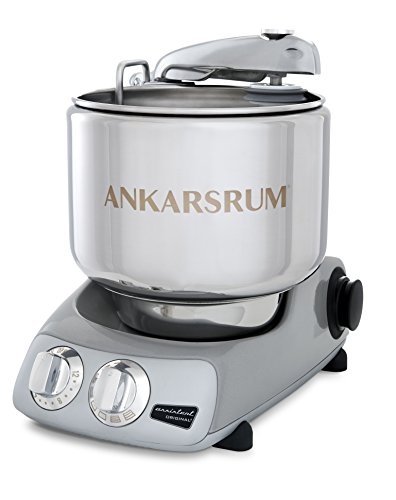
Ankarsrum Original Stand Mixer AKM6230 — Best Overall for Bread
The Ankarsrum does not knead like other mixers, and that is its entire case. Instead of a hook dragging through dough, its bowl rotates while a roller and scraper work the dough against the bowl wall — a motion closer to hand kneading than anything else in this guide. The result is exceptional gluten development in large and stiff batches without the dough climbing a hook or the machine straining, and the open bowl makes adding flour and judging hydration effortless. It suits committed bread bakers making multiple loaves or stiff doughs weekly. Cake-first bakers should note its whipping uses a separate bowl and beaters — capable, but this machine’s heart is dough.
Strengths
- Roller kneading develops gluten gently and thoroughly
- Handles large and stiff dough batches other mixers refuse
- Open rotating bowl makes hydration judgment easy
Trade-offs
- Premium price — a specialist’s purchase
- Learning curve differs from hook mixers
- Whipping and creaming use a separate bowl setup
| Configuration | Rotating-bowl roller/scraper mixer |
| Finish (per Amazon listing) | Jubilee Silver, AKM6230 |
Watch an Ankarsrum knead and the difference is visible within a minute: the dough folds and presses, folds and presses, in a rhythm that builds elasticity without tearing — the exact failure mode of aggressive hooks in stiff dough. Bakers working whole-grain, low-hydration or double batches report the machine finishing doughs that stall prestige stand mixers, and doing it quietly enough to hold a conversation. It is also famously long-lived, with a design that has been refined rather than replaced for decades. If bread is your primary baking and the budget exists, this is the machine the hobby eventually points to.
Best for: Committed bread bakers, stiff and large doughs, whole grains / Not suited for: Cake-first bakers and small occasional batches
Check on Amazon — check the current price on Amazon for the exact configuration reviewed here.
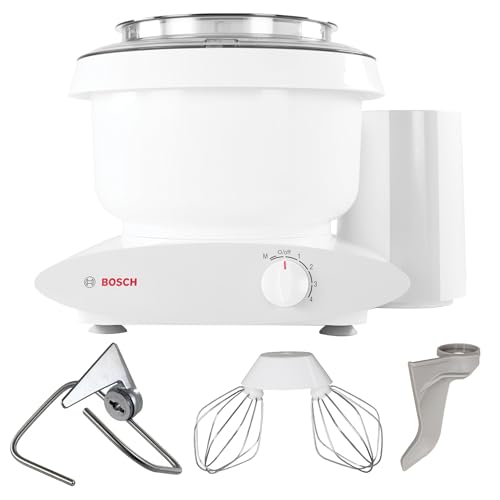
Bosch Universal Plus Stand Mixer 500 Watt, 6.5 Quarts (Bundle) — Best for Big Batches
Bosch’s Universal Plus inverts the stand mixer: the drive sits in the base, the bowl mounts over a central column, and twin whips or a dough hook work from below. The design is beloved by high-volume and whole-grain bakers because it kneads large batches — multiple loaves at once — with a thoroughness that made it the default machine of serious home milling households. This verified bundle includes wire whips, a dough hook and the NutriMill dough hook extender, which improves the hook’s reach in the bowl. It is a big-batch specialist: small single doughs are better served by the bowl-lift KitchenAids below.
Strengths
- Kneads large, heavy batches including whole-grain doughs
- Bottom-drive design with an open, accessible bowl
- Bundle includes the dough hook extender for better bowl reach
Trade-offs
- Overkill and less efficient for one small dough
- Plastic bowl aesthetic divides opinion
- Learning curve for bakers raised on top-drive mixers
| Motor (per Amazon listing) | 500 watts |
| Bowl | 6.5 quarts |
| Included (per Amazon listing) | Wire whips, dough hook, NutriMill dough hook extender (bundle) |
The Bosch’s reputation was built in farmhouse kitchens kneading four loaves of whole-wheat at a time, and it holds because the engineering suits the load: a belt-driven bottom drive with torque to spare and a bowl shape that keeps dough in the hook’s path instead of letting it ride a wall. Five hundred watts sounds modest next to four-figure headline numbers elsewhere, which is precisely the lesson of this category — gearing and design knead dough, not wattage labels. If your bread habit is measured in loaves per week rather than per month, the Universal Plus is the workhorse pick, and this bundle’s extender closes its one known dough-reach quirk.
Best for: High-volume and whole-grain bread bakers / Not suited for: Single small doughs and cake-first bakers
Check on Amazon — check the current price on Amazon for the exact configuration reviewed here.

KitchenAid 7-Quart Bowl-Lift Stand Mixer KSM70 (Contour Silver) — Best Stand Mixer for Bread
Not every bread baker wants a dough-only specialist, and the KSM70 is the answer for those who do not. Its fixed bowl-lift head removes the hinge flex that limits tilt-heads, the 7-quart bowl takes double bread batches, and eleven speeds — including the half-speed fold — keep it a complete baking machine for cakes and meringues on the days between loaves. In this Contour Silver configuration it is the same machine we badge for large batches in our stand-mixer guide, here judged on its dough merits: strong, composed, and honest about its flour ceiling. Respect that ceiling and it will knead weekly for years.
Strengths
- Rigid bowl-lift frame stays composed under dough load
- 7-quart bowl handles double batches
- Full stand-mixer versatility beyond bread
Trade-offs
- Flour capacity still caps stiff whole-grain batches
- Tall and heavy — a permanent counter resident
- Premium price for a generalist
| Configuration | Bowl-lift stand mixer |
| Bowl | 7-quart |
| Speeds | 11 (including 1/2 speed) |
The KSM70’s dough case is about composure. Where a tilt-head nods under a stiff dough’s rhythm, the bowl-lift simply works, revolution after revolution, and the big bowl gives dough room to fold instead of climbing. It will not match the Ankarsrum’s finesse on very stiff dough or the Bosch’s appetite for quadruple batches — specialists remain specialists — but it covers the realistic bread program of a mixed baker (a double loaf batch, pizza for six, enriched holiday breads) while remaining the best cake machine in this article. For one-machine kitchens that bake everything, it is the bread pick.
Best for: Mixed bakers who want one machine with real dough strength / Not suited for: Maximum-capacity or very stiff dough specialists
Check on Amazon — check the current price on Amazon for the exact configuration reviewed here.

KitchenAid Commercial Series 8-Qt Bowl-Lift Stand Mixer KSM8990 — Best Heavy-Duty
The KSM8990 is KitchenAid’s commercial answer: NSF-certified, an 8-quart bowl, and a bowl-lift build specified for environments where the mixer runs daily under load — which describes cottage-food bakers, market-stall producers and the home baker whose ‘hobby’ now has customers. Its dough case is endurance: sustained kneading sessions, batch after batch, with components and a service culture built for repair rather than replacement. It is more machine than a weekly-loaf household needs, and priced like it; buy it when your baking has a schedule and a revenue line, or when you simply want the last stand mixer you will purchase.
Strengths
- NSF-certified commercial build for daily duty
- 8-quart bowl — the largest stand-mixer capacity here
- Service and parts culture aimed at repair, not replacement
Trade-offs
- Commercial price and size for home kitchens
- Small batches mix inefficiently in the big bowl
- Utilitarian finish and presentation
| Configuration | Bowl-lift stand mixer, commercial |
| Bowl | 8-quart |
| Certification (per Amazon listing) | NSF Certified Commercial Series |
Heavy-duty is a duty cycle, not a mood. The commercial KitchenAid earns the badge by being specified, certified and supported for the workload that wears out domestic machines: daily dough, long sessions, no delicate feelings about flour dust. In bread terms that means the double and triple batches of a production morning, kneaded in sequence without thermal sulking. Home bakers without production needs will find the KSM70 the same idea in a friendlier size; producers will recognize the KSM8990 as the correct tool and the cheaper purchase over any three-year horizon.
Best for: Cottage bakers, market producers, daily heavy use / Not suited for: Casual weekly bakers and small kitchens
Check on Amazon — check the current price on Amazon for the exact configuration reviewed here.

Ninja Professional Plus Food Processor BN601 — Best for Small Dough Batches
The BN601 earns its place for a specific bread job: the single small batch, mixed fast and cool. Its Auto-iQ dough program pulses and runs the dough blade in the pattern processors need — short of continuous running, which overheats dough — and a pizza dough or single loaf comes together in about a minute of machine time, with almost no motor heat in the dough. That speed suits enriched and pastry-adjacent doughs and weeknight pizza perfectly. It is not a bread program: batch size is capped by the 9-cup bowl, stiff doughs strain it, and gluten development benefits from a short hand finish. Judged as the small-batch specialist, it is excellent.
Strengths
- Auto-iQ dough preset automates correct processor technique
- Fast, cool mixing suits weeknight pizza dough
- 9-cup bowl doubles as a full baking-prep processor
Trade-offs
- Single-batch ceiling — no double loaves
- Dough benefits from a brief hand-knead to finish
- Stiff, low-hydration doughs are beyond its brief
| Bowl | 9-cup |
| Base (per Amazon listing) | 1000W peak |
| Programs (per Amazon listing) | Auto-iQ presets including dough |
Processor dough is a legitimate technique with a long pedigree — the food processor’s speed develops dough before friction can warm it, which is why lean pizza and flatbread doughs suit it so well. The BN601’s contribution is programming: its dough preset encodes the pulse-and-run rhythm that beginners otherwise learn by ruining a batch, and its bowl size matches the single-batch reality of most weeknight baking. Keep it in that lane, finish with thirty seconds of hand kneading, and it produces dough that embarrasses the idea that bread requires a flagship machine.
Best for: Weeknight pizza and single-loaf bakers, small kitchens / Not suited for: Volume baking and stiff doughs
Check on Amazon — check the current price on Amazon for the exact configuration reviewed here.

Kitchen in the Box Stand Mixer 8.5-QT 900W — Best Budget Big Bowl
This pick is for the new bread baker whose recipes keep outgrowing small bowls and whose budget will not stretch to the specialists above. The 8.5-quart bowl is the largest in this guide, the listing positions the 900-watt machine for heavy dough work, and ten speeds with the standard three attachments cover the beginner’s repertoire. The honest caveats belong in the same paragraph: it is a tilt-head, so very stiff dough will find the hinge’s limits, and a value brand’s parts and service network is thinner than the majors’. Treat it as a high-capacity soft-to-medium dough machine, knead in sensible batches, and it returns remarkable volume per dollar while you learn whether bread becomes a weekly habit worth a specialist.
Strengths
- 8.5-quart bowl — largest capacity in this guide
- Budget price for the size class
- Ten speeds and full core attachment set
Trade-offs
- Tilt-head hinge limits the stiffest doughs
- Value-brand parts and service network
- Newer model with a shorter track record
| Configuration | Tilt-head stand mixer |
| Bowl | 8.5-quart with handle (per Amazon listing) |
| Motor (per Amazon listing) | 900 watts |
| Speeds | 10 |
Budget bread machines fail in one predictable way: a big bowl on a frame that cannot use it. This one’s saving grace is that its dough ambitions and its price are aligned — it asks to be judged as a learning and volume machine for standard doughs, not as an Ankarsrum rival. Pizza dough, sandwich loaves, dinner rolls and enriched doughs in generous batches are its honest territory, and for a baker’s first year that territory is most of the map. If bread becomes a weekly production, this machine will have taught you exactly which specialist to buy next; if it stays a monthly pleasure, it may be all the bread mixer you ever need.
Best for: New bread bakers needing volume on a budget / Not suited for: Stiff dough production and heirloom expectations
Check on Amazon — check the current price on Amazon for the exact configuration reviewed here.
Comparison Table
| Pick | Badge | Key Spec | Best For |
|---|---|---|---|
| Ankarsrum Original Stand Mixer AKM6230 | Best Overall for Bread | Roller + scraper kneading system | Committed bread bakers, stiff and large doughs, whole grains |
| Bosch Universal Plus Stand Mixer 500 Watt, 6.5 Quarts (Bundle) | Best for Big Batches | 500W bottom-drive, 6.5-qt bowl | High-volume and whole-grain bread bakers |
| KitchenAid 7-Quart Bowl-Lift Stand Mixer KSM70 (Contour Silver) | Best Stand Mixer for Bread | 7-qt bowl-lift, 11 speeds | Mixed bakers who want one machine with real dough strength |
| KitchenAid Commercial Series 8-Qt Bowl-Lift Stand Mixer KSM8990 | Best Heavy-Duty | 8-qt bowl-lift, NSF commercial | Cottage bakers, market producers, daily heavy use |
| Ninja Professional Plus Food Processor BN601 | Best for Small Dough Batches | 9-cup processor, Auto-iQ dough preset | Weeknight pizza and single-loaf bakers, small kitchens |
| Kitchen in the Box Stand Mixer 8.5-QT 900W | Best Budget Big Bowl | 8.5-qt tilt-head, 900W, 10 speeds | New bread bakers needing volume on a budget |
How to Choose the Best Food Mixers for Bread Making
Start with your flour math, because bread machines are bought in grams of flour per batch. A single standard loaf uses roughly 500 g of flour; a double batch, 1 kg; a serious Saturday, more. Every machine in this guide has an honest comfort zone in those terms — the processor around a single batch, the bowl-lift stand mixers around a double, the Bosch and Ankarsrum beyond it — and buying below your real batch size means either split batches forever or a strained motor. Buy for your actual Saturday, with one step of headroom.
Then choose your kneading philosophy. Hook machines (KitchenAid bowl-lifts) knead by dragging and folding — effective, familiar, and shared with a machine that also does all your other baking. Roller machines (Ankarsrum) knead by pressing and folding against a rotating bowl — gentler, better at extremes of stiffness and slackness, and dough-only in spirit. Bottom-drive (Bosch) kneads big and wet or dry with equal indifference. Processors knead small and fast. None is ‘correct’; each matches a dough style and a baker’s temperament, and the reviews above are written to help you recognize yours.
- Stiff doughs (bagel, low-hydration whole grain) demand rigid frames: bowl-lift, roller or bottom-drive — not tilt-heads.
- Slack doughs (ciabatta, focaccia) reward the open-bowl designs where you can watch and adjust hydration.
- Enriched doughs (brioche, panettone-style) want patient, cool kneading and a machine that will not heat the butter out of the dough.
- Frequency multiplies everything: a weekly baker should buy one class above a monthly baker at the same batch size.
Finally, read the manual’s flour capacity before purchase — reputable makers publish it — and treat any brand that will not state one as answering your question. Capacity honesty is the dividing line between bread machines and mixers that merely tolerate dough.
Kneading Actions Compared: Roller, Hook, Bottom-Drive and Blade
The roller (Ankarsrum) imitates the hand: dough is pressed against the bowl wall, folded, pressed again. Gluten develops in sheets rather than strands, stiff doughs cannot climb away from the action, and the dough’s temperature stays low because nothing is being torn. Its weakness is unfamiliarity — speeds and timings from hook recipes translate imperfectly, and the first two bakes are calibration bakes.
The planetary hook (KitchenAid bowl-lifts) is the reference action most recipes silently assume: the hook picks up the dough, stretches it against the bowl, and drops it, thousands of times. It is versatile, predictable and well documented, with two known limits — dough climbing the hook on slack mixes, and frame flex setting the stiffness ceiling. The bottom-drive hook (Bosch) keeps dough engaged by geometry, excelling at volume. The processor blade is the sprinter: total dough in a minute, cool and fast, with a hard ceiling on batch size and stiffness and a tendency to overwork if you blink. Choose by the dough you make most, and every action on this list will feel like the right one.
Flour Capacity, Hydration and Other Numbers That Actually Matter
Hydration — water weight as a percentage of flour — predicts machine stress better than batch size alone. A 1 kg flour batch at 75% hydration (soft, slack) is gentle work; the same flour at 55% (stiff) is the hardest load a home mixer will ever see. When a manual states a flour capacity, it assumes a medium dough; derate it mentally for stiff recipes and you will never meet the thermal cutoff mid-knead. This is also why experienced bakers mix stiff doughs in two stages — a shaggy rest (autolyse) before kneading — which can halve the machine’s effective workload at zero equipment cost.
Bowl size interacts with capacity in a way spec sheets blur: a big bowl with a modest motor (the budget pick) kneads standard doughs in volume but not stiff ones, while a smaller bowl on a rigid frame (the bowl-lifts) handles stiffness at moderate volume. Match the pair — frame first for stiffness, bowl second for volume — and the machine will feel overbuilt for your bread, which is precisely the feeling that predicts a decade of Saturday loaves.
Dough Technique That Makes Any of These Machines Better
Machines knead; bakers manage. Four habits multiply any bread mixer’s results. Autolyse: mix flour and water to a shaggy mass and rest 20–40 minutes before adding salt and kneading — the flour hydrates, gluten begins forming unaided, and machine time drops by a third. Temperature discipline: use cool water for long kneads, because friction adds heat and a dough that finishes above roughly 26–27°C ferments on the machine’s schedule, not yours. The windowpane test, not the timer, ends kneading: stretch a small piece thin enough to pass light without tearing; timers lie across flours and hydrations, the membrane does not. And rest the machine on production days the way you rest the dough — ten minutes between batches keeps motors in their comfort zone for years.
When dough misbehaves, diagnose before blaming hardware. Climbing the hook means the dough is slack or the batch small for the bowl — a minute of hand folding or a slightly larger batch fixes it. Dough tearing instead of stretching means it needs rest, not more speed. A machine that slows audibly on a rated batch is telling you the hydration dropped below the plan; a splash of water is a legitimate mid-knead correction. Bakers who learn these reads stop shopping for new mixers, because the one they own suddenly performs.
Whole Grains, Enriched Doughs and the Specialist Cases
Whole-grain doughs are the stress test that separates this guide’s tiers. Bran cuts gluten strands as they form, so whole-wheat doughs need thorough kneading yet punish over-kneading by collapsing — the roller’s gentle persistence and the Bosch’s volume torque earned their reputations exactly here. Fresh-milled flour intensifies everything: it drinks water slowly, heats faster, and rewards the open-bowl designs where hydration can be adjusted by feel mid-knead. If whole grains are your staple rather than your variation, weight the two specialists at the top of this guide heavily.
Enriched doughs invert the problem: the enemy is heat, not stiffness. Brioche asks for long kneading while butter stays emulsified rather than melted, which favors machines that knead efficiently at moderate speed in a cool bowl — and bakers who chill the bowl and add cold butter gradually. The processor, surprisingly, has a niche here for small enriched batches precisely because it finishes before friction matters. Match the machine to the dough family you bake most, and the specialist cases stop being special.
From Machine to Loaf: Matching the Mixer to Your Bread Program
Name your bread program in loaves per week and dough types, and the right machine usually names itself. One or two standard loaves weekly, mostly white and sandwich styles: the bowl-lift KSM70 or even the processor for singles covers you completely, and the specialists are indulgence. Four-plus loaves with whole grains in the rotation: the Bosch or Ankarsrum stops being indulgence and becomes arithmetic, because their cost divides across hundreds of loaves and thousands of unstrained kneads. Production for sale, at any dough type: the commercial KitchenAid’s duty cycle is the specification that matters, and buying below it is a false economy measured in downtime.
The reverse audit matters too. A baker whose program is actually ‘pizza Fridays and a monthly focaccia’ owns one of the happiest setups in this guide with the Ninja processor and a bench scraper, and should resist every upgrade urge the internet manufactures. Bread baking’s equipment curve has a long, flat, satisfying middle where technique — fermentation timing, shaping, steam in the oven — improves loaves far more than machinery does. Buy the machine that removes kneading as your bottleneck, then spend the following year removing fermentation as the next one. That order of operations is how good home bakers are actually made.
The First Month With a Bread Machine: Calibration, Not Disappointment
Every bread machine in this guide has a first month, and it follows a pattern new owners should expect rather than fear. Week one produces a loaf slightly worse than your hand-kneaded best, because the machine’s timings are strangers to your flour. Week two improves sharply once you learn its dough speed’s sound — the relaxed churn of correct kneading versus the labored note of a batch one splash of water too dry. By week four, most bakers report the crossover: machine loaves matching hand loaves for effort that no longer counts as exercise, and the first experiments beyond the safe recipe — a higher hydration, a whole-grain percentage creeping upward — begin.
Three calibration habits shorten the month. Keep a notebook page per dough: flour weight, hydration, kneading minutes, dough temperature at the end, and the result in three words. Change one variable per bake; bread punishes shotgun experimentation by teaching nothing. And bake the same recipe five times before judging the machine — the first loaf measures your unfamiliarity, the fifth measures the equipment. Bakers who quit a good machine in week one are usually quitting their own learning curve, which would simply restart, at full price, inside the next machine’s bowl.
The Ankarsrum’s curve is the steepest and the most documented — its roller logic inverts hook habits — while the Bosch and bowl-lifts feel familiar within a bake or two. All of them share the same destination: a Saturday routine where the machine kneads, you shape and judge, and the bread that emerges is limited by fermentation and the oven rather than by anyone’s arms. That is the entire promise of this category, and a month is a fair price for it.
A word about secondhand machines belongs here, because bread mixers — the Ankarsrum and Bosch especially — circulate in a healthy used market, built as they are for decades. A used specialist at half price, inspected for smooth running through its speeds and a bowl and roller or hook in sound condition, is often a better bread purchase than a new generalist at the same money. The calibration month applies identically; only the price of admission changes. Bakers who haunt that market patiently are, disproportionately, the ones whose kitchens end up containing the machines everyone else is still saving for.
However the machine arrives, give it a permanent home within reach of the flour. Bread is a habit before it is a skill, and habits obey friction: a kneading machine that must be fetched from a garage shelf will be fetched monthly, while the same machine parked beside the flour bin gets used on a Wednesday whim. Set up the station once, properly, and the bread program this guide keeps mentioning stops being a program at all — it just becomes how your kitchen works.
Flour storage, since the station now invites it: keep your working flour in a wide, sealed bin the scoop or scale can enter directly, near the machine, and your reserve flour cool and dark elsewhere. Bread programs die of small frictions — the bin in another room, the scale with flat batteries — far more often than of equipment. Remove the frictions once, and the machine you chose from this guide becomes the most-used appliance in the house, which is the only ranking that was ever going to matter.
Do the same for the scale and the bench scraper while you are at it — the two cheapest tools in bread, and the two whose absence is felt in every single session, unlike any premium feature on any machine in this guide.
With the frictions gone and the flour close, most bakers find their bread program quietly doubles within a season — not because the machine demanded it, but because nothing was standing in the way anymore.
How to Knead Bread Dough in a Mixer: Setup and Step-by-Step
Good machine kneading is a sequence, not a button. This is the workflow that suits every machine in this guide, with the specialist notes where they differ.
- Weigh everything, flour first. Bread rewards scales over cups more than any other baking, and machine capacity is rated in flour weight — know your batch in grams before it enters the bowl.
- Combine flour and water (hold back a splash) and mix to a shaggy mass. Rest 20–40 minutes for the autolyse; your kneading time and the dough’s smoothness will both improve.
- Add salt and any remaining water, then knead at the machine’s dough speed — speed 2 on KitchenAid-style dials, the roller’s gentle default on the Ankarsrum, the dough preset on the Ninja processor.
- Watch the dough, not the clock: it should move from shaggy to smooth to elastic, clearing the bowl sides on hook machines and forming a coherent mass on the roller.
- Test with the windowpane: a small piece stretched thin should pass light without tearing. If it tears, knead two more minutes and retest; if it feels tight and resistant, rest it ten minutes instead.
- For enriched doughs, add cold butter in pieces only after the base dough is smooth, letting each addition absorb before the next.
- Finish with a brief hand fold on the bench — thirty seconds that tells your hands the dough’s true state better than any dial — then bowl, cover, and proof.
Clean up with dough in mind: soak the bowl and hook immediately (dried dough is concrete), keep water out of the drive hub, and wipe flour dust from the head and vents. A bread machine’s worst enemy is not work — it is residue and neglect between Saturdays.
Common Buying Mistakes
Exceeding the flour capacity because the bowl looks half empty. Dough expands in work, not just volume. The manual’s flour limit is a torque rating, and ignoring it is the fastest route to a thermal shutdown or a worn gear set.
Kneading at high speed to save time. Dough speeds exist because gluten and motors both fail at speed. Fast kneading heats dough, tears structure and overheats drives; slow kneading is not the cautious option, it is the correct one.
Skipping the autolyse. Twenty resting minutes do a third of the kneading for free. Bakers who skip it work their machines harder for worse dough and blame the equipment.
Judging doneness by the timer. Flours and hydrations vary too much for clock kneading. The windowpane test is the standard because it measures the dough, not the schedule.
Adding all the water at once. Hold back a splash. Flour absorption varies by brand and season, and it is far easier to add water to a stiff dough than to rescue a soup with flour.
Buying a cake machine for a bread habit. Tilt-heads and light mixers are excellent at their jobs. Weekly stiff dough is not their job, and no badge in a listing changes the physics of a hinge.
Final Recommendation
If bread is the center of your baking, the Ankarsrum AKM6230 is the machine this guide exists to point you to — nothing else kneads like it, and committed bakers do not outgrow it. Volume and whole-grain bakers should choose the Bosch Universal Plus bundle; mixed bakers who want one machine for everything should take the 7-quart KSM70 bowl-lift; producers should step to the commercial KSM8990 without hesitation. Weeknight pizza bakers will be delighted by the Ninja BN601’s small-batch dough, and new bakers learning the craft get the most bowl per dollar from the Kitchen in the Box 8.5-Qt. Whichever you choose, weigh your flour, autolyse, knead slowly, and test the windowpane — technique will make any of these machines feel like the best one.
Start with the shortlist: Ankarsrum Original Stand Mixer AKM6230, Bosch Universal Plus Stand Mixer 500 Watt, 6.5 Quarts (Bundle), KitchenAid 7-Quart Bowl-Lift Stand Mixer KSM70 (Contour Silver) — check price on Amazon for each and buy the one whose strengths match how you actually cook.
Related guides in this program: Best Food Mixers For Baking; Best Electric Mixers On Stands; Best Electric Mixers For Baking; Best Food Mixers And Blenders; Best Stand Mixers; Best Bread Machines.
Frequently Asked Questions
What is the best type of mixer for bread dough?
For dough alone, dedicated designs lead: roller mixers like the Ankarsrum for finesse across stiffness levels, and bottom-drive machines like the Bosch for volume. Bowl-lift stand mixers are the best generalists — real dough strength plus full baking versatility. Processors suit small, fast batches only.
How much flour can a stand mixer knead at once?
It depends on the model’s rated flour capacity, which the manual states and which assumes a medium-hydration dough. As a working guide from this article’s picks: bowl-lift KitchenAids handle double standard batches comfortably, the commercial 8-qt goes beyond, and tilt-heads should stay at single-to-moderate batches — derate all of them for stiff, low-hydration doughs.
Why does dough climb the hook, and how do I stop it?
Slack dough and small batches climb because the hook’s grip exceeds the dough’s weight. Fixes: knead at the correct low speed, make a batch sized to the bowl, pause and push the dough down once early, and consider a brief hand finish. Persistent climbing on rated batches suggests the dough needs a rest to relax, not more speed.
Is a food processor good for bread dough?
For small batches, genuinely yes — the BN601’s dough preset mixes a pizza or single-loaf dough quickly and coolly. The limits are batch size, stiffness and a tendency to overwork if left running. Finish with a short hand knead and the results are properly good; for weekly volume, buy a kneading machine.
Do I need to knead longer in a mixer than by hand?
Usually less time, because the machine works continuously without tiring — but judge by the windowpane test, not the clock. Autolyse before kneading shortens machine time further and improves the dough. Over-kneading is possible in strong machines: dough that turns slack and shiny after being elastic has gone too far.
What speed should I knead dough at?
The manufacturer’s dough speed — commonly speed 2 on KitchenAid-style dials, and the dedicated dough settings on the Bosch, Ankarsrum and Ninja in this guide. Higher speeds heat dough, tear gluten and strain gears. If your manual names a dough speed, it is a specification, not a suggestion.


