Disclosure: airfryerkitchensupply.com is reader-supported. When you buy through links on our site, we may earn an affiliate commission at no extra cost to you.
Where to Buy
Every verified pick in this guide to the best food mixers for baking is sold through Amazon, where you can check the current price on Amazon, confirm the exact configuration, and read the full manufacturer specification sheet before you commit. Listings for this category change often — finishes go in and out of stock and bundles change — so use the links below to land on the exact model we verified, not a look-alike variant.
- Cuisinart 14-Cup Food Processor DFP-14BCNY — Best Overall for Baking Prep: check price on Amazon.
- KitchenAid 9-Cup Food Processor KFP0921 — Best Mid-Size Processor: check price on Amazon.
- Cuisinart Precision Pro Digital Stand Mixer SMD-50BC — Best Stand Mixer Anchor: check price on Amazon.
- Breville Sous Chef 16-Cup Food Processor BFP810 — Best Premium Processor: check price on Amazon.
- KitchenAid 7-Cup Food Processor KFP0718 — Best Compact Processor: check price on Amazon.
- Hamilton Beach Stack & Snap 14-Cup Food Processor 70585 — Best Budget Large Processor: check price on Amazon.
Ask a British or Australian baker for a ‘food mixer’ and they will point at the machine American shops shelve under two different names: the stand mixer and the food processor. The best food mixers for baking, read properly, cover both — because real baking uses both, for different jobs. A processor makes pastry by cutting cold butter into flour faster than it can melt, grates a kilo of carrots or cheese in seconds, and kneads small doughs without heating them. A stand mixer creams, whips and develops dough with a patience no processor blade can imitate. This guide is built on that division of labor, which is what makes it different from a stand-mixer list wearing a new title.
That distinction shapes the picks. Four of the six are food processors chosen for baking-specific work — pastry, dough, grating, slicing, batch prep — and two are stand mixers chosen as the baking anchors they pair with. Every model was verified, with bowl sizes and included discs and blades taken from the actual listings. If you came here expecting only stand mixers, our electric-mixers-for-baking guide is the companion read; this one assumes your baking includes pastry, prep and volume, not just batter.
One warning the category needs: a food processor is not a small stand mixer, and treating it as one ruins both cakes and machines. Processors mix by cutting at high speed, which is perfect for pastry and fatal for creamed sponges. The reviews below are explicit about which side of that line each pick lives on.
In this guide
Quick Picks
If you only read one section, make it this one. These are the six best food mixers for baking we would shortlist for real kitchens, each with a clear job to do:
- Best Overall for Baking Prep — Cuisinart 14-Cup Food Processor DFP-14BCNY: The 14-cup classic with a 720W motor and a genuine dough-kneading reputation — pastry, prep and small doughs in one bowl.
- Best Mid-Size Processor — KitchenAid 9-Cup Food Processor KFP0921: Nine cups, a four-blade multipurpose design and all-in-one storage — the right-sized processor for most baking households.
- Best Stand Mixer Anchor — Cuisinart Precision Pro Digital Stand Mixer SMD-50BC: A 5.5-quart digital stand mixer with 12 speeds and three preprogrammed settings — the creaming and whipping half of a complete baking station.
- Best Premium Processor — Breville Sous Chef 16-Cup Food Processor BFP810: Sixteen cups of capacity with Breville’s precision disc system — the processor for bakers who prep at production scale.
- Best Compact Processor — KitchenAid 7-Cup Food Processor KFP0718: Seven cups with three speeds and in-bowl storage — the compact processor that still handles a full pie dough.
- Best Budget Large Processor — Hamilton Beach Stack & Snap 14-Cup Food Processor 70585: Fourteen cups, dishwasher-safe blades and an assembly design with no twist-lock wrestling — big-bowl baking prep on a budget.
How These Picks Were Chosen
Candidates were verified — exact model, bowl capacity, and the discs and blades in the box — then judged on baking-specific criteria rather than general cooking scores. For processors: pastry performance (can it cut cold butter to pea-size without melting or smearing?), dough capacity in honest batch terms, grating and slicing quality for baking prep (carrots, nuts, cheese, chocolate), and bowl size matched to recipe scale. For the stand mixers: creaming and whipping quality and low-speed control, as in our other mixer guides.
We excluded processors whose listings hide their disc sets, mini choppers too small for a single pie dough, and any machine whose ‘dough’ claim rests on a standard chopping blade alone — real dough work needs a dough blade or a stand mixer’s hook, and the picks here have one or the other. Safety recalls and discontinued lines with poor parts support were also cut.
Badges follow baking jobs: pastry and prep overall, mid-size processing, the stand-mixer anchor, premium processing, compact processing, and budget capacity. A baker building a full station will often end with one pick from each family; the final recommendation explains the pairings.
The 6 Best Food Mixers for Baking, Reviewed

Cuisinart 14-Cup Food Processor DFP-14BCNY — Best Overall for Baking Prep
If a baker may own only one processor, this is the one the smart money buys. The 14-cup bowl takes a full batch of pie dough, a kilo of grated carrots or cheese, or a double crumb topping without batching, and the 720-watt motor in the verified listing has the low-speed torque that dough and pastry actually need — processors live on torque, not blade speed, when the load gets stiff. It kneads small-to-standard doughs credibly, cuts butter for pastry beautifully, and its simple lever controls have outlived three generations of touch-panel rivals. It will not cream a cake batter — nothing with a blade does — which is why the stand mixers below exist.
Strengths
- 14-cup bowl ends batch-splitting for baking prep
- Torque suited to pastry and small dough kneading
- Simple, durable control design with deep parts support
Trade-offs
- Too big to be efficient for a single small sauce
- No creaming or whipping ability — it is a processor, not a mixer
- Wide feed tube parts add washing after grating jobs
| Bowl | 14-cup |
| Motor (per Amazon listing) | 720 watts |
| Jobs (per Amazon listing) | Mincing, dicing, shredding, puree and kneading dough |
The DFP-14’s baking case rests on pastry. Pulse cold butter into flour and it produces the discrete, pea-sized pieces that become flaky crust — the single technique where processors beat every other tool in the kitchen, because speed keeps the butter cold. The same machine then grates the cheese for the quiche filling, slices the apples, and kneads the tart dough, which is why bakers who own one describe it as the prep station rather than an appliance. Its dough work is honest: standard pizza and bread batches in the bowl’s comfort zone, mixed cool and fast, which suits enriched and pastry doughs especially well.
Best for: Bakers who make pastry and bake in family-size batches / Not suited for: Creamed cakes, whipped toppings, tiny single-serve prep
Check on Amazon — check the current price on Amazon for the exact configuration reviewed here.
KitchenAid 9-Cup Food Processor KFP0921 — Best Mid-Size Processor
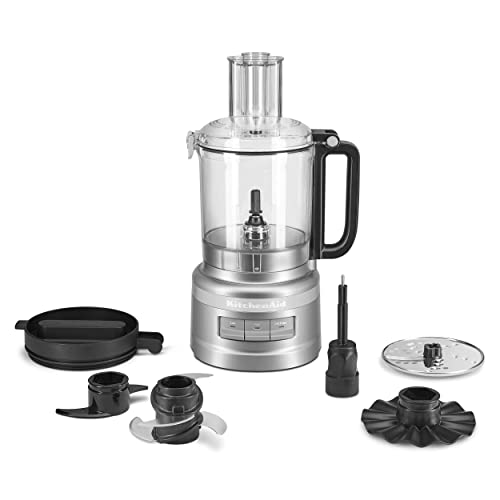
Nine cups is the processor size most baking households actually need: a full pie dough, a standard crumb crust, a batch of grated vegetables for a loaf cake, with headroom to spare — in a machine that still fits a normal cupboard and washes without a project. The KFP0921’s four-blade design handles the chop-to-puree range evenly, and its all-in-one storage keeps blades and discs inside the bowl, which matters more in real kitchens than any speed setting. Choose it over the 14-cup Cuisinart if your batches are standard and your storage is not; choose the Cuisinart if you regularly prep at volume.
Strengths
- Right-sized 9-cup bowl for standard baking recipes
- All-in-one in-bowl storage for blades and discs
- Even chopping from the four-blade multipurpose design
Trade-offs
- Big pastry batches need splitting
- Dough capacity is single-batch scale
- Disc set is narrower than the Breville flagship
| Bowl | 9-cup |
| Design (per Amazon listing) | Four-blade multipurpose; all-in-one storage |
Mid-size processors win on a ratio: capability per cupboard centimeter. The KFP0921 covers the complete baking prep repertoire — pastry cutting, nut grinding for frangipane, crumb crusts, grated zucchini and carrot for loaf cakes, sliced fruit — at a size that comes out of the cupboard willingly, which is the strongest predictor of use. Its storage design deserves emphasis: processors fail socially when their discs live in a dangerous drawer jumble, and keeping everything inside the bowl removes the friction and the cut fingers in one move. For standard-recipe bakers, this is the sweet spot of the category.
Best for: Standard-recipe bakers wanting one right-sized processor / Not suited for: Volume pastry production
Check on Amazon — check the current price on Amazon for the exact configuration reviewed here.
Cuisinart Precision Pro Digital Stand Mixer SMD-50BC — Best Stand Mixer Anchor
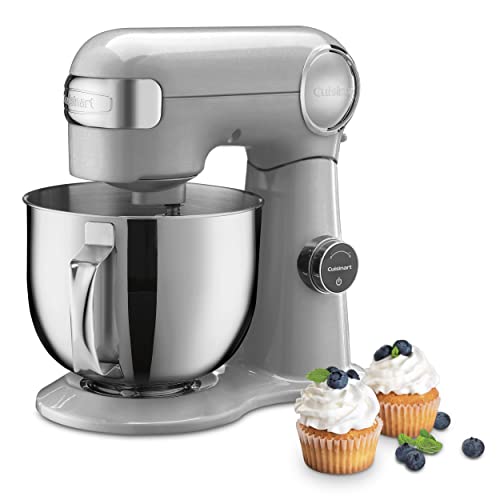
Every baking station built on processors still needs its anchor: the machine that creams butter, whips whites and kneads with a hook. The SMD-50BC fills that role with a digital interface, twelve speeds, a 5.5-quart bowl and three preprogrammed food-prep settings that take the guesswork out of common mixing routines. It pairs naturally with the processors in this guide — processor for pastry and prep, stand mixer for batter and dough finishing — and its digital speed control is the most precise in this article. Bakers who prefer a dial to a display can look at the SM-50 in our other guides; bakers who like repeatability will prefer this one.
Strengths
- Digital 12-speed control with preprogrammed settings
- 5.5-quart bowl suits family baking batches
- Precise low speeds for folding and starting flour
Trade-offs
- Digital controls are a love-or-hate interface
- Still a stand mixer — no pastry cutting or grating
- Premium over the analog SM-50 for the interface
| Configuration | Stand mixer, digital |
| Bowl | 5.5-quart |
| Speeds | 12, with 3 preprogrammed settings (per Amazon listing) |
The case for digital control in baking is repeatability. Creaming is a timed transformation, whipping has a narrow glossy window, and a mixer that returns to the exact speed that worked last time removes one variable from recipes you are perfecting. The SMD-50’s preprogrammed settings encode sensible ramps for common jobs, while the manual range stays wide enough for everything else. As the anchor of a processor-plus-mixer station, it handles the full batter spectrum — sponges, butter cakes, meringues, frostings — and moderate doughs, leaving the processor free for the cutting and grating work it does better.
Best for: Bakers building a complete station who value repeatable settings / Not suited for: Anyone wanting one machine to also grate and slice
Check on Amazon — check the current price on Amazon for the exact configuration reviewed here.

Breville Sous Chef 16-Cup Food Processor BFP810 — Best Premium Processor
The Sous Chef 16 is the premium end of baking prep: a 16-cup bowl for the largest home batches, a feed tube that takes whole vegetables, and a disc ecosystem that slices at adjustable thicknesses — the feature pastry and produce bakers actually dream about, because uniform apple or potato slices bake evenly and look professional. It suits bakers who run production days: freezer pastry sessions, holiday grating marathons, market-stall prep. Its size and price are unjustifiable for standard weekly baking, where the 9-cup KitchenAid above is the smarter buy — this badge is for scale, and it is honest about it.
Strengths
- 16-cup capacity for production-scale prep
- Adjustable slicing precision for even baking results
- Wide feed tube minimizes pre-cutting
Trade-offs
- Largest footprint and price in this guide
- Overkill for standard single recipes
- Many parts to wash after full disc sessions
| Bowl | 16-cup |
| Construction (per Amazon listing) | Brushed stainless steel |
Premium processors justify themselves in the discs, and Breville’s system is the benchmark: consistent slice thickness is not a cosmetic feature in baking, it is the difference between a gratin or tarte that cooks evenly and one with raw and burnt layers sharing a dish. The big bowl and strong drive turn a kilo of carrots or a cabbage into grated product in under a minute, at a uniformity no hand grater survives. For the baker whose calendar includes real production, the Sous Chef is less an appliance than a staff member; everyone else should admire it and buy smaller.
Best for: Production bakers and large-batch pastry work / Not suited for: Small kitchens and standard weekly baking
Check on Amazon — check the current price on Amazon for the exact configuration reviewed here.
KitchenAid 7-Cup Food Processor KFP0718 — Best Compact Processor
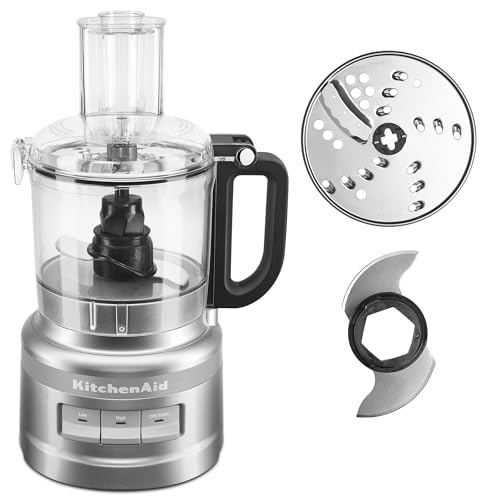
The KFP0718 is the compact pick that does not feel like a toy: seven cups is enough for a standard pie dough, a crumb crust, a batch of pesto for a pasta bake, or the grated cheese for a family quiche, and the three-speed control (high, low, pulse) covers the technique range without menu-diving. All-in-one storage keeps the kit in the bowl. It suits small kitchens and bakers whose processing is recipe-scale rather than production-scale. If you grate and slice weekly in volume, step up to the 9- or 14-cup picks; if your processor comes out for pastry and prep a few times a month, this size is the rational one.
Strengths
- 7-cup bowl still covers a standard pie dough
- Simple three-speed control with proper pulse
- In-bowl storage keeps a small footprint honest
Trade-offs
- Double pastry batches need splitting
- Disc range is narrower than larger models
- Dough work is single-batch only
| Bowl | 7-cup |
| Speeds (per Amazon listing) | Three-speed control, 2-in-1 feed tube |
Compact processors earn their keep by being present. A machine that lives in an easy cupboard, assembles in seconds and washes without a sink full of parts gets used for the small jobs — the crumb crust, the nut flour, the quick pastry — that big machines are never dragged out for. The KFP0718’s seven cups keep it honest for real recipes rather than garnish work, which is exactly the line between a compact processor and a mini chopper. For apartment bakers and modest households, it is the size that maximizes baking capability per stored centimeter.
Best for: Small kitchens and recipe-scale baking prep / Not suited for: Production batches and heavy dough programs
Check on Amazon — check the current price on Amazon for the exact configuration reviewed here.

Hamilton Beach Stack & Snap 14-Cup Food Processor 70585 — Best Budget Large Processor
Hamilton Beach’s Stack & Snap attacks the two complaints budget processors earn: fiddly assembly and small bowls. The parts stack and snap without the twist-and-align ritual, the bowl is a full 14 cups for family baking prep, and the stainless blades go in the dishwasher when the session ends. Three speeds at 500 watts (per the listing family) handle pastry cutting, grating and chopping at recipe scale. It lacks the premium machines’ disc finesse and dough torque, so pastry purists and production bakers should look up the page — but for big-bowl prep on a firm budget, it is the rational buy.
Strengths
- Full 14-cup bowl at a budget price
- Stack-and-snap assembly removes the usual fiddle
- Dishwasher-safe blades and parts
Trade-offs
- Less disc precision than premium processors
- Dough capacity is modest despite the big bowl
- Plastic construction feels lighter than rivals
| Bowl | 14-cup |
| Assembly (per Amazon listing) | Stack & Snap; dishwasher-safe stainless blades |
The Stack & Snap’s insight is that assembly friction, not power, is what sends processors back to the cupboard. By making setup a stack and a click, Hamilton Beach removed the small daily annoyance that compounds into disuse — and then added the big bowl that makes the machine worth setting up for baking days: a full pastry batch, a kilo of grated vegetables for freezing, crumbs for a week of crusts. Treat its dough claims modestly and its prep claims seriously, and it returns excellent value per bake.
Best for: Budget-conscious bakers needing a big prep bowl / Not suited for: Precision slicing and heavy dough work
Check on Amazon — check the current price on Amazon for the exact configuration reviewed here.
Comparison Table
| Pick | Badge | Key Spec | Best For |
|---|---|---|---|
| Cuisinart 14-Cup Food Processor DFP-14BCNY | Best Overall for Baking Prep | 14-cup, 720W, dough-capable | Bakers who make pastry and bake in family-size batches |
| KitchenAid 9-Cup Food Processor KFP0921 | Best Mid-Size Processor | 9-cup, four-blade, in-bowl storage | Standard-recipe bakers wanting one right-sized processor |
| Cuisinart Precision Pro Digital Stand Mixer SMD-50BC | Best Stand Mixer Anchor | 5.5-qt digital stand mixer, 12 speeds | Bakers building a complete station who value repeatable settings |
| Breville Sous Chef 16-Cup Food Processor BFP810 | Best Premium Processor | 16-cup, precision disc system | Production bakers and large-batch pastry work |
| KitchenAid 7-Cup Food Processor KFP0718 | Best Compact Processor | 7-cup, 3 speeds, in-bowl storage | Small kitchens and recipe-scale baking prep |
| Hamilton Beach Stack & Snap 14-Cup Food Processor 70585 | Best Budget Large Processor | 14-cup, stack-and-snap assembly | Budget-conscious bakers needing a big prep bowl |
How to Choose the Best Food Mixers for Baking
Start by splitting your baking into the two machine families and auditing which jobs you actually do. Creaming, whipping, folding and hook-kneading belong to stand mixers. Cutting butter into flour, grating, slicing, crumb-making and fast small-dough kneading belong to processors. Most mixed baking lives need both eventually, but the audit tells you which to buy first: pastry-heavy bakers (pies, tarts, scones, biscuits) should buy the processor first; cake-heavy bakers should buy the stand mixer first and let a knife handle pastry until the budget recovers.
Size the processor by your largest regular batch, not your largest imaginable one. A standard pie dough fits 7 cups; family pastry and grating sessions want 9–14; production wants 16. Oversized bowls chop small quantities badly — a cup of nuts in a 16-cup bowl mostly orbits uncut — so the biggest bowl is a genuine downgrade for small households. The same logic, mirrored, applies to stand mixer bowls in our companion guides.
- Pastry test: the listing should name a dough blade or explicitly support dough; a lone chopping blade is not a pastry program.
- Disc audit: a reversible shredding/slicing disc covers most baking prep; adjustable slicing is a premium worth paying only at volume.
- Feed tube: wide tubes save pre-cutting on grating days; narrow tubes are fine for pastry-first bakers.
- Storage system: in-bowl storage (KitchenAid’s approach) or a case — loose discs in a drawer are a safety and sharpness failure.
Finally, plan the station, not the appliance. Processor and mixer divide baking labor so cleanly that owning the right one of each beats owning the flagship of either. Sequence the purchases by your audit, and let each machine be excellent at its own half of baking rather than adequate at all of it.
Processor vs Stand Mixer for Baking: Who Does What
Pastry is the processor’s kingdom. Flaky dough is a race against butter temperature, and a blade finishes in twenty seconds what fingertips do in five warm minutes. The same speed makes processors supreme for crumb crusts, nut flours, grated butter for biscuits, and the fast, cool kneading of small enriched doughs. Their limit is physics: a blade cuts and heats, so creamed sponges — which need gentle beating and air folded, not chopped — come out dense, and egg whites meet a blade and simply refuse to become meringue.
The stand mixer rules the aerated world: creamed butter and sugar, whipped whites and cream, folded batters, and hook-kneaded doughs developed slowly and evenly. Its limit is the opposite one — it cannot cut, grate or slice, and its idea of ‘prep’ is stirring what you chopped by hand. Neither machine is the other’s budget version. They are two halves of a bakery, and this guide’s structure — processors for prep and pastry, a stand mixer as anchor — is simply that truth expressed as a shopping list.
The practical consequence for buyers sequencing purchases: your first machine should be the one whose kingdom contains your three most-baked recipes. The second machine, when it comes, will feel less like an upgrade and more like unlocking the other half of the recipe book — because that is literally what it is.
Baking Prep Workflows That Justify a Processor
Three workflows repay a processor’s cost fastest in baking. Freezer pastry sessions — making four pie doughs or a batch of scone dough in one cold, efficient run, portioned and frozen — turn future pies into assembly jobs, and only a processor keeps the butter cold across that volume. Grating days do the same for loaf cakes and muffins: carrots, zucchini, apples and cheese grated in minutes, portioned and frozen, convert weekday baking from a project into a possibility. And crumb production — crackers, cookies and bread turned into crusts and toppings at a uniformity hand methods cannot match — is a weekly job in crumb-crust households that a processor reduces to ninety seconds.
If none of those workflows sounds like your kitchen, your processor need is probably garnish-scale, and the honest recommendation is a compact 7-cup model or even a mini chopper, with the savings redirected to the stand mixer. Equipment should follow workflow, never precede it — the bakers happiest with their processors are the ones who can name the three jobs theirs performs monthly.
Discs, Blades and Feed Tubes: Reading a Processor Listing Like a Baker
A processor listing hides its baking value in three places. First, the blade set: you want the S-blade for chopping and pastry, and a separate dough blade — shaped to fold and press rather than slice — if dough is promised. Listings that promise dough with only an S-blade will still mix a dough, but hotter and tougher than a dough blade does. Second, the discs: a reversible shred/slice disc is the baking workhorse (grating one side, slicing the other); adjustable-thickness slicers and julienne or dicing kits are production luxuries. Third, the feed tube and pusher: a wide tube with a smaller inner pusher handles both whole carrots and single garlic cloves, and the pusher is also your safety system, so its fit and feel matter.
Motor language needs the same translation as in stand mixers: watts are consumption, and what pastry and dough feel is torque at low speed. Heavy bases, direct drives and long model histories (the Cuisinart 14-cup’s decades on sale are themselves data) predict that torque better than any number on the box. When two listings tie, choose the one whose manufacturer still sells the bowl, lid and blades as spare parts — processors outlive their first blade by years when owners can replace it.
Keeping Blades Sharp, Bowls Clear and Fingers Whole
Processor blades dull by abuse, not use: the dishwasher’s jostling, the drawer jumble, and grinding abrasive loads bone-dry are the main culprits. Hand-wash and immediately dry the S-blade, store every blade and disc in the bowl or a case, and your edges will last years. Bowls craze and cloud from heat and harsh detergents; a baking-soda paste handles most staining without scratching, and keeping the bowl off the dishwasher’s heating element preserves the locking tabs that alignment depends on.
Safety deserves its sentence: a processor blade is the sharpest object in most kitchens, and it is handled most casually because it looks like a part rather than a knife. Grip it by the hub, never the edges; wash it separately rather than fishing for it in soapy water; and teach every household member the same rule before the machine’s first use. The best food mixer for baking is the one that never gives its owner a story to tell in an emergency room.
Building the Baking Station Over Time: A Sensible Purchase Order
Few bakers should buy this entire guide at once, and the order matters. Year one belongs to the machine covering your three most-baked recipes — for most households that is the stand mixer or the mid-size processor, not the flagship of either. Learn its ceilings honestly: the recipes it refuses are your specification sheet for purchase two. Year two adds the complementary machine, chosen one size more honestly than enthusiasm suggests — the 9-cup processor rather than the 16, unless production has genuinely arrived. By year three the station is complete, and the remaining purchases are the unglamorous multipliers: a second bowl, a spare blade, the disc you actually missed.
This sequencing has a financial logic beyond patience. Baking habits declare themselves over a year of seasons — the pastry enthusiasm of autumn may or may not survive the bread winter — and equipment bought after the habit is proven never becomes the cupboard’s expensive archaeology. It also has a quality logic: one excellent machine teaches you more than two adequate ones, because its results are consistent enough to learn from. The bakers with the best-equipped kitchens in any neighborhood almost always built them slowly, one justified machine at a time, and this guide is designed to be shopped that way.
Keep the receipts and registrations for both machines in one place, note the exact model numbers in your recipe binder, and the station becomes maintainable for a decade: any part, for either machine, orderable in one sitting. That small administrative habit is the difference between a baking station and a pair of aging appliances.
The Recipes That Decide It: Five Baking Jobs, Scored Honestly
Take five jobs that between them cover most home baking, and the processor-versus-mixer map stops being theory. A double-crust apple pie: processor, unambiguously — pastry cut cold in seconds, apples sliced uniformly, and the stand mixer never leaves its shelf. A birthday layer cake with buttercream: stand mixer, unambiguously — creaming and frosting are its native language, and the processor’s only role is crushing the cookie crumbs for a decorative edge, a job it does in ninety seconds on the way past. Scones for eight: processor again, because grated frozen butter folded through flour is the whole technique. A meringue-topped lemon tart: both, in sequence — processor for the tart shell, mixer for the meringue — which is the single recipe that best explains why complete baking stations exist. And a tray of brownies: either, honestly, which is why brownies are every new baker’s friend.
Score your own top five the same way before buying. If three or more land in one machine’s column, that machine is your first purchase and possibly your only one this year. If the score splits, you have confirmed the station thesis of this guide — and you also know your purchase order, because the column containing your single most-baked recipe wins the first budget. This five-recipe audit takes ten minutes with your recipe binder open, and it is worth more than any amount of spec comparison, because it measures your kitchen instead of the manufacturer’s.
Re-run the audit yearly. Baking lives evolve — the pastry phase yields to the bread phase, the household grows or shrinks — and the station should evolve by addition and honest retirement, not by accumulation. The goal was never to own this entire page; it is to own the two machines your recipes keep asking for by name.
The audit has a budget corollary worth stating plainly: the machine that wins your audit deserves the larger share of a fixed budget, even if that means the second machine waits a year. A flagship processor beside a future mixer outperforms two mid-tier machines bought together for most bakers, because the flagship’s jobs — pastry, grating, dough — will be done at full quality from day one, while the deferred machine’s jobs can be covered temporarily by hand tools and patience. Temporary gaps are tolerable; permanent mediocrity in your most-baked category is not.
Keep the audit honest in one specific way: score the recipes you baked in the last ninety days, not the ones saved in an app for someday. Someday-recipes are how kitchens fill with equipment for a baker who does not exist. The ninety-day binder never lies, and the station it specifies will still be earning its shelf when the someday list has been forgotten.
There is a storage postscript to the audit: the winning machine gets the accessible shelf, and the loser — there is always a relative loser — gets the deeper cupboard, without guilt. Stations fail when both machines are equally inconvenient; they thrive when the primary tool is effortless to reach and the secondary is merely stored. Arrange the kitchen for the baker you are ninety percent of the time, and let the other ten percent involve one extra reach into a cupboard. That is not a compromise; it is interior design obeying statistics.
And when the second machine finally arrives, resist reorganizing the whole kitchen around the event. Put it where the audit said it would live, bake the recipe that justified it within the week, and let the station settle into routine. Equipment earns its place through repetitions, not unveilings — a truth every section of this guide has been circling, and the one worth keeping after the receipts are filed.
Stations built that way have a recognizable feel: nothing gleams with novelty, everything is within reach, and the baking that comes out of them is limited by the baker’s curiosity rather than the cupboard’s contents — which is, in the end, the only equipment goal worth the money.
That is the station this guide set out to build: two honest machines, each bought for named recipes, each reachable without a negotiation — and a baker whose only remaining problem is deciding what to bake next, which was the point of all of it.
Everything else — the discs, the dials, the quart counts — is commentary on that single arrangement.
How to Use a Food Processor for Baking: Pastry, Dough and Prep Technique
Processor technique is about temperature and pulses. Master these and the machine will produce pastry and prep that hand methods genuinely cannot match.
- For pastry, freeze the butter cubes for 15 minutes and chill the flour if your kitchen is warm. Cold is the entire game; the processor’s speed is only valuable because it wins the race against melting.
- Pulse, never run, when cutting butter into flour: bursts of one second, checking after each set, until the pieces look like peas and coarse crumbs. Continuous running smears butter and heats the bowl.
- Add ice water a spoon at a time through the feed tube, pulsing just until the dough holds when squeezed. It should look shaggy, not smooth — smooth pastry dough is overworked pastry dough.
- For processor dough (pizza, simple breads), use the dough blade, add flour gradually, and stop the moment a ball forms and cleans the bowl. Rest the dough before shaping; processor kneading is fast and the gluten needs to relax.
- Grate with even pusher pressure and full tubes — a packed feed tube gives uniform shreds; single items rattle and slice unevenly.
- Make crumbs in batches below half a bowl. Overfilled bowls produce rubble on top and dust at the bottom instead of an even crumb.
- Rest the motor on marathon prep days. Ten continuous minutes is a sensible ceiling before a cooling pause, especially on dough.
Wash the bowl promptly after pastry work — butter films harden into a greasy varnish that flavors the next batch — and dry the blade by hand. Store the machine assembled with its blade in the bowl; a processor that must be built before use is a processor that gets skipped.
Common Buying Mistakes
Running the processor continuously for pastry. Holding the button melts butter with friction and blade heat. Pastry is a pulsing job; the pea-sized pieces you want exist only between pulses.
Using the processor to cream cake batter. Blades cut; they do not cream. Processor cake batter comes out dense and tough. That job belongs to the stand mixer or a hand mixer, full stop.
Buying the biggest bowl for a small kitchen. Oversized bowls chop small quantities badly and store worse. Match bowl size to your largest regular batch, not your largest fantasy.
Grinding nuts to butter by accident. Nuts pass from chopped to flour to butter in seconds. Pulse and watch; the window you want is measured in individual pulses.
Storing discs loose in a cutlery drawer. Dulled discs and cut fingers. In-bowl storage or a case is not an accessory preference — it is the safe way to own the machine.
Ignoring the dough blade distinction. Kneading with a chopping blade overheats dough and strains the motor. If the listing has no dough blade, its dough ambitions are marketing, not engineering.
Final Recommendation
Build the station in the order your baking demands. Pastry-and-prep bakers should start with the Cuisinart DFP-14BCNY — or the 9-cup KitchenAid KFP0921 at standard scale, the Breville Sous Chef 16 at production scale, the 7-cup KFP0718 in small kitchens, and the Hamilton Beach Stack & Snap when the budget is firm — then add the Cuisinart SMD-50BC stand mixer as the creaming and whipping anchor when the budget allows. Cake-first bakers should reverse the order. Either way, the destination is the same: two machines, each excellent at its half of baking, instead of one machine adequate at all of it and loved for none of it.
One sentence to carry into the store: buy the machine your last ninety days of baking voted for, at the size your largest regular batch demands — and let the other half of the station wait its turn without anxiety.
Start with the shortlist: Cuisinart 14-Cup Food Processor DFP-14BCNY, KitchenAid 9-Cup Food Processor KFP0921, Cuisinart Precision Pro Digital Stand Mixer SMD-50BC — check price on Amazon for each and buy the one whose strengths match how you actually cook.
Related guides in this program: Best Electric Mixers For Baking; Best Food Mixers For Bread Making; Best Food Mixers And Blenders; Best Electric Mixers On Stands; Best Food Processors; Best Stand Mixers.
Frequently Asked Questions
Is a food processor or a stand mixer better for baking?
They do different halves of baking. Processors win at pastry, grating, slicing, crumbs and fast small doughs. Stand mixers win at creaming, whipping, folding and developed doughs. Most serious bakers eventually own both; buy first whichever covers your three most-baked recipes, as this guide’s station approach explains.
Can a food processor really make good pie dough?
It makes the best pie dough in the home kitchen, because its speed cuts cold butter into flour before the butter can melt — the entire secret of flaky pastry. Pulse to pea-sized pieces, add ice water sparingly, and stop while the dough still looks shaggy. Rest it chilled before rolling.
What size food processor do I need for baking?
Seven cups covers a standard pie dough and recipe-scale prep; nine cups adds comfortable headroom; fourteen cups suits family pastry batches and grating sessions; sixteen is production scale. Match to your largest regular batch — oversized bowls handle small quantities poorly.
Can a food processor knead bread dough?
Yes, within limits: with a dough blade, standard pizza and bread batches knead quickly and coolly, which suits many doughs. Very stiff doughs and large batches belong to stand mixers or dedicated dough machines. Stop when the ball forms; processor dough over-processes fast.
Why did my processor turn my cake batter dense?
Because blades cut rather than cream, and they develop gluten quickly. Cake batter needs beaten air and gentle folding — stand or hand mixer work. This is the most common processor disappointment in baking, and it is a category error, not a defective machine.
Are processor attachments and bowls interchangeable?
No — bowls, lids, blades and discs are model-specific, and feed-tube geometry differs even within a brand. Order spares by exact model number, and favor models whose manufacturers still stock bowls and blades, since those are the parts a long-lived processor eventually needs.


