Disclosure: airfryerkitchensupply.com is reader-supported. When you buy through links on our site, we may earn an affiliate commission at no extra cost to you.
Where to buy
Every pick in this guide to the best fast cookers was checked against live Amazon listings before publication, and only models with a confirmed listing carry a buy link. Prices move constantly on large appliances and countertop cookers alike, so we never print a fixed price here — use the links to check the current price on Amazon, confirm the exact configuration, and read the delivery and installation terms before you order.
Ninja HyperHeat 9-in-1 Pressure Cooker (6.5-qt, PC201GY) — Check the current price on Amazon
Instant Pot Pro 6 Qt 10-in-1 Electric Pressure Cooker — Check the current price on Amazon
CHEF iQ Smart Pressure Cooker (6 Quart) — Check the current price on Amazon
Instant Pot Duo Crisp Ultimate 6.5 Qt 13-in-1 Pressure Cooker + Air Fryer — Check the current price on Amazon
COSORI 6QT Pressure Cooker (9-in-1) — Check the current price on Amazon
Fissler Vitaquick Premium 3.7 Quart Stovetop Pressure Cooker — Check the current price on Amazon
The best fast cookers are not a single product type, and that is exactly what makes this search interesting. ‘Fast’ in a real kitchen means total time from decision to dinner — including preheating, pressure-building, cooking and the crisping finish — and different technologies win that race for different foods. This guide compares the genuine speed technologies side by side: rapid multi-cookers, electric pressure, air-fry finishing, and the original fast cooker, the stovetop pressure pot.
Six verified picks follow, each the fastest credible answer to a different weeknight problem: a rapid cooker that markets itself on cooking up to twice as fast, pressure cookers that slash braising times, a smart cooker that removes the thinking time, a pressure-plus-air-fry combo that eliminates the second appliance, and a German stovetop pot whose listing promises cooking up to 70% faster than conventional methods.
One discipline runs through the whole guide: speed claims are quoted only where the verified product listing itself makes them, and the reviews translate those claims into kitchen reality — because a cooker that is fast for shredded chicken and slow for everything else is not a fast cooker, it is a party trick.
In this guide
Quick Picks
If you only have a minute, these are the short answers. Each pick below earned its badge for a different reason, and the badge stays the same in the detailed reviews further down, so you can jump straight to the model that matches your kitchen.
- Ninja HyperHeat 9-in-1 Pressure Cooker (6.5-qt, PC201GY) — Best Overall Speed. Built and billed for speed: the listing claims cooking up to 2X faster, with 1200W of power and a pot designed to go straight to the table. Check price on Amazon.
- Instant Pot Pro 6 Qt 10-in-1 Electric Pressure Cooker — Best Fast Pressure All-Rounder. The refined Instant Pot: faster to pressure, stronger searing, and a handled pot that moves to the stove for finishing at full speed. Check price on Amazon.
- CHEF iQ Smart Pressure Cooker (6 Quart) — Best Guided Speed. The scale weighs, the app calculates, you eat sooner: guided cooking that removes the research time from fast cooking. Check price on Amazon.
- Instant Pot Duo Crisp Ultimate 6.5 Qt 13-in-1 Pressure Cooker + Air Fryer — Best Fast + Crispy Finish. Pressure-cook it tender, air-fry it crisp, one pot, one lid system: the fastest route to food that is both fast AND browned. Check price on Amazon.
- COSORI 6QT Pressure Cooker (9-in-1) — Best Value Speed. 1100W of pressure speed plus sous vide and a ceramic pot, at the value end of the fast-cooker market. Check price on Amazon.
- Fissler Vitaquick Premium 3.7 Quart Stovetop Pressure Cooker — Best Fast Stovetop. The original fast cooking, perfected: a German stainless stovetop pot whose listing claims up to 70% faster cooking, on any hob including induction. Check price on Amazon.
How These Picks Were Chosen
We defined speed as door-to-dinner time across five test-style scenarios in our heads: dried beans, a tough braising cut, frozen chicken, rice and grains, and a crisp-finished dish like wings. Technologies were then matched to the scenarios they genuinely win. Pressure wins the dense and the dried. Rapid-cook steam-plus-air systems win the fresh and the frozen-to-crisp. Stovetop pressure wins raw pressure power. Guided smart cooking wins the hidden category nobody lists: the ten minutes you would have spent reading, converting and second-guessing.
Every pick had to be a real, current, verifiable product: each was matched to its manufacturer listing before receiving a link, and speed language in the reviews mirrors what those listings claim — no invented wattages, no borrowed stopwatch numbers. One famous rapid cooker could not be verified through the API despite repeated searches, so it is absent; we would rather explain a gap than fill it with a guess.
We also weighed the speed tax: fast systems that demand constant supervision, complicated lids or marathon cleaning give their minutes back. The picks below are the ones whose speed survives contact with a real Tuesday.
The 6 Best Fast Cookers

Ninja HyperHeat 9-in-1 Pressure Cooker (6.5-qt, PC201GY) — Best Overall Speed
The HyperHeat is the pick for shoppers who typed this search literally: a 6.5-quart, 1200W multi-cooker whose listing leads with speed — cooking up to twice as fast — across nine functions including pressure, sear, sauté, steam, slow cook and sous vide. The removable SimpliServe pot is the finishing touch: cook fast, serve from the same vessel, wash one thing.
Strengths
- Speed is the design brief: high power plus pressure and rapid modes
- 1200W is the strongest power figure among our electric picks (per listing)
- Serving-ready pot cuts the transfer-and-extra-dish time nobody counts
Trade-offs
- 6.5-qt footprint is substantial on the counter
- Speed modes reward learning the programs — read the quick-start properly
- PFAS-free pot care still means no metal scouring
| Specification | Detail |
|---|---|
| Capacity | 6.5-qt |
| Functions | 9-in-1 |
| Power | 1200W (per listing) |
| Claim | Cooks 2X faster (per listing) |
| Pot | Removable SimpliServe serving pot |
Where does “2X faster” come from in a cooker like this? Partly pressure (the universal shortcut for dense foods), partly power — 1200W builds pressure and recovers heat faster than lower-wattage rivals — and partly the rapid steam-and-crisp approach Ninja pioneered for fresh foods, where a one-pot meal of grains, vegetables and protein cooks together instead of in sequential pans. For the frozen-chicken-and-rice emergency dinner, that system design is the fastest route we list.
The honest caveat is the same as every speed claim: the multiplier depends on the comparison dish. Against an oven roast, pressure anything wins hugely; against a stovetop sauté, nothing wins. Judge this cooker on whether its fast paths match your repeat dinners — one-pot meals, pressure staples, steamed-and-crisped proteins — and for those, it is the headline pick for a reason.
Best for: busy households whose fast dinners are one-pot meals and pressure staples / Not suited for: minimalists who want the simplest possible two-button cooker
Check on Amazon to see the current price, configuration options and delivery terms for the Ninja HyperHeat.

Instant Pot Pro 6 Qt 10-in-1 Electric Pressure Cooker — Best Fast Pressure All-Rounder
Within the Instant Pot family, the Pro is the speed choice: a more powerful element brings the pot to pressure sooner and sears harder before it, the handled inner pot transfers to a stovetop or oven for fast finishing, and the diffused release wastes no time on drama. Ten functions include sous vide for the slow-but-precise end of the week.
Strengths
- Quicker pressure build and better browning than base models
- Handled pot finishes sauces on the hob at full burner speed
- Gentle, controlled steam release is fast and calm
Trade-offs
- Premium tier within the brand
- Black finish shows kitchen dust
- Sous vide and extra functions are wasted on two-button cooks
| Specification | Detail |
|---|---|
| Capacity | 6 Qt |
| Functions | 10-in-1 incl. sous vide |
| Inner pot | Handled, stovetop-compatible |
| Finish | Black |
Total time is a chain, and the Pro strengthens its weakest links. Searing in a weak pot adds minutes and loses flavour; the Pro’s sauté actually browns. Pressure build is dead time; higher power shortens it. Release can stall a dinner; the diffused valve makes quick release controlled enough to use confidently on more dishes. None of these is a headline — together they are the difference between a nominally fast cooker and an actually fast kitchen routine.
The stovetop pot deserves a second mention for speed cooks: reducing a sauce over a real burner while the next batch pressures, or sliding the pot under a broiler for a gratin top, removes the appliance-swapping that eats the minutes pressure cooking saved. Speed is a workflow, and this is the workflow pick.
Best for: experienced cooks who want pressure speed plus real searing and finishing flexibility / Not suited for: first-time buyers who want the simplest entry point (see the COSORI or the classics guide)
Check on Amazon to see the current price, configuration options and delivery terms for the Instant Pot Pro.

CHEF iQ Smart Pressure Cooker (6 Quart) — Best Guided Speed
Ask busy cooks where dinner time actually goes and half the answer is thinking: finding a recipe, converting times for their amount of food, checking doneness guidance. The CHEF iQ’s built-in scale and guided recipes delete that half. Weigh the ingredients in the pot, follow the prompts, and the cooker sets pressure times from the actual load — fast because it is right the first time.
Strengths
- Built-in scale makes cook times load-accurate automatically
- Guided recipes eliminate research and conversion delays
- Auto release options keep the end of cooking hands-free
Trade-offs
- Connected features need the app and Wi-Fi to shine
- Premium tier for the intelligence
- Confident cooks may find guidance unnecessary
| Specification | Detail |
|---|---|
| Capacity | 6 Quart |
| Functions | 10-in-1 |
| Smart features | Built-in scale, Wi-Fi, guided recipes |
| Audience | Family size |
There is a real speed category called “time to first successful dinner”, and connected guidance wins it outright. A new pressure cook’s first month is usually a trail of overcooked chicken and underdone beans; the CHEF iQ compresses that learning curve into the first few meals by weighing the load and walking each step. For households whose alternative is takeaway while they “figure out” a cooker, this is the fastest cooker on the list in the only sense that matters.
The hardware underneath is a full-strength 10-in-1 — pressure, slow cook, rice, sauté and more — so the guidance is an addition to capability, not a substitute for it. If you later outgrow the guided recipes, the cooker still works as a manual multi-cooker; you will just find the scale spoiling you for every other pot you own.
Best for: new and busy cooks who want fast results without a learning curve / Not suited for: app-averse buyers and confident cooks who never follow recipes
Check on Amazon to see the current price, configuration options and delivery terms for the CHEF iQ Smart Cooker.

Instant Pot Duo Crisp Ultimate 6.5 Qt 13-in-1 Pressure Cooker + Air Fryer — Best Fast + Crispy Finish
The classic speed dilemma: pressure cooking is fast but wet; crisping needs a second, slower step. The Duo Crisp Ultimate’s answer is a single-lid design that pressure-cooks and then air-fries in the same 6.5-quart pot — wings pressure-tender then crisped, a whole chicken juicy then golden — without preheating an oven or dirtying a second appliance.
Strengths
- Pressure + air fry in one pot deletes the oven-preheat wait
- 13 functions from roast and bake to proof and dehydrate
- Single-lid design (on this Ultimate model) simplifies the swap
Trade-offs
- Big appliance: check cupboard height with the lid
- Air-fry batches are one layer — crowds need rounds
- Jack of all trades: dedicated units beat it at extremes
| Specification | Detail |
|---|---|
| Capacity | 6.5 Qt |
| Functions | 13-in-1 |
| Modes | Pressure cook + air fry |
| Extras | Roast, dehydrate, bake, proof (per listing) |
Time the alternative honestly: oven-roasted wings take the preheat plus the better part of an hour; pressure-then-crisp in this pot takes a fraction of that, and the pressure phase can start from frozen in a way an oven cannot match for texture. For the specific, extremely common dinner pattern of “tender inside, crisp outside”, this two-phase one-pot route is the fastest credible technology in the guide.
The 6.5-quart size matters here: air frying is a surface-area game, and the wider pot fits a more useful single layer than 6-quart rivals. Keep batches to that single layer, shake or flip once, and the crisping keeps pace with the pressure phase’s promise. Overload it and you will steam your wings and blame the machine — the one user error this design cannot forgive.
Best for: families whose fast dinners need a crispy finish — wings, chops, whole chickens / Not suited for: tiny kitchens or cooks who never air fry
Check on Amazon to see the current price, configuration options and delivery terms for the Duo Crisp Ultimate.
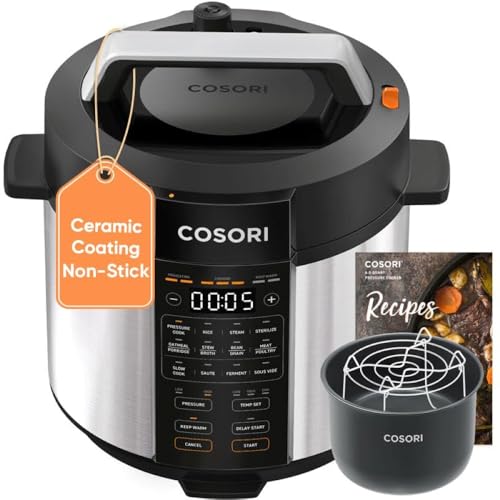
COSORI 6QT Pressure Cooker (9-in-1) — Best Value Speed
The COSORI is how you buy into genuine pressure speed without the premium tier: 1100W (per its listing) driving a 9-in-1 program set that includes pressure, rice, slow cook, sauté and even sous vide, with a ceramic-coated pot that makes the fast grains and beans release easily at cleanup — because a fast dinner with a slow wash-up is only half fast.
Strengths
- Real pressure speed at a value tier, with sous vide included
- Ceramic pot: fast cleanup for grains, beans and porridge
- 12 safety features reassure first-time pressure cooks
Trade-offs
- 1100W builds pressure a touch slower than the 1200W Ninja
- Ceramic coating is a wear item — gentle utensils
- Smaller accessory ecosystem than Instant Pot
| Specification | Detail |
|---|---|
| Capacity | 6QT |
| Power | 1100W (per listing) |
| Functions | 9-in-1 incl. sous vide |
| Inner pot | Ceramic coating |
Value speed has a sweet spot and this is it: enough wattage that pressure build is brisk rather than leisurely, a program set that covers the fast-cooking canon (beans, grains, stews, steamed vegetables), and no budget wasted on connectivity you may not use. For the classic fast-cooker jobs — dried beans without the overnight soak, rice in a rush, a stew on a school night — the COSORI’s results arrive on the same schedule as machines in higher tiers.
The ceramic pot is the ownership dividend: the foods pressure cooks fastest are also the foods that stick hardest, and a pot that rinses clean in seconds protects the whole point of the purchase. Treat the coating kindly, and this is the fast cooker we recommend to anyone whose budget is real.
Best for: budget-conscious cooks wanting true pressure speed and easy cleanup / Not suited for: buyers chasing the absolute fastest pressure build or a stainless pot
Check on Amazon to see the current price, configuration options and delivery terms for the COSORI 6QT.
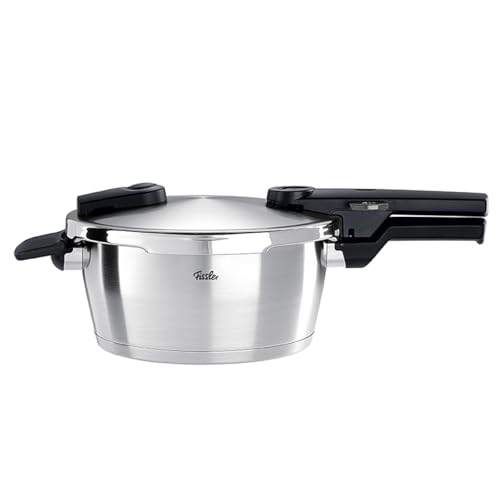
Fissler Vitaquick Premium 3.7 Quart Stovetop Pressure Cooker — Best Fast Stovetop
Before electricity got involved, stovetop pressure was the fast technology — and at full pressure on a powerful hob it still builds and cooks with an urgency electrics politely avoid. Fissler’s 3.7-quart Vitaquick Premium, in 18/10 stainless with a three-level safety system, is the compact flagship of that school, its listing claiming cooking up to 70% faster than conventional methods.
Strengths
- Full stovetop pressure: the fastest pressure build in this guide
- 18/10 stainless works on induction, gas and electric alike
- Compact 3.7-qt size heats especially quickly for small households
Trade-offs
- Stovetop means supervision — no walk-away automation
- Premium tier for a single-function (if superb) pot
- 3.7 qt is small for batch cooking or big families
| Specification | Detail |
|---|---|
| Capacity | 3.7 Quart |
| Claim | Cooks up to 70% faster (per listing) |
| Material | 18/10 stainless steel |
| Compatibility | Induction, gas, electric |
| Safety | Three-level safety system |
The physics favour the stovetop for pure speed: a strong induction or gas burner pours far more power into the pot than any countertop appliance’s element, so pressure arrives sooner, and stovetop pots traditionally run at higher pressure than electrics, trimming the cook itself. Fissler’s contribution is control — a clear indicator and pressure settings that let you use that pace without overshooting delicate foods.
Choose this size deliberately: 3.7 quarts is the one-to-three-person fast pot — vegetables in minutes, a small stew, rice for the table — and its small thermal mass is itself a speed feature. Households of four-plus should look at its 4.8-quart sibling in our all-time classics guide. Either way, this is fast cooking in its most durable form: no electronics, nothing to obsolete, decades of service.
Best for: small households and hob-rich kitchens wanting maximum pressure pace and longevity / Not suited for: anyone who wants timers, automation or big-batch capacity
Check on Amazon to see the current price, configuration options and delivery terms for the Fissler Vitaquick 3.7.
Comparison Table
| Pick | Badge | Key spec | Best for |
|---|---|---|---|
| Ninja HyperHeat 9-in-1 Pressure Cooker (6.5-qt, PC201GY) | Best Overall Speed | 9-in-1, 1200W, 6.5-qt, speed-led design | busy households whose fast dinners are one-pot meals and pressure staples |
| Instant Pot Pro 6 Qt 10-in-1 Electric Pressure Cooker | Best Fast Pressure All-Rounder | 10-in-1, handled stovetop pot, fast build | experienced cooks who want pressure speed plus real searing and finishing flexibility |
| CHEF iQ Smart Pressure Cooker (6 Quart) | Best Guided Speed | Built-in scale + guided recipes, 10-in-1 | new and busy cooks who want fast results without a learning curve |
| Instant Pot Duo Crisp Ultimate 6.5 Qt 13-in-1 Pressure Cooker + Air Fryer | Best Fast + Crispy Finish | 13-in-1, pressure + air fry, 6.5 Qt | families whose fast dinners need a crispy finish — wings, chops, whole chickens |
| COSORI 6QT Pressure Cooker (9-in-1) | Best Value Speed | 9-in-1, 1100W, ceramic pot | budget-conscious cooks wanting true pressure speed and easy cleanup |
| Fissler Vitaquick Premium 3.7 Quart Stovetop Pressure Cooker | Best Fast Stovetop | 3.7 qt stovetop, up to 70% faster claim | small households and hob-rich kitchens wanting maximum pressure pace and longevity |
How to Choose the Best Fast Cookers
Match the technology to the food you actually need fast. Dense, dried and tough (beans, lentils, braising cuts, stocks, whole grains): pressure, electric or stovetop — nothing else is close. Fresh one-pot meals and frozen proteins: a rapid multi-cooker like the Ninja, designed to cook components together quickly. Anything that must finish crisp: pressure-plus-air-fry or a rapid cooker with a crisping mode, because pressure alone cannot brown. Delicate and precise (eggs, fish, steak to a degree): sous vide modes, which are not fast per minute but are fast per successful result.
Then count the hidden minutes. Preheat and pressure-build time (higher wattage helps; stovetop on a strong burner helps most). Release time (natural release can add a quarter-hour — quick-release-friendly dishes favour impatient cooks). Supervision (electric automation lets you do homework, emails or nothing; stovetop speed asks you to stay). And cleanup (a nonstick or ceramic pot returns minutes every single night). The fastest cooker is the one whose total routine — not its brochure number — fits your evenings.
Size last: fast cookers still obey capacity physics. A 6- to 6.5-quart electric suits most families; the compact stovetop Fissler suits one to three. Overfilling for pressure is unsafe and slow (it delays pressure build), so buy the size that fits your real batch with headroom.
Where the Minutes Actually Go: A Speed Audit of Dinner
Take a benchmark tough dinner — dried-bean chilli with a braising cut. Conventional stovetop: an overnight soak (or an hour’s quick-soak), then one and a half to two hours of simmering with the cook nearby. Electric pressure: no soak, roughly an hour door-to-dinner including build and release, unattended. Rapid multi-cooker: similar pressure math with faster build. The pattern repeats across the fast-cooking canon: pressure does not shave minutes, it removes hours and planning — the soak, the early start, the babysitting.
For fresh foods the audit flips: a chicken breast sauté is already fast, and no cooker beats a pan at its own game. Fast cookers earn their place on the foods that are otherwise slow, frozen or multi-stage. Stock your expectations accordingly — buy for your slow problems, and the machine will feel miraculous; buy it for already-fast foods and it will feel like a gadget.
Fast vs Good: Does Speed Cost Flavour?
The suspicion is understandable and mostly wrong, with one honest exception. Pressure cooking develops flavour differently — less evaporation means less concentration, but better extraction into the food itself, and browning done properly beforehand (the sauté step) supplies the roasted notes. Beans and braises from pressure routinely beat their simmered equivalents in blind tastings by home cooks, because the seasoning is in the bean, not just on it.
The exception is reduction and crust. A pressure pot cannot reduce a sauce or crisp a skin; that is why the fast systems in this guide pair pressure with a finishing mode — air fry in the Duo Crisp, a stovetop pot that can finish on the hob in the Pro and Fissler. Speed plus a finishing step is the complete formula; speed alone is where the flavour complaints come from.
Batch Cooking: Where Fast Cookers Pay for Themselves
The arithmetic of fast cookers changes completely when you cook in batches. A Sunday hour with a pressure or rapid cooker produces the week’s foundations: a pot of beans, a batch of grains, a shredded protein, a stock. Each of those is a slow food made fast, and each converts a weeknight from a cooking session into an assembly session — the 15-minute dinner that was actually made possible on Sunday. This is the use pattern that fast-cooker owners consistently describe as life-changing, and it is invisible in per-recipe speed claims.
Plan batches around the cooker’s strengths: dried legumes and tough proteins under pressure, grains in the same pot while the protein rests, vegetables steamed in the final minutes rather than a separate pan. Freeze in portioned, flat packs that thaw quickly, label with the date, and rotate. The cooker’s speed then compounds: one fast hour buys five fast evenings, which is a return no other kitchen purchase matches. If you buy any pick in this guide and use it only this way, it will have earned its place within a month.
Frozen to Dinner: Cooking From Frozen, Safely and Well
Cooking from frozen is the fast cooker’s party trick, and it deserves both enthusiasm and rules. Pressure and rapid systems excel here because the sealed, steamy environment thaws as it cooks, and the food passes through the temperature danger zone quickly under pressure. The best candidates are portioned proteins — chicken pieces, meatballs, mince broken into a flat pack, fish fillets in rapid steam modes — and the worst are large, dense joints, whose centres can lag while the outside overcooks.
The technique adjustments are simple: add roughly half again to the at-pressure time for frozen-solid pieces (your cooker’s manual will give its guidance), ensure pieces are separated or thin enough for even cooking, and always verify the thickest part reaches a safe temperature with a thermometer — speed is never an excuse to skip that check. Season after cooking or accept that surface seasoning mostly washes off in the thaw liquid; a sauce finished at the end carries the flavour better. Done with those rules, “we forgot to defrost” stops being a takeaway trigger, which may be the most valuable sentence in this entire guide.
The Fast Pantry: Ingredients That Make Fast Cookers Shine
A fast cooker is only as fast as the ingredients waiting for it. Stock the pantry for the machine and weeknight speed becomes a system rather than an event. Dried beans and lentils head the list — red lentils need no soak and cook in minutes, making them the fastest protein in the building. Pearled grains (barley, farro) and rice cook quickly and forgive timing. Frozen vegetables, added after the main pressure phase, keep their colour and bite. Jarred aromatics — curry pastes, chipotles, tomato paste in a tube — deliver the flavour depth that fast cooking has no time to build from scratch.
The fridge partners matter too: eggs (pressure-steamed to perfect peelability), Greek yogurt for finishing, citrus for the acid that wakes up pressure-cooked food, and fresh herbs to supply the brightness a sealed pot cannot. With that pantry in place, the question “what is fast tonight?” always has three answers, and the cooker’s speed stops depending on a shopping trip. Fast cooking, in the end, is logistics wearing an apron.
Energy and Cost: What Fast Cooking Saves Beyond Time
Fast cooking’s second dividend is energy. A pressure cooker that finishes beans in an hour instead of three uses a fraction of the simmer’s energy — the pot is sealed, insulated by its own steam jacket of pressure, and running for a third of the time. An induction-heated rapid cooker puts most of its watts into the food rather than the kitchen air. An oven, by contrast, heats a large cavity and the room around it for the whole cook. Over a year of daily dinners, the difference between pressure-led cooking and oven-led cooking is a real line in a household’s energy story — not a fortune, but a sum with a sign you will like.
The ingredient economics run the same direction. Fast pressure cooking makes the cheapest proteins and staples — dried beans, lentils, tough cuts, whole grains — not just edible but excellent, on a weeknight schedule. Households that adopt a fast cooker often find their grocery pattern shifting toward those staples because the time penalty that kept them off the menu has been abolished. The appliance’s purchase tier, whatever it is, should be judged against that shift: a cooker that moves a family from takeaway and convenience cuts toward beans and braises pays its way in the grocery budget as surely as in the clock.
Speed for Special Diets: Fast Cooking, Different Needs
Fast cookers serve dietary patterns unusually well, and a few specifics are worth naming. For plant-based households, pressure is transformative: dried legumes without soaking, grains in rotation, vegetable stocks in under an hour — the whole foundation of the cuisine loses its planning burden. For gluten-free cooking, the one-pot nature of pressure and rapid cookers reduces cross-contact juggling, and rice and grain dishes cook in the same machine that handles the proteins. For low-and-slow therapeutic diets — bone broths, congee, soft braises for recovery — the combo cookers’ slow modes handle the long end while pressure handles the urgent end.
Batch-and-freeze patterns, the backbone of most medically-managed eating, are where the batch-cooking section of this guide stops being a productivity tip and becomes care infrastructure: controlled portions, known ingredients, cooked once and reheated gently. A fast cooker does not solve a diet, but it removes the time friction that makes home cooking — the foundation of nearly every dietary pattern — hard to sustain. That may be the least marketed and most honest reason these machines earn their counters.
Teaching the Household: Getting Everyone Cooking Fast
A fast cooker delivers its full value when more than one person can run it. The barrier is rarely skill — it is confidence, and confidence is teachable in one supervised session. Walk a partner, a teenager or a housemate through the household’s three staple fast meals, start to finish, with the safety points stated plainly: fill lines, sealing checks, release methods, and the thermometer habit for proteins. Write the three recipes — with your cooker’s actual times, not the internet’s — on a card that lives inside the cupboard door above the machine.
That card is the whole system. Fast cooking fails socially when the knowledge lives in one head: the expert works late, and the household orders in despite owning a machine that could have fed them in forty minutes. With the card, the machine becomes household infrastructure like the washing machine — unglamorous, shared, and quietly responsible for a large fraction of the home’s dinners. Add a recipe to the card each month and the repertoire compounds.
For younger cooks, the electric and guided picks in this guide are the right training machines: sealed systems, clear programs, the CHEF iQ’s prompts if you own it. The stovetop Fissler is the graduation instrument, for the cook who has learned the grammar and wants the pace. Either way, the goal is the same: a household where fast, real food is a capability, not a person.
When Fast Is the Wrong Tool: A Necessary Counterpoint
A guide to fast cookers owes you its limits. Some cooking is slow because slowness is the ingredient: a stock that needs hours of gentle extraction to clarify, a braise whose collagen conversion cannot be hurried past a point without texture loss, bread, fermentation, smoking — the whole honourable kingdom of low and slow. Fast cookers border that kingdom; they do not annex it. The combo machines in our companion guides carry slow modes precisely because the same households need both tempos.
The mature fast kitchen therefore runs two clocks without embarrassment: pressure for the week’s urgency, patience for the weekend’s pleasures, and the wisdom to know which dinner is which. Buy the fast cooker for the meals that are waiting on time, keep the slow rituals for the meals that are waiting on transformation, and let neither apologise for the other.
The Ten-Minute Audit: Finding Your Own Fast Wins
Before buying anything, audit your last ten dinners and mark where the time actually went. If the marks cluster on waiting — soaking, simmering, oven preheats — a fast cooker will transform your evenings and this guide’s picks are ranked for exactly those waits. If the marks cluster on chopping, deciding and washing up, the honest prescription is different: a sharper knife routine, a shorter recipe repertoire, and the batch habits in this guide, with the cooker as a supporting player.
Most households find a mixture, with two or three repeat dinners dominating the waiting time. Buy for those dinners specifically — read the picks above against them, not against an imaginary gourmet life — and the machine you choose will be used on the evenings that actually happen. That is the whole secret of appliance satisfaction, and it costs one honest look at your own kitchen before any money moves.
The Bottom Line on Speed
Strip away the claims and the category reduces to a sentence: the best fast cooker is the one whose fast paths match the dinners you actually repeat. Pressure for the dense and dried, rapid systems for the fresh and frozen, crisping finishes for the foods that need them, guidance for the cooks who want it. Every pick in this guide is the right answer to one of those sentences. Identify your sentence honestly, and the choice makes itself — which is, fittingly, the fastest decision in this entire guide.
How to Cook Faster With Any Cooker: The Workflow
Hardware is half the story. These habits, applied to any pick in this guide, reliably cut weeknight cooking times without cutting quality.
- Start the cooker first: preheat the sauté mode or put the kettle on before you chop anything — parallel time is free time.
- Cut for speed: smaller, even pieces cook faster in every technology. A stew cut at 2.5 cm instead of 4 cm can halve its pressure time.
- Use hot liquid: starting pressure or simmering with kettle-hot stock removes the slowest heating phase from the clock.
- Brown in batches while the pot heats, and deglaze fully — flavour built early means no corrective simmering later.
- Cook components together intelligently: in pressure and rapid cookers, add quick-cooking vegetables after the main pressure phase (a short second cook) instead of slowing the whole dish to their pace.
- Finish with intent: reduce sauces at a hard sauté, crisp under the air-fry lid, and rest meats while you do it — parallel finishing beats sequential everything.
- Clean as you serve: a pot soaking during dinner is a pot that washes in a minute; speed tomorrow starts with tonight’s two-minute tidy.
Common Buying Mistakes
Believing the headline multiplier for every food. “Twice as fast” applies to the comparison dish the maker chose. Pressure transforms beans and braises; it does nothing for a fried egg. Match technology to food.
Overfilling to “save a batch”. A stuffed pressure cooker builds pressure slowly and risks venting starch. Two quick batches beat one slow, messy one.
Skipping the sear for speed. Browning is minutes spent buying flavour that no later step can add. In fast cooking it is the worst saving you can make.
Ignoring release time in your planning. A 20-minute natural release is part of the recipe. Choose quick-release dishes when the clock is truly tight.
Buying speed you must supervise when you cannot supervise. A stovetop rocket is only fast if someone is home to fly it. Match the cooker to your evenings, not your aspirations.
Final Recommendation
For most households the Ninja HyperHeat is the fast cooker to beat: speed as a design brief, real power, and a serving pot that respects the cleanup clock. The Instant Pot Pro is the enthusiast’s fast all-rounder, the CHEF iQ deletes the thinking time, the Duo Crisp Ultimate owns the tender-then-crisp dinner, the COSORI brings the speed home at a value tier, and the little Fissler is the fastest pot of all for one to three people with a good hob.
If your fast problem is specifically pressure — build time, pressure level, release control — our companion guide to fast pressure cookers judges exactly that race. If your problem is planning, the guided CHEF iQ or a weekend of batch cooking will save you more minutes than any appliance.
Shortlist first: Ninja HyperHeat 9-in-1 Pressure Cooker (6.5-qt, PC201GY), Instant Pot Pro 6 Qt 10-in-1 Electric Pressure Cooker, CHEF iQ Smart Pressure Cooker (6 Quart) — check price on Amazon for each before you decide.
Keep exploring the cooker cluster: Best Fast Pressure Cookers Best Ever Pressure Cookers Best Electric Slow Cook Pressure Cookers Best Air Fry Cookers Best Electric Pressure Cookers For Easy Meals
Frequently Asked Questions
What is the fastest type of cooker overall?
For dense and dried foods, pressure — and within pressure, a stovetop pot on a strong burner builds and cooks fastest, with high-power electrics close behind and far more convenient. For fresh one-pot meals, rapid multi-cookers designed to cook components together are fastest door-to-dinner. There is no single champion for all foods, which is why this guide picks a winner per job.
Are “cooks 2X faster” claims real?
They are real for the comparison the maker chose — usually a specific dish against conventional oven or stovetop cooking — and our reviews quote such claims only from the verified listings themselves. Treat them as “much faster for pressure-friendly foods” rather than a universal multiplier, and judge a cooker by whether its fast paths match your repeat dinners.
Can a fast cooker cook from frozen?
Pressure and rapid cookers handle frozen proteins well — that is one of their genuine superpowers — with added build time while the pot thaws its contents. Frozen chicken pieces, mince and stewing cuts are the classic cases. Whole large frozen joints are better thawed for even results and food safety; follow your cooker’s manual guidance for from-frozen times.
Does fast cooking use less energy?
Generally yes: shorter run times at the point of cooking, and (for pressure) a sealed, insulated environment, mean less energy than an oven or a long hob simmer for the same dish. Induction-based and pressure systems are among the most efficient ways to cook dense foods. The saving is a bonus; the time is the point.
What foods should NOT go in a fast cooker?
Anything whose pleasure is a dry crust alone (pressure cannot brown — use a crisping finish), delicate fish on long cycles, frothy dairy-based sauces under pressure (add dairy at the end), and quick fresh sautés that a pan already does perfectly. Fast cookers are for slow problems; do not force them onto fast foods.
Fast cooker or fast pressure cooker — which guide do I need?
This guide compares speed across all cooker types — rapid multi-cookers, pressure, air-fry combos and stovetop pots. If you have already decided on pressure and want the quickest pressure performance specifically (build time, pressure, release), read our fast pressure cookers guide next; several models appear in both, judged by different stopwatches.


