Disclosure: airfryerkitchensupply.com is reader-supported. When you buy through links on our site, we may earn an affiliate commission at no extra cost to you.
Where to buy
Every cooker in this guide is a countertop air fryer sold on Amazon, and the category rewards buyers who check capacity in real food terms rather than headline quarts. The strongest starting points are the Ninja Air Fryer AF101 4 Qt, COSORI TurboBlaze 6 Qt Air Fryer, Ninja Air Fryer Pro AF141 5 Qt. Also linked in this guide: the Instant Pot Vortex Plus 6 Qt ClearCook, Philips Premium Airfryer XXL, Chefman 8 Qt Air Fryer with Hi-Fry. Check the current price on Amazon for each pick before you order, and confirm the exact configuration on the product page, because bundles and colourways change.
Introduction
The best air fry cookers share one honest job: move very hot air around food fast enough to crisp the outside before the inside dries out. Everything else — presets, apps, windows, dual baskets — is a variation on that job, and this guide ranks the six machines that do the core job best for different kitchens. The phrase air fry cookers is the generic name shoppers use for the whole category, covering single-basket models, dual-basket models and oven-style machines, so this guide deliberately mixes formats and explains which format suits which household instead of pretending one shape fits everyone.
Capacity is where most buyers go wrong first. A quart figure tells you the basket volume, not how much food cooks well in it. Fries, wings and vegetables need a single layer with air gaps; pile them deep and you get steaming, not frying. As a working rule, a 4-quart basket serves one or two people properly, a 5 to 6-quart basket serves three or four, and families cooking two foods at once should look at dual baskets or a 10-quart oven format. Every pick below is annotated with the household size it genuinely serves, not the size its box claims.
Temperature range and fan power matter more than preset counts. A cooker that reaches 400°F or beyond with a strong fan will crisp frozen food and skin-on chicken properly; one that tops out lower will always feel like a compromise. Dehydrate and reheat functions are genuinely useful, broil is a bonus, and a long list of food-named presets is mostly the same few temperature and time combinations wearing different labels. We weighted real cooking range and basket design ahead of preset theatre throughout this guide.
Cleanup decides whether an air fry cooker gets used daily or exiled to a cupboard. Nonstick baskets that are dishwasher safe, crisper plates that do not trap grease in perforated corners, and exteriors that wipe clean without dismantling are the features owners actually praise after six months. All six picks below were chosen with that long view in mind, and each review states plainly where its cleaning or size trade-offs lie.
In this guide
Quick Picks
- Best Overall — Ninja Air Fryer AF101 4 Qt: The reference single-basket cooker: strong crisping, simple controls, honest 1–2 person capacity.
- Best Performance — COSORI TurboBlaze 6 Qt Air Fryer: The performance pick: 450°F top heat, five fan speeds and a PFAS-free ceramic basket in a family size.
- Best for Small Kitchens — Ninja Air Fryer Pro AF141 5 Qt: Family capacity in a slimmer body: 5 quarts, strong power, and a footprint apartment kitchens can keep out.
- Best with a Window — Instant Pot Vortex Plus 6 Qt ClearCook: The see-inside pick: a clear window and light end the guesswork of opening the basket to check browning.
- Best Premium — Philips Premium Airfryer XXL: The premium engineering pick: fat-removal basket design and refined airflow for big, even batches.
- Best Large Basket on a Budget Tier — Chefman 8 Qt Air Fryer with Hi-Fry: The big-basket value pick: 8 quarts and a 450°F finishing blast for extra-crisp results.
How These Picks Were Chosen
Only listing-confirmed models carry Amazon links here; nothing in this guide relies on a remembered or guessed listing.
Selection weighted five things. First, cooking performance fundamentals: maximum temperature, fan-driven air circulation design, and basket or cavity shape. Second, honest capacity for the stated household size. Third, control clarity — a dial or a well-organised touchscreen both qualify, a confusing preset maze does not. Fourth, cleanup: nonstick surfaces, dishwasher-safe parts and grease management. Fifth, footprint, because a cooker that does not fit under standard cabinets or in its storage spot will not be used.
We deliberately spread the six picks across formats and tiers: a compact single-basket reference model, a high-performance ceramic-coated basket, a slim 5-quart design, a large single-cavity oven-style machine, a premium fat-removal design, and a big family basket. If your kitchen matches one of those briefs exactly, your decision is mostly made; the buying guide sections below exist for everyone still deciding between formats.
The 6 Best Air Fry Cookers

Ninja Air Fryer AF101 4 Qt — Best Overall
The AF101 is the machine the rest of this category is measured against. It is a straightforward 4-quart basket cooker with four functions — air fry, roast, reheat and dehydrate — a wide temperature range and a ceramic-coated nonstick basket and crisper plate. For one or two people cooking fries, wings, salmon or reheated pizza, it remains the easiest recommendation in the class because it does the basics without a single confusing menu layer.
Strengths
- Crisping performance is consistently strong for its size, especially on frozen foods and chicken skin
- Controls are a model of clarity — time, temperature and one function button, nothing buried
- Basket and crisper plate are dishwasher safe and the nonstick releases grease easily
Trade-offs
- 4 quarts is genuinely a 1–2 person machine; family batches mean multiple rounds
- No viewing window, so checking browning means pulling the basket and losing heat
- The glossy finish shows fingerprints and splashes more than matte rivals
| Specification | Detail |
|---|---|
| Capacity | 4 quart basket |
| Functions | Air fry, roast, reheat, dehydrate |
| Power | 1550W (per Amazon title) |
| Basket | Ceramic-coated nonstick, dishwasher safe |
In daily use the AF101’s virtue is repeatability. The basket geometry and fan produce even browning across a single layer of fries without the pale centre patch cheaper cookers leave, and the dehydrate range is low enough for herbs, apple chips and jerky rather than being a token setting. Reheat is the quiet star: leftover fried food comes back crisp in a few minutes instead of going leathery as it does in a microwave.
Size it honestly. A whole small chicken is a squeeze; two chicken breasts, a pound of wings or a generous portion of fries for two is the comfortable working range. Couples who batch-cook should step up to the 5.5 or 6-quart picks below instead of overfilling this basket, because overfilling is the single most common reason owners conclude that air frying does not work.
Best for: Singles and couples who want the proven, no-fuss basket cooker / Not suited for: Families cooking for four or more in a single batch
Check the current price on Amazon

COSORI TurboBlaze 6 Qt Air Fryer — Best Performance
The TurboBlaze is what happens when a manufacturer competes on cooking physics instead of preset counts. It reaches 450°F, offers five fan speeds so delicate foods are not blasted while dense foods get full airflow, and uses a PFAS-free ceramic coating on the basket. At 6 quarts it is a true family-size single basket, and its nine functions cover the realistic set: air fry, roast, bake, broil, dehydrate, proof, reheat, keep warm and frozen-food cooking.
Strengths
- 450°F ceiling and multi-speed fan give the widest real cooking range in this guide
- Ceramic PFAS-free basket answers the coating concern many buyers now start with
- Square basket fits more food in a single layer than round rivals of the same volume
Trade-offs
- Larger footprint than 4–5 quart models; measure your counter and cabinet clearance
- Touch controls take a short learning period compared with a simple dial
- Ceramic coating still deserves non-metal utensils and gentle sponges to stay slick
| Specification | Detail |
|---|---|
| Capacity | 6 quart |
| Temperature | 90–450°F (per Amazon title) |
| Fan | 5 speeds (per Amazon title) |
| Coating | PFAS-free ceramic (per Amazon title) |
The fan speeds are not a gimmick. Drying herbs or proofing dough wants gentle warmth; finishing skin-on thighs wants maximum blast. Being able to separate heat from airflow is the difference between a cooker that handles both and one that burns the first while under-crisping the second. In this class, the TurboBlaze is the most flexible cooking tool here.
The 6-quart square basket is the practical sweet spot for families of three or four: a full layer of wings, a family portion of fries, or four salmon fillets without stacking. If you regularly cook two different foods at different temperatures, though, a dual-basket pick further down this list will serve you better than any single basket, however good.
Best for: Families of three or four who cook varied food and want maximum control / Not suited for: Tiny kitchens where a 6-quart footprint will not fit
Check the current price on Amazon

Ninja Air Fryer Pro AF141 5 Qt — Best for Small Kitchens
The AF141 solves the most common air fryer dilemma: family capacity without family footprint. Its 5-quart basket handles around four pounds of food — a family portion of fries or wings — while the body stays slimmer than most 5-quart rivals, so it can live on the counter instead of in a cupboard. It keeps Ninja’s simple four-function formula and adds the Air Crisp approach the brand uses across its Pro line.
Strengths
- Best capacity-to-footprint ratio in this guide for apartment and galley kitchens
- 1750W element recovers heat quickly after the basket is opened for shaking
- Familiar, uncluttered Ninja controls that new users master in one session
Trade-offs
- Single basket, so two-food meals still mean sequencing or a second batch
- 400°F ceiling is fine for almost everything but below the TurboBlaze’s 450°F
- No dehydrate-specific trays included; improvise with racks for large batches
| Specification | Detail |
|---|---|
| Capacity | 5 quart |
| Power | 1750W (per Amazon title) |
| Max temperature | 400°F (per Amazon title) |
| Functions | Air fry, roast, reheat, dehydrate |
Counter space is a real specification. A cooker that must be hauled from a cupboard gets used weekly; one that lives out gets used daily, and the AF141’s slimmer profile is designed exactly for that reality. Under-cabinet clearance is the measurement to check: open the basket fully in the spot you intend to keep it before committing.
Performance sits close to the AF101’s standard, scaled up: even browning, fast preheat, and a crisper plate that keeps food out of its own rendered fat. For households of three, this is arguably the balanced default; for four hungry people cooking fries and wings together, look at the dual-basket and oven picks below.
Best for: Small households wanting family capacity without a bulky machine / Not suited for: Cooks who regularly prepare two foods at once
Check the current price on Amazon
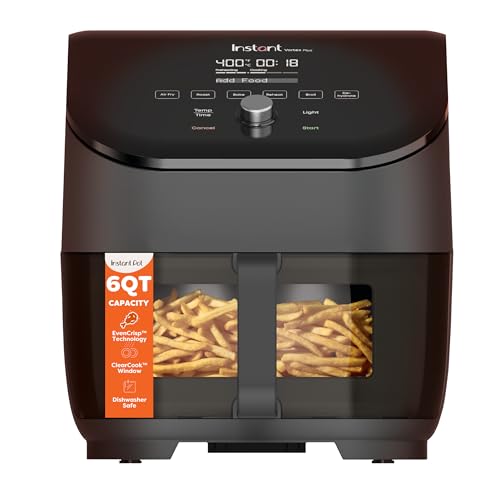
Instant Pot Vortex Plus 6 Qt ClearCook — Best with a Window
The Vortex Plus ClearCook adds the one feature basket-cooker owners consistently wish for: a window. Instead of pulling the basket — dumping heat and interrupting cooking — you watch browning happen and shake only when needed. At 6 quarts with six functions including broil and bake, it is a full family cooker, and the ClearCook basket keeps the monitoring advantage without giving up capacity.
Strengths
- Window and interior light make doneness checks free — no heat loss from opening
- Six functions including broil broaden it beyond basic basket cooking
- EvenCrisp-style airflow produces reliable browning on frozen and fresh foods
Trade-offs
- Window needs regular wiping; splatter films it over if you neglect it
- Body is wider than slim 5-quart rivals at the same family capacity
- Touch panel is less glove-friendly than a physical dial
| Specification | Detail |
|---|---|
| Capacity | 6 quart |
| Functions | Air fry, broil, roast, dehydrate, bake, reheat |
| Viewing | ClearCook window (per Amazon title) |
The window changes cooking behaviour more than any preset. Beginners stop overcooking ‘just in case’, delicate foods like fish get pulled at the right moment, and cheese-topped dishes can be watched through the melt. For households teaching teenagers to cook, that visibility is a genuine safety and confidence feature.
As a cooker it is a strong all-rounder: wings crisp well, vegetables roast with proper edges, and the bake function handles small cakes and reheats pastries without firing up a full oven. Choose it over the TurboBlaze if monitoring matters more to you than the extra temperature range and fan control.
Best for: Visual cooks and families who hate opening the basket to check food / Not suited for: Buyers who prioritise the smallest possible footprint
Check the current price on Amazon

Philips Premium Airfryer XXL — Best Premium
Philips invented this category, and the Premium XXL is its flagship argument: a 7-quart-class cavity rated around three pounds of food, a fat-removal basket floor that separates rendered fat from the cooking food, and Rapid Air circulation tuned over more product generations than any rival. It is the premium-priced pick in this guide and justifies it with batch evenness and build feel rather than feature inflation.
Strengths
- Fat-removal design keeps food out of rendered grease for cleaner crisping
- Excellent batch evenness on large loads of fries and wings
- Premium build, smooth basket action and a keep-warm function that works gently
Trade-offs
- Premium tier pricing within this category — check price on Amazon and buy it for the engineering, not the badge
- Large body; the XXL name is honest about its counter demands
- Accessory ecosystem is brand-specific, so extras cost more than generic ones
| Specification | Detail |
|---|---|
| Capacity | 3 lb / 7 qt class (per Amazon title) |
| Technology | Rapid Air, fat removal (per Amazon title) |
| Controls | Digital display, keep warm |
Where the XXL earns its tier is the second and third year: hinges, basket rails and coatings on premium machines age better, and the fat-separation design measurably reduces the smoky, greasy finish heavy foods can get in flat-floor baskets. If you air fry fatty foods several times a week, that difference is weekly, not theoretical.
Capacity is family-plus: whole chickens in the smaller size range, big wing batches, and party quantities of fries in fewer rounds than any other single-basket pick here. Pair that with realistic expectations — it is still one cavity at one temperature, so two-food timing belongs to the dual-basket format.
Best for: Frequent air fryers who cook fatty foods and big batches / Not suited for: Budget-first buyers or very small counters
Check the current price on Amazon
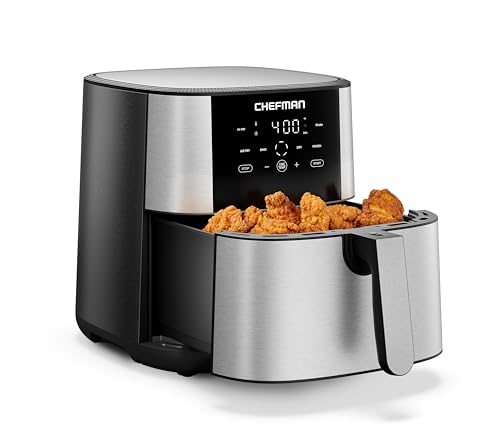
Chefman 8 Qt Air Fryer with Hi-Fry — Best Large Basket on a Budget Tier
Chefman’s 8-quart TurboFry is the capacity-per-tier champion of this guide: a genuinely large single basket, four core functions, and a Hi-Fry option that pushes to 450°F for the final minutes to deepen crisping. For big families or batch cooks who want one basket rather than two, it delivers the volume that smaller premium machines cannot, at a value tier the premium brands do not attempt.
Strengths
- Largest single basket here — whole family batches in one layer, fewer rounds
- Hi-Fry finishing heat genuinely improves crust on wings and frozen foods
- Simple function set keeps it approachable for first-time air fryer owners
Trade-offs
- Big footprint and tall body; confirm cabinet clearance before ordering
- Value-tier fit and finish — handles and rails feel less refined than Ninja or Philips
- Single temperature zone, so mixed meals need planning despite the size
| Specification | Detail |
|---|---|
| Capacity | 8 quart |
| Functions | Air fry, bake, dehydrate, frozen (per Amazon title) |
| Special | 450°F Hi-Fry option (per Amazon title) |
The honest comparison is rounds versus zones. An 8-quart basket cooks a family quantity of one food superbly; a dual-basket machine cooks two foods simultaneously in smaller amounts. Households whose air frying is mostly one star dish at a time — fries night, wing night, roast vegetable trays — get more from this volume than from split baskets.
Use the Hi-Fry finish as directed: cook at normal temperature until nearly done, then finish hot and short. Used from the start it can scorch coatings and sugary marinades. With that discipline, results on frozen snacks and skin-on chicken rival machines from higher tiers.
Best for: Large families wanting maximum single-basket volume on a value tier / Not suited for: Cooks who need two temperatures at once
Check the current price on Amazon
Comparison Table
| Pick | Badge | Key spec | Best for |
|---|---|---|---|
| Ninja Air Fryer AF101 4 Qt | Best Overall | 4 qt basket, 4-in-1, up to 400°F class cooking | Singles and couples who want the proven, no-fuss basket cooker |
| COSORI TurboBlaze 6 Qt Air Fryer | Best Performance | 6 qt, 90–450°F, 5 fan speeds, ceramic coating | Families of three or four who cook varied food and want maximum control |
| Ninja Air Fryer Pro AF141 5 Qt | Best for Small Kitchens | 5 qt slim design, 1750W, 400°F max | Small households wanting family capacity without a bulky machine |
| Instant Pot Vortex Plus 6 Qt ClearCook | Best with a Window | 6 qt, ClearCook window, 6-in-1 | Visual cooks and families who hate opening the basket to check food |
| Philips Premium Airfryer XXL | Best Premium | 7 qt class / 3 lb capacity, fat-removal design, Rapid Air | Frequent air fryers who cook fatty foods and big batches |
| Chefman 8 Qt Air Fryer with Hi-Fry | Best Large Basket on a Budget Tier | 8 qt basket, 450°F Hi-Fry finish | Large families wanting maximum single-basket volume on a value tier |
How to Choose the Best Air Fry Cookers for Your Kitchen
Start with format, not features. Basket cookers are fastest, crispiest and easiest to clean, and they suit the majority of households. Dual baskets add simultaneous two-food cooking at the cost of smaller individual zones. Oven-style cookers trade a little crisping intensity for racks, rotisserie options and toast-and-bake versatility. The six picks above concentrate on basket formats because that is what most shoppers mean by air fry cookers; our sister guides cover oven and pressure-combo formats in depth.
Size by people, then verify by footprint. One to two people: 4 quarts. Three to four: 5 to 6 quarts. Five-plus or batch cooking: 8 quarts or dual baskets. Then measure the actual space — width, depth, and the height with the basket open — because a cooker that cannot open fully under your cabinets will annoy you every single day. Leave air space behind and above the unit as the manual directs; these machines exhaust hot air.
Read temperature and airflow before presets. A 400°F ceiling covers nearly all air frying; 450°F adds finishing power. Wide low ranges (down toward 90–150°F) unlock proofing and dehydrating. Fan speed control, as on the TurboBlaze, is a real capability difference. By contrast, twelve presets that are all minor variations of 400°F for fifteen minutes add nothing but menu scrolling.
Finally, judge the basket, not the brochure. Ceramic or quality nonstick coatings, a crisper plate that lifts food out of rendered fat, dishwasher-safe parts and a basket that slides without sticking are the ownership features that decide satisfaction in month six. Every pick in this guide was chosen to clear that bar.
Basket, Dual Basket or Oven: Which Air Fry Format Fits You?
Choose a single basket if your air frying is one food at a time and speed matters most — it preheats fastest, crisps hardest and cleans quickest. Choose dual baskets if your typical plate is protein plus side at different settings, and you hate sequencing batches while the first batch cools. Choose an oven format if you also want to toast, bake on racks, or cook flat foods like pizza that baskets handle poorly.
There is no format that wins at everything, and marketing that implies otherwise should be distrusted. This guide’s six picks show the basket format at its best across sizes; if reading them leaves you wanting two zones or a rotisserie, follow the internal links at the end to the dedicated format guides rather than forcing a basket to do an oven’s job.
How to Use an Air Fry Cooker for Crisp Results Every Time
Preheat briefly. Two to three minutes at cooking temperature stabilises the cavity so the first side of the food starts crisping on contact. Some models preheat automatically; on manual models, simply run the empty basket for a few minutes before loading.
Load in a single layer with gaps. Air is the cooking medium; food touching food steams at the contact points. If you have more food than fits in one layer, cook two batches — the second batch runs faster in a hot machine, and the total time is usually less than one overcrowded, disappointing batch.
Use a light oil coating on fresh foods. A teaspoon of oil tossed with vegetables or a light spray on fresh potatoes dramatically improves browning and seasoning adhesion. Frozen prepared foods usually carry enough surface fat already. Avoid aerosol propellant sprays on nonstick baskets; use a pump sprayer or brush instead to protect the coating.
Shake or flip halfway. Set a halfway habit: shake baskets of small items, flip cutlets and fillets. That single habit fixes most uneven-browning complaints. With a window model, shake when the palest pieces tell you to rather than by the clock alone.
Rest and clean promptly. Give fried foods a minute on a rack so steam escapes instead of softening the crust. Wash the basket and crisper plate while warm with a soft sponge; prompt cleaning prevents the baked-on grease film that makes older air fryers smoke.
Common Buying Mistakes
The most common mistake is buying by headline quarts and then overfilling the basket daily. The fix is honest sizing at purchase and batch discipline afterwards. The second mistake is choosing presets over physics — paying a premium tier price for food-named buttons while accepting a low temperature ceiling or a flimsy basket.
Skipping the footprint check is the third classic error: the cooker arrives, does not fit under the cabinets, and lives in a cupboard until it is sold. Fourth is coating abuse — metal utensils, abrasive pads and propellant sprays quietly destroy nonstick surfaces that would otherwise last for years.
Finally, many buyers never use the low-temperature range they paid for. Dehydrating fruit, proofing dough, reheating pastries and keeping food warm are weekly-useful functions hiding behind the air fry button. A cooker used for five jobs earns its counter space; one used for fries alone often does not.
Final Recommendation
For most people, the Ninja AF101 remains the best air fry cooker to start with: proven, simple and honestly sized for one or two. Families should step directly to the COSORI TurboBlaze for its range and ceramic basket, or the Ninja AF141 if counter depth is tight. Visual cooks will love the Vortex Plus ClearCook, frequent fryers of fatty foods should consider the Philips XXL, and big-batch households on a value tier should take the Chefman’s 8-quart volume.
Whichever you choose, check price on Amazon, confirm the model code matches the pick exactly, and size it for the meals you actually cook. Explore the related guides below for dual-basket, oven and pressure-combo formats.
Start your shortlist here: Ninja Air Fryer AF101 4 Qt COSORI TurboBlaze 6 Qt Air Fryer Ninja Air Fryer Pro AF141 5 Qt. Check price on Amazon for each, read the configuration carefully, and buy the one whose trade-offs you can live with longest.
Best Air Fryer Cookers Best Air Fryer Pressure Cookers Best 10 Air Fryers Best Affordable Air Fryers Best Air Fryer Convection Ovens
Living With Each Pick: Owner Notes
Ninja Air Fryer AF101 4 Qt
Owners settle into a rhythm with the AF101 quickly: fries and wings on weeknights, reheats at lunch, and the dehydrate setting discovered later for snacks. The basket’s size teaches portion honesty — two people eat well from it, and a third person means a planned second batch rather than a crowded first one. The most common long-term note is that the crisper plate’s edges collect grease if washing is skipped, and a weekly soak prevents the baked-on film that eventually causes smoke.
COSORI TurboBlaze 6 Qt Air Fryer
TurboBlaze owners tend to become temperature experimenters: the fan speeds invite small tests — herbs dried gently, potatoes blasted hard — and the machine rewards that curiosity. The ceramic basket wipes clean more easily than most in the first year, and owners who use pump oil sprayers rather than aerosol cans report the coating staying slick longest. Its size means it earns a permanent counter spot in most homes, which suits a machine used this often.
Ninja Air Fryer Pro AF141 5 Qt
The AF141’s owner story is about placement: it fits where 6-quart rivals do not, so it stays out, and staying out means it gets used for breakfast reheats and snack batches its owners never planned. The 5-quart basket handles a family side dish in one layer, and the machine’s simplicity makes it the one teenagers and grandparents in the same house both operate without instruction.
Instant Pot Vortex Plus 6 Qt ClearCook
ClearCook owners describe a changed cooking style: they watch. Cheese melts are caught at the right second, fish leaves the basket on time, and the shake moment is chosen by colour rather than by timer. The window needs a wipe after fatty cooks — a damp cloth while the basket is still warm handles it in seconds — and owners who keep that habit find the feature stays genuinely useful rather than filming over.
Philips Premium Airfryer XXL
XXL ownership is a long-game story: the machine is bought for fatty-food performance and kept for build quality. The fat-removal floor shows its worth on sausages, thighs and salmon skin, where the finished food tastes cleaner than flat-floor rivals produce. Owners note the basket action and hinges still feel new after years, which is the premium tier quietly justifying itself in month twenty rather than week one.
Chefman 8 Qt Air Fryer with Hi-Fry
Chefman owners organise around volume: batch-cooking Sundays, big family fry nights, and party batches in fewer rounds than any other pick here. The Hi-Fry finish becomes a house technique — normal temperature until nearly done, then a short hot blast — and owners who learn it produce wings that hold their own against far pricier machines. The trade is counter space, accepted gladly by the households this machine suits.
Air Fry Cooker Settings, Translated: What the Functions Really Do
Strip away the marketing names and every air fry cooker offers the same small set of physical programmes. Air fry is high heat with maximum fan. Roast is slightly gentler airflow for items that benefit from calmer surfaces, like vegetables and joints. Bake lowers the fan further so batters and doughs are not disturbed. Reheat is moderate heat with moderate fan, tuned to restore texture without cooking further. Dehydrate is the outlier: low heat, long time, gentle air movement to remove moisture rather than add crust.
Understanding that map frees you from preset dependence. A frozen pastry wants bake logic even if the button says otherwise; a tray of wedges wants air fry logic at a roast temperature. The TurboBlaze’s fan-speed control, the window on the Vortex Plus and the Hi-Fry finish on the Chefman are all ways of adjusting those same variables — heat, airflow, time — with more or less finesse. Buy the machine whose way of adjusting them matches how you like to cook.
Keep warm deserves a warning: it holds food safely and pleasantly for a short window, but crisp food held too long steams itself soft in its own moisture. Use it for minutes while plates are assembled, not as a parking mode while a second course cooks. For longer holds, a low conventional oven with the door’s heat kept gentle is the kinder tool.
Energy, Noise and Heat: The Practical Ownership Costs
Air fry cookers are frugal appliances compared with full ovens: they heat a small cavity, reach temperature in minutes and rarely need the long preheats oven cooking assumes. For single dishes and small batches, that translates into noticeably lower energy use per meal and a kitchen that stays cooler in summer — a benefit owners in warm climates mention as often as the crisping itself.
Noise is the cost nobody advertises. A powerful fan in a small cavity is audible across a kitchen, roughly comparable to a microwave’s hum with more air movement. It is rarely a problem during cooking, but open-plan households running a dehydrate cycle for hours should place the machine thoughtfully. Basket models are generally quieter than oven formats with larger fans.
Heat exhaust matters for placement too. These machines vent hot air, usually from the rear, and need clearance from walls, cupboards and other appliances. The footprint check in our buying guide is not pedantry: a cooker with proper clearance runs cooler, smells less and ages better than one wedged into a steamy corner.
Your First Two Weeks With an Air Fry Cooker: A Practical On-Ramp
Week one should be built on forgiving foods. Frozen fries, nuggets and reheated pizza teach you the machine’s timing without punishing mistakes, and they calibrate your expectations for how much faster an air fry cooker runs than an oven — most new owners overcook their first fresh items by trusting oven timings. Reduce oven recipe times by roughly a fifth and check early; your machine’s exact pace becomes obvious within a few cooks.
Week two is for fresh proteins and vegetables. Chicken thighs with skin are the ideal teacher: they show you the crisping power, the fat management of the crisper plate, and the value of patting food dry. Roast vegetables teach the single-layer rule better than any instruction, because a crowded tray steams visibly while a spaced tray caramelises. Take phone photos of your best results with their settings; that small album becomes your personal manual.
By the end of the fortnight, clean the machine properly once — basket, plate, cavity walls, and the element area as the manual allows — so the habit is set before grease films establish themselves. Owners who build the routine early describe their machines as ageing slowly; owners who skip it meet the smoking, smelling phase that gives older air fryers a bad name.
Troubleshooting Crispness: Why Food Comes Out Pale, Soggy or Uneven
Pale food almost always means moisture or crowding. Wet surfaces spend their first minutes steaming instead of frying, so pat proteins and vegetables dry, and drain marinades rather than loading them dripping. Crowding multiplies the moisture problem by trapping steam between pieces. The fix is unglamorous and total: dry food, single layer, air gaps, and a shake halfway.
Soggy reheats usually mean the wrong function. Reheat and air fry settings exist to restore crust with moving hot air; a microwave’s steam-based heating destroys it. If reheated food still disappoints, the portion was likely too thick for the time — give dense items a few minutes at moderate heat to warm through, then a short hot finish to recrisp the surface, the same two-stage logic the Chefman’s Hi-Fry formalises.
Uneven browning points to geometry: pieces of mixed size, a basket loaded past its layer, or a machine placed so its exhaust is obstructed and its airflow compromised. Cut evenly, load honestly, and check the clearance behind the unit. If one side of the basket consistently browns faster, rotate the basket or turn the food at the shake — small machines have personalities, and learning yours is part of ownership.
Choosing by Household: Who Should Buy What
For a first apartment
Start with the AF101 or the AF141 if the household is two people who cook. Both forgive beginners, clean easily and fit small counters. Resist the large machines until your cooking proves it needs them; a compact cooker used daily beats a flagship used monthly, every time.
For a family of four
Take the TurboBlaze for single-basket cooking or step to the dual-basket guide if two-food dinners dominate. The 6-quart square basket is the minimum that keeps family batches in a single layer, and single layers are where this category’s quality lives.
For a keen reheater
If your main use is restoring leftovers, the Vortex Plus ClearCook’s window and gentle reheat make it the connoisseur’s choice. Fried food, pastries and roast vegetables all return properly under watched heat.
What You Will Cook in Year Two (That You Did Not Expect)
Owners consistently report mission creep, in the best sense. The cooker bought for fries starts proofing dough, drying garden herbs, reheating bakery pastries, roasting nuts and chickpeas, and warming plates’ worth of leftovers for lunches. Each new use displaces an oven cycle or a microwave compromise, and the machine’s cost per use falls month by month.
That creep is why the low-temperature range and the reheat quality matter in this guide’s rankings, despite being unglamorous specifications. A cooker that only fries is a cooker used twice a week; a cooker that reheats, proofs and dries is used twice a day. Buy for the second machine, not the first.
A Note on Safety and Placement
Air fry cookers are safe appliances used with ordinary respect: clearance for exhaust heat, a stable surface, cords kept from hot zones, and baskets opened away from the face because the steam release is real. Keep the machine away from the hob’s own heat, never run it under a low cupboard that traps its exhaust, and let it cool before moving it to storage.
Households with children should treat the basket like a hot pan — because it is one — and build the same rules used for oven trays. None of this is burdensome, and all of it is the difference between an appliance the whole household uses confidently and one surrounded by small anxieties.
Frequently Asked Questions
What is the difference between an air fry cooker and a regular air fryer?
Nothing structural — air fry cooker is simply the generic category name shoppers use. Basket models, dual-basket models and oven-style models are all air fry cookers; the format sections in this guide explain which shape suits which kitchen.
What size air fry cooker do I need for a family of four?
A 5 to 6-quart single basket is the comfortable minimum, cooking a family portion of fries or wings in one layer. If you regularly cook two foods at once, choose a dual-basket model or an 8-quart basket and accept sequencing.
Do I need to preheat an air fry cooker?
A short preheat of two to three minutes improves first-side crisping and makes cooking times more predictable. It is not mandatory for reheating, but for fresh proteins and potatoes it is worth the habit.
Can I put foil or parchment in an air fry cooker?
Yes, if it is weighed down by food and does not block airflow or touch the element. Perforated parchment liners made for air fryers simplify cleanup; never preheat with loose paper or foil inside, as moving air can lift it into the element.
How do I stop my air fry cooker from smoking?
Smoke usually means rendered fat is hitting a hot surface or old grease film is burning off. Keep food out of pooled fat with the crisper plate, clean the basket and cavity regularly, and for very fatty foods cook at a slightly lower temperature with a longer time.
Is a ceramic-coated basket better than standard nonstick?
Ceramic coatings, like the PFAS-free basket on the COSORI TurboBlaze pick, answer buyers who prefer to avoid traditional nonstick chemistry. Both types need gentle utensils and sponges; ceramic tends to lose slickness gradually rather than peeling, while quality traditional nonstick often stays slicker longer.


