Disclosure: airfryerkitchensupply.com is reader-supported. When you buy through links on our site, we may earn an affiliate commission at no extra cost to you.
Where to Buy
The fastest way to buy any pick in this guide to the best environmental friendly toilets is through Amazon, where each verified model below is listed with its current specification details. Use the links in this box to check the current configuration before you order — toilet listings sometimes bundle different seats or rough-ins under one page, and the variant you select is the toilet you get.
- Separett Villa Urine-Separating Toilet — Best Overall — Zero Water. Check the current price on Amazon.
- VORTEXTOVE Dual Flush Water-Saving One-Piece Elongated Toilet (W2111) — Best Flush Toilet for Water Saving. Check the current price on Amazon.
- Nature’s Head Self-Contained Composting Toilet (Close Quarters Spider Handle) — Best True Composting. Check the current price on Amazon.
- TOTO Eco Soiree One-Piece Elongated Toilet, 1.28 GPF — Best Low-Chemical Cleaning. Check the current price on Amazon.
- DeerValley Compact One-Piece Toilet, Dual Flush 1.1/1.6 GPF — Best for Small Bathrooms. Check the current price on Amazon.
- Gerber Maxwell Select Round Two-Piece Dual-Flush Toilet — Best Budget Dual Flush. Check the current price on Amazon.
If a pick shows as unavailable in your region, choose the next pick in the same badge family rather than substituting an unverified model — every recommendation in this guide was checked against its listing before inclusion.
The best environmental friendly toilets share one trait: they treat water as a resource, not a transport medium to be thrown away by the gallon. At one end of this guide sit toilets that use no water at all — urine-separating and composting designs that eliminate flushing entirely. At the other end sit the most frugal flush toilets we could verify, models that do the job on 0.8 to 1.28 gallons instead of the 3.5 gallons an older toilet spends. Both strategies are genuinely environmental; they suit very different homes, and this guide is honest about which is which.
A note on scope, because ‘environmentally friendly’ gets stretched by marketing: a toilet’s footprint is mostly its water use, the chemicals needed to keep it clean, and how long it stays in service before replacement. We weighted picks on exactly those three axes — verified flush volume (or zero), features that reduce chemical cleaning like slick glazes and rimless bowls, and build quality that keeps the toilet working for decades instead of years. Every flush figure below comes from the product’s verified listing; where a listing does not print a figure, we say so.
Who should read which half? If you have a cottage, homestead, off-grid build, boat, or a bathroom where plumbing is impossible or unwanted, start with the waterless picks — the Separett Villa and the Nature’s Head. If you have a normal plumbed bathroom and simply want the greenest flush, start with the VORTEXTOVE and the TOTO Eco Soiree. Both paths beat the status quo by a wide margin.
In this guide
Quick Picks: The Best environmental friendly toilets
If you only read one section, make it this one. Each pick below carries a badge naming the job it does best, and the same badge appears at its full review further down so you can jump straight to the detail.
Best Overall — Zero Water — Separett Villa Urine-Separating Toilet: Uses no water at all — the ultimate flush saving. Urine separation keeps solids dry and dramatically reduces odor. Check the current price on Amazon.
Best Flush Toilet for Water Saving — VORTEXTOVE Dual Flush Water-Saving One-Piece Elongated Toilet (W2111): The 0.8 GPF light flush is the lowest verified light-flush volume in this roundup. One-piece body has no tank-to-bowl seam to leak or trap grime. Check the current price on Amazon.
Best True Composting — Nature’s Head Self-Contained Composting Toilet (Close Quarters Spider Handle): True composting with a hand-crank agitator — no separation-only management. Self-contained: no external tank or drain required. Check the current price on Amazon.
Best Low-Chemical Cleaning — TOTO Eco Soiree One-Piece Elongated Toilet, 1.28 GPF: TOTO’s CEFIONTECT glaze helps waste slide off, reducing scrubbing and cleaner use. Universal Height suits most adults while staying family-friendly. Check the current price on Amazon.
Best for Small Bathrooms — DeerValley Compact One-Piece Toilet, Dual Flush 1.1/1.6 GPF: Compact skirted body made for small bathrooms. Dual flush with a quiet-flush emphasis in the listing. Check the current price on Amazon.
Best Budget Dual Flush — Gerber Maxwell Select Round Two-Piece Dual-Flush Toilet: Dual flush in a budget-friendly round two-piece format. Tool-free install kit with wax ring included in the box. Check the current price on Amazon.
How These Picks Were Chosen
We built the shortlist for the best environmental friendly toilets from models whose listings we could verify, then ranked them on the criteria this category actually turns on: verified flush volume or waterless design, evidence of clearing performance (a MaP score, a certification, a named flushing platform, or a flush-valve specification printed in the listing), fit (rough-in, bowl shape, seat height), and the completeness of what ships in the box.
Two rules governed inclusion. First, no specification appears in this guide unless the product’s own verified listing states it — where a listing is silent on a figure, the review says so instead of estimating. Second, no static prices and no fixed ratings appear anywhere in the article: prices move, ratings move, and a buying guide should send you to the live listing for both. Picks are ordered by overall fit for the keyword, with badges flagging the specialist choices.
The 6 Best environmental friendly toilets — Full Reviews

Separett Villa Urine-Separating Toilet — Best Overall — Zero Water
Separett, from Sweden, is the defining name in urine-separating toilets, and the Villa is its flagship for fixed installations — cottages, homesteads, and converted buses (‘skoolies,’ per the listing). The principle is simple: a separator under the seat diverts urine away from solids, so the solid waste stays dry, odor stays low, and no water, chemicals, or mixing are involved. For an off-grid building, eliminating flush water also eliminates the well pumping, septic load, and freeze risk that come with it.
Strengths
- Uses no water at all — the ultimate flush saving
- Urine separation keeps solids dry and dramatically reduces odor
- High-capacity design suits full-time cottage and homestead use
Trade-offs
- Requires a vent pipe and a plan for urine drainage or collection
- Solids must be emptied and composted or disposed of responsibly
- US dealer and parts network is smaller than domestic brands
| Specification | Verified detail |
|---|---|
| Type | Urine-separating dry toilet |
| Water use | None — waterless |
| Additives | None required (from listing title) |
| Capacity | High-capacity design (from listing title) |
| Use cases | Homestead, skoolie, cottage (from listing title) |
The Villa is not a drop-in replacement for a flush toilet in a plumbed suburban home; it needs a vent, a urine outlet plan, and an owner willing to manage the solids container. Within its intended world, though, it is the benchmark — which is why it anchors both our environmental and European composting lists. Buy it through the verified listing so you get the correct US-market configuration.
Environmentally, the Villa is not an incremental improvement — it deletes the problem. No flush water, no septic load, no treatment chain. Its footprint reduces to a vent, a container, and the owner’s routine, which is why it tops a guide about environmental impact rather than mere efficiency.
Best for: buyers who want a pick where uses no water at all — the ultimate flush saving. / Not suited for: anyone who would be put off because requires a vent pipe and a plan for urine drainage or collection.
Check on Amazon — check the current price on Amazon and confirm the exact variant, seat inclusion, and rough-in on the listing before ordering.

VORTEXTOVE Dual Flush Water-Saving One-Piece Elongated Toilet (W2111) — Best Flush Toilet for Water Saving
The VORTEXTOVE W2111 is built around one idea: most flushes do not need much water. Its top-press dual flush lets you choose a 0.8-gallon light flush for liquid waste or the full 1.28-gallon flush for solids, and that light-flush figure is the smallest verified number anywhere in this guide. The one-piece ceramic body keeps the silhouette compact, which helps in smaller bathrooms where a two-piece toilet with a separate tank can look bulky.
Strengths
- The 0.8 GPF light flush is the lowest verified light-flush volume in this roundup
- One-piece body has no tank-to-bowl seam to leak or trap grime
- Quick-release seat lifts off for fast cleaning around the hinges
Trade-offs
- Lesser-known brand, so long-term parts support is less proven than the legacy makers
- Top-press button gives less tactile feedback than a side lever for some users
- Compact footprint may feel short for taller users despite the elongated bowl
| Specification | Verified detail |
|---|---|
| Flush | Dual flush, top-press button |
| Flush volume | 0.8 / 1.28 GPF (from listing title) |
| Bowl | Elongated |
| Rough-in | 12 in |
| Seat | Quick-release soft-close V-seat included |
The quick-release soft-close seat is a practical touch: it pops off for cleaning and drops without slamming. Because this is a newer brand rather than a century-old plumbing name, we would pair it with a standard wax ring or silicone seal you can source anywhere, and keep the fill valve model noted in case a generic replacement is ever needed.
Among flush toilets, the W2111’s verified 0.8 GPF light flush is the smallest water cost per everyday use we found. It is the pick that lets a conventional plumbed bathroom approach waterless-level savings on the flushes that happen most often.
Best for: buyers who want a pick where the 0.8 gpf light flush is the lowest verified light-flush volume in this roundup. / Not suited for: anyone who would be put off because lesser-known brand, so long-term parts support is less proven than the legacy makers.
Check on Amazon — check the current price on Amazon and confirm the exact variant, seat inclusion, and rough-in on the listing before ordering.
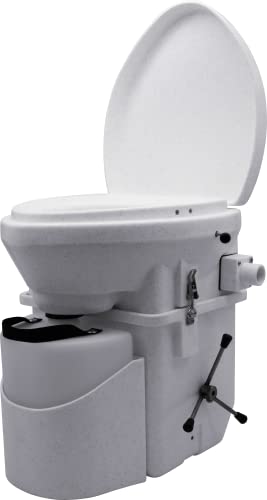
Nature’s Head Self-Contained Composting Toilet (Close Quarters Spider Handle) — Best True Composting
Nature’s Head is the American benchmark for self-contained composting toilets, built originally for marine use. Unlike separation-only designs, it actively composts: a hand crank turns an agitator through a bed of coco coir or peat moss, while urine is diverted to a separate bottle. The Close Quarters Spider Handle variant is shaped for tight installs in boats, vans, and tiny homes where a standard crank would foul the wall.
Strengths
- True composting with a hand-crank agitator — no separation-only management
- Self-contained: no external tank or drain required
- Close-quarters handle suits tight marine and van installations
Trade-offs
- Requires a composting medium such as coco coir or peat moss
- Crank and agitator add a hands-on routine some users dislike
- US-made — included as an environmental pick, not a European design
| Specification | Verified detail |
|---|---|
| Type | Self-contained composting toilet |
| Water use | None — waterless |
| Handle | Close Quarters Spider Handle (from listing title) |
| Design | Urine-diverting, hand-crank agitator |
The routine is the trade: you add medium, turn the crank after use, empty the urine bottle regularly, and empty the solids chamber every few weeks depending on crew size. Owners who keep up the routine report remarkably little odor; owners who expected a flush-and-forget toilet are the unhappy minority. As an environmental choice it eliminates flush water entirely and returns waste as compostable material where local rules allow.
The Nature’s Head adds genuine composting to the zero-water formula: waste becomes a soil-like output rather than a disposal problem, where local rules allow it to be used. For homesteaders closing the nutrient loop, that is the deepest environmental story in this guide.
Best for: buyers who want a pick where true composting with a hand-crank agitator — no separation-only management. / Not suited for: anyone who would be put off because requires a composting medium such as coco coir or peat moss.
Check on Amazon — check the current price on Amazon and confirm the exact variant, seat inclusion, and rough-in on the listing before ordering.

TOTO Eco Soiree One-Piece Elongated Toilet, 1.28 GPF — Best Low-Chemical Cleaning
The Eco Soiree is TOTO’s argument that efficiency is about more than gallons. Yes, it flushes at 1.28 GPF, but the CEFIONTECT glaze is the environmental story: the ultra-smooth ceramic surface gives waste and mineral deposits less to grip, so the bowl stays cleaner with less scrubbing and less chemical cleaner over the toilet’s life. The skirted one-piece body at Universal Height covers the comfort side.
Strengths
- TOTO’s CEFIONTECT glaze helps waste slide off, reducing scrubbing and cleaner use
- Universal Height suits most adults while staying family-friendly
- Skirted one-piece design with TOTO’s long reliability record
Trade-offs
- This listing is Sedona Beige — check color before ordering for a white bathroom
- Single flush gives no lighter option for liquid waste
- Premium tier pricing for the category
| Specification | Verified detail |
|---|---|
| Flush | Single flush |
| Flush volume | 1.28 GPF (from listing title) |
| Bowl | Elongated, skirted, Universal Height |
| Glaze | CEFIONTECT (from listing title) |
| Color | Sedona Beige (this listing) |
Note the listing color carefully — this verified listing is Sedona Beige, a warm off-white that can clash with a bright-white tub or sink. TOTO’s fit-and-finish and parts availability are the long-game reasons to pay its premium tier price: a toilet that stays in service for twenty years is greener than a cheap one replaced twice. If your household wants a lighter flush for liquids, look at the dual-flush picks instead; the Soiree bets on doing one flush volume very well.
The Eco Soiree’s environmental case is chemical and temporal: CEFIONTECT reduces the cleaners its bowl will consume, and TOTO build quality stretches its service life across decades. Not the lowest GPF here — the lowest lifetime footprint among conventional flush toilets.
Best for: buyers who want a pick where toto’s cefiontect glaze helps waste slide off, reducing scrubbing and cleaner use. / Not suited for: anyone who would be put off because this listing is sedona beige — check color before ordering for a white bathroom.
Check on Amazon — check the current price on Amazon and confirm the exact variant, seat inclusion, and rough-in on the listing before ordering.

DeerValley Compact One-Piece Toilet, Dual Flush 1.1/1.6 GPF — Best for Small Bathrooms
DeerValley’s compact one-piece targets the small full bathroom: a skirted body that does not eat floor space, a standard seat height that suits average and shorter users, and a dual flush rated 1.1/1.6 GPF with the listing calling out powerful yet quiet operation. Small bathrooms are where efficient toilets often get skipped — owners assume nothing modern fits — and this model is the counter-argument.
Strengths
- Compact skirted body made for small bathrooms
- Dual flush with a quiet-flush emphasis in the listing
- Standard seat height suits shorter users and kids better than chair height
Trade-offs
- Full flush is 1.6 GPF
- Standard height may be low for tall users
- Compact bowl trades some seating room for space
| Specification | Verified detail |
|---|---|
| Flush | Dual flush |
| Flush volume | 1.1 / 1.6 GPF (from listing title) |
| Bowl | Compact, skirted, standard seat height |
| Rough-in | 12 in |
The standard height deserves emphasis because ‘chair height’ has become the default marketing answer; for households with kids or shorter adults, standard height is genuinely more comfortable and safer for feet-on-floor posture. The 1.6 GPF full flush is the water trade-off, partly offset by the 1.1 light flush handling most daily use. For a small primary bath, this is a well-judged balance of fit, quiet, and savings.
Small bathrooms are where old, thirsty toilets survive longest, because owners assume nothing efficient fits. The DeerValley Compact’s dual flush in a compact skirted body removes that excuse — an environmental upgrade measured in bathrooms converted, not just gallons.
Best for: buyers who want a pick where compact skirted body made for small bathrooms. / Not suited for: anyone who would be put off because full flush is 1.6 gpf.
Check on Amazon — check the current price on Amazon and confirm the exact variant, seat inclusion, and rough-in on the listing before ordering.

Gerber Maxwell Select Round Two-Piece Dual-Flush Toilet — Best Budget Dual Flush
The Maxwell Select is Gerber’s value play in dual flush: a round two-piece toilet with a water-saving dual-flush valve, a seat that lifts off in seconds for cleaning, and a tool-free installation kit including the wax ring. For landlords, flippers, and first-time DIYers, the all-in-the-box approach removes the two most common mid-install surprises — the missing wax ring and the seat bought separately.
Strengths
- Dual flush in a budget-friendly round two-piece format
- Tool-free install kit with wax ring included in the box
- Lift-off seat makes deep cleaning fast
Trade-offs
- Listing title does not state GPF figures — verify on the product page before relying on a number
- Round bowl is less roomy than elongated
- Basic styling aimed at value, not design impact
| Specification | Verified detail |
|---|---|
| Flush | Dual flush, water-saving (from listing title) |
| Bowl | Round, two-piece |
| Seat | Lift-off seat for cleaning |
| Install | Tool-free install kit with wax ring included |
One transparency note we apply to every pick in this guide: the listing title calls the dual flush ‘water-saving’ but does not print the actual GPF figures, so check the specification section on the product page before you count specific savings from this model. The mechanism — two flush volumes instead of one — is what does the saving. As a straightforward, economical way to bring dual flush to a secondary bathroom, it earns its place.
The Maxwell Select is the democratizer: dual-flush water saving at a budget tier, with the install kit included. We flag openly that its listing states no GPF figure — verify it on the product page — but the mechanism and the price put water saving into rentals and second baths that premium picks never reach.
Best for: buyers who want a pick where dual flush in a budget-friendly round two-piece format. / Not suited for: anyone who would be put off because listing title does not state gpf figures — verify on the product page before relying on a number.
Check on Amazon — check the current price on Amazon and confirm the exact variant, seat inclusion, and rough-in on the listing before ordering.
Comparison Table
| Pick | Badge | Key spec (verified) | Best for |
|---|---|---|---|
| Separett Villa Urine-Separating Toilet | Best Overall — Zero Water | None — waterless | Overall — Zero Water |
| VORTEXTOVE Dual Flush Water-Saving One-Piece Elongated Toilet (W2111) | Best Flush Toilet for Water Saving | 0.8 / 1.28 GPF (from listing title) | Flush Toilet for Water Saving |
| Nature’s Head Self-Contained Composting Toilet (Close Quarters Spider Handle) | Best True Composting | None — waterless | True Composting |
| TOTO Eco Soiree One-Piece Elongated Toilet, 1.28 GPF | Best Low-Chemical Cleaning | 1.28 GPF (from listing title) | Low-Chemical Cleaning |
| DeerValley Compact One-Piece Toilet, Dual Flush 1.1/1.6 GPF | Best for Small Bathrooms | 1.1 / 1.6 GPF (from listing title) | for Small Bathrooms |
| Gerber Maxwell Select Round Two-Piece Dual-Flush Toilet | Best Budget Dual Flush | Round, two-piece | Budget Dual Flush |
Key specs are quoted from each product’s verified listing. Where two picks share a headline figure, the deciding factors are usually the ones in the full reviews: bowl shape, seat height, what is included in the box, and how the flush achieves its result.
How to Choose an Environmental Friendly Toilet
First decision: waterless or flushing? Waterless toilets (urine-separating and composting) eliminate flush water, septic load, and most plumbing, but they ask something of you — venting, emptying, and managing output responsibly. They shine off-grid, in accessory buildings, and anywhere a drain does not exist. Flushing toilets ask nothing new of your routine and still cut water use by half to two-thirds versus old models; they are the right environmental upgrade for ordinary homes.
Within flushing models, judge three things. Flush volume, verified: dual-flush light volumes and 1.28 GPF full flushes are the current frontier. Cleaning chemistry: glazes like TOTO’s CEFIONTECT and rimless bowls reduce how much cleaner and scrubbing the bowl demands. Longevity: a toilet is a 15-to-25-year appliance, and a durable, repairable model from a maker with deep parts support has a smaller lifetime footprint than a cheap unit replaced twice. The greenest toilet is usually the one you never have to throw away.
Waterless Toilets, Explained Honestly
Urine-separating toilets (the Separett approach) divert urine through a separate outlet — to a drain, a container, or a soakaway where rules allow — while solids drop into a lined container, kept dry and low-odor precisely because the liquids are gone. There is no active composting in the unit; the container is emptied and the contents composted or disposed of per local rules. Composting toilets (the Nature’s Head approach) keep everything in one chamber where an agitator mixes waste with a medium like coco coir, starting genuine decomposition in the unit.
Both need a small vent to the outside; both reward owners who follow the routine and punish those who expected a flush toilet’s invisibility. Neither is legal everywhere as a primary toilet — check local codes, especially for full-time residences. And both eliminate not just flush water but the entire downstream chain: no septic pumping load, no sewer treatment, no freeze risk in unheated buildings. For the right property, nothing else in this guide comes close.
The Hidden Footprint: Cleaners, Parts, and Replacement Cycles
A toilet’s lifetime footprint includes the bottles of bleach cleaner scrubbed through it and the spare parts — or whole replacement toilets — it consumes. Bowls with engineered glazes and rimless interiors stay cleaner with milder, less frequent cleaning. Models built on widely stocked parts (the legacy American and Japanese makers especially) can be kept at full efficiency with a seal or valve swap instead of a landfill trip.
This is why this guide includes a budget dual-flush pick (the Gerber Maxwell Select) alongside premium models without pretending they are equal: the Maxwell’s dual-flush mechanism saves water from day one at a price that puts it in rentals and second baths, while the premium picks repay their cost in decades of service. Environmental buying is portfolio thinking — the best choice is the one that fits your property and stays in service.
Beyond the Bathroom: Where Waterless Toilets Change the Property
A waterless toilet is rarely just a toilet purchase — it is an infrastructure decision. Adding a bathroom to a barn, studio, pool house, or accessory dwelling usually triggers the real costs: trenching a drain, tying into septic capacity, permits for new plumbing. A vented urine-separating or composting toilet collapses that project into a fixture, a vent pipe, and a urine path. For rural properties, that difference decides whether the extra bathroom exists at all, which is why the Separett class of toilets has such a loyal following among homesteaders and cabin owners despite the routine they require.
The environmental ledger extends beyond water. No drain means no septic load — meaningful for properties whose septic systems are at capacity or whose soils drain poorly. No water supply line means no freeze-burst risk in intermittently heated buildings, a failure mode that causes enormous water damage and waste in cold climates. And at the system level, every household that handles its own waste on-site is one the municipal treatment network never has to pump and process. None of this makes waterless right for a suburban primary bath; all of it makes waterless transformative in the right setting.
If you are weighing that setting, prototype the routine mentally with complete honesty: Who empties the container, and how do they feel about it? Where does the urine line run in January? Where does the vent exit, and what does the wind do there? What is the legal route for the solids? The owners who answer those questions before purchase are the ones writing the glowing long-term reviews; the questions are the whole game.
Reading Green Claims Like an Auditor
The toilet aisle is full of environmental vocabulary — eco, green, planet-friendly, sustainable — attached to products with no verifiable claim underneath. Audit any model, including ours, with four questions. What is the flush volume, and who verified it — a certification label, an independent MaP score, or only the seller’s adjective? What does the bowl need to stay clean — an engineered glaze and mild cleaners, or weekly bleach? How long will it serve — are wear parts stocked, standardized, and priced like consumables? And what happens at the end — can it be repaired, or is it a sealed unit with a landfill appointment?
Applied to this guide, the audit is why the picks look the way they do. The waterless models answer the first question with zero. The VORTEXTOVE prints its dual volumes in its listing. The TOTO Eco Soiree answers the cleaning question with a glaze. The Gerber Maxwell Select is included with its omission stated — its listing claims ‘water-saving’ dual flush without printing a figure — because a budget pick that brings dual flush to more bathrooms has environmental value even under a transparency flag. That flag is the standard: a claim you cannot check is a claim you should discount, whoever makes it.
One more audit habit: beware the halo of a single green feature on an otherwise ordinary product. A toilet with a bamboo seat and a 1.6 GPF flush is a 1.6 GPF toilet. Features that move the ledger are measured in gallons, chemicals, and years — everything else is decoration, and decoration is fine as long as you know that is what you are paying for.
If You Cannot Go Waterless: The Maximum-Impact Flush Bathroom
Most readers of this guide will keep flushing — the property, the codes, or the household demand it. So it is worth describing what the maximum-impact flush bathroom actually looks like, because it is achievable with ordinary products. The toilet is a verified low-volume model with clearing evidence — the profile of this guide’s flush picks. The bowl stays clean with mild cleaners because its glaze or rimless design does the heavy lifting. The tank is leak-free because someone runs the dye test yearly. And the seat, seals, and valves are replaceable parts from a stocked catalog, so the fixture’s service life is measured in decades.
Around the toilet, the same philosophy compounds: a shower and faucets chosen to the same verified-efficiency standard, cleaning products bought for mildness rather than marketing, and repairs made promptly because a dripping fixture is an environmental event, not a cosmetic one. None of this requires sacrifice or exotic products — it requires the auditor’s habit from the previous section, applied at the scale of one room. The cumulative effect across a housing stock is how cities actually bend their water curves.
And keep the waterless option in its proper place in your thinking: not as a purity test you failed, but as a tool waiting for its job. The future studio over the garage, the barn bathroom, the cabin — when a project arrives where a drain is expensive, septic is full, or water is precious, the Separett pattern will be there, proven and available. Environmental buying is a portfolio across a lifetime of properties, and knowing both families in this guide is the real takeaway.
Greywater, Rainwater, and the Toilet: The Next Frontier at Home
Ambitious households sometimes ask whether a flush toilet can run on something other than drinking water — and the honest answer is ‘sometimes, carefully, and usually not as a DIY improvisation’. Purpose-built greywater systems that treat shower and sink water for flushing exist in some jurisdictions under permit, and rainwater-to-toilet systems are standard practice in parts of Australia and Europe. Where they are legal and professionally installed, they cut a toilet’s potable-water footprint toward the waterless tier while keeping flush convenience.
What does not work is improvisation: pouring bucket greywater into a tank invites odor, biofilm, and valve damage, and untreated stored water in a tank is a hygiene problem, not a hack. The picks in this guide are designed for potable supply; if your property pursues rainwater or greywater flushing, it should be through a designed system with filtration, disinfection where required, backflow protection, and a permit — at which point almost any efficient toilet in this guide becomes a suitable endpoint, and the dual-flush models stretch the harvested water furthest.
For everyone else, the frontier is already in the bathroom: the verified low volumes, clean-keeping bowls, and leak discipline this guide describes capture nearly all of the practical benefit with none of the regulatory adventure. Treat harvested-water flushing as a property-level project for a future remodel, not a reason to delay replacing a 3.5 GPF toilet today.
Quick Checklist Before You Order
Match the technology to the property first: waterless only where venting, a urine path, and a legal solids route all exist; a verified low-volume flush everywhere else. For flush picks, confirm the rough-in, the bowl shape against the door swing, and the seat height against the household. Check what the box includes — seat, wax ring, kit — and note the model’s wear parts (flush seal, fill valve, dual-flush cartridge) in your house file at purchase time, while the listing is open in front of you. For waterless picks, walk the vent route and the urine line’s downhill path in the actual building before ordering, and confirm local code acceptance if the unit will serve as a primary toilet. Every disappointment in this category is a skipped item on this list; every item takes under a minute.
One Last Distinction: Friendly to Which Environment?
It is worth ending on the word itself. ‘Environment’ in this category usually means the watershed — the river, aquifer, and treatment plant your flush travels through. But the picks in this guide also serve the immediate environment: a bathroom that needs less chemical cleaning is a gentler room to breathe in; a cottage that handles its own waste is a property independent of fragile infrastructure; a bowl that stays clean on mild cleaners is kinder to the septic biology in your own yard. The Separett and Nature’s Head picks serve the watershed absolutely, by using nothing. The glazed, low-volume flush picks serve it relatively, by using far less and demanding less chemistry. Both meanings are legitimate, and the right one for your property is the one your infrastructure supports — which is why this guide ranks two families under one keyword and labels them clearly, rather than pretending a single winner exists.
How to Set Up and Use a Urine-Separating or Composting Toilet
Start with the vent, because venting is what makes waterless toilets odor-free in practice. Both Separett and Nature’s Head style units want a vent pipe routed to outside air, ideally vertical with minimal bends; many models include a small fan in the vent path. Plan the vent route before you place the toilet, and seal the joints — a leaky vent joint inside a wall cavity is the classic cause of ‘my composting toilet smells’ complaints that are really installation complaints.
For a urine-separating toilet, decide the urine path: a plumbed drain to an approved outlet, or the model’s container. Keep the urine line sloping continuously downward with no traps or sags where liquid can pool. Line the solids container as the maker directs. For a composting toilet, charge the chamber with the specified medium (commonly coco coir, rehydrated and fluffed) to the maker’s fill line before first use.
Daily use is simple: sit (separation geometry assumes seated use by everyone), and for composting models, turn the agitator crank after solid use. Empty on the maker’s schedule, not your nose’s — by the time a well-run unit smells, something (vent, urine line, medium moisture) needs attention. Keep a small troubleshooting habit: check the vent fan monthly, rinse the urine line periodically to prevent crystal buildup, and keep spare medium and container liners on hand so maintenance never gets postponed.
Common Buying Mistakes
Buying a waterless toilet for a home that expects flush-and-forget. Waterless designs need venting, emptying, and a routine. In a plumbed primary bathroom with unwilling users, a frugal flush toilet is the greener real-world choice.
Ignoring local codes for composting and separating toilets. Rules for primary residences, urine disposal, and compost handling vary. Check before you build a bathroom around a waterless toilet.
Skipping the vent or venting into an attic. The vent is the odor system. Route it outside, keep it as straight as possible, and seal every joint.
Judging flush toilets on GPF alone. Cleaning chemistry and service life matter. A slick-glazed, repairable 1.28 GPF toilet can beat a fragile ultra-low-flow model over twenty years.
Letting a urine line sag. Pooled urine crystallizes and blocks lines. Continuous downward slope, no traps, periodic rinsing.
Trusting a ‘water-saving’ claim with no figure. One pick in this guide is included with the explicit note that its listing states no GPF. That transparency is the standard — apply it to any toilet you consider.
Final Recommendation
If your property can take it, the Separett Villa is the environmental ceiling: zero water, zero chemicals, and a design proven across decades of Scandinavian cottages. If you want active composting instead of separation, the Nature’s Head is the benchmark. For plumbed homes, the VORTEXTOVE’s verified 0.8 GPF light flush and the TOTO Eco Soiree’s low-chemical glaze are the greenest flushes we verified, with the DeerValley Compact serving small bathrooms and the Gerber Maxwell Select bringing dual flush to a budget.
Read the sibling lenses for the same models ranked differently: Best Environmental Toilets, Best Energy Efficient Toilets, Best Energy Saving Toilets, and Best European Composting Toilets for the deep dive on the waterless category.
The shortlist, for a final check of current price and configuration on Amazon: Separett Villa Urine-Separating Toilet (Best Overall — Zero Water); VORTEXTOVE Dual Flush Water-Saving One-Piece Elongated Toilet (W2111) (Best Flush Toilet for Water Saving); Nature’s Head Self-Contained Composting Toilet (Close Quarters Spider Handle) (Best True Composting); TOTO Eco Soiree One-Piece Elongated Toilet, 1.28 GPF (Best Low-Chemical Cleaning); DeerValley Compact One-Piece Toilet, Dual Flush 1.1/1.6 GPF (Best for Small Bathrooms); Gerber Maxwell Select Round Two-Piece Dual-Flush Toilet (Best Budget Dual Flush).
Frequently Asked Questions
What makes a toilet environmentally friendly?
Primarily water use: zero for waterless designs, or a verified low GPF for flush toilets. Secondary factors are how much chemical cleaner the bowl demands (glazes and rimless designs reduce it) and how long the toilet stays in service, since manufacturing and replacing a porcelain fixture carries its own footprint.
Are composting toilets legal in a house?
It depends on your jurisdiction and whether the toilet serves as the primary fixture. Many areas allow certified waterless toilets, sometimes with conditions on venting and waste handling. Check local plumbing and health codes before relying on one as your only toilet.
Do urine-separating toilets smell?
A correctly installed one — vented outside, urine line sloping properly — smells remarkably little, because separating urine from solids prevents most odor formation. The common causes of odor are vent problems, a blocked or sagging urine line, or an overdue solids container, all of which are fixable.
What do you do with the waste from a waterless toilet?
Urine is typically drained to an approved outlet or container and disposed of per local rules (it is often usable as a diluted garden fertilizer where allowed). Solids from separating toilets are composted in a dedicated outdoor composter or disposed of as local rules direct; composting toilets begin decomposition in the unit and finish it in a composter. Always follow the maker’s and your locality’s guidance.
Is a dual-flush toilet really better for the environment than a 1.28 GPF single flush?
In a household that uses the light flush for liquids — most flushes — yes, the average volume per flush drops below 1.28 gallons. If the light button goes unused, the single-flush model wins. The honest answer depends on your household’s habits, which is why this guide includes both types.
Can a waterless toilet work in winter or unheated spaces?
Yes — that is one of their strengths, since there is no water to freeze. Separett’s Weekend Prime is even listed for off-grid and emergency use. Composting slows in the cold, so units in unheated spaces may need emptying on schedule rather than relying on decomposition, but separating models are largely unaffected.


