Disclosure: airfryerkitchensupply.com is reader-supported. When you buy through links on our site, we may earn an affiliate commission at no extra cost to you.
Where to Buy
The fastest way to buy any pick in this guide to the best energy saving toilets is through Amazon, where each verified model below is listed with its current specification details. Use the links in this box to check the current configuration before you order — toilet listings sometimes bundle different seats or rough-ins under one page, and the variant you select is the toilet you get.
- HOROW T0338W One-Piece Toilet, Dual Flush 1.1/1.6 GPF — Best Overall. Check the current price on Amazon.
- TOTO Eco Soiree One-Piece Elongated Toilet, 1.28 GPF — Best Premium Pick. Check the current price on Amazon.
- Gerber Avalanche Select Chair Height Elongated Toilet, 1.28 GPF — Best Value Two-Piece. Check the current price on Amazon.
- Mansfield Summit ADA Toilet, 1.28 GPF — Best Simple and Serviceable. Check the current price on Amazon.
- Swiss Madison Sublime II One-Piece Round Compact Toilet, Dual Flush 1.1/1.6 GPF — Best for Small Bathrooms. Check the current price on Amazon.
- American Standard Compact Cadet 3 One-Piece Elongated Toilet, 1.28 GPF — Best Compact Elongated. Check the current price on Amazon.
If a pick shows as unavailable in your region, choose the next pick in the same badge family rather than substituting an unverified model — every recommendation in this guide was checked against its listing before inclusion.
The best energy saving toilets save energy the only way a toilet can: by saving water. Every gallon a toilet flushes was pumped, treated, and pressurized before it reached your tank, and it will be collected and treated again after it leaves — so a toilet that does the same job on less water is, in the only sense that matters, an energy saving appliance. If you came here expecting a plug, a wattage rating, or a standby draw, a standard toilet has none of those; the savings show up on your water and sewer bill instead. This guide ranks six toilets by verified flush volume and, just as importantly, by whether they clear in a single flush.
That second criterion is where most ‘water saving’ purchases go wrong. Savings are calculated per flush, but households live per visit: a weak toilet that gets flushed twice saves nothing and teaches everyone in the house to distrust low-flow fixtures. So we favored models with verified clearing credentials — a MaP score printed in the listing, a WaterSense certification stated in the title, or a flushing platform with a long service record — and we tell you plainly when a listing does not state a figure, rather than inventing one.
The six picks split into two strategies. Dual-flush models (the HOROW and the Swiss Madison) save by using a small volume for liquids, which are most flushes. Efficient single-flush models (the TOTO, Gerber, Mansfield, and American Standard) save by doing one volume — 1.28 GPF — very reliably. Both strategies beat the 1.6 GPF federal standard and demolish the 3.5 GPF toilets still flushing away money in older homes.
In this guide
Quick Picks: The Best energy saving toilets
If you only read one section, make it this one. Each pick below carries a badge naming the job it does best, and the same badge appears at its full review further down so you can jump straight to the detail.
Best Overall — HOROW T0338W One-Piece Toilet, Dual Flush 1.1/1.6 GPF: MaP 1000g in the listing title — maximum-grade bulk removal. Compact skirted one-piece body suits smaller bathrooms. Check the current price on Amazon.
Best Premium Pick — TOTO Eco Soiree One-Piece Elongated Toilet, 1.28 GPF: TOTO’s CEFIONTECT glaze helps waste slide off, reducing scrubbing and cleaner use. Universal Height suits most adults while staying family-friendly. Check the current price on Amazon.
Best Value Two-Piece — Gerber Avalanche Select Chair Height Elongated Toilet, 1.28 GPF: WaterSense certification is stated right in the listing title. Soft-close seat and installation kit included — fewer extra purchases. Check the current price on Amazon.
Best Simple and Serviceable — Mansfield Summit ADA Toilet, 1.28 GPF: 1.28 GPF efficiency in an ADA-height format. Mansfield is a long-running American plumbing maker. Check the current price on Amazon.
Best for Small Bathrooms — Swiss Madison Sublime II One-Piece Round Compact Toilet, Dual Flush 1.1/1.6 GPF: Round compact bowl fits bathrooms where elongated bowls crowd the door swing. Dual top flush gives a genuine light-flush option. Check the current price on Amazon.
Best Compact Elongated — American Standard Compact Cadet 3 One-Piece Elongated Toilet, 1.28 GPF: Elongated comfort in a compact one-piece footprint. Cadet 3 is one of the most widely serviced flushing platforms in North America. Check the current price on Amazon.
How These Picks Were Chosen
We built the shortlist for the best energy saving toilets from models whose listings we could verify, then ranked them on the criteria this category actually turns on: verified flush volume or waterless design, evidence of clearing performance (a MaP score, a certification, a named flushing platform, or a flush-valve specification printed in the listing), fit (rough-in, bowl shape, seat height), and the completeness of what ships in the box.
Two rules governed inclusion. First, no specification appears in this guide unless the product’s own verified listing states it — where a listing is silent on a figure, the review says so instead of estimating. Second, no static prices and no fixed ratings appear anywhere in the article: prices move, ratings move, and a buying guide should send you to the live listing for both. Picks are ordered by overall fit for the keyword, with badges flagging the specialist choices.
The 6 Best energy saving toilets — Full Reviews

HOROW T0338W One-Piece Toilet, Dual Flush 1.1/1.6 GPF — Best Overall
The HOROW T0338W leads with proof of power: its listing cites a MaP score of 1000 grams, the top grade on the standard bulk-removal test. That is exactly the credential a water-saving toilet needs, because savings only count when the first flush works. The dual flush splits 1.1 gallons for liquids and 1.6 for solids, and the elongated bowl sits at a 17.3-inch ADA chair height inside a compact, skirted one-piece body that fits bathrooms where a full-size toilet would crowd the room.
Strengths
- MaP 1000g in the listing title — maximum-grade bulk removal
- Compact skirted one-piece body suits smaller bathrooms
- ADA chair height suits most adult households
Trade-offs
- Full flush is 1.6 GPF, higher than 1.28 GPF rivals
- Skirted design makes bolt access tighter during installation
- Top-mount buttons are less familiar to guests than a lever
| Specification | Verified detail |
|---|---|
| Flush | Dual flush |
| Flush volume | 1.1 / 1.6 GPF (from listing title) |
| Bulk removal | MaP 1000g (from listing title) |
| Seat height | ADA chair height 17.3 in (from listing title) |
| Rough-in | 12 in |
The honest trade-off is the 1.6 GPF full flush: households whose use skews toward solids will use more water than with a 1.28 GPF model. But for mixed family use, the light flush does most of the work and the MaP-rated full flush avoids the double-flush trap. HOROW has built a solid reputation in the compact-toilet niche, and this is its most complete package.
As a saving machine, the T0338W’s story is the split: most of your flushes cost 1.1 gallons, and the 1.6-gallon full flush carries a MaP 1000g listing claim, so it should rarely need a second press. That combination — cheap everyday flushes, decisive expensive ones — is exactly the profile that produces real annual savings.
Best for: buyers who want a pick where map 1000g in the listing title — maximum-grade bulk removal. / Not suited for: anyone who would be put off because full flush is 1.6 gpf, higher than 1.28 gpf rivals.
Check on Amazon — check the current price on Amazon and confirm the exact variant, seat inclusion, and rough-in on the listing before ordering.

TOTO Eco Soiree One-Piece Elongated Toilet, 1.28 GPF — Best Premium Pick
The Eco Soiree is TOTO’s argument that efficiency is about more than gallons. Yes, it flushes at 1.28 GPF, but the CEFIONTECT glaze is the environmental story: the ultra-smooth ceramic surface gives waste and mineral deposits less to grip, so the bowl stays cleaner with less scrubbing and less chemical cleaner over the toilet’s life. The skirted one-piece body at Universal Height covers the comfort side.
Strengths
- TOTO’s CEFIONTECT glaze helps waste slide off, reducing scrubbing and cleaner use
- Universal Height suits most adults while staying family-friendly
- Skirted one-piece design with TOTO’s long reliability record
Trade-offs
- This listing is Sedona Beige — check color before ordering for a white bathroom
- Single flush gives no lighter option for liquid waste
- Premium tier pricing for the category
| Specification | Verified detail |
|---|---|
| Flush | Single flush |
| Flush volume | 1.28 GPF (from listing title) |
| Bowl | Elongated, skirted, Universal Height |
| Glaze | CEFIONTECT (from listing title) |
| Color | Sedona Beige (this listing) |
Note the listing color carefully — this verified listing is Sedona Beige, a warm off-white that can clash with a bright-white tub or sink. TOTO’s fit-and-finish and parts availability are the long-game reasons to pay its premium tier price: a toilet that stays in service for twenty years is greener than a cheap one replaced twice. If your household wants a lighter flush for liquids, look at the dual-flush picks instead; the Soiree bets on doing one flush volume very well.
The Eco Soiree saves quietly in a second currency: cleaning. CEFIONTECT’s slick surface means less residue, which means fewer flush-to-clean moments and less chemical cleaner over the years. Its single 1.28 flush will not beat a dual flush on paper, but its whole-life footprint is the argument.
Best for: buyers who want a pick where toto’s cefiontect glaze helps waste slide off, reducing scrubbing and cleaner use. / Not suited for: anyone who would be put off because this listing is sedona beige — check color before ordering for a white bathroom.
Check on Amazon — check the current price on Amazon and confirm the exact variant, seat inclusion, and rough-in on the listing before ordering.
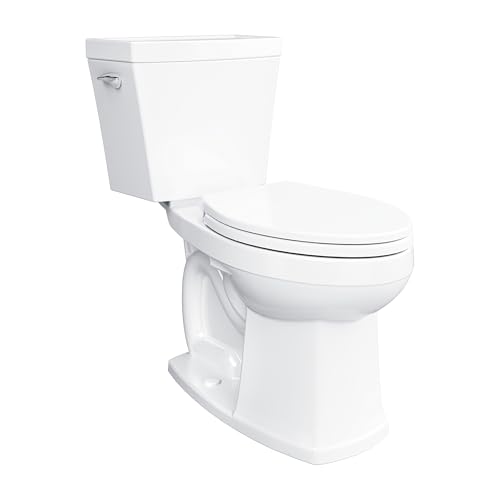
Gerber Avalanche Select Chair Height Elongated Toilet, 1.28 GPF — Best Value Two-Piece
The Gerber Avalanche Select is the straightforward water-saver: a WaterSense certified 1.28 GPF flush, an elongated chair-height bowl, and a box that includes the soft-close seat and installation kit. Gerber is a plumber-channel brand, and the Avalanche line is built for dependable clearing rather than showroom drama — the listing promises a quiet, powerful flush with a stain-resistant glaze.
Strengths
- WaterSense certification is stated right in the listing title
- Soft-close seat and installation kit included — fewer extra purchases
- Two-piece design is easier to carry and install than one-piece models
Trade-offs
- Single flush only; no lighter liquid option
- Two-piece seam needs periodic cleaning attention
- Chair height may not suit shorter users
| Specification | Verified detail |
|---|---|
| Flush | Single flush |
| Flush volume | 1.28 GPF, WaterSense certified (from listing title) |
| Bowl | Elongated, chair height |
| Seat | Soft-close seat and install kit included |
| Glaze | Stain-resistant (from listing title) |
For budget math, the included seat and kit matter: several rivals in this guide are sold ‘less seat,’ so their true installed cost creeps up. The two-piece format also makes DIY installation easier, since you carry the bowl and tank separately. If you want the absolute lowest water use, a dual-flush or 0.8 GPF pick beats it; if you want certified efficiency with everything in one box, this is the sensible buy.
The Avalanche Select is the accountant’s pick: WaterSense certified 1.28 GPF stated in the title, and a box that already includes the soft-close seat and install kit. Several rivals look cheaper until the seat is added; this one’s savings start at the checkout, not just the water bill.
Best for: buyers who want a pick where watersense certification is stated right in the listing title. / Not suited for: anyone who would be put off because single flush only; no lighter liquid option.
Check on Amazon — check the current price on Amazon and confirm the exact variant, seat inclusion, and rough-in on the listing before ordering.

Mansfield Summit ADA Toilet, 1.28 GPF — Best Simple and Serviceable
The Mansfield Summit keeps the formula simple: ADA height, 1.28 GPF, and the backing of an American plumbing manufacturer that has supplied bathrooms for generations. Not every water-saving toilet needs a dual-flush button or a pressure vessel; a well-engineered 1.28 GPF gravity flush, maintained properly, saves the same water decade after decade, and Mansfield’s internals are the kind any plumber can service with parts from a local supply house.
Strengths
- 1.28 GPF efficiency in an ADA-height format
- Mansfield is a long-running American plumbing maker
- Simple, serviceable design with widely available internals
Trade-offs
- Listing title is sparse — confirm seat inclusion before ordering
- Single flush with no light-flush option
- Styling is utilitarian rather than decorative
| Specification | Verified detail |
|---|---|
| Flush | Single flush |
| Flush volume | 1.28 GPF (from listing title) |
| Design | ADA height (from listing title) |
| Brand | Mansfield Plumbing |
The listing title is brief, so verify what is in the box — particularly whether a seat is included — before you order. Treat this as the low-drama option: it will not win design awards, and it offers no lighter flush for liquids, but for a rental property, a basement bath, or a second bathroom where certified efficiency and easy service matter more than looks, the Summit is a rational, budget-friendly choice.
The Summit saves by being keepable. A plain 1.28 GPF toilet from a long-running American maker, serviceable with universal parts, is a toilet that stays efficient for decades instead of being landfilled when a proprietary part vanishes. For rentals and second baths, that durability is the saving.
Best for: buyers who want a pick where 1.28 gpf efficiency in an ada-height format. / Not suited for: anyone who would be put off because listing title is sparse — confirm seat inclusion before ordering.
Check on Amazon — check the current price on Amazon and confirm the exact variant, seat inclusion, and rough-in on the listing before ordering.

Swiss Madison Sublime II One-Piece Round Compact Toilet, Dual Flush 1.1/1.6 GPF — Best for Small Bathrooms
The Sublime II solves the small-bathroom version of the efficiency problem. Its round, compact bowl projects less into the room than an elongated model, yet it still carries a dual top flush at 1.1 and 1.6 GPF, so a powder room or tight ensuite can cut water use without giving up the light-flush button. The one-piece glossy-white body keeps the look clean and modern.
Strengths
- Round compact bowl fits bathrooms where elongated bowls crowd the door swing
- Dual top flush gives a genuine light-flush option
- One-piece body with a glossy, easy-wipe finish
Trade-offs
- Round bowl offers less seating room than elongated models
- Full flush is 1.6 GPF
- Compact size may feel small for larger users
| Specification | Verified detail |
|---|---|
| Flush | Dual flush, top flush |
| Flush volume | 1.1 / 1.6 GPF (from listing title) |
| Bowl | Round, compact |
| Rough-in | 12 in |
| Finish | Glossy White |
Round bowls are the honest compromise here: less front-to-back room, which some adults notice on longer sits. And like other 1.1/1.6 dual-flush models, the full flush is thirstier than a 1.28 GPF toilet’s. But in a small bathroom, the choice is often between a compact dual-flush toilet and no efficient toilet at all — door clearance and knee room decide. For that room, the Sublime II is the pick that fits, literally.
In a small bathroom, the relevant saving is that an efficient toilet fits at all. The Sublime II’s round compact body brings a genuine 1.1 GPF light flush to rooms where the alternative was keeping an old 3.5 GPF relic because nothing modern cleared the door swing.
Best for: buyers who want a pick where round compact bowl fits bathrooms where elongated bowls crowd the door swing. / Not suited for: anyone who would be put off because round bowl offers less seating room than elongated models.
Check on Amazon — check the current price on Amazon and confirm the exact variant, seat inclusion, and rough-in on the listing before ordering.
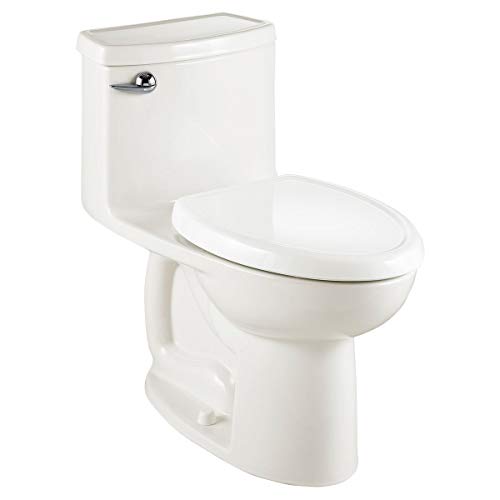
American Standard Compact Cadet 3 One-Piece Elongated Toilet, 1.28 GPF — Best Compact Elongated
The Compact Cadet 3 answers a common puzzle: how to get elongated-bowl comfort and 1.28 GPF efficiency into a bathroom with limited depth. American Standard shrank the one-piece footprint while keeping the elongated seat shape, and the Cadet 3 flushing platform underneath is one of the most proven and widely serviced systems in North American plumbing — flappers, fill valves, and seals are available everywhere.
Strengths
- Elongated comfort in a compact one-piece footprint
- Cadet 3 is one of the most widely serviced flushing platforms in North America
- 1.28 GPF efficiency from a legacy brand with deep parts support
Trade-offs
- Listing title is minimal — confirm included seat and hardware
- Single flush, no light-flush option
- Compact elongated bowl is slightly shorter than full-size elongated models
| Specification | Verified detail |
|---|---|
| Flush | Single flush (Cadet 3 flushing system) |
| Flush volume | 1.28 GPF (from listing title) |
| Bowl | Elongated, compact one-piece |
| Brand | American Standard |
That serviceability is itself a savings story: a toilet you can repair for a decade with inexpensive, universal parts beats a sealed exotic that gets replaced when one component fails. The listing title is terse, so confirm exactly what ships — seat inclusion varies by listing. For a smaller primary bathroom that still wants a real brand name and real efficiency, this is a safe, sensible pick.
The Cadet 3’s compact elongated format saves the same way the Sublime does — by fitting — but keeps the elongated bowl most adults prefer. Add the Cadet platform’s everywhere-available parts, and it is the low-risk way to bring 1.28 GPF to a small primary bathroom.
Best for: buyers who want a pick where elongated comfort in a compact one-piece footprint. / Not suited for: anyone who would be put off because listing title is minimal — confirm included seat and hardware.
Check on Amazon — check the current price on Amazon and confirm the exact variant, seat inclusion, and rough-in on the listing before ordering.
Comparison Table
| Pick | Badge | Key spec (verified) | Best for |
|---|---|---|---|
| HOROW T0338W One-Piece Toilet, Dual Flush 1.1/1.6 GPF | Best Overall | 1.1 / 1.6 GPF (from listing title) | Overall |
| TOTO Eco Soiree One-Piece Elongated Toilet, 1.28 GPF | Best Premium Pick | 1.28 GPF (from listing title) | Premium Pick |
| Gerber Avalanche Select Chair Height Elongated Toilet, 1.28 GPF | Best Value Two-Piece | 1.28 GPF, WaterSense certified (from listing title) | Value Two-Piece |
| Mansfield Summit ADA Toilet, 1.28 GPF | Best Simple and Serviceable | 1.28 GPF (from listing title) | Simple and Serviceable |
| Swiss Madison Sublime II One-Piece Round Compact Toilet, Dual Flush 1.1/1.6 GPF | Best for Small Bathrooms | 1.1 / 1.6 GPF (from listing title) | for Small Bathrooms |
| American Standard Compact Cadet 3 One-Piece Elongated Toilet, 1.28 GPF | Best Compact Elongated | 1.28 GPF (from listing title) | Compact Elongated |
Key specs are quoted from each product’s verified listing. Where two picks share a headline figure, the deciding factors are usually the ones in the full reviews: bowl shape, seat height, what is included in the box, and how the flush achieves its result.
How to Choose an Energy Saving Toilet
Do the household math first. Count your flushes honestly: in most homes, liquid flushes outnumber solid flushes by a wide margin, which is why dual flush exists. If your household will use the small button, a 1.1 GPF light flush saves more over a year than any single-flush design. If your household includes small children, frequent guests, or anyone who will simply press whatever is there, a strong 1.28 GPF single flush delivers its savings automatically, with no behavior to manage.
Next, verify clearing power. Look for a MaP score in the listing (1000g is the maximum; the HOROW in this guide prints one), a WaterSense label (the Gerber Avalanche Select states its certification in its title), or a platform name with a track record (TOTO’s and American Standard’s flushing systems). Then confirm the physical fit: rough-in distance, bowl shape, seat height, and whether the seat is included. A toilet returned because it does not fit saves nothing and costs freight.
How Much Water (and Money) Can a Toilet Actually Save?
Work in gallons, then translate. A family of four flushing five times each per day makes about 20 flushes daily. At 3.5 GPF — a pre-1994 toilet — that is 70 gallons a day down one drain. At 1.28 GPF it is about 26 gallons. The difference, roughly 44 gallons a day or 16,000 gallons a year, comes straight off combined water and sewer billing in most municipalities. Dual flush pushes the average lower still, because the majority of those 20 flushes use the light volume.
We deliberately keep this in gallons rather than inventing a dollar figure: water and sewer rates vary enormously by city, and any guide quoting you a precise annual saving without knowing your rates is making the number up. Check your last water bill for your combined per-thousand-gallon rate and multiply — that is your real payback math, and for an old 3.5 GPF toilet it is usually measured in months, not years.
Retrofit Option: Dual-Flush Conversion Kits
If your existing toilet is sound but thirsty, a dual-flush conversion kit replaces the flapper and fill valve inside the tank and adds a two-option flush, converting a 1.6 GPF toilet into a part-time light-flush toilet for a fraction of a replacement’s cost. Verified kits exist from Fluidmaster and Danco (the HydroRight line) among others. A conversion is the right call when the porcelain is good, the bowl still rinses well, and the rough-in or budget argues against replacement.
Know the limits, though: a kit cannot fix a badly designed bowl, a glazed-over trapway, or a toilet that already clogs. Conversion improves the tank’s water metering; it does not improve the bowl’s clearing geometry. If your current toilet double-flushes for solids today, replace it with a verified strong performer from the picks above instead of spending money to meter water into the same weak flush.
A Worked Example: One Bathroom, Three Toilets
Make the comparison concrete. Take a household of three, each flushing five times a day — fifteen flushes. On a legacy 3.5 GPF toilet, that bathroom uses 52.5 gallons a day, about 19,000 gallons a year. On a 1.28 GPF single-flush pick from this guide, the same routine uses 19.2 gallons a day, about 7,000 a year. On a dual-flush pick, assuming the realistic pattern that most flushes are liquid — say eleven light flushes at 1.1 and four full at 1.6 — the day costs about 18.5 gallons, a little under the single-flush figure, with the gap widening the more disciplined the household is.
Notice what the example teaches: the jump from 3.5 to 1.28 does most of the work — roughly 12,000 of the 12,500 gallons saved. The dual-flush refinement is worth having, but it is a refinement. That ordering should calm anyone torn between picks: choose the toilet your household will use correctly and maintain, at 1.28 GPF or in dual-flush form, and you have captured the overwhelming majority of the available saving. The remaining differences between the six picks in this guide are about fit, comfort, and evidence of clearing — which is why the reviews spend their words there.
Translate gallons to money with your own bill, not our guesses. Find the combined water-plus-sewer rate per thousand gallons on your last statement — in many cities the sewer component, charged per gallon of water used, is as large as the water charge itself, which doubles the value of every gallon saved. Multiply your rate by the thousands of gallons your household will save annually. For older-toilet households the result routinely justifies the mid-tier picks in this guide on payback alone, before comfort enters the argument.
The Savings Nobody Sees: Leaks, Refills, and Standby Waste
The largest water waste in many homes is not flushing at all — it is the toilet that leaks between flushes. A worn flapper or flush-tower seal lets tank water trickle into the bowl around the clock; a fill valve that never quite shuts off sends a continuous sip down the overflow tube. These leaks are silent, invisible in normal use, and capable of wasting more water in a month than the difference between a 1.6 and a 1.28 GPF toilet makes in a year. Any honest guide to energy saving toilets has to rank leak discipline alongside flush volume.
The detection kit costs almost nothing: food coloring or a dye tablet, fifteen minutes, and your ears. Dye in the tank that appears in the bowl without flushing proves a flush-seal leak. A tank that tops itself up when nobody has flushed — the phantom refill — proves the same thing acoustically. A water meter that creeps with every fixture in the house off proves a leak somewhere, and the toilet is the first suspect to isolate by closing its supply valve overnight.
The encouraging part is that the fixes are the cheapest in plumbing: seals, flappers, and fill valves are inexpensive, standardized on the mainstream picks in this guide, and replaceable with the water off and basic tools. Budget a few minutes a year for the dye test and you protect the entire saving you bought the toilet for. An efficient toilet, maintained, is a system; an efficient toilet ignored is a leak with good marketing.
When Saving Water Meets Saving the Plumbing: Whole-System Habits
A toilet does not save water alone; it saves inside a system, and three household habits decide whether the rated saving survives contact with reality. The first is leak discipline, covered elsewhere in this guide — the dye test, the phantom-refill listen, the meter check. The second is pressure sanity: homes with very high static water pressure stress fill valves and seals across every fixture, toilets included, and a pressure-reducing valve at the main protects all of them at once. If your fill valves fail young and your faucets hiss, ask a plumber to measure your pressure before blaming the toilets.
The third habit is thermal and seasonal awareness in intermittently used homes. A vacation property’s toilets sit for weeks; seals dry, and the first flush after a vacancy is where leaks announce themselves. A quick tank inspection on arrival — water level, a listen, a look at the supply connections — takes two minutes and prevents the scenario where a ‘saving’ toilet trickles away a season’s worth of water into a bowl nobody is watching. Smart water monitors that flag continuous flow exist for exactly this failure, and for second homes they can be worth more than the toilet upgrade itself.
None of these habits requires expertise, which is the point: the difference between the households that realize their toilets’ rated savings and the households that do not is rarely the model chosen. It is whether someone in the house owns the system — a named person who runs the dye test, knows where the shutoffs are, and notices when a flush sounds different. Appoint that person when the new toilet goes in, and the savings in this guide stop being estimates.
Comparing the Six Picks Head-to-Head: Which Saving Strategy Wins Where
Line the strategies up by bathroom and the choice simplifies. For the primary family bathroom, the HOROW T0338W’s combination of a MaP-verified full flush and a cheap light flush is the most complete saving profile in the guide — it wins on both flush types instead of trading one against the other. For the ensuite, where quiet and cleanliness shape satisfaction, the TOTO Eco Soiree’s glaze-driven, low-chemical routine saves in a currency the water bill does not capture. For the rental, the second home, or the bathroom nobody wants to think about, the Mansfield Summit and Gerber Avalanche Select save by being serviceable and complete out of the box — savings that survive tenants and time.
For small bathrooms, the contest is between the two compact picks, and it is decided by bowl shape: the Swiss Madison Sublime II’s round bowl fits where nothing elongated can, while the American Standard Compact Cadet 3 preserves the elongated shape in a shortened footprint for rooms that can spare a few more inches. Neither is a compromise on the saving itself — both flush at efficient volumes — so let the room’s tape measure cast the deciding vote.
And across all six, remember the ordering this guide established at the start: replacing an old high-volume toilet captures most of the available saving regardless of which pick you choose. The head-to-head differences above are real but second-order. Choose the pick that fits your room, your people, and your maintenance temperament, and you have made the saving decision correctly — the rest is refinement.
Quick Checklist Before You Order
Before the order button, run this list against your bathroom and your household. Rough-in measured from the finished wall: 12 inches for every pick in this guide. Bowl shape chosen for the room’s real projection and door swing. Seat height matched to the regular users — chair height for most adults, standard for shorter households and kids. Seat inclusion confirmed on the listing, along with the wax ring and any install kit. Flush strategy agreed by the household: dual flush only if the small button will actually be used. And a plan for the old toilet — utility rebate paperwork, disposal, or donation — arranged before the new one arrives, so the swap happens in one clean motion instead of two weekends.
One Last Distinction: Saving at Purchase vs Saving in Use
Everything in this guide so far concerns saving in use — gallons not flushed, leaks not leaked. There is a second, quieter ledger: saving at purchase, meaning the total cost of getting a working, efficient toilet into the bathroom. That ledger includes the seat when the box lacks one, the ring and bolts, the conversion kit you did not need because you chose correctly the first time, and the return freight on the toilet that did not fit because nobody measured the rough-in. The picks and checklists in this guide are arranged to keep that ledger small — included kits where they exist, measurements before ordering, strategies matched to households. A toilet that saves water for twenty years but cost a weekend and a return shipment to install still saved money overall; it just saved less than it should have. Do the unglamorous checks, and both ledgers come out ahead.
How to Use a Dual-Flush Toilet Correctly (And Teach the Household)
This sounds trivial and is, in practice, where dual-flush savings are won or lost. The small button (or short lever press) is for liquid waste and paper-free flushes; the large button is for solids and paper. On top-button models the buttons are usually different sizes or marked with droplet icons — the smaller button is the smaller flush. Post a discreet note in guest bathrooms for the first month; guests guess, and they usually guess the big button.
Teach by exception, not by lecture: if a light flush ever leaves the bowl unclear, use the full flush and note whether it recurs. Recurring failures on the light flush usually mean the tank water level is set low or the light-flush volume needs adjusting at the flush valve — most dual-flush valves let you raise or lower each volume independently with a slider or dial inside the tank. Set the light flush as low as it will go while still rinsing the bowl cleanly; that setting, multiplied by thousands of flushes, is your savings.
For single-flush efficient toilets, ‘using it correctly’ means maintenance: keep the tank water level at the marked line, replace a worn flush seal at the first sign of phantom refilling (the tank topping itself up unprompted), and run the dye test yearly. A 1.28 GPF toilet with a leaking seal can waste more than a healthy 1.6 — efficiency is a condition you maintain, not a feature you buy once.
Common Buying Mistakes
Counting only the light-flush number. A 1.1/1.6 dual-flush toilet’s real average depends on your household’s mix and button discipline. Compare realistic averages, not brochure minimums.
Replacing a toilet but keeping a leaking supply line or angle stop. Slow supply-side leaks waste water around the clock. Inspect and, if corroded, replace the stop and line during the install — the toilet is already off.
Buying a conversion kit for a toilet that clogs. Kits meter water; they do not add clearing power. A clog-prone bowl needs replacement, not a smaller flush.
Skipping the WaterSense check. Certification bundles a flush-volume claim with independent clearing tests. A bare GPF claim without certification or a MaP score deserves more skepticism.
Choosing a compact round toilet for a primary bath. Compact round bowls save space but compromise comfort for adults. Reserve them for genuinely small bathrooms, as with the Sublime II pick.
Not checking what is in the box. Seats, wax rings, and install kits are included with some picks here and sold separately for others. The true installed cost is the toilet plus everything the box lacks.
Final Recommendation
Start with the HOROW T0338W if you want the complete package: MaP 1000g clearing printed in its listing, a dual flush, and a compact skirted body. Choose the TOTO Eco Soiree if you value a glaze that keeps the bowl cleaner with less chemical help, the Gerber Avalanche Select for certified efficiency with seat and kit included, or the Mansfield Summit for simple, serviceable 1.28 GPF savings. Small bathrooms get two real answers here — the Swiss Madison Sublime II in round compact, and the American Standard Compact Cadet 3 in elongated.
Compare the sibling lenses before you decide: Best Energy Efficient Toilets, Best Environmental Toilets, Best Environmental Friendly Toilets, and Best Extended Bowl Toilets each rank overlapping models by a different priority.
The shortlist, for a final check of current price and configuration on Amazon: HOROW T0338W One-Piece Toilet, Dual Flush 1.1/1.6 GPF (Best Overall); TOTO Eco Soiree One-Piece Elongated Toilet, 1.28 GPF (Best Premium Pick); Gerber Avalanche Select Chair Height Elongated Toilet, 1.28 GPF (Best Value Two-Piece); Mansfield Summit ADA Toilet, 1.28 GPF (Best Simple and Serviceable); Swiss Madison Sublime II One-Piece Round Compact Toilet, Dual Flush 1.1/1.6 GPF (Best for Small Bathrooms); American Standard Compact Cadet 3 One-Piece Elongated Toilet, 1.28 GPF (Best Compact Elongated).
Frequently Asked Questions
What is the difference between ‘energy efficient’ and ‘energy saving’ toilets?
In practice, none — both phrases describe toilets that use less water per flush, and the saving that follows is water, sewer, and the pumping and treatment energy behind them. Neither type of standard toilet uses electricity. We treat the terms as synonyms and rank by verified GPF and clearing performance.
How much water does a dual-flush toilet save versus a single-flush 1.28 GPF toilet?
It depends on the flush mix. Because most household flushes are liquid, a dual-flush model using about 1.1 gallons for those can average meaningfully below 1.28 gallons per flush across a week. In a household that mostly uses the full flush, the advantage disappears — which is why we present both strategies honestly.
Will a water-saving toilet work with my old plumbing?
Usually, yes — and often better than the toilet it replaces, because modern trapways are designed to move waste with less water. Homes with very long, flat drain runs or known drain issues should consider a pressure-assist model or a MaP-rated strong performer, and any repeated clogging after install deserves a drain inspection rather than a different toilet.
What is MaP testing?
MaP (Maximum Performance) testing is an independent protocol that measures how many grams of standardized test media a toilet clears in a single flush. Scores run up to 1000 grams. It is the best publicly available evidence that a low-volume flush actually clears, which is why we quote it whenever a listing provides it.
Should I convert my old toilet to dual flush or replace it?
Convert when the toilet is a sound 1.6 GPF model that clears well and you want light-flush savings cheaply. Replace when the toilet is a 3.5 GPF model, clogs, has a damaged bowl or trapway, or when you are remodeling anyway. A conversion kit cannot rescue a weak bowl.
Do water-saving toilets need special maintenance?
No special regime — the usual toilet care applies, with one emphasis: keep the flush seal healthy. A leaking flapper or tower seal wastes water silently and can quietly cancel the model’s savings. The annual dye test (color in the tank, check the bowl in fifteen minutes) is the whole secret.


