Disclosure: airfryerkitchensupply.com is reader-supported. When you buy through links on our site, we may earn an affiliate commission at no extra cost to you.
Where to buy
If you are shopping for the best electrical grills outdoor, start here: every linked pick in this guide was matched against the retailer listing for this site before publication, and the fastest way to confirm current availability is Amazon:
- Weber Lumin Compact Portable Electric Grill — check price on Amazon
- Cuisinart CEG-115 2-in-1 Portable Outdoor Electric Grill — check price on Amazon
- Char-Broil Patio Bistro TRU-Infrared Electric Grill — check price on Amazon
- Ninja Woodfire Outdoor Grill & Smoker OG301 — check price on Amazon
- George Foreman Indoor/Outdoor Electric Grill with Stand, 15-Serving — check price on Amazon
- Weber Q 1400 Portable Electric Grill — check price on Amazon
Prices move with seasons and promotions, so this guide never prints a fixed figure — use the links above to check price on Amazon on the day you buy. Every pick below is a corded outdoor electrical grill verified against its retailer listing for this site, chosen for patio, balcony and deck cooking where gas or charcoal is banned, impractical or simply unwanted.
The case for the best electrical grills outdoor cooking can offer is usually made by a lease, a condo board or a fire code: no open flame, no propane storage, no problem. But outdoor electrical grilling has grown past being a compromise for the banned. Modern outdoor-rated models hold real heat, wear weather-resistant bodies, and cook on the patio you actually have — including the small balcony where a gas cart would never fit and a charcoal kettle would never be allowed.
This guide is deliberately outdoor-only. Indoor-outdoor crossover models appear in a companion guide; here the questions are the patio questions. How does the grill behave in a breeze? Can it live outside under a cover? Does the cord reach a GFCI outlet without drama? Will it sear in cool evening air, when a thin element gives up? Six verified grills answer those questions in different ways, from Weber’s compact Lumin to a 15-serving stand grill for a full deck.
Set expectations correctly and outdoor electrical grilling is genuinely satisfying: no fuel runs, no ash, instant start, and food that browns properly on the stronger models. What you give up is off-grid freedom — the grill goes where the outlet is — and the deepest smoke flavour, which only the pellet-assisted pick below really chases. For the growing number of homes where flame is not an option, that is a trade worth making well.
In this guide
Quick Picks
Six outdoor electrical grills, ranked by the job each does best on a patio or balcony:
- Weber Lumin Compact Portable Electric Grill — Best Overall: Weber’s compact outdoor electric, built light for small spaces with the brand’s usual fit and finish — the balcony benchmark. — check price on Amazon
- Cuisinart CEG-115 2-in-1 Portable Outdoor Electric Grill — Best High-Heat Sear: the heat leader — a listed 550°F from a wall outlet, on a stand or tabletop, for cooks whose first complaint about electric grilling is pale steaks. — check price on Amazon
- Char-Broil Patio Bistro TRU-Infrared Electric Grill — Best for Small Patios: a lidded infrared bistro grill whose emitter plate kills flare-ups and hot spots — forgiving heat in a footprint made for tight outdoor corners. — check price on Amazon
- Ninja Woodfire Outdoor Grill & Smoker OG301 — Best Smoke Flavor: electric heat plus real wood-pellet smoke, with grill, smoke and bake/roast modes — the flavour ceiling of outdoor electrical grilling. — check price on Amazon
- George Foreman Indoor/Outdoor Electric Grill with Stand, 15-Serving — Best for Crowds: the big round stand grill — the largest single surface here, with a sloped plate and drip tray that keep a full deck cook tidy. — check price on Amazon
- Weber Q 1400 Portable Electric Grill — Best Build Quality: a cast-aluminium, cast-iron-grate Weber that plugs in — the outdoor electrical grill most likely to still be cooking in ten years. — check price on Amazon
How These Picks Were Chosen
Picks were drawn from the outdoor electrical grills verified through this site’s product data, then filtered for genuine outdoor design: weather-tolerant construction, a lid or wind-sensible shape, stable stance on a stand or patio table, and heat output that survives outdoor conditions. Purely indoor contact grills were excluded even when their marketing photos showed a garden — outdoor duty is a construction standard, not a backdrop.
The shortlist was then balanced across footprints and households: two compact balcony-class grills, two stand grills for family decks, one infrared specialist and one smoke-capable outlier. Temperature and wattage figures quoted in reviews come from the manufacturer listings themselves. Models whose listings could not be matched confidently were dropped rather than described from memory, which is why a few famous names in this category do not appear.
The 6 Best Electrical Grills for Outdoor Cooking

1. Weber Lumin Compact Portable Electric Grill — Best Overall
The Lumin Compact is what happens when a serious grill maker designs for the balcony first: light enough to move without planning, finished like a Weber, and shaped to live in small outdoor spaces full-time. You can check the current price on Amazon before the detail below.
Strengths
- Lightweight, compact body genuinely suits balconies and small decks
- Weber build quality and parts support behind it
- Portable format works on a patio table, stand or tailgate-style setup
Trade-offs
- Compact surface means cooking for two to four, in batches beyond that
- Premium positioning among compact electrics
- Small size limits whole-roast ambitions
Key specs
- Format: Compact portable outdoor electric grill
- Positioning: Small spaces / balcony (manufacturer listing)
- Brand support: Weber parts and accessory network
Outdoors, the Lumin’s virtues compound: it heats without the long wait of a big grill, shrugs off being moved for cleaning or storms, and its compact lid keeps heat in when a breeze crosses the balcony. It is not the grill for a dozen burgers at once, and it does not pretend to be. It is the grill a couple or small family will actually use three nights a week, which is the metric that matters on a small patio. If your outdoor space is measured in square feet rather than square yards, start here.
A season with the Lumin teaches its real lesson: outdoor grills get used in proportion to how little friction they create, and a light, compact grill that preheats fast and stores anywhere creates almost none. It is the grill that comes out for two sausages and a pepper on a Wednesday, not just for Saturday productions. Weber’s fit and finish also mean the lid, grate and tray still feel new after a year of balcony weather under a cover. If your outdoor cooking ambition is frequency rather than scale, this is the most rational purchase in the guide.
Care notes: the Lumin’s compact parts wash easily, and its portability means it can be stored indoors in winter — the gentlest life any outdoor grill can have. Keep the cord inspected and the surfaces dry before covering. Because it is light, secure it in high winds rather than trusting its stance. Owners who treat it as a precision appliance rather than patio furniture get the longest service from it.
Best for: balcony and small-deck cooks, couples and small families / Not suited for: hosts who regularly grill for eight or more
Check on Amazon — check price on Amazon.

2. Cuisinart CEG-115 2-in-1 Portable Outdoor Electric Grill — Best High-Heat Sear
Outdoor electrical grills live or die by their top temperature once cool air and a breeze start stealing heat. The CEG-115’s listed 550°F ceiling is the strongest answer in this roundup. You can check the current price on Amazon before the detail below.
Strengths
- Listed 550°F maximum — highest here
- 2-in-1 stand or tabletop setup adapts to deck or balcony
- Strong heat reserve helps in cool or breezy conditions
Trade-offs
- Surface area is modest for the heat on offer
- Full-power draw leaves no room for other appliances on the circuit
- Stand is functional rather than heavy-duty
Key specs
- Max temperature: 550°F (manufacturer listing)
- Format: 2-in-1 stand / tabletop
- Power source: Standard wall outlet
That temperature headroom changes outdoor cooking in practice: chicken skin crisps instead of paling, burgers crust before they overcook inside, and vegetables char at the edges. The CEG-115 also recovers faster after the lid opens — a small thing that becomes a big thing across a breezy evening of lid-lifting. Keep groups realistic at two to four per batch and give it a dedicated circuit. Within those limits, this is the outdoor electrical grill that least often reminds you it is electric.
The CEG-115’s ownership pattern is that of a specialist instrument: it comes out when browning matters. Steak nights, chicken-skin nights, charred vegetable nights — the 550°F ceiling earns its circuit every time. Owners should protect that strength with two habits: always preheat fully on the stand or table before food is ready, and keep the cooking surface clean so the heat reaches the food instead of last week’s residue. It is not the grill for a crowd, but for two to four people who care about crust, it is the outdoor electric benchmark.
Care notes: high heat carbonises residue quickly, so the warm scrape after each cook is close to mandatory; a neglected surface will smoke and streak at 550°F. The stand benefits from level ground and an occasional joint check. Keep the cord run dry and off the ground where possible. Maintained this way, the CEG-115’s party trick — real sear from an outlet — stays available on demand for years.
Best for: sear-first cooks on small patios and decks / Not suited for: large-group hosts needing maximum area
Check on Amazon — check price on Amazon.
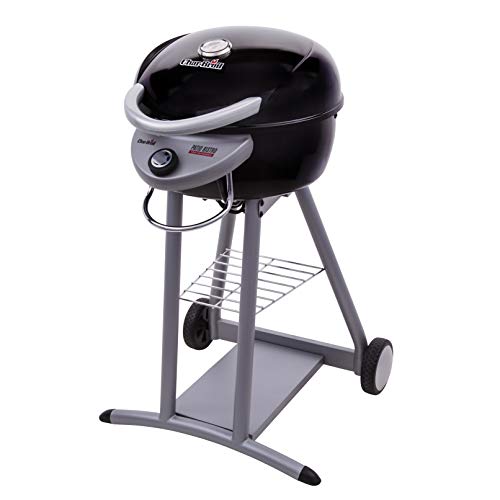
3. Char-Broil Patio Bistro TRU-Infrared Electric Grill — Best for Small Patios
The Patio Bistro was designed for exactly the spaces outdoor electrical grills serve: apartment patios and small decks where a flare-up is a neighbour problem and a big grill is a storage problem. You can check the current price on Amazon before the detail below.
Strengths
- TRU-Infrared emitter evens heat and vaporises drippings
- Compact lidded body stores and covers easily outdoors
- Juicier results for beginners than basic element grills
Trade-offs
- Capacity suits two to four servings
- Emitter plate needs scheduled cleaning
- Less raw char character than open-grate searing
Key specs
- Cooking system: TRU-Infrared electric emitter
- Format: Compact bistro grill with lid
- Model: 20602107
Infrared cooking outdoors has a practical advantage beyond juiciness: wind disturbs an emitter system less than an exposed element and open grate, so the Bistro cooks consistently on exposed balconies where other electrics fluctuate. The lid keeps the whole system working as a small oven for thicker cuts. Its discipline is cleaning — the emitter is the technology, and a neglected one smokes and streaks. Kept clean, this is the most forgiving small outdoor grill in the guide, and the one least likely to produce a dry chicken breast.
Over a season, the Bistro’s infrared evenness changes how a beginner cooks: food can be arranged across the whole surface without a mental map of hot corners, and the results forgive the timing wobbles that dry out chicken on lesser grills. The emitter cleaning rhythm — a few minutes on schedule — is the entire maintenance contract. Balcony owners also report the social benefit: fewer flare-ups means fewer smoke events, which matters when your patio is four feet from a neighbour’s window. Small, calm and consistent is a genuinely valuable combination outdoors.
Care notes: the emitter is the whole contract — scheduled brushing, burn-offs after fatty cooks, and a seasonal inspection. The Bistro’s lidded body otherwise asks little: a wipe, a tray check, a cover. Balcony storage is kind to it, and its compact size means the cover discipline is a ten-second habit. This is the lowest-maintenance outdoor pick here provided the one job it asks for actually gets done.
Best for: small-patio cooks and infrared-curious beginners / Not suited for: big households or char-maximalists
Check on Amazon — check price on Amazon.

4. Ninja Woodfire Outdoor Grill & Smoker OG301 — Best Smoke Flavor
Every outdoor electrical grill faces the same heckle: where is the smoke? The OG301 is the one model here built to answer it, burning real wood pellets for flavour while electricity does the heating. You can check the current price on Amazon before the detail below.
Strengths
- Genuine wood smoke from a plug-in appliance
- Grill, smoke and bake/roast versatility in one unit
- Listing capacity of six steaks or a brisket-class cut
Trade-offs
- Pellets are an ongoing consumable to keep in stock
- More modes means more to learn than a dial-and-go grill
- Needs outdoor ventilation when smoking, obviously
Key specs
- Functions: Grill, smoke, bake/roast (3-in-1)
- Fuel story: Electric heat, real wood pellets for smoke
- Capacity note: 6 steaks or a 9 lb brisket (manufacturer listing)
On a patio where charcoal is banned, the Woodfire is less a compromise than a category of its own: ribs, brisket-style cuts and smoked chicken become possible from an outlet. The grill mode alone is competent, but the purchase only makes sense if you will actually smoke — pellet loading and smoke timing are simple, yet they are steps a pure electric grill does not ask of you. Buyers who light it twice a month for low-and-slow cooks will love it; buyers who only ever grill burgers should save the complexity and choose the Lumin or CEG-115.
Owning the Woodfire means organising one small supply chain — pellets, stored dry — and in exchange your patio gains a smoker. The pattern that emerges for happy owners is a split week: quick electric grilling on weeknights, pellet smoke sessions on weekends when the grill earns its name. Battery-free and fuel-tank-free, it also suits patios where a gas bottle is impractical. The honest warning stands: if the smoke mode will not be used, the simpler picks serve better. If it will, no other outdoor electrical grill is even in the conversation.
Care notes: beyond standard grill cleaning, the Woodfire’s pellet path needs respect — ash out on schedule, pellets stored sealed and dry, and the manufacturer’s shutdown routine followed so the auger clears properly. Electronics and vents should be kept free of grease film for accurate operation. It is the most maintenance-involved pick in this guide, and the owners who love it consider the exchange — real smoke from an outlet — overwhelmingly fair.
Best for: smoke lovers in flame-restricted homes / Not suited for: set-and-forget burger cooks wanting zero fuss
Check on Amazon — check price on Amazon.
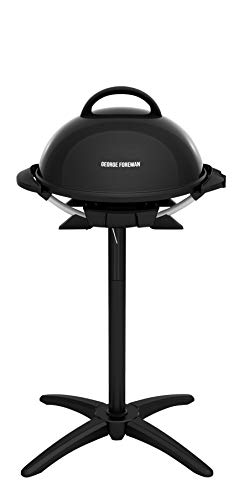
5. George Foreman Indoor/Outdoor Electric Grill with Stand, 15-Serving — Best for Crowds
For outdoor volume, the Foreman stand grill remains the category’s workhorse: the biggest cooking surface in this guide, a dome lid for thick cuts, and a fat-draining plate that keeps a crowded cook from turning greasy. You can check the current price on Amazon before the detail below.
Strengths
- Largest surface in this roundup for group cooking
- Sloped plate and drip tray manage fat across long cooks
- Dome lid handles thick chops and chicken pieces well
Trade-offs
- Single heat zone across a big surface
- Light stand can feel unsteady on uneven decking
- Round shape wastes corner space for skewers and ribs
Key specs
- Format: Stand grill, removable pedestal
- Serving class: 15-serving (manufacturer rating)
- Grease system: Sloped plate with removable drip tray
Outdoors is where this grill’s design makes most sense: the stand puts a family-sized surface at working height, the tray keeps patio grease contained, and the lid lets you work through a mixed load — burgers, then chicken, then vegetables — without a second appliance. Temperature recovery is the limit to respect: load it in two waves rather than one cold mountain of food. For a household whose grill night means eight people on the deck, this is the outdoor electrical pick that respects the guest list.
The Foreman’s outdoor life is about volume with containment. The drip system means a long cook for a crowd does not end with a greasy patio, and the dome lid lets the cook work in waves — a feature hosts appreciate more than any specification. Its stand benefits from a level, sheltered spot; on an exposed deck, weight the base or choose calmer positions. For a household whose outdoor cooking is fundamentally social, this remains the category’s most practical big surface, and its indoor tabletop mode is a genuine bonus rather than the reason to buy.
Care notes: the sloped plate and tray want washing after group cooks, not before the next one; grease left sitting is next week’s smoke. The stand rewards a level, sheltered placement and an occasional stability check. The temperature probe cord is the flex-wear item to inspect seasonally. None of this is heavy work, and the Foreman’s long production history means any part it ever needs is easy to find.
Best for: families and hosts cooking for groups outdoors / Not suited for: precision searers wanting zoned heat
Check on Amazon — check price on Amazon.

6. Weber Q 1400 Portable Electric Grill — Best Build Quality
The Q 1400 is the durability pick: cast body, porcelain-enamelled cast-iron grate and a 1,560-watt element, built to live outdoors season after season in a way lighter electrics are not. You can check the current price on Amazon before the detail below.
Strengths
- Cast-iron grate stores heat for proper searing outdoors
- Cast aluminium body built for outdoor life
- Deepest parts and support network in the category
Trade-offs
- Heavy for a ‘portable’ grill
- Premium tier within outdoor electrics
- Stand is an add-on, not the base configuration
Key specs
- Element: 1,560 W / 120 V
- Grate: Porcelain-enamelled cast iron
- Body: Cast aluminium
Outdoor cooking exposes the difference between built and assembled. The Q 1400’s mass works for you twice: the grate holds searing heat through a load of cold steaks, and the body ignores the knocks, weather and storage conditions that age thin steel grills quickly. It asks for a stable table or stand and a realistic view of its weight. Buyers who have replaced a cheap grill twice already will recognise the economics immediately — this is the buy-once entry in outdoor electrical grilling.
Time is the Q 1400’s argument outdoors. Seasons of weather, knocks and storage sort grills into survivors and replacements, and the cast Weber is built for the survivor column. Owners tend to give it a permanent station — stand or table, cover, outlet — and then simply stop thinking about their grill, which is the highest compliment outdoor equipment can earn. The cast-iron grate also ages gracefully: seasoned and maintained, it sears better in year three than week one. Buy it as infrastructure, not as a gadget, and it will behave like infrastructure.
Care notes: oil the cast-iron grate lightly after cleaning, inspect the cord and plug each season, and let the enamelled surfaces cool before covering to avoid trapped moisture. The Q’s construction tolerates outdoor life better than anything else here, but tolerance is not immunity — the cover habit still doubles cosmetic life. In return, it asks for the least intervention per cook of any pick in this guide.
Best for: long-term owners and sear-focused cooks / Not suited for: anyone needing to carry the grill any distance
Check on Amazon — check price on Amazon.
Comparison Table
Here is the whole outdoor shortlist on one screen — each grill’s badge, its defining specification and the patio job it does best.
| Pick | Badge | Key spec | Best for |
|---|---|---|---|
| Weber Lumin Compact Portable Electric Grill | Best Overall | Compact lightweight outdoor format | balcony and small-deck cooks, couples and small families |
| Cuisinart CEG-115 2-in-1 Portable Outdoor Electric Grill | Best High-Heat Sear | 550°F max from wall outlet | sear-first cooks on small patios and decks |
| Char-Broil Patio Bistro TRU-Infrared Electric Grill | Best for Small Patios | TRU-Infrared emitter, compact lidded body | small-patio cooks and infrared-curious beginners |
| Ninja Woodfire Outdoor Grill & Smoker OG301 | Best Smoke Flavor | Pellet smoke + electric heat, 3-in-1 | smoke lovers in flame-restricted homes |
| George Foreman Indoor/Outdoor Electric Grill with Stand, 15-Serving | Best for Crowds | 15-serving round surface on stand | families and hosts cooking for groups outdoors |
| Weber Q 1400 Portable Electric Grill | Best Build Quality | 1,560 W, cast-iron grate, cast body | long-term owners and sear-focused cooks |
How to Choose: Best electrical grills outdoor
Begin with your outdoor reality: the size of the space, the distance to a GFCI outlet, and the rules of your building. Balconies reward compact lidded grills; open decks can host stand models. Then think about weather exposure honestly — a grill that lives outdoors year-round needs a cover, corrosion-tolerant materials and a cord you can keep dry, while a grill stored in a closet between cooks can be lighter and simpler.
Capacity planning deserves the same honesty. Manufacturer serving counts are optimistic; plan on roughly half for mixed loads. A couple grilling weeknight dinners needs far less surface than a family hosting deck nights, and oversizing an electrical grill has a real cost: bigger surfaces on the same circuit wattage recover heat more slowly. Match the surface to your largest regular cook, and let the occasional party be handled in batches.
Outdoor Power: Outlets, Cords and Weather Safety
Outdoor electrical grilling runs on one rule set: GFCI-protected outlet, direct plug-in wherever possible, and no light-duty extension cords, ever. If reach forces a cord, it should be short, outdoor-rated and heavy gauge, laid where nobody trips and no water pools. Keep the connection point off the ground and under some shelter; a dripping plug connection is the one genuinely dangerous failure mode in this category.
Circuit discipline matters outdoors too. The grill should own its circuit while cooking — patio heaters, string-light transformers are trivial, but a second cooking appliance or a power tool on the same circuit invites a trip mid-sear. Finally, respect the cool-down: never cover or store the grill until it is fully cold, and never leave an electrical grill cooking unattended in wind-blown rain. These are simple rules, and they cover essentially every incident report this category generates.
Getting Real Sear and Smoke from an Outdoor Electrical Grill
Searing outdoors on electricity is a technique problem more than an equipment problem once you own a capable grill. Preheat longer than feels necessary — cast iron and infrared systems reward a full heat soak. Dry the food surface thoroughly, oil the food rather than the grate, and resist crowding: a half-empty hot grill out-sears a full lukewarm one every time. Keep the lid down between flips to hold the heat you have.
Smoke is the honest gap. Apart from the pellet-assisted Woodfire in this guide, outdoor electrical grills produce grill flavour from fat vapour and browning, not wood smoke. Marinades, dry rubs, smoked salts and a finishing brush of smoked oil close much of the perceived distance for weeknight food. If true low-and-slow barbecue is the goal, choose the pellet-smoke model deliberately rather than expecting a standard electric grill to improvise it.
Outdoor Electrical Grills and Building Rules: Reading the Fine Print
Most outdoor-grilling bans are written against fuel and flame, not against cooking. Typical lease and condo language prohibits ‘charcoal or gas grills’, ‘open flame devices’ or ‘fuel storage on balconies’ — categories an electrical grill simply does not enter. Fire codes in many cities draw the same line, restricting fuel-fired grills near combustible construction while permitting listed electric appliances. That is why outdoor electrical grills exist as a category: they are the legal grill for millions of balconies.
Two cautions keep the advice honest. First, some buildings ban all balcony cooking regardless of fuel, and no product feature overrides a signed lease — read your documents, and if the wording is ambiguous, ask management in writing before buying. Second, keep the paperwork: the grill’s listing and manual language describing it as an electric appliance is occasionally useful if a question ever arises. Chosen knowingly, an outdoor electrical grill is not a loophole; it is compliance with the rule as written.
Extending the Season: Outdoor Electrical Grilling in Shoulder Weather
Electrical grills are secretly the best shoulder-season grills: no charcoal to light in the cold, no propane pressure sagging in low temperatures, and a preheat you can start from the doorway. The physics to respect is heat loss — wind and cold air tax an electric element’s fixed output, so position the grill in the most sheltered spot available, keep the lid closed, and preheat longer than summer habits suggest. Cast-iron and infrared models hold their working temperature best in these conditions.
Menu choices help too. Shoulder-season outdoor cooking favours foods that cook under a closed lid in one load — chops, chicken pieces, sausages, dense vegetables — over long sessions of lid-lifting for a crowd. Cook in tighter batches, rest food indoors, and the season comfortably stretches by months at both ends. Owners in cold climates who follow this pattern report grilling in every month of the year, which is a claim few charcoal households can honestly make.
Outdoor Electrical Grill Placement: The Ten-Minute Audit
Before the first cook on any new patio, run this audit. One: the outlet — GFCI-protected, within honest cord reach, on a circuit the grill can own. Two: the surface — level, stable, heat-safe, with the grill’s footprint plus working room in front. Three: the overhead — no low branches, awnings or eaves in the heat path. Four: the wind — a prevailing direction you can position the lid against. Five: the route — a cord path that crosses no walkway and no puddle. Ten minutes of checking converts the patio from a place the grill happens to be into a station designed for it.
Revisit the audit when anything changes: new furniture, a new circuit load like a patio heater, a different season’s wind. Outdoor cooking problems are overwhelmingly placement problems discovered late — a tripped breaker during a party, a scorched railing, a grill that never gets hot in its windy corner. The audit costs nothing and prevents all three, which is why experienced outdoor cooks run it instinctively every time they move a grill.
Matching an Outdoor Electrical Grill to Your Patio
The small high-rise balcony. The Weber Lumin Compact or the Char-Broil Patio Bistro, chosen by whether you value portability or infrared juiciness more. Both live happily in a corner under a cover, respect the neighbours, and turn a few square feet into a working grill station.
The family deck in a no-gas HOA. The George Foreman stand grill for surface and containment, with the Weber Q 1400 as the alternative if the household is smaller and values build over area. Either turns an HOA restriction into a non-issue for family grilling.
The flavour-first patio. The Ninja Woodfire OG301 — the only pick here that adds real smoke. Accept the pellet habit and your flame-free patio gains a barbecue capability that guests will not believe came from an outlet.
The windy, exposed terrace. Infrared and cast iron are your friends: the Patio Bistro’s emitter shrugs off gusts, and the Q 1400’s mass holds heat. Avoid light open plates in exposed spots; the wind will win every argument with them.
The Outdoor Electrical Learning Curve: Your First Month
Week one with an outdoor electrical grill is mostly unlearning gas and charcoal habits. There is no flame to read, so temperature awareness moves to preheat discipline and the food itself: colour, firmness, and a probe thermometer replace the knuckle-and-guess era quickly. Owners also learn their patio’s electrical geography in this week — which outlet, which circuit, where the cord honestly reaches — and the cooks who map it once, deliberately, stop thinking about it entirely. The grill that felt like a compromise in the showroom starts feeling like an appliance, in the complimentary sense: predictable, ready and quiet.
By week three or four, the technique specific to the category emerges. Batches get smaller and more confident, because the cook has learned the surface’s recovery rhythm. The lid stays down more. Food goes on drier and comes off browner. The models with stored heat — cast iron, infrared — reveal why they cost what they cost, as cool evenings stop being an excuse. This is also when the neighbourhood effect appears: outdoor electrical grilling is sociable in a way flame grilling is not, because there is no smoke column announcing dinner to the entire building, and many owners find that changes how often they cook outside at all.
At the month mark, the honest assessment most owners reach is that the grill’s ceiling is set less by its element than by their own habits. The households grilling three nights a week on a compact Lumin are eating better than the household with a giant grill used monthly. That is the deepest argument for choosing by fit — space, circuit, headcount, temperament — rather than by maximum specification. The best outdoor electrical grill is the one still being used when the novelty is gone, and every pick in this guide was chosen to survive exactly that test.
How to Set Up an Outdoor Electrical Grill on a Patio or Balcony
Outdoor setup is five minutes of deliberate choices that prevent nearly every problem owners report. Run this sequence for your first cook in a new spot.
- Position the grill on a level, stable surface with clearance from siding, railings and overhangs, and out of the main foot-traffic path.
- Confirm the outlet is GFCI-protected and test the reset button before the grill goes anywhere near it.
- Route the cord along walls or edges, never across walkways or through standing water, and keep the plug connection off the ground.
- Fit the grate, plate or emitter and the drip tray, then preheat with the lid closed until the grill is fully heat-soaked.
- Check the wind direction once: position yourself and the lid opening so gusts do not strip heat every time you lift the lid.
- Cook in batches sized to the surface, keeping finished food on a warm tray rather than crowding the grill to hold it.
- When finished, unplug first, let the grill cool completely in place, then clean the removable parts and fit the cover only once cold and dry.
- Periodically inspect the cord, plug and outlet for weather wear — outdoor electrics age from the cable inward.
A grill set up this way behaves like an appliance rather than a hazard, and the routine takes less time than lighting charcoal. The cooks who struggle with outdoor electrical grilling are almost always skipping one of these steps, not using the wrong grill.
Common Buying Mistakes
Using an indoor extension cord outside. Light cords overheat under a grill’s sustained draw and are not weather-rated. Short, heavy, outdoor-rated — or move the grill closer to the outlet.
Leaving the grill uncovered all winter, then blaming the grill. Even outdoor-rated electrics age fast under standing water and freeze-thaw. A cover and dry storage of removable parts doubles service life.
Judging heat by the dial instead of the food. Outdoor conditions change the equation daily. Preheat fully, watch the first batch closely, and adjust — the grill is consistent, the weather is not.
Crowding the surface to feed everyone at once. Electrical recovery is finite. Two confident batches beat one steaming pile, and guests prefer properly browned food five minutes later.
Ignoring the drip tray during long cooks. Outdoor group cooks fill trays. A tray that overflows onto a deck — or back toward the element — turns a tidy system into a mess. Check it between batches.
Final Recommendation
Start with the Weber Lumin Compact if your outdoor space is small and your cooks are weeknight-sized — it is the most complete compact outdoor electrical grill here. Sear-focused buyers should take the Cuisinart CEG-115 and its 550°F ceiling; small-patio beginners, the forgiving Char-Broil Patio Bistro. Groups point to the George Foreman stand grill, longevity to the Weber Q 1400, and smoke, unambiguously, to the Ninja Woodfire OG301.
Outdoor electrical grilling rewards buyers who match the grill to the patio, the outlet and the guest list. Do that, and the absence of flame stops feeling like a restriction remarkably quickly.
One more consideration for buyers still weighing an outdoor electrical grill against waiting for a home where flame is allowed: grilling seasons are not refundable. The household that buys the right electrical grill now cooks outside this year, on the patio it actually has, under the rules that actually apply — and if a future home permits gas or charcoal, the electrical grill retires gracefully to balcony, camping and backup duty rather than to the scrap heap. Capability bought for the present beats capability postponed for a hypothetical.
So choose by the audit: space, outlet, headcount, wind. The Lumin for compact frequency, the CEG-115 for sear, the Bistro for calm infrared consistency, the Woodfire for smoke, the Foreman for crowds, the Q 1400 for permanence. Any of them, honestly matched, will make this the summer your patio started working.
And if you are buying for a household rather than a person, involve the household in one decision: where the grill will live. The patio corner everyone walks past without complaint, the outlet nobody fights over, the spot the cook can reach with a plate in one hand — those logistics, agreed once, quietly determine whether the grill becomes shared infrastructure or one person’s project. Outdoor electrical grills ask so little of a home that the remaining friction is almost entirely human, and it is the easiest kind to remove before the box is even opened.
Finally, remember that the first cook is a calibration, not a verdict. Every outdoor electrical grill has a tempo set by its element, its surface and your patio’s conditions, and one evening of burgers teaches it more honestly than any review can — including this one. Preheat fully, cook a familiar food, note the timing, and adjust once. From the second cook onward you are no longer learning the grill; you are simply using it, which is when outdoor electrical grilling becomes the effortless habit its owners describe.
Best Electrical Grills Indoor Outdoor Best Electronic Grills Best Electric Grills
Frequently Asked Questions
Are outdoor electrical grills weatherproof?
They are weather-tolerant, not weatherproof. Outdoor-rated models handle normal patio conditions and light splashes, but they should be covered when idle, kept out of standing water, and never operated in heavy rain. Removable parts store best indoors.
Can I leave an electrical grill outside all year?
You can with a good cover and periodic checks, and cast-bodied models like the Weber Q tolerate it best. Expect cords, plugs and finishes to age faster outdoors; a sheltered spot and a dry cover are the difference between seasons of use and years of it.
How far can an outdoor electrical grill be from the outlet?
As close as possible. Grill cords are short by design. If you must extend, use one short, heavy-gauge outdoor-rated extension cord — never a chain of cords and never an indoor cord. Every extra metre is voltage drop and heat the grill never delivers to the food.
Do outdoor electrical grills work in cold weather?
Yes, with longer preheats and a realistic batch size. Cast-iron grates and infrared systems hold up best in the cold; thin plates struggle most. Keep the lid closed, preheat fully, and the grill will cook properly in conditions that would make charcoal lighting miserable.
What size outdoor electrical grill do I need?
Work backwards from your largest regular group and halve the manufacturer’s serving claim. Couples and small families do well with compact models; regular cooks for six or more need a stand grill’s surface or a willingness to batch-cook on a smaller one.
Can an outdoor electrical grill replace a gas grill entirely?
For households in flame-restricted settings, yes — that is the point of the category. You trade peak heat and fuel freedom for permission, convenience and zero fuel handling. Sear-focused models narrow the cooking gap considerably; only deep smoke flavour requires the pellet-assisted exception.
Best Entry Level Gas Grills Best Everyday Grills Under $1000 Best Grills For Balconies


