Disclosure: airfryerkitchensupply.com is reader-supported. When you buy through links on our site, we may earn an affiliate commission at no extra cost to you.
Where to buy
If you are shopping for the best entry level gas grills, start here: every linked pick in this guide was matched against the retailer listing for this site before publication, and the fastest way to confirm current availability is Amazon:
- Charbroil Classic 2-Burner Propane Gas Grill — check price on Amazon
- Charbroil Classic 3-Burner Propane Gas Grill — check price on Amazon
- Weber Spirit E-210 Gas Grill — check price on Amazon
- Megamaster Deluxe 2 Burner Gas Grill — check price on Amazon
- Nexgrill Deluxe 2-Burner Gas Grill — check price on Amazon
- Coleman RoadTrip 225 Portable Tabletop Grill — check price on Amazon
Prices move with seasons and promotions, so this guide never prints a fixed figure — use the links above to check price on Amazon on the day you buy. Every pick below is a verified listing matched for this site, and each one sits at the genuine entry tier of its maker’s line — checked against internal product data, never by printing prices here.
The best entry level gas grills share a philosophy: spend on the firebox, burners and grates — the parts that cook — and save on the theatre. At the entry tier you should expect a sound 2 or 3-burner grill that lights reliably, holds a steady temperature, and feeds a household without drama. What you should not expect is stainless everything, smart features or a decade of cosmetic perfection, and a guide that pretends otherwise is selling you something.
Six verified grills define the current entry tier honestly. There are two Char-Broil Classic models that anchor the value end, Weber’s Spirit E-210 as the premium entry for buyers who want to keep a grill for years, two compact 2-burner alternatives from Megamaster and Nexgrill, and a portable Coleman for the large group of ‘entry’ buyers whose first grill needs to travel. Each was checked against this site’s product data to confirm it genuinely sits at the entry level of its line rather than wearing the label.
The trap in this category is not buying too cheap — it is buying the wrong shape of cheap: a huge, thin 5-burner box that heats unevenly and rusts in two seasons, instead of a modest 2-burner built properly. Every pick below chooses build over size. Learn that one lesson and your first gas grill is very likely to be a good one.
In this guide
Quick Picks
Six entry level gas grills, from the value anchor to the buy-it-for-years option:
- Charbroil Classic 2-Burner Propane Gas Grill — Best Overall Entry: 280 sq. in. and 20,000 BTU of honest 2-burner grilling with porcelain-coated grates in a compact cart — the default first gas grill for most households. — check price on Amazon
- Charbroil Classic 3-Burner Propane Gas Grill — Best Step-Up Entry: the same Classic formula with a third burner, 30,000 BTU and 360 sq. in. — plus side shelves — for households that cook a little bigger. — check price on Amazon
- Weber Spirit E-210 Gas Grill — Best Premium Entry: Weber’s smallest Spirit — 2 burners with porcelain-enamelled components and the deepest support network in grilling, for buyers who keep things. — check price on Amazon
- Megamaster Deluxe 2 Burner Gas Grill — Best Budget Cart: a compact 2-burner cart with foldable shelves, a built-in thermometer and a listed 28,000 BTU — maximum function per entry dollar. — check price on Amazon
- Nexgrill Deluxe 2-Burner Gas Grill — Best Compact Alternative: another compact 28,000 BTU 2-burner with foldable shelves, tool hooks and a built-in thermometer — a strong alternative spec in the same entry shape. — check price on Amazon
- Coleman RoadTrip 225 Portable Tabletop Grill — Best Portable Entry: a 2-burner tabletop portable with Instastart ignition and 11,000 BTU — the first grill for campers, tailgaters and balcony cooks who need to pack it away. — check price on Amazon
How These Picks Were Chosen
Entry level was defined by the product data, not by vibes: each pick was confirmed as the accessible tier of its maker’s range, with burner counts, cooking areas and outputs taken from the verified listings themselves. Preference went to simple, proven architectures — porcelain-coated or cast grates, push or electronic ignition, standard propane fittings — over novelty features, because a first grill’s job is to cook reliably while its owner learns.
The list deliberately spans the tier’s real shapes: freestanding 2 and 3-burner carts, one premium-entry model for longevity buyers, and one portable for renters, campers and tailgaters whose first grill cannot be a cart. Models that could not be verified in this site’s data were excluded even when heavily marketed as beginner grills, and no prices are printed anywhere in this guide — entry positioning was confirmed internally, and you can check price on Amazon for the current figure.
The 6 Best Entry Level Gas Grills

1. Charbroil Classic 2-Burner Propane Gas Grill — Best Overall Entry
The Classic 2-Burner is the entry tier done right: a compact cart, two burners, porcelain-coated grates and nothing you do not need, sized for the couples and small families who actually buy first grills. You can check the current price on Amazon before the detail below.
Strengths
- Right-sized surface and output for small households
- Porcelain-coated grates are forgiving and easy to maintain
- Compact cart fits small patios and stores neatly
Trade-offs
- Two burners means limited two-zone cooking
- Entry-tier materials reward covered storage
- Outgrown by households that start hosting regularly
Key specs
- Burners: 2-burner propane
- Output: 20,000 BTU (manufacturer listing)
- Cooking area: 280 sq. in., porcelain-coated grates
What makes this the default recommendation is the absence of failure modes: it lights, it heats evenly enough across a modest surface, and its parts are standard and replaceable. The 280 sq. in. surface is a feature disguised as a limitation — two burners over a compact box hold temperature more honestly than the same money spread across a giant thin box. For a first grill that will cook weekly for two to four people, this is the shape of sense.
The Classic 2-Burner’s ownership story is written in its parts catalogue: grates, burners, heat tents and igniters are standard, stocked and swappable with basic tools, which is exactly what an entry grill should offer. Owners who cover it and clean the grease path twice a year routinely get long service from a grill that asked very little money. Its cooking personality is friendly — modest heat, forgiving surface, no surprises — which is the right personality for learning on. Many households keep it as the second grill long after upgrading, which is the entry tier’s version of a five-star review.
Care notes: porcelain-coated grates want a warm brush and no steel-wool heroics; the grease cup empties in seconds and should. Burner tubes get an annual check for blockages. That is the entire contract, and it is why this grill suits beginners — the maintenance teaches the same habits every future grill will ask for, at the gentlest possible scale.
Best for: couples and small families buying a first gas grill / Not suited for: regular hosts cooking for eight or more
Check on Amazon — check price on Amazon.

2. Charbroil Classic 3-Burner Propane Gas Grill — Best Step-Up Entry
Step one rung up the Classic line and everything grows by half: three burners, 360 sq. in. of cooking area and side shelves, in the same honest entry-tier construction. You can check the current price on Amazon before the detail below.
Strengths
- Three burners enable a genuine two-zone setup
- 360 sq. in. handles family dinners without batch stress
- Side shelves add the prep space small carts usually lack
Trade-offs
- Still entry-tier materials — cover it and keep it dry
- Bigger footprint than the 2-burner for small balconies
- No side burner at this tier
Key specs
- Burners: 3-burner propane
- Output: 30,000 BTU (manufacturer listing)
- Cooking area: 360 sq. in., porcelain-coated grates, side shelves
The third burner is the real upgrade, more than the extra area: it lets a beginner run a hot zone and a gentle zone, which is the foundational skill of gas grilling and impossible to fake on two burners at full family load. Everything else stays Classic — simple, proven, replaceable. If your household is four to six people, or your two-person household hosts monthly, this is the entry grill that will not feel small by the second summer.
What owners discover about the Classic 3-Burner is that the third burner changes their cooking more than the extra area does. Weeknight dinners become two-zone exercises — chicken finishing gently while vegetables char — and the household’s grilling vocabulary grows accordingly. The side shelves, unglamorous as they sound, remove the plate-juggling that makes small-cart cooking stressful. It remains an entry grill in materials, so the cover-and-clean contract applies in full; honoured, that contract returns a grill that teaches its owner properly and feeds the family while doing it.
Care notes: three burners mean three tubes to keep clear, and the side shelves’ hinges appreciate a wipe so they keep folding honestly. The larger grease load of family cooking makes tray discipline a weekly habit rather than a monthly one. Seasonal burner and igniter checks keep the two-zone performance that justified the step up. None of it is skilled work; all of it is the difference between year five and year two.
Best for: families of four to six and two-zone learners / Not suited for: balcony cooks with tight footprints
Check on Amazon — check price on Amazon.

3. Weber Spirit E-210 Gas Grill — Best Premium Entry
The Spirit E-210 is the entry grill for people who do not believe in entry grills: Weber’s build quality, porcelain-enamelled parts and parts support, in the line’s smallest 2-burner format. You can check the current price on Amazon before the detail below.
Strengths
- Build quality and finish a class above the entry tier
- Porcelain-enamelled components resist corrosion well
- Weber parts availability makes it a long-term appliance
Trade-offs
- Premium positioning within the entry category
- 2-burner capacity still limits big cooks
- Fewer headline features than feature-led rivals at its tier
Key specs
- Burners: 2-burner propane
- Construction: Porcelain-enamelled components
- Line: Weber Spirit series, compact format
The economics are simple: the E-210 costs its tier premium once, while a cheaper grill can cost it twice through replacement burners, rusted grates and a full replacement in year four. Cooking performance is the other half — Weber’s burner and firebox design delivers the even, controllable heat that teaches beginners good habits instead of workarounds. If your first grill is meant to be your grill for the decade, this is the entry point that respects the intention.
The E-210’s second paragraph is about the absence of stories. Owners of premium-entry Webers tend not to have grill stories — no rusted-through firebox in year two, no unavailable burner in year five, no ignition ritual involving a lighter and hope. The grill lights, cooks evenly and cleans up, season after season, and the support network exists if anything ever does wear. That uneventfulness is precisely what the premium buys, and for a buyer whose time is worth more than the price difference, it is the most rational purchase in this entire guide.
Care notes: porcelain-enamelled parts clean easily and resist the corrosion that kills cheaper fireboxes; keep them that way with a cover and prompt grease management. Weber’s support means the occasional wear item is a phone call, not a research project. The E-210 asks the least maintenance per year of any pick here relative to its lifespan — one more form of the premium quietly paying for itself.
Best for: longevity buyers and quality-first beginners / Not suited for: tight budgets or buyers who upgrade gear often
Check on Amazon — check price on Amazon.

4. Megamaster Deluxe 2 Burner Gas Grill — Best Budget Cart
Megamaster’s Deluxe 2 Burner is the value engineer’s entry grill: foldable shelves for small spaces, a built-in lid thermometer, and strong listed output for its class, in a compact cart. You can check the current price on Amazon before the detail below.
Strengths
- Foldable shelves suit small patios and storage
- Built-in thermometer aids beginner temperature awareness
- Strong listed output for a compact 2-burner
Trade-offs
- Fit and finish are a step below the premium entry
- Long-term parts depth is thinner than Weber or Char-Broil
- Thermometer is a guide, not a precision instrument
Key specs
- Burners: 2-burner propane
- Output: 28,000 BTU (manufacturer listing)
- Extras: Foldable shelves, built-in thermometer
For renters and first-home buyers, the Megamaster’s compromises are in the right places: the cooking fundamentals are present and the savings come from finish and brand depth rather than from the firebox. The folding shelves genuinely matter in the small outdoor spaces entry buyers actually have. Treat the lid thermometer as a rough guide, verify doneness with a proper probe thermometer, keep the grill covered, and it will return several seasons of perfectly good grilling for its tier.
The Megamaster’s realistic ownership arc is three to five good seasons with light care — a fair return at its tier — with the folding shelves earning their keep every single week in the small spaces it was bought for. Its thermometer should be treated as a rough neighbourhood rather than an address, and a probe thermometer is the essential companion purchase. Buyers who understand that bargain get a capable compact cart; buyers expecting Weber longevity at this tier will be disappointed by any brand, not just this one. Matched expectations are the whole game at the budget end.
Care notes: at this tier, the cover is not an accessory but a life-expectancy decision — use it religiously. Keep the folding mechanisms clean so they keep working, treat the thermometer as advisory, and check burner flames each season for the yellow, lazy pattern that signals a blockage. Owners who accept the tier’s terms get honest service; the grill fails only when it is asked to be something it is not.
Best for: budget-conscious first-time buyers with small spaces / Not suited for: buyers wanting a decade-long appliance
Check on Amazon — check price on Amazon.

5. Nexgrill Deluxe 2-Burner Gas Grill — Best Compact Alternative
The Nexgrill Deluxe 2-Burner matches the entry formula feature for feature — compact cart, foldable shelves, thermometer, tool hooks — giving buyers a genuine second option in the most contested shape of the category. You can check the current price on Amazon before the detail below.
Strengths
- Compact format with foldable shelves for tight spaces
- Listed 28,000 BTU across two burners
- Tool hooks and thermometer cover beginner needs
Trade-offs
- Entry-tier materials need covered storage
- Brand support network is mid-sized
- Two burners cap zone cooking at modest loads
Key specs
- Burners: 2-burner propane
- Output: 28,000 BTU (manufacturer listing)
- Extras: Foldable shelves, 2 tool hooks, thermometer
Choice at the entry tier is healthy, and the Nexgrill earns its slot by executing the same brief as its rivals without an obvious miss: it heats, it folds away, it keeps tools off the ground. Between this and the Megamaster, the decision is honestly down to availability and which cart you prefer the look of — the cooking will be comparable. As with every entry grill here, a cover and a probe thermometer are the two accessories that most improve ownership.
The Nexgrill Deluxe covers the same ground as its budget rivals with its own small graces — the tool hooks sound trivial until the first cook with nowhere to put the tongs. Its compact cart suits the same balconies and small patios, and its listed output is competitive in class. The honest comparison across the budget 2-burners is that cooking results will be near-identical; the differences are in finish, shelf design and which brand’s parts shelf your local store stocks. Choose on those grounds and you will not go wrong with any of them.
Care notes: the Nexgrill follows the same budget-cart contract — cover always, grease managed, burners checked seasonally, folding parts kept clean. Its mid-sized brand network stocks the standard wear items without drama. Treat it as a maintained appliance rather than a disposable one and it will behave like one, which at the entry tier is the whole secret.
Best for: small-space buyers wanting a well-rounded compact cart / Not suited for: large households or feature seekers
Check on Amazon — check price on Amazon.
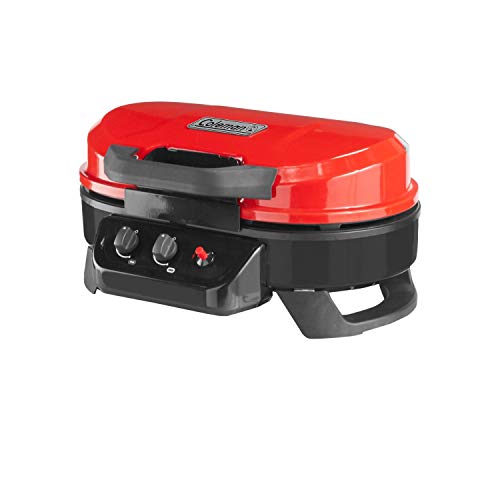
6. Coleman RoadTrip 225 Portable Tabletop Grill — Best Portable Entry
Not every first grill can be a cart. The RoadTrip 225 is the portable branch of entry level: a 2-burner tabletop grill with push-button Instastart ignition that travels to campsites and tailgates and stores in a closet at home. You can check the current price on Amazon before the detail below.
Strengths
- Portable tabletop format travels and stores anywhere
- Instastart ignition lights without matches or fuss
- Two burners give a portable grill real zone control
Trade-offs
- 11,000 BTU is modest — wind and cold are its enemies
- Tabletop height needs a suitable stand or surface
- Not a substitute for a full cart for big home cooks
Key specs
- Burners: 2-burner portable propane
- Output: 11,000 BTU (manufacturer listing)
- Ignition: Instastart push-button
The RoadTrip’s entry logic is lifestyle logic: for the buyer whose grilling happens at campsites, beaches and parking lots — or on a small balcony with a storage rule — a portable 2-burner is not a compromise but the correct tool. Two burners in a portable is a real capability step over single-burner travel grills, allowing a hot side and a holding side. Keep expectations matched to its output, shelter it from wind, and it will introduce its owner to gas grilling in more places than any cart in this guide.
The RoadTrip’s owners tend to become its evangelists, because it changes where grilling happens: the campsite dinner, the beach lunch, the stadium car park. Its tabletop format also makes it the rare entry grill that works for balcony households with strict storage rules — it lives in a cupboard, not on the patio. The discipline it asks is wind awareness and realistic batch sizes. As a first grill it teaches portable cooking; as a household’s only grill it suits small families who genuinely cook in small batches and many places.
Care notes: portable grills age at their hinges, latches and ignition — keep them clean and dry, and store the RoadTrip indoors, which its size makes easy. A windscreen for exposed cooking spots is the one accessory that transforms its performance. Regulator and hose checks matter doubly on a grill that travels and gets reconnected often. Cared for this way, it will see more campsites than most grills see patios.
Best for: campers, tailgaters and storage-limited beginners / Not suited for: home hosts wanting a permanent full-size cart
Check on Amazon — check price on Amazon.
Comparison Table
The entry tier in one view: burners, output class and best-fit household for all six picks, so the shortlist builds itself.
| Pick | Badge | Key spec | Best for |
|---|---|---|---|
| Charbroil Classic 2-Burner Propane Gas Grill | Best Overall Entry | 2-burner, 20,000 BTU, 280 sq. in. | couples and small families buying a first gas grill |
| Charbroil Classic 3-Burner Propane Gas Grill | Best Step-Up Entry | 3-burner, 30,000 BTU, 360 sq. in. | families of four to six and two-zone learners |
| Weber Spirit E-210 Gas Grill | Best Premium Entry | 2-burner Spirit, porcelain-enamelled | longevity buyers and quality-first beginners |
| Megamaster Deluxe 2 Burner Gas Grill | Best Budget Cart | 2-burner, 28,000 BTU, folding shelves | budget-conscious first-time buyers with small spaces |
| Nexgrill Deluxe 2-Burner Gas Grill | Best Compact Alternative | 2-burner, 28,000 BTU, folding shelves | small-space buyers wanting a well-rounded compact cart |
| Coleman RoadTrip 225 Portable Tabletop Grill | Best Portable Entry | Portable 2-burner, 11,000 BTU | campers, tailgaters and storage-limited beginners |
How to Choose the Best Entry Level Gas Grills Without Regrets
Judge an entry grill by its firebox, burners and grates, in that order. A sound firebox holds heat and resists rust; stainless or well-coated burners light evenly across their length; porcelain-coated or cast grates cook and clean well. Everything else — shelf count, wheel size, badge styling — is secondary, and at this tier every dollar spent on theatre is a dollar taken from the firebox. Two good burners beat four bad ones at the same money, every time.
Size by your real headcount. Two burners and around 280 sq. in. feed two to four people happily; three burners and 360 sq. in. stretch to six and unlock comfortable two-zone cooking. Bigger than that at entry prices means thinner metal everywhere. Finally, think in cost per season: a slightly dearer grill with available spare parts commonly outlasts two cycles of the cheapest option, which is why the premium-entry Weber sits in this guide beside the value picks.
Propane Basics Every First-Time Gas Griller Should Know
Your grill runs on a standard refillable propane tank with a regulator and hose that should be inspected each season: look for cracks, keep connections hand-tight plus a firm quarter turn as the manual directs, and run a soapy-water leak check on the fittings whenever you change the tank — bubbles mean stop and fix, not cook anyway. Store tanks outdoors, upright, never in a sealed garage corner, and keep a sense of your fuel level; running dry mid-cook is the most common beginner mishap and a tank gauge or a spare small tank solves it permanently.
Lighting discipline matters too: lid open when lighting, always, so unburned gas cannot accumulate. If a burner will not light after a couple of attempts, turn everything off, wait several minutes, and retry — patience is a safety feature. Close the tank valve first when shutting down, then the burner knobs, so the hose empties safely. These habits take a week to form and protect you for every grill you will ever own.
Entry Level Ownership: Making a Modest Grill Last
The difference between a three-season entry grill and an eight-season one is almost entirely care. Cover the grill — entry-tier finishes need the help. Clean the grates while warm after cooks, empty the grease tray before it becomes a hazard, and once a season clean the burner tubes and check for spider webs in the venturis, the classic cause of weak or uneven flames. A wire brush, a venturi brush and thirty minutes twice a year covers nearly all of it.
Know the wear items and their order: igniters and heat tents usually go first, then grates, then burners — all replaceable on the established brands in this guide, which is a core reason they are here. When a part fails on a sound firebox, replace the part rather than the grill. That single habit is how entry-level buyers quietly end up with the cheapest grilling of anyone: one modest grill, maintained, for the better part of a decade.
The Bread-Slice Test and Other Beginner Skills That Matter More Than Features
Every gas grill has a heat map, and learning yours is the highest-value hour in beginner grilling. Cover the grates with slices of plain bread, run the grill at medium for a few minutes, and read the toast: the browning pattern is your burner’s true map, showing the hot lanes and cool corners you will manage for the grill’s whole life. Repeat once a season, because the map shifts as burners age. No feature on any spec sheet teaches you as much about your specific grill.
The companion skills are equally unglamorous. Two-zone setup — one side hot, one side gentle — is the technique that turns an entry grill into a flexible cooker. A probe thermometer replaces guessing with knowing. And resting meat, five quiet minutes that beginners skip, is worth more juiciness than any grill upgrade at this tier. Master these four habits and an entry grill will outcook a premium grill in careless hands — a truth worth remembering whenever the upgrade itch arrives.
When to Repair, When to Replace: Entry Grill Economics
Entry grills invite a clear decision rule. Repair when the firebox and frame are sound and the failed part is a wear item — igniter, heat tents, grates, a burner — because those parts are cheap relative to a new grill and the established brands in this guide stock them. Replace when the firebox itself is rusting through, the frame is unstable, or several major systems fail at once; at that point money spent on parts is money spent postponing the inevitable.
Run the arithmetic per season rather than per purchase. A modest grill maintained for eight seasons costs less per year than a cheaper grill replaced three times — and cooks better in every one of those seasons, because maintained equipment outperforms neglected equipment at any tier. This is why the guide weights parts availability so heavily in its picks: at the entry level, the support network is not a luxury feature. It is the mechanism by which an inexpensive grill becomes an economical one.
Gas Grill Vocabulary for First-Time Buyers
A short glossary prevents expensive misunderstandings. BTU measures maximum heat output, not cooking quality — distribution matters more, which is why modest-BTU well-built grills outcook giant cheap ones. Heat tents (flavouriser bars, vaporiser bars) sit over burners to spread heat and vaporise drippings. The venturi is the tube where gas meets air before the burner; spiders love it, which is why seasonal cleaning exists. A regulator controls tank pressure and is a wear item with a finite life. Two-zone cooking means arranging burners so one side runs hot and the other gentle — the foundational technique of the craft.
Two more terms protect your wallet. ‘Infrared’ on an entry gas grill should mean an emitter system, as the infrared guide in this series explains — not a marketing tint. And ‘stainless’ spans grades from excellent to decorative; at the entry tier, porcelain-enamelled steel often outlasts thin stainless in real weather. Buyers who learn this vocabulary before shopping make decisions based on the firebox in front of them rather than the adjectives above it — which is, in the end, the skill this entire category rewards.
First-Grill Scenarios: Who Should Buy What
The couple in their first house. The Char-Broil Classic 2-Burner, a cover and a probe thermometer. Cook on it for two seasons; by then you will know exactly what your second grill — if you ever need one — should be.
The family of five, new to gas. The Classic 3-Burner: the third burner and the shelves will be used every single week, and the size will not be outgrown by the second summer.
The buyer who hates replacing things. The Weber Spirit E-210. Pay the entry premium once, maintain it lightly, and let the parts network carry it through the decade.
The renter with a tiny patio and a storage closet. The Coleman RoadTrip 225 if the grill must disappear after use, or the Megamaster or Nexgrill compacts if a small cart can stay. Measure the space first; the right answer is the one that fits it.
Your First Season on an Entry Gas Grill: A Month-by-Month Guide
Month one is calibration. Cook the forgiving canon — burgers, sausages, chicken thighs — while you run the bread-slice test, learn the hot lanes, and discover that the lid thermometer is a suggestion and your new probe thermometer is the truth. Expect one under-seasoned triumph and one overcooked lesson; both are tuition, and the entry grill’s forgiving nature keeps tuition cheap. By the end of the month the lighting, preheating and shutdown sequence should be muscle memory, performed in the right order without thinking.
Months two and three are expansion. Two-zone cooking becomes deliberate rather than accidental: vegetables finish gently while proteins sear, and whole dinners start landing together. This is when most beginners attempt their first ‘project’ — a beer-can-style chicken, a thick steak reverse-finished, ribs given the low-and-slow treatment a gas grill can approximate with patience. Some projects will expose the grill’s honest limits, and that knowledge is valuable: it defines the cook you are becoming and the features your eventual second grill, if any, actually needs.
By the end of the first season, the maintenance rhythm should be set — grates brushed warm, grease managed, one deeper clean done — and the grill should look like a tool that works for a living rather than a showroom piece. That is the correct end state. The entry grill’s job was never to impress anyone; it was to teach you grilling on honest equipment and feed your household while doing it. Judged on that job, every pick in this guide, matched to the right household, passes its first season with room to spare.
How to Set Up and Light Your First Gas Grill Safely
Assembly varies by model, but the first-light sequence is universal. Follow it once, carefully, and it becomes permanent habit.
- Assemble the grill on a level surface, keeping every bolt finger-tight until the frame is square, then tighten in sequence as the manual directs.
- Position the grill outdoors on level ground, clear of siding, eaves and anything combustible, where it will live while cooking.
- Connect the regulator to the propane tank with the tank valve closed; hand-tighten firmly, then open the valve slowly and leak-check the connection with soapy water.
- Fit the heat tents, grates and grease tray exactly as shown in the manual — tray in place before the first cook, not after the first mess.
- Light with the lid open: turn one burner to high, press the igniter, confirm the flame, then light additional burners as needed.
- Run the grill empty on high for fifteen minutes for the first burn-off to clear manufacturing residues, watching for even flame patterns across each burner.
- Season porcelain or cast grates lightly per the manual, then cook something forgiving first — burgers or chicken thighs — while you learn your grill’s hot spots.
- Shut down tank-first, then knobs, let everything cool, and fit the cover once the grill is cold and dry.
A careful first hour pays for itself all season: a square frame, sealed connections and a known flame pattern mean every later cook starts from confidence instead of troubleshooting.
Common Buying Mistakes
Buying the biggest box at the budget. At entry prices, size is bought with thinner metal and weaker burners. A compact grill built properly outcooks and outlasts a giant built cheaply.
Lighting with the lid closed. Unburned gas pools under a closed lid and ignites as a fireball. Lid open, every light, no exceptions — the easiest safety habit in grilling.
Skipping the leak check. Thirty seconds with soapy water after every tank change catches the fitting problems that matter. There is no cheaper insurance in the category.
Never cleaning the burners or grease tray. Weak flames and grease fires are maintenance failures, not grill failures. A twice-yearly clean keeps an entry grill performing like it did when new.
Judging doneness by the lid thermometer. Lid thermometers read air, not food, and entry ones are approximate. A simple probe thermometer transforms a beginner’s results more than any grill upgrade.
Final Recommendation
Most first-time buyers should start with the Char-Broil Classic 2-Burner — or the 3-Burner if the household is four-plus — because the formula is proven, right-sized and honest. Buyers who keep appliances for years should stretch to the Weber Spirit E-210 and be done deciding. The Megamaster and Nexgrill compact carts serve small spaces and tight budgets well, and the Coleman RoadTrip 225 is the entry grill for lives that happen away from a fixed patio.
An entry level grill is not a lesser grill; it is a grill with its money in the right places. Choose build over size, maintain it lightly and consistently, and your first gas grill will teach you grilling on equipment that deserves the lesson.
One last piece of first-grill wisdom, offered by everyone who has been through the purchase: your first gas grill’s most important specification is that it gets used. Every pick in this guide will cook well; the one that fits your space, your household size and your patience for maintenance is the one that will be lit on a Tuesday in November, long after the novelty has gone. Buy for that Tuesday, not for the showroom Saturday, and the entry tier will do for you exactly what it has done for generations of grillers.
Start simple, learn the fire, maintain the machine, and let your skills — not your equipment — be the thing that grows this season. When they outgrow the grill, you will know precisely why, and that knowledge is the real graduation the entry tier offers.
It is also worth saying plainly what an entry grill is not: it is not a statement, a status object or a patio monument, and buying it as if it were one is how households end up with giant, thin, disappointing grills. The entry tier’s dignity is functional — fire, food, family, repeat — and the grills in this guide honour it. A modest grill that cooks well every week contributes more to a household’s life than an impressive one that cooks badly twice a year, and everyone who has owned both knows which one they remember fondly.
And keep the first season in perspective when something goes imperfectly — a flare-up on fatty burgers, a burner that needs its ports cleared, a chicken that took longer than the recipe promised. These are not signs you bought the wrong grill; they are the ordinary texture of learning a live-fire appliance, experienced by every griller who ever lived, on equipment at every price. The entry grill’s job is to make those lessons cheap, safe and well-fed, and on the evidence of this guide’s picks, it does exactly that.
Best Entry Level Pellet Grills Best Entry Infrared Grills Best 2-burner Gas Grills
Frequently Asked Questions
How many burners does a beginner actually need?
Two burners cover couples and small families and teach the fundamentals. Three burners add comfortable two-zone cooking and family capacity, and are worth it for households of four to six. Beyond that, entry-tier money spreads too thin — buy size when your budget can keep the build quality with it.
Is a cheap gas grill a waste of money?
A badly built one is; a modest well-built one is not. The picks in this guide were chosen because their fireboxes, burners and parts support give them multi-season lives. The waste is in the giant thin-metal grill that rusts out in two years, not in a compact grill at an honest tier.
What should I buy alongside my first gas grill?
A cover, a probe thermometer, a spare tank or gauge, and basic tools — tongs, spatula, brush. That kit improves results and longevity more than any feature upgrade at the entry tier, and it all transfers to your next grill whenever that day comes.
How long should an entry level gas grill last?
With covered storage and twice-yearly cleaning, the established-brand picks here should give many seasons; wear parts like igniters, heat tents and grates are replaceable along the way. Uncovered, unmaintained entry grills can look tired in two seasons — care, not price, is the main variable.
Propane or natural gas for a first grill?
Propane, for nearly every beginner: no plumbing, portable tank, and every pick in this guide runs on it. Natural gas makes sense only with an existing outdoor gas line and a permanent grill spot. The cooking difference is negligible; the installation difference is not.
Why do entry grills have hot spots?
Modest burners and thin fireboxes distribute heat less evenly than premium designs. Manage it by preheating fully, learning your grill’s map with a bread-slice test, and moving food between zones as it cooks. Two-zone setup turns hot spots from a flaw into a tool.
Best Gas Grills Best Everyday Grills Under $1000 Best Portable Grills


