Disclosure: airfryerkitchensupply.com is reader-supported. When you buy through links on our site, we may earn an affiliate commission at no extra cost to you.
Where to buy
If you are shopping for the best electrical grills indoor outdoor, start here: every linked pick in this guide was matched against the retailer listing for this site before publication, and the fastest way to confirm current availability is Amazon:
- George Foreman Indoor/Outdoor Electric Grill with Stand, 15-Serving — check price on Amazon
- Techwood 15-Serving Indoor/Outdoor Electric Grill — check price on Amazon
- Cuisinart CEG-115 2-in-1 Portable Outdoor Electric Grill — check price on Amazon
- Char-Broil Patio Bistro TRU-Infrared Electric Grill — check price on Amazon
- Weber Q 1400 Portable Electric Grill — check price on Amazon
- Ninja Woodfire Outdoor Grill & Smoker OG301 — check price on Amazon
Prices move with seasons and promotions, so this guide never prints a fixed figure — use the links above to check price on Amazon on the day you buy. Every model in this roundup is a corded electrical grill cleared by its maker for both kitchen and patio duty, so the same listing covers you whichever side of the sliding door you cook on.
Finding the best electrical grills indoor outdoor shoppers can rely on starts with a simple filter: the grill has to be genuinely rated for both environments, not just small enough to carry inside. A true indoor-outdoor electrical grill runs on a standard household outlet, sheds or contains its grease safely on a countertop, shrugs off patio weather when it is outside, and comes apart far enough that sink washing is realistic after a weeknight cook. Plenty of products call themselves indoor-outdoor because they are portable; far fewer are designed for the grease, smoke and storage realities of both settings.
This guide compares six verified electrical grills that clear that bar, from a 15-serving stand grill that feeds a patio party to a compact infrared bistro grill built for apartment balconies. The picks were matched against their retailer listings for this site, and each one earns its place for a different household: big families, small-space cooks, smoke-sensitive neighbours, and anyone whose building bans gas and charcoal outright.
One honest note before the picks: an electrical grill will not reproduce charcoal flavour, and indoor-outdoor models trade raw searing power for flexibility. What they give back is permission — the ability to grill in apartments, condos, dorms and fire-restricted areas where flame grills are banned — plus weeknight convenience that a kettle or gas cart cannot match. If that trade sounds right, the six models below are the strongest current ways to make it.
In this guide
Quick Picks
Six electrical grills that genuinely work on both sides of the door, each with a clear job:
- George Foreman Indoor/Outdoor Electric Grill with Stand, 15-Serving — Best Overall: the round-domed stand grill that defined this category, with a removable stand for tabletop indoor use and a sloped plate that drains fat into a tray. — check price on Amazon
- Techwood 15-Serving Indoor/Outdoor Electric Grill — Best for Big Groups: a double-layer indoor-outdoor design that adds a warming level above the main plate, stretching a 15-serving footprint across two tiers. — check price on Amazon
- Cuisinart CEG-115 2-in-1 Portable Outdoor Electric Grill — Best Sear: a 2-in-1 stand-or-tabletop grill whose listing leads with 550°F heat from a wall outlet — the strongest sear claim in this roundup. — check price on Amazon
- Char-Broil Patio Bistro TRU-Infrared Electric Grill — Best for Balconies: a compact TRU-Infrared bistro grill whose emitter plate vaporises drippings, giving small-space cooks juicier results and fewer flare-ups. — check price on Amazon
- Weber Q 1400 Portable Electric Grill — Best Build Quality: Weber’s cast-aluminium electric Q with a porcelain-enamelled cast-iron grate — the heaviest, longest-lived build in this roundup. — check price on Amazon
- Ninja Woodfire Outdoor Grill & Smoker OG301 — Best for Smoke Flavor: an electric grill that burns real wood pellets for smoke, grilling six steaks or smoking a brisket-sized cut while running on outlet power. — check price on Amazon
How These Picks Were Chosen
Selection started with the electrical grill listings verified through this site’s product data feed, then applied four filters. First, dual-environment design: a removable stand, a tabletop mode, or explicit indoor and outdoor positioning from the manufacturer — a purely indoor contact grill with no outdoor story did not qualify. Second, grease management that works indoors: enclosed drip trays, sloped plates or infrared emitters that keep flare-ups and smoke down to levels a kitchen can tolerate. Third, realistic power: every pick draws within a normal household circuit, and the outdoor picks reach temperatures that actually brown food rather than steaming it. Fourth, cleaning: removable plates, trays or grates that fit in a sink or dishwasher, because an indoor-outdoor grill that is miserable to clean ends up used in neither place.
Models were then spread across serving sizes and budgets so the list is not six versions of the same grill. Where a listing could not be matched with confidence, the product was left out rather than guessed at, and the one category convention worth knowing is that serving counts in product names describe small burgers or steaks laid edge to edge — real-world capacity for mixed grilling is always lower, which the individual reviews flag where it matters.
The 6 Best Electrical Grills for Indoor and Outdoor Use
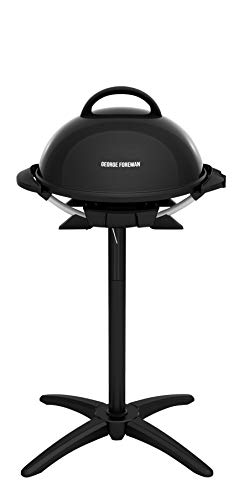
1. George Foreman Indoor/Outdoor Electric Grill with Stand, 15-Serving — Best Overall
This is the grill most people picture when they search for an indoor-outdoor electrical grill, and it still earns the top spot: a large round cooking surface on a stand that lifts off in seconds so the same grill sits on a kitchen counter. You can check the current price on Amazon before the detail below.
Strengths
- Removable stand converts it from patio grill to countertop grill in one motion
- Sloped nonstick surface drains fat into a removable tray, cutting smoke indoors
- Dome lid traps heat for thicker cuts that flat contact grills struggle with
Trade-offs
- Round surface is awkward for long items like kebab skewers and ribs
- Single heat zone means no two-temperature cooking across the surface
- Stand is light, so it feels less planted than a cart grill on a windy patio
Key specs
- Format: Stand grill with removable pedestal, tabletop-capable
- Serving class: 15-serving (manufacturer rating)
- Heat control: Variable temperature probe control
In practice the Foreman works because it respects how people actually move between spaces: outside on the stand for weekend burgers, inside on the counter when weather turns, with the same drip tray catching fat in both places. The domed lid matters more than it looks — it lets chicken pieces and thick chops finish through without the constant flipping a flat plate demands. Temperature recovery after loading cold food is adequate rather than fast, so batch cooking in two smaller loads beats one crowded load. For households that want one grill, one outlet and no fuel at all, this remains the reference design.
Ownership is where the Foreman quietly wins converts. The nonstick surface releases food with a wipe while warm, the tray slides out for the sink, and the whole head lifts off the stand for storage in a way that makes a small kitchen workable. Parts like trays and temperature probes are easy to find because the design has been sold for years. The compromises show up at the extremes: a full load of thick steaks will test its recovery, and purists will miss grate-mark char. But as a two-environment appliance that a household genuinely uses weekly, its record of staying out of the cupboard and on the counter is the strongest argument in this entire guide.
Care notes: the nonstick plate wants soft tools and a warm wipe rather than a cold soak; the tray should never go back in greasy, because it is the smoke-control system for indoor cooks. Check the temperature probe’s cord seasonally — it flexes at the same point every cook and is the likeliest wear item. Treated that way, the Foreman’s simple construction has very little else to go wrong, which is precisely its long-term appeal.
Best for: households wanting one proven grill for both patio and kitchen / Not suited for: cooks who need two heat zones or heavy cast-iron sear marks
Check on Amazon — check price on Amazon.
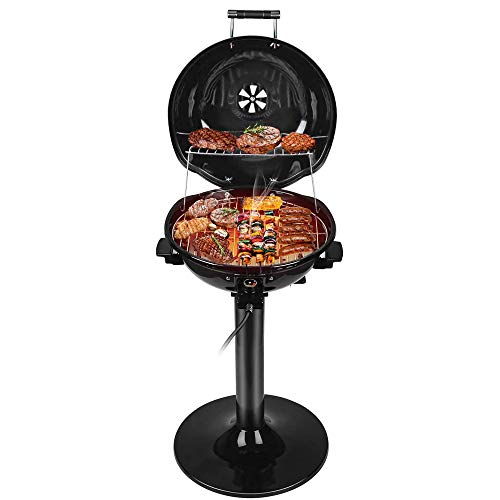
2. Techwood 15-Serving Indoor/Outdoor Electric Grill — Best for Big Groups
Techwood’s indoor-outdoor model attacks the category’s biggest weakness — capacity — with a double-layer layout that keeps finished food warm above the cooking surface instead of crowding it. You can check the current price on Amazon before the detail below.
Strengths
- Double-layer design separates cooking and warming space for bigger groups
- Positioned for both indoor and outdoor use with a stand format
- Generous flat surface suits burgers, vegetables and breakfast items alike
Trade-offs
- Two tiers take longer to break down and wash than a single plate
- Upper layer warms rather than cooks, so it is not true extra grill area
- Brand support and spare parts are thinner than the legacy names here
Key specs
- Format: Stand grill, double-layer design
- Serving class: 15-serving (manufacturer rating)
- Use rating: Indoor and outdoor
The honest way to read the double layer is as a staging system: sear on the main plate, hold on the upper level, and a 15-serving claim becomes plausible for a family cookout without a second grill. Indoors, the same tier keeps pancakes or finished skewers warm while the next batch cooks. Heat is even across the centre with the usual fall-off at the edges, so rotate food rather than trusting the corners. Buyers who regularly cook for six or more and refuse to run two appliances will get the most from this design.
The Techwood’s ownership story is about throughput discipline. The upper tier is best used as a true holding zone — cooked food rests there in the lid’s warmth while the main plate keeps working — and hosts who learn that rhythm can feed a surprising number of people from one outlet. Cleaning is the counterweight: two levels mean two surfaces to wash, and the honest advice is to wash them the same night, every time, because the double-layer advantage evaporates if the grill becomes a chore. Buyers with the discipline get a party-capable grill; buyers without it should choose a simpler single-surface model and will be happier.
Care notes: wash both tiers the same night — the double layer’s only real enemy is baked-on residue compounding between cooks. Keep the surfaces dry before storage, since the grill may sit between big gatherings, and inspect the cord if it lives outdoors. The Techwood’s value is realised over years of group cooks, and a five-minute cleanup ritual after each one is what protects that value.
Best for: large families and hosts cooking in batches / Not suited for: solo cooks who will never use the second tier
Check on Amazon — check price on Amazon.

3. Cuisinart CEG-115 2-in-1 Portable Outdoor Electric Grill — Best Sear
Most electrical grills apologise for their top temperature; the CEG-115 advertises it. Reaching a listed 550°F from a standard outlet puts real crust on steaks, and the 2-in-1 stand design moves it between patio and tabletop. You can check the current price on Amazon before the detail below.
Strengths
- Listed 550°F maximum is the highest in this group
- Stand or tabletop configuration covers patio and indoor use
- Compact footprint stores easily between cooks
Trade-offs
- Cooking area is modest — plan on cooking for two to four
- High heat draws the full circuit, so share the outlet with nothing
- Smaller lid clearance limits very thick roasts
Key specs
- Max temperature: 550°F (manufacturer listing)
- Format: 2-in-1 stand / tabletop
- Power source: Standard wall outlet
Heat is the whole argument here. Electrical grills commonly plateau where browning gets sluggish, and the CEG-115’s higher ceiling shows up as better colour on burgers, chicken skin and vegetables without extending cook times. The trade is space: this is a couples-and-small-family grill, not a party machine, and its stand is best treated as a convenience rather than furniture. Indoors it behaves well on a tabletop with the tray managed between batches. If your complaint about electric grilling has always been pale food, this is the pick aimed at you.
Living with the CEG-115 means planning around two numbers: its surface, which rewards cooking for two to four, and its appetite for current, which rewards a dedicated circuit. Within those numbers it is a delight — the stand sets up and packs down quickly, the tabletop mode makes it a genuine indoor grill in winter, and the high ceiling means outdoor cooks in cool weather still brown properly. Accessory-wise it needs little beyond a cover and a probe thermometer. It is the pick for the cook who has been disappointed by an electric grill before and traced the disappointment, correctly, to heat.
Care notes: the CEG-115’s high heat is hard on residue, so a warm scrape after every cook keeps the surface honest and the next preheat smoke-free. Give the stand’s joints an occasional wipe and check, since it folds and unfolds often. Store it with the cord loosely coiled rather than wrapped tight around hot-zone parts. Small disciplines, but they are what keep a high-performance electric cooking like one.
Best for: small households that prioritise browning and crust / Not suited for: hosts cooking for six or more at once
Check on Amazon — check price on Amazon.
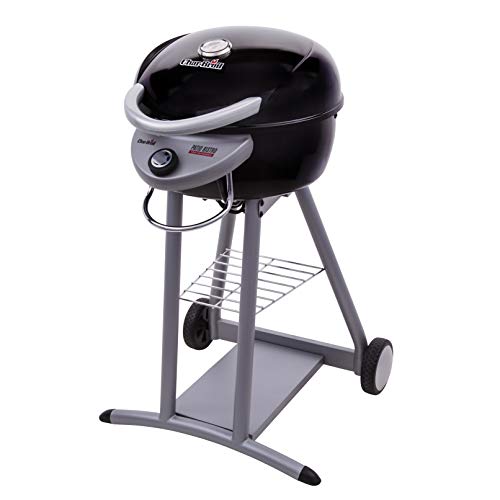
4. Char-Broil Patio Bistro TRU-Infrared Electric Grill — Best for Balconies
The Patio Bistro is the balcony specialist: a compact footprint, a lid for weather and heat retention, and Char-Broil’s TRU-Infrared emitter between the element and the food, which evens out heat and catches drippings before they flare. You can check the current price on Amazon before the detail below.
Strengths
- TRU-Infrared emitter reduces flare-ups and hot spots
- Lidded, compact design suits balconies and small patios
- Infrared cooking is forgiving for beginners — food dries out less
Trade-offs
- Cooking space is sized for two to four servings
- Emitter plate needs regular cleaning to keep performance up
- No stand conversion story as flexible as the Foreman or Techwood
Key specs
- Cooking system: TRU-Infrared electric emitter
- Format: Compact bistro grill with lid
- Model: 20602107
Infrared changes the indoor-outdoor equation in a subtle way: because drippings vaporise on the emitter instead of pooling and smoking, the Bistro behaves politely near open windows and in covered outdoor spaces. It is primarily an outdoor grill that tolerates sheltered, semi-indoor settings like screened porches better than open-plate designs. Steaks and chops come off noticeably juicier than on a basic element grill of the same size. The discipline it asks in return is cleaning — a neglected emitter plate slowly turns the grill’s best feature into a smoke source.
The Bistro rewards a particular kind of owner: one who cooks often for a few people and keeps the emitter clean. Its small footprint means it can live on the balcony permanently under a cover, ready in minutes, which changes how often grilling happens — frequency is the hidden benefit of every compact grill in this guide. The infrared system also makes it the most neighbour-friendly outdoor option here, since vaporised drippings mean fewer flare-up smoke events drifting over the railing. If your grilling life is weeknight dinners for two or three on a small outdoor space, this is the most tailored tool in the roundup.
Care notes: the emitter plate is the maintenance contract in writing — brush it on schedule, run a burn-off after fatty cooks, and inspect it each season for heavy carbon build-up. The rest of the Bistro is simple: wipe the lid, empty any tray, cover it. Owners who keep the emitter clean report a grill that performs in year three like week one; owners who do not, report a smoky grill and blame the technology.
Best for: apartment and condo grillers on small balconies / Not suited for: large households needing maximum surface area
Check on Amazon — check price on Amazon.

5. Weber Q 1400 Portable Electric Grill — Best Build Quality
The Q 1400 brings Weber’s gas-grill engineering to an outlet: a cast body, a porcelain-enamelled cast-iron cooking grate and a 1,560-watt element, in a portable format that works on a patio table or a sturdy counter. You can check the current price on Amazon before the detail below.
Strengths
- Cast-iron grate holds heat and marks food like a gas grill
- Cast aluminium body shrugs off outdoor seasons
- Weber parts and support network is the deepest in the category
Trade-offs
- Heaviest pick here — portable in principle, luggable in practice
- Premium positioning within the electric category
- No stand included in the base configuration
Key specs
- Element: 1,560 W / 120 V
- Grate: Porcelain-enamelled cast iron
- Body: Cast aluminium lid and bowl
What the extra build buys is heat behaviour: the cast-iron grate stores energy, so food keeps searing when a cold steak lands, where thin nonstick plates dip and steam. Outdoors it feels like a small gas grill that happens to plug in; indoors it needs a stable, heat-safe surface and sensible clearance, and its weight argues for a semi-permanent home rather than daily cupboard trips. For buyers who keep appliances a decade, the Q 1400 is the easiest recommendation in this guide — it is the electrical grill least likely to be replaced.
The Q 1400’s second paragraph is about time. Everything on it — the cast body, the enamelled grate, the element — is specified for a long service life, and Weber’s support means the wear items remain available when they eventually wear. It also holds its heat outdoors in marginal weather better than lighter rivals, extending the grilling season at both ends. The ownership cost is literal weight: you will choose its spot and leave it there, stand or sturdy table, rather than treating it as a portable. Households that accept that bargain get the closest thing to a permanent outdoor grill that an outlet can power.
Care notes: treat the cast-iron grate like cast iron — a light oil after cleaning while warm keeps the enamel and seasoning happy and the sear improving with age. The element and body ask only for a cool, damp wipe. Because the Q lives outdoors, an annual cord and plug inspection is worthwhile. None of this is burdensome, and the reward is a grill whose best years are not its first ones.
Best for: buyers who keep gear for years and value sear quality / Not suited for: anyone needing a light grill to carry between locations
Check on Amazon — check price on Amazon.

6. Ninja Woodfire Outdoor Grill & Smoker OG301 — Best for Smoke Flavor
The Woodfire OG301 answers the standard objection to electrical grills — no smoke — by burning a small amount of real wood pellets alongside its electric heat, adding genuine wood-fired flavour to a plug-in grill. You can check the current price on Amazon before the detail below.
Strengths
- Real wood-pellet smoke from an electric appliance
- 3-in-1 grill, smoke, bake and roast functions
- Sized for six steaks or a brisket-class cut per the listing
Trade-offs
- Smoke function is an outdoor or well-ventilated-space activity, not a countertop one
- Pellet supply is a small ongoing consumable
- Multi-function controls take a session or two to learn
Key specs
- Functions: Grill, smoke, bake/roast (3-in-1)
- Fuel story: Electric heat with real wood pellets for smoke
- Capacity note: 6 steaks or a 9 lb brisket (manufacturer listing)
Treat the OG301 as an outdoor-first grill that can do plain grilling indoors with the smoke off. With pellets burning it produces the closest thing to barbecue flavour available to someone whose lease bans charcoal, and the bake and roast modes stretch it beyond grill duty into a genuine patio oven. The learning curve is real but short: pellet loading, smoke timing and the air-fry-adjacent modes reward one careful read of the manual. For flavour-first buyers in flame-restricted homes, nothing else in this roundup is a substitute.
The OG301 asks for a small new habit — keeping a bag of pellets on hand — and returns a flavour dimension no other pick here can offer. Indoors, run it as a straightforward electric grill and it behaves; outdoors with the smoke running, it produces food that makes guests ask what kind of smoker you bought. The bake and roast modes widen its weeknight value beyond grilling, which matters for an appliance competing for patio space. The buyers who regret it are the ones who never use the smoke; the buyers who love it build their weekend cooking around it. Know which one you are before choosing.
Care notes: the pellet system adds two jobs — empty the ash and keep pellets dry — to the usual grill cleaning, and the smoke sensor area and vents should stay clear for the electronics to read conditions properly. Run the shutdown routine the manual specifies rather than simply unplugging. Kept that way, the OG301’s extra complexity stays theoretical; neglected, it is the first pick in this guide that will remind you it has moving parts.
Best for: flavour-focused cooks in flame-banned buildings / Not suited for: buyers wanting a silent, smoke-free indoor-only grill
Check on Amazon — check price on Amazon.
Comparison Table
Six grills, two environments, one table: badges, headline specs and best-fit jobs for every pick, so you can shortlist before reading the deep reviews above.
| Pick | Badge | Key spec | Best for |
|---|---|---|---|
| George Foreman Indoor/Outdoor Electric Grill with Stand, 15-Serving | Best Overall | 15-serving round surface, removable stand | households wanting one proven grill for both patio and kitchen |
| Techwood 15-Serving Indoor/Outdoor Electric Grill | Best for Big Groups | Double-layer 15-serving stand grill | large families and hosts cooking in batches |
| Cuisinart CEG-115 2-in-1 Portable Outdoor Electric Grill | Best Sear | 550°F max, stand or tabletop | small households that prioritise browning and crust |
| Char-Broil Patio Bistro TRU-Infrared Electric Grill | Best for Balconies | TRU-Infrared emitter, compact lidded design | apartment and condo grillers on small balconies |
| Weber Q 1400 Portable Electric Grill | Best Build Quality | 1,560 W element, cast-iron grate | buyers who keep gear for years and value sear quality |
| Ninja Woodfire Outdoor Grill & Smoker OG301 | Best for Smoke Flavor | Electric heat + real pellet smoke, 3-in-1 | flavour-focused cooks in flame-banned buildings |
How to Choose: Best electrical grills indoor outdoor
Start with permission, not products. Check your lease, condo rules or dorm policy for the exact wording: many buildings ban ‘open flame’ or fuel storage rather than grilling itself, which is precisely the gap electrical grills fill. Then check the space the grill will live in. A stand model needs a corner to occupy; a tabletop model needs a heat-safe surface with clearance on all sides and an outlet within cord reach — measure both spaces before falling for a serving count.
Next, match the grease system to your indoor tolerance. Enclosed drip trays and sloped plates (Foreman-style) contain fat best for true indoor cooking. Infrared emitters vaporise drippings and cut flare-ups, which suits covered porches and balconies. Open-plate designs smoke the most and belong outdoors or under a strong range hood. Finally, be honest about headcount: a 15-serving rating means roughly eight real servings of mixed food, and a compact bistro grill that suits a couple will frustrate a family of five every single weekend.
Electrical Grill Power, Heat and Circuit Basics
Every pick in this guide runs on a standard household circuit, and that imposes a shared ceiling: roughly the draw of a large microwave or space heater. Two consequences follow. First, never run an electrical grill on the same circuit as another heavy appliance — a tripped breaker mid-cook is the most common ‘broken grill’ story in this category. Outdoor cooking should use a GFCI-protected outlet, and if an extension cord is unavoidable it must be a short, heavy-gauge outdoor-rated cord, never a light indoor one.
Heat behaviour matters more than headline wattage. Cast-iron grates and infrared emitters store and radiate energy, so they sear through the temperature dip when cold food lands; thin nonstick plates recover more slowly. Lid design is the other half of the equation — a domed or hinged lid turns a grill into a small oven for thick cuts, while open flat plates are really griddles with grill marks. Buy the heat system that matches your food: steaks and chops reward stored heat, while vegetables, seafood and breakfast items are happy on simpler plates.
Indoor-Outdoor Storage, Weather and Care
A grill that lives in two environments needs a storage plan for each. Outdoors, even weather-tolerant models last longer under a cover with the cord coiled dry; bring removable plates and trays inside for washing rather than hosing the whole appliance, which no electrical grill is designed for. Indoors, store the grill only when it is fully cool and degreased — a warm drip tray in a cupboard is a smell and pest problem waiting to happen.
Build a five-minute routine after every cook: scrape the surface while warm, empty and wash the drip tray, wipe the lid interior, and check the cord for nicks. Monthly, deep-clean infrared emitters and nonstick plates with the maker’s approved method, since baked-on residue is the main cause of both smoke and uneven heat as these grills age. Followed consistently, that routine is the difference between a grill that lasts two seasons and one that lasts ten.
Matching an Indoor-Outdoor Grill to Your Floor Plan
The dual-environment promise fails in one predictable way: a grill that is awkward in both homes gets used in neither. Before buying, physically walk the route — where will it stand outside, where will it sit inside, where does it store, and where is the outlet in each place? A stand grill needs roughly a square metre of patio and a corner to live in; a tabletop model needs a heat-safe run of counter near an outlet and a cupboard or shelf that fits its actual dimensions, which are always larger than they look in photos.
Renters should also weigh the building’s practical politics: a compact grill that appears on the balcony for dinner and disappears into a closet afterwards rarely attracts attention, while a permanent large installation invites questions even where rules allow it. The Foreman and Techwood stand models suit owners with dedicated patio corners; the Bistro, Q 1400 and CEG-115 suit move-it-when-you-need-it living. Buy for the floor plan you have this year, not the one you hope for next year.
What Indoor-Outdoor Grills Cook Best — and What to Cook Elsewhere
The sweet spot of this category is the weeknight canon: burgers, chicken breasts and thighs, sausages, fish fillets, vegetables, kebabs and sandwiches. These foods are portion-sized, cook in minutes, and suit the moderate surface temperatures and single zones of electrical grills. Thick steaks are achievable on the high-heat and cast-iron picks with a full preheat and an uncrowded surface. Breakfast on a flat or griddle-capable surface is an underrated strength, especially indoors in winter.
Be equally clear about the weak spots. Large roasts, whole packer briskets and multi-rack rib sessions belong to bigger dedicated equipment; pizzas want more top heat than most lids here deliver; and anything requiring true wood smoke needs the Woodfire’s pellet system or a different appliance entirely. A guide that pretends one grill does everything sets its readers up for disappointment — the six picks here are excellent inside their lane, and the lane is most of what households actually cook.
Accessories That Earn Their Place with an Indoor-Outdoor Grill
Four accessories genuinely earn their storage space with these grills. A fitted cover protects any model that lives outside and doubles the finish’s life. An instant-read probe thermometer ends doneness guessing on every pick in this guide and is the single highest-value purchase after the grill itself. A set of long, soft-tipped tools protects nonstick surfaces while keeping hands clear of the heat. And a heavy-gauge, outdoor-rated short extension cord — bought before you need it, to the specification in the safety section — turns outlet distance from a crisis into a non-issue.
Beyond those four, buy accessories only in response to a real cooking pattern: a griddle plate if breakfast becomes a habit, a stand if a tabletop model earns a permanent patio spot, a second drip tray if you cook for crowds weekly. Accessory drawers fill with good intentions; the disciplined approach is to let the cooking nominate the tools. The grills in this guide are complete as sold — everything else should have to argue its way into your kitchen.
Which Indoor-Outdoor Grill Fits Your Situation?
The apartment couple with a small balcony. Choose the Char-Broil Patio Bistro for permanent balcony duty, or the Cuisinart CEG-115 if searing matters more than footprint. Both respect the space, the neighbours and the lease; the Bistro is the gentler, juicier cook, the Cuisinart the browning specialist.
The family that grills on the deck all summer and the counter all winter. The George Foreman stand grill was designed for exactly this migration, with the Techwood double-layer as the pick when the guest list regularly passes eight. Either way, dedicate one indoor counter spot with an outlet and the seasonal move becomes a non-event.
The flavour lover in a no-flame building. The Ninja Woodfire OG301 is your grill: electric for the lease, pellet smoke for the palate. Budget a shelf for pellets and learn the smoke timing on chicken before attempting the brisket — the learning curve is short and the payoff is the category’s best.
The buy-it-once homeowner. The Weber Q 1400, on a stand or sturdy table, with a cover. It is the heaviest and the longest-lived, and its cast-iron grate will still be searing properly when lighter grills have been replaced twice.
What Changes After Six Months of Indoor-Outdoor Grilling
The first month with a dual-environment grill is about learning the appliance; the sixth month is about learning your own patterns, and they surprise most owners. The grill migrates toward whichever environment hosts the weeknight dinner — for many households that turns out to be indoors more often than the purchase assumed, because weather, darkness and tiredness all vote for the kitchen. That is why the indoor virtues in this guide — grease containment, modest smoke, easy washing — are weighted as heavily as the outdoor ones. A grill bought for the patio that cannot behave in the kitchen becomes a seasonal appliance, and seasonal appliances are the ones households stop replacing when they fail.
The second six-month lesson is that serving capacity and cooking frequency trade against each other in an unexpected direction: owners of compact grills grill more often. A bistro or tabletop model that preheats in minutes and washes in the sink lowers the activation energy of a grilled dinner below the takeaway threshold, while a big stand grill, for all its party virtues, asks for an occasion. Neither pattern is wrong, but knowing your household’s centre of gravity — frequency or scale — is the single best predictor of satisfaction with any pick in this guide, and it is why the recommendations are organised by situation rather than by a single overall ranking pretending to fit everyone.
Finally, the electrical reality settles in as a genuine lifestyle benefit rather than a compromise: no fuel runs, no tank anxiety, no ash, and a grill that can be used the same evening it occurs to you. Owners consistently report that the flavour gap they feared narrows in practice — marinades, rubs and good browning technique carry most of what they actually missed — while the convenience gap never narrows at all. That is the honest long-term verdict on the category, and it is why these six grills, chosen carefully, tend to stay in service for years.
How to Set Up an Indoor-Outdoor Electrical Grill Safely
The same grill needs two different setups. Work through these steps the first time you cook in each environment and the routine becomes automatic.
- Choose the surface first: outdoors, a level patio spot away from siding and overhangs; indoors, a heat-safe counter with clear space on all sides and nothing stored above it.
- Inspect the cord and plug before every cook. Any nick, fray or loose prong means the grill stays off until it is repaired or replaced.
- Plug directly into a wall or GFCI outlet. Avoid power strips entirely, and use only a short heavy-gauge outdoor extension cord if reach truly requires one.
- Fit the drip tray, plate or emitter exactly as the manual shows, then preheat with the lid closed for the time the maker specifies — electrical grills reward patience here.
- Cook in batches that leave gaps between items. Airflow around food is what keeps an electrical grill searing instead of steaming, indoors and out.
- For indoor cooks, run the range hood or crack a window even with a low-smoke model; vapour and odour management is part of the setup, not an afterthought.
- After cooking, let the grill cool on its surface, then remove plates and trays for sink washing. Never immerse the body or spray water into the element housing.
- Dry everything fully before storage, coil the cord loosely, and cover outdoor-stored grills once completely cool.
None of these steps is complicated, but together they cover nearly every failure mode electrical grill owners report: tripped breakers, excess smoke, scorched counters and premature element wear. Set up deliberately twice and it becomes habit for the life of the grill.
Common Buying Mistakes
Buying by serving count alone. Manufacturer servings assume small items packed edge to edge. Halve the number for mixed real-world cooking and size the grill to your largest regular group, not your average Tuesday.
Assuming indoor-outdoor means smokeless indoors. Every grill produces some vapour and odour. Low-smoke designs reduce it; none eliminate it. Plan ventilation for indoor cooks regardless of marketing language.
Sharing the circuit with other appliances. An electrical grill plus a microwave, kettle or space heater on one circuit is a tripped breaker waiting for the worst moment. Give the grill the circuit to itself.
Hosing down an electrical grill. Water and element housings do not mix. Removable parts go in the sink; the body gets a damp cloth, once cool and unplugged.
Skipping the emitter or tray cleaning. Infrared plates and drip trays are the smoke-control system. Neglected, they become the smoke source — clean them on schedule, not when guests notice.
Final Recommendation
For most households, the George Foreman 15-Serving Indoor/Outdoor is the safest single purchase: proven format, easy cleaning, and a stand that makes the indoor-outdoor promise literal. If browning quality is your priority, step to the Cuisinart CEG-115 for its 550°F ceiling or the Weber Q 1400 for cast-iron heat. Balcony cooks should look hard at the Char-Broil Patio Bistro, batch cooks at the Techwood double-layer, and anyone who misses smoke at the Ninja Woodfire OG301.
Whichever you choose, buy the grill that fits your space, your circuit and your headcount — in this category the honest fit beats the biggest spec sheet every time.
A last word on value, because this category is often misjudged at both extremes. The cheapest indoor-outdoor grills save money by thinning the cooking surface and simplifying the grease system — the two things this format lives on — while the most expensive add size and finish that many households never use. The six picks here occupy the honest middle and upper-middle of the category, where the dual-environment promise is actually kept. That is the ground on which an appliance that must perform in two homes should be bought.
Buy once, buy for your floor plan and your headcount, and keep the drip tray clean. Do those three things and an indoor-outdoor electrical grill stops being a compromise appliance and becomes simply the grill your household uses — in January, in July, indoors and out.
Best Electrical Grills Outdoor Best Electronic Indoor Grills Best Electric Grills
Frequently Asked Questions
Can an electrical grill really be used indoors?
Yes, provided the model is designed for it, as all six picks here are. Use a heat-safe surface, keep clearance around the grill, manage the drip tray, and ventilate the room. Smoke and odour are reduced by enclosed and infrared designs but never zero, so a range hood or open window remains part of indoor grilling.
Will an electrical grill trip my breaker?
It can if the circuit is shared. These grills draw close to the practical limit of a household circuit, so run the grill alone on its circuit, plug directly into the outlet, and use GFCI protection outdoors. Tripping almost always traces to a second appliance or a light extension cord.
Do indoor-outdoor electrical grills get hot enough to sear?
The better ones do. Models with cast-iron grates, infrared emitters or a listed 550°F ceiling brown food convincingly. Thin open plates are the weakest searers; preheating fully and cooking in uncrowded batches closes most of the remaining gap with gas.
What is the difference between this and an indoor contact grill?
Contact grills press food between two heated plates and live only on counters. Indoor-outdoor electrical grills cook on an open surface under a lid, handle thicker and larger items, and are built — with stands, weather-tolerant bodies and grease systems — to work on a patio as well as a counter.
How do I clean an indoor-outdoor electrical grill?
Scrape the warm surface, wash removable plates, grates and drip trays in the sink, and wipe the cooled body with a damp cloth. Never immerse the body or spray water at the element. Infrared emitter plates need periodic cleaning per the manual to keep flare-ups and smoke down.
Are electrical grills allowed in apartments that ban grilling?
Often, yes, because most bans target open flame and fuel storage, and an electrical grill has neither. Rules vary by building and city, though, so confirm your specific lease or condo wording before buying — the grill cannot argue with your landlord for you.
Best Entry Infrared Grills Best Everyday Grills Under $1000 Best Portable Grills


