Disclosure: airfryerkitchensupply.com is reader-supported. When you buy through links on our site, we may earn an affiliate commission at no extra cost to you.
Where to buy
Every pick in this guide to the best electric top cookers and ovens was checked against live Amazon listings before publication, and only models with a confirmed listing carry a buy link. Prices move constantly on large appliances and countertop cookers alike, so we never print a fixed price here — use the links to check the current price on Amazon, confirm the exact configuration, and read the delivery and installation terms before you order.
Empava 30-Inch Induction Cooktop (4 Burner) — Check the current price on Amazon
Frigidaire Professional FPEC3077RF 30-Inch Electric Cooktop — Check the current price on Amazon
Karinear 30-Inch Electric Cooktop (4 Burners, Knob Control) — Check the current price on Amazon
GE JKS5000SNSS 27-Inch Electric Single Wall Oven — Check the current price on Amazon
Cosmo COS-30ESWC 30-Inch Electric Wall Oven (5 Cu. Ft.) — Check the current price on Amazon
Empava 30-Inch Electric Single Wall Oven Air Fryer Combo — Check the current price on Amazon
A quick word on what this search means, because it is genuinely ambiguous: ‘top cookers’ is the phrasing many shoppers use for the cooking surface that sits on top — the cooktop or hob — as distinct from the oven beneath or beside it. So this guide to the best electric top cookers and ovens covers the separate-components route: three electric cooktops (induction and radiant) and three electric wall ovens that pair with them into a built-in cooking wall, instead of a single all-in-one range.
Why choose separates over a range? Layout freedom (cooktop in an island, oven at eye level), redundancy (one can be serviced without losing both), and the ability to buy each half at the level you actually use — many households cook on top daily and bake weekly, or the reverse. The trade is cost and installation complexity, and we are frank about both in the buying guide below.
Every product here was verified against its live Amazon listing — brand, model, size and type confirmed — before earning a link. Three picks are cooktops, three are wall ovens, and the Final Recommendation suggests pairings for common kitchen plans.
In this guide
Quick Picks
If you only have a minute, these are the short answers. Each pick below earned its badge for a different reason, and the badge stays the same in the detailed reviews further down, so you can jump straight to the model that matches your kitchen.
- Empava 30-Inch Induction Cooktop (4 Burner) — Best Induction Cooktop. Four induction zones in the standard 30-inch cutout — the speed and precision pick for the top half of the cooking wall. Check price on Amazon.
- Frigidaire Professional FPEC3077RF 30-Inch Electric Cooktop — Best Radiant Cooktop. A major-brand radiant smoothtop with professional styling — the pan-friendly, service-friendly mainstream choice. Check price on Amazon.
- Karinear 30-Inch Electric Cooktop (4 Burners, Knob Control) — Best Knob Control. Real knobs on a 30-inch radiant cooktop — for cooks who want to adjust heat by feel, with gloves on, without looking down. Check price on Amazon.
- GE JKS5000SNSS 27-Inch Electric Single Wall Oven — Best 27-Inch Wall Oven. The replacement-friendly 27-inch wall oven from a major brand — for the many kitchens whose cabinets were built around this size. Check price on Amazon.
- Cosmo COS-30ESWC 30-Inch Electric Wall Oven (5 Cu. Ft.) — Best Value Wall Oven. A full 5 cu. ft. of true convection in the standard 30-inch width, at a value tier the big brands rarely visit. Check price on Amazon.
- Empava 30-Inch Electric Single Wall Oven Air Fryer Combo — Best Wall Oven with Air Fry. Convection, air fry and ten cooking functions in a 30-inch wall oven — the modern mode set at eye level. Check price on Amazon.
How These Picks Were Chosen
For cooktops, we split the picks by heating technology and control style, because those are the real decision axes: an induction model for speed and precision, a radiant smoothtop from a major brand for pan compatibility and service support, and a knob-controlled radiant model for buyers who dislike touch controls (and for households where gloves, floury hands or accessibility make knobs the right answer). All three are standard 30-inch built-in units.
For ovens, the picks are all single wall ovens in the two standard widths: a 27-inch major-brand model for replacement projects where the cabinet dictates the size, a 30-inch true-convection value model, and a 30-inch convection model with air fry for households that want the modern mode set. Capacity, convection quality and cleaning method were the deciding criteria, in that order.
Verification was strict: separates are a category full of near-identical model numbers, so each pick was matched on full model designation through the API before a dp link was attached. Where a search returned gas or dual-fuel variants of a similar name, they were excluded — this guide is electric only, as the keyword specifies.
The 6 Best Electric Top Cookers and Ovens

Empava 30-Inch Induction Cooktop (4 Burner) — Best Induction Cooktop
The Empava Ease is our induction pick for the cooktop half: four zones, the standard 30-inch built-in format, and the induction virtues in full — near-instant response, a surface that stays comparatively cool, and precise low heat for sauces and chocolate. For households converting from gas, this is the format that ends the argument.
Strengths
- Induction speed: boils fast, adjusts instantly, simmers gently
- Cool-to-the-touch surface (pan heat only) makes cleanup a wipe
- Four zones in the standard cutout suits most existing kitchens
Trade-offs
- Needs magnetic cookware — run the magnet test on your pans
- Touch controls divide opinion; wet fingers can frustrate
- Requires the correct 240V circuit and professional-grade installation
| Specification | Detail |
|---|---|
| Format | 30-inch built-in cooktop |
| Zones | 4 burners |
| Technology | Induction |
| Brand line | Empava Ease (per listing) |
Induction’s real advantage in a separates layout is control density: four genuinely independent zones, each able to hold a different precise level, with no residual-heat lag when you drop from boil to simmer. In an island installation — the classic separates move — the cool surface also matters socially: the cook faces the room, and guests lean on counters that are not radiating stored heat.
Plan the electrical work honestly: a 30-inch induction cooktop is a serious 240V load, and most kitchens adding separates need an electrician’s visit for the cooktop circuit, the oven circuit, or both. Cost that into the project, confirm the cutout dimensions against the template before the counter is cut, and this cooktop will feel like the future every single day.
Best for: keen cooks converting from gas or radiant who want precision and an island-friendly top / Not suited for: households with mostly non-magnetic cookware or anyone avoiding electrical work
Check on Amazon to see the current price, configuration options and delivery terms for the Empava induction cooktop.

Frigidaire Professional FPEC3077RF 30-Inch Electric Cooktop — Best Radiant Cooktop
If induction’s cookware rules do not suit your kitchen, the Frigidaire Professional radiant cooktop is the separates answer: a ceramic-glass smoothtop that takes any flat-bottomed pan you own, in a pro-styled 30-inch format from a brand with a national service network behind it.
Strengths
- Works with every flat-bottomed pan — no cookware audit needed
- Major-brand parts and service support for the long term
- Smoothtop surface wipes clean and looks integrated
Trade-offs
- Radiant elements respond and cool more slowly than induction
- Glass needs correct cleaning to avoid baked-on rings
- No induction-style precision at very low heat
| Specification | Detail |
|---|---|
| Format | 30-inch built-in electric cooktop |
| Model | FPEC3077RF |
| Technology | Radiant smoothtop |
| Line | Frigidaire Professional |
Radiant smoothtop remains the sensible default for mixed cookware households: the aluminium pan you love, the copper you inherited, the enamelled Dutch oven — all work, no magnet test required. Modern radiant elements cycle intelligently and the keep-warm and expandable-element layouts on pro-line models like this one handle odd pan sizes gracefully.
The ownership case is the other half of this pick. A cooktop is a 15-year appliance embedded in a counter; when an element or control eventually fails, a major brand’s parts pipeline is the difference between a repair and a re-cut counter. That, plus the clean integrated look, is what the Professional badge is buying here.
Best for: mixed-cookware households wanting a built-in top with mainstream support / Not suited for: cooks who prioritise instant response above pan compatibility
Check on Amazon to see the current price, configuration options and delivery terms for the Frigidaire Professional cooktop.
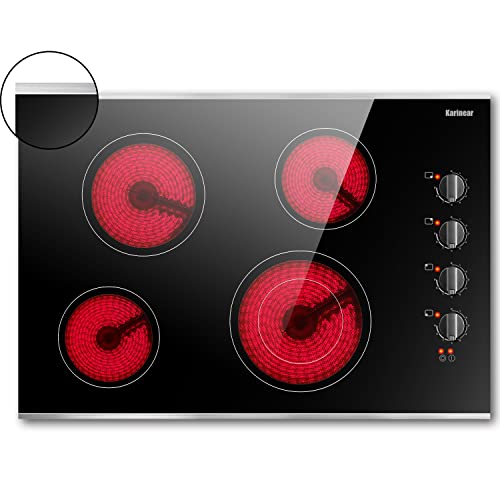
Karinear 30-Inch Electric Cooktop (4 Burners, Knob Control) — Best Knob Control
Touch controls are not an upgrade for everyone. The Karinear’s reason to exist is its knob control panel: four radiant burners adjusted by turning a dial you can operate with an oven glove, floury fingers or limited vision, in the standard 30-inch built-in format at a value tier.
Strengths
- Knobs are operable with gloves and by feel — genuinely more accessible
- Four radiant burners accept all flat-bottomed cookware
- Value tier for a built-in separates project
Trade-offs
- Knobs interrupt the flush look and need cleaning around
- Smaller brand: verify warranty and support for your region
- Radiant response limits apply, as with any smoothtop
| Specification | Detail |
|---|---|
| Format | 30-inch built-in electric cooktop |
| Burners | 4 |
| Controls | Knob control |
| Technology | Radiant ceramic glass (per listing family) |
There is a quiet accessibility argument for knobs that the industry undervalues: a dial gives positional feedback — you can feel roughly where the heat is set — and it never ignores a wet or gloved touch. For multigenerational households, keen bakers with permanently floury hands, and anyone who has fought a touch panel mid-sauce, knob control is not nostalgia; it is ergonomics.
As a radiant top it plays by radiant rules: give elements a moment to respond, use the residual heat after switching off for gentle holding, and keep the glass clean with the right scraper and cleaner. At its tier, with those habits, it delivers the separates experience — island or peninsula cooking with the oven at eye level across the room — to budgets the big brands do not reach.
Best for: knob loyalists, gloved and floury-handed cooks, and value-led renovations / Not suited for: buyers who want induction speed or a big-brand service network
Check on Amazon to see the current price, configuration options and delivery terms for the Karinear knob cooktop.

GE JKS5000SNSS 27-Inch Electric Single Wall Oven — Best 27-Inch Wall Oven
Wall oven replacements live and die by cabinet size, and a huge installed base of kitchens was built for 27-inch units. The GE JKS5000SNSS is our pick for that reality: a major-brand 27-inch single wall oven that refreshes an existing opening with modern controls and cooking performance, without a cabinet rebuild.
Strengths
- Fits the common 27-inch replacement opening
- Major-brand support, parts and installer familiarity
- Modern even-baking performance in a compact cavity
Trade-offs
- 27-inch cavity is narrower — full sheet pans need checking
- If you are building new cabinets, 30-inch gives more room
- Feature set is mainstream rather than flagship
| Specification | Detail |
|---|---|
| Format | 27-inch built-in single wall oven |
| Model | JKS5000SNSS |
| Brand | GE |
| Type | Electric |
The unglamorous truth of wall ovens is that the best oven is the one that fits the hole. A 27-inch replacement preserves cabinetry worth far more than the price difference between oven sizes, and a current GE unit brings decades of control, sensor and element improvement over the ageing oven it replaces — more even baking, more accurate temperatures, a door and seal that actually seal.
Measure like a professional before ordering: cabinet cutout width, height and depth, the junction box position, and the door swing against adjacent handles. GE publishes a fit guarantee-style dimension sheet for this class of oven; use it. Matched with any of the cooktops above, this is the refresh path for the classic wall-oven kitchen.
Best for: replacement projects with an existing 27-inch opening / Not suited for: new-build kitchens free to choose 30-inch, or sheet-pan bakers
Check on Amazon to see the current price, configuration options and delivery terms for the GE 27-inch wall oven.

Cosmo COS-30ESWC 30-Inch Electric Wall Oven (5 Cu. Ft.) — Best Value Wall Oven
For new 30-inch openings, the Cosmo COS-30ESWC is the value headline: a genuinely large 5 cu. ft. cavity with true convection — fan plus its own heating element — in a clean stainless built-in format, from the same European-styled brand as our range picks, at a friendlier tier than the majors.
Strengths
- 5 cu. ft. capacity fits the biggest roasting and baking loads
- True convection for even multi-rack results
- Value tier for a full-size wall oven
Trade-offs
- Smaller brand — confirm service coverage locally
- Check interior width against your widest pans before ordering
- Controls are functional rather than luxurious
| Specification | Detail |
|---|---|
| Format | 30-inch built-in single wall oven |
| Model | COS-30ESWC |
| Capacity | 5 cu. ft. |
| System | True convection |
True convection is the specification that separates wall ovens that merely bake from wall ovens that bake evenly on three racks at once. With the fan’s own element, incoming air is already at temperature, so a full load of cookies or a tray of roasting vegetables on every level finishes together. In a 5 cu. ft. cavity — big enough for the holiday bird plus sides in rotation — that evenness is the whole point of the separates layout.
Paired with the Empava induction top, this oven makes a cooking wall whose total capability embarrasses many single ranges at similar project cost; paired with the Karinear knob top, it is the budget separates build. Either way, verify the cutout, plan the circuit, and the value here is hard to argue with.
Best for: new 30-inch installations wanting maximum cavity and true convection per budget / Not suited for: buyers who want the deepest local service network
Check on Amazon to see the current price, configuration options and delivery terms for the Cosmo wall oven.

Empava 30-Inch Electric Single Wall Oven Air Fryer Combo — Best Wall Oven with Air Fry
The Empava wall oven is the pick for households that want the contemporary function list — convection across ten cooking functions, with a proper air fry mode — in the eye-level convenience of a wall oven. No bending to check a roast, no countertop air fryer hogging the worktop: the crisping happens in the big cavity.
Strengths
- Air fry mode in a full-size cavity — family batches, no countertop unit
- Ten functions cover bake, roast, broil and more
- Eye-level loading is kinder to backs and heavy roasters
Trade-offs
- Air fry in a big cavity uses more energy for tiny portions
- Touch-style controls, like most modern wall ovens
- Confirm cutout and circuit requirements carefully before ordering
| Specification | Detail |
|---|---|
| Format | 30-inch built-in single wall oven |
| Functions | 10 cooking functions |
| System | Convection with air fryer combo |
| Brand | Empava |
Wall-oven air fry deserves the same honest framing as range air fry: use a perforated tray, a single layer, and the big cavity repays you with batches a countertop fryer needs three rounds to match — a tray of wings for the whole table, crisped at once, at eye level where you can watch them. For a snack for one, it is overkill; for family cooking, it deletes an appliance from your counter.
The ten-function spread matters in a separates kitchen because this oven is your only oven: everyday baking, high-heat roasting, broiling and the gentler modes all live here. Empava’s execution at this tier is the value story of the oven half of this guide, and it pairs naturally with the same brand’s induction cooktop for a matched cooking wall.
Best for: families wanting air fry capacity and modern modes in a wall oven / Not suited for: single-snack air fryers or knob-control loyalists
Check on Amazon to see the current price, configuration options and delivery terms for the Empava wall oven.
Comparison Table
| Pick | Badge | Key spec | Best for |
|---|---|---|---|
| Empava 30-Inch Induction Cooktop (4 Burner) | Best Induction Cooktop | 30-inch, 4-zone induction | keen cooks converting from gas or radiant who want precision and an island-friendly top |
| Frigidaire Professional FPEC3077RF 30-Inch Electric Cooktop | Best Radiant Cooktop | 30-inch radiant smoothtop, pro line | mixed-cookware households wanting a built-in top with mainstream support |
| Karinear 30-Inch Electric Cooktop (4 Burners, Knob Control) | Best Knob Control | 30-inch, 4 burners, knob control | knob loyalists, gloved and floury-handed cooks, and value-led renovations |
| GE JKS5000SNSS 27-Inch Electric Single Wall Oven | Best 27-Inch Wall Oven | 27-inch single wall oven, replacement fit | replacement projects with an existing 27-inch opening |
| Cosmo COS-30ESWC 30-Inch Electric Wall Oven (5 Cu. Ft.) | Best Value Wall Oven | 30-inch, 5 cu. ft., true convection | new 30-inch installations wanting maximum cavity and true convection per budget |
| Empava 30-Inch Electric Single Wall Oven Air Fryer Combo | Best Wall Oven with Air Fry | 30-inch, 10 functions, air fry combo | families wanting air fry capacity and modern modes in a wall oven |
How to Choose Electric Top Cookers and Ovens (Separates, Explained)
Budget the project, not the products. Separates cost more than an equivalent range once you count two appliances, two electrical runs in many kitchens, and installation — the cooktop needs its cutout in the counter, the oven needs its cabinet and circuit. What you buy with that premium is layout freedom and eye-level baking, which renovators consistently rank as the change they would not undo. If the budget is tight, a range from our companion guide cooks just as well; separates are a layout decision first and a cooking decision second.
Choose the cooktop technology with the same logic as a range: induction for speed, precision and a cool surface (with the magnetic-cookware condition); radiant smoothtop for universal pan compatibility; knobs versus touch by ergonomics, not fashion. Then the oven: match the width to your cabinet reality (27-inch replacements are a real category — do not let anyone sell you a cabinet rebuild you do not need), prioritise true convection if you bake on multiple racks, and decide whether air fry in the big cavity will genuinely replace a countertop unit in your house.
Finally, the unglamorous checks that decide success: exact cutout dimensions for both units from the manufacturers’ templates, circuit capacity for the combined project, junction-box positions, and door/drawer clearances around the oven. Separates fail on millimetres, not on cooking. Measure from the documents, not from the old appliance.
Cooktop + Wall Oven Pairings That Work
The precision pairing: Empava induction cooktop with the Empava air-fry wall oven. Maximum control on top, maximum modes below, a matched look, and a cooking wall that handles everything from a delicate sauce to a tray of wings. Best for keen cooks renovating fully.
The value pairing: Karinear knob cooktop with the Cosmo true-convection wall oven. Knob ergonomics and universal pan compatibility on top, the biggest cavity and true convection below, at the friendliest total tier in this guide. Best for family renovations watching the budget.
The replacement pairing: any of the three cooktops (choose by technology) with the GE 27-inch wall oven, when the existing cabinet dictates 27 inches. Best for refreshing a classic wall-oven kitchen without touching the cabinetry. In all pairings, confirm both units’ electrical requirements together — the combined project is what your electrician is quoting for.
Eye-Level Ovens and Island Cooktops: Living With Separates
Two ergonomic wins explain why separates owners rarely go back. The wall oven loads at waist-to-eye height: a heavy roaster slides in and out without the deep bend a range demands, basting and checking happen face-to-face with the food, and the hot door is out of toddler reach. The island or peninsula cooktop turns cooking social — you face the room, and with induction the surface around the pans stays safe to set a spoon on.
The honest costs: you lose the range’s storage drawer (plan a home for sheet pans), two appliances mean two eventual service lives to manage, and a cooktop failure and an oven failure arrive on separate schedules. Most owners judge the trade worth it. If you are mid-renovation and undecided, stand in the planned kitchen and mime lifting a heavy, hot roaster from knee height versus waist height — your back will cast the deciding vote.
Cutouts, Circuits and Cabinets: The Separates Measurement Bible
Every separates disaster story begins with a measurement taken from the wrong source — the old appliance, a guess, a listing’s rounded marketing dimension. The professional method uses three documents: the new cooktop’s cutout template, the new oven’s installation sheet, and a tape measure applied to your actual cabinet. Cooktop cutouts are not standardised even within the 30-inch class; they vary by centimetres between brands, and a counter cut for one model may leave another rocking or gapped. Wall oven cutouts vary in all three dimensions, and the 27-versus-30-inch question is only the first of them — height and depth decide fit just as finally.
Electrical planning deserves the same rigour. Each unit’s manual states its required circuit; the combined project often needs two dedicated 240V runs, and the junction boxes must land where each manufacturer specifies — an oven whose box sits in the wrong stud bay will not slide home no matter how correct the cutout is. Get the electrician’s assessment before ordering, not after delivery: discovering a full panel or an undersized feed at installation time converts a weekend project into a month of cooking on a hot plate.
Finally, the clearances people forget: the cooktop’s required distance to the hood or microwave above it, the oven door’s swing against the handles of the cabinet opposite in a galley kitchen, and the drawer that will no longer open because a handle moved. Walk the finished kitchen in your head, tape measure in hand, before anything is cut. Separates reward planners lavishly and punish improvisers without malice or exception.
Cooktop Surfaces Compared: Induction, Radiant Glass and the Cleaning Reality
All three cooktop picks in this guide present a glass face to the world, but they live very differently. Induction glass is heated only by the pan, so spills sit on a warm — not searing — surface and wipe away without baking into glaze; a weekly once-over with a damp cloth is genuinely most of the maintenance. Radiant glass is heated by the element beneath it, so spills bake on with enthusiasm, and ownership includes the razor scraper and the cream cleaner as regular tools. Neither surface tolerates being treated as a worktop: no standing on it, no dropping cast iron from height, no dragging rough-based pans.
The sugar rule applies to both and deserves repeating in any kitchen that makes jam, caramel or sweet glazes: a sugary spill left to cool on hot glass can pit the surface as it contracts. Wipe it warm, with protection, immediately. Beyond that single hazard, glass cooktops are among the lowest-maintenance cooking surfaces ever sold — no burner grates to scrub, no drip pans to foil-line, just a flat sheet that returns to showroom condition with two minutes of correct care. It is a large part of why the separates format has become the renovation default.
Designing the Cooking Wall: Layouts That Work
The classic cooking wall puts the oven (or a pair) in a tall cabinet at the end of a run, with the cooktop in the counter nearby — close enough that a tray travels two steps from oven to resting zone, far enough that the two heat sources never crowd one cook’s elbows. Landing space is the layout detail that decides daily happiness: a heat-proof stretch beside the oven for the roaster coming out, and beside the cooktop for the pan coming off. Skimp there and the finest appliances in this guide will annoy you daily.
The island variation — cooktop in the island, ovens in the wall behind — is the entertainer’s layout: the cook faces guests, and the wall ovens work like a backstage. It demands the ventilation decision early (an island hood or a downdraft) and suits induction particularly well, since the surface around pans stays cool for the inevitable leaning guest. The galley variation keeps everything on one wall and wins on pure efficiency. In all three, the triangle between sink, cooktop and oven should stay tight and unobstructed; separates give you the freedom to achieve that, which is, in the end, the entire argument for them.
Double Wall Ovens and Oven Pairs: When One Cavity Is Not Enough
This guide’s picks are single wall ovens, but the separates format’s other classic move deserves an honest overview: the double wall oven, or its modern variant, a full oven paired with a smaller speed or steam oven in the same tall cabinet. The case for two cavities is the two-temperature problem — the roast resting while the gratin browns, the bread proving while the casserole bakes, the holiday when everything lands at once. Households that entertain monthly or bake seriously feel that constraint often enough to justify the second cavity’s cost and cabinet space.
The case against is equally practical: a double oven consumes the tall cabinet that might have held storage, each cavity is typically smaller than a single oven’s, and the lower oven of a double pair sits at the same bend-down height as a range oven — surrendering the ergonomic win that motivates separates in the first place. The increasingly popular compromise is the single full oven at the ideal height plus a compact second oven (or a microwave-combi) placed elsewhere in the run. If you are planning from scratch, list your last five two-temperature occasions; if you cannot name them, one excellent cavity — the Cosmo or Empava in our picks — is the right build.
Hoods and Ventilation for Cooktops: The Forgotten Half
Every cooktop conversation should end at the ceiling. Electric cooking produces less combustion byproduct than gas — no nitrogen dioxide, no carbon monoxide from the cooking itself — but it produces the same steam, grease aerosol and cooking odours, and those need extraction if your kitchen is to stay clean and pleasant. A hood sized to the cooktop, vented outside where the building allows, is the correct answer; recirculating hoods with good filters are the fallback, better than nothing and worse than ducting.
Island cooktops make the decision structural: a ceiling hood changes the room’s sightlines, a downdraft changes the cooktop choice itself (and pairs with the downdraft models that appear in the wider cooktop market). Decide it before the counter is cut and the ceiling is closed, not after the first smoky sear sets off the alarm. Capture efficiency depends on the hood overhanging the cooktop and sitting at the manufacturer’s specified height — closer is not better beyond the spec, and a beautiful hood mounted too high is furniture, not ventilation. Budget the hood as part of the cooktop purchase, because functionally, it is.
Living With the Gap: What Separates Owners Wish They Had Known
Ask separates owners a year in what surprised them, and the answers cluster in useful places. First, the oven’s height cuts both ways: eye-level loading is glorious for roasters and trays, but the highest rack of a wall oven installed high can be a stretch for shorter cooks with a heavy, hot dish — installation height is a decision to make with the actual cooks standing in the actual kitchen, tape on the wall, before the cabinet is built. Second, two appliances mean two clocks, two timers and two manuals; the households that thrive set both clocks once, properly, and keep both manuals in the same drawer as the templates.
Third, the cooktop’s control position matters more than its technology for some cooks: front-edge controls can be brushed by hips and aprons, centre controls sit under steam from back pans, and knobs — as our Karinear pick argues — solve problems touch panels create. Fourth, the loss of the range’s storage drawer is real every single day until you solve it: a vertical tray cabinet, a drawer under the oven cabinet, somewhere deliberate for sheet pans and racks, planned rather than improvised.
None of these are arguments against separates — the same owners overwhelmingly say they would build the same kitchen again. They are arguments for planning the format as a system: heights, controls, storage, ventilation and circuits decided together, on paper, before the first cut. Do that, and the cooking wall delivers the daily, unglamorous satisfaction that renovation money is actually for.
Resale, Renovations and Future-Proofing Your Choices
Kitchens are sold with houses, and separates choices echo into that future more than range choices do. A standard 30-inch cooktop cutout and a standard-width wall oven are the formats the next owner’s appliances will fit; an unusual size or an exotic cutout narrows their options and, occasionally, your buyer pool. Keeping the cut conservative — the standard sizes this guide’s picks use — is not a lack of ambition; it is respect for the house’s next thirty years as well as your own ten.
Keep the paperwork with the house: cutout templates, circuit details, manuals and purchase records in one folder that transfers at sale. The next owner inherits a documented cooking wall instead of a guessing game, your installer’s work becomes verifiable, and warranty and parts conversations for years to come start from facts. It is the least glamorous advice in this guide and, over a kitchen’s life, possibly the most valuable.
A Word on Finishes: Stainless, Black and Fingerprints
Separates are bought as a pair of visible faces in the kitchen, so finish deserves thirty seconds of honesty. Stainless steel remains the safe, resale-friendly default and the finish most brands match most closely — though “match” across brands is approximate, and a cooktop from one maker beside an oven from another will differ slightly in grain and tone. Black and black-stainless finishes hide fingerprints better in daily life and show dust and flour more; white is rare in modern separates and the hardest to match across brands.
If the pair will be mixed-brand — as several of our recommended pairings are — place the two units in different planes (cooktop horizontal, oven vertical) where small tone differences read as texture rather than mismatch, and keep handles and hardware in the same family where you can. The cooking, mercifully, does not care what colour the front is.
One Final Check Before You Order Either Unit
Before the order goes in, run the three confirmations one last time, out loud, from documents rather than memory: the cutout dimensions of both units against your measured cabinet and counter; the circuit requirements of both units against your electrician’s assessment; and the door-swing and clearance picture of the finished kitchen against the way your household actually moves through it. Five minutes of that discipline, applied to the picks above, is the difference between a cooking wall that feels inevitable and a project that feels negotiated. Separates reward exactly one virtue above all others — measuring twice — and they reward it for decades.
How to Plan the Installation of a Cooktop and Wall Oven
Separates installation is a coordination exercise between you, your electrician and whoever cuts the counter and cabinet. These planning steps — not the physical fitting, which is professional work — are where projects succeed or stall.
- Download the official cutout templates for your exact cooktop and oven models, and work only from those dimensions — never from the old appliances.
- Confirm cabinet reality: for a wall oven replacement, measure the existing cutout (width, height, depth) and compare it against the new unit’s requirements before ordering.
- Have an electrician confirm circuit capacity for both units and the junction-box positions each manufacturer specifies; separates often need two dedicated circuits.
- Sequence the trades: cabinet and counter cutouts first, electrical second, appliance setting and connection last — and never cut a counter before the cooktop is on site to test-fit.
- Check clearances: cooktop-to-hood distance, oven door swing against adjacent handles and drawers, and ventilation above the cooktop per both manuals.
- Plan the sheet-pan storage you lose with the range drawer: a vertical divider cabinet near the oven is the standard solution.
- On completion, test every zone and oven mode, verify temperatures with an oven thermometer, and keep all templates and manuals with the house documents for the next owner or service visit.
Common Buying Mistakes
Cutting the counter from the old cooktop’s size. Cutouts vary by model even within a size class. Work from the new unit’s official template, with the appliance on site.
Ordering a 30-inch oven for a 27-inch kitchen. Measure the existing cutout first. The GE pick exists precisely because 27-inch replacements should not require new cabinets.
Forgetting the second circuit. A cooktop plus a wall oven is usually two dedicated 240V loads. Discovering that at installation time is an expensive surprise.
Choosing touch controls for a knobs household. If the cooks wear gloves, cook with wet hands, or simply hate touch panels, buy the knob model. Ergonomics beat showroom looks within a week.
Skipping ventilation planning. A high-output cooktop in an island still needs extraction above it. Decide the hood or downdraft plan before the counter is cut, not after the first smoky sear.
Final Recommendation
For most renovators, the Empava induction cooktop paired with the Cosmo true-convection wall oven is the sweet spot of this guide: precision on top, the biggest even-baking cavity below. Add the Empava air-fry oven instead if family-size crisping matters, choose the Frigidaire Professional top for pan freedom and brand support, the Karinear for knobs, and the GE whenever a 27-inch cabinet is calling the shots.
And if the project math stops working — two circuits, two cutouts, two installations — there is no shame in the range route: our companion guide to electric range cookers covers the same cooking in one box. Separates are a layout luxury; good cooking is available either way.
Shortlist first: Empava 30-Inch Induction Cooktop (4 Burner), Frigidaire Professional FPEC3077RF 30-Inch Electric Cooktop, Karinear 30-Inch Electric Cooktop (4 Burners, Knob Control) — check price on Amazon for each before you decide.
Keep exploring the cooker cluster: Best Electric Range Cookers Best Electric Cookers With Induction Hobs Best Cooktops Best Dual Fuel Cookers 60cm Best Electric Slow Cook Pressure Cookers
Frequently Asked Questions
What does “top cooker” mean in this guide?
It is the term many shoppers use for the cooking surface that sits on top — the cooktop or hob — as opposed to the oven. Because the keyword pairs top cookers with ovens, we have written this guide about the separates format: a built-in electric cooktop plus a built-in electric wall oven, rather than a single freestanding range. If you want the all-in-one format instead, see our electric range cookers guide.
Are separates better than a range?
Not at cooking — equivalent technology cooks equivalently. Separates are better at layout: the oven goes at eye level, the cooktop can sit in an island, and each half can match how much you actually use it. They cost more to buy and install. It is a kitchen-design decision with cooking consequences, not a cooking upgrade in itself.
Can I mix brands between cooktop and oven?
Yes. Cooktops and wall ovens are independent appliances with independent circuits and cutouts; nothing requires a matched pair. Mixed pairings (our value pairing crosses brands) are common. Just confirm each unit’s cutout and electrical requirements separately, and accept that finishes described as “stainless” vary slightly between brands.
Do I need two circuits for a cooktop and wall oven?
In most installations, yes — each is a substantial 240V appliance with its own dedicated-circuit requirement in its manual. Some smaller combinations can share under specific rules, but that is a determination for your electrician under local code, not a guess to make from a buying guide. Get the electrical quote before ordering either unit.
Induction cooktop or radiant — which should I choose?
Induction if your cookware is magnetic (test with a magnet) and you value speed, precision and a cooler surface. Radiant if your pans are mixed or non-magnetic, or if you prefer the lower tier and universal compatibility. Both are represented in our picks; the deciding test takes thirty seconds with a fridge magnet.
What size wall oven do I need?
Match the cabinet, not the ambition: 27-inch and 30-inch are the standard widths, and replacements must fit the existing cutout. Within a width, capacity and interior dimensions decide whether your widest roaster and sheet pans fit — check the stated interior width against your largest pan, because a half-inch there matters more than a cubic foot on the badge.


