Disclosure: airfryerkitchensupply.com is reader-supported. When you buy through links on our site, we may earn an affiliate commission at no extra cost to you.
Where to buy
Shopping for the best cookware sets for camping? Start here. Every linked set below was verified against Amazon’s catalog data for this site before earning a link — exact kit composition confirmed, most of them in this programme’s live checks on 2026-11-21. Camping cookware splits into two worlds, backpacking and car camping, and this list serves both; read the first review that matches how you actually camp. Jump to a listing, or read on.
- Stanley Adventure All-in-One 2 Bowl Cook Set — check price on Amazon
- GSI Outdoors Glacier Stainless Camper 4 Person Set — check price on Amazon
- Snow Peak Titanium Camping Cook Set — check price on Amazon
- Odoland 19pcs Camping Cookware Mess Kit — check price on Amazon
- MalloMe Camping Cookware 17 pcs Mess Kit with 1.1L Kettle — check price on Amazon
- Lodge Pre-Seasoned Cast Iron Deep Camp Dutch Oven, 6 Quart — check price on Amazon
The best cookware sets for camping are really two different products wearing one name. Backpacking sets are an exercise in grams and nesting: a pot, a pan, bowls and utensils collapsing into a single bundle that rides in a pack for miles. Car-camping sets are an exercise in appetite: heavier, larger cookware — up to cast iron Dutch ovens that cook over coals — for campsites the car reaches and appetites the trail builds. This guide ranks both worlds honestly, with the badge on each pick telling you which world it belongs to.
Three variables decide every camping set purchase. Weight, because a backpacker counts grams and a car camper counts nothing. Nesting, because camp storage — in a pack or a plastic tote — rewards kits whose pieces were designed to occupy one another’s volume. And heat source, because a set must suit the stove or fire you actually use: canister stoves want stable, moderate-diameter pots; campfires forgive everything except plastic handles and thin bases.
All six picks were verified in this site’s Amazon catalog data before being linked — the backpacking kits in this programme’s live verification round on 2026-11-21, the cast-iron camp oven in the programme’s verified cooker cache. Compositions are described exactly as their listings state them. No set here is a kitchen set with the word ‘camping’ taped on; each was designed for the outdoors first.
In this guide
Quick Picks
Short on time? These are the best cookware sets for camping worth your money, in the order most shoppers should consider them. Every pick below gets a full review further down the page, with its badge carried through so you can match the summary to the detail.
- Best Overall: Stanley Adventure All-in-One 2 Bowl Cook Set — Stanley’s all-in-one nesting cook set with two bowls — the car-camping and basecamp standard, from the brand that has equipped outdoor cooking for a century. — Check on Amazon
- Best for Groups: GSI Outdoors Glacier Stainless Camper 4 Person Set — a packable stainless cookware and dinnerware set for four — the family and group camping answer from outdoor specialists GSI. — Check on Amazon
- Best Ultralight: Snow Peak Titanium Camping Cook Set — a titanium cook set from Snow Peak — the gram-counter’s choice, verified for backpacking and outdoor cooking, built to boil water and cook simply for years. — Check on Amazon
- Best Value for Two: Odoland 19pcs Camping Cookware Mess Kit — a 19-piece mess kit for two with non-stick pot, pan and kettle plus stainless cups, plates and cutlery — the most complete two-person camp kitchen at a value tier. — Check on Amazon
- Best Budget Backpacking Kit: MalloMe Camping Cookware 17 pcs Mess Kit with 1.1L Kettle — a 17-piece mess kit with a 1.7L pot and 1.1L kettle, listed as portable-stove compatible — the budget doorway into backpacking cook kits. — Check on Amazon
- Best Campfire Cooker: Lodge Pre-Seasoned Cast Iron Deep Camp Dutch Oven, 6 Quart — a 6-quart pre-seasoned cast iron camp Dutch oven with dual handles and a steel bail — the coal-and-campfire classic for breads, stews and cobblers at the campsite. — Check on Amazon
How These Picks Were Chosen
Selection began with a world split: three picks serve backpacking and lightweight camping, two serve car and family camping, and one — the cast-iron camp Dutch oven — serves the campfire tradition specifically. Within each world, kits were judged on nesting design, honest composition (vessels and tableware you will use, not padding), material matched to heat source, and whether the maker specialises in outdoor equipment. Stanley, GSI Outdoors, Snow Peak and Lodge are not kitchen brands dabbling in camping; the outdoors is their home category, and it shows in the details.
Verification followed the programme standard: exact kit confirmed in the site’s catalog data — search-verified for the mess kits on 2026-11-21, cache-verified for the Lodge oven — before any link was written. Where a listing’s composition is summarised rather than enumerated piece by piece, the review describes it at exactly that level and no finer, because a camper packing for a trip deserves counts that survive contact with the actual box.
The 6 Best Cookware Sets for Camping

Stanley Adventure All-in-One 2 Bowl Cook Set — Best Overall
Stanley’s Adventure line is what most people picture when they picture a camp cook set, and the All-in-One 2 Bowl configuration is its centrepiece: a nesting system built around two servings, from a maker whose outdoor credentials need no introduction. It suits car campers, van travellers, scout and family campers and anyone whose camping is measured in weekends rather than miles. It does not suit ultralight backpackers — Snow Peak’s titanium pick below exists for them — or solo minimalists who need half this capacity.
Strengths
- All-in-one nesting design: the kit packs into its own footprint, which is the entire storage game in a camp tote
- Stanley’s build quality and outdoor heritage — this is equipment from a specialist, made to be knocked around
- Two-bowl configuration matches the commonest camping unit: a pair cooking and eating together
Trade-offs
- Weight and packed size are car-camping numbers, not backpacking numbers
- Two servings is the design centre — groups should step up to the GSI 4-person set
- Like all nesting kits, the pieces you use least still travel with you unless you edit the kit at home
| Type | Nesting camp cook set |
| Configuration (verified from listing) | All-in-one, 2 bowl |
The reason this set wins overall is that most camping is car camping, and for car camping this is the balanced answer: durable, complete, packable and priced in the sane middle of the category. It cooks breakfast, boils water, serves two properly and then disappears into its own pot for the drive home. Equipment that disappears is equipment that gets brought, and equipment that gets brought is the whole point.
Buy it as the house camp kit — the tote that lives ready — and it will serve for years of weekends. Backpackers should read on without resentment; their pick is lighter, costlier per gram and waiting two reviews down.
Best for: car campers, couples and basecamp cooking / Not suited for: ultralight backpackers
Check on Amazon — check the current price on Amazon before you decide, because set configurations and included pieces change between listings.
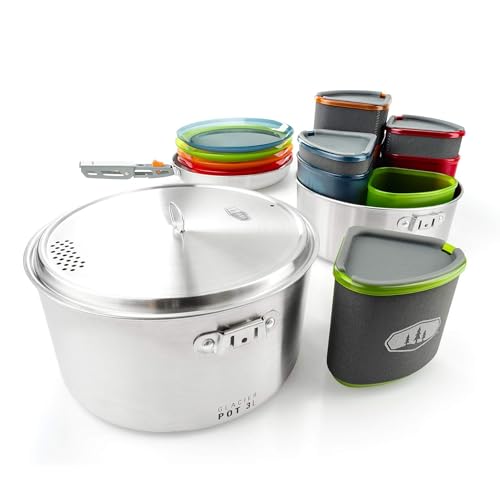
GSI Outdoors Glacier Stainless Camper 4 Person Set — Best for Groups
Group camping breaks solo kits in predictable ways: not enough bowls, not enough pot, one person eating from the lid. GSI’s Glacier Stainless Camper answers with a four-person packable system — cookware plus dinnerware in stainless — from one of the category’s true specialists. It suits families, scout groups and basecamps of four. It does not suit backpackers splitting it across packs without thought, or couples, for whom it is pure surplus.
Strengths
- Four-person completeness: cooking and eating kit for the whole group in one packable system
- Glacier stainless construction takes campfire and stove abuse that coated kits cannot
- GSI’s outdoor specialisation shows in nesting and packability — the set was designed by people who camp
Trade-offs
- A four-person system is real weight and volume — car camping territory, honestly labelled
- Stainless shows heat discoloration and needs a soak after campfire use; that is the material’s nature
- Groups larger than four outgrow it; it is a four-person answer, not a banquet one
| Type | Camp cookware and dinnerware set |
| Capacity (verified from listing) | 4 person |
| Material | Glacier stainless steel |
| Design (per listing) | Packable |
The Glacier line’s stainless is the point: at a group basecamp, cookware gets used over fires, knocked off picnic tables and washed in cold water with sand nearby. Stainless takes all of it and scrubs clean at home. Families who camp several times a year will get more service from this set than from two generations of lighter, more delicate kits.
Packability seals the case. Four people’s kitchen collapsing into one nested unit is what makes group camping feel organised rather than expeditionary, and it is why GSI owns this niche. If your camping is a family at a lakeside site, stop reading here and buy this one.
Best for: families and groups of four camping together / Not suited for: solo or ultralight campers
Check on Amazon — check the current price on Amazon before you decide, because set configurations and included pieces change between listings.

Snow Peak Titanium Camping Cook Set — Best Ultralight
Snow Peak is the name ultralight campers say when money stops being the objection, and this titanium cook set is why: a backpacking cook set whose material — titanium — cuts weight to the category’s floor while shrugging off corrosion forever. Its verified listing positions it exactly: backpacking and outdoor cooking, boil water or cook outdoors. It suits thru-hikers, bikepackers and weight-serious backpackers. It does not suit car campers, who pay titanium’s premium for a benefit they will never feel, or cooks who want even heating — titanium’s known trade.
Strengths
- Titanium construction: the lightest durable cookware material, immune to rust and built for decades of trail use
- Backpacking-specific design from the category’s most respected maker — nesting, handles and lids all serve the pack
- Perfect for the boil-water and simple-meals style that real backpacking cooking actually is
Trade-offs
- Titanium heats unevenly and scorches easily — it boils brilliantly and simmers reluctantly
- Premium pricing per piece that only makes sense when grams are the currency
- Small capacities by design; group cooking is not its language
| Material | Titanium |
| Use (verified from listing) | Backpacking and outdoor cooking |
Judge titanium by trail logic. At home its hot spots are a flaw; at mile fifteen they are a footnote, because trail cooking is boiling water for dehydrated meals, coffee and oatmeal — tasks titanium performs at the lowest carried weight in existence. The set is an instrument for that reality, made by the company that understands it best.
The longevity argument seals it for serious backpackers: titanium does not wear out, pit or peel, so the premium is paid once across a decade of trips. Car campers should admire it and buy the Stanley. Backpackers should buy it and stop weighing their options — in every sense.
Best for: backpackers and ultralight campers who boil and cook simply / Not suited for: car campers or even-heating devotees
Check on Amazon — check the current price on Amazon before you decide, because set configurations and included pieces change between listings.

Odoland 19pcs Camping Cookware Mess Kit — Best Value for Two
Odoland’s 19-piece kit is the completeness play: non-stick pot, pan and a 27-ounce kettle for cooking, 304 stainless cups, plates and cutlery for eating, sized for two, at a value position. Its verified listing enumerates the composition with unusual honesty, which this guide appreciates. It suits couples car camping or short-hiking, festival campers and first-time kit buyers. It does not suit ultralighters — 19 pieces is a philosophy opposite to theirs — or expedition users who need specialist-grade durability.
Strengths
- Verified composition covers cooking and eating for two — most kits make you buy tableware separately
- A kettle in the kit is a genuine quality-of-life feature: tea and coffee without tying up the pot
- 304 stainless tableware outlasts the plastic sets bundled with cheaper kits
Trade-offs
- Non-stick cooking pieces carry coating care rules even outdoors — no metal tools at the picnic table
- 19 pieces is car-and-tote camping; backpackers should edit it down hard or choose the titanium pick
- Value-tier construction rewards reasonable treatment rather than expedition abuse
| Pieces | 19 |
| Capacity | For 2 |
| Included (verified from listing) | Non-stick pot, pan, 27oz kettle, 304 stainless cups, plates, cutlery |
Most camp kits fail at the table, not the stove: the cooking works, then four people eat from two bowls with a shared spoon. This kit’s insistence on complete tableware for two is its real design intelligence, and the kettle — perpetually the piece campers wish they had packed — completes a camp kitchen that feels civilised rather than improvised.
For a couple equipping for car camping from zero, this is the fastest route to ‘we have everything’ in one purchase. Add experience and you may specialise later; start here and your first season will lack nothing.
Best for: couples equipping a complete camp kitchen on a budget / Not suited for: ultralight or expedition campers
Check on Amazon — check the current price on Amazon before you decide, because set configurations and included pieces change between listings.

MalloMe Camping Cookware 17 pcs Mess Kit with 1.1L Kettle — Best Budget Backpacking Kit
MalloMe’s kits are how many backpackers start: a many-piece mess kit at a budget tier, this configuration adding a 1.1L kettle alongside the 1.7L pot, with the verified listing confirming portable-stove compatibility. It suits new backpackers, scouts, festival and bug-out kits, and anyone who wants to learn what they actually use before spending seriously. It does not suit weight perfectionists or stove systems it was not designed around — check your stove’s stability with any kit before the trail does it for you.
Strengths
- Budget tier with a genuinely complete composition — pot, kettle and the mess-kit essentials in one bag
- Kettle included at a tier where kettles are usually the first omission
- Portable-stove compatibility stated in the verified listing — the pairing most buyers will actually use
Trade-offs
- Budget materials and coatings ask for gentle tools and reasonable heat
- Weight is backpacking-acceptable rather than ultralight — fine for weekends, felt on thru-hikes
- Many-piece kits invite overpacking; edit ruthlessly to what your menu uses
| Pieces | 17 |
| Included (verified from listing) | 1.7L pot, 1.1L kettle |
| Compatibility (per listing) | Backpacking / portable stove compatible |
The correct way to buy a first backpacking cook kit is cheaply and completely, then let a season of trips edit it. This kit enables exactly that process: everything a beginner might use is present, the tier forgives the learning, and by autumn the hiker knows which three pieces are their real kitchen — knowledge that makes the eventual premium purchase precise instead of guessed.
Treat the coating kindly, pack only what the menu needs, and this budget kit will deliver several seasons of perfectly good trail cooking. Its owners’ most common review is surprise at how long the ‘temporary’ kit stayed in the pack.
Best for: new backpackers and budget camp kitchens / Not suited for: ultralight perfectionists
Check on Amazon — check the current price on Amazon before you decide, because set configurations and included pieces change between listings.

Lodge Pre-Seasoned Cast Iron Deep Camp Dutch Oven, 6 Quart — Best Campfire Cooker
One pick in this guide is not a nesting kit at all, because campfire cooking is its own tradition: Lodge’s deep camp Dutch oven, 6 quarts of pre-seasoned cast iron with the legs, rimmed lid and steel bail handle that coal cooking requires — its verified listing names heavy-duty camping and campfire cooking outright. It suits car campers, scout troops and campfire cooks who bake bread and cobbler where there is no kitchen. It does not suit backpackers in any universe — cast iron is the anti-gram — or campers whose sites ban open fires.
Strengths
- Purpose-built for coals: the flanged lid holds charcoal for true top-and-bottom baking in the open
- Cast iron is effectively immortal — this oven will be handed down, not replaced
- 6-quart capacity feeds a campsite: stew for the group, bread for the morning, cobbler for the legend
Trade-offs
- Weight confines it to car camping and strong arms, permanently
- Cast iron care is a discipline: dry it, oil it lightly, never let it sit wet in the tote
- Campfire cooking requires fire permission and coal management skills that stoves do not
| Capacity | 6 quart |
| Material | Pre-seasoned cast iron |
| Design (verified from listing) | Deep camp Dutch oven with lid, dual handles and steel handle, for campfire cooking |
Nothing else in this guide — or in most kitchens — bakes bread at a campsite. The camp Dutch oven’s coal-on-lid architecture is a complete oven with no power, no gas and no moving parts, and in practiced hands it produces the meals camping stories are made of. Lodge has made these for generations, pre-seasoned and ready, at a tier that makes the tradition accessible to any car camper.
Buy it as the campsite’s centrepiece rather than as part of a nesting system: it pairs with any stove kit here, lives in the tote’s bottom, and anchors the kind of camping where dinner is the evening’s entertainment. For that camper, it is not the heaviest pick in this guide. It is the best one.
Best for: car campers and campfire cooks who bake and braise outdoors / Not suited for: backpackers or fire-restricted sites
Check on Amazon — check the current price on Amazon before you decide, because set configurations and included pieces change between listings.
Comparison Table
| Pick | Badge | Key spec | Best for |
|---|---|---|---|
| Stanley Adventure All-in-One 2 Bowl Cook Set | Best Overall | All-in-one nesting cook set, 2 bowls | car campers, couples and basecamp cooking |
| GSI Outdoors Glacier Stainless Camper 4 Person Set | Best for Groups | 4-person stainless packable cook and dinnerware set | families and groups of four camping together |
| Snow Peak Titanium Camping Cook Set | Best Ultralight | Titanium backpacking cook set | backpackers and ultralight campers who boil and cook simply |
| Odoland 19pcs Camping Cookware Mess Kit | Best Value for Two | 19 pc mess kit for 2 with kettle and stainless tableware | couples equipping a complete camp kitchen on a budget |
| MalloMe Camping Cookware 17 pcs Mess Kit with 1.1L Kettle | Best Budget Backpacking Kit | 17 pc mess kit with 1.7L pot and 1.1L kettle | new backpackers and budget camp kitchens |
| Lodge Pre-Seasoned Cast Iron Deep Camp Dutch Oven, 6 Quart | Best Campfire Cooker | 6 Qt cast iron camp Dutch oven for coal cooking | car campers and campfire cooks who bake and braise outdoors |
How to Choose the Best Cookware Sets for Camping
Decide your world first: backpacking or car camping. The decision is binary and it governs everything — weight limits, materials, sizes, budget. Backpackers should shop nesting kits in aluminium or titanium sized to their party and stove; car campers should shop capacity, durability and tableware, in stainless or cast iron, without a gram of guilt. The misery in this category is almost always a world mismatch: a cast-iron soul in a backpack, or a titanium teacup at a family basecamp.
Match the kit to the heat source second. Canister stoves want pots stable on small burner heads, with diameters that do not turn the whole stove into a sail. Integrated stove systems have their own pot logic entirely. Campfires want metal handles, no coatings near flame lick, and bases that tolerate uneven coals — stainless and cast iron territory. A kit is a system with your stove, not an independent object.
Audit the composition third, counting what your menu uses. Most campers cook in one pot and eat from one bowl; kits that add a kettle earn it daily, while kits padded with duplicate cups and novelty tools add weight without meals. The honest kits in this guide enumerate their contents in their listings — read those enumerations the way you would read a contract, because on the trail, the kit is the kitchen and there is no drawer of backups.
Materials in the Wild: Titanium, Aluminium, Stainless and Cast Iron
Titanium is the backpacker’s material: lightest, corrosion-proof, expensive, and a poor heat spreader that scorches sauces while boiling water brilliantly. Anodized aluminium is the value middle — light, even-heating, reasonably tough, and the default of most mess kits. Stainless steel is the basecamp material: heavier, durable, fire-tolerant and cleanable with anything at hand, which is why group and family sets choose it.
Cast iron is not a set material at all but a destination: the campfire oven and skillet tradition, where weight is irrelevant because the car carried it and longevity is measured in generations. Coatings, finally, belong to the gentle end of camping — car campers who cook like it’s a kitchen will enjoy nonstick kits like the Odoland; open-flame and expedition cooking will destroy coatings and should not be asked of them. Material honesty is the whole game outdoors: every pick here is matched to the fire it will actually meet.
Packing a Camp Kitchen: The Tote and Pack Systems
Car campers should build the kitchen tote as a permanent system: cook set nested, stove and fuel in a side pocket, utensils in a roll, a small kit of oil, salt and spice that never leaves the tote. The tote goes from garage shelf to boot to picnic table untouched, and camping becomes a decision rather than a project. Every set in this guide’s car-camping half was chosen to nest into that system without loose pieces migrating through the car.
Backpackers pack by menu, not by kit: the pot the meals need, the bowl or the lid-as-bowl, one spork, and nothing the menu does not name. Full commercial kits are starting points to be edited, and the editing is a skill — after three trips, weigh what you carried against what you used and cut the difference. The lightest camp kitchen is the one assembled by experience, which is why this guide’s budget backpacking pick exists: to buy that experience cheaply.
Camp Stoves and Fires: Matching Heat to Kit
Canister stoves are the default heat of modern camping, and they reward pots with stable bases and diameters that keep the centre of gravity low — a tall, narrow pot on a pocket stove is a spill rehearsing itself. Integrated systems solve stability by locking pot to burner, at the price of locking you into one maker’s pots. Liquid-fuel stoves serve cold weather and big groups, with the power to run the larger stainless sets in this guide without apology.
Wood fires invert every priority: stability comes from grates and flat rocks, soot is guaranteed, and heat is managed by moving the pot rather than turning a knob. Cast iron and stainless treat this as home; aluminium survives it; coatings should not be asked to. Alcohol stoves, the ultralight fringe, pair with the titanium pick’s boil-first philosophy — small flames, small pots, simple food, and a cook who values silence as much as speed.
The practical rule is to buy the kit and the heat source as one decision. Campers who inherit a stove should bring its dimensions to the cookware purchase; campers starting from zero should choose the world’s standard pairing — canister stove plus nesting aluminium kit for backpacking, two-burner stove plus stainless system for basecamps — and deviate only with a reason they can say out loud.
Feeding a Group at Camp: Scaling Without a Second Kitchen
Group camp cooking scales by format, not by pan count. One-pot meals — stews, chilis, pasta sauces built in the pot — feed eight from a vessel that serves two at home, because the pot’s job changes from cooking portions to holding a communal dish that is served in rounds. The GSI four-person set plus one large pot is, in practice, a six-to-eight-person kitchen, and the camp Dutch oven extends it further with bread and dessert that no stove kit can produce.
Plan the group’s water as seriously as its food: boiling is the camp kitchen’s bottleneck, and a kettle or second pot dedicated to water unblocks drinks, rehydration and washing in one move. Assign a water-keeper at group camps the way fish fries assign a fryer — it sounds ceremonial until the first morning everyone wants coffee at once.
Finally, groups eat in shifts more happily than they admit. Serve the hungry first wave from the pot, keep the second batch warming at the fire’s edge, and let the cook eat with the second wave instead of after it. The best group camp kitchens — like the best fish fries — are designed so the cook sits down too.
Leave No Trace in the Camp Kitchen
Camp cooking leaves traces unless the cook plans otherwise: micro-trash from packaging, grey water, food scraps, soot-blackened fire rings. The discipline is simple and total. Repackage food at home into reusable containers to cut packaging at source. Strain and scatter grey water widely, far from any water source, and pack out the strained solids with the trash. Food scraps are trash, full stop — never burned incompletely, never buried, never ‘returned to nature’ in a place where the next camper will meet the animal they attracted.
Fire craft carries the same ethic: use established fire rings, keep fires small and cooking-sized, and burn only wood that the site permits to be gathered or brought. A Dutch oven’s coals should be drowned, stirred and felt cold before they are scattered or packed per local rules. The standard is a campsite that shows no evidence a kitchen ever stood there — which is also, not coincidentally, the standard that keeps these places open to campers at all.
The Camp Coffee Question
Every camp kitchen is judged at 7 a.m., and the verdict is coffee. A kettle — included in two kits here — plus any pour-over, press or percolator method turns a cook set into a morning institution, and the ritual organises the whole camp day around it. Backpackers solve it with the pot and a filter or press attachment sized to their cup; basecamps solve it with volume, because group coffee is a logistics problem disguised as a beverage.
Choose the method your party will actually perform half-asleep in the cold: the fewer parts, the better the coffee. And pack the coffee kit inside the cook kit, nested, so the morning never begins with a search. It is a small decision that experienced campers treat as load-bearing — because it is.
Renting, Borrowing and First-Trip Advice
If you camp twice a year, the correct first purchase may be no purchase: borrow a kit, or rent from an outfitter, and let two real trips teach you your world, your party size and your menu before money moves. The campers who buy best are the ones who have already suffered a bad kit’s specific failures — the pot too small, the missing bowl, the handle that folded — because those memories convert directly into criteria.
When you do buy, buy for the third trip, not the first: the first trip is learning, the second is editing, and by the third your camping has a stable shape that a set can serve for years. Every pick in this guide was chosen to still make sense on that third trip and the thirtieth — which is the only honest definition of value outdoors.
Winter and Shoulder-Season Camping: When the Kit Earns Its Keep
Cold-weather camping rewrites camp kitchen priorities in one evening. Gloves make small handles and fiddly nesting lids genuinely difficult, so kits with positive, chunky grips — the stainless group set and the Stanley — pull ahead of minimalist designs the moment temperatures drop. Fuel consumption climbs as cold canisters lose pressure and water starts colder, which rewards lids on everything and the wind discipline of cooking in shelter. The camp Dutch oven, meanwhile, becomes a heat source as much as a cooker: a coal-topped oven at the centre of camp is warmth, light and dinner in one object.
Condensation and freezing add the storage rules: dry the kit before it goes into a cold car, because trapped water freezes seals and seams into next morning’s frustration, and keep the kettle’s last hot water for bottles rather than washing when the temperature is below freezing. None of this requires different equipment — every pick in this guide works in the cold — but it rewards the robust end of the list, and it is why experienced winter campers sound so conservative about their kits. They are not being precious. They are remembering a January morning.
How to Cook Well at Camp: Setup, Fire and Cleanup
Camp cooking succeeds on setup more than recipes. This routine works whether your heat is a canister stove or a bed of coals.
Step 1: Set the kitchen before the hunger
Choose a flat, stable cooking spot away from tent doors and traffic, with your water, ingredients and utensils arranged before any flame is lit. On a stove, test stability with the full pot of water before it is hot. At a fire, build the coal bed early — cooking over flames soots and scorches; cooking over coals is the controlled heat every camp recipe quietly assumes.
Step 2: Boil first, cook second
Put water on the moment camp is pitched: drinks, rehydration and washing all draw from it, and a camp with hot water available is a camp whose cook is calm. Sequence the meal so the pot that boils water becomes the pot that cooks grains, and let the pan — the scarcest resource in any kit — be reserved for the one element that truly needs it.
Step 3: Cook in the pot’s order, season at the end
Dense and slow ingredients first, quick ones last, delicate herbs and cheese off the heat entirely. Camp portions are small, so seasoning concentrates fast; salt late, taste, then salt again if needed. The camper who seasons at the table instead of the pot eats better and washes less, because oversalted pots are the ones that get scrubbed with sand.
Step 4: Wash with the three-bowl discipline (or its minimalist echo)
Scrape plates into the trash first — never into the environment. Wash hot with a drop of biodegradable soap, rinse, and strain wash water to scatter well away from water sources and camp, per local rules. Backpackers compress this to a single pot of hot water and a thorough wipe, but the principle survives: food waste travels out with you, always.
Step 5: Dry, nest and store the kit as one object
Dry every piece before nesting — a sealed damp kit mildews and pits by the next trip. Store stove fuel separate from food kit, and return the whole system to its tote or stuff sack as a single ready unit. The next trip’s ease is decided in this ten minutes, not at the trailhead.
Camp cooking’s secret is that it is ordinary cooking with better scenery and stricter logistics. Master the setup and the cleanup, and even the simplest kit in this guide will feed you memorably.
Common Buying Mistakes
Buying for the wrong world
A backpacking kit at a family basecamp starves the group; a car-camping fleet in a backpack ends the hike. Decide the world first — the single most expensive sentence in camping gear is ‘it can do both’ applied to cookware.
Cooking over flames instead of coals or a stove
Flames soot pots black, scorch food and swing temperatures wildly. Coals and stoves are cooking heat; flames are for looking at. New camp cooks who learn this once eat better forever.
Packing the whole kit because it came in one box
Kits are assortments, not commandments. Pack what the menu uses. Every unused piece carried for miles — or stored in the tote for years — is weight and clutter bought with real money.
Leaving food waste and grey water at the site
Scraps and wash water go out or get scattered properly per local rules, far from water and camp. Beyond the ethics, food waste at a site is an invitation to animals that the next campers — possibly you — will regret.
Storing the kit damp
One damp storage can pit aluminium, rust fittings and mildew a whole tote. Dry everything, every time, before it nests. It is the cheapest maintenance in all of camping.
Final Recommendation
Most campers should start with the Stanley Adventure set: the balanced, durable, car-camping answer that disappears into its own pot. Groups and families should take the GSI Glacier stainless four-person system; ultralight backpackers, the Snow Peak titanium set and no substitutes; couples equipping completely on a budget, the Odoland 19-piece kit; new backpackers, the MalloMe kit and a season of learning; and campfire traditionalists, the Lodge camp Dutch oven — ideally alongside a stove kit, as the campsite’s oven and crown.
Camping cookware rewards honesty about how you camp. Buy for your real trips, and every meal outdoors gets easier from the first morning’s coffee onward.
The shortlist, with direct links for final checking:
- Best Overall: Stanley Adventure All-in-One 2 Bowl Cook Set
- Best for Groups: GSI Outdoors Glacier Stainless Camper 4 Person Set
- Best Ultralight: Snow Peak Titanium Camping Cook Set
- Best Value for Two: Odoland 19pcs Camping Cookware Mess Kit
- Best Budget Backpacking Kit: MalloMe Camping Cookware 17 pcs Mess Kit with 1.1L Kettle
- Best Campfire Cooker: Lodge Pre-Seasoned Cast Iron Deep Camp Dutch Oven, 6 Quart
Keep researching within this cluster: Best Cookware Sets For A Small Apartment Best Cookware Sets For Family Camping Best Backpacking Cookware Sets Best Fish Frying Cookers Best Cookware Sets For Beginners
Frequently Asked Questions
What is the difference between a backpacking cook set and a car camping set?
Weight, size and materials. Backpacking sets nest tightly, serve one or two, and use aluminium or titanium to keep weight minimal. Car camping sets serve groups, include full tableware, and use stainless or cast iron for durability. Choosing the wrong world is the commonest camping cookware mistake — decide how you camp first.
Is titanium cookware worth it?
For backpackers who count grams, yes: titanium is the lightest durable material, never rusts, and lasts essentially forever, which spreads its premium across a decade of trips. For car campers it is money spent on a benefit that will never be felt — stainless or aluminium serves them better for less.
Can I use a camping cookware set over a campfire?
Stainless steel and cast iron sets are built for it. Aluminium kits tolerate careful fire use but soot heavily and can warp in direct flame; coated kits should stay on stoves, because flame licking around a pan’s sides damages coatings. Match the set to the fire you will actually build — the picks here are labelled by world for exactly this reason.
How many pieces does a camping set need?
For one or two backpackers: a pot, a lid or small pan, a bowl each and a spork each — most of any kit beyond that is editing material. For a family basecamp: a full cook-and-dine system like the GSI four-person set, where tableware completeness matters more than piece-count minimalism.
Do I need a kettle for camping?
Not strictly — a pot boils water — but a kettle pours safely, keeps the pot free for cooking, and makes camp coffee and tea civilised. Two kits in this guide include one, and campers who add a kettle rarely remove it. It is the most appreciated ‘extra’ in the category.
How do I clean cookware at camp responsibly?
Scrape food waste into your trash, wash with hot water and minimal biodegradable soap, strain the wash water and scatter it well away from lakes, streams and camp, following local rules. Pack out everything that came in — including, always, your food scraps.

