Disclosure: airfryerkitchensupply.com is reader-supported. When you buy through links on our site, we may earn an affiliate commission at no extra cost to you.
Where to buy
Shopping for the best bread machines for home bakers? Every pick in this guide was verified against Amazon listings before writing, and you can check price on Amazon for each one before you decide: Zojirushi Home Bakery Virtuoso Plus BB-PDC20BA · Breville Custom Loaf BBM800XL · Cuisinart Convection Bread Maker CBK-210 · Panasonic SD-R2550 · KITCHENARM 29-in-1 Smart Bread Machine · KBS 17-in-1 Bread Maker (710W, dual heaters, ceramic pan). Prices and stock move often, so the live listing — not any number printed in a guide — is the figure to trust on the day you buy.
The best bread machines for home bakers are judged by a tougher standard than convenience alone. A home baker — someone who knows what a good crumb looks like, who has opinions about crust, who wants whole wheat to actually rise and a custom cycle for the recipe in the notebook — needs a machine that behaves like a tool, not an appliance that hides the process. Even heating, a kneading action that develops gluten properly, programs that respect whole grains and gluten-free doughs, and crust control that goes beyond pale-medium-burnt: these are the criteria that matter. This guide ranks six verified machines for bakers who will use them weekly and notice the details.
Let us be honest about what a bread machine can and cannot do for a serious baker. It will not replace a Dutch oven for a lean artisan boule, and this guide will not claim otherwise. What it does superbly is the daily and weekly repertoire — sandwich loaves, whole wheat, enriched doughs, pizza and flatbread doughs, jam and cake settings on some models — with a consistency and hands-off reliability that even committed bakers come to rely on during busy weeks.
Control is the theme of the ranking. Machines earned their places with dual heaters, collapsible paddles, custom or homemade cycles, convection fans and dispensers — features that change the loaf, not the brochure. Where a machine is simpler, we say who that simplicity suits.
In this guide
Quick Picks
Zojirushi Home Bakery Virtuoso Plus BB-PDC20BA — Best Overall. A flagship 2 lb bread maker with dual heaters for even crust, dedicated gluten-free and whole-wheat programs and a 13-hour timer — the most complete baker’s machine here. Check the current price on Amazon
Breville Custom Loaf BBM800XL — Best for Custom Control. A brushed stainless bread maker built around control: custom crust settings, a collapsible kneading paddle that prevents the classic hole, and an automatic dispenser for add-ins. Check the current price on Amazon
Cuisinart Convection Bread Maker CBK-210 — Best Crust with Convection. A 2 lb programmable bread maker whose convection fan circulates heat for an artisan-style crust, with 16 programs including sourdough starter and an automatic mix-in dispenser. Check the current price on Amazon
Panasonic SD-R2550 — Best Program Variety. A bread maker with 20 presets and an advanced temperature sensor that adjusts for room conditions, covering bread, cake and pizza dough plus gluten-free baking, with a raisin and nut dispenser. Check the current price on Amazon
KITCHENARM 29-in-1 Smart Bread Machine — Best for Experimenters. A 29-in-1 smart bread machine with a homemade cycle for building your own program, three loaf sizes and gluten-free settings — a playground for bakers who experiment. Check the current price on Amazon
KBS 17-in-1 Bread Maker (710W, dual heaters, ceramic pan) — Best Mid-Range Features. A 17-in-1 bread maker with dual heaters, a ceramic pan, touch panel and 15-hour timer at a mid-range tier — flagship heating ideas without the flagship outlay. Check the current price on Amazon
How These Picks Were Chosen
Every model was verified through Amazon listing before writing, confirming program counts, loaf sizes, dispensers and special features as actually sold. The evaluation then weighted four baker-specific factors: heating design, because even top-and-bottom heat decides crust quality; kneading design, because gluten development decides crumb; program depth, including whole wheat, gluten-free and custom cycles; and the small dignities — a paddle that does not tear a hole in every slice, a dispenser that adds nuts at the right moment, a timer that fits a baker’s schedule.
Machines were marked down for single small heating elements that pale the top crust, for program lists long on novelty and short on grain handling, and for pans with coatings or shapes that fight the baker. What remains is a six that spans the serious spectrum, from a flagship with dual heaters to a 29-program experimenter’s machine.
The 6 Best Bread Machines for Home Bakers

Zojirushi Home Bakery Virtuoso Plus BB-PDC20BA — Best Overall
The Zojirushi Home Bakery Virtuoso Plus is the machine home bakers graduate to. Dual heaters — including one in the lid — solve the oldest bread-machine complaint, the pale top crust, while dedicated whole-wheat and gluten-free programs and a 13-hour timer cover the repertoire a serious home baker actually rotates through.
Strengths
- Dual heaters bake an evenly coloured crust, top included
- Programs tuned for whole wheat and gluten-free doughs, not afterthoughts
- 13-hour delay timer fits overnight and workday baking rhythms
Trade-offs
- Premium tier pricing within this guide
- 2 lb maximum loaf size caps very large households
- Footprint is substantial on smaller counters
| Loaf size | 2 lb |
| Heating | Dual heaters |
| Programs | Including gluten-free and whole-wheat |
| Timer | 13-hour delay |
Crust is where the Virtuoso Plus makes its case slice after slice. Bread machines heat from below and around, and most leave the top pale and soft; the lid heater changes the bake geometry so the whole loaf colours like an oven loaf. For a baker, that is not cosmetic — crust is flavour, and a sandwich loaf with a proper crust toasts, keeps and eats better through the week.
The program tuning shows the same seriousness. Whole wheat gets the longer kneading and rising patience it needs instead of a basic cycle with a new label, and the gluten-free program handles the batter-like doughs that defeat generic settings. If your baking spans grains and dietary needs within one household — a common modern pattern — this is the machine that treats each loaf as its own problem and solves it.
Best for: serious home bakers wanting oven-like crust and grain versatility / Not suited for: occasional bakers who only need a basic white loaf
Check the current price on Amazon

Breville Custom Loaf BBM800XL — Best for Custom Control
Breville’s Custom Loaf is named for its philosophy: the baker decides. Custom crust settings, control over the details of the loaf, an automatic fruit and nut dispenser, and — the feature bakers write home about — a collapsible kneading paddle that folds down before baking so the loaf comes out without the torn hole at its base.
Strengths
- Collapsible paddle prevents the hole that mars machine loaves
- Automatic dispenser adds fruit and nuts at the correct moment
- Custom settings reward bakers who tweak recipes
Trade-offs
- Control depth means a learning curve for true beginners
- Premium tier pricing
- More moving parts to clean than a fixed-paddle machine
| Design | Brushed stainless steel |
| Paddle | Collapsible kneading paddle |
| Dispenser | Automatic fruit & nut dispenser |
| Settings | Custom crust and loaf settings |
The paddle hole is a small flaw that bakers feel out of proportion to its size: it ruins the two centre slices of every loaf and makes a gift loaf look amateur. A paddle that collapses flat before the bake removes the flaw at its source. Combined with the dispenser — which keeps raisins and nuts from being shredded by early kneading or dumped in by a baker who must be home at the beep — the Custom Loaf respects both the loaf and the baker’s time.
Custom control is the other half of the appeal. Bakers iterate: a little more crust colour for the seeded loaf, a tweak for the enriched dough. A machine that lets you save and adjust rather than accept factory decisions becomes a recipe-development tool. If you keep a baking notebook, this is your machine; if you want to press one button and never think, its talents are partly wasted on you — and the guide says so plainly.
Best for: tweaking bakers who customise recipes and hate paddle holes / Not suited for: set-and-forget users who never adjust a setting
Check the current price on Amazon

Cuisinart Convection Bread Maker CBK-210 — Best Crust with Convection
Convection is how ovens make great crust, and the Cuisinart CBK-210 brings it to the bread machine: a fan circulates hot air around the loaf for the even, artisan-style browning that static machines struggle to reach. Sixteen programs, including a sourdough starter cycle, and an automatic mix-in dispenser round out a baker-focused package.
Strengths
- Convection fan produces notably even, artisan-style crust
- 16 programs including sourdough starter for levain bakers
- Automatic dispenser handles mix-ins without babysitting
Trade-offs
- Fan adds a little noise during the bake phase
- 2 lb size will not cover the largest families in one loaf
- Program depth takes a weekend to learn properly
| Loaf size | 2 lb |
| Programs | 16, including sourdough starter |
| Heating | Convection fan |
| Dispenser | Automatic mix-in dispenser |
Circulating air evens out the hot and cool spots that make one side of a machine loaf dark and the other wan. For seeded and whole-grain loaves — the loaves home bakers make most — that evenness shows up as consistent colour and a crust that stays crisp rather than steaming itself soft in a stagnant pocket of air. It is the closest a countertop machine in this guide gets to oven behaviour, short of the Zojirushi’s dual heaters, and the two machines reward comparison.
The sourdough starter program deserves attention from levain bakers: maintaining a starter at a steady, suitable temperature is half the sourdough battle in cold or drafty kitchens, and a machine that holds that environment frees the baker from oven-light hacks. Use the starter cycle for culture care and the dough settings for preferments, then finish shaped loaves in your oven if you like — many serious bakers use a machine exactly this way, as a temperature-controlled dough studio.
Best for: crust-focused bakers and sourdough starter keepers / Not suited for: bakers who want the quietest possible bake
Check the current price on Amazon
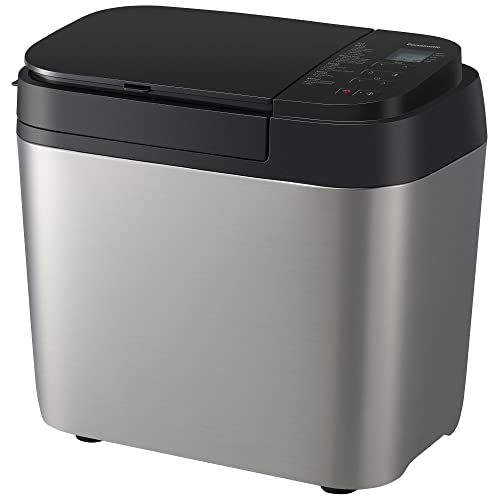
Panasonic SD-R2550 — Best Program Variety
The Panasonic SD-R2550 is the thinking baker’s variety machine: 20 presets spanning bread, cake and pizza, an advanced temperature sensor that compensates for the room the dough is rising in, gluten-free baking and a raisin-nut dispenser. Ambient temperature is the hidden variable in home baking, and this machine measures it.
Strengths
- Temperature sensor adapts cycles to warm or cool kitchens
- 20 presets cover the widest repertoire in this guide
- Dispenser times fruit and nut additions correctly
Trade-offs
- Preset abundance means menu navigation takes practice
- Design prioritises function over countertop looks
- Serious crust specialists may still prefer convection or dual heaters
| Presets | 20 |
| Sensor | Advanced temperature sensor |
| Dispenser | Raisin nut dispenser |
| Programs | Bread, cake, pizza, gluten-free |
Ask bakers why the same recipe rose beautifully in July and sulked in January and the answer is room temperature. A sensor-driven machine quietly lengthens or shortens rises to compensate, which turns seasonal inconsistency — the frustration that makes home bakers distrust machines — into repeatable results. For households that bake year-round in real kitchens rather than climate-controlled studios, that quiet intelligence is worth more than another novelty preset.
The breadth is real, too: cake and pizza settings that are genuinely programmed rather than renamed dough cycles, and gluten-free handling for mixed-diet households. If your baking curiosity runs wide — a sandwich loaf on Tuesday, pizza dough on Friday, a cake on Sunday — the Panasonic is the one machine here that never says no. Crust purists can finish shaped doughs in the oven; everyone else will simply eat well.
Best for: variety-driven bakers in kitchens with shifting temperatures / Not suited for: single-loaf specialists who use one program forever
Check the current price on Amazon
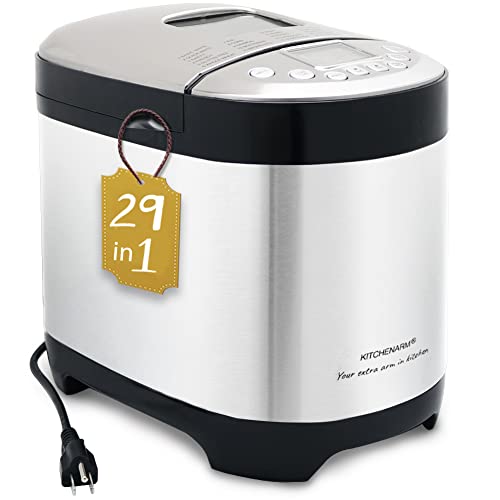
KITCHENARM 29-in-1 Smart Bread Machine — Best for Experimenters
Twenty-nine programs sounds like marketing until you meet the homemade cycle: the KITCHENARM lets you build and save your own sequence of knead, rise and bake times. For the baker who ferments slowly, proofs twice or works with unusual flours, that programmability turns a preset machine into an instrument.
Strengths
- Homemade cycle lets you design custom knead-rise-bake sequences
- 29 programs include gluten-free and whole wheat options
- Three loaf sizes suit households that scale recipes up and down
Trade-offs
- Experimentation requires record-keeping to be repeatable
- Interface learning curve is the steepest here
- Mid-tier build compared with the flagship picks
| Programs | 29-in-1 |
| Loaf sizes | 1 lb, 1.5 lb, 2 lb |
| Special | Homemade custom cycle |
| Settings | Including gluten-free |
Every experienced baker eventually hits a recipe a preset cannot express: a slow-fermented dough that wants a long cool rise, a enriched dough that needs a gentler second knead. The homemade cycle is the escape hatch, and it changes the machine’s role from appliance to collaborator. Keep a notebook — a custom cycle you cannot reproduce is a rumour, not a recipe — and the KITCHENARM rewards the methodical experimenter more than any preset list can.
The three loaf sizes support the experimental life, too: test a new formula at 1 lb before committing a 2 lb batch of expensive flour. Gluten-free and whole-wheat settings cover household range. Bakers who want the machine to decide everything should look at the simpler picks; bakers who want to decide everything themselves, with the machine as tireless assistant, have found their match.
Best for: methodical experimenters who design their own cycles / Not suited for: bakers who never want to read a manual
Check the current price on Amazon

KBS 17-in-1 Bread Maker (710W, dual heaters, ceramic pan) — Best Mid-Range Features
The KBS 17-in-1 borrows the flagship playbook — dual heaters for even baking, a ceramic-coated pan, a nut dispenser, touch controls and a long 15-hour timer — and sells it at a mid-range tier. For bakers who read the Zojirushi section with longing and a budget, this is the compromise that gives up the least.
Strengths
- Dual heaters address top-crust colour like the flagship pick
- Ceramic pan appeals to bakers avoiding conventional nonstick
- 15-hour timer is the longest scheduling window here
Trade-offs
- Brand support network is smaller than the legacy names
- Touch panel is less tactile than physical dials with floury hands
- Program tuning is good rather than class-leading
| Power | 710W |
| Heating | Dual heaters |
| Programs | 17-in-1 |
| Pan | Ceramic |
| Timer | 15-hour |
Dual heating at this tier is the headline: the pale-top problem is a geometry problem, and a second heater solves it regardless of the badge on the front. In practice the KBS produces evenly coloured loaves that satisfy the crust test, with a ceramic pan that releases cleanly and suits bakers who prefer to avoid conventional nonstick coatings. Three loaf sizes and three crust colours cover the standard repertoire without fuss.
Where the flagship machines pull ahead is refinement — kneading nuance, program tuning for tricky grains, long-term support. Where the KBS pulls ahead is value: most of the loaf quality for a mid-range commitment. For a baker building the habit, or a second machine for a holiday home, it is the rational middle of this guide, and its long timer genuinely suits overnight scheduling for fresh morning bread.
Best for: budget-aware bakers wanting dual-heater crust quality / Not suited for: buyers who prioritise legacy-brand support networks
Check the current price on Amazon
Comparison Table
| Pick | Badge | Key spec | Best for |
|---|---|---|---|
| Zojirushi Home Bakery Virtuoso Plus BB-PDC20BA | Best Overall | 2 lb, dual heaters, gluten-free and whole-wheat programs, 13-hour timer | serious home bakers wanting oven-like crust and grain versatility |
| Breville Custom Loaf BBM800XL | Best for Custom Control | Custom loaf settings, collapsible paddle, automatic fruit & nut dispenser | tweaking bakers who customise recipes and hate paddle holes |
| Cuisinart Convection Bread Maker CBK-210 | Best Crust with Convection | 2 lb, convection fan, 16 programs, automatic mix-in dispenser | crust-focused bakers and sourdough starter keepers |
| Panasonic SD-R2550 | Best Program Variety | 20 presets, advanced temperature sensor, raisin nut dispenser | variety-driven bakers in kitchens with shifting temperatures |
| KITCHENARM 29-in-1 Smart Bread Machine | Best for Experimenters | 29-in-1 programs, homemade cycle, 1/1.5/2 lb sizes | methodical experimenters who design their own cycles |
| KBS 17-in-1 Bread Maker (710W, dual heaters, ceramic pan) | Best Mid-Range Features | 17-in-1, 710W dual heaters, ceramic pan, 15-hour timer | budget-aware bakers wanting dual-heater crust quality |
The flagship contest is Zojirushi’s dual heaters versus Breville’s control and collapsible paddle versus Cuisinart’s convection — all three make excellent loaves with different philosophies. Panasonic wins on adaptive variety, KITCHENARM on programmability, and KBS on bringing dual heating to a mid-range tier. Choose by the flaw you most want eliminated: pale crust, paddle hole, inconsistency, or routine itself.
How to Choose a Bread Machine as a Home Baker
Judge heating first. A bread machine is a small oven, and its crust is decided by where the heat comes from. Single-element machines bake from below and leave tops pale; lid heaters, dual heaters and convection fans each fix that geometry in their own way. If you care about crust — and bakers do — heating design outranks program count every time.
Judge kneading second. Gluten development decides whether a whole-wheat loaf slices like bread or crumbles like cake. Look for machines with strong kneading action, sensible rest periods built into whole-grain cycles, and — for shaped-dough bakers — a dough cycle you will actually use for pizza, rolls and flatbreads finished in the oven. A collapsible or removable paddle is a genuine quality feature, not a gimmick, if you bake full loaves in the machine.
Then match programs to your real repertoire. Gluten-free households need a true gluten-free cycle, not a quick bake renamed. Sourdough bakers should look for starter support or a custom cycle. Everyone should confirm the delay timer fits their schedule — overnight baking is the feature that turns a good machine into fresh bread at breakfast, which is the moment the purchase justifies itself.
Flour, Yeast and Machine Settings: A Baker’s Notes
Machines are consistent; ingredients are not. Flour protein varies by brand and season, and a dough that was perfect in one bag can be slack in the next. Learn the five-minute check: look at the dough early in the first knead. It should form a smooth, slightly tacky ball that cleans the pan walls. Add flour a spoon at a time if it smears, water a spoon at a time if it thuds dryly. That single habit fixes more machine loaves than any program upgrade.
Yeast handling matters as much. Keep yeast dry and away from direct contact with salt and hot liquid in the pan — layer liquids, then flour, then yeast in a small well on top for delay-timer loaves. In warm kitchens, cool liquids keep a long timer cycle from over-proofing before the bake. Whole grains drink more water than white flour and drink it slowly; the longer cycles on the better machines exist precisely to let them hydrate.
Finally, weigh ingredients if you can. Volume measures of flour vary by a fifth between scoops, which is the difference between a risen loaf and a brick. A small kitchen scale is the cheapest upgrade in all of bread making, and machine bakers — who cannot adjust by feel mid-cycle the way hand bakers do — benefit from it most.
Advanced Techniques: Preferments, Soakers and Enriched Doughs in a Machine
Once the basic loaves are reliable, the machine becomes a fermentation studio. A preferment — a portion of flour, water and a pinch of yeast left to develop before the main dough — adds the flavour depth that straight doughs lack, and the machine handles it gracefully: mix the preferment on a short dough cycle, let it rest in the pan for the hours your recipe asks, then add the remaining ingredients and run the full cycle. The loaf that results has the keeping quality and gentle tang that make people ask which bakery it came from.
Soakers are the whole-grain baker’s version of the same idea. Cracked grains, seeds and coarse wholemeal absorb water slowly; adding them dry to a cycle steals moisture from the dough and leaves grit in the crumb. A soak in the pan — grains plus their water, resting before the cycle starts, or simply using the delay timer as a soaking window with the yeast kept separate and dry on top — transforms whole-grain loaves from dense to tender. The better machines in this guide, with their patient whole-wheat cycles, reward the technique immediately.
Enriched doughs — brioche styles, cinnamon swirls, festival breads heavy with butter, egg and sugar — test kneading and timing in the opposite direction: the dough is soft, rich and easy to overwork or over-proof in a warm machine. Use the machine for mixing and the first rise, then shape by hand and bake in the oven for the best crumb and finish. This hybrid method is not a failure of the machine; it is how thoughtful bakers have always used it — as tireless arms and a warm, steady proofing box, while the baker keeps the shaping and the bake.
Maintaining a Bread Machine Like a Baker
A bread machine’s lifespan is decided by three components: the pan coating, the paddle and its drive, and the heating element’s cleanliness. The pan coating dies by a thousand cuts — literally. Never use metal utensils to free a loaf; a plastic or silicone spatula, a few minutes of patience as the loaf cools and contracts, and a brief soak for anything stuck will keep the surface releasing cleanly for years. Wash the pan by hand even if a dishwasher is allowed; detergents and heat cycles age coatings faster than any loaf does.
The paddle drive is the hidden wear point. Dough works its way into the paddle socket over time and bakes there into a cement that makes the paddle stick or strain the drive shaft. The countermeasure is boring and total: after every bake, remove the paddle, wash it and the shaft, dry both fully, and leave the pan to air before storing. If a paddle ever sticks mid-loaf, soak — never force. A forced paddle is how a healthy machine becomes a repair bill.
Finally, keep the interior honest. Crumbs and flour dust accumulate around the element and eventually smoke faintly into loaves. A soft brush and a cool, unplugged machine once a month prevents it. Store the machine with the lid ajar so the interior stays dry and odour-free. None of this takes more than minutes, and it is the difference between a machine that bakes beautifully in year five and one that was replaced in year two — a difference any baker, who thinks in years of loaves, should care about.
Reading a Loaf: Diagnosing Your Machine Bakes
Bakers improve by reading loaves, and machine loaves are unusually legible because the machine removes most variables. A loaf that rose well but collapsed at the crown points to over-proofing — too much yeast for a warm kitchen, or a timer cycle that let the dough sit too long before baking; reduce the yeast slightly or cool the liquid. A dense, tight crumb with a pale crust suggests under-proofing or tired yeast, while a coarse, holey crumb with a sour note hints at a dough that fermented too long or too warm. Each symptom has a short list of causes, and the machine’s consistency means changing one variable genuinely tests it.
Crust readings are equally direct. Pale all over means the bake ran cool or short for that loaf size — check the crust setting before suspecting the machine. Dark at the base and pale on top is the classic single-element geometry this guide’s top picks were chosen to correct. A crust that softens within the hour usually left the pan late; steam trapped against the loaf is the enemy, and prompt removal to a rack is the fix. Gumminess in the crumb, finally, is most often impatience — the loaf was sliced while its interior was still setting.
Keep the diagnosis habit written. A line per loaf — flour, liquid, yeast, program, observation — turns a month of baking into a personal reference that no general guide can match, because it describes your flour, your kitchen and your machine. Home bakers who keep that log stop having mysterious failures; they have data, and data makes the next loaf better with a reliability that feels, from the outside, like talent.
Grains and Flours: Matching Ingredients to Machine Strengths
Flour choice interacts with machine design more than most guides admit. Strong bread flour with high protein rewards the powerful kneading of the flagship picks, producing tall, well-structured loaves; softer all-purpose flours make tender loaves but can over-develop in aggressive cycles, where a gentler program or a shorter knead serves better. Wholemeal flours absorb more water and absorb it slowly — the long, patient whole-wheat cycles on the better machines exist for them — and a proportion of wholemeal to white, rather than an all-or-nothing jump, is how most bakers find their household’s favourite loaf.
Ancient and alternative grains each bring a note: spelt is flavourful but its gluten is fragile, suiting gentler handling; rye contributes depth but almost no structure, so it performs best as a partner grain with strong wheat flour; oat and seed additions enrich crumb and crust while asking for the soaker technique described earlier in this guide. Gluten-free baking is its own discipline — batter-like doughs, a single rise, dedicated cycles — and the machines here with true gluten-free programs handle it as a designed task rather than an improvisation.
The practical method is incremental: change one flour variable at a time, keep the liquid adjustment habit from the five-minute dough check, and let the log arbitrate. A home baker with a consistent machine and a notebook can walk through the entire grain shelf in a season, learning what each flour wants — which is, in the end, the real curriculum of baking, and the machine simply makes the lessons affordable in time.
The Baker’s Pantry: Stocking for Machine Baking
Machine baking rewards a pantry stocked for consistency. Flour is the foundation, and the baker who finds a brand whose protein and grind suit their machine should buy it in quantity and store it properly — airtight, cool, and used in rotation — because flour variability is the largest remaining variable once the machine has standardised everything else. A small stock of supporting flours — wholemeal, rye, a seed mix — turns the standard loaf into a repertoire without new equipment, and the soaker and preferment techniques earlier in this guide show how to introduce them without dense surprises.
Yeast deserves its own discipline: buy it in a form you use fast enough to keep fresh, store it sealed and cold, and proof-test any jar that has been open through a season of baking before trusting it with a timer loaf. Salt, often treated as an afterthought, is a structural ingredient in machine doughs — it moderates fermentation across long cycles — so measure it as carefully as the flour. A little fat, a little sweetener, a jar of milk powder for timer-safe enriched loaves: the complete machine baker’s pantry fits on one shelf, and its total cost is a rounding error against a year of bakery prices.
The last stocking decision is records. Keep the baking log with the pantry, not in a drawer across the house, so the note about last week’s perfect wholemeal gets written while the flour is still in your hands. Pantries and notebooks together are the baker’s real equipment; the machine, for all the attention this guide gives it, is the third member of that team.
Baking Through the Seasons: Adjusting to Your Kitchen’s Year
A home baker’s machine lives in a kitchen that changes temperature with the calendar, and the loaves notice. Summer doughs rise eagerly — timer loaves in a warm kitchen can over-proof before their bake begins, and the countermeasures are cool liquids, a slight yeast reduction, and shorter effective delays on the hottest nights. Winter doughs are the opposite personality: sluggish rises, pale enthusiasm, and a genuine benefit from the machine’s enclosed warmth, which is one reason winter is when many households fall in love with their bread machine — it provides the steady proofing environment the room cannot.
Ingredient behaviour shifts with the seasons too. Flour absorbs humidity in a damp summer and dries in heated winter air, which is why the five-minute dough check in this guide is a year-round habit rather than a beginner’s exercise: the same weighed recipe can want a spoon more water in January and a spoon more flour in July. The Panasonic’s temperature sensor, praised earlier in this guide, automates part of this adjustment; the baker’s part is the dough check and the log, noting the season beside the result so next year’s same month starts from knowledge instead of rediscovery.
What to Bake First: A Suggested First Month
New machines earn trust through a sensible sequence. Begin with the basic white or light loaf on the standard cycle, twice — once to learn the machine, once to confirm it — because a known recipe exposes the machine’s personality without ingredient variables. Move in week two to your household’s real staple, whole wheat or sandwich, and apply the dough-check habit from the first knead. Week three is for the dough cycle: pizza or rolls, shaped by hand, which teaches you the machine’s other half. Save the experiments — preferments, soakers, enriched doughs — for week four, when the basics are boring in the best way.
By the end of that month you will know your machine’s voice: how its knead sounds when the dough is right, how its crust settings map to your taste, which of its programs your household actually lives on. That knowledge is the real deliverable of the first month, and it compounds for years.
A Note on Noise, Heat and Kitchen Placement
Bread machines ask little of a kitchen, but placement repays a moment’s thought. Kneading is the vigorous phase — a machine working a stiff whole-grain dough on a hollow counter can drum audibly, and a folded towel or mat beneath it civilises the sound. The bake phase radiates gentle heat, so a small clearance from walls and cupboards is both a safety habit and a kindness to the machine’s own ventilation. Place it where the timer’s overnight work will not disturb light sleepers, where the lid can open fully for pan removal, and where the smell of baking — the machine’s most persuasive feature — can do its work on the household.
How to Get Oven-Quality Results From a Bread Machine
These steps apply to any pick in this guide and address the complaints bakers most often blame on the machine.
- Add ingredients in the order your manual specifies — usually liquids, then dry ingredients, with yeast last in a shallow well in the flour, kept away from salt and liquid for timer loaves.
- Five minutes into the first knead, open the lid and judge the dough ball: smooth and tacky is right; wet smearing needs a spoon of flour, a dry cracking ball needs a spoon of water. Adjust once, in small amounts.
- Resist opening the lid after the final rise begins. Heat and steam escape, and the loaf can fall. Use the viewing window and light if your machine has them.
- For a crisper crust on a finished loaf, remove it promptly to a rack so steam escapes instead of softening the crust in the pan. For oven-finished doughs, remove at the end of the dough cycle, shape by hand, proof and bake on a preheated surface.
- Cool loaves fully — at least an hour for large loaves — before slicing. Cutting early gums the crumb and makes a good loaf seem underbaked.
- Clean the pan and paddle after every bake and dry them fully; old dough residue in the paddle socket is the main cause of paddles sticking mid-cycle.
Keep a simple log for your first ten loaves: flour brand, liquid amount, program, crust setting and result. Machines are consistent enough that a short log turns guesswork into a personal recipe collection within a month.
Common Buying Mistakes
Judging a machine by program count alone. Twenty novelty programs cannot compensate for weak heating or kneading. For bakers, the quality of the basic, whole-wheat and dough cycles decides everything.
Never checking the dough ball. Flour varies; the machine cannot see the dough. One five-minute check and a spoon of flour or water is the difference between a loaf and a brick.
Using the delay timer with perishable ingredients carelessly. Eggs and fresh milk sitting at room temperature for many hours are a food-safety problem. Use the timer with shelf-stable ingredients, or recipes designed for delayed starts.
Slicing the loaf hot. Steam is still setting the crumb. A hot-sliced loaf turns gummy and convinces bakers a good machine failed. Cool fully, then judge.
Expecting a machine to make artisan boules. Machines excel at pan loaves and dough preparation. Lean, crackling boules still belong in a Dutch oven — use the machine’s dough cycle as your tireless first stage and finish by hand.
Final Recommendation
The Zojirushi Virtuoso Plus is the home baker’s default answer: dual heaters, serious grain programs and consistency loaf after loaf. Take the Breville if custom control and a hole-free slice matter most, the Cuisinart if convection crust and starter care call to you, the Panasonic for adaptive variety, the KITCHENARM for programmable experimentation, and the KBS for dual-heater quality at a mid-range tier. For the everyday set-and-forget view of the same machines, see Best Bread Machines For Home Use; for dough-specific depth, Best Bread Machines For Pizza Dough; and for the full category, Best Bread Machines and Best Bread Machines For Beginners.
Ready to decide? Start with the top three picks and check price on Amazon for each before you buy: Zojirushi Home Bakery Virtuoso Plus BB-PDC20BA · Breville Custom Loaf BBM800XL · Cuisinart Convection Bread Maker CBK-210.
Frequently Asked Questions
Do bread machines make bread as good as oven baking?
For pan loaves — sandwich, whole wheat, enriched and soft breads — a good machine matches or beats casual oven baking, with far more consistency. For lean artisan boules with crackling crusts, the oven and Dutch oven still win. Many home bakers use both: machine for the weekly repertoire and dough cycles, oven for weekend showpieces.
Why is the top of my machine loaf pale?
Most machines heat from below and the sides, so the top steams more than it bakes. Machines with lid heaters, dual heaters or convection fans — three of the designs in this guide — exist specifically to fix that geometry. A lighter crust setting habit or an over-proofed loaf can also pale the top.
What is a collapsible paddle and does it matter?
A collapsible paddle folds flat before the bake phase, so the loaf does not bake around an upright paddle and tear a hole when removed. It matters if you bake full loaves in the machine and care about clean centre slices; dough-cycle users who shape by hand will not notice the difference.
Can a bread machine handle whole wheat and gluten-free well?
Yes, with the right programs. Whole wheat needs longer hydration, kneading and rising patience; gluten-free doughs are batters that need different mixing and a single rise. Machines with dedicated cycles for each — several in this guide — produce genuinely good results; a basic cycle renamed for grains usually does not.
Should I use the delay timer overnight?
It is one of the great pleasures of machine baking — fresh bread at breakfast — provided the recipe suits it. Use shelf-stable ingredients, keep yeast dry and separated until the cycle starts, and use cool liquid in warm kitchens so the dough does not over-proof before baking.
How long do bread machines last with weekly use?
A well-kept machine from the brands in this guide should serve for years of weekly baking. The wear points are the pan coating and the paddle drive; prompt cleaning, full drying and not forcing a stuck paddle extend life considerably. Treat the pan gently — no metal utensils — and it stays nonstick far longer.


