Disclosure: airfryerkitchensupply.com is reader-supported. When you buy through links on our site, we may earn an affiliate commission at no extra cost to you.
Where to buy
Shopping for the best blenders for individual servings? Every pick in this guide was verified against Amazon listings before writing, and you can check price on Amazon for each one before you decide: NutriBullet Pro 900 Special Edition (White), 900W · Ninja Nutri-Blender Pro BN401, 1100 peak W, Auto-iQ, (2) 24-oz cups · nutribullet Turbo Personal Blender, 1000W · Ninja Fit QB3001SS, 700W, (2) 16-oz cups · Ninja Blast BC151BK, cordless, 18 oz, USB-C · Hamilton Beach Portable Blender 51172G, 300W peak, 14 oz travel jar. Prices and stock move often, so the live listing — not any number printed in a guide — is the figure to trust on the day you buy.
The best blenders for individual servings solve a specific daily problem: one person, one drink, no washing a family-size pitcher. A personal blender earns its counter space when the cup you blend in is the cup you drink from, when a frozen-fruit smoothie comes out smooth in under a minute, and when the whole ritual — blend, rinse, leave — fits inside a morning routine. But the category is crowded with underpowered cups that leave berry seeds gritty and ice chunks intact, and with flimsy lids that leak in a gym bag. This guide ranks six verified personal blenders by what actually decides satisfaction: single-serving power, cup and lid quality, frozen-fruit ability, and how little friction stands between you and a daily habit.
Serving size honesty matters. Individual servings run from a modest 14 oz travel jar to generous 32 oz cups, and the right size depends on whether your drink is a light protein shake or a meal-replacement smoothie loaded with greens, frozen mango and nut butter. We flag the real working capacity of each pick, because a cup filled past its max line blends badly and leaks enthusiastically.
One more framing point: personal blenders are specialists. They will not make soup for six or grind a litre of batter, and this guide does not pretend otherwise. What they do — one perfect serving, fast, with almost no washing up — they should do flawlessly. Every pick below clears that bar at its tier.
In this guide
Quick Picks
NutriBullet Pro 900 Special Edition (White), 900W — Best Overall. A 900W personal blender with pulse control and generous cups that produces genuinely smooth single servings from frozen fruit and greens — the benchmark of the category. Check the current price on Amazon
Ninja Nutri-Blender Pro BN401, 1100 peak W, Auto-iQ, (2) 24-oz cups — Best Power. An 1100 peak-watt personal blender with Auto-iQ programs and two 24 oz cups — the strongest crushing performance here for ice-heavy and frozen-fruit servings. Check the current price on Amazon
nutribullet Turbo Personal Blender, 1000W — Best Cup Selection. A 1000W personal blender shipping with both 32 oz and 24 oz cups and flip-top travel lids — the most flexible serving-size range in the guide. Check the current price on Amazon
Ninja Fit QB3001SS, 700W, (2) 16-oz cups — Best Compact. A compact 700W personal blender with two 16 oz cups that stores in a drawer-adjacent footprint and still crushes ice and frozen fruit for true single servings. Check the current price on Amazon
Ninja Blast BC151BK, cordless, 18 oz, USB-C — Best Cordless. A cordless, USB-C rechargeable 18 oz blender that blends at the gym, desk or campsite — freedom from the counter, with enough power for fresh and frozen-fruit servings. Check the current price on Amazon
Hamilton Beach Portable Blender 51172G, 300W peak, 14 oz travel jar — Best Budget. A simple, affordable personal blender with a 14 oz travel jar and stainless steel blades — the right first blender for shakes and soft smoothies at a budget tier. Check the current price on Amazon
How These Picks Were Chosen
All six picks were verified through Amazon listing, confirming cup sizes, included lids and motor ratings as actually sold. The filter then applied four single-serving tests. First, frozen performance: can the cup format crush ice and frozen fruit without the load riding above the blades? Second, texture: do seeds and fibrous greens come out smooth at single-serving volumes? Third, the carry test: do the lids seal well enough for a bag, and does the cup fit a car holder? Fourth, cleanup: can the whole thing be rinsed and reused tomorrow in under a minute?
Weak entries failed in familiar ways — motors that smelled hot on frozen strawberries, cups too narrow for a scoop of protein powder, and lids that wept smoothie into tote bags. Capacity claims were read carefully: a headline cup size that includes the space above the max-fill line is marketing, not capacity, and the reviews below use working volumes.
The 6 Best Blenders for Individual Servings

NutriBullet Pro 900 Special Edition (White), 900W — Best Overall
The nutribullet Pro 900 is the personal blender most others are measured against, and for individual servings it still earns the top spot. The 900W base, extractor blade and choice of 32 oz and 24 oz cups handle the full single-serving menu — frozen smoothies, protein shakes, green drinks — with a texture cheaper cups cannot match.
Strengths
- 900W power smooths frozen fruit and fibrous greens at single-serving volumes
- Pulse function gives control for thicker blends and salsas
- Generous cup sizes suit meal-size smoothies, not just light shakes
Trade-offs
- Counter footprint is larger than the smallest personal blenders
- Cups are hand-wash-preferred for longest life despite easy rinsing
- Not a tool for hot liquids or family batches
| Motor | 900W |
| Cups | 32 oz and 24 oz sizes in the range |
| Controls | Blend and pulse |
Texture is where the Pro 900 separates itself. Raspberry and blackberry seeds, kale stems, frozen banana chunks — the loads that leave grit in weaker cups — come out smooth because the blade speed and cup geometry keep a single serving circulating instead of bouncing. For the daily smoothie drinker, that difference is the difference between a habit that sticks and a machine that migrates to the back of a cupboard by March.
The pulse control matters more than expected at this size: a thick Greek-yogurt blend or a quick pico de gallo needs bursts, not a continuous run. Fill to the max line and no further — the most common cause of leaks and poor blends in this format is an overfilled cup, not a weak motor. Rinse the cup and blade immediately after use and cleanup genuinely takes under a minute, which is the entire point of the category.
Best for: daily smoothie drinkers wanting the smoothest single servings / Not suited for: buyers needing the absolute smallest footprint
Check the current price on Amazon
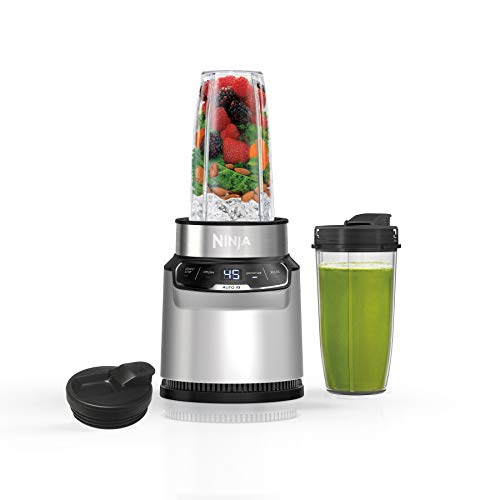
Ninja Nutri-Blender Pro BN401, 1100 peak W, Auto-iQ, (2) 24-oz cups — Best Power
If your individual serving leans frozen — ice, frozen berries, frozen banana, maybe a handful of spinach to hide in it — the Ninja Nutri-Blender Pro BN401 is the power pick. Its 1100 peak-watt motor and Auto-iQ programs are built to run a frozen load down without intervention.
Strengths
- Strongest frozen-crushing performance in this guide
- Auto-iQ programs make a perfect serving a one-button routine
- Two 24 oz cups suit a blend-and-go morning rhythm
Trade-offs
- Louder than lower-powered rivals at full tilt
- 24 oz cups cap truly large meal smoothies
- Programs are drink-focused; manual control is simpler on rivals
| Motor | 1100 peak watts |
| Cups | (2) 24 oz to-go cups |
| Programs | 2 Auto-iQ programs |
Auto-iQ’s pulsing pattern is genuinely well matched to frozen loads: it knocks the mass down into the blades in stages instead of letting the blades carve a cave in the middle of frozen fruit. The result is an even, slush-free smoothie without stopping to shake the cup — the small luxury that makes a 7 a.m. blend feel effortless. Ice for a single frozen coffee or margarita-style drink comes out uniformly crushed, not half boulders and half snow.
Two cups in the box sounds like a minor detail until you live the routine: one cup in the dishwasher or drying rack, one ready to blend. Spout lids seal confidently for the commute. Keep the load at or below the max line and give very thick blends a single shake midway; even this motor cannot repeal the physics of an overfilled cup. For power per serving, this is the ceiling of the category.
Best for: frozen-drink lovers and ice-heavy smoothie routines / Not suited for: quiet-kitchen households blending before dawn
Check the current price on Amazon
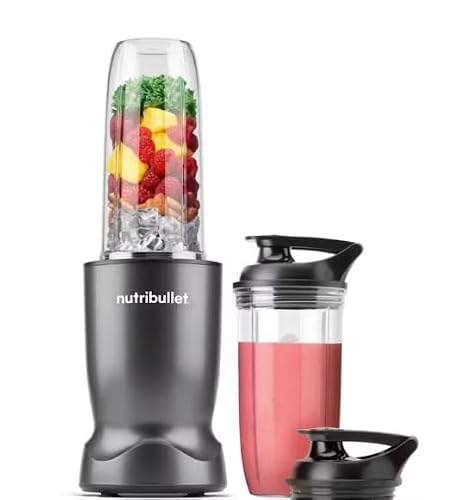
nutribullet Turbo Personal Blender, 1000W — Best Cup Selection
Serving size is personal: some mornings want a light 24 oz shake, others a 32 oz meal in a cup. The nutribullet Turbo covers both in one box — a 1000W base, a 32 oz cup, a 24 oz cup and flip-top travel lids — making it the flexible household pick.
Strengths
- Two cup sizes match light shakes and meal-size smoothies
- 1000W motor handles frozen blending confidently
- Flip-top lids are genuinely commute- and gym-friendly
Trade-offs
- More parts to store than single-cup rivals
- Blade assembly needs a prompt rinse after protein shakes
- No pulse finesse for non-drink tasks like salsas
| Motor | 1000W |
| Cups | 32 oz and 24 oz |
| Lids | (2) flip-top travel to-go lids |
The two-cup system maps neatly onto real life. The 24 oz cup is the weekday protein shake; the 32 oz is the weekend smoothie with greens, frozen fruit, oats and nut butter that functions as breakfast. Power sits comfortably between the Pro 900 and the Ninja — frozen loads blend smooth with the standard technique of liquid first, soft ingredients next, frozen last, so the vortex forms before the hard work starts.
Flip-top lids deserve their mention: a lid you can drink from without unscrewing the whole cup, that still seals in a bag, is the feature that decides whether a personal blender leaves the kitchen with you. It does, here. As with all extractor-style blenders, respect the max line and never blend hot or carbonated liquids in a sealed cup — pressure has nowhere to go, and the manual’s warning is worth heeding.
Best for: households whose serving size changes day to day / Not suited for: minimalists who want exactly one cup and no extras
Check the current price on Amazon

Ninja Fit QB3001SS, 700W, (2) 16-oz cups — Best Compact
Small kitchens, dorms, offices and RVs need a personal blender that disappears when not in use. The Ninja Fit pairs a compact 700W base with two 16 oz cups — honestly sized for one serving — and enough power for the frozen fruit and ice a real smoothie requires.
Strengths
- Smallest storage footprint among the full-power picks
- Two cups included for a blend, drink, wash-later rhythm
- Handles ice and frozen fruit credibly at 16 oz volumes
Trade-offs
- 16 oz cups are too small for meal-replacement smoothies
- 700W motor works harder on very dense frozen loads
- No larger cup option in the box
| Motor | 700W |
| Cups | (2) 16 oz with spout lids |
| Parts | Dishwasher safe |
Sixteen ounces is the classic single serving — a banana, a handful of frozen berries, a scoop of protein, milk or yogurt to the line — and at that volume the Fit’s 700W is well matched to its job. Blends come out smooth, the cups fit car holders, and the base tucks into spaces a full blender cannot enter. For a student, a desk worker or a small-apartment cook, that fit is worth more than headline wattage.
The honest limit is appetite: if your smoothie is breakfast — oats, nut butter, greens, frozen mango — you will outgrow 16 oz and start blending twice, at which point a 24 or 32 oz pick above is the better buy. Judge by your real recipe, not your aspirational one. Within its size class, the Fit is the most capable compact option we verified, and its two-cup box keeps the morning routine moving.
Best for: small kitchens, dorms and office smoothie routines / Not suited for: meal-smoothie drinkers needing 24 oz or more
Check the current price on Amazon

Ninja Blast BC151BK, cordless, 18 oz, USB-C — Best Cordless
The Ninja Blast removes the last excuse: no outlet, no problem. This cordless 18 oz blender recharges by USB-C, travels leakproof in a bag, and blends where you actually drink — after a workout, at a desk, on a trail weekend — rather than only in a kitchen.
Strengths
- True cordless freedom for gym, office and travel servings
- USB-C charging matches the cables you already carry
- Leakproof, dishwasher-safe vessel keeps the routine simple
Trade-offs
- Battery runtime limits back-to-back heavy frozen blends
- 18 oz vessel suits one modest serving, not a meal smoothie
- Less raw power than the corded picks on ice-heavy loads
| Vessel | 18 oz |
| Power | Cordless, USB-C rechargeable |
| Design | Leakproof, dishwasher safe |
Cordless blending is a trade, and the Blast makes it honestly: you give up the crushing ceiling of the corded picks and gain a blender that lives in a gym bag. Fresh fruit, protein shakes, soft frozen fruit and drink mixes are squarely in its ability; a cup packed solid with ice cubes is not the use case, and no cordless blender at this size changes that. Load liquid first and frozen pieces small, and servings come out smooth and cold.
The routine is the delight: blend at the locker room, drink from the same vessel, rinse when you get home. Battery discipline is the only habit to learn — charge it with your phone at night and it is always ready. For travellers, desk workers and anyone whose smoothie habit kept dying at the kitchen counter, the Blast is not a compromise pick; it is the only pick that fits the life.
Best for: gym, office and travel smoothie routines / Not suited for: ice-crushing frozen drinks as a daily staple
Check the current price on Amazon

Hamilton Beach Portable Blender 51172G, 300W peak, 14 oz travel jar — Best Budget
Not every individual serving needs a thousand watts. For protein shakes, milkshakes, fresh-fruit smoothies and drink mixes, the Hamilton Beach Portable Blender — 300W peak, a 14 oz BPA-free travel jar and stainless steel blades — covers the basics at the lowest tier in this guide.
Strengths
- Lowest-cost route to a genuine blend-and-go routine
- 14 oz jar is a true single serving with a travel lid
- Simple one-job design with almost nothing to learn
Trade-offs
- Not built for hard ice or dense frozen loads
- Small jar excludes meal-size smoothies
- Basic power means longer blends on fibrous ingredients
| Motor | 300W peak |
| Jar | 14 oz travel jar, BPA free |
| Blades | Stainless steel |
Judge this blender by its intended menu and it succeeds completely. A scoop of protein, milk and a banana; a fresh strawberry smoothie; a milkshake — these blend quickly and pour smoothly, and the jar goes straight into a bag or car holder. Push it toward frozen mango chunks and ice and it will labour, audibly, and deliver a chunkier result; that is a category limit at this tier, not a defect, and this guide flags it so you buy with open eyes.
The budget logic is sound for beginners: if you are testing whether a daily shake habit will stick, this is the inexpensive way to find out, and it remains useful as a travel or office second blender even if you later upgrade the home counter. Use small frozen pieces, thaw the hardest fruit for five minutes, and keep the jar at its max line. Simple machines reward simple technique.
Best for: first-time buyers making shakes and fresh smoothies / Not suited for: daily frozen-fruit smoothie drinkers
Check the current price on Amazon
Comparison Table
| Pick | Badge | Key spec | Best for |
|---|---|---|---|
| NutriBullet Pro 900 Special Edition (White), 900W | Best Overall | 900W, 32 oz and 24 oz cups, pulse control | daily smoothie drinkers wanting the smoothest single servings |
| Ninja Nutri-Blender Pro BN401, 1100 peak W, Auto-iQ, (2) 24-oz cups | Best Power | 1100 peak W, Auto-iQ, (2) 24 oz cups | frozen-drink lovers and ice-heavy smoothie routines |
| nutribullet Turbo Personal Blender, 1000W | Best Cup Selection | 1000W, 32 oz and 24 oz cups, flip-top lids | households whose serving size changes day to day |
| Ninja Fit QB3001SS, 700W, (2) 16-oz cups | Best Compact | 700W, (2) 16 oz cups with spout lids | small kitchens, dorms and office smoothie routines |
| Ninja Blast BC151BK, cordless, 18 oz, USB-C | Best Cordless | Cordless 18 oz vessel, USB-C rechargeable | gym, office and travel smoothie routines |
| Hamilton Beach Portable Blender 51172G, 300W peak, 14 oz travel jar | Best Budget | 300W peak, 14 oz travel jar, stainless blades | first-time buyers making shakes and fresh smoothies |
Choose by serving and setting. The Pro 900 is the texture benchmark, the Ninja BN401 the frozen-load champion, the Turbo the size-flexible option, the Fit the compact, the Blast the traveller, and the Hamilton Beach the budget starter. Every step up in price buys frozen performance and texture first — decide how frozen your daily serving really is, and the table chooses for you.
How to Choose a Blender for Individual Servings
Start with your actual recipe. Write down what goes into your usual serving: if the list includes frozen fruit, ice or fibrous greens, you need the power tier of the top three picks. If it is protein powder, milk and fresh fruit, almost any personal blender works and budget or size should decide. Most disappointment in this category comes from buying a light-duty cup for a heavy-duty recipe.
Then size the cup to the serving, honestly. A 14 to 16 oz cup suits a shake; 24 oz suits a standard smoothie; 32 oz suits a meal replacement. Remember that working capacity stops at the max-fill line — a cup filled to the brim blends badly, leaks under pressure and wears its seals early. Buy the cup your biggest regular serving needs, not the smallest you can survive.
Finally, weigh the routine: lids that seal in a bag, cups that fit your car holder, parts that rinse clean in seconds. A personal blender is a habit machine. The one with slightly less power but a lid you trust and a footprint you can live with will be used five hundred times; the marginally stronger one that leaks will be used nine times.
Personal Blender Technique: Smooth Servings Every Time
Loading order decides texture. Liquid goes in first, then soft ingredients, then powders and greens, with frozen fruit and ice last, nearest the blades’ draw. This order lets a vortex form early and pulls the hard pieces down steadily, instead of trapping them above a dry pocket. Fill only to the max line — headspace is part of how the cup circulates.
Blend in the machine’s natural rhythm: a continuous run for soft loads, short pulses first for frozen ones. If a thick blend stalls, stop, shake the cup or stir once, and run again — thirty seconds of patience beats five minutes of motor strain. Never blend hot liquids or fizzy drinks in a sealed personal cup; pressure build-up is the one real hazard of the format.
Rinse immediately. Dried smoothie residue is the only genuinely annoying cleanup in this category, and it is entirely optional: a ten-second rinse after drinking keeps cups and blades like new for years. If a blade base smells of yesterday’s protein shake, blend warm water with a drop of dish soap, rinse, and dry with the lid off.
Beyond Smoothies: What a Personal Blender Does Well
A personal blender that only makes smoothies is underemployed. The same cup-and-blade format excels at a small repertoire of single-portion jobs that a big blender handles clumsily. Salad dressings emulsify beautifully at cup scale — a vinaigrette or a yogurt-herb dressing for one meal, blended in the cup it will be stored in. Sauces for one or two follow the same logic: a quick peanut sauce, a chimichurri, a single portion of pesto without a food processor to wash. Dips and spreads in small quantities — hummus for one lunch, a white-bean dip, a personal guacamole — come out at exactly the scale a household of one or two consumes before freshness fades.
Breakfast is the second shift. Pancake and waffle batter for one blends lump-free in thirty seconds and pours straight from the cup. Egg mixtures for omelettes and frittatas whisk themselves. Overnight-oat and chia mixtures stir to an evenness a spoon cannot match, so the texture sets uniformly. Even coffee drinks join in: a personal blender froths and blends iced coffees and frappé-style drinks at single-serving scale, which is the scale at which they are actually consumed at home.
The honest boundary is texture and volume. Thick, low-liquid mixtures — nut butters, dense hummus in quantity, doughs of any kind — belong to food processors and full-size machines, and forcing a personal cup through them shortens its life. Treat the personal blender as the champion of pourable, single-portion work and it will be used daily; ask it to be a whole kitchen and it will disappoint you by Friday. The picks in this guide were chosen with that boundary in mind, which is why their drink performance — the core job — is beyond reproach.
Personal Blender Care: Making a Daily Machine Last
Personal blenders fail in predictable places, and nearly all of them are preventable. The gasket in the blade base is the first: it seals every blend, flexes with heat and pressure, and eventually hardens or tears. Rinse it promptly, let it dry fully rather than sealing a damp cup for storage, and inspect it monthly — a gasket that no longer sits flat is a leak rehearsing itself. Replacement gaskets are inexpensive; a smoothie inside a gym bag is not.
The blade base is the second wear point, and its enemy is residue. Protein and smoothie films dry into a varnish around the blade shaft if the base is left unrinsed, and that varnish is what makes older personal blenders smell permanently faintly sour. The ten-second immediate rinse — the same habit recommended throughout this guide — prevents it entirely. Once a week, the warm-water-and-soap blend keeps the base honest. Never immerse a powered base beyond what the maker allows; the cup and blade assembly are the washable parts, the motor base gets a wipedown.
Cups themselves age by clouding and by absorbing odours, especially from strong flavours like coffee and garlic-heavy sauces. Dedicate cups by job if you blend beyond drinks — one for smoothies, one for savoury — and store them with lids off so they dry completely. Loaded with reasonable care, the machines in this guide serve for years of daily use; neglected, any of them can be grubby within a season. The difference is measured in seconds per day, which is the best bargain in kitchen maintenance.
The Single-Serving Pantry: Ingredients That Make Personal Blending Work
A personal blender performs at its best with a pantry arranged for it, and the arrangement is mostly about the freezer. Frozen fruit in small pieces is the backbone: banana halves frozen on a tray before bagging, berries bought frozen, mango and pineapple in chunks small enough to blend without a fight. Freezer organisation sounds trivial until you are the person chipping at a solid brick of frozen strawberries at 7 a.m. — portion fruit into serving-size bags when you buy it, and the morning blend becomes a dump-and-blend operation that any of the picks in this guide handles gracefully.
The shelf and fridge supporting cast is short: a protein source you actually like the taste of, a liquid you enjoy — milk, a plant alternative, yogurt drinks, coconut water — and two or three flavour anchors such as cocoa, cinnamon, vanilla, peanut butter or ginger. Greens keep the honest caveat: spinach blends invisibly into fruit smoothies, while tougher kale wants the stronger motors in this guide and a little extra liquid. Sweetness is best borrowed from fruit itself; a ripe banana or a few dates sweeten a serving without turning breakfast into dessert.
What the pantry should not contain is a museum of supplements bought for a routine that never formed. Start with the blender and a week of simple recipes; add specialty powders only when a gap in your actual routine asks for them. The machines in this guide reward simple, repeated use — the pantry that serves them is five or six faithful ingredients, restocked, rather than twenty experiments, expiring.
Personal Blenders at Work, the Gym and on the Road
The individual serving often happens away from the kitchen, and each setting has its own practical logic. At a desk, the winning setup is the quietest routine: a compact or cordless pick, ingredients portioned the night before, a blend timed to a break rather than a meeting, and the immediate rinse at the office sink that keeps the cup welcome in shared spaces. The Ninja Fit and the cordless Blast in this guide exist for exactly this life — small footprint, sealed lids, no ceremony.
At the gym, timing is the science: a shake blended immediately after training, from a cup that lived in a locker, beats the perfect shake blended an hour later at home. Cordless blending owns this setting outright, and the routine is simple — powder and liquid measured into the vessel before the session, blend, drink, rinse when home. For travel, the cordless pick doubles as the hotel-room breakfast machine, and even the compact corded models pack flat enough for extended stays; a small kit of shelf-stable portions turns any room into a smoothie station.
The thread connecting all three settings is friction. Every step removed between deciding and drinking — no outlet hunt, no washing queue, no leaking lid — measurably increases how often the blender gets used, and frequency is where the health and budget value of the category actually lives. Choose the pick that removes the most friction from your particular day, which is why this guide ranks a cordless traveller alongside stronger corded machines without apology.
Troubleshooting Single-Serving Blends
The chunky smoothie is the category’s signature failure, and it has a short diagnostic list. If frozen pieces survive the blend, the pieces were too big, the liquid too little, or the cup overfilled so nothing could circulate — fix the recipe before blaming the motor, because at single-serving scale the load geometry matters more than wattage. Blend order is the second suspect: frozen ingredients loaded first, against the blades with no liquid beneath them, will ride and rattle; the liquid-first order described in this guide exists precisely to prevent it. A single shake or stir midway rescues most stubborn blends without any recipe change at all.
Leaks diagnose just as quickly. Check the fill line first — the cause of most leaks is enthusiasm — then the gasket’s seating, then the cup’s threads for residue that prevents a full seal. A cup that leaks at a correct fill with a clean, seated gasket is asking for a gasket replacement, an inexpensive part that restores the machine to trustworthiness. Texture complaints split by direction: too thin usually means too much liquid or ice that melted during a long blend, while too thick and stalling means the opposite — add liquid in splashes, not quarter cups, because a personal cup’s balance tips quickly.
Finally, the warm smoothie nobody ordered: long blending heats a small volume noticeably, which is why frozen ingredients double as the chilling system in this format. If your servings come out cool rather than cold, increase the frozen share and shorten the run — pulse to break down, then one continuous finish. These are thirty-second diagnoses once learned, and learning them is the difference between a personal blender that feels temperamental and one that feels like it reads your mind.
One Cup, Two People: Sharing a Personal Blender Household
Many individual-serving blenders actually serve a household of two with different mornings, and the format handles it better than expected. The working pattern is sequential, not simultaneous: one blend, a ten-second rinse, a second blend — under three minutes for two completely different servings, which is faster than one large batch of a compromise flavour neither person chose. The two-cup boxes among the picks exist for exactly this choreography, letting the second cup wait loaded while the first is drunk, and households that adopt the rhythm rarely miss the big pitcher for weekday drinks.
Taste divergence is the hidden benefit. One partner’s green-heavy, ginger-forward smoothie and the other’s banana-and-peanut-butter breakfast are irreconcilable in a shared pitcher and trivial in personal cups. The same logic extends to dietary differences — protein targets, allergies, a child’s milder version — each handled at cup scale without separate appliances. A personal blender in a two-person home is not a compromise purchase; used sequentially, it is the more flexible tool, and its only true limit remains the family-sized batch, which is what full-size machines are for.
A Final Fit Check Before You Buy
Before ordering, run three quick physical checks against your real life. Measure the cup you currently drink a smoothie from — if it is a large café-style serving, the 14 and 16 oz picks will feel like a downgrade no matter their quality, and the 24 to 32 oz models are your true shortlist. Check your car or bike holder’s diameter against the cup you fancy; a serving that cannot travel is a serving that stays home. And glance at the space where the base will live: personal blenders earn their keep by being out and ready, so a base that must be fetched from a cupboard each morning loses half its advantage before the first blend.
None of these checks appears on a specification sheet, and all three decide satisfaction more reliably than a wattage comparison. The picks in this guide are all capable machines; the fit checks are how you find your capable machine.
A Note on Noise
Personal blenders are loud in the way of small, fast motors, and the household rhythm should plan around the fact rather than discover it at dawn. A frozen blend at full power will carry through a small apartment; if your mornings start before a partner’s or a baby’s, the practical solutions are to blend the night before and refrigerate the serving in its sealed cup — most smoothies hold their quality overnight perfectly well — or to choose the softest load order, with frozen pieces smallest, so the loudest phase of the blend is also the shortest. None of the picks in this guide is quiet in an absolute sense, and this guide will not pretend otherwise; the honest variable is duration, and a well-loaded cup finishes its noisy work in under a minute.
How to Build a Perfect Single-Serving Smoothie
This formula scales to every cup size in the guide; the proportions are for a roughly 20 oz serving — trim or stretch each element to your cup’s max line.
- Add the liquid first: about a cup of milk, yogurt drink, juice or water. Liquid first is what lets the vortex form.
- Add soft ingredients next: banana, fresh berries, yogurt, nut butter or protein powder, plus a handful of greens if you use them.
- Add frozen fruit or ice last, in pieces no bigger than a large strawberry. Small pieces blend faster and smoother than a few huge chunks.
- Seal the cup firmly, invert it onto the base until it locks, and blend — pulsing twice for frozen loads, then running continuously — until the surface swirls evenly and no chunks ride the top.
- Check texture through the cup: a good serving pours in a thick, even ribbon. If it is too thick, add liquid a splash at a time; too thin, add frozen fruit.
- Drink from the cup or its travel lid, then rinse cup and blade base immediately. That ten-second rinse is the whole maintenance plan.
Once a week, blend warm water with a drop of dish soap for thirty seconds to keep the blade base fresh, and store cups with lids off so seals dry fully and stay odour-free.
Common Buying Mistakes
Overfilling past the max line. The most common personal-blender failure is self-inflicted: no headspace, no vortex, poor blend, leaking seal. The max line is a performance specification, not a suggestion.
Blending hot soup in a sealed cup. Sealed cups cannot vent steam. Personal blenders are for cold and room-temperature servings; hot blending belongs in a vented full-size pitcher.
Buying light-duty power for frozen recipes. A 300W cup blender is a fine shake machine and a miserable frozen-mango machine. Match the motor to the hardest ingredient in your daily recipe.
Letting cups sit unrinsed. Dried smoothie film and sour protein residue are why people abandon personal blenders. The ten-second immediate rinse prevents all of it.
Ignoring the lid. A serving you carry needs a lid that seals. Test a new cup with water over the sink before trusting it in a bag with your laptop.
Final Recommendation
For most people, the nutribullet Pro 900 is the individual-serving answer: the smoothest texture, sensible cups and power for every realistic recipe. Choose the Ninja BN401 if your servings are ice-heavy, the Turbo if your serving size swings day to day, the Fit for small spaces, the Blast for life away from the kitchen, and the Hamilton Beach if your menu is shakes and fresh fruit on a budget. Readers blending beyond drinks should look at Best Blenders For Indian Recipes for full-recipe workloads, Best Blenders For Indian Cooking Spices Mix for grinding, Best Blenders For Smoothies for the wider smoothie field, and Best Personal Blenders for the broader personal category.
Ready to decide? Start with the top three picks and check price on Amazon for each before you buy: NutriBullet Pro 900 Special Edition (White), 900W · Ninja Nutri-Blender Pro BN401, 1100 peak W, Auto-iQ, (2) 24-oz cups · nutribullet Turbo Personal Blender, 1000W.
Frequently Asked Questions
What size cup do I actually need for one serving?
A protein shake typically runs 12 to 16 oz; a standard fruit smoothie 16 to 24 oz; a meal-replacement smoothie with oats, nut butter and greens 24 to 32 oz. Buy for your largest regular serving and respect the max-fill line — working capacity is always a little below the headline cup size.
Can a personal blender crush ice?
The stronger picks in this guide — the 900W and above corded models — crush ice well at single-serving volumes. Light-duty and cordless models handle small amounts of ice or frozen fruit best when pieces are small and there is enough liquid. A cup packed solid with cubes is beyond any personal blender’s design.
Why does my personal blender leak?
Almost always overfilling or a seal that is not seated. Fill to the max line only, check the gasket sits flat in the blade base, and tighten the cup firmly. Worn gaskets eventually need replacement — if a well-filled, well-seated cup still leaks, the seal is the first suspect.
Can I blend hot liquids in a personal blender?
No. Sealed personal cups cannot vent steam, and pressure can force the cup open. Let hot ingredients cool before blending, or use a full-size vented blender for soups and hot purees.
How long should a single serving take to blend?
Most servings finish in thirty to sixty seconds. Soft shakes take less; frozen loads may need a pulse sequence plus a short continuous run. If a blend regularly needs several minutes, the load is too big, too frozen or too dry for the machine — adjust the recipe before blaming the motor.
Are personal blenders hard to clean?
They are the easiest blenders to clean when rinsed immediately: cup, lid and blade base all rinse in seconds, and many parts are dishwasher safe. The only difficult cleanup is a cup left unrinsed overnight — a habit problem, not a design problem.


