Disclosure: airfryerkitchensupply.com is reader-supported. When you buy through links on our site, we may earn an affiliate commission at no extra cost to you.
Where to Buy
Every model in this guide is sold on Amazon, and every model was checked against Amazon catalog data before inclusion — specifically for one thing most listings blur: a real compressor. If a unit could not be confirmed as a compressor refrigerator, it did not make this list, no matter how fridge-like its photos looked.
Start with our top three: ICECO GO20 Dual Zone 12V Refrigerator (SECOP Compressor), Dometic CFX2 37L Electric Cooler, BougeRV 12V Refrigerator 23 Quart. Use any Check on Amazon link in this guide to confirm live availability and check the current price on Amazon — we never print static prices, because prices in this niche move too often to trust in print.
The best 12 volt true refrigerator is not the same product as a 12 volt cooler, and the difference decides whether your food survives a hot weekend. A true refrigerator uses a compressor and refrigerant, exactly like your kitchen fridge, so it holds a set temperature whether the vehicle interior is mild or brutally hot. A thermoelectric cooler — the cheap alternative that fills this search — can only cool a limited amount below the surrounding air, which means on a hot day its interior can sit in the food-danger zone while its listing still calls it a refrigerator.
That is why this guide uses the word true deliberately. All six picks below are compressor models that run on 12/24V DC as well as household AC, can work as a fridge or a freezer, and include battery protection so the fridge does not strand you with a flat starter battery. Sizes run from a personal 16-quart box to a family-size dual-zone chest, because true refrigeration is now a capacity choice, not a technology gamble.
Read the buying guide sections even if you already know which size you want. Compressor fridges fail in predictable ways — blocked vents, wrong battery-protection settings, undersized wiring — and almost all of them are preventable on day one. The how-to section walks through first setup, and the mistakes section covers the errors that quietly kill compressors and batteries alike.
In this guide
Quick Picks
Six compressor refrigerators, six different jobs. Every badge below matches the badge in the full review, so you can jump straight from this list to the detail you need.
- Best Overall — ICECO GO20 Dual Zone 12V Refrigerator (SECOP Compressor): A 21-quart dual-zone box built around a SECOP compressor — the compressor name serious overland builders look for — with independent fridge and freezer space in a footprint one person can carry. Check the current price on Amazon before you decide.
- Best Premium — Dometic CFX2 37L Electric Cooler: Dometic’s 37L app-controlled cooler with 3-stage battery protection and freezing to -7 F — the polished, set-it-and-monitor-it option from the most established name in mobile cooling. Check the current price on Amazon before you decide.
- Best Compact — BougeRV 12V Refrigerator 23 Quart: A 23-quart fridge-freezer with a listed 15-minute fast cool to 32F — the small box that gets cold quickly and sips from 12/24V DC or 110V AC. Check the current price on Amazon before you decide.
- Best Large Single-Zone Value — Alpicool C50 Portable Car Freezer 47 Quart: A 47-quart fast-cooling chest on 12/24V DC and 100-240V AC — family capacity without a dual-zone price structure. Check the current price on Amazon before you decide.
- Best Dual Zone for Families — Setpower 12V Refrigerator 48QT Dual Zone: A 48-quart dual-zone fridge with independent control and a -4F to 68F range — family capacity with a real freezer compartment beside the fridge. Check the current price on Amazon before you decide.
- Best for Solo Travel — Alpicool C15 Portable Car Freezer 16 Quart: A 16-quart (15 liter) compressor box with a -4F to 68F range — true refrigeration shrunk to personal size for one person’s food and drinks. Check the current price on Amazon before you decide.
How These Picks Were Chosen
Verification came first. Each pick was confirmed through Amazon catalog data for three things: a compressor (named in the listing or in the model’s confirmed specification), genuine 12/24V DC input alongside AC, and a stated temperature range that reaches true freezing. Thermoelectric coolers were excluded outright, however they were marketed, and so were compressor models with no battery-protection system.
We then balanced the list across real use cases rather than picking six near-identical boxes: a dual-zone expedition model, a premium app-controlled cooler, a fast-cooling compact, a large single-zone value pick, a big dual-zone family chest, and a small solo-travel box. Within each role we favored clear specifications, honest temperature ranges, and power systems that treat a vehicle battery with respect.
A note on temperature claims: a stated range such as -4F to 68F describes what the compressor can reach in reasonable conditions, not a promise for a sealed vehicle in desert sun. We call out where a model’s range or zone layout limits it, and the buying guide explains how ambient heat, ventilation, and pre-chilling change real-world results far more than brand badges do.
The 6 Best 12 Volt True Refrigerator Models Worth Your Battery
Each review explains who the fridge suits, where it compromises, and the verified specifications from its catalog listing. No prices are printed — check price on Amazon on the product page, where the current figure actually lives.

ICECO GO20 Dual Zone 12V Refrigerator (SECOP Compressor) — Best Overall
The ICECO GO20 earns the top badge because it solves the hardest problem in small 12 volt refrigeration: keeping frozen food genuinely frozen next to fresh food that must not freeze. Its dual-zone layout gives each compartment its own control, and the SECOP compressor at its heart is the same family of compressor trusted in far larger expedition fridges. At 21 quarts it is sized for a couple on a long weekend or a solo traveler on a long haul.
Strengths
- SECOP compressor — a proven, serviceable compressor rather than an anonymous unit
- True dual-zone layout, so ice cream and salad can finally travel together
- Runs on DC 12/24V in the vehicle and AC 100-240V at home or camp with hookups
Trade-offs
- 21 quarts disappears fast once drinks join the food — plan capacity honestly
- Dual-zone flexibility costs more than a basic single-zone box of similar size
- 0F floor is fine for frozen food storage but is not deep-freeze territory
| Capacity | 21 quart (per API title) |
| Compressor | SECOP compressor (per API title) |
| Zones | Dual zone (per API title) |
| Temperature range | 0F to 50F (per API title) |
| Power input | DC 12/24V and AC 100-240V (per API title) |
In practice the GO20 behaves like a shrunken household fridge-freezer, which is exactly the compliment this category rarely earns. Pre-chill it on AC the night before a trip, load it cold, and the compressor only has to maintain temperature on the road — the easiest work a compressor ever does. The dual-zone divider is the feature owners end up valuing most: one side holds freezing point for meat and ice, the other hovers in safe fridge territory for produce and dairy. Battery behavior is civilized, cycling rather than droning, and the box is compact enough to live behind a seat or in a crowded cargo area without dominating it. If you buy one true refrigerator for mixed fridge-and-freezer duty, this is the balanced choice.
Best for: couples and solo overlanders who need real fridge and freezer space in one compact box / Not suited for: families feeding four for a week — step up to a 48-quart class model instead

Check on Amazon — check price on Amazon and confirm the exact size and power lead in the box before ordering.

Dometic CFX2 37L Electric Cooler — Best Premium
Dometic built its reputation in RV and marine refrigeration, and the CFX2 37L shows it. The verified details — freezing to -7 F, 3-stage battery protection, app control, and room for 48 cans — describe a fridge designed for people who run it for weeks at a time and want to check its status from the driver’s seat or the camp chair rather than by opening the lid.
Strengths
- Freezes to -7 F per its listing — proper freezer performance, not fridge-only cooling
- 3-stage battery protection lets you choose how aggressively it guards your battery
- App control for temperature checks and adjustments without opening the lid
Trade-offs
- Premium positioning — this is the pay-for-polish end of the category
- Single-zone layout, so fridge and freezer share one temperature compromise
- 37L suits couples and small families; big groups will outgrow it
| Capacity | 37L — holds 48 cans (per API title) |
| Lowest temperature | Freezes to -7 F (per API title) |
| Power input | 12/24V (per API title) |
| Battery protection | 3-stage battery protection (per API title) |
| Control | App control (per API title) |
The CFX2 makes most sense where the fridge is infrastructure rather than luggage: a camper van build, a boat, an off-grid cabin, or a work truck that carries temperature-sensitive supplies daily. The 3-stage protection matters more than it sounds — set it conservative on a single starter battery, or relaxed on a deep-cycle house bank, and the fridge adapts to your electrical system instead of gambling with it. App control sounds like a gimmick until the first hot day, when checking the temperature without cracking the lid saves both cold and compressor work. Everything about this model assumes long service, and it is priced and built accordingly.
Best for: van builders, boaters, and long-trip travelers who want monitored, premium refrigeration / Not suited for: shoppers who only need a basic weekend box and would rather keep the budget lean
Check on Amazon — check price on Amazon and confirm the exact size and power lead in the box before ordering.
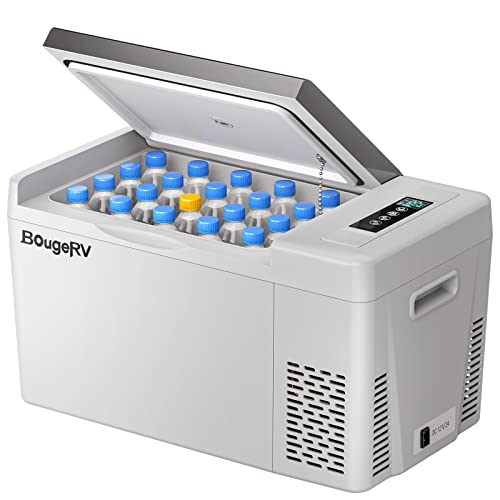
BougeRV 12V Refrigerator 23 Quart — Best Compact
The BougeRV 23 Quart is the compact pick for buyers whose trips are measured in days, not weeks. Its listing highlights a fast 15-minute cool to 32F, a -8F to 50F working range, and dual DC/AC power — a combination aimed at the Thursday-night packer who plugs in at home, loads up, and moves the box to the vehicle without breaking the cold chain.
Strengths
- Fast-cool performance highlighted in its listing — useful when plans change late
- -8F to 50F range covers freezer duty and fridge duty in one zone
- Compact 23-quart footprint fits footwells, trunks, and tight cargo corners
Trade-offs
- Single zone — frozen goods and fresh goods share one setting
- 23 quarts is drinks-plus-weekend-food, not a family grocery haul
- Fast cooling works the compressor hard; pre-chilling on AC is still the smart move
| Capacity | 23 quart (per API title) |
| Temperature range | -8F to 50F (per API title) |
| Cooling note | Fast 15-minute cool to 32F (per API title) |
| Power input | 12/24V DC and 110V AC (per API title) |
Small compressor fridges live or die on honesty about capacity, and 23 quarts is honestly a two-person weekend box — meals, a few drinks, and condiments, packed with some Tetris. Within that brief the BougeRV performs its party trick well: it pulls down temperature quickly, which also makes it a good second fridge for drinks at a campsite while a larger box guards the food. The wide temperature range means it can freeze a tray of ice or hold fridge temperatures for a farmers-market run on the way home. For solo travelers, couples, and day-boat use, it hits the size most people actually need — as opposed to the size they imagine needing.
Best for: solo travelers, couples, and anyone adding a compact second fridge for drinks / Not suited for: groups who need a week of food storage — look at the 48-quart class
Check on Amazon — check price on Amazon and confirm the exact size and power lead in the box before ordering.

Alpicool C50 Portable Car Freezer 47 Quart — Best Large Single-Zone Value
The Alpicool C50 answers a simple brief: maximum cold space for a family, one temperature zone, no complications. At 47 quarts it swallows a long weekend of food for four, runs on the vehicle’s 12/24V system or household AC, and its fast-cooling compressor design suits the load-it-and-go rhythm of family camping, where the fridge is packed in the driveway and opened constantly thereafter.
Strengths
- 47 quarts of genuine compressor space at a value-tier position
- 12/24V DC plus 100-240V AC power covers vehicle, home, and hookup sites
- Single-zone simplicity — one control, one temperature, nothing to misconfigure
Trade-offs
- One zone means choosing: fridge temperature for everything, or freezer for everything
- A full 47-quart chest is a two-hand carry — plan its home in the vehicle
- No app or dual-zone refinement; it is deliberately basic
| Capacity | 47 quart (per API title) |
| Power input | 12/24V DC and 100-240V AC (per API title) |
| Use | Fridge/freezer for RV, truck and camping (per API title) |
Single-zone versus dual-zone is the honest fork in this category, and the C50 makes the case for simplicity. Most family camping food — drinks, dairy, meat for the next two days, produce — is happy at one fridge temperature, with anything longer-term traveling frozen-solid from home and thawing in the box as the trip progresses. Run that system and the C50’s size becomes pure advantage: fewer lid openings per item, room for awkward shapes, and space to add ice packs as thermal ballast. It is also the natural pick for events — team snacks, market days, power-outage backup at home on AC — where one big cold space beats two clever small ones.
Best for: families and groups who want one big, simple, cold space / Not suited for: travelers who must keep some food frozen while other food stays fresh — choose dual zone
Check on Amazon — check price on Amazon and confirm the exact size and power lead in the box before ordering.

Setpower 12V Refrigerator 48QT Dual Zone — Best Dual Zone for Families
The Setpower 48QT is what the C50’s compromise looks like solved: nearly the same family capacity, but split into independently controlled zones across a -4F to 68F span. One side freezes properly while the other keeps fridge temperatures, and the listing’s stated 3 year warranty is a meaningful signal in a category where support can be thin.
Strengths
- 48 quarts split into two independently controlled zones
- Full -4F to 68F range across the box
- 3 year warranty stated in its listing — unusually clear support for the class
Trade-offs
- Bigger and heavier commitment than compact boxes — measure your cargo space
- Dual-zone control asks a little more setup attention on day one
- Families who never freeze anything are paying for a feature they will idle
| Capacity | 48 quart (per API title) |
| Zones | Dual zone with independent control (per API title) |
| Temperature range | -4F to 68F (per API title) |
| Warranty note | 3 year warranty stated in API title |
For a family basecamp or a long RV trip, this layout changes meal planning entirely: proteins stay frozen until their day, ice keeps for drinks, and the fridge side runs at a produce-friendly temperature instead of the too-cold compromise single-zone owners accept. Independent control also lets you run the whole box as one big fridge or one big freezer on trips that lean one way — holiday hauls, hunting and fishing returns, market runs. Set the battery protection to match your setup before the first trip, give the vents their breathing room, and the Setpower settles into the background the way good refrigeration should.
Best for: families and long-trip travelers who genuinely use both a fridge and a freezer / Not suited for: minimalists who pack light and would feel the size every single trip
Check on Amazon — check price on Amazon and confirm the exact size and power lead in the box before ordering.

Alpicool C15 Portable Car Freezer 16 Quart — Best for Solo Travel
The Alpicool C15 proves the point of this entire guide in the smallest package: even at 16 quarts, a compressor fridge holds its set temperature in a hot vehicle while a thermoelectric box of the same size would be warming your lunch. For solo drivers, truckers on day routes, anglers, and anyone whose cold storage is genuinely personal, it delivers real refrigeration without surrendering half the cargo area.
Strengths
- Real compressor cooling and freezing, -4F to 68F, in a 15-liter box
- 12/24V DC and 100-240V AC power — vehicle by day, home or hotel by night
- Small footprint fits where family-size chests simply cannot
Trade-offs
- 16 quarts is one person’s supply — there is no sharing capacity here
- Single zone, so fridge-or-freezer is a per-trip decision
- Heavy for its size compared with a thermoelectric cooler, because a compressor is real hardware
| Capacity | 16 quart / 15 liter (per API title) |
| Temperature range | -4F to 68F (per API title) |
| Power input | 12/24V DC and 100-240V AC (per API title) |
Judge the C15 as personal infrastructure. It keeps medication-adjacent supplies, lunch, and drinks at a chosen temperature through a workday in a parked vehicle — with battery protection set correctly — and then comes inside on AC at night. Solo campers get a fridge that matches a one-person tent and a one-burner stove instead of dominating both. Its limits are purely arithmetic: count your items before a trip, and if they exceed 15 liters, they exceed it. Within its size, though, there is no compromise in the technology — and that, in a category flooded with thermoelectric impostors, is the whole argument.
Best for: solo drivers, anglers, and one-person campers who want true refrigeration at personal scale / Not suited for: anyone feeding more than one person — size up without hesitation
Check on Amazon — check price on Amazon and confirm the exact size and power lead in the box before ordering.
Comparison Table
Side by side, the six differ mainly in capacity, zone layout, and refinement — the compressor principle underneath is the same, which is precisely what makes them all true refrigerators.
| Pick | Badge | Key spec | Best for |
|---|---|---|---|
| ICECO GO20 Dual Zone 12V Refrigerator (SECOP Compressor) | Best Overall | 21 qt, dual zone, SECOP compressor | Balanced fridge + freezer in one box |
| Dometic CFX2 37L Electric Cooler | Best Premium | 37L, freezes to -7 F, app control | Premium monitored long-term use |
| BougeRV 12V Refrigerator 23 Quart | Best Compact | 23 qt, -8F to 50F, fast cool | Quick-cooling weekend trips |
| Alpicool C50 Portable Car Freezer 47 Quart | Best Large Single-Zone Value | 47 qt, single zone, DC + AC | Family capacity, simple control |
| Setpower 12V Refrigerator 48QT Dual Zone | Best Dual Zone for Families | 48 qt, dual zone, -4F to 68F | Family trips using both zones |
| Alpicool C15 Portable Car Freezer 16 Quart | Best for Solo Travel | 16 qt, -4F to 68F, compact | One person’s food and drinks |
How to Choose a 12 Volt True Refrigerator — Compressor vs Thermoelectric
Start with the technology test, because everything else is decoration. A true refrigerator compresses and expands a refrigerant in a sealed loop; that is what lets it hold 35F inside when it is 100F outside, and reach below-zero freezer temperatures at all. A thermoelectric cooler uses a Peltier plate that moves a limited amount of heat — typically cooling only modestly below ambient. Park in summer sun and a thermoelectric box can sit at temperatures where food safety guidance says perishables should not linger. If a listing avoids the word compressor, assume it is thermoelectric until proven otherwise.
Next, match the temperature range to your food. Fridge-only duty needs a range centered on 32-40F; genuine freezer duty needs a range that reaches at least 0F, and every pick in this guide states a sub-zero or near-zero floor. Dual-zone models remove the compromise entirely, but only pay for two zones if your trips really mix frozen and fresh — many happy owners run a single zone at fridge temperature and let home-frozen food thaw slowly as ballast.
Finally, interrogate the electrical side. Confirm 12/24V DC input, look for multi-level battery protection, and check whether an AC adapter is included for pre-chilling at home. A fridge that cannot pre-chill forces its hardest work — the initial pull-down — onto your vehicle battery, which is backwards. The best setup is boring: chill on AC overnight, transfer to DC for the drive, and let the compressor merely maintain.
Sizing a True 12 Volt Refrigerator for Your Trips
Capacity in this category is brutally literal. Around 16-23 quarts serves one or two people for a weekend once drinks are included. The 37-48 quart class is the family and long-trip heartland, and dual-zone versions of it effectively replace a separate cooler entirely. Buy for your typical trip, not your biggest imagined one: an oversized fridge runs half-empty, wastes power cooling air, and eats the cargo space you needed for everything else.
Shape matters alongside volume. Chest-style boxes like all six picks here open from the top, which keeps cold air pooled inside far better than a front door in a moving vehicle, and they double as a step, seat, or table in camp. Measure the exact footprint — including clearance for vents and the power lead — against the spot the fridge will actually live, whether that is a cargo floor, a slide, or a boat locker.
Think about who carries it, too. A loaded 48-quart compressor fridge is a committed two-person lift. If one person routinely loads the vehicle alone, a smaller box carried twice beats a big box carried dangerously once. Handles, tie-down points, and a lid that stays shut on rough roads are worth more than one extra quart on the spec sheet.
Powering a 12 Volt True Refrigerator Without Killing Your Battery
Every compressor fridge cycles: it draws its working current while the compressor runs, then rests. Total daily consumption depends on ambient heat, how full the box is, how often the lid opens, and the set temperature — freezer settings in summer are the hungriest combination in this category. Your defense is a system, not a hope: a healthy battery, the fridge’s battery-protection level set to match it, and wiring thick enough that voltage drop does not trick the fridge into thinking the battery is emptier than it is.
Battery protection deserves its own paragraph because it is the most misunderstood setting on these fridges. On its most protective setting, the fridge shuts off early to guarantee an engine start — right for a single starter battery. On a relaxed setting, it runs deeper — right for a dedicated house battery or a lithium power station, wrong for the battery that has to start your truck on a cold morning. Match the setting to the battery’s job, not to your optimism.
Solar and power stations pair naturally with compressor fridges, since the fridge’s steady, modest cycling load is exactly what a house battery handles well. Whatever your source, pre-chill on AC, load cold food, keep the box as full as practical — cold mass is free thermal storage — and park in shade when you can. Ambient temperature is the one specification no manufacturer can repeal.
One more habit separates calm owners from anxious ones: check the system on the first evening, not the third morning. Confirm the fridge is cycling normally, the battery sits where you expect it, and the protection setting matches the battery doing the work. Ten seconds of attention on night one turns the rest of the trip into the set-and-forget experience a true refrigerator is supposed to deliver — and catches the one loose connection or wrong setting while it is still a story, not a spoiled grocery load.
What Daily Life With a Compressor Fridge Actually Feels Like
New owners notice the sound first — or rather, how little of it there is. A compressor fridge cycles on with a low hum, settles the temperature, and falls silent, sometimes for long stretches in mild weather. In a quiet campsite at night it is audible if you listen for it and irrelevant if you do not. What owners notice second is the behavioral change: you stop managing ice. No meltwater soaking the bread, no daily ice run, no cooler Tetris as the ice shrinks. Food simply stays at the temperature you chose, and meal planning becomes about appetite instead of spoilage deadlines.
The third realization is electrical discipline becoming habit. You learn your battery’s rhythm — how the fridge behaves on a driving day, when the alternator feeds it, versus a parked day, when the house battery carries it alone. Most owners settle into a pattern within two trips: pre-chill at home, drive with the fridge fed, arrive with everything cold, and let battery protection stand guard overnight. Solar owners add one more habit — parking so the panels, not the fridge, face the sun’s consequences.
There is also a honest downside to plan around: weight and permanence. A compressor fridge is real machinery, and a loaded family-size box is not something you casually move between vehicles. Most owners give it a fixed home — a cargo corner, a slide, a dedicated spot in the van — and build the rest of their packing around it. Accept that once, and the fridge stops being luggage and becomes part of the vehicle, which is exactly how its designers intended it.
Keeping a 12 Volt True Refrigerator Healthy for Years
Compressor fridges are durable but not immortal, and their enemies are mundane: heat with nowhere to go, dust in the condenser area, and long storage with a damp interior. Wipe the interior dry after trips, store the lid ajar, and vacuum dust from the vents and condenser area a few times a season — especially after dusty roads, where a clogged condenser silently taxes every cooling cycle that follows.
Treat the power lead as part of the appliance. A frayed DC lead or a loose socket creates voltage drop, and voltage drop makes the fridge misread the battery and cycle strangely. Inspect the lead each season, keep connections clean and tight, and replace a damaged lead with the correct gauge rather than the nearest thin substitute. The same discipline applies to the vehicle’s socket: a worn socket that runs warm is a fault waiting for a hot day to introduce itself.
Finally, run the fridge periodically in the off-season — a few hours on AC every couple of months keeps seals supple and the compressor exercised. Store it upright, and if it ever travels on its side, let it stand upright for several hours before powering on so the compressor oil settles. None of this is difficult; all of it is the difference between a fridge that serves for a decade and one that fades in three summers.
True Refrigerator vs Cooler on a Real Trip — A Day-by-Day Contrast
Day one flatters both technologies. The cooler starts full of ice and confidence; the compressor fridge starts at its set temperature. By day two in warm weather, the cooler’s ice is half water, its interior has drifted upward, and everything in it is damp. The fridge, meanwhile, has simply cycled — its interior reads the same temperature it read on day one, because a compressor does not consume its cooling the way ice consumes itself.
By day three the contrast turns into food safety. Temperature guidance for perishables is unforgiving: food held too warm for too long should be thrown away, not debated. A thermoelectric cooler in a hot vehicle can spend its afternoons in exactly that grey zone, which is why experienced travelers restrict thermoelectric boxes to drinks. The compressor fridge’s whole value proposition is that it never asks you to make that judgment call at a picnic table.
The economics follow the same arc. Ice is cheap per bag and expensive per season, and it taxes every trip with a stop, a detour, or a cooler of meltwater. A compressor fridge concentrates its cost at purchase and then runs for years on electricity you were generating anyway. For the occasional single-day outing, a cooler remains perfectly sensible. For multi-day travel in real heat — the trips this keyword is actually about — the true refrigerator is not the luxury option. It is the only option that does the job the name promises.
How to Set Up and Use a 12 Volt True Refrigerator
First setup takes twenty minutes and decides how the fridge behaves for years. Do it at home, on AC power, before its first trip.
- Unpack and let the fridge stand upright for several hours before first power-on if it traveled on its side — compressor oil needs to settle back where it belongs.
- Place it on a flat surface with clear space around every vent. Compressor fridges reject heat through those vents; a vent pressed against cargo is a fridge working against itself.
- Plug into household AC, set your target temperature — fridge zone around 35-38F, freezer zone at 0F or below — and let it pull down empty until it reaches temperature and begins cycling calmly.
- Set the battery-protection level now, while you are thinking about it: most protective for a starter battery, mid or relaxed only for a dedicated house battery or power station.
- Load cold food into the cold fridge. Arrange airflow gaps between items, put the most-opened items on top, and fill empty space with cold drinks or ice packs as thermal ballast.
- Transfer to the vehicle, connect the DC lead to a sound 12V socket or direct battery connection, secure the fridge against sliding, and re-check that vents stayed clear after loading the rest of your gear.
- During the trip, open the lid briefly and deliberately, keep the box shaded, and if you stop for hours in heat on a starter battery, check the protection setting rather than gambling on a jump start.
At home, empty the fridge, wipe it dry, and store it with the lid cracked open so seals and interior stay fresh. Run it on AC for a few hours every couple of months in the off-season — compressors, like engines, prefer occasional work to endless rest.
Common Buying Mistakes
Buying a thermoelectric cooler dressed as a refrigerator. It is the category’s original sin. If the listing never says compressor, you are buying a plate that cools modestly below ambient — fine for drinks, wrong for food safety on hot days. Every pick in this guide passed the compressor test; apply the same test to anything else you consider.
Skipping the pre-chill. Loading warm food into a warm fridge in a hot vehicle makes the compressor run flat-out on battery power for hours. Pre-chill on AC, load cold, and the road portion becomes cheap maintenance cooling instead of an expensive pull-down.
Leaving battery protection on the wrong level. Too relaxed on a starter battery risks a no-start; too protective on a house battery wastes usable capacity and warms your food early. The setting exists to match your electrical system — set it deliberately, per vehicle, per trip.
Blocking the vents with cargo. A compressor fridge buried under sleeping bags cannot reject heat, so it runs longer, draws more, cools worse, and ages faster. Vent clearance is not a suggestion in the manual; it is the cooling system.
Sizing for the fantasy trip. The once-a-year expedition size becomes the every-weekend burden. Most owners are happiest with the fridge that fits their typical trip and their actual cargo space — rent or borrow capacity for the exceptional trip instead.
Final Recommendation
If you want one answer: the ICECO GO20 is the best 12 volt true refrigerator for most people, because its SECOP compressor and dual-zone layout deliver genuine fridge-and-freezer service in a box that still fits real vehicles. Choose the Dometic CFX2 if the fridge will live in a build and you value monitoring and polish, the BougeRV 23 Quart for fast-cooling compact weekends, the Alpicool C50 for simple family volume, the Setpower 48QT when a family truly needs both zones, and the Alpicool C15 when the crew is exactly one person.
Whichever you pick, you are buying the same underlying promise — a compressor that holds its temperature regardless of the weather outside the vehicle. That promise is what separates a true refrigerator from a cooler with ambitions, and it is worth paying for exactly once. For the electrical side of the setup, see Best 12 Volt 2000 Watt Inverter and Best 12 Volt Deep Cycle Battery — and if your trips lean marine, Best 12 Volt Tv For Boats covers the screen that pairs with a cold drink from a fridge like these.
Shortlist again, in full: ICECO GO20 Dual Zone 12V Refrigerator (SECOP Compressor), Dometic CFX2 37L Electric Cooler, BougeRV 12V Refrigerator 23 Quart, Alpicool C50 Portable Car Freezer 47 Quart, Setpower 12V Refrigerator 48QT Dual Zone, Alpicool C15 Portable Car Freezer 16 Quart. Whichever you choose, check price on Amazon first and keep the receipt and the DC lead — in this category the lead and the mount matter almost as much as the product itself.
Best 12 Volt Tv For Rv Best 12 Volt Tv For Camper Best 12 Volt 2000 Watt Inverter Best 12 Volt Tv
Frequently Asked Questions
What makes a 12 volt refrigerator a true refrigerator?
A compressor and a refrigerant loop — the same technology as a household fridge. That is what allows it to hold a set temperature far below ambient and to reach real freezer temperatures. Thermoelectric coolers, which cool only modestly below the surrounding air, are not true refrigerators however they are marketed, and none appear in this guide.
Can a 12 volt true refrigerator really freeze food?
Yes — every pick here states a range reaching 0F or below, and the Dometic CFX2 lists freezing to -7 F. Frozen storage still depends on conditions: pre-chill, keep vents clear, limit lid openings, and expect any compressor to work harder in extreme ambient heat.
Will a 12 volt fridge drain my vehicle battery?
It can if you let it — which is why battery protection matters. Set the protection level to suit the battery: most protective on a starter battery, more relaxed on a dedicated house battery or power station. A full, shaded, pre-chilled fridge cycling at fridge temperatures is a modest load; a warm fridge pulling down in the sun is not.
What size 12 volt true refrigerator do I need?
Roughly: 16-23 quarts for one or two people on weekends, 37-48 quarts for families and longer trips. Drinks consume more space than new buyers expect, so count cans and bottles honestly. When in doubt between two sizes for group trips, the larger box run at fridge temperature is usually the happier compromise.
Is dual zone worth it on a 12 volt refrigerator?
Only if your trips genuinely mix frozen and fresh food. Dual zone removes the one-temperature compromise and earns its keep on long trips and family basecamps. If everything you carry is happy at fridge temperature, a single-zone box is simpler, usually cheaper to run, and gives you the full volume in one space.
Can I run a 12 volt true refrigerator at home?
Yes — all six picks also run on household AC (100-240V or 110V depending on the model, per their listings). That makes pre-chilling easy, and doubles the fridge as power-outage insurance or overflow cold storage at home.
How long will a 12 volt true refrigerator run on a battery?
It depends on the battery’s usable capacity, the set temperature, and the weather — there is no honest single number. A pre-chilled fridge holding fridge temperatures in mild weather cycles gently and can run for days on a healthy house battery; the same fridge freezing food in a sun-baked vehicle works far harder. Driving days recharge as you go, solar extends parked days, and the battery-protection setting is your guarantee that the fridge stops before the battery is harmed.


