Disclosure: airfryerkitchensupply.com is reader-supported. When you buy through links on our site, we may earn an affiliate commission at no extra cost to you.
Where to buy
Shopping for the best 12 volt travel mug? Start here. This keyword hides two different products, so the links below are split honestly: these are the verified travel mugs that genuinely involve 12 volts — vessels with a heating element that plug into the vehicle: Sunsbell 650ml: check price on Amazon. Miicasa tumbler: check price on Amazon. 400ml heating mug: check price on Amazon. The purely passive insulated mugs that many buyers also mean by this search are covered as prose picks below, because the right passive mug is chosen by fit and lid, and no single verified listing in this programme represents that class fairly.
The best 12 volt travel mug is a phrase that needs untangling before it needs ranking, because a travel mug, strictly speaking, has no volts at all. A conventional travel mug is a passive object — a double-walled, usually vacuum-insulated vessel that keeps a hot drink hot and a cold drink cold by slowing heat transfer. Nothing plugs in. The 12 volt part of this keyword belongs to its close relative, the heated travel mug, which adds a vehicle-powered element that can heat and keep drinks hot from the socket. This guide covers both honestly: verified heated models with links for buyers who want the plug, and the passive classes in prose for buyers who only ever needed insulation.
Knowing which one you are will save you money in one direction and disappointment in the other. If your drink is made at home or bought at a café and your problem is that it cools on the drive, a passive mug is the complete answer — cheaper, simpler, and cordless. If your drink must be made or reheated in the vehicle — water heated at a rest stop, coffee kept at temperature through a long shift — only the heated models answer. The six picks below are ordered to serve both readers, and every entry says plainly which kind of mug it is.
In this guide
Quick Picks
Three picks are verified 12 volt heated travel mugs with purchase links. Three are the passive insulated classes, covered in prose with no link, because choosing them is about cupholder fit and lid design rather than a single model. Badges match the review headings throughout.
- Sunsbell Portable Electric Car Kettle 650ml (Heated Travel Mug) — Best Heated Travel Mug. The verified heated travel mug in the truest sense: a stainless travel cup that heats water, warms coffee, and drinks like a mug, on 12 volts. Check the current price on Amazon.
- Miicasa Car Electric Kettle Insulated Tumbler (Heated, 6 Temperatures) — Best Heated Mug with Insulation. The bridge product: a vacuum-insulated tumbler that also heats on 12/24V with six temperatures — passive manners, active power. Check the current price on Amazon.
- Car Travel Electric Kettle 400ml Heating Mug (Anti-Spill) — Best Compact Heated Mug. A compact heated mug with variable temperature to 100°C and an anti-spill lid — the solo driver single serving, engineered against spills. Check the current price on Amazon.
- The Vacuum-Insulated Stainless Commuter Mug (Passive Class) — Best Passive Class for Hot Drinks. No plug, no element, no fuss: the double-wall vacuum stainless mug that keeps a home-made coffee hot through the longest commute. Sold as a product class rather than one verified listing, so this pick is covered in prose below with no purchase link.
- The Insulated Tumbler Class for Cold Drinks (Passive Class) — Best Passive Class for Iced Drinks. The tall, straw-friendly insulated tumbler: ice that survives the shift, sized for cupholders and summer. Sold as a product class rather than one verified listing, so this pick is covered in prose below with no purchase link.
- The Ceramic-Lined Taste-First Mug Class (Passive Class) — Best Passive Class for Taste. For drinkers who taste steel in every sip: insulated mugs with a ceramic-lined interior that keeps the drink flavour clean. Sold as a product class rather than one verified listing, so this pick is covered in prose below with no purchase link.
Read the list as a fork: heated picks first, for the plug-in need; passive classes after, for the insulation need. Most readers will find their answer entirely on one side of that fork — and knowing which side is the real deliverable of this guide.
How These Picks Were Chosen
Selection began by splitting the keyword honestly. Candidates for the heated side had to verify through the Creators API as vehicle-powered heating vessels in mug or tumbler form. Candidates for the passive side were organised into the three classes that organise the real market — vacuum-insulated stainless commuter mugs, tumbler-style mugs for iced drinks, and ceramic-lined taste-first mugs — and are presented as classes, because fit, lid, and size decide passive purchases more than brand does.
The three linked heated picks were chosen to span the heated class usefully: the defining Sunsbell heat-and-drink mug, the temperature-controlled insulated Miicasa tumbler that behaves most like a premium travel mug, and the compact anti-spill 400ml for solo drivers. Each is a product a travel-mug buyer can genuinely use as their daily mug, not a kettle that happens to be listed nearby.
No passive model was linked without verification, and no heated model was described as passive or vice versa anywhere in this guide. That labelling discipline — dull as it sounds — is the difference between this page and the keyword-stuffed listings that created the confusion in the first place. Prices and ratings were not used.
The 6 Best 12 Volt Travel Mugs
Each review names its kind — heated or passive — in its text, with strengths, trade-offs, verified specifications where a product exists, and a verdict. Choose your side of the fork first; the reviews then compare within it.
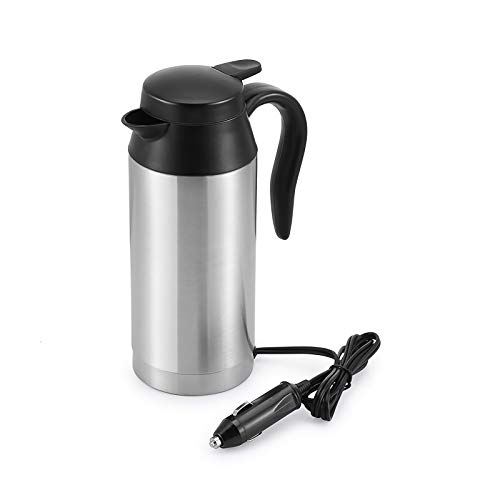
Sunsbell Portable Electric Car Kettle 650ml (Heated Travel Mug) — Best Heated Travel Mug
This is the pick for the buyer who meant the 12 volt part literally. It heats in the vehicle — water for tea or instant coffee, or a made drink kept properly hot — and then serves as the mug itself. It suits commuters and drivers whose drinks are made on the road. It does not suit buyers whose drink starts hot at home; they need insulation, not an element, and the passive classes below serve them better.
Strengths
- Genuinely heats: the only way to make or rescue a hot drink in the vehicle
- 650ml mug-format capacity covers a large drink in one cycle
- One vessel to wash, carry, and cuphold — kettle and mug combined
Trade-offs
- Requires the socket and the cord; not a walk-away insulated mug
- 12V only, so 24V truck users need a dual-voltage alternative
- Unplugged, it keeps heat only as well as its walls allow — it is not a vacuum flask
| Specification | Detail |
|---|---|
| Capacity | 650ml (per API listing title) |
| Power | 12 volt DC (per API listing title) |
| Material | Stainless steel (per API listing title) |
| Roles | Heating travel cup, kettle, coffee warmer (per API listing title) |
As a travel mug, the Sunsbell earns its place by ending the cold-coffee problem at the root. Passive mugs manage decline; this mug reverses it. The driver who plugs in at departure drinks at temperature at arrival, and the driver on a long shift can restore a drink that a passive mug would have surrendered hours earlier. That capability is what the 12 volt half of this keyword is actually asking for.
Its honest boundary is the cord. This is a vehicle appliance in mug form, happiest in the cupholder of a car that is running, and it should be bought by people whose drinking happens there. For the desk, the train, or the school run on foot, the passive classes below are the right tools — and this guide would rather sell you those, in prose, than pretend one product does both lives.
Best for: drivers who make or reheat drinks in the vehicle / Not suited for: walk-away insulation needs
Check on Amazon to see the current listing for the Sunsbell 650ml.

Miicasa Car Electric Kettle Insulated Tumbler (Heated, 6 Temperatures) — Best Heated Mug with Insulation
Choose this if you refuse the fork. The Miicasa behaves like a proper insulated travel tumbler — vacuum walls holding temperature after unplugging — and also heats from the vehicle socket with drink-specific temperature control. It suits drivers whose day mixes driving and away-from-car hours. It suits car and truck alike. Buyers wanting maximum passive performance alone should still read the passive classes; this is a hybrid, with a hybrid compromises.
Strengths
- Vacuum insulation plus heating: holds heat unplugged, restores it plugged
- Six temperature settings for tea, coffee, and everything between
- 12/24V dual voltage for mixed car and truck households
Trade-offs
- Hybrid design costs more class than a pure passive mug
- Heating still happens at socket pace while plugged in
- More features to learn than any passive mug asks
| Specification | Detail |
|---|---|
| Power | 12V/24V (per API listing title) |
| Temperature | 6 temperatures (per API listing title) |
| Build | Stainless steel vacuum insulated tumbler (per API listing title) |
Hybrids usually inherit the weaknesses of both parents; this one inherits the strengths in the order a driver needs them. The insulation does the daily work — the morning drink stays hot through the commute and the first meetings — while the element waits for the moments insulation cannot cover: the afternoon refill heated from water, the long-drive restoration, the tea made at a rest stop. Six temperatures make those moments precise rather than approximate.
For the genuinely undecided reader of this guide, this is the safest single purchase on the page: it cannot be the wrong category, because it is both. The premium over a passive mug buys the option on every future road drink, and for drivers who live in their vehicles, that option gets exercised weekly.
Best for: drivers who want insulation and heating in one mug / Not suited for: pure passive simplicity at the lowest cost
Check on Amazon to see the current listing for the Miicasa tumbler.

Car Travel Electric Kettle 400ml Heating Mug (Anti-Spill) — Best Compact Heated Mug
Solo drivers in smaller cars are the audience: one drink, heated precisely, in a bottle-format mug whose lid takes the road seriously. Dual voltage extends it to trucks. It suits short commutes, where its small volume heats fastest in the heated class. It does not suit sharing or the two-cup routine — the Sunsbell capacity exists for that.
Strengths
- Anti-spill lid designed for real roads (per API listing title)
- Variable temperature control up to 100°C (per API listing title)
- Compact size heats fastest and fits any cupholder
Trade-offs
- 400ml is one serving per cycle
- Heated-class cord and socket dependence, as with all heated picks
- Small format is a poor choice for passengers or groups
| Specification | Detail |
|---|---|
| Capacity | 400ml (per API listing title) |
| Power | 12V-24V compatible (per API listing title) |
| Temperature | Variable, up to 100°C (per API listing title) |
| Lid | Anti-spill (per API listing title) |
Every heated mug heats; the differentiator at this end of the class is what happens after. The anti-spill lid acknowledges that the mug lives on a moving, braking, cornering platform, and that a precisely heated drink on the upholstery is worse than a slightly cooler one in the cup. Combined with the fastest heat-up in the guide — physics rewarding the smallest volume — the package is the short-commute instrument of the class.
It also travels between vehicles gracefully: bottle format, dual voltage, one-serving discipline. Drivers who keep a mug in the car rather than carrying one from the house will find this the lowest-friction version of the heated idea.
Best for: solo drivers and short commutes / Not suited for: sharing or large drinks
Check on Amazon to see the current listing for the 400ml heating mug.
The Vacuum-Insulated Stainless Commuter Mug (Passive Class) — Best Passive Class for Hot Drinks
This class is the answer for the majority of travel-mug buyers, including many who typed 12 volt into the search box out of habit. Your drink starts hot; the vacuum wall — the same principle as a flask — slows its cooling to a crawl for hours, with no power, no cord, and nothing to unplug. It suits commuters, school runs, and desk days. It cannot help a drink that starts cold or must be made in the car.
Strengths
- Hours of heat retention with zero power draw and zero cord
- Bombproof daily simplicity: fill, seal, go, wash
- Widest choice of sizes, lids, and cupholder fits of any class in this guide
Trade-offs
- Can only slow cooling, never reheat — a forgotten drink is a cold drink
- Quality varies enormously by lid seal and steel grade; the class rewards buying well
- No help at all for making drinks in the vehicle
The physics of the passive mug is the physics of absence: a vacuum between two steel walls conducts almost nothing, so the drink heat has nowhere to go. A well-made commuter mug keeps coffee properly hot across a morning and warm into the afternoon, which covers the overwhelming majority of real travel-mug days. The buying variables are human, not electrical: a lid that seals against a handbag or a braking car, a base that fits your cupholder, a mouth that drinks pleasantly, and a finish that survives the dishwasher years.
Buy this class by those variables and by steel quality, in a size matched to your actual drink — most commuters land between a medium coffee-shop large and a big homemade pour. It is covered in prose because no single model is the right answer for every cupholder and hand; the class guidance above is the honest help, and it will outlast any model cycle.
Best for: hot drinks made at home or bought on the way / Not suited for: making or reheating drinks in the vehicle
Prose-only pick: Prose-only class pick: passive insulated mugs have no 12V function and are chosen by fit/lid/size; no single API-verified listing in this programme represents the class, so no link is given rather than attaching an unverified ASIN.
The Insulated Tumbler Class for Cold Drinks (Passive Class) — Best Passive Class for Iced Drinks
Cold-drink people are a distinct nation and this is their mug: a large insulated tumbler, usually with a straw or sip lid, that keeps iced coffee, tea, or water cold for a full day of driving and desk. It suits summer commuters, gym routines, and anyone whose drink is measured in ice hours. It does not suit hot-drink purists — the wide mouths and straw lids that serve cold drinks spill heat and, occasionally, coffee.
Strengths
- Ice retention across a full day is this class party trick
- Large capacities match hydration habits rather than coffee servings
- Cupholder-tapered bases are standard across the class
Trade-offs
- Hot drinks cool faster here than in a sealed commuter mug
- Straw lids are the least spill-proof lids in the guide
- Size can exceed smaller cupholders despite the taper — measure first
The tumbler class exists because cold drinks fail differently: the enemy is dilution as much as warmth, and a vacuum wall that keeps ice solid keeps the last sip tasting like the first. For drivers in hot climates this is not a preference but a category of sanity, and the class has evolved around the vehicle — tapered bases, big grips, lids that accept a straw without removing a hand from life for long.
Choose within the class by lid honesty and size truth: a lid you trust at your roads speed, and a capacity matched to your refill reality rather than your ambition. Like the commuter class, it is presented in prose because fit and lid decide satisfaction, and those are personal measurements no badge can take for you.
Best for: iced drinks, hydration, and hot-climate driving / Not suited for: hot drinks or maximum spill security
Prose-only pick: Prose-only class pick: passive tumblers have no 12V function; selection is by size/lid/fit, so no single ASIN is linked.
The Ceramic-Lined Taste-First Mug Class (Passive Class) — Best Passive Class for Taste
A minority of drinkers — real, vocal, and correct about their own palates — find that coffee and tea from bare stainless carry a metallic note. The ceramic-lined class answers them: insulation outside, a neutral ceramic drinking surface inside. It suits taste-first commuters and tea drinkers especially. It does not suit the careless: linings reward gentler washing and no metal scouring, and the class usually costs a premium over plain steel.
Strengths
- Neutral taste surface for coffee and tea purists
- Full passive insulation performance behind the lining
- Often paired with the best-sealing lids in the passive market
Trade-offs
- Premium cost class within passive mugs
- Lining care: no abrasive cleaning, more mindful washing
- Still purely passive — no reheating a drink that has gone cold
Taste is the most personal specification in this entire guide, and the one least visible in a product table. The ceramic-lined class survives because, for its drinkers, it removes the single flaw of the stainless commuter mug — and a mug used twice a day for years should be bought on exactly that kind of daily detail. If you have ever abandoned a steel mug over flavour, this class was designed from your complaint.
It closes the passive side of the guide deliberately: three classes, three different definitions of the best travel mug — retention, cold, and taste — none of them involving a plug. Readers who arrived here expecting electricity and leave with a passive class have not been short-changed; they have been correctly diagnosed, which is the service this page exists to provide.
Best for: taste-sensitive coffee and tea drinkers / Not suited for: rough handling or lowest cost
Prose-only pick: Prose-only class pick: passive ceramic-lined mugs have no 12V function and are chosen by taste/fit; no single verified ASIN is linked.
Comparison Table
The table places the heated products and the passive classes side by side, with the kind of mug stated in the key-spec column so the comparison never blurs the line this guide exists to draw.
| Pick | Badge | Key spec | Best for |
|---|---|---|---|
| Sunsbell Portable Electric Car Kettle 650ml (Heated Travel Mug) | Best Heated Travel Mug | 650ml heated mug, 12V | drivers who make or reheat drinks in the vehicle |
| Miicasa Car Electric Kettle Insulated Tumbler (Heated, 6 Temperatures) | Best Heated Mug with Insulation | Insulated tumbler, 6 temps, 12/24V | drivers who want insulation and heating in one mug |
| Car Travel Electric Kettle 400ml Heating Mug (Anti-Spill) | Best Compact Heated Mug | 400ml, anti-spill, variable temp | solo drivers and short commutes |
| The Vacuum-Insulated Stainless Commuter Mug (Passive Class) | Best Passive Class for Hot Drinks | Passive vacuum-insulated class | hot drinks made at home or bought on the way |
| The Insulated Tumbler Class for Cold Drinks (Passive Class) | Best Passive Class for Iced Drinks | Passive insulated tumbler class | iced drinks, hydration, and hot-climate driving |
| The Ceramic-Lined Taste-First Mug Class (Passive Class) | Best Passive Class for Taste | Passive ceramic-lined class | taste-sensitive coffee and tea drinkers |
Use the table as the fork made visible: if any row in the heated half matches your routine, buy there; if your drink always starts hot or cold from elsewhere, the passive half serves you at lower cost and zero cords. The Miicasa stands at the fork itself for households that genuinely live both lives.
Travel Mug or Heated Mug: The Decision This Keyword Hides
Ask where your drink is born. Born at home or at a café, already at temperature, your problem is retention, and retention is a passive problem: vacuum walls, a sealing lid, the right size. Born in the vehicle — from water, from powder, from a bottle that must become tea — your problem is heating, and heating is an element, a plug, and the heated class. The keyword mixes the two births because shoppers do; your routine does not have to.
Ask also where your drink dies. A drink finished within the hour barely needs insulation at all, and either class is over-built for it. A drink nursed across a shift needs the best passive retention you can buy, or the heated restoration only the plug-in class offers. The honest answers to those two questions — birth and lifespan — select the side of this guide you should shop from with more reliability than any badge.
How to Choose a Travel Mug: Fit, Lid, and Size Before Everything
For passive mugs, the cupholder is the first specification: measure its diameter and the clearance above it, because a mug that rides in your hand or wedges against the console will be left at home by week two. The lid is the second specification, and the one that decides spills: commuters need a true seal, cold-drink tumblers trade some seal for straw access, and every buyer should test the lid one-handed, because that is how it will be used at every junction for years.
For heated mugs, add the electrical checks from the companion heated-mug guide: capacity against routine, temperature control against drink, dual voltage if a truck shares the mug, and an anti-spill lid where offered. Size comes last in both worlds, and it should be your drink size — the size you actually finish — rather than the largest the holder accepts. Mugs are daily objects; ergonomic truth beats catalogue ambition every single morning.
Budget Tiers Across Both Mug Worlds
Passive mugs span the gentlest tiers in this series: a serviceable insulated mug costs little, a premium one buys lid engineering, steel quality, and — in the ceramic-lined class — taste neutrality. The value concentrates at the lid and the seal, so the mid tier of passive is the rational ceiling for most buyers; beyond it you are paying for finish and brand, which are pleasures, not performance.
Heated mugs sit a tier above passive at every size, because they are appliances: element, control, cord, and vessel in one. Within the heated class, spend first on the capacity your routine drinks, then on temperature control if your drinks have opinions. And across both worlds, the cheapest correct purchase is the one that matches your drink birthplace — a premium passive mug will never heat, and a heated mug will never be as simple as the flask it replaces on foot.
A Short History of the Confusion: Why This Keyword Mixes Two Products
The muddle in this keyword has an ordinary origin. Sellers discovered that buyers searching for travel mugs would also click heated products, and buyers searching for heated mugs would also click insulated ones, so listings began collecting both vocabularies at once — travel mug in the title, 12 volt in the keywords, heating in the bullets, insulation in the photographs. Search results inherited the mixture, and a generation of shoppers learned to treat the two products as one category with confusing reviews: five-star praise for heat retention beside one-star anger that a mug never heated anything.
Both reviewers were right about different products. That is why this guide spends its length on the distinction rather than on a longer list: the classification is the content. Once a buyer can say, in one sentence, whether their drink is born hot or must be made hot, every subsequent decision — budget, size, brand, lid — becomes easy, in this guide and in any shop. The distinction is also portable: it applies to flasks, bottles, and every future vessel that marketing will try to blur.
If this page has a single ambition, it is that its readers never again pay appliance money for insulation, or insulation money expecting an appliance. Everything else — the picks, the classes, the tables — is scaffolding around that one act of clarity.
Mugs for Passengers, Children, and the Second Seat
Most mug guidance is written for the driver, but vehicles carry other people, and their mug needs differ in ways worth a section. Passengers can handle larger capacities and two-handed lids, which makes the big passive tumblers and the larger heated vessels better second-seat choices than driver choices. A passenger heated mug also changes the social maths of the heated class: one 750ml vessel serving two people is a shared appliance, and its longer heat-up is amortised across two drinks.
Children change the specification entirely: smaller volumes, lids that seal completely rather than conveniently, exteriors that stay cool to hold, and — for heated vessels — the firm rule that heating is an adult job done at a stop, with the drink checked before it is handed over. The anti-spill compact pick in this guide is the closest heated fit for family use precisely because its lid takes containment seriously, but the supervision rule stands above any product feature.
The second-seat lesson generalises: buy the driver mug by the driver constraints in the main guide, then buy passenger vessels by their looser, larger logic, instead of forcing one purchase to serve two different seats badly. Households that split the purchase this way report the rare outcome of everyone in the vehicle liking their own mug.
The One-Mug Household vs the Stable: How Many Mugs Do You Actually Need
A closing thought experiment this guide offers every reader: count the mugs your household actually uses weekly. Most discover a stable, not a single champion — the driver commuter mug, the big cold tumbler, the small taste-first favourite, perhaps the heated vessel in the work vehicle. That is not consumer excess; it is the natural result of the distinctions this guide has drawn, because no one vessel wins on retention, capacity, taste, and heating at once. The honest buying strategy is therefore per-role: choose the best mug for each real role, using the classes above, and retire the drawer of almost-right freebies they replace.
The exception proves the rule usefully. The genuine one-mug household exists — the solo driver whose drink is born in the vehicle and dies on the same commute — and for that reader the hybrid Miicasa or the Sunsbell heated mug really can be the single purchase this whole keyword was hunting for. Everyone else should buy the stable, role by role, and enjoy the quiet satisfaction of a mug cupboard where every occupant has a job.
Pre-Purchase Checklist for Any Travel Mug
One: complete the founding sentence — my drink is born (at home / at a café / in the vehicle) and dies (within the hour / across the morning / across the shift) — and let it assign you to the heated or passive half of this guide before any model is discussed. Two: measure the cupholder, diameter and clearance, and take the numbers shopping; a mug that does not ride in the holder does not ride at all. Three: choose the lid as if it were the product, because in daily use it is: seal for commuters, straw for the cold class, anti-spill for the heated compact, one-handed operation for everyone.
Four: size to the drink you finish, not the drink you imagine. Five: for passive mugs, set the class by your palate and your climate — retention, cold, or ceramic-lined taste — and buy the best lid and steel in that class rather than the largest discount. Six: for heated mugs, run the companion checklist on voltage, capacity, and control. A mug bought through these steps joins the small set of objects a household uses daily for years; a mug bought on impulse joins the drawer. The difference was never the mug — it was the six questions asked before it.
The Mug Drawer Audit: A Five-Minute Exercise Before You Buy
Before any mug in this guide is purchased, this guide prescribes a five-minute audit of the mug drawer or cupboard you already own. Lay out every travel vessel in the household. For each one, answer three questions: when did it last leave the house, what drink was in it, and why is it not the answer to this purchase? The audit is occasionally embarrassing — most households find a serviceable passive mug they had forgotten — and it is always clarifying, because it converts a vague feeling of needing a mug into a specific, named gap.
The gap usually names itself in the language of this guide: nothing here heats; nothing here seals; nothing here fits the new car holder; everything here tastes of steel. Each of those sentences is a purchase specification, and each maps to a pick or a class above. If the audit finds no gap at all, the correct purchase is none, and this guide is content — its job was the clarity, and the clarity sometimes spends nothing. Readers who run the audit first buy once, correctly, which is the whole philosophy of this series compressed into a kitchen drawer.
Gifting a Travel Mug Without Getting It Wrong
A closing, lighter application of everything this guide teaches: the travel mug is a classic gift, and a classic gift failure, because givers buy the silhouette and not the routine. The audit questions repair this. Where is the recipient drink born — the home machine, the café on the corner, or the vehicle itself? How long must it live? Which vehicle, and what cupholder? Three answers, obtainable in one casual conversation, convert the gift from a guess into the per-role purchase this guide recommends for oneself.
The heated version is the gift with the highest delight and the highest risk: transformative for the driver whose routine it matches, puzzling for the train commuter who has no socket to offer it. The passive classes are the safer generosity — a ceramic-lined mug for the taste-sensitive friend is a gift that says you listened, which is rarer and more valuable than any specification. Buy the routine, wrap the mug, and the gift joins the small set of presents that are still in daily use a year later.
How to Get the Most from a Travel Mug, Heated or Passive
Pre-condition the vessel. For a passive mug, fill it with hot water for a few minutes before the coffee goes in on cold mornings — a warm wall spends none of your drink heat — and rinse it cold before iced drinks in summer. For a heated mug, plug in at departure and let the drive do the heating, rather than idling the engine or draining the battery at a standstill for a drink.
Seal, seat, and check: lid fully closed, mug fully seated in the holder, cord routed where it cannot catch a gear lever or a knee. These three seconds, repeated daily, prevent essentially every travel-mug accident ever recorded. At the destination, unplug heated mugs without exception, and carry passive mugs by the body, not the lid — lids are closures, not handles, whatever they look like.
Wash like you mean it. Coffee oils and milk residue are the quiet ruin of both classes: a daily rinse, a weekly wash with the lid disassembled as far as it allows, and a monthly descale for heated vessels in hard-water areas keep every drink tasting like itself. A mug maintained this way serves for years; a mug rinsed occasionally serves until the first sip that tastes like last month.
Common Buying Mistakes
The keyword mistake itself is the first: ordering a passive mug and expecting heat, or a heated mug and expecting flask-like unplugged endurance. This guide has separated the two from its first paragraph; carry that separation into any other shop or listing you read, because most of them will not make it for you.
The second mistake is buying size by ambition. The largest mug that fits the holder is usually larger than the drink you finish, and the surplus is weight, washing, and — in the heated class — heating time you pay daily for capacity you use never. Buy your drink, not your thirstiest day of the year.
The third mistake is lid negligence: trusting a sip lid like a seal, carrying by the lid, or never washing under the slider. Lids are the moving part of every mug in this guide, heated lids included, and they repay the small maintenance they ask with years of dry upholstery.
Finally, do not leave a heated mug plugged into a parked vehicle, and do not leave any mug of hot liquid where a child or a pet can reach it during stops. Small disciplines, kept daily, are the entire safety story of this category.
Final Recommendation
If your drinks are made in the vehicle, buy heated: the Sunsbell 650ml for the full heat-and-drink routine, the Miicasa tumbler if you also want true insulation and temperature control, or the compact anti-spill 400ml for the solo short commute. If your drinks are made elsewhere, buy passive and buy by class: vacuum stainless for hot retention, the tall tumbler class for iced days, ceramic-lined if your palate demands it.
Either way, you now own the distinction this keyword hides, and it will serve you in every future listing that blurs it. The best 12 volt travel mug is the one whose kind — heated or passive — matches the life of your drink. Choose the kind first, and the model chooses itself.
Shop the verified picks: Sunsbell 650ml. Miicasa tumbler. 400ml heating mug. Each link goes to the current Amazon listing, where you can check price on Amazon before you buy.
Related guides in this series: Best 12 Volt Travel Heated Mug Best 12 Volt Stove Best 12 Volt Space Heater Best 12 Volt Thermoelectric Cooler Best 12 Volt Television.
Frequently Asked Questions
Is a travel mug the same as a heated travel mug?
No. A travel mug is passive insulation: it slows a drink cooling or warming and has no power source. A heated travel mug adds a vehicle-powered element that can heat drinks and keep them hot while plugged in. This guide covers both, labels each pick clearly, and links only the verified heated products.
Do travel mugs need 12 volts?
Ordinary travel mugs need no power at all — the 12 volt in this keyword refers to the heated sub-category. If your drink starts at the right temperature, a passive mug is the complete, cordless answer, which is why half of this guide picks are passive classes.
How long does a good travel mug keep coffee hot?
A well-made vacuum-insulated mug keeps coffee properly hot through a morning and drinkably warm well beyond it, provided it was pre-warmed and the lid seals well. Exact endurance varies with size, fill level, and how often the lid opens — every opening spends heat no wall can save.
Which is better for a long shift: heated or passive?
For a single drink nursed all shift, a premium passive mug or the insulated heated Miicasa both serve. For drinks made or refreshed during the shift — a second tea, a reheated coffee — only the heated class answers. Many shift workers end up with the hybrid for exactly this reason.
Can a heated travel mug replace a travel mug entirely?
In the vehicle, largely yes: it drinks like a mug and heats like a kettle. Away from the vehicle it is a heavier, corded object with ordinary unplugged retention, so walkers, train riders, and desk workers are usually happier with a passive mug as their main vessel.
What size travel mug should I buy?
The size of the drink you actually finish: a medium-large coffee for most commuters, a full litre-class tumbler only for genuine all-day hydration habits. Oversized mugs heat slower, wash worse, and get left behind — the daily-fit size is the correct size.
Can I put a travel mug in the dishwasher?
Many passive stainless mugs are dishwasher-tolerant for the body, but lids with seals and sliders last longer washed by hand, and heated mugs must never be immersed or dishwashed — their electrical parts are wiped and rinsed only, following the maker instructions. When in doubt, hand-wash: it takes a minute and doubles the life of every seal in this guide.
Why does coffee taste different from a travel mug than from a cup?
Three small causes: the lid changes how aroma reaches you, which changes perceived flavour; stainless can carry a faint note for sensitive palates, which the ceramic-lined class exists to solve; and yesterday coffee oils, unwashed, season today drink. A clean mug, an open sip when parked, and the right interior material close almost the whole gap.


