Disclosure: airfryerkitchensupply.com is reader-supported. When you buy through links on our site, we may earn an affiliate commission at no extra cost to you.
Where to Buy
Every fan in this guide was verified against Amazon’s catalog data — brand, size, 12 volt PWM operation, and pressure-optimised design — before inclusion. Use the Check on Amazon links to confirm availability and check the current price on Amazon; we do not print static prices. One clarification this category needs: every fan here is a native 12 volt DC fan, the standard for PC and electronics cooling. “Static pressure” means the fan is designed to push air through resistance — radiator fins, heatsinks, filters — rather than merely move air in open space, and “silent” is judged at the speeds a quiet build actually uses, not at a laboratory minimum.
Start with our top three: Noctua NF-A12x25 PWM, Noctua NF-A12x25 G2 PWM, ARCTIC P12 PWM PST 5 Pack.
The best 12 volt silent static pressure fan solves a specific physics problem: moving air through things that do not want air moved through them. A radiator’s fin stack, a tower heatsink, a dense dust filter — each resists airflow, and a fan designed only for open-air volume numbers quietly fails against that resistance. Static pressure is the measure of a fan’s ability to keep pushing anyway, and silence is the art of doing it without announcing itself to the room.
This category has an unusual shape: it is dominated by two makers with opposite philosophies. Noctua builds benchmark fans at premium prices, with obsessive blade and bearing engineering, and sells them one at a time to people who keep them for a decade. ARCTIC builds pressure-optimised fans that capture most of the performance for a fraction of the cost, and sells them in five packs to people outfitting whole systems. Both philosophies are represented honestly in the picks — the right answer depends on whether you are buying two fans or seven, and on how literally you mean the word silent.
Every pick is a 120mm, 12 volt DC, pressure-optimised fan — the size class where this technology is most developed. That 12 volt standard also makes these fans citizens of a wider world: the same fans cool RV electronics bays, solar charge-controller cabinets, network racks, and 3D printer enclosures, anywhere a 12V supply and a noise budget coexist. The buying guide covers both the PC brief and the project brief.
A note on honesty in fan specifications: the industry measures noise and pressure under conditions that flatter every brand, so this guide ranks on design, verified specification, and the consensus behaviour of each platform rather than on any single laboratory number. Where a pick is a compromise — and the slim fan below is proudly one — the review says so.
In this guide
Quick Picks
Short on time? These are the six best 12 volt silent static pressure fan options we would actually buy, from the benchmark Noctua to the five-pack ARCTIC value play. Every pick was verified against Amazon’s catalog data, and every link lets you check the current price on Amazon.
- Noctua NF-A12x25 PWM — Best Overall: The reference 120mm static pressure fan: a 12V PWM fan engineered for radiators and dense heatsinks that delivers high static pressure at genuinely low noise — the fan this entire category is measured against. — Check on Amazon
- Noctua NF-A12x25 G2 PWM — Best Premium — Newest Generation: The second generation of the reference fan: Noctua’s G2 revision of the A12x25 platform, again 120mm, 12V PWM, high airflow and static pressure at low noise — for buyers who want the newest iteration of the best. — Check on Amazon
- ARCTIC P12 PWM PST (5 Pack) — Best Value: The value benchmark: pressure-optimised 120mm PWM fans with daisy-chain PST sharing, sold as a five pack — a whole case or radiator setup for the tier of a single premium fan. — Check on Amazon
- Noctua NF-P12 redux-1700 PWM — Best Mid-Range Noctua: Noctua’s redux line brings its proven pressure fan design down a tier: a 120mm, 1700 RPM PWM fan with high airflow and low noise in a streamlined, no-frills package. — Check on Amazon
- ARCTIC P12 Silent — Best for Silence-First Builds: A pressure-optimised 120mm fan designed around a low fixed speed for near-inaudible operation — the pick when the brief is silence first and cooling loads are modest. — Check on Amazon
- ARCTIC P12 Slim PWM PST — Best Slim Fan: The space-saver: a slim-profile 120mm pressure-optimised PWM fan with PST sharing, for small-form-factor builds and tight radiator clearances where a standard 25mm fan cannot fit. — Check on Amazon
How These Picks Were Chosen
We verified every candidate against Amazon’s catalog data and applied four filters. First, native 12 volt DC operation with PWM control where the design calls for it — these are PC-standard fans, and off-voltage curiosities were excluded. Second, genuine static pressure design: a pressure-optimised impeller intended for radiators, heatsinks, or filters, not a generic airflow case fan. Third, a credible silence story — low-noise design intent verified in the listing and consistent with the platform’s reputation. Fourth, the 120mm size class, where pressure fan development is concentrated and mounting is universal.
Within those filters we ranked on pressure capability, acoustic behaviour at realistic speeds, bearing and build quality, control flexibility, and value per fan in the quantities builders actually buy. We deliberately included both ends of the market — flagship and value — because the honest answer in this category is famously “it depends on how many you need.”
Excluded: high-speed industrial 12V fans whose noise disqualifies them from any silent brief, 5V USB fans (a different category), and unbranded fans whose pressure claims dissolved under cross-checking. What remains is the short list the enthusiast community itself keeps arriving at, verified model by model.
The 6 Best 12 Volt Silent Static Pressure Fan Options, Reviewed

Noctua NF-A12x25 PWM — Best Overall
Check the current price on Amazon
Some products define their category, and the Noctua NF-A12x25 PWM is the defining static pressure fan of the last decade. The verified listing states its design brief plainly: a high-performance quiet 120mm fan with high airflow and static pressure, 25mm thick, built for coolers, radiators, and cases. It runs on 12 volts with PWM speed control, like every fan in this guide.
The engineering story is in the details Noctua is known for: impeller blades placed extremely close to the frame to stop pressure leaking backwards, a metal-reinforced motor hub, and a bearing designed for long service. The result is a fan that pushes air through the dense fin stack of a radiator without needing to spin — and scream — to do it.
Strengths
- Benchmark static pressure performance for restrictive radiators and heatsinks
- Genuinely quiet at the speeds where rivals start to drone
- Premium bearing and build, backed by Noctua’s long warranty culture
Trade-offs
- Premium-tier price for a single fan — a full radiator set adds up
- The classic Noctua colour scheme divides opinion (a black version is pick six below)
- Peak airflow for open case exhaust is matched by cheaper fans; you pay for pressure and quiet
| Spec | Detail |
|---|---|
| Size | 120mm x 25mm |
| Power | 12V DC, PWM control |
| Design focus | Static pressure for radiators/heatsinks |
| Includes | Rich accessory bundle (per listing) |
Why does static pressure decide radiator performance? A radiator or tower heatsink is a wall of fins with narrow air channels. A fan rated for big open-air airflow numbers can stall against that resistance, moving far less air than its headline figure. A pressure-optimised fan like the NF-A12x25 keeps pushing. The practical result: the same cooling at lower RPM, and lower RPM is where silence lives.
In a silent build, the NF-A12x25 is usually run on a curve that keeps it near-inaudible at idle and moderate load, reserving its upper range for genuine heat. Owners coming from stock case fans describe the change less as “quieter fan” and more as “the computer stopped being a presence in the room.” For a bedroom PC, a studio machine, or a living-room build, that is the entire purchase justified.
Beyond PCs, this is the fan that appears in 12 volt project builds everywhere — RV electronics bays, solar inverter cabinets, 3D-printer enclosures — anywhere a 12V supply needs quiet, reliable, pressure-capable airflow. The guide’s how-to section covers that wiring honestly, including the PWM control question.
Best for: radiator and heatsink cooling where silence and pressure both matter / Not suited for: buyers who need several fans on a tight budget (see the ARCTIC value pick)

Noctua NF-A12x25 G2 PWM — Best Premium — Newest Generation
Check the current price on Amazon
The NF-A12x25 G2 PWM is Noctua’s generational update to its own benchmark. The verified listing describes the same mission — a high-performance quiet 120mm fan with high airflow and static pressure, low-noise 25mm design for coolers, radiators, and cases — executed as the G2 revision of the platform.
Generational updates from Noctua are evolutionary by philosophy: refine the blade geometry, the frame, and the motor behaviour, keep everything that made the original the reference. The G2 is the pick for a new build where the fans will serve for the life of the machine and the buyer wants the current state of the art rather than the previous one.
Strengths
- The newest refinement of the category’s reference design
- Static pressure and acoustics at the top of the 120mm class
- Built and warranted for long service — a buy-once component
Trade-offs
- The highest tier in this guide; value buyers should look at ARCTIC
- Incremental over the original A12x25 — not a necessary upgrade
- Availability of the newest generation can fluctuate; check the listing
| Spec | Detail |
|---|---|
| Size | 120mm x 25mm |
| Generation | G2 (second generation A12x25) |
| Power | 12V DC, PWM control |
| Design focus | Static pressure, low noise |
Who should pay the G2 premium? Builders assembling a machine they intend to keep through several component generations — the fans, case, and power supply are the parts that persist, and a fan set bought once at this level simply disappears from the owner’s attention for years. That invisibility is the product.
In radiator service, run G2 fans as a matched set on one curve. Matched fans on a shared header or splitter behave predictably, avoid beat-frequency droning between mismatched units, and let a single tuned curve serve the whole radiator. The accessory ecosystem and cabling discipline Noctua ships supports exactly that kind of clean installation.
If you already own original A12x25 fans, keep them and spend elsewhere — this guide’s honesty rule applies to upgrades too. The G2 is for new builds and for replacing genuinely lesser fans, where its advantage is not incremental but categorical.
Best for: new flagship builds and anyone replacing a full fan set once, properly / Not suited for: owners of the original A12x25, whose upgrade gain is incremental

ARCTIC P12 PWM PST (5 Pack) — Best Value
Check the current price on Amazon
The ARCTIC P12 PWM PST is the fan that made pressure-optimised cooling affordable, and the five pack is the form most builders should buy it in. The verified listing gives the essentials: 120mm case fans with PWM Sharing Technology, pressure-optimised design, a quiet motor, and a 200 to 1800 RPM range that can drop to 0 RPM at low PWM signal.
PST — PWM Sharing Technology — is the quietly brilliant feature: the fans daisy-chain, sharing one header’s signal, so a five-fan installation does not require five motherboard headers or a separate controller. For clean, simple builds, that matters as much as the acoustics.
Strengths
- Pressure-optimised performance at a fraction of premium-fan cost
- PST daisy-chaining simplifies multi-fan wiring enormously
- Wide 200-1800 RPM range with 0 RPM stop at low signal
Trade-offs
- At equal RPM it is not as quiet as the Noctua picks — the gap is real
- Bearing and accessory refinement are a class below the premium tier
- Five packs tempt over-fanning; more fans at low speed beats fewer at high, but plan the layout
| Spec | Detail |
|---|---|
| Size | 120mm |
| Speed range | 200-1800 RPM (0 RPM below 5% PWM, per listing) |
| Control | PWM with PST sharing |
| Pack | 5 fans |
The honest comparison: at the gentle speeds a silent build actually uses, the P12 gets you most of the way to the premium experience for a small fraction of the money. The last stretch — the final few decibels, the smoothest tone, the longest bearing life — is what Noctua money buys. Many builders rationally stop at the P12, outfit the entire case, and put the savings into storage or graphics. This guide respects that arithmetic.
On radiators, the P12’s pressure-optimised impeller is the right tool — this is not a generic case fan being stretched into radiator duty, it is ARCTIC’s pressure line doing its designed job. A 360mm radiator takes three; the five pack covers that plus two case positions, which is why the pack size is so well judged.
One setup note: with PST chaining, confirm your motherboard header’s current rating before hanging five fans on it — the fans are frugal, but headers have limits, and a powered hub is cheap insurance for big chains.
Best for: full case and radiator builds on a real-world budget / Not suited for: silence absolutists chasing the last few decibels
Noctua NF-P12 redux-1700 PWM — Best Mid-Range Noctua
Check the current price on Amazon
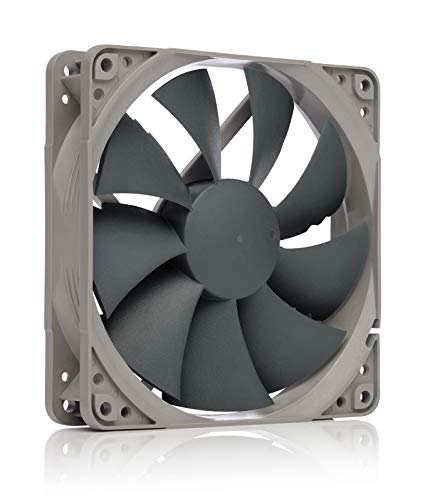
The redux line is Noctua’s answer to a fair question: what if I want the engineering without the elaborate bundle? The NF-P12 redux-1700 PWM takes the long-proven P12 pressure fan design — the fan that built Noctua’s radiator reputation before the A12x25 existed — and sells it in a streamlined package at a friendlier tier. The verified listing confirms the formula: quiet 120mm fan, high airflow, low noise, 25mm thick, 1700 RPM, 4-pin PWM.
The P12 design’s specialty was always static pressure per dollar within the Noctua range: dense heatsinks and radiators are its home ground, and its pressure credentials come from an era when it was the enthusiast default.
Strengths
- Proven Noctua pressure design at a mid-range tier
- 1700 RPM ceiling gives real headroom for hot components
- Streamlined package: pay for the fan, not the accessories
Trade-offs
- An older design generation than the A12x25 — good, not benchmark
- No rich accessory bundle; cables and extras are minimal
- Grey redux colourway suits some builds and clashes with others
| Spec | Detail |
|---|---|
| Size | 120mm x 25mm |
| Max speed | 1700 RPM (per listing) |
| Power | 12V DC, 4-pin PWM |
| Line | redux — streamlined package |
The redux-1700 is the connoisseur’s budget Noctua: chosen by builders who know the P12’s history and do not need the flagship’s last decibel. On a tower air cooler — the duty this design was born for — it remains an excellent, quiet, pressure-capable choice, and on radiators it performs with the same competence.
The 1700 RPM ceiling distinguishes it from gentler fans in this guide. If your cooling problem includes genuinely hot components in a warm room, headroom is a feature: a fan that can reach 1700 RPM but usually runs at 800 is a quieter long-term proposition than a fan straining at its 1200 RPM maximum.
Buy it as the workhorse of a build — heatsink and radiator positions — and consider the ARCTIC picks for pure case airflow, where pressure matters less. Mixed fleets are normal in considered builds; match each fan to its resistance load.
Best for: buyers who want Noctua engineering without the flagship price or accessory bundle / Not suited for: buyers who want the A12x25’s absolute acoustic ceiling

ARCTIC P12 Silent — Best for Silence-First Builds
Check the current price on Amazon
The ARCTIC P12 Silent takes the pressure-optimised P12 platform and tunes it for the quietest possible brief: a low, fixed operating speed that keeps the fan near the threshold of hearing while still pushing air through resistance. The verified listing describes it plainly as a 120mm PC case fan, pressure-optimised — the silent member of the P12 family.
Fixed low speed is a deliberate design philosophy, not a missing feature. A fan that cannot spin fast cannot be made loud by a bad fan curve, a hot day, or a motherboard’s aggressive default profile. For machines that live in bedrooms and recording spaces, that guarantee has real value.
Strengths
- Near-inaudible by design — silence is structural, not a setting
- Pressure-optimised impeller still serves heatsinks and slim radiators
- Simple installation: no curve tuning required to get the promised quiet
Trade-offs
- Low fixed speed means a hard ceiling on cooling capacity
- Not the choice for overclocked or high-TDP components
- No PWM range to exploit — what you buy is what it does
| Spec | Detail |
|---|---|
| Size | 120mm |
| Design | Pressure-optimised, low-speed |
| Role | Silence-first case/heatsink fan |
The P12 Silent is the right fan for a defined set of machines: the HTPC under the television, the bedroom download-and-office box, the studio PC that shares air with a microphone. In those rooms, fan noise is not a spec-sheet abstraction; it is the difference between a machine that disappears and one that nags. This fan disappears.
The discipline it demands is thermal honesty. Add up your components’ heat before choosing it. A modest CPU, integrated or efficient graphics, and sane case airflow are its habitat. Ask it to cool a flagship gaming rig and it will fail politely and quietly while the components throttle — the fan kept its promise; the brief was wrong.
Pairing strategy: P12 Silent fans at intake and exhaust for baseline silence, with a PWM pressure fan on the CPU heatsink under motherboard control, gives quiet-first builds a safety valve without giving up their character.
Best for: bedroom PCs, HTPCs, and studio machines with modest heat loads / Not suited for: high-heat gaming rigs that need real RPM headroom

ARCTIC P12 Slim PWM PST — Best Slim Fan
Check the current price on Amazon
The ARCTIC P12 Slim PWM PST exists for the millimetres that decide small-form-factor builds. It keeps the P12 family’s pressure-optimised design and PWM PST daisy-chaining, in a slim 120mm frame made for positions where a standard-thickness fan physically cannot go: under a low-profile heatsink, above a radiator in a compact case, behind a front panel with millimetres to spare.
Slim fans are always a compromise — less blade depth means less pressure than a full-thickness equivalent — and the honest way to buy one is exactly the way this guide presents it: as the best tool for spaces that rule out the better tool.
Strengths
- Fits SFF positions that exclude standard 25mm fans entirely
- Pressure-optimised design retains real heatsink/radiator usefulness
- PWM control with PST sharing, like its full-size siblings
Trade-offs
- Lower absolute pressure and airflow than full-thickness P12 models
- Slim fans can be tonally less smooth at speed — tune the curve gently
- A niche pick: pointless where normal fans fit
| Spec | Detail |
|---|---|
| Size | 120mm, slim profile |
| Design | Pressure-optimised |
| Control | PWM with PST sharing |
Small-form-factor building is a game of stacked tolerances, and the slim fan is often the piece that makes an ambitious layout possible at all: a 240mm radiator where only slim fans clear the memory, a top exhaust above a tall GPU backplate, intake under a PSU shroud. In those slots the comparison is not slim fan versus full fan — it is slim fan versus no fan, and the slim fan wins that comparison every time.
Set expectations on acoustics: run slim fans on conservative curves, accept slightly higher temperatures as the SFF tax, and let the pressure-optimised design do quiet, useful work in the background. The P12 Slim’s PST chaining also simplifies the cable origami that tight cases demand.
Outside PCs, slim 12V fans earn their keep in cramped project enclosures — shallow electronics bays, rack drawers, and cabinet doors — anywhere the standard fan’s depth is the problem. Measure the space first; buy the slim fan second.
Best for: small-form-factor PCs and cramped radiator or case positions / Not suited for: builds with normal clearance, where full-thickness fans perform better
Comparison Table
| Pick | Badge | Key Spec | Best For |
|---|---|---|---|
| Noctua NF-A12x25 PWM | Best Overall | 120mm, 12V PWM, high static pressure, low noise | radiator and heatsink cooling where silence and pressure both matter |
| Noctua NF-A12x25 G2 PWM | Best Premium — Newest Generation | 120mm G2, 12V PWM, high airflow & static pressure | new flagship builds and anyone replacing a full fan set once, properly |
| ARCTIC P12 PWM PST (5 Pack) | Best Value | 120mm, 200-1800 RPM PWM, pressure-optimised, 5 pack | full case and radiator builds on a real-world budget |
| Noctua NF-P12 redux-1700 PWM | Best Mid-Range Noctua | 120mm, 1700 RPM PWM, streamlined redux package | buyers who want Noctua engineering without the flagship price or accessory bundle |
| ARCTIC P12 Silent | Best for Silence-First Builds | 120mm, pressure-optimised, low-speed silent design | bedroom PCs, HTPCs, and studio machines with modest heat loads |
| ARCTIC P12 Slim PWM PST | Best Slim Fan | 120mm slim profile, pressure-optimised, PWM PST | small-form-factor PCs and cramped radiator or case positions |
How to Choose a 12 Volt Silent Static Pressure Fan
Start by naming the resistance. Radiator fins and tower heatsinks are high-resistance loads: prioritise pressure capability (the Noctua picks, the P12 family). A filtered case intake is medium resistance. An open exhaust grille is low resistance, where almost any quiet fan works and pressure spending is wasted. Most builds mix loads, so most builds should mix fans — pressure fans on the restrictive positions, simpler fans elsewhere.
Count the fans before choosing the tier. Two fans for a CPU cooler is a Noctua-shaped purchase: the per-fan premium is small in absolute terms and the fans will outlive the build. Seven fans for a full case and radiator is an ARCTIC-shaped purchase: the five pack exists precisely for that arithmetic, and its performance at gentle speeds is closer to the flagship than the price suggests.
Understand PWM control, because it is how silence is actually achieved. A 4-pin PWM fan’s speed is set by the motherboard or controller, and a good fan curve keeps fans near-inaudible until heat genuinely arrives. Fixed-speed fans like the P12 Silent take the opposite approach — silence by construction. Choose control if your loads vary; choose construction if your room demands a guarantee.
Finally, respect the supporting details: header current limits when daisy-chaining, anti-vibration mounting for case positions, and intake filtration, which converts your case fans into a system that stays clean — and keeps the pressure fans’ job stable over years, not weeks.
Static Pressure vs Airflow: The Physics in Plain Language
Fan listings advertise two numbers: airflow (volume moved in open air) and static pressure (pushing force against resistance). Open-air airflow is measured with nothing in front of the fan — a condition that exists nowhere inside a real computer. The moment air meets a radiator’s fin stack, the fan’s pressure curve takes over, and a high-airflow, low-pressure fan can deliver a fraction of its headline volume.
Pressure-optimised fans use blade shapes that sacrifice some open-air volume for pushing strength: more blades, steeper angles, tighter tip clearances. That is why every pick in this guide looks subtly different from a generic case fan, and why swapping a pressure fan onto a radiator cools better at lower speed — and lower speed is the whole silence game, because fan noise rises steeply with RPM.
The practical rule: the denser the obstacle, the more pressure matters. Thick radiators, dense fin stacks, and clogged-prone filters justify the flagship picks. Thin radiators and open grilles forgive almost anything. Match the fan to the obstacle and the acoustic result follows.
Using 12V Fans Beyond the PC: RV, Solar, and Project Cooling
Because these fans run on native 12 volts, they are standard equipment in the wider 12V world: cooling an RV’s inverter and battery bay, ventilating a solar charge-controller cabinet, moving air in a network rack or a boat’s electronics locker. The virtues transfer directly — pressure to push through vents and filters, quiet for living spaces, and PWM or simple voltage control for speed.
Two cautions for project use. First, control: a 4-pin PWM fan expects a PWM signal for speed control; run without one, most default to full speed — fine for a cabinet, loud for a cabin — so plan a controller, a low-noise adapter, or a fixed-speed pick like the P12 Silent where appropriate. Second, environment: these are electronics fans, not marine exhaust fans; keep them in dry, interior duty and they will run for years.
Wiring discipline matters as much as fan choice: fuse the feed, respect polarity, and strain-relieve the thin leads. A Noctua in a solar cabinet, quietly keeping a charge controller cool for a decade, is one of the best-value reliability upgrades in any 12V system.
How to Install and Tune Static Pressure Fans for Silence
Installation is quick; tuning is where silence is won. Work through this sequence for any of the picks in this guide.
- Assign fans to loads. Pressure fans on radiators, heatsinks, and filtered intakes. Simpler or silent-fixed fans on open exhausts. Do not spend flagship money on a rear grille.
- Mount softly. Use the anti-vibration mounts or silicone pins where supplied, especially on case panels. A fan screwed hard to a resonant panel is a speaker with a motor.
- Mind airflow direction. Fan frames are marked; radiators usually want push or pull consistently across the set, and cases want a deliberate front-to-back, bottom-to-top path — not a civil war.
- Wire within header limits. Daisy-chained PST fans share a header; count the total draw against the header rating and use a powered hub for long chains.
- Build the curve around your ears. Start with a gentle curve: minimum speed until components are genuinely warm, a measured rise through the working range, and full speed reserved for temperatures you rarely reach. Then listen, in the room, at night, and adjust.
- Verify under real load. Run your actual workload — game, render, compile — and confirm temperatures hold with the curve you set. Silence that throttles is not silence; it is a slower computer.
If a finished build still hums, the culprit is usually one fan at a resonant speed or a panel vibration, not the whole set. Adjust individual curves in small steps to move each fan out of its resonant band before replacing anything.
Fan Curves, Resonance, and the Last Decibel
The difference between a quiet build and a silent one is rarely the fans — it is the last hour of tuning. Every fan has resonant bands: speeds where its vibration couples with the case or radiator and produces a hum louder than its airflow noise. Those bands are individual to each installation, which is why no downloaded curve is ever final. The method is patience: sweep each fan’s speed slowly under a steady load, note where the tone roughens, and shape the curve to pass through those bands quickly rather than rest in them.
Grouping matters too. Fans on a shared curve and header move together, and matched fans (the reason this guide recommends matched sets on a radiator) rise and fall in unison without the slow beat-frequency waver that mismatched pairs produce. Where a build mixes fan models, give each model its own header and its own curve; independence is the next best thing to uniformity.
Temperature targets deserve the same realism. Chasing the lowest possible component temperatures with fan speed is a noise purchase disguised as a cooling decision. Modern components are specified to run warm for decades; a silent build sets its curve for safe, sane temperatures — and takes the silence as the reward for not gold-plating the thermal numbers.
Bearings, Lifespan, and What Premium Money Actually Buys
Strip away the marketing and the premium fan premium buys three things: bearing quality, balance quality, and time. The bearing is the fan’s life: the fluid-dynamic and magnetic-levitation class bearings in the premium picks are designed for continuous service measured in decades of typical use, running smoothly long after sleeve bearings have developed play, wobble, and the rattle that announces them. In a machine — or an RV cabinet — that runs daily for years, that is not luxury; it is the difference between a component and a consumable.
Balance quality is the acoustic half of the same coin. A precisely balanced impeller does not vibrate at speed, and vibration is the seed of most fan noise that is not airflow. Premium fans are balanced and tested to tolerances that budget production cannot economically match, which is why two fans with identical paper specifications can sound like different species at the same RPM.
None of this makes budget fans bad purchases — the ARCTIC picks in this guide are rational for most builds, and their value is real. It makes the premium a legible purchase: you are buying years of silence and service, priced per fan. Buy it where the count is low and the room is quiet; save it where the count is high and the room is not.
A Note on 140mm and Other Sizes: Why This Guide Stays at 120mm
Buyers will reasonably ask about 140mm fans, which move more air per revolution and can run slower for the same cooling. The honest answer is that the static pressure category is simply deeper at 120mm: radiator standards, heatsink mounts, and the flagship pressure designs — including every pick verified for this guide — concentrate at 120mm, and the verified 140mm pressure options were thinner on the ground at the time of writing. A guide that ranks only what it can verify ranks 120mm.
If your case or radiator natively fits 140mm and your loads are airflow-led, a quality 140mm fan run slowly is a fine silence strategy — the physics of larger, slower fans is real. But for restrictive radiator and heatsink duty, the 120mm pressure specialists in this guide remain the reference tools, and adapters or 120mm mounts on 140mm positions are common precisely because of that depth.
The principle generalises beyond fans: buy into the size class where the serious engineering concentrates, unless your constraints genuinely live elsewhere. It is the same reasoning that makes 24 inches the centre of the 12 volt television market and 1.5 to 2 quarts the practical ceiling of vehicle slow cooking.
Common Buying Mistakes
The classic mistake is buying fans by open-air airflow numbers for a radiator build, then compensating for the disappointing cooling by raising speeds — purchasing noise to fix a pressure problem that the right fans would have solved quietly at the start.
- One fan type everywhere: flagship pressure fans on open grilles waste money; airflow fans on radiators waste cooling.
- Ignoring the curve: motherboard default profiles are written for safety, not silence. Five minutes of tuning is the cheapest upgrade in this guide.
- Over-fanning: beyond a point, extra fans add noise and turbulence, not cooling. A planned path beats a populated case.
- Hard-mounting to thin panels: vibration turns the case into an instrument. Soft mounts are not decoration.
- Mixing speeds on one radiator: mismatched fans on a shared curve can drone against each other. Matched sets behave.
- Forgetting the filter: an unfiltered intake coats fins in dust, raising resistance until even pressure fans must spin up. Filtration is a silence feature.
Choose pressure where resistance lives, tune the curve to the room, and a 12 volt fan set becomes the rare component you install once and genuinely never think about again.
Final Recommendation
For most builders, the Noctua NF-A12x25 PWM is the answer wherever the fan count is small and the silence brief is serious, with the G2 as its newest-generation alternative for fresh flagship builds. Whole-system outfitters should take the ARCTIC P12 PWM PST five pack and spend the savings elsewhere, silence absolutists with modest loads should take the P12 Silent, value-minded Noctua loyalists the redux-1700, and small-form-factor builders the P12 Slim.
The category’s lesson generalises across this site’s 12 volt guides: match the tool to the resistance it faces, and the quiet, efficient result follows. The same thinking sizes a Best 12 Volt Rv Refrigerator to its battery bank and a Best 12 Volt Small Cooler to its mission. If your fans are destined for a vehicle or off-grid cabinet rather than a PC, pair them with the power guides in Best 12 Volt Rv Battery and Best 12 Volt 2000 Watt Inverter to complete the system.
Shop the picks: Noctua NF-A12x25 PWM · Noctua NF-A12x25 G2 PWM · ARCTIC P12 PWM PST 5 Pack · Noctua NF-P12 redux-1700 PWM · ARCTIC P12 Silent · ARCTIC P12 Slim PWM PST
One last check before ordering a full set: buy one fan first if your build allows it, and live with it for a week at your tuned curve. Fan preference is partly personal — tone is a taste as much as a measurement — and a single auditioned fan confirms the model before the radiator set or the five pack commits you. The audition costs a few days; the wrong set costs a return, a rebuild, and a lasting suspicion of your own judgement every time the room goes quiet.
And if the build still is not silent enough after honest tuning, look beyond the fans before replacing them: a vibrating hard drive, a coil-whining power supply, or a pump at a resonant speed can each dominate a room that the fans have already vacated. Silence is a system property. The fans in this guide remove themselves from the list of suspects — the final decibel is found by listening to what remains.
That is also why this guide treats the fan purchase as a ten-year decision made in an afternoon: measure twice, audition once, tune patiently — and then enjoy a machine that has left the room.
Frequently Asked Questions
What does static pressure mean in a fan?
Static pressure is a fan’s ability to keep pushing air against resistance — radiator fins, heatsink stacks, filters. A high-airflow fan can stall against those obstacles; a pressure-optimised fan keeps delivering. If your fan blows through anything denser than open air, pressure is the spec that decides performance.
Are 120mm fans the same as 12 volt fans?
In the PC world, effectively yes: standard case and radiator fans run on 12V DC, and every pick in this guide is a native 12 volt fan. That is also why they are popular for 12V project cooling in RVs, solar cabinets, and racks. Always confirm voltage before wiring any fan into a vehicle system.
How many fans do I need for a silent build?
Fewer than marketing suggests. A typical silent build runs two to four fans: one or two on the CPU cooler or radiator, one intake, one exhaust, all on a tuned curve at low speed. Airflow path planning matters more than fan count.
Is Noctua worth it over ARCTIC?
For one or two fans in a silence-critical machine, the Noctua premium buys the quietest, longest-lived result and is easy to justify. For a whole case of fans, ARCTIC’s five pack delivers most of the real-world performance for a fraction of the total, and the savings usually do more good elsewhere in the build.
Can I run these fans in my RV or solar cabinet?
Yes — they are native 12V fans and are widely used for electronics-bay and cabinet cooling. Plan speed control (a PWM fan without a PWM signal usually runs at full speed), keep them in dry interior duty, and fuse the feed. For guaranteed quiet without a controller, a fixed low-speed pick like the P12 Silent suits cabinet duty well.
Why is my new fan loud at idle?
Almost always the fan curve: motherboard defaults often run fans fast until told otherwise. Set a gentle curve with a low idle speed, confirm the fan is soft-mounted, and check for a resonant speed band. The fan is rarely the problem; the instructions it is following are.