Disclosure: airfryerkitchensupply.com is reader-supported. When you buy through links on our site, we may earn an affiliate commission at no extra cost to you.
Where to buy
The fastest way to buy best japanese teapots is through Amazon, where every pick below that carries a verified listing can be checked for current availability in a couple of clicks. Picks with a link have been cross-checked against Amazon’s own catalogue data before this guide was published, so the link lands on the exact model reviewed, not a look-alike. Where a pick is described without a link, it is an unlinked recommendation: use the full product name in Amazon search and match the details in its review section before you order. Prices move constantly on measuring tools, small appliances and footwear alike, so this guide never prints a fixed price — use the check-price links to see today’s figure.
- suyika Japanese Tetsubin Cast Iron Teapot with Stainless Steel Infuser, 22 oz / 650 ml (Best Overall) — Check the current price on Amazon
- Hario ChaCha Kyusu Maru Tea Pot, 700ml (Best Glass Kyusu) — Check the current price on Amazon
- ZENS Ceramic Teapot with Infuser, 27 oz, Matte White, Bentwood Handle (Best Modern Ceramic) — Check the current price on Amazon
- HVH 40 oz Porcelain Teapot with Stainless Steel Infuser, Wabi Sabi Striped (Best Wabi-Sabi Porcelain) — Check the current price on Amazon
- Japanese Teapot Kyusu Tokoname Youhen Clay Teapot, 11.8 fl oz, Fusen L161 (Best Traditional Clay Kyusu) — Check the current price on Amazon
- Japanese Porcelain Dobin Teapot, Mino Ware, 13.5 oz, White (Best for Herbal and Shared Pots) — Check the current price on Amazon
The best Japanese teapots are not one object but a family of forms, each shaped by the tea it serves: the side-handled kyusu for green tea precision, the cast iron tetsubin for heat and ceremony, the clay pots of Tokoname seasoned by a single tea, the top-handled dobin for the household, and modern ceramic interpretations that carry the design language into contemporary kitchens. This guide compares six expressions of that family — all six pinned to verified listings — including, after a follow-up verification pass, the porcelain dobin, pinned to a Mino ware listing made in Japan that meets the buying criteria given in its review.
Japanese teapot culture rewards the drinker who matches pot to tea. Green teas want small pots, fine filtration and short infusions; roasted and herbal teas want capacity and forgiveness; black teas and long conversations want iron’s heat. The reviews below are organised by those jobs, with badges naming each pot’s role, and the guide is transparent throughout about which picks are Japanese-made, which are Japanese in form, and which are traditional patterns to shop by criteria.
After the reviews, the buying guide maps Japan’s teapot forms and materials, and the how-to section covers seasoning, brewing and care across iron, clay, glass and porcelain.
Prices across this family span from everyday to artisan, and this guide prints none of them — check price on Amazon for the verified picks, and expect artisan forms to vary by maker, kiln and importer. What the guide does print is the reasoning that survives price changes: form, material, filtration, capacity and care. Learn those five and you can judge any Japanese teapot ever listed, including the ones that will replace today’s listings next season.
In this guide
Quick Picks
If you only read one section, make it this one. These six best japanese teapots earned their places for different reasons, and the badge on each pick in this list is the same badge used at the top of its full review further down, so you can jump straight from the shortlist to the detail that matters to you.
- suyika Japanese Tetsubin Cast Iron Teapot with Stainless Steel Infuser, 22 oz / 650 ml — Best Overall. The tetsubin tradition in a practical modern form: cast iron body, enamelled interior, stainless infuser and stovetop-safe build at the classic 650ml Japanese scale. — check price on Amazon
- Hario ChaCha Kyusu Maru Tea Pot, 700ml — Best Glass Kyusu. Japan’s glass specialist renders the kyusu in glass: side handle, fine filtration, 700ml — the precision instrument for green tea in this guide. — check price on Amazon
- ZENS Ceramic Teapot with Infuser, 27 oz, Matte White, Bentwood Handle — Best Modern Ceramic. A matte white ceramic pot with a bentwood handle in the Japanese modernist manner — 27 oz of calm design with a proper infuser for daily loose-leaf brewing. — check price on Amazon
- HVH 40 oz Porcelain Teapot with Stainless Steel Infuser, Wabi Sabi Striped — Best Wabi-Sabi Porcelain. A 40 oz porcelain pot in a wabi-sabi striped finish — the Japanese aesthetic of imperfect beauty, scaled up to serve six cups with a stainless infuser. — check price on Amazon
- Japanese Teapot Kyusu Tokoname Youhen Clay Teapot, 11.8 fl oz, Fusen L161 — Best Traditional Clay Kyusu. The connoisseur’s kyusu: unglazed red clay from Tokoname, one of Japan’s six ancient kilns, with a built-in clay filter — buy by maker and listing detail, not by brand badge. — check price on Amazon
- Japanese Porcelain Dobin Teapot, Mino Ware, 13.5 oz, White — Best for Herbal and Shared Pots. The dobin — Japan’s top-handled teapot, traditionally porcelain — is the sharing format: larger, kettle-adjacent, and made for herbal teas and family pots rather than precision greens. — check price on Amazon
How These Picks Were Chosen
Picks were chosen to map the Japanese teapot family rather than to rank six similar pots. Each candidate had to represent a distinct form or material with a real role — tetsubin, glass kyusu, modern ceramic, wabi-sabi porcelain, Tokoname clay kyusu and porcelain dobin — and each verified pick’s construction was confirmed from its catalogue listing before inclusion.
One form was nearly presented unlinked, deliberately. Japanese porcelain dobin reach the marketplace through changing importer listings of widely varying quality; pinning the form to a single unverified listing would be exactly the kind of false precision this programme’s rules forbid. A follow-up pass did confirm one listing against the criteria — Mino ware porcelain, made in Japan, with the traditional vine top handle — and that listing is the linked pick; the review still gives the criteria — origin, porcelain, filter construction — that identify a genuine example on any current listing. The Tokoname kyusu, by contrast, could be pinned: the Fusen L161 listing was verified against the catalogue data, so it carries a link like the other verified picks.
Badges follow brewing jobs: overall tradition, glass precision, modern daily use, family-scale porcelain, connoisseur clay and household sharing. The comparison table lines the six up by capacity and material so the form decision — the decision Japanese tea culture itself starts with — can be made at a glance before the details are read.
Capacity honesty shaped the final six as much as form did. Japanese teapot listings sometimes headline a brim-full volume no brewer would ever use, so the reviews describe each pot’s working role — how many drinkers, in what service style — rather than repeating headline numbers as if they were servings. A 650ml kyusu serving three through re-steeps is not ‘smaller’ than a 40 oz pot serving six once; they are different instruments, and the comparison table’s best-for column exists to keep that difference visible.
The 6 Best Japanese Teapots

suyika Japanese Tetsubin Cast Iron Teapot with Stainless Steel Infuser, 22 oz / 650 ml — Best Overall
The tetsubin — Japan’s cast iron teapot, descended from the iron kettles of Morioka — is the most recognisable Japanese teapot in the world, and this suyika interpretation covers the tradition’s essentials honestly: a cast iron body that holds heat like a promise, an enamelled interior that keeps the iron from flavouring the tea or rusting in service, a stainless infuser for loose leaf, and a 650ml capacity true to Japanese scale.
Cast iron changes the brewing experience in one decisive way: temperature stability. The pot preheats, the walls hold the heat, and a slow conversation over tea does not punish the second cup with a lukewarm liquor. The listing rates it stovetop safe, extending its life toward kettle duty, though the care section below explains why most owners still heat water separately and let the tetsubin be a brewer.
Strengths
- Cast iron heat retention keeps second cups hot
- Enamelled interior protects flavour and resists rust
- Stainless infuser included; classic 650ml scale
Trade-offs
- Heavy for its size — iron is iron
- Enamel chips if knocked or thermally shocked
- Not dishwasher thinking; rinse and dry by hand
| Capacity | 22 oz / 650 ml |
| Body | Cast iron, enamelled interior |
| Infuser | Stainless steel |
| Stovetop | Safe per listing |
Buy the tetsubin if your tea is an occasion: the weight in the hand, the heat in the walls and the silhouette on the table are the product as much as the brew. It suits black teas, roasted teas and any infusion that rewards sustained heat, and it anchors a tea shelf visually like nothing else in this guide. Treat the enamel with respect — no sudden cold water into a hot pot, no metal scouring — and a tetsubin serves for decades, which is rather the point of iron.
Best for: occasion brewers who value heat retention and tradition / Not suited for: anyone wanting a light, dishwasher-easy daily pot
Check on Amazon — check the current price on Amazon before you decide, and confirm the size, colour or configuration in the review above is the one selected on the listing.

Hario ChaCha Kyusu Maru Tea Pot, 700ml — Best Glass Kyusu
In a guide spanning iron, clay, ceramic and porcelain, the Hario kyusu represents glass — and Japan’s own glassmaking tradition — at its most purposeful. The side-handled kyusu form, executed in clear glass by the country’s defining glassware house, turns brewing into observation: leaves opening, liquor colouring, the pour judged by eye.
Its 700ml capacity and fine filtration are tuned to Japanese greens, and its manner is the opposite of the tetsubin’s: where iron hoards heat for long conversations, the kyusu brews small and fresh, round after round. Most serious Japanese tea drinkers would recognise both as correct — for different hours of the day.
Strengths
- Authentic Japanese kyusu from a Japanese maker
- Glass visibility for precise green-tea brewing
- Fine filtration suited to small sencha leaves
Trade-offs
- Glass fragility versus every other material here
- Modest heat retention — brew, pour, re-steep
- 700ml serves the ritual, not a crowd
| Capacity | 700ml |
| Maker | Hario (Japan) |
| Form | Glass kyusu, side handle |
Choose the Hario when green tea is the centre of your practice and precision is the pleasure. It is the pot this guide’s companion glass article benchmarks against, and in this all-materials roundup it holds the precision badge against heavier rivals. A tea shelf with the tetsubin for occasions and the kyusu for mornings is a shelf that understands Japanese tea — and many readers will end up owning exactly that pair.
Best for: green tea practitioners who brew by observation / Not suited for: drinkers wanting heat retention or large capacity
Check on Amazon — check the current price on Amazon before you decide, and confirm the size, colour or configuration in the review above is the one selected on the listing.
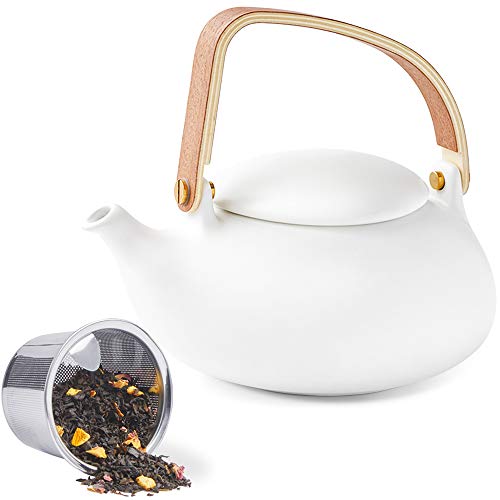
ZENS Ceramic Teapot with Infuser, 27 oz, Matte White, Bentwood Handle — Best Modern Ceramic
Japanese teapot design did not stop at tradition, and the ZENS represents its modernist line: a matte white ceramic body, clean geometry, and a bentwood handle whose curve is as functional as it is beautiful — cool in the hand, balanced in the pour. At 27 oz it is sized for real daily use: a couple of mugs, a shared pot for two, a solo drinker’s generous morning.
Ceramic is the balanced material of this guide — better heat manners than glass, lighter than iron, flavour-neutral, and forgiving in daily washing. The included infuser keeps loose leaf practical. Where the tetsubin is ceremony and the kyusu is precision, this is the contemporary Japanese aesthetic made domestic: the pot that lives on the counter and gets used three times a day.
Strengths
- Modern Japanese design language, matte ceramic calm
- Bentwood handle stays cool and balances the pour
- 27 oz daily-use capacity with infuser included
Trade-offs
- Ceramic chips if knocked against taps and sinks
- Matte white shows tea staining without regular rinsing
- Design-led pick at a mid-to-premium position
| Capacity | 27 oz |
| Body | Ceramic, matte white |
| Handle | Bentwood |
| Infuser | Included |
Buy the ZENS if your kitchen speaks modern and your tea habit is daily rather than ceremonial. It is the easiest pick in this guide to live with — dishwasher-calm, counter-beautiful, sized for real life — while keeping a genuine line to Japanese design through its handle and its restraint. Gift buyers should note it too: it is the Japanese teapot most likely to delight a recipient whose taste runs contemporary rather than traditional.
Best for: daily drinkers with modern kitchens and design-led gift buyers / Not suited for: traditionalists who want iron, clay or porcelain heritage
Check on Amazon — check the current price on Amazon before you decide, and confirm the size, colour or configuration in the review above is the one selected on the listing.
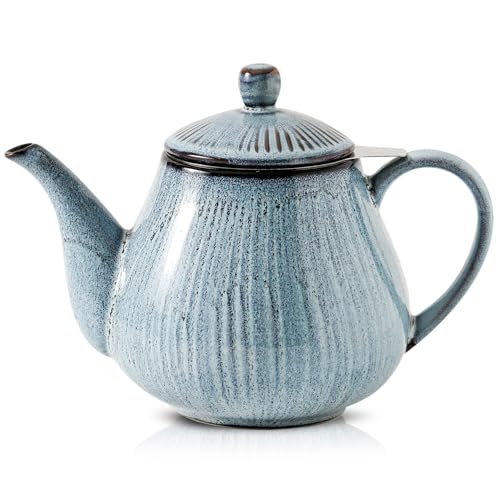
HVH 40 oz Porcelain Teapot with Stainless Steel Infuser, Wabi Sabi Striped — Best Wabi-Sabi Porcelain
Wabi-sabi — the Japanese aesthetic that finds beauty in imperfection and irregularity — gives this porcelain pot its striped, hand-finished character, and its 40 oz capacity gives it a job none of the ritual pots can do: serving six cups at once. It is the Japanese teapot for the family table and the dinner party, wearing its philosophy on its glaze.
Porcelain is the refined end of the ceramic family: fine, strong for its weight, and completely flavour-neutral, with a stainless infuser keeping loose-leaf service practical at scale. The wabi-sabi finish has a practical virtue too — an intentionally irregular surface hides the small marks of daily use that a stark white pot displays, making this the low-anxiety family choice in the guide.
Strengths
- 40 oz serves six cups — the family and party scale
- Wabi-sabi finish hides daily wear gracefully
- Porcelain body with practical stainless infuser
Trade-offs
- Large for solo ritual brewing
- Aesthetic-led design; purists of form should look to kyusu and tetsubin
- Porcelain still chips on hard knocks
| Capacity | 40 oz |
| Body | Porcelain |
| Finish | Wabi-sabi striped |
| Infuser | Stainless steel |
Choose the HVH when Japanese tea culture meets a household that drinks together. It carries the aesthetic honestly — wabi-sabi is a real philosophy, visibly applied — while solving the capacity problem that excludes the ritual pots from family service. Brew a full pot, lift the infuser at the peak, and it will hold a table through a long meal with more grace than any Western pot in its price conversation.
Best for: families and hosts who want Japanese style at serving scale / Not suited for: solo ritual brewers
Check on Amazon — check the current price on Amazon before you decide, and confirm the size, colour or configuration in the review above is the one selected on the listing.

Japanese Teapot Kyusu Tokoname Youhen Clay Teapot, 11.8 fl oz, Fusen L161 — Best Traditional Clay Kyusu
Tokoname, in Aichi prefecture, is one of Japan’s six ancient kiln towns, and its unglazed red-clay kyusu are the traditional summit of Japanese teapot craft. The clay is fine enough to be worked thin, the side handle is formed for the kyusu pour, and the filter is traditionally clay itself — a sasame or ceramic mesh built into the pot’s wall, straining leaves without any metal in the brew.
The Fusen L161 is the verified example this guide pins: a Tokoname youhen clay kyusu at 11.8 fluid ounces, squarely in the small kyusu band the form demands. When you check the listing, apply the criteria this guide applies to the whole artisan category: Tokoname origin stated plainly, unglazed clay, and the built-in filtration the tradition uses. A listing that will not say where its pot was made is telling you something — this one says it.
Strengths
- The traditional material for sencha — clay mellows and rounds the brew
- Built-in clay filtration, no metal contact
- Ancient-kiln craft with genuine collector depth
Trade-offs
- Artisan listings vary; verify maker and origin details on the listing
- Unglazed clay absorbs flavour; dedicate it to one tea family
- Artisan pricing and fragility exceed every other pick here
| Capacity | 11.8 fl oz |
| Form | Kyusu, side handle |
| Material | Tokoname youhen clay |
Buy a Tokoname kyusu when the journey into Japanese tea becomes a commitment: one pot, one tea family, years of seasoning as the clay and the drinker learn each other. It is the least convenient pick in this guide and, for the sencha devoted, the most rewarding — the pot against which the glass Hario reads as the modern interpretation. Search carefully, pay for provenance, and treat big claims on vague listings with the scepticism this review models.
Best for: sencha devotees ready for an artisan clay kyusu / Not suited for: beginners, mixed-tea drinkers or dishwasher households
Check on Amazon — check the current price on Amazon before you decide, and confirm the size, colour or configuration in the review above is the one selected on the listing.

Japanese Porcelain Dobin Teapot, Mino Ware, 13.5 oz, White — Best for Herbal and Shared Pots
Every Japanese tea shelf historically held two shapes: the kyusu for green tea precision and the dobin, the larger top-handled pot for everything else — bancha, hojicha, mugicha and herbal infusions served to a household. Porcelain dobin with woven or bent handles are the classic form, generous in capacity and democratic in purpose.
Dobin listings on Amazon mix genuine Japanese porcelain with look-alike ware, so this pick is the one listing a follow-up verification pass could pin against the criteria: Mino ware porcelain, made in Japan, with the traditional wisteria vine top handle. Hold any dobin to the same criteria — stated Japanese origin, porcelain (not generic ceramic) construction, a removable infuser basket sized to the pot, and the traditional top handle in cane, bamboo or bentwood. A dobin bought on those criteria will serve a family for years.
Strengths
- The traditional Japanese sharing format
- Porcelain suits herbal and roasted teas beautifully
- Top handle carries large capacities comfortably
Trade-offs
- Smaller 13.5 oz capacity — a sharing pot for two to three, not a crowd
- Too large and imprecise for fine sencha work
- Quality varies widely across marketplace listings
| Form | Dobin, top handle |
| Material | Porcelain (traditional) |
| Use | Shared pots, herbal and roasted teas |
Choose the dobin pattern when your Japanese tea life is a household’s, not a solo practice: barley tea in summer, hojicha after dinner, herbal pots for guests. It completes this guide’s map of Japanese forms — kyusu, tetsubin, modern ceramic, wabi-sabi porcelain and now the family dobin — and it is the shape most Japanese homes actually use daily. Buy on provenance and porcelain, and the pattern will not disappoint you.
Best for: households brewing shared and herbal pots / Not suited for: precision green-tea brewing
Check on Amazon — check the current price on Amazon before you decide, and confirm the size, colour or configuration in the review above is the one selected on the listing.
Comparison Table
| Pick | Badge | Key spec | Best for |
|---|---|---|---|
| suyika Japanese Tetsubin Cast Iron Teapot with Stainless Steel Infuser, 22 oz / 650 ml | Best Overall | Cast iron tetsubin, enamel interior, 650ml | occasion brewers who value heat retention and tradition |
| Hario ChaCha Kyusu Maru Tea Pot, 700ml | Best Glass Kyusu | 700ml glass kyusu, Japanese-made | green tea practitioners who brew by observation |
| ZENS Ceramic Teapot with Infuser, 27 oz, Matte White, Bentwood Handle | Best Modern Ceramic | 27 oz ceramic, bentwood handle, matte white | daily drinkers with modern kitchens and design-led gift buyers |
| HVH 40 oz Porcelain Teapot with Stainless Steel Infuser, Wabi Sabi Striped | Best Wabi-Sabi Porcelain | 40 oz porcelain, wabi-sabi finish, 6-cup | families and hosts who want Japanese style at serving scale |
| Japanese Teapot Kyusu Tokoname Youhen Clay Teapot, 11.8 fl oz, Fusen L161 | Best Traditional Clay Kyusu | Unglazed Tokoname clay kyusu, built-in filter | sencha devotees ready for an artisan clay kyusu |
| Japanese Porcelain Dobin Teapot, Mino Ware, 13.5 oz, White | Best for Herbal and Shared Pots | Porcelain dobin, top handle, sharing format | households brewing shared and herbal pots |
Read the table as a map, not a verdict. The right best japanese teapots pick depends on how you actually cook, brew, grind or live day to day, and the sections after the table explain the trade-offs behind each row in plain language.
A Map of Japanese Teapot Forms: Kyusu, Tetsubin, Dobin
The kyusu is the precision instrument: side handle at ninety degrees to the spout, compact body, fine filtration, built for green tea’s short infusions and small cups. It exists in glass (the Hario pick), in unglazed Tokoname clay (the connoisseur pick), and in porcelain and ceramic across Japan’s kilns. If sencha is your tea, the kyusu is your form, and every other consideration — material, maker, capacity within the small band — is secondary to that match.
The tetsubin is the vessel of occasion: cast iron, enamelled inside in its modern teapot form, holding heat through long, slow drinking. Its ancestor was a kettle, and some owners still heat water in stovetop-rated examples, but its modern role is brewing with presence — the pot as the table’s centre. Choose it for black and roasted teas, for winter, and for the drinker who experiences tea as an event rather than a beverage break.
The dobin is the household pot: top-handled, larger, traditionally porcelain, made for the teas a family drinks by the potful — barley tea, hojicha, bancha, herbals. It is the least ceremonial and most used form in Japanese homes, and its absence from Western guides says more about Western marketing than Japanese practice. Modern ceramic and wabi-sabi porcelain pots, like this guide’s ZENS and HVH picks, extend the family’s design language into contemporary and family-scale forms without breaking its logic: the pot still follows the tea, the drinkers and the hour.
A word on pricing tiers across these forms, since the family spans them all. Machine-made glass and ceramic Japanese-form pots sit in the budget and mid tiers and serve daily drinkers honestly. Enamelled tetsubin and quality porcelain occupy the mid-to-premium band, where the money buys material and finish. Genuine artisan Tokoname work is the premium summit, priced by maker and clay, and bought as craft as much as equipment. None of these tiers is the ‘correct’ one; Japanese tea culture itself spans farmhouse dobin and museum kyusu without anxiety, and a buyer should feel the same freedom.
Materials and Their Manners: Iron, Clay, Glass, Porcelain, Ceramic
Cast iron hoards heat and demands respect: preheat it, never shock it with cold water, rinse and dry it, and it will serve for decades. Its enamelled interior is the compromise that makes iron practical as a brewer — flavour-neutral and rust-resistant — and the enamel is also its vulnerability, chipping under knocks and thermal shock. Iron is the material of commitment, in both directions.
Unglazed clay is the opposite philosophy: it participates. Tokoname clay absorbs a trace of every brew, gradually seasoning toward one tea family’s character, which is why devotees dedicate a clay pot to a single tea. The participation is the point and the price — never soap a clay kyusu, never brew a competing tea in it, and accept that it is a relationship, not an appliance. Glazed ceramics and porcelain step back out of the brew: neutral, washable, promiscuous across teas, asking only protection from hard knocks.
Glass is the observer’s material: no heat hoarding, no seasoning, total information. It suits the drinker who brews by eye and rotates teas freely, and it forgives everything except being dropped or heated beyond its rating. Read across the five materials and the guide’s six picks sort themselves: pick your philosophy of brewing — hoard, participate, or observe — and the material, then the pot, follows.
One more material note belongs to porcelain, the quiet overachiever of this family. Fine porcelain is fired hot enough to be fully vitrified — non-porous, genuinely flavour-neutral, stronger than its delicacy suggests and dishwasher-calm in a way iron and clay can never be. Japan’s porcelain tradition, centred on Arita, is as old and honoured as its clay tradition, and a porcelain dobin or kyusu is not a compromise purchase but a different branch of the same tree. Buyers who want Japanese authenticity with modern convenience should weigh porcelain more heavily than its understated reputation suggests.
Setting Up a Japanese Tea Shelf: Which Pots, in Which Order
Most tea households accumulate pots in the wrong order — a showpiece first, a workhorse never. The order this guide recommends runs the other way. Start with the daily pot your actual tea demands: a kyusu for the green-tea drinker, a dobin-style family pot for the household brewer, the ZENS-style ceramic for the modern all-rounder. That first pot teaches you your own habits — capacities you really use, teas you really drink, rituals you really keep — and every later purchase becomes precise instead of hopeful.
Second comes the complement, not the duplicate: the tetsubin for occasions if your first pot was a kyusu, the glass kyusu for precision if your first was iron or family porcelain. The pair covers the two poles of Japanese tea — ceremony and precision, heat and observation — and most drinkers find their shelf complete there for years. The HVH-scale family porcelain joins when the household or the dinner parties demand it, solving capacity without surrendering the aesthetic.
The Tokoname clay kyusu comes last, deliberately, when it comes at all: it is a commitment device, bought when a drinker knows their tea family the way a musician knows their instrument. Bought first, it is an expensive ornament; bought fourth, it is a destiny. This ordering — workhorse, complement, capacity, commitment — is the quiet argument of the whole guide, and it will save most readers money while surrounding them, within a year or two, with exactly the pots their tea life uses.
How to Season, Brew and Care for Japanese Teapots by Material
Japanese teapots ask for material-specific manners. These are the working rules for every pick in this guide.
- Before first use, rinse any new pot with plain hot water several times. For a tetsubin, brew and discard one pot of plain water to clear the enamel; for unglazed clay, a soak in hot water — traditionally in water the tea itself will be brewed in — begins the seasoning honestly.
- Preheat the pot before brewing whenever the tea matters: a hot-water rinse that is discarded. Iron and ceramic hold the preheat; glass benefits most, starting nearer the infusion’s temperature.
- Match water to tea, not habit: green teas below boiling and briefly steeped, roasted teas and herbals hotter and more forgiving, black teas at a full boil in iron or porcelain that can hold the heat. The pot serves the tea’s requirements, never the reverse.
- Pour fully and promptly. Japanese brewing is small rounds, completely poured; liquor left standing on leaves is an accidental second steep, and in clay it is also uneven seasoning.
- Clean by material: glass and glazed porcelain/ceramic with hot water and a soft cloth, detergent only occasionally; enamelled iron rinsed and dried immediately, never soaked; unglazed clay with water only — never soap, which the clay would absorb and return to future brews.
- Dry and store with air moving: lids ajar on iron until fully dry inside, clay pots stored clean and dry, infusers dried separately so fine mesh never sits damp. A Japanese teapot stored dry is a teapot ready for decades.
None of these manners is burdensome once habitual, and together they are the difference between owning Japanese teapots and merely having bought them. The forms evolved with these cares attached; honour the cares and the pots repay you in the currency they were designed for — better tea, calmly made, for a very long time.
Keep a small notebook with the pots for the first month — tea, water temperature as you judged it, steep time, verdict. Japanese tea mastery is mostly this: recorded attention. The notebook turns vague impressions (‘last Tuesday’s was better’) into adjustable variables, and it respects the pots’ design philosophy, which assumes a drinker who is paying attention on purpose. After a month the notebook becomes a personal brewing chart no book can sell you, because it describes your water, your leaves and your palate.
Common Buying Mistakes
Using one pot for every tea, in unglazed clay. Clay seasons toward what it brews. A Tokoname kyusu rotated through mint, jasmine and sencha seasons toward confusion. Dedicate clay to a tea family, or choose glazed or glass materials that stay neutral.
Soaping an unglazed clay pot. The clay absorbs detergent as faithfully as tea, and returns it at the next brew. Water only, always, for unglazed interiors — this is the one absolute rule in Japanese teapot care.
Shocking a hot tetsubin with cold water. Thermal shock is how enamel chips. Let iron cool, or warm it gradually; rinse warm, dry promptly, and the enamel — and the pot — will last.
Brewing sencha in a litre pot and letting it stand. Form follows tea: green tea in a big standing pot over-extracts into bitterness. Use the kyusu scale, pour fully, and re-steep — the method is the flavour.
Judging a marketplace ‘Japanese’ pot by its photograph. Forms are copied worldwide. For the traditional patterns especially, buy on stated origin, material and construction — the criteria in this guide’s unlinked reviews — not on silhouette alone.
Storing a tetsubin or clay pot with its lid sealed while still damp inside. Trapped moisture is rust’s invitation in iron and mustiness in clay. Dry the interior fully, store lids ajar until the pot is bone dry, and only then close it up. The habit costs one shelf-hour per use and is the difference between a pot that ages into an heirloom and one that ages into a smell.
Final Recommendation
For one Japanese teapot that carries the tradition into daily life, buy the suyika tetsubin: heat, presence and the classic form in a practical enamelled build. Green-tea practitioners should pair or prefer the Hario glass kyusu; modern kitchens, the ZENS ceramic; families, the wabi-sabi HVH porcelain; and the devoted should hunt a genuine Tokoname clay kyusu and a porcelain dobin meeting the criteria given, completing the family’s map. Japanese tea rewards the drinker who matches pot to tea — this guide’s six badges are that matching, done for you.
Whichever form you choose, learn its manners from the care section before the first brew. A Japanese teapot is a long relationship conducted in small rituals, and it begins paying out from the very first properly poured round.
One practical shortcut for readers torn between the two anchor picks: the HVH wabi-sabi porcelain covers family scale while the kyusu decision matures, and the Hario glass kyusu covers precision while the tetsubin decision matures — check price on Amazon for both and let your household size break the tie.
And a word for collectors at the start of the road: buy slowly, brew constantly, and let each pot earn the next. A Japanese tea shelf assembled over years, one understood vessel at a time, is worth more — in tea and in pleasure — than a complete set bought in a weekend and never quite learned. The forms have waited centuries; they can wait for you to be ready for each of them.
Start with the pot your tea demands, learn its manners well, and let the shelf grow slowly at the speed of your own practice — that is the Japanese way with teapots, and it has never once produced a regretted collection of beautiful vessels.
The three picks most readers end up choosing between are suyika Japanese Tetsubin Cast Iron Teapot with Stainless Steel Infuser, 22 oz / 650 ml, Hario ChaCha Kyusu Maru Tea Pot, 700ml, ZENS Ceramic Teapot with Infuser, 27 oz, Matte White, Bentwood Handle — check price on Amazon for each, compare the configurations against the reviews above, and buy the one whose badge matches your kitchen.
Keep exploring the cluster before you check out — these companion guides cover the neighbouring questions buyers in this category usually ask next:
- Best Japanese Glass Teapots
- Best Cast Iron Teapots
- Best Teapots With Infusers
- Best Ceramic Teapots
- Best Teapots For Loose Leaf Tea
Frequently Asked Questions
What is the difference between a kyusu and a tetsubin?
Form and material. A kyusu is the side-handled precision pot — clay, ceramic, porcelain or glass — built for green tea’s short infusions. A tetsubin is the cast iron pot, enamelled inside in modern form, built for heat retention and occasion. They complement rather than compete; many tea households own both.
Are tetsubin used to boil water or to brew tea?
Historically the iron tetsubin was a kettle; the modern enamelled tetsubin is a brewing teapot. Some listings rate examples for stovetop use, but most owners heat water in a kettle and brew in the tetsubin, preserving the enamel and the ritual alike.
How do I know a Tokoname teapot listing is genuine?
Apply the criteria in the Tokoname review: Tokoname origin stated plainly by the seller, unglazed clay rather than glazed look-alike ware, the small kyusu capacity band, and built-in clay or fine ceramic filtration. The Fusen L161 pinned in this guide was verified against Amazon’s catalogue data; other listings should be held to the same standard before you buy.
Can I brew different teas in the same Japanese teapot?
In glass, glazed ceramic and porcelain, yes — they stay neutral. In unglazed clay, no: dedicate the pot to one tea family so its seasoning deepens rather than muddles. Enamelled iron sits between: rinse promptly and it handles variety well.
What size Japanese teapot should a beginner buy?
The 600–700ml band — the scale of this guide’s tetsubin and kyusu picks — serves one to three drinkers in the Japanese manner of small cups and re-steeps, and teaches the small-fresh-rounds method from day one. Larger pots suit families and herbal brewing, as the dobin and HVH picks show.
How do I stop my cast iron teapot rusting?
The enamelled interior does most of the work. Help it: never leave water standing in the pot, rinse and dry immediately after use, store with the lid ajar until fully dry, and never scour the enamel. Exterior rust spots on unenameled iron yield to a gentle rub and thorough drying.
Do Japanese teapots need a special kettle or water?
No special kettle is required — any kettle that pours controllably works, and the traditional habit of cooling boiled water in a separate vessel (a yuzamashi, or any spare pot) matters more than the kettle itself for green teas. Water quality matters as it does for all tea: fresh, not repeatedly reboiled, and soft where possible. The pot shapes the ritual; the water decides the ceiling.
Which Japanese teapot is best for beginners?
A glazed ceramic or glass pot in the 600–700ml band — forgiving of mixed teas, easy to clean, and sized for the small-rounds method. In this guide that means the ZENS ceramic for modern kitchens or the Hario glass kyusu for green-tea learners. Save unglazed clay and heavy iron rituals for the second purchase, when your habits are known.
Are Japanese teapots worth it for casual tea drinkers?
The accessible end of the family — glass kyusu, modern ceramic, porcelain — absolutely: they brew better tea by design and ask little. The artisan end repays devotion rather than casual use. Casual drinkers should buy the forms that fit a daily habit and skip the collector tiers without guilt; Japanese tea culture itself honours the everyday pot as much as the masterpiece.
What is a yuzamashi, and do I need one?
A yuzamashi is the small open vessel used to cool boiled water to green-tea temperature before it meets the leaves. You do not need the dedicated object — any spare pot, jug or large cup performs the cooling — but the step itself is close to non-negotiable for sencha, and owning the little vessel makes the step feel, and become, routine.

