Disclosure: airfryerkitchensupply.com is reader-supported. When you buy through links on our site, we may earn an affiliate commission at no extra cost to you.
Where to buy
The fastest way to buy best japanese glass teapots is through Amazon, where every pick below that carries a verified listing can be checked for current availability in a couple of clicks. Picks with a link have been cross-checked against Amazon’s own catalogue data before this guide was published, so the link lands on the exact model reviewed, not a look-alike. Where a pick is described without a link, it is an unlinked recommendation: use the full product name in Amazon search and match the details in its review section before you order. Prices move constantly on measuring tools, small appliances and footwear alike, so this guide never prints a fixed price — use the check-price links to see today’s figure.
- Hario ChaCha Kyusu Maru Tea Pot, 700ml (Best Overall) — Check the current price on Amazon
- HIWARE 1000ml Glass Teapot with Removable Infuser, Stovetop Safe (Best Large Capacity) — Check the current price on Amazon
- Teabloom Stovetop & Microwave Safe Glass Teapot 40 oz with Removable Glass Infuser (Best for Blooming Tea) — Check the current price on Amazon
- PARACITY Glass Teapot Stovetop 22 oz / 650ml with Removable 18/8 Stainless Steel Infuser (Best Compact) — Check the current price on Amazon
- Hario ChaCha Kyusu Maru Tea Pot, 450ml (Best Personal Kyusu) — Check the current price on Amazon
- DOPUDO Small Glass Teapot with Infuser 18 oz / 530ml (Best for Gongfu-Style Sessions) — Check the current price on Amazon
The best Japanese glass teapots bring together two traditions: the kyusu, Japan’s side-handled brewing pot refined over centuries for green tea, and modern borosilicate glass, which lets the drinker watch leaves and liquor as they brew. This guide compares six glass pots in that tradition — genuine Japanese-made kyusu from Hario in two sizes, and four glass pots built in the Japanese form at scales from a 530ml session pot to a 40 oz display brewer — and it is transparent about provenance: where a pot is Japanese in form rather than manufacture, the review says so.
Glass changes brewing from guesswork to observation. You see sencha leaves unfurl, judge a green tea’s colour before it over-steeps, and watch blooming teas perform. That visibility is why glass became a serious tea material in Japan’s own market, and why the kyusu form — compact, precise, made for small fresh infusions — translates so well into it. The reviews below judge each pot on capacity honesty, infuser quality, pour control and how faithfully it serves the small-fresh-rounds philosophy.
After the reviews, the buying guide explains kyusu anatomy, glass care and water temperature for Japanese teas, and the how-to section walks through brewing sencha in a glass kyusu step by step.
A note on what ‘best’ means in a category this ritual-driven: there is no fastest or strongest glass teapot, only pots matched or mismatched to a way of drinking. This guide therefore refuses to crown a single winner for everyone. It crowns six, one per ritual, and spends its guide sections teaching the method that makes any of them sing — because in Japanese tea, method is not the garnish on the equipment decision. It is most of the flavour.
In this guide
Quick Picks
If you only read one section, make it this one. These six best japanese glass teapots earned their places for different reasons, and the badge on each pick in this list is the same badge used at the top of its full review further down, so you can jump straight from the shortlist to the detail that matters to you.
- Hario ChaCha Kyusu Maru Tea Pot, 700ml — Best Overall. The genuine article: a Japanese-made glass kyusu from Hario, the country’s defining glassware maker, with the side-handle form and fine mesh made for Japanese green teas. — check price on Amazon
- HIWARE 1000ml Glass Teapot with Removable Infuser, Stovetop Safe — Best Large Capacity. A litre of borosilicate glass with a removable infuser and stovetop-safe construction — the Japanese-form glass pot scaled up for households that brew for the table. — check price on Amazon
- Teabloom Stovetop & Microwave Safe Glass Teapot 40 oz with Removable Glass Infuser — Best for Blooming Tea. An all-glass 40 oz pot — glass infuser included — built to display blooming teas, and safe for both stovetop and microwave heating. — check price on Amazon
- PARACITY Glass Teapot Stovetop 22 oz / 650ml with Removable 18/8 Stainless Steel Infuser — Best Compact. A 650ml stovetop glass pot with a fine 18/8 stainless infuser — kyusu-scale capacity with the filtration fine Japanese leaves demand. — check price on Amazon
- Hario ChaCha Kyusu Maru Tea Pot, 450ml — Best Personal Kyusu. The 450ml sibling of the guide’s benchmark — the same Japanese-made glass kyusu, scaled for one drinker’s fresh, small rounds. — check price on Amazon
- DOPUDO Small Glass Teapot with Infuser 18 oz / 530ml — Best for Gongfu-Style Sessions. The smallest pot in the guide at 530ml — a glass brewer for short, repeated infusions where each steep is poured off and tasted on its own. — check price on Amazon
How These Picks Were Chosen
The shortlist was built around the kyusu idea rather than around glass alone: compact bodies, controlled pours, infusers fine enough for small leaves, and capacities that favour fresh rounds over stewed litres. One pick — the Hario kyusu — is Japanese-made and anchors the guide as the authentic reference, in 700ml and 450ml sizes. The other four were chosen as the strongest glass expressions of the same tradition at different scales, and their reviews state their provenance plainly rather than borrowing Japan’s name silently.
Infuser quality was the technical filter. Japanese green teas shed fine particles that pass through coarse strainers and cloud the cup, so picks needed either fine mesh, glass filtration suited to the style, or basket designs honest about the leaf sizes they serve. Stovetop safety was the practical filter for the larger pots, where a separate kettle step is the friction that stops daily use.
Badges were assigned by brewing job — authentic kyusu, family capacity, blooming display, compact two-cup, personal kyusu brewing and session brewing — because glass teapot buyers divide by ritual, not by budget. The comparison table lines the six up by capacity and key specification so the scale decision, the one that most shapes daily use, is easy to make.
A note on the stovetop question, since it decided several places: glass teapots divide sharply into brewers and brewer-kettles, and confusing the two cracks pots. Picks rated by their makers for stovetop use are described as such; picks without that rating are described as brewers, and the how-to and mistakes sections repeat the distinction because it is the costliest misunderstanding in this category. When a listing’s rating is ambiguous, this guide treats the pot as a brewer — the conservative reading that keeps glass whole.
The 6 Best Japanese Glass Teapots

Hario ChaCha Kyusu Maru Tea Pot, 700ml — Best Overall
Start with the real thing. Hario is Japan’s glass specialist, and the ChaCha Kyusu Maru is its classic glass teapot: a rounded 700ml pot in the kyusu tradition, with the side handle that defines the form and a fine filter suited to the small leaves of sencha and other Japanese greens. It brews the way Japanese tea is meant to be brewed — quick infusions, leaves free to move, liquor poured clear.
Glass is the honest material for this style: you watch the leaves unfurl and judge the colour of the infusion directly, which for green tea is half the brewing information. The 700ml size serves two to three drinkers in the Japanese manner of modest cups, refilled often. It is also the only pick in this guide manufactured by a Japanese maker, and for purists that provenance is the purchase.
Strengths
- Genuine Japanese manufacture from Hario
- Kyusu side-handle form pours with fine control
- Glass shows leaf and liquor colour for precise brewing
Trade-offs
- 700ml is modest for large Western mugs
- Glass demands the care glass always demands
- Not a stovetop kettle — brew in it, do not heat on flame
| Capacity | 700ml |
| Maker | Hario (Japan) |
| Form | Kyusu, side handle |
| Material | Glass |
Buy this if Japanese tea is the point: sencha, gyokuro, genmaicha and hojicha brewed in the vessel designed for them. The kyusu’s side handle keeps the wrist neutral and the pour precise, the filter handles fine leaf particles that choke coarser strainers, and the glass body rinses clean with no flavour memory between teas. It is the benchmark of this guide — the pot the style picks below are measured against — and the one a Japanese tea drinker would recognise as home equipment.
Best for: Japanese green tea drinkers who want the authentic kyusu / Not suited for: large households wanting a big sharing pot
Check on Amazon — check the current price on Amazon before you decide, and confirm the size, colour or configuration in the review above is the one selected on the listing.
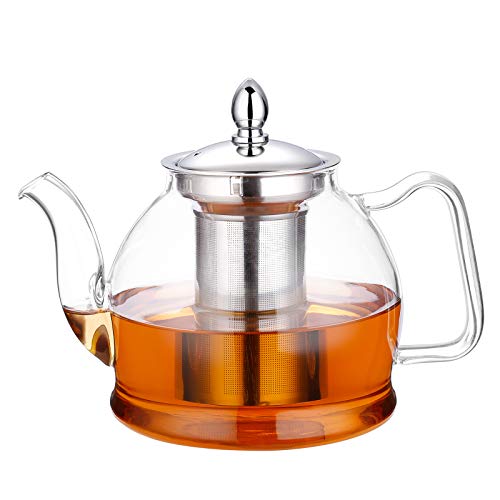
HIWARE 1000ml Glass Teapot with Removable Infuser, Stovetop Safe — Best Large Capacity
Where the Hario serves the ceremony, the HIWARE serves the table. Its litre capacity, removable infuser and stovetop-safe borosilicate body make it the practical family glass pot in this guide: boil, brew and pour in one vessel, with loose leaf or blooming teas, for a household rather than a meditation.
The form follows the Japanese glass tradition — clear walls, infuser basket, unhurried pour — at a scale Japanese domestic pots rarely reach. Removable infuser means the leaves leave when the brew is right, which is the single most important control in teapot brewing, and the stovetop rating removes the kettle-to-pot transfer that cools water and enthusiasm alike.
Strengths
- Full 1000ml capacity for family brewing
- Removable infuser stops over-extraction on time
- Stovetop-safe borosilicate — one vessel, start to finish
Trade-offs
- Not a Japanese-made pot — Japanese form, global manufacture
- Litre of glass is a two-hand pour when full
- Basket infusers suit larger leaves better than fine sencha
| Capacity | 1000ml |
| Material | Borosilicate glass |
| Infuser | Removable |
| Stovetop | Safe |
Choose the HIWARE when the tea is for everyone: weekend pots, iced tea brewed strong then chilled, blooming teas displayed at their best. Its transparency is functional as much as beautiful — herbal blends and flowering teas are judged by eye — and its capacity forgives the second cup that ceremony-sized pots cannot offer. It is the workhorse glass pick, honest about its provenance and excellent at its job.
Best for: families and hosts brewing litre pots of loose or blooming tea / Not suited for: purists who want Japanese manufacture above capacity
Check on Amazon — check the current price on Amazon before you decide, and confirm the size, colour or configuration in the review above is the one selected on the listing.

Teabloom Stovetop & Microwave Safe Glass Teapot 40 oz with Removable Glass Infuser — Best for Blooming Tea
Blooming tea is theatre, and theatre needs a stage with no obstructions. Teabloom’s 40 oz pot is glass everywhere — body and removable glass infuser alike — so a flowering tea ball opens in full view with no metal basket crossing the picture. For the many drinkers who came to glass teapots through blooming tea, this is the native habitat.
The practical specifications back the show: stovetop and microwave safe, a generous 40 oz capacity for company, and an infuser that lifts out when the brew peaks. Glass-on-glass infusion also suits delicate teas where metal-shy drinkers prefer no steel in contact with the liquor, a preference this guide respects even while noting most drinkers taste no difference.
Strengths
- All-glass construction — infuser included — for unobstructed display
- 40 oz serves a table of tea drinkers
- Stovetop and microwave safe for flexible heating
Trade-offs
- Glass infuser is the most fragile component in this guide
- 40 oz is oversized for solo Japanese-style brewing
- Display-first design; kyusu purists should buy the Hario
| Capacity | 40 oz |
| Material | Glass, glass infuser |
| Heating | Stovetop & microwave safe |
Buy the Teabloom for the ritual of watching tea happen: flowering teas, herbal blends with visible botanicals, and the simple pleasure of judging a brew by its colour deepening. It earns its badge honestly — nothing else here displays like it — and its capacity makes it the party pot of the six. Treat the glass infuser as the delicate instrument it is, lift leaves out on time, and this pot will anchor a tea shelf the way a vase anchors a table.
Best for: blooming tea lovers and hosts who brew for company / Not suited for: solo drinkers or anyone careless with glassware
Check on Amazon — check the current price on Amazon before you decide, and confirm the size, colour or configuration in the review above is the one selected on the listing.

PARACITY Glass Teapot Stovetop 22 oz / 650ml with Removable 18/8 Stainless Steel Infuser — Best Compact
At 650ml, the PARACITY sits in the size band Japanese pots call home: enough for two modest cups or one generous mug, small enough that the brew is drunk fresh rather than stewed. Its removable infuser is 18/8 stainless with the fine mesh that small-leaf teas require, answering the commonest complaint about compact glass pots — filters too coarse for the teas they are bought for.
Stovetop-safe glass keeps the workflow single-vessel, and the compact footprint suits small kitchens, desks and tea corners where the litre-class pots cannot live. It is a Japanese-form pot in the practical modern mould: honest materials, right size, filtration that respects fine leaf.
Strengths
- 650ml — the classic two-cup Japanese scale
- Fine 18/8 stainless infuser handles small leaves
- Stovetop safe and compact for small spaces
Trade-offs
- Too small for family or company brewing
- Not Japanese-made; form and scale are the Japanese elements
- Steel infuser where some purists prefer glass or mesh-in-pot designs
| Capacity | 22 oz / 650ml |
| Infuser | Removable 18/8 stainless steel |
| Stovetop | Safe |
This is the desk-and-two-cup pick: the pot for a household of one or two that brews often and drinks immediately. Its fine infuser makes it the most sencha-capable of the non-Hario picks, and its scale enforces the freshest habit in tea — brew small, brew again. If your tea life is measured in quiet pairs of cups rather than pots for a table, the PARACITY’s proportions will feel immediately correct.
Best for: one-to-two drinkers brewing fine-leaf teas often / Not suited for: hosts who need litre-plus capacity
Check on Amazon — check the current price on Amazon before you decide, and confirm the size, colour or configuration in the review above is the one selected on the listing.

Hario ChaCha Kyusu Maru Tea Pot, 450ml — Best Personal Kyusu
Not every kyusu needs to serve company. The 450ml ChaCha Kyusu Maru is Hario’s personal-scale version of this guide’s benchmark pot: the same Japanese glassmaking, the same side-handled Maru form, sized for the solo drinker whose tea is a daily ritual rather than an event. At 450ml it brews one generous mug or two small cups — exactly a single round, drunk fresh.
That scale is a feature in Japanese brewing, not a limitation. Small rounds are re-steeped rounds: the same leaves give a second and third infusion, each watched through the glass, each poured off completely. For the desk, the studio and the quiet morning, this is the most authentic personal pot in the guide — a genuine Japanese kyusu at the size Japanese solo drinkers actually use.
Strengths
- Genuine Japanese Hario manufacture, like the 700ml benchmark
- 450ml personal scale enforces fresh, re-steeped rounds
- Kyusu side handle and fine filtration for green teas
Trade-offs
- One drinker’s capacity — no use for company
- Glass care, as with the whole category
- Not stovetop rated; heat water separately
| Capacity | 450ml |
| Maker | Hario (Japan) |
| Form | Kyusu, side handle |
| Material | Glass |
Buy this as your personal kyusu: the sencha-for-one on a work desk, the evening gyokuro, the small brew a big pot would waste. Owners of the 700ml version buy this one for solo days; newcomers to Japanese tea buy it as the truest starting point in the guide, because its scale teaches the method — brew small, pour fully, re-steep — by simple necessity. In a category where bigger is marketed as better, this pick defends the Japanese insight that tea is best in small, fresh rounds.
Best for: solo Japanese tea drinkers and kyusu beginners / Not suited for: couples or hosts brewing for more than one
Check on Amazon — check the current price on Amazon before you decide, and confirm the size, colour or configuration in the review above is the one selected on the listing.

DOPUDO Small Glass Teapot with Infuser 18 oz / 530ml — Best for Gongfu-Style Sessions
Small pots change the drinker’s behaviour in the best way: they force short infusions, poured off completely, tasted one at a time. The DOPUDO’s 530ml glass body with infuser is the guide’s session pot — the one for an afternoon of re-steeping the same leaves and watching the liquor evolve from pale to deep and back.
Glass suits session brewing because every steep announces itself in colour before it reaches the cup, letting the drinker pull the infusion at the right moment by eye. The infuser lifts out between steeps to rest the leaves. It is a modest object with a connoisseur’s workflow, and its size — the smallest here — is precisely its qualification.
Strengths
- 530ml enforces short, fresh, repeated infusions
- Glass gives steep-by-steep colour feedback
- Infuser rests leaves cleanly between steeps
Trade-offs
- Far too small for serving groups
- Session style is a hobbyist’s ritual, not a quick cup
- Delicate scale demands deliberate handling
| Capacity | 18 oz / 530ml |
| Infuser | Included |
| Style | Small session pot |
Choose the DOPUDO if tea is a pastime rather than a beverage: oolongs and greens re-steeped through an afternoon, notes compared, the same leaves giving four different cups. It is also the natural second pot for owners of a big family brewer who want a personal ritual vessel. Judged as a kettle for crowds it fails; judged as an instrument for attention, it is the most characterful pick in this guide.
Best for: tea hobbyists who re-steep and taste by the steep / Not suited for: anyone brewing for a table or a timetable
Check on Amazon — check the current price on Amazon before you decide, and confirm the size, colour or configuration in the review above is the one selected on the listing.
Comparison Table
| Pick | Badge | Key spec | Best for |
|---|---|---|---|
| Hario ChaCha Kyusu Maru Tea Pot, 700ml | Best Overall | 700ml glass kyusu, Japanese-made | Japanese green tea drinkers who want the authentic kyusu |
| HIWARE 1000ml Glass Teapot with Removable Infuser, Stovetop Safe | Best Large Capacity | 1000ml borosilicate, removable infuser, stovetop safe | families and hosts brewing litre pots of loose or blooming tea |
| Teabloom Stovetop & Microwave Safe Glass Teapot 40 oz with Removable Glass Infuser | Best for Blooming Tea | 40 oz all-glass, glass infuser, blooming display | blooming tea lovers and hosts who brew for company |
| PARACITY Glass Teapot Stovetop 22 oz / 650ml with Removable 18/8 Stainless Steel Infuser | Best Compact | 650ml, fine steel infuser, stovetop safe | one-to-two drinkers brewing fine-leaf teas often |
| Hario ChaCha Kyusu Maru Tea Pot, 450ml | Best Personal Kyusu | 450ml glass kyusu, Japanese-made | solo Japanese tea drinkers and kyusu beginners |
| DOPUDO Small Glass Teapot with Infuser 18 oz / 530ml | Best for Gongfu-Style Sessions | 530ml session pot, glass with infuser | tea hobbyists who re-steep and taste by the steep |
Read the table as a map, not a verdict. The right best japanese glass teapots pick depends on how you actually cook, brew, grind or live day to day, and the sections after the table explain the trade-offs behind each row in plain language.
How to Choose a Japanese Glass Teapot: Kyusu Form, Capacity and Infusers
Begin with the handle, because it defines the form. A true kyusu carries its handle on the side, at ninety degrees to the spout, letting the wrist pour with a rotation rather than a tip — a small ergonomic masterpiece for the short, repeated pours of Japanese tea service. Top-handled pots (dobin style) and back-handled Western pots brew the same leaves but pour with different manners. If Japanese green tea is your centre, the side handle is not decoration; it is the tool’s working end, and the Hario in this guide is its glass exemplar.
Capacity is the second decision, and Japanese tradition argues for small. Tea steeps, then stews: a pot brewed and left standing over-extracts while it waits. Pots in the 500–700ml band brew rounds that get finished, and the ritual answer to thirst is a fresh second round, not a bigger first one. Buy above a litre only when the pot serves a table at one sitting, as the HIWARE and Teabloom picks here are designed to do, and even then, remove the infuser when the brew peaks.
Infusers divide into three families. Built-in or fine steel mesh handles small Japanese leaves best. Basket infusers — glass or steel — lift out cleanly and suit medium and large leaves, blooming teas and herbals. Glass infusers preserve the all-glass aesthetic and the purist’s no-metal preference at the cost of fragility. Match the infuser to your leaf: sencha and fine greens demand fine filtration; flowering teas demand an unobstructed stage; oolongs forgive almost anything.
Glass itself needs one honest paragraph. Borosilicate glass tolerates boiling water and, in stovetop-rated pots, direct gentle heat; ordinary glass does not, and the distinction is stated in each review above. Glass holds no flavour memory — a virtue for drinkers who rotate teas — but shows every water stain, asking for a rinse-and-dry habit. Budget tiers in glass teapots track size and infuser quality more than glass quality; the mid tier buys the best balance, and the premium here buys Japanese manufacture and design lineage.
Handles and lids deserve a final practical check, because glass exposes their quality mercilessly. A glass handle should be thick enough to grip without finger-crowding and attached with smooth, substantial joins; a lid should sit securely enough to stay in place during the pour without being held, yet lift freely for filling. On any glass pot you already own, test the pour with plain water first — balance, dribble and lid behaviour announce themselves immediately, and a pot that pours badly with water will pour worse with tea, leaves and an audience. The picks in this guide were favoured partly on these unglamorous virtues, which is why their reviews mention pour control as often as capacity.
Water, Leaf and Time: Brewing Japanese Teas in Glass
Japanese green teas are the most temperature-sensitive common teas, and glass brewing rewards the drinker who respects that. Sencha steeps best in water well below boiling — the range Japanese practice treats as standard for the style — for short times measured in tens of seconds to a couple of minutes, with the leaves then re-steeped. Boiling water on sencha is the single commonest cause of the bitterness that makes newcomers declare they dislike green tea; the tea was never the problem.
Glass helps twice here. First, colour: a sencha infusion moves from pale gold toward deeper green as extraction proceeds, and the eye learns to call the pour before the palate would complain. Second, honesty: glass shows you the leaves themselves — how much they have opened, whether they are spent — information a ceramic pot keeps to itself. Session-style brewing, the DOPUDO pick’s home ground, is simply this observation practised steep by steep.
Leaf quantity follows the small-pot philosophy: Japanese practice uses a generous leaf-to-water ratio with short steeps, rather than a sparse ratio left to stew. With the fine infusers in this guide, that ratio is practical — the leaves can be given room and still poured clear. Between steeps, rest the infuser out of the liquor so the leaves wait in steam, not in soup; the second and third infusions of a good sencha are often the sweetest, and they are the glass kyusu’s home advantage.
Glass Teapot Care: Keeping Borosilicate Clear and Whole
Glass asks for two habits and repays them with permanent clarity. The first is prompt rinsing: tea left standing in glass paints it, gradually, with a tan film that later demands soaking. A rinse with hot water while the pot is still warm from service prevents nearly all of it, and the occasional bicarbonate soak removes what life accumulates anyway. The second habit is thermal courtesy: borosilicate tolerates boiling water poured in, and stovetop-rated pots tolerate gentle direct heat, but no glass enjoys a cold-water plunge while hot or a bare element at full blast. Treat temperature changes as slopes, not cliffs.
Storage is the third, quiet habit. Glass teapots die in cupboards more often than in service — chipped spouts from crowded shelves, cracked bodies from being the thing something else was stacked inside. Give the pot its own space, store the infuser inside the body only if it cannot rattle, and lift by the body rather than the handle when the pot is full and heavy. A glass pot stored with respect is, paradoxically, one of the longest-lived objects in the tea cupboard, because its material never wears, seasons or rusts — it only breaks, and breaking is almost always a handling event, not an age.
Japanese Glass Teapots for Different Teas: Matching Pot to Leaf
Sencha and gyokuro want the kyusu treatment: fine filtration, small capacity, short steeps — the Hario first, the fine-meshed PARACITY second. Their leaves are small, their temperaments are delicate, and their reward for correct handling is a sweetness that coarse equipment physically cannot deliver, because the fine particles that escape a coarse filter keep extracting in the cup and turn it bitter from inside. If Japanese greens are your daily tea, filtration fineness is not a detail; it is the purchase.
Oolongs and greens destined for re-steeping want the session format: the DOPUDO’s small glass, where each infusion is its own event and the leaves’ opening is part of the entertainment. Blooming and flowering teas want the opposite — room and a stage: the Teabloom’s all-glass 40 oz, where the flower’s architecture is the point of the exercise and a metal basket crossing the view is a genuine loss. Herbal blends, with their large botanicals and forgiving temperaments, suit the big basket pots, HIWARE at their head.
Black teas and chai in glass want capacity and a removable infuser more than delicacy, because their enemy is over-extraction during a long table service rather than fragility in the leaf. The pattern across all four cases is the guide’s recurring lesson: the leaf chooses the pot. Buyers who start from their actual tea — not from a photograph of a pot — end up with the right glass the first time, and the six badges above are organised to make that starting point easy.
How to Brew Sencha in a Glass Kyusu, Step by Step
This sequence suits the Hario kyusu and, with scale adjusted, every pick in this guide. It assumes loose sencha; adapt times for other teas.
- Warm the pot with a rinse of hot water and discard it. A warmed glass pot keeps the infusion temperature steady instead of donating the first degrees to cold glass.
- Add sencha leaf generously — Japanese practice favours a fuller measure than Western teabag habits suggest — spreading it evenly across the infuser or pot base.
- Cool your boiled water to the style’s range by pouring it into a separate vessel first; water poured boiling onto sencha scalds it bitter. When in doubt, wait longer: slightly cool water makes a sweet cup, slightly hot water makes an undrinkable one.
- Pour the water over the leaves in a slow circle, lid the pot, and steep briefly — start under a minute for a first infusion and adjust by taste over sessions. Watch the colour through the glass; it is your timer’s second opinion.
- Pour in small alternating motions between cups so every cup tastes identical, and pour to the last drop — the final drops carry the concentrated flavour, and leaving liquor standing on the leaves starts an unintended second steep.
- Re-steep immediately with water a touch hotter and a shorter time. Good sencha gives two to three rewarding infusions; rest the infuser out of the liquor between rounds so the leaves wait in steam.
Two habits protect the ritual: rinse the glass with plain hot water after use — tea needs no detergent theatre, and glass rewards simple care with permanent clarity — and dry the infuser fully before storage so fine mesh stays fine. Brew this way a dozen times and the kyusu stops being equipment and becomes a practice, which is what Japanese tea design has been aiming at for centuries.
If your first kyusu brews taste thin, resist changing three variables at once. Adjust one — a little more leaf, or five seconds more steep, or slightly hotter water — and taste the difference cleanly. Glass makes this learning unusually fast because you can see each change’s effect on the liquor before you taste it. Within a week of single-variable brews, most drinkers find their sencha transformed, and the transformation was never the pot: it was the attention the pot made possible.
Common Buying Mistakes
Pouring boiling water on green tea. The classic error. Sencha and its relatives want water well below boiling; scorched leaves brew bitter regardless of the pot’s quality. Cool the water first, every time.
Leaving the infuser in the pot after brewing. Tea continues extracting while it stands, and the second cup from a litre pot becomes a different, harsher drink. Lift the infuser out when the brew peaks — that is what removable infusers are for.
Buying capacity for guests you never host. A 40 oz pot brewed for one drinker teaches stewing, not tea. Match the pot to your daily round; borrow the big-pot logic only when the table is real.
Putting a non-stovetop glass pot on a burner. Only pots explicitly rated stovetop-safe — as several picks here are — may take direct heat, and then gently. The Hario kyusu is a brewer, not a kettle; heat water separately.
Washing glass with abrasive pads. Scratched glass clouds permanently and weakens. Hot water, a soft cloth and prompt rinsing keep glass clear for years; stains yield to a soak, not a scour.
Judging an infusion by time alone when the pot is glass. The entire advantage of glass is information: colour, leaf movement, clarity. Drinkers who set a timer and look away own an expensive transparent pot and brew as if it were clay. Watch the liquor; when its colour reaches the depth your palate prefers, pour — and let the timer serve as the backup, not the master. Two or three watched brews teach your eye a calibration no chart can give you, and from then on the glass is doing the job it was bought for.
Final Recommendation
Buy the Hario ChaCha Kyusu if Japanese tea is the point — it is the authentic instrument and the guide’s benchmark. Households brewing for a table should take the HIWARE litre pot; blooming-tea lovers, the all-glass Teabloom; two-cup drinkers, the fine-filtered PARACITY; solo drinkers, the 450ml Hario kyusu; and session brewers, the little DOPUDO. Each badge is a ritual described honestly, and the right ritual is the one your tea life actually follows.
Whichever glass you choose, brew small, watch the colour, lift the leaves on time, and let the water cool for green tea. The pot is glass so that you can see; the method is Japanese so that what you see becomes what you taste.
A final word for the hesitant: if you drink Japanese greens weekly, do not let the perfect become the enemy of the brewed. The Hario is in stock, the method is in this article, and a month of watched, small, fresh infusions will teach you more than another month of reading about teapots. Glass rewards the drinker who starts.
Brew small, watch closely, pour fully — the glass will teach you the rest, one clear infusion at a time, starting with tonight’s very first pot of tea.
The three picks most readers end up choosing between are Hario ChaCha Kyusu Maru Tea Pot, 700ml, HIWARE 1000ml Glass Teapot with Removable Infuser, Stovetop Safe, Teabloom Stovetop & Microwave Safe Glass Teapot 40 oz with Removable Glass Infuser — check price on Amazon for each, compare the configurations against the reviews above, and buy the one whose badge matches your kitchen.
Keep exploring the cluster before you check out — these companion guides cover the neighbouring questions buyers in this category usually ask next:
- Best Japanese Teapots
- Best Glass Teapots
- Best Teapots With Infusers
- Best Cast Iron Teapots
- Best Teapots For Loose Leaf Tea
Frequently Asked Questions
What makes a teapot a kyusu?
A kyusu is the Japanese side-handled teapot: handle set at a right angle to the spout, compact body, built-in or fine filtration, designed for short infusions of green tea poured in small rounds. The Hario ChaCha Kyusu in this guide is the glass expression of the form.
Can I put a glass teapot on the stove?
Only if it is explicitly stovetop-rated, as the HIWARE, Teabloom and PARACITY picks here are — and then over gentle heat. Brewers not rated for stovetop use, like the Hario kyusu, should never take direct flame or element contact.
Why does my green tea taste bitter?
Almost always water too hot or a steep too long. Use water well below boiling for sencha, steep briefly, pour fully, and re-steep rather than leaving leaves standing in liquor. Glass helps: judge the infusion by colour as well as by the clock.
Glass or ceramic for Japanese tea?
Both are traditional in spirit: ceramic kyusu retain heat and hide the leaves; glass shows leaf and liquor and suits drinkers who brew by eye. Glass also carries no flavour memory between teas. Choose by whether you brew by temperature habit or by observation.
How much tea does a 700ml kyusu serve?
In Japanese service — small cups, refilled through re-steeps — 700ml serves two to three drinkers generously across multiple infusions. In Western mug terms it is roughly two mugs per fill. The re-steep is part of the capacity calculation, not an afterthought.
How do I clean a glass teapot without clouding it?
Rinse promptly with hot water, use a soft cloth, and soak stubborn tea stain in warm water with a little bicarbonate before wiping. Avoid abrasive pads and harsh scouring, which scratch glass into permanent cloudiness.
Is a glass teapot as good as a ceramic kyusu for sencha?
For flavour, equally good when filtration is fine and water temperature is respected — glass is neutral and shows you the brew. Ceramic holds heat a little better across a long session and hides the leaves; glass informs better and forgives nothing. Drinkers who brew by eye choose glass; drinkers who brew by habit and temperature choose ceramic. Both are authentic paths in modern Japanese practice.
How long does a glass teapot last?
Indefinitely, in material terms — glass does not wear, rust or season. Its lifespan is set by handling: chips, drops and thermal shock are the only real endings, which is why the care section emphasises shelf space and temperature courtesy. A respected glass pot routinely outlives the metal and ceramic pots bought beside it.
Do glass teapots stain?
Tea films glass gradually if it is left standing, but the film is cosmetic and reversible: a warm bicarbonate soak and a soft cloth restore full clarity. Prompt rinsing after service prevents nearly all of it. Unlike plastic, glass never absorbs the stain into its material, so a well-kept glass pot looks new for years.


