Disclosure: airfryerkitchensupply.com is reader-supported. When you buy through links on our site, we may earn an affiliate commission at no extra cost to you.
Where to buy
Every pick in this guide to the best electric burner for pressure cookers was checked against live Amazon catalogue data, because burner listings are notorious for inflated wattage claims. Each model below links to its Amazon listing so you can check price on Amazon and confirm the wattage, plate size and voltage on the current listing before you order — those three numbers decide whether a burner suits pressure cooking at all.
- Duxtop Portable Induction Cooktop 9600LS (Best Overall) — check price on Amazon
- CUSIMAX Electric Burner Hot Plate, 1500W Cast Iron (Best for Any Cooker Material) — check price on Amazon
- Cuisinart Cast-Iron Single Burner CB-30P1 (Best Build Quality) — check price on Amazon
- ChangBERT Induction Cooktop, Commercial Grade (Best Heavy-Duty Induction) — check price on Amazon
- Waring Portable Double Burner WDB600X (Best Double Burner) — check price on Amazon
- Elite Gourmet Electric Burner, 1000W Cast Iron (Best Budget) — check price on Amazon
Choosing the best electric burner for pressure cookers is a different exercise from choosing a burner for a frying pan. A pressure cooker is a tall, heavy, sealed vessel that must reach and then hold a precise pressure for up to an hour or more. The burner underneath it needs three things a casual hot plate may not have: enough wattage to bring several quarts of liquid to pressure in reasonable time, a flat, stable surface that supports real weight without wobbling, and temperature control steady enough that the cooker is not constantly venting and re-pressurising.
The first decision is technology, and it is dictated by your cooker. Induction burners are faster, more efficient and more precisely controllable, but they only heat magnetic cookware — a stainless steel pressure cooker with an induction-compatible base works; a classic aluminium cooker does not, and no adapter plate fixes that satisfactorily. Cast iron electric plates heat any cooker material, respond more slowly, and hold heat after switch-off. Both types appear in the picks below, labelled clearly, because the right answer depends on the pot you already own.
One more reality check before the picks: a countertop burner is a supplement, not a stove replacement, for pressure canning or very large cookers. If your pressure cooker is a big canner, check its manufacturer’s guidance — some specify minimum burner output and warn against glass-top surfaces for weight reasons. For everyday pressure cooking up to family size, the burners below are well matched to the job.
In this guide
Quick Picks
Six burners, split between induction models for stainless cookers and cast iron plates that heat any pressure cooker ever made. Match the technology to your pot first; the rankings assume you have.
- Duxtop Portable Induction Cooktop 9600LS — Best Overall. The benchmark portable induction burner: 1800W, precise touch control and the steady power delivery pressure cooking rewards. — Check on Amazon
- CUSIMAX Electric Burner Hot Plate, 1500W Cast Iron — Best for Any Cooker Material. A 1500W cast iron plate that heats aluminium and stainless pressure cookers alike — the universal answer for classic stovetop cookers. — Check on Amazon
- Cuisinart Cast-Iron Single Burner CB-30P1 — Best Build Quality. Cuisinart’s coil-less cast iron burner pairs a heavy flat plate with a stainless housing — the best-finished universal burner here. — Check on Amazon
- ChangBERT Induction Cooktop, Commercial Grade — Best Heavy-Duty Induction. A commercial-grade induction unit with a large coil, stainless body and NSF certification — built for long, heavy pressure-cooking sessions. — Check on Amazon
- Waring Portable Double Burner WDB600X — Best Double Burner. Two heavy cast iron plates: run the pressure cooker on the main burner while a second pot works beside it — and any cooker material heats. — Check on Amazon
- Elite Gourmet Electric Burner, 1000W Cast Iron — Best Budget. An inexpensive 1000W cast iron plate that keeps a small pressure cooker working anywhere — with honest limits on size and speed. — Check on Amazon
How These Picks Were Chosen
Burner listings are among the most exaggerated in small appliances, so every pick here was verified against live Amazon catalogue data for its stated type, wattage and plate configuration before inclusion. Models whose listings claimed outputs their plug and format could not deliver were dropped. The surviving six split deliberately by technology — induction for magnetic cookware, cast iron for everything — because that compatibility question, not brand, is the first filter for pressure cooking.
Ranking then weighed the pressure-specific virtues: stability under a tall, heavy vessel; steadiness of heat at the maintenance stage, which is most of a pressure cook; and control fine enough to avoid constant venting. General cooking virtues like rapid boiling mattered less — a burner that boils a kettle spectacularly but cycles power coarsely will make a pressure cooker hiss and spit for an hour.
As throughout this series, no fixed prices are printed: burner prices are promotion-driven and change constantly. Use the links to check price on Amazon at the moment of purchase, and confirm wattage and plate size on the live listing, because sellers occasionally revise specifications under the same listing.
Verification cut several tempting listings from this guide: two burners whose advertised wattage exceeded what their stated plug and format could physically deliver, and one glass-top unit whose weight limit sat below that of a filled family pressure cooker. Pressure vessels deserve honest foundations, so all three were excluded regardless of their other merits.
One more criterion quietly shaped the final order: behaviour at the end of the cook. Pressure recipes frequently finish with the cooker sitting on the burner during a natural release, so a burner that stops adding heat cleanly — or, in the cast iron case, one whose residual heat you can plan around — protects the result. Burners that overshoot badly after switch-off were marked down for it, because a perfect pressure phase deserves a controlled landing.
The 6 Best Electric Burners for Pressure Cookers, Reviewed
Each review states plainly which pressure cookers the burner can and cannot run — start there, because compatibility decides this purchase before quality does.
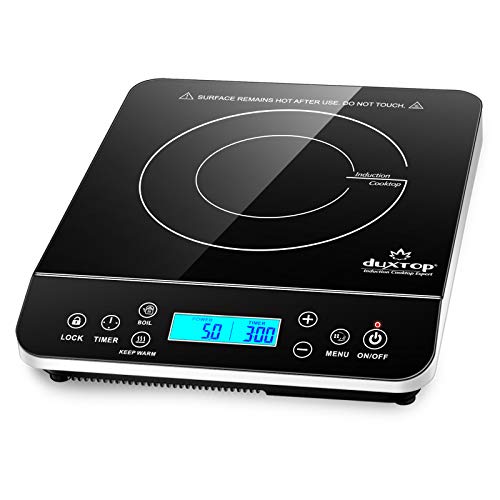
Duxtop Portable Induction Cooktop 9600LS — Best Overall
If your pressure cooker is stainless steel with a magnetic base, the Duxtop 9600LS is the burner to beat. Its 1800 watts bring a family-size cooker to pressure briskly, and its power levels are fine-grained enough to hold a gentle, steady pressure without the constant venting that coarse controls cause. The LCD touch panel and timer suit the set-and-monitor rhythm of pressure cooking.
| Type | Portable induction cooktop |
| Power | 1800W |
| Controls | LCD sensor touch with timer |
| Requirement | Induction-compatible (magnetic) pressure cooker |
Strengths
- Full 1800W output for fast come-to-pressure times
- Fine power control holds steady pressure with minimal venting
- Flat glass surface is stable and wipes clean
Trade-offs
- Induction only — aluminium pressure cookers will not heat
- Touch controls can be fiddly with wet hands
- Cooling fan is audible during long cooks
Induction’s advantage for pressure cooking is control at the low end. Once a cooker is at pressure, the burner only needs to replace lost heat; the Duxtop’s lower power levels do that in smooth increments, so the cooker’s regulator stays calm instead of rocking and venting. That steadiness is gentler on food, quieter, and wastes less water from the pot over a long cook.
Build quality is the other reason this model leads. The glass top handles the weight of a filled family-size cooker without flex, the housing vents heat properly during hour-long sessions, and Duxtop’s portable induction units have a long track record in exactly this role. For stainless cooker owners, this is the default recommendation.
A detail pressure cooks appreciate: the Duxtop remembers the practical realities of long cooks with a built-in timer and automatic shut-off behaviour, so a maintenance stage does not run away if you are called away from the kitchen. Its pan detection also refuses to heat an empty surface — a small safety grace when a cooker is lifted off mid-session to adjust a recipe.
One more Duxtop trait pressure cooks exploit: its power steps are remembered behaviourally — owners quickly learn ‘my stew holds at this level’ and can set it blind. That repeatability across hundreds of cooks is what separates a tool from a gadget, and it is why this model appears in so many serious home kitchens as the permanent second hob.
Best for: owners of induction-compatible stainless pressure cookers / Not suited for: owners of aluminium pressure cookers, which induction cannot heat
Check on Amazon — check the current price on Amazon before you decide, because listings and included accessories change over time.

CUSIMAX Electric Burner Hot Plate, 1500W Cast Iron — Best for Any Cooker Material
Millions of households own aluminium pressure cookers that induction simply cannot heat. The CUSIMAX cast iron burner is built for them: a solid 1500W plate, a simple temperature dial, and a heavy-duty build that takes the weight of a filled cooker without complaint. It is the least glamorous pick here and, for owners of traditional cookers, the most useful.
| Type | Cast iron electric hot plate |
| Power | 1500W |
| Controls | Adjustable temperature dial |
| Compatibility | All pressure cooker materials, including aluminium |
Strengths
- Heats every pressure cooker material, including aluminium
- 1500W is strong for a single cast iron plate
- Simple dial control anyone can use
Trade-offs
- Slower to respond than induction when you adjust heat
- Plate stays hot long after switch-off
- Less precise at holding a gentle simmer-pressure
Cast iron plate technique matters with pressure cookers. The plate’s thermal mass is both the strength and the quirk: it smooths out power cycling, giving steady heat at pressure, but it also means you should reduce the setting slightly before the cooker reaches full pressure, because the plate will keep pushing heat in after you turn it down. Experienced stovetop cooks already think this way from gas and solid-fuel cooking; the habit transfers directly.
At 1500W, bringing a large cooker to pressure takes longer than on the induction picks — that is physics, not a defect — but once there, the plate holds pressure contentedly. For the owner of a classic aluminium cooker who has moved to a kitchen without a stove, this is the burner that keeps their cooker in service.
Owners upgrading from a cheap exposed-coil burner will notice the CUSIMAX difference immediately in one place: the cooker stops rocking. A pressure vessel that sits dead still at pressure is not a luxury — the regulator’s rhythm stays even, the lid seal is undisturbed, and the whole cook feels calmer. That stability, more than the wattage, is what the money buys over the bargain-basement alternatives.
The CUSIMAX plate also serves double duty as a keep-warm station for the finished cooker: switched to its lowest setting, it holds a pot of soup at serving temperature through a long meal without scorching the base. It is not a function on the box, but it is one owners use weekly.
Best for: owners of aluminium or non-induction pressure cookers / Not suited for: cooks who want instant heat response and fine digital control
Check on Amazon — check the current price on Amazon before you decide, because listings and included accessories change over time.

Cuisinart Cast-Iron Single Burner CB-30P1 — Best Build Quality
The Cuisinart CB-30P1 is the cast iron burner for buyers who care how an appliance is made. The coil-less cast iron plate gives a pressure cooker a completely flat, stable seat — no rocking on exposed coils — and the stainless housing and tidy controls look and feel a class above budget hot plates. Six marked heat settings make repeatable pressure-cooking settings easy to note and reuse.
| Type | Cast iron single burner |
| Plate | Coil-less 7.4-inch cast iron plate |
| Controls | 6 adjustable heat settings with indicator lights |
| Finish | Stainless steel housing |
Strengths
- Flat coil-less plate seats heavy cookers stably
- Stainless housing and quality fit and finish
- Marked settings make your pressure routine repeatable
Trade-offs
- Plate diameter suits small and medium cookers best
- Costs more than basic cast iron burners
- Same slow response inherent to cast iron plates
Stability deserves emphasis for pressure cooking. A sealed cooker at pressure should sit dead level and motionless; a wobbly coil burner is not just annoying, it is the wrong foundation for a pressurised vessel. The Cuisinart’s solid plate removes that concern entirely for the small-to-midsize cookers its diameter suits, which covers most household pressure cooking.
Buy it as the long-term, leave-it-out burner. Owners of very large cookers should step up to a bigger plate or the double burner below, but for the standard family cooker this is the cast iron option with the fewest compromises and the backing of a major kitchen brand.
The Cuisinart’s indicator lights earn a mention because pressure cooking is a process of stages: knowing at a glance whether the plate is actively heating or resting helps you read the cooker’s behaviour — whether a spell of venting is the plate pushing or the cooker settling. Small feedback details like that are what separate burners designed by cooks from burners designed by catalogue.
Cuisinart’s burner suits the cooker-as-system household: the same plate that runs the pressure cooker all winter becomes the fondue and tabletop-cooking base for gatherings. Premium small appliances earn their price through exactly this kind of second life, and the CB-30P1’s finish survives it looking respectable.
Best for: quality-focused buyers with small to medium pressure cookers of any material / Not suited for: owners of very large-diameter cookers and canners
Check on Amazon — check the current price on Amazon before you decide, because listings and included accessories change over time.

ChangBERT Induction Cooktop, Commercial Grade — Best Heavy-Duty Induction
The ChangBERT is the workhorse pick: a commercial-pattern induction cooker with a big 8-inch coil that spreads heat across the base of larger pressure cookers, a stainless steel body designed to be wiped down in working kitchens, and certification to commercial sanitation standards. Its 10-hour timer acknowledges real use — long stocks, big batch cooking, all-day low pressure work.
| Type | Commercial-grade portable induction cooker |
| Power | 1800W with large 8-inch heating coil |
| Body | Stainless steel, NSF certified |
| Timer | Up to 10 hours |
Strengths
- Large coil suits wider cooker bases
- Commercial build and NSF certification
- Long timer supports extended pressure cooking
Trade-offs
- Utilitarian design prioritises function over looks
- Induction-only, like all induction picks
- More appliance than a casual user needs
Coil size is the under-discussed specification in portable induction. A small coil under a wide cooker concentrates heat in the centre of the base, which can scorch sauces during the sauté stage and cycle unevenly. The ChangBERT’s larger coil mitigates that, making it the induction pick we would choose for wide-based stainless cookers and for cooks who pressure cook in serious volume.
It is also the pick for non-domestic settings — a food business, a community kitchen, a workshop canteen — where certification and a metal body matter. Home users who simply cook a lot will appreciate the same durability. This is professional equipment that happens to be portable, priced and built accordingly.
The ChangBERT’s stainless body is not a styling choice: in working kitchens, and in homes where a burner lives beside a busy sink, a metal housing shrugs off splashes, knocks and hot splatters that crack plastic casings. Its controls are likewise built for gloved, wet, hurried hands. If your pressure cooking happens in a productive rather than a decorative kitchen, this build philosophy will feel familiar and right.
For buyers running a pressure cooker as part of a small food business, the ChangBERT’s certification trail simplifies conversations with landlords and inspectors that a domestic appliance can complicate. That administrative virtue never appears in cooking tests, and in commercial reality it is sometimes the deciding one.
Best for: heavy users, wide-based stainless cookers and semi-commercial settings / Not suited for: occasional users who need only a light-duty burner
Check on Amazon — check the current price on Amazon before you decide, because listings and included accessories change over time.
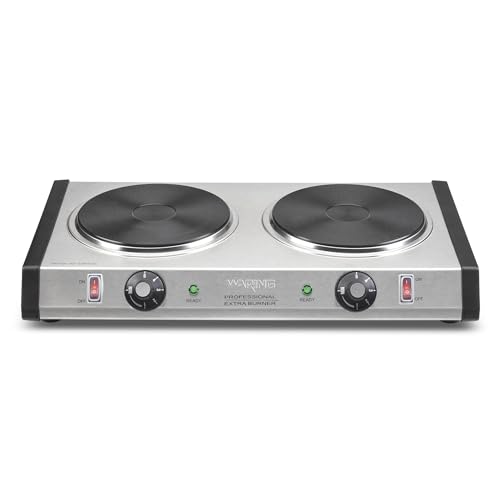
Waring Portable Double Burner WDB600X — Best Double Burner
Pressure cooking rarely happens alone — there is rice to make, a sauce to reduce, vegetables to steam for the same meal. The Waring double burner answers with two cast iron plates in one heavy countertop unit, from a brand whose natural habitat is the professional kitchen. The main plate takes the pressure cooker; the smaller plate handles the supporting act.
| Type | Double cast iron electric burner |
| Plates | Two heavy-duty cast iron plates (7.5-inch main plate) |
| Power | 120V countertop unit |
| Use | Pressure cooker on one plate, second pot alongside |
Strengths
- Two burners solve the whole meal, not just the cooker
- Cast iron plates heat any pressure cooker material
- Professional-grade build and stability
Trade-offs
- Largest footprint in this guide
- Total power is shared across both plates
- Premium pricing for a hot plate format
Be realistic about shared power: with both plates running hard, neither gets the unit’s full output, so the pressure cooker comes to pressure more slowly when the second burner is also at maximum. In practice the workflow still wins — the cooker needs full power only to reach pressure, and gentle maintenance power afterwards, which leaves plenty for the second pot during the long middle of the cook.
For households cooking in kitchens without a working stove — renovations, annexes, small rentals — this Waring is the closest thing to a hob you can put on a counter, and the only pick here that makes a pressure-cooker dinner with sides a one-appliance job.
A workflow the Waring enables that no single burner can: while the pressure cooker holds its long maintenance stage on the main plate at low power, the second plate is free for the high-attention work — reducing a sauce, boiling greens, frying eggs for the top of a rice bowl. The meal comes together in parallel instead of in sequence, which is the difference between a relaxed cook and a juggling act.
Waring’s double also solves a seasonal problem: holiday cooking, when the main stove is fully committed and one more burner — for the gravy, the greens, the warming pot — is the difference between calm and chaos. A unit bought for pressure cooking that rescues every feast day afterwards has a strong claim on its cupboard space.
Best for: cooks who want a pressure cooker plus a second pot on one unit / Not suited for: minimalists with tight counters who only ever run one pot
Check on Amazon — check the current price on Amazon before you decide, because listings and included accessories change over time.

Elite Gourmet Electric Burner, 1000W Cast Iron — Best Budget
The Elite Gourmet is the budget reality check of this guide: a simple 1000W cast iron plate, seven heat settings, and a price that makes it an easy purchase for a dorm, an RV, an office kitchen or a temporary setup. It will run a small pressure cooker — the key word is small — and it asks for patience in return.
| Type | Cast iron electric hot plate |
| Power | 1000W |
| Controls | 7 heat settings |
| Use | Compact and portable for small kitchens, dorms and RVs |
Strengths
- Lowest cost way to power a pressure cooker electrically
- Cast iron plate heats any cooker material
- Compact and light enough to store in a drawer
Trade-offs
- 1000W brings larger cookers to pressure slowly
- Not suitable for big cookers or canning loads
- Basic controls and finish at this tier
Wattage honesty matters here. At 1000W, a small 3–4 quart cooker reaches pressure in acceptable time; a full 6–8 quart cooker will take a long while and may struggle to maintain vigorous pressure in a cold room. That is not a flaw in this burner — it is a mismatch to avoid. Matched to a small cooker, it does its job reliably and the cast iron plate gives steadier heat than cheap coil alternatives.
Buy it for the use it suits: one or two people, a compact cooker, occasional pressure cooking away from a full kitchen. Buyers who pressure cook daily for a family should put the same money toward the CUSIMAX or Duxtop above and will be happier within a week.
Set the Elite Gourmet up for success and it rewards you: preheat the plate with the small cooker already on it, keep the lid on while pressure builds, and cook in a warm room rather than a cold garage. Those small kindnesses close much of the gap between its 1000 watts and stronger burners — for small loads. The moment your cooking outgrows it, the upgrade path in this guide is clear.
Finally, a fairness note for the budget pick: judged against other 1000W plates rather than against 1800W induction, the Elite Gourmet is a well-made example of its class — a real cast iron plate rather than a fragile coil, at a price that asks little. Its limits are its class’s limits, stated plainly in its review.
Best for: small cookers in dorms, RVs and temporary kitchens on a budget / Not suited for: large family cookers or any pressure canning
Check on Amazon — check the current price on Amazon before you decide, because listings and included accessories change over time.
Comparison Table
| Pick | Badge | Key spec | Best for |
|---|---|---|---|
| Duxtop Portable Induction Cooktop 9600LS | Best Overall | 1800W induction, LCD sensor touch | owners of induction-compatible stainless pressure cookers |
| CUSIMAX Electric Burner Hot Plate, 1500W Cast Iron | Best for Any Cooker Material | 1500W cast iron plate, works with all cookware | owners of aluminium or non-induction pressure cookers |
| Cuisinart Cast-Iron Single Burner CB-30P1 | Best Build Quality | Cast iron 7.4-inch plate, 6 heat settings | quality-focused buyers with small to medium pressure cookers of any material |
| ChangBERT Induction Cooktop, Commercial Grade | Best Heavy-Duty Induction | 1800W induction, 8-inch coil, NSF certified, stainless body | heavy users, wide-based stainless cookers and semi-commercial settings |
| Waring Portable Double Burner WDB600X | Best Double Burner | Double cast iron burners, heavy-duty, 120V | cooks who want a pressure cooker plus a second pot on one unit |
| Elite Gourmet Electric Burner, 1000W Cast Iron | Best Budget | 1000W cast iron hot plate, 7 heat settings | small cookers in dorms, RVs and temporary kitchens on a budget |
The table compresses the one decision that matters: induction picks (Duxtop, ChangBERT) are faster and steadier but demand a magnetic stainless cooker; cast iron picks (CUSIMAX, Cuisinart, Waring, Elite Gourmet) heat anything but respond slowly and stay hot. If you own an aluminium pressure cooker, your shortlist is the cast iron half of the table, whatever the induction reviews promise.
Wattage is the second filter. Around 1800W brings family-size cookers to pressure briskly; 1500W is workable; 1000W is for small cookers and patient cooks. No countertop burner in this guide is a pressure canning solution for large canners — that job still belongs to a full stove burner matched to the canner maker’s guidance.
How to Choose the Best Electric Burner for Pressure Cookers
Match the technology to your cooker first. Test your pressure cooker’s base with a magnet: if it sticks firmly across the base, induction is open to you and is usually the better experience — faster, steadier, cooler to work around. If the magnet does not stick, you need a cast iron or coil plate, and no accessory disc makes induction work well through an aluminium base; discs waste energy and still heat unevenly.
Size the plate to the cooker’s base, not its lid. The heated area should roughly match the flat base diameter of your cooker. A much smaller plate concentrates heat and slows the whole process; a much larger one wastes energy around the edges. Check the burner’s stated weight capacity too — a filled 8-quart cooker is a serious load, and pressure vessels deserve a burner that treats that weight as routine.
Then judge control by the maintenance stage, not the boil. Pressure cooking spends most of its time barely simmering under pressure. Burners with many low settings, or induction’s fine power steps, hold that stage calmly. A burner with three coarse settings will cycle between venting and dropping, which is noisy, wasteful and harder on gaskets.
- Magnet test first: induction only for magnetic bases
- Plate diameter matched to the cooker’s base
- Wattage: 1800W ideal, 1500W workable, 1000W for small cookers only
- Fine low-end control for a calm maintenance stage
- Stated weight capacity comfortably above your filled cooker
Can You Pressure Can on a Countertop Burner?
This question follows every burner guide, so it gets a direct answer: be very cautious. Pressure canning demands sustained, precisely held pressure for long, tested processing times, and canner manufacturers publish burner requirements — including minimum output and warnings about smooth glass surfaces and weight — that most portable burners do not meet. A countertop unit that sags in output or cycles coarsely is not a safe foundation for canning, however well it cooks stew.
For ordinary pressure cooking, the burners in this guide are entirely appropriate. For canning, use a full-size stove burner that your canner’s manual approves, and follow tested processing guidance for your altitude and food. The distinction is not fussiness; it is the difference between cooking and preserving, and preserving carries food-safety stakes that shortcuts do not respect.
Induction vs Cast Iron Plates for Pressure Cooking: The Full Picture
The technology choice deserves more than a paragraph, because it shapes every cook you will ever do on the burner. Induction heats the base of the cooker directly through magnetism. The response is immediate: turn it up and the base is hotter within seconds; turn it down and heating stops just as fast. For pressure cooking, that means brisk come-to-pressure times and — more importantly — fine, instant corrections during the maintenance stage. Efficiency is the other dividend: most of the energy becomes heat in the food rather than heat in your kitchen.
Cast iron plates work by contact: an element heats a solid iron disc, and the disc heats the pot. Everything is slower in both directions, and the plate remains dangerously hot long after the cook ends. But the plate’s thermal mass is also a genuine virtue at pressure: it irons out the power cycling of simple thermostats into a smooth, steady heat that keeps a cooker humming calmly. And it heats absolutely any pot ever made, including the aluminium pressure cookers that induction cannot touch.
The deciding questions, in order: Is your cooker magnetic? If not, the debate is over — cast iron. If yes, do you value response and efficiency (induction) or simplicity and thermal smoothness (cast iron)? Most cooks who try induction for pressure work do not go back, but cooks raised on solid-fuel and plate cooking often prefer the cast iron rhythm they already understand. Both halves of this guide’s table are respectable; the wrong technology for your pot is the only true mistake.
Reading Your Cooker: What the Sounds at Pressure Tell You
A pressure cooker talks to you through its regulator, and a good burner keeps that conversation calm. A gentle, rhythmic hiss or a soft rocking of the weight means the burner is delivering exactly maintenance power — the goal state. Hard, continuous venting with steam blasting means excess heat is being wasted as noise, water loss and gasket wear: turn the burner down a notch and wait a full minute before judging, because cast iron plates especially keep pushing stored heat after adjustment.
Silence is the other warning. If the regulator stops entirely and the cooker’s sounds fade, pressure is falling — the burner is set too low, or a cast iron plate has cycled off, or an induction unit has reduced power because its own cooling needs attention. Nudge the setting up slightly. Learning this two-sound diagnostic — too loud, too quiet, just right — is the whole skill of burner-based pressure cooking, and it transfers to every cooker and burner combination you will ever own.
Matching Burner to Cooker: A Size and Weight Checklist
Before ordering any pick in this guide, run three checks with your actual cooker. First, diameter: measure the flat base of the pressure cooker — not the lid, not the widest point — and compare it with the burner’s heated plate or coil size. The base should sit mostly within the heated area; a small overhang is normal, a large one wastes the burner’s power and can overheat the cooker’s handles. Second, weight: weigh or estimate your cooker full of its heaviest typical load and check it against the burner’s stated capacity with margin to spare — pressure vessels deserve margin.
Third, stability: your cooker should sit on the burner without rocking in any direction. Solid plates pass this test by design; if you are replacing a coil burner, this check alone will justify the change. Add a fourth check for induction: the magnet test, firmly applied across the whole base, because a base that is magnetic only at its rim will heat unevenly and cycle strangely. Four checks, five minutes, and the burner you order will be the burner your cooker needed.
When a Burner Is Not Enough: Recognising the Limits of Countertop Pressure Cooking
Honesty about limits completes this guide. A countertop burner serves pressure cookers up to family size beautifully, but three situations outgrow it. The first is pressure canning, covered earlier: sustained precision at canner scale belongs on a full stove. The second is the very large stockpot-style cooker — the 10-quart-plus vessels used for events and preserving prep — whose weight and diameter exceed what portable burners are built to carry. The third is professional volume, where a commercial range’s output and duty cycle are simply different equipment.
There is also a subtler limit: electricity supply. A burner drawing full power on a shared, older circuit alongside other appliances can trip breakers mid-cook — annoying with a frying pan, genuinely disruptive at pressure. If your kitchen circuits are marginal, the induction picks’ efficiency or a dedicated outlet solves it; pretending the constraint does not exist does not. Within these stated limits, though, the burners in this guide give pressure cookers a full and proper life away from a stove — which is exactly what they are for.
How to Run a Pressure Cooker on a Countertop Burner
Portable burners behave a little differently from a stove hob. This routine gets a calm, steady pressure cook out of any pick in this guide.
- Set up level and stable. Place the burner on a flat, heat-safe surface away from edges, with clearance above for the cooker’s steam release. Confirm the cooker sits without rocking before you fill it.
- Preheat with the cooker, not before. Cast iron plates especially should heat up with the pot on them; an empty plate at full power wastes energy and can overshoot. Induction can start with the cooker in place too.
- Bring to pressure at high power. Use a high setting until the cooker reaches pressure and the regulator starts its steady rhythm. This is the only stage that needs full power.
- Back off earlier than you think. Just before full pressure, reduce the setting — cast iron plates carry stored heat that keeps pushing for minutes. Aim for the lowest setting that keeps the regulator gently active.
- Watch the first ten minutes. Stay nearby while the cook settles. Constant hard venting means the heat is still too high; a cooker that falls silent and drops pressure needs a notch more.
- Cool down safely. After cooking, switch the burner off but leave the cooker on the plate to depressurise naturally if the recipe calls for it — the plate’s residual heat slows the drop slightly, which is harmless for natural-release dishes. Move the cooker only when pressure is fully down.
Write down the setting that held pressure calmly for your cooker-and-burner pair. That one note turns every future cook into a repeat performance instead of a fresh experiment.
Common Buying Mistakes
Buying induction for an aluminium cooker. Induction cannot heat non-magnetic metal, full stop. Do the magnet test before ordering, not after unboxing.
Trusting headline wattage. Some listings quote impossible outputs for a standard plug. Verify the wattage on the live listing and prefer established models with consistent specifications.
Using a small plate under a wide cooker. A concentrated hot spot scorches food during sautéing and cycles unevenly at pressure. Match plate size to the cooker’s base.
Running a big canner on a portable burner. Weight, output and control all argue against it. Canning belongs on a stove burner your canner’s manual approves.
Turning the heat off and walking away at pressure. The maintenance stage needs a low, steady input, not zero input. A cooker left to cool mid-recipe falls out of pressure and undercooks the food.
Final Recommendation
For stainless cooker owners, the Duxtop 9600LS is the burner to buy — fast, steady and proven in exactly this role — while the ChangBERT is the step up for wide cookers and heavy use. If your pressure cooker is aluminium, the CUSIMAX 1500W is the practical default and the Cuisinart the better-finished alternative. Need a second pot alongside? The Waring double is the only pick that runs the whole meal.
Whichever you choose, do the magnet test first and match the plate to your cooker’s base. Those two checks prevent nearly every disappointment in this category. Related cooker guides are linked below.
Check the Duxtop Portable Induction Cooktop 9600LS on Amazon. Check the CUSIMAX Electric Burner Hot Plate, 1500W Cast Iron on Amazon. Check the Cuisinart Cast-Iron Single Burner CB-30P1 on Amazon.
Best Electric 8 Qt Pressure Cookers Best Electric Cookers With Induction Hobs Best Electric Indoor Cookers Best Electric Multipot Cookers Best Electric Multi Use Pressure Cookers
Frequently Asked Questions
Will an induction burner work with my pressure cooker?
Only if the cooker’s base is magnetic — typically stainless steel models sold as induction-compatible. Test with a fridge magnet: a firm stick across the base means yes. Classic aluminium pressure cookers will not heat on induction at all.
How many watts does a pressure cooker burner need?
For family-size cookers, 1800W brings the pot to pressure briskly and 1500W is workable. Around 1000W suits small cookers only and makes large pots slow. More important than the peak is fine low-end control for holding pressure steadily.
Why does my pressure cooker keep venting on my burner?
The heat is too high for the maintenance stage. Once at pressure, the cooker needs only gentle input. Reduce the setting — remembering that cast iron plates keep pushing stored heat — until the regulator is just gently active.
Can I use a countertop burner for pressure canning?
It is not recommended. Canning requires sustained, precise pressure and canner makers publish burner requirements that portable units rarely meet. Use a full stove burner approved by your canner’s manual and follow tested processing guidance.
Is a cast iron plate or a coil burner better for pressure cookers?
A cast iron plate gives a flat, stable seat and smoother heat, which suits a heavy pressurised vessel. Exposed coils are cheaper but can rock the pot and create hot spots. For pressure cooking, the solid plate is the safer foundation.
Do I need a burner with a timer?
It is a convenience, not a requirement — the cooker itself determines cooking time, and most pressure recipes end with a manual release decision. A timer helps with long, unattended maintenance stages, but control quality matters far more.
Why does my induction burner keep cycling on and off under the pressure cooker?
At low settings, many induction units pulse power rather than delivering a continuous trickle, which shows up as the cooker alternately venting and quieting. Finer-grained models minimise it. A heavy-based cooker smooths the pulses, and choosing a slightly higher setting with the cooker’s own regulation often settles the rhythm better than the lowest possible setting.
Can I use an extension cord with an electric burner?
Avoid it where possible: high-wattage burners draw serious current, and light extension cords overheat under sustained load. Plug the burner directly into a wall outlet. If a cord is genuinely unavoidable, use the shortest, heaviest-duty appliance-rated cord available and never leave the setup unattended.


