Disclosure: airfryerkitchensupply.com is reader-supported. When you buy through links on our site, we may earn an affiliate commission at no extra cost to you.
Where to buy
For best dj intro mixers, start here: An intro mixer should cost little, survive learning, and teach real technique — judge listings on crossfader quality, per-channel EQ and whether the layout matches the mixers you will meet later. Every linked pick below was matched by brand and model against Amazon’s catalog before this guide was written, so the product you land on is the product described. Linked picks say “check price on Amazon” because live pricing changes too often to print honestly. Any pick marked as unlinked is a real product without a stable listing-confirmed Amazon listing; it is described in full, with no purchase link, rather than swapped for a weaker substitute.
Behringer PRO MIXER NOX101 (Best Overall Intro Mixer): Check on Amazon — check the current price on Amazon.
Gemini MM1 (Best Budget): Check on Amazon — check the current price on Amazon.
Numark M2 (Best for First Turntable Rigs): Check on Amazon — check the current price on Amazon.
Pioneer DJ DJM-250MK2 (Best Step-Up Intro): Check on Amazon — check the current price on Amazon.
Gemini MM1BT (Best with Bluetooth): Check on Amazon — check the current price on Amazon.
Behringer PRO MIXER DJX750 (Best Feature-Packed Intro): Check on Amazon — check the current price on Amazon.
Introduction: what actually matters here
The best dj intro mixers share a philosophy: spend as little as possible without buying habits you will have to unlearn. An intro mixer is a first instrument — two channels, honest EQ, a crossfader that behaves — bought to discover whether DJing is a phase or a life. The six below are the ones that respect that mission: every one is a real mixer from a real DJ brand, verified against Amazon’s catalog, and none of them is a light-show toy wearing a mixer’s clothes.
Set expectations correctly and this price tier is a joy. You will not get club effects, dual USB interfaces or a decade of touring durability — nor do you need them to learn cueing, beatmatching, EQ blending and basic scratching. What you must get is a layout that transfers: channel faders, gain, three-band (or at least two-band) EQ and a crossfader with a sensible curve, arranged the way every bigger mixer arranges them. All six picks pass that test, which is why they are here and the novelty boxes are not.
One honest alternative deserves naming at the start: if your sources will be a laptop rather than turntables or players, a beginner controller may serve you better than any mixer in this list, because a mixer alone plays nothing. This guide assumes you have — or are building — sources: two turntables, two media players, or a DVS setup. The companion controller guide on this site covers the other path.
In this guide
Quick Picks
Behringer PRO MIXER NOX101 — Best Overall Intro Mixer: The intro benchmark: a proper two-channel battle-capable layout with VCA control and an Ultraglide crossfader, at a price that leaves budget for records and headphones. — Check on Amazon
Gemini MM1 — Best Budget: The smallest honest mixer money can buy: pocket-sized, two channels, a full-size crossfader — the minimum viable instrument for learning and travelling light. — Check on Amazon
Numark M2 — Best for First Turntable Rigs: A rack-mountable two-channel scratch mixer with three-band EQ and a slope-adjustable, replaceable crossfader — the first mixer that grows with a turntablist. — Check on Amazon
Pioneer DJ DJM-250MK2 — Best Step-Up Intro: The club layout in miniature: Magvel crossfader, per-channel Sound Color FX and a built-in sound card with rekordbox DVS — the intro mixer that is also a destination. — Check on Amazon
Gemini MM1BT — Best with Bluetooth: The pocket mixer goes wireless: MM1 simplicity plus Bluetooth input for a phone channel — casual sets, practice and parties where the phone is a legitimate source. — Check on Amazon
Behringer PRO MIXER DJX750 — Best Feature-Packed Intro: The maximalist exception: five channels, digital effects and BPM counters at an intro price — for buyers who know they want a party mixer, not a purist’s teacher. — Check on Amazon
How These Picks Were Chosen
Candidates were entry-level two-channel and compact mixers from established DJ brands, each matched by brand and model to its Amazon listing title before linking. Mixers whose listings could not be confirmed were excluded rather than guessed at, and the mini spec boxes quote only what the verified titles support.
Ranking weighed teaching value first: crossfader quality and curve options, EQ completeness, and layout fidelity to standard mixers. Then came source flexibility (phono inputs for turntables, line inputs for players, a mic input for the inevitable party hosting) and build honesty — at this tier, a simple metal box that works for five years beats a feature-crammed box that works for one.
Effects and extras were deliberately deprioritised, with one exception made consciously: the DJX750 pick exists for buyers who know they want a multi-channel, effects-bearing mixer from day one. It is badged as such, so its compromise — size and complexity against the intro mission — is a choice, not a trap.
The 6 Best Options: Best dj intro mixers in detail
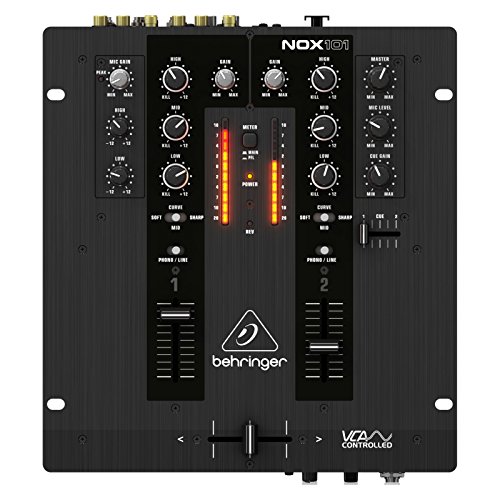
Behringer PRO MIXER NOX101 — Best Overall Intro Mixer
The NOX101 is what an intro mixer should be: two channels with phono and line inputs, three-band EQ, a mic input, and a crossfader — the Ultraglide, with full VCA control — good enough to learn scratching on without fighting the hardware. Behringer’s NOX line was designed as an honest entry to the craft, and this remains the pick against which other first mixers are measured.
Strengths
- Crossfader quality above its class — scratching practice feels right from the first week
- Complete, standard layout: everything is where bigger mixers keep it
- Phono and line inputs cover turntables and players alike
Trade-offs
- No USB or DVS — a laptop rig needs an interface or a different pick
- No built-in effects; your technique is the effect, which beginners eventually thank it for
- Basic metering and finish remind you it is an entry product — fairly
Key specs (verified): Premium 2-channel DJ mixer, full VCA control, Ultraglide crossfader (per Amazon title)
The NOX101’s restraint is its curriculum. With no effects to hide behind, a new DJ learns gain staging, EQ and timing — the skills that survive every equipment upgrade. Its crossfader is the standout: many intro mixers sabotage scratch learning with vague, sticky faders, while the Ultraglide’s smooth travel lets chirps and crabs develop honestly. If the plan is turntables and craft, start here and spend the savings on vinyl.
It also serves a second life gracefully: when its owner graduates, the NOX101 becomes the bedroom, backup or friend’s-party mixer, roles where its simplicity is a feature. Intro gear that remains useful after graduation is the definition of value in this category.
Best for: First-time buyers on turntables or players who want to learn real technique cheaply / Not suited for: Laptop DJs needing USB/DVS built in
Check on Amazon — check the current price on Amazon before you buy, and confirm the exact configuration in the listing title matches the model reviewed here.

Gemini MM1 — Best Budget
The MM1 is a cult object for a reason: it strips the DJ mixer to its essence — two channels, EQ, gains, a proper full-size crossfader — and shrinks it to pocket format. Portable turntablists practise on it in parks; travelling DJs keep one as an emergency mixer; beginners with almost no budget learn on it rather than on nothing. Nothing this small has any right to be this legitimate, yet it is.
Strengths
- Genuinely portable — a practice and backup mixer that fits in a record bag
- Full-size crossfader preserves real technique despite the tiny footprint
- The lowest price of entry to a real mixer from a real DJ brand
Trade-offs
- Two-band EQ and minimal metering mark its class — blends are simpler than on full mixers
- Compact controls reward small hands and patience; big-handed DJs will find it fiddly
- No mic input, no effects, no USB — it is an essence, not a system
Key specs (verified): Portable 2-channel DJ mixer, full-size crossfader, 2-band EQ (per Amazon title)
Treat the MM1 as the floor of the category — the point below which a ‘mixer’ stops being one. For a beginner whose alternative is a phone app or a toy, it teaches the physical grammar of DJing with real faders under real fingers. Its limitations are honest and even instructive: with two-band EQ you learn arrangement and timing to make blends work, which are the skills underneath all the polish bigger mixers add.
Its second market is telling: experienced DJs buy MM1s as travel and backup mixers, which means a beginner’s first mixer is also a product professionals respect. Resale and hand-me-down value in this tier is rare; the MM1 has both because the concept — essence, executed properly — does not date.
Best for: Minimal budgets, portable practice and a first real mixer for small spaces / Not suited for: DJs wanting three-band EQ, effects or a mic channel
Check on Amazon — check the current price on Amazon before you buy, and confirm the exact configuration in the listing title matches the model reviewed here.

Numark M2 — Best for First Turntable Rigs
The M2 is the intro mixer for buyers whose direction is already clear: turntables, scratching, and a rig that might end up racked in a small booth or studio. Its crossfader is both slope-adjustable — dial the curve from smooth blends to sharp cuts — and replaceable, the two features that separate a learning tool from a dead end, and its three-band EQ and mic input cover party duty without complaint.
Strengths
- Adjustable, replaceable crossfader — the component that matters most, done properly
- Three-band EQ per channel for real blending control
- Rack-mountable metal chassis suits permanent first rigs and small installs
Trade-offs
- No USB/DVS and no effects — it is a purist analogue hub
- Rack format is a commitment; desktop wobblers should check dimensions before ordering
- Sits above the MM1/NOX101 on price — the premium is the fader and the chassis
Key specs (verified): 2-channel scratch DJ mixer, rack-mountable, 3-band EQ, mic input, replaceable slope-adjustable crossfader (per Amazon title)
Crossfaders are consumables in scratch culture, and a mixer that treats its fader as replaceable respects its owner. The M2’s adjustability matters pedagogically too: a beginner can soften the curve while learning blends, then sharpen it as cuts develop, on the same instrument. That continuity — one mixer across the whole learning curve — is why the M2 takes the turntable-rig badge over cheaper rivals that a developing scratch DJ would outgrow in a year.
Numark’s long production run for this design means parts, faders and community knowledge are easy to find — a practical virtue in a first purchase that spec sheets never capture. For a bedroom rig built around two turntables and ambition, it is the grown-up choice at an intro price.
Best for: Aspiring turntablists building a first permanent two-turntable rig / Not suited for: Buyers wanting USB, DVS or effects in the box
Check on Amazon — check the current price on Amazon before you buy, and confirm the exact configuration in the listing title matches the model reviewed here.

Pioneer DJ DJM-250MK2 — Best Step-Up Intro
The DJM-250MK2 breaks the intro rule in the best way: it is priced for beginners but built as the bottom rung of the actual club ladder. Its Magvel crossfader is the same family as the flagship DJMs, each channel carries a Sound Color FX filter knob exactly where club mixers keep it, and the built-in USB sound card unlocks rekordbox DVS — meaning two turntables and a laptop become a full digital rig through this one box.
Strengths
- Club-authentic layout and fader feel — skills transfer to DJM-450, S-series and A9 booths
- Built-in sound card with rekordbox DVS support: turntables plus laptop, no extra interface
- Sound Color FX per channel teaches the effects language of the professional range
Trade-offs
- Costs more than the pure-analogue intro picks — you are buying the ecosystem entry ticket
- Two channels and a compact surface; four-channel ambitions look elsewhere
- DVS timecode vinyl and software setup add first-week complexity pure analogue avoids
Key specs (verified): 2-channel DJ mixer, Magvel crossfader, Sound Color FX, USB sound card with rekordbox DVS (per listing class)
For a beginner whose destination is known — Pioneer booths, rekordbox library, DVS or media players — the 250MK2 is not the expensive intro option but the cheap final one: many owners never replace it, because it already speaks the professional language. The DVS point deserves emphasis: it converts a pair of humble turntables into a system that plays your whole digital library, which is the most capability per unit of money anywhere in this guide.
Its recording path via USB also quietly professionalises a beginner’s practice: record every session to the laptop, listen back cold, improve. Intro mixers are supposed to teach; the 250MK2 additionally documents the teaching. If the budget stretches to exactly one serious first purchase, this is the stretch target.
Best for: Beginners committed to the Pioneer/rekordbox path and DVS with turntables / Not suited for: Minimal budgets — the NOX101 and MM1 teach the basics for less
Check on Amazon — check the current price on Amazon before you buy, and confirm the exact configuration in the listing title matches the model reviewed here.

Gemini MM1BT — Best with Bluetooth
The MM1BT takes the MM1’s essence-of-a-mixer idea and adds the input modern casual DJing actually uses: Bluetooth. One channel can be a turntable or player while the other streams from a phone — for practice over reference tracks, for the house party where requests arrive as links, for the beginner whose second ‘deck’ is honestly a phone for now. It does not pretend Bluetooth is a professional format; it acknowledges it is a real one.
Strengths
- Bluetooth channel makes a phone a working second source for practice and parties
- Same pocket format and full-size crossfader as the MM1 — technique stays real
- Ideal first mixer for casual and social DJing rather than booth ambitions
Trade-offs
- Bluetooth latency makes it unsuitable for scratching on the wireless channel — use it for playback, not performance
- Two-band EQ and compact controls, as with the MM1
- Serious learners will graduate sooner than with the step-up picks
Key specs (verified): Portable 2-channel Bluetooth DJ mixer, crossfader, 2-band EQ (per Amazon title)
Purists scoff at Bluetooth in a mixer, and for the booth they are right. But the MM1BT is not for the booth — it is for the kitchen-table practice session and the garden party, where the alternative to a phone channel is no second channel at all. Judged on the work it actually does, the wireless input is the difference between a mixer that gets used weekly and one that waits for a ‘proper’ setup that rarely assembles. Use is the first virtue of an intro product.
It is also a kind first gift of gear: a teenager with one turntable or a media player gains a complete, working two-source rig in a box that fits a stocking. Keep expectations at its badge — casual, social, practice — and it exceeds them.
Best for: Casual, social and practice DJing where a phone is one of the sources / Not suited for: Scratch practice on the Bluetooth channel, or booth ambitions
Check on Amazon — check the current price on Amazon before you buy, and confirm the exact configuration in the listing title matches the model reviewed here.

Behringer PRO MIXER DJX750 — Best Feature-Packed Intro
Every guide needs its honest exception, and the DJX750 is this one’s: a five-channel mixer with built-in digital effects, BPM counters and a stack of inputs, sold at a price the purist two-channel picks charge. It breaks the intro philosophy — more features than a learner needs — in service of a different buyer: the party and mobile starter who needs microphones, multiple sources and effects for a crowd from the very first gig.
Strengths
- Five channels swallow parties whole: two sources, spare players, microphones and a phone
- Built-in effects and BPM counters deliver the party toolkit without extra boxes
- Unmatched feature count for its price tier — the value maximalist’s pick
Trade-offs
- Complexity is the cost: a pure beginner learns slower amid this many options
- Fader and finish are built to the price — it is a workhorse, not an heirloom
- Large footprint beside the compact two-channel picks; check your space
Key specs (verified): Professional 5-channel DJ mixer, digital effects, BPM counter (per Amazon title)
The DJX750’s buyers are rarely confused about what they want: a lot of mixer, immediately, cheaply. For community events, school discos, bars kitting a first booth and mobile starters, its channel count and effects answer the actual brief better than a purist two-channel ever could. This guide includes it with its compromises labelled rather than pretending the purist answer fits every life — while noting plainly that a craft-focused beginner should still start with the NOX101 or 250MK2.
Its longevity in the market is its own evidence: designs that fail their buyers disappear, and this one has served the party tier for years. Treat it as the events appliance it is — set it up, label the channels, keep a spare mic cable — and it will earn its keep at the first function.
Best for: Party, mobile and venue starters needing channels, mics and effects immediately / Not suited for: Craft-focused beginners, who learn faster on the simple two-channel picks
Check on Amazon — check the current price on Amazon before you buy, and confirm the exact configuration in the listing title matches the model reviewed here.
Comparison Table
| Pick | Badge | Key spec | Best for |
|---|---|---|---|
| Behringer PRO MIXER NOX101 — Check on Amazon | Best Overall Intro Mixer | 2-ch / VCA / Ultraglide fader | First-time buyers on turntables or players who want to learn real technique cheaply |
| Gemini MM1 — Check on Amazon | Best Budget | 2-ch pocket / full-size fader | Minimal budgets, portable practice and a first real mixer for small spaces |
| Numark M2 — Check on Amazon | Best for First Turntable Rigs | 2-ch / 3-band EQ / adjustable fader | Aspiring turntablists building a first permanent two-turntable rig |
| Pioneer DJ DJM-250MK2 — Check on Amazon | Best Step-Up Intro | 2-ch / Magvel / DVS sound card | Beginners committed to the Pioneer/rekordbox path and DVS with turntables |
| Gemini MM1BT — Check on Amazon | Best with Bluetooth | 2-ch pocket / Bluetooth input | Casual, social and practice DJing where a phone is one of the sources |
| Behringer PRO MIXER DJX750 — Check on Amazon | Best Feature-Packed Intro | 5-ch / FX / BPM counter | Party, mobile and venue starters needing channels, mics and effects immediately |
What Is DVS and Why Does It Change the Intro Decision?
Digital Vinyl System lets turntables control digital files: a timecode record on a real deck, a sound card in or beside the mixer, and your laptop’s library under your hands with full scratch feel. It is the bridge between vinyl craft and digital convenience, and it is why the DJM-250MK2 — with its built-in rekordbox DVS sound card — punches so far above its price for turntable owners.
If DVS is your destination, the intro shortlist narrows honestly: a mixer with a built-in interface (250MK2) or a standalone interface budget added to an analogue pick. Deciding this before purchase, rather than discovering it after, is the difference between a rig and a pile of almost-rig.
What Else Does a First DJ Rig Need Besides the Mixer?
The mixer is the middle of the rig, not the whole of it, and beginners budget best when they see the full picture from the start. Sources come first — two turntables with cartridges, or two media players — with the DVS interface question settled by the mixer choice (built into the DJM-250MK2, external with the analogue picks). Headphones come next and deserve real money: closed-back, comfortable for hours, honest in the bass, because every cue you ever set passes through them. Then cables — two more than you think — and a surface at the right height, because DJing learned hunched over a bed is DJing learned with a posture tax on every session.
Finally, the invisible purchase: music. A beginner’s library should be small and loved — fifty tracks known completely outperform five thousand skimmed — and if vinyl is the medium, a cleaning brush and spare stylus protect the investment better than any accessory. Notice what is absent from this list: lights, stands shaped like logos, and a second anything. The intro rig’s elegance is its completeness at small scale; everything on this page was chosen to keep it that way.
How Do You Know If DJing Is a Phase or a Life?
You do not — and the intro tier exists precisely so that the question costs little to answer. The honest signals arrive within a few months and they are behavioural, not emotional: Do you practise when nobody will hear it? Do you hear transitions in other DJs’ sets involuntarily? Did the first frustrating month — and there is always one — send you back to the decks or away from them? The gear cannot answer these questions, but the right gear keeps the experiment clean: a real mixer teaches real skills, so a ‘no’ means DJing is not for you, rather than meaning your equipment failed you.
If the answer turns out to be yes, the intro mixer’s second life begins — backup, travel, the friend’s party — and its purchase price amortises across a decade of small services. If the answer is no, a recognised model from a real brand sells to the next beginner quickly, because the market for honest starter gear never dries up. Either way, the experiment was well designed. That is all an intro purchase owes you, and the six picks here pay that debt in full.
The Anatomy of a Crossfader: Why Beginners Should Care
The crossfader is the only component a DJ touches thousands of times a night, and its design decides what techniques are possible. Three properties matter. Curve: how volume changes across the travel — gradual for blending, sharp-cutting for scratch, adjustable on the better picks here (the M2’s slope dial) so one fader serves both schools. Feel: the physical resistance and smoothness — the NOX101’s Ultraglide and the DJM-250MK2’s Magvel are famous because they disappear under the fingers. And mortality: faders wear, so replaceability (M2, and the professional fader families) converts a death sentence into a maintenance item.
Beginners should test a fader the way the all-time guide prescribes: slowly through the cut point, listening for crackle; then fast, feeling for lag or grit. On a new intro mixer all three properties should be present and correct — this is the component where ‘cheap’ must never mean ‘vague’, because vague faders teach vague hands. It is not coincidence that every pick in this guide was chosen partly by its fader; in the intro tier, the fader is the mixer.
Two Decks and a Mixer: The Complete History of Almost Everything
It is worth pausing on how much music the humble format in this guide has made. Two turntables and a two-channel mixer carried hip-hop from parks to arenas, house from warehouses to the mainstream, and drum and bass, garage and grime through their formative decades. The techniques now taught as advanced — juggling, transformer scratches, long EQ blends — were invented on equipment less capable than the cheapest pick on this page, by DJs whose limitation was never the mixer in front of them.
The lesson for a beginner is liberating: your intro rig is not a waiting room for real DJing; it is the historically standard instrument of the art form. The DJs who outgrew two channels did so after years, at the head of fully developed skills — and the ones who speak most fondly of their first mixer are those who bought an honest one and played it to its edges. Choose from this page, then go and find your edges. They are further away than the marketing of four-channel everything would have you believe.
The First Party: A Survival Guide for Intro-Rig DJs
Your intro rig’s first real party will teach more than a month of bedroom practice, provided you prepare the unmusical parts. Arrive with cables doubled, a phone loaded with a background playlist for setup and emergencies, requests policy decided in advance (a notebook for them works wonders), and your levels set conservatively — parties get louder as they warm up, and headroom at 9 p.m. is professionalism at midnight. Put the speakers where the dancers are, not where the furniture suggests, and keep one hand free for the room: an intro DJ’s job is reading faces, not performing routines.
Expect one thing to go mildly wrong — a cable, a channel, a request you cannot play — and know that the room will judge only your calm. Every pick in this guide has survived thousands of such nights in other beginners’ hands. Yours will too, and the mixer that felt like an experiment in the shop will feel, by the second party, like the beginning of a reputation. That transformation — from purchase to instrument — is what the intro tier is for.
Before You Order: The Intro Checklist
Five quick confirmations protect an intro purchase. Sources: named and owned, or the controller guide read instead — a mixer alone is silent. Inputs: phono present if turntables exist anywhere in your future; line for players; mic if you will ever host. Fader: curve and quality checked against your style — scratch learners, this line is your whole purchase. Digital path: DVS decided now, either built into the mixer or consciously declined. Completion money: headphones and cables inside the budget, not after it. Run those five and the intro mixer that arrives will teach from the first evening — which is the entire promise of this tier, kept.
How to Choose an Intro DJ Mixer: What Should a First Mixer Teach?
A first mixer should teach the four permanent skills: gain staging (setting levels so nothing distorts), EQ blending, crossfader control, and cueing. Any mixer with honest channel strips and a decent crossfader teaches all four; any mixer that substitutes effects and automation for them teaches dependence. That is why this guide ranks simple, standard-layout mixers above feature-crammed ones for learners — while keeping one feature pick, clearly badged, for buyers whose brief is parties rather than craft.
Check three physical things before buying: phono inputs if turntables are (or may be) in your future, because not every cheap mixer has them; a replaceable or at least adjustable crossfader if scratching interests you; and a mic input if you will ever host, MC or run events. Each is cheap at purchase and impossible to retrofit — the classic first-purchase regrets in this category are all omissions, not commissions.
Intro Mixer or Beginner Controller: Which First Purchase Is Right?
Follow your sources. If you own or are buying turntables or media players, a mixer completes the rig and this guide applies. If your music lives on a laptop and you own no players, a controller is the complete instrument — mixer, players and sound card in one box — and a standalone mixer alone would leave you unable to play a note. Many DJs own both across a lifetime; the first purchase should be the one that makes music this month.
Budget honestly for the whole first rig either way: headphones you can cue in (the most underrated purchase in DJing), cables, and music. A modest mixer with good headphones and a stocked library produces better parties than a flagship mixer with neither — a sentence that remains true at every level of this hobby.
How Long Will an Intro Mixer Last Before You Outgrow It?
Physically, the metal-box picks here last for years; the honest limit is ambition. Two channels serve most DJs for a long time — but DVS curiosity, a third source, or four-channel mixing styles eventually call. The picks were chosen to age gracefully: the DJM-250MK2 often never gets replaced, the M2’s replaceable fader extends its scratch life, and the NOX101 and MM1 retire into backup and travel roles rather than landfill.
Buy with the second life in mind and the intro purchase stops feeling like a toll on the way to real gear. Every working DJ’s kit contains humble boxes doing quiet jobs; starting with one that can join that fleet is the economical definition of a good intro mixer.
How to Set Up an Intro DJ Mixer with Two Sources
This walkthrough assumes two sources — turntables, media players, or one of each — plus the mixer and powered speakers or an amplifier. It is the setup every pick in this guide shares.
- Connect sources to channels before powering anything: turntables to phono inputs (with ground wires attached — hum is almost always a missing ground), players to line inputs, and set each channel’s phono/line selector to match.
- Connect the mixer’s master output to your speakers or amplifier, headphones to the mixer’s headphone socket, and only then power up — sources first, mixer next, speakers last, to keep switch-on thumps out of the system.
- Set the master volume to a moderate level and each channel’s gain so your loudest track peaks healthily in the meters without sitting in the red; gains are set per track, every track, forever — make it a reflex now.
- Configure cueing: select the incoming channel to headphones, set the cue mix so you hear the cued track clearly against the playing one, and practise hearing both worlds at once — that split attention is the core DJ skill.
- Set the crossfader curve for your practice: smooth and gradual for blend exercises, sharper as scratch work begins (on the M2 this is a dial; on simpler mixers it is fixed and forgiving).
- Play one complete blend at low volume — cue, beatmatch, EQ, fade — then record the session on your phone and listen back. The recording habit, started on day one, is worth more than any upgrade you are currently browsing.
Label your inputs with tape and pen — ‘LEFT DECK’, ‘RIGHT DECK’, ‘MIC’ — however obvious it feels. In the dark, at a party, with someone asking for a request, obvious labels are the difference between a smooth night and a very public silence.
Common Buying Mistakes
Buying a mixer with no sources to plug into it. A mixer alone is silent. Turntables, players or DVS complete it — or buy a controller instead.
Skipping phono inputs to save a little. The turntable you buy next year needs them. Check the panel before the price.
Learning on effects instead of EQ. Effects decorate blends; EQ makes them. Intro mixers without effects are teachers, not omissions.
Cheap headphones. You cue through them on every transition. A decent closed-back pair outranks every other accessory purchase.
Never recording practice. Your memory of a mix is generous; a recording is honest. Start the habit with the first session.
Final Recommendation
For most first-time buyers the Behringer NOX101 is the intro mixer to beat: proper layout, a crossfader that teaches honestly, and money left over for the headphones and records that matter more. The Gemini MM1 is the budget floor done right, and the Numark M2 is the first-turntable-rig choice for developing scratch DJs.
Step up to the Pioneer DJM-250MK2 if your destination is the Pioneer ecosystem or DVS — it is an intro price for a mixer many never replace. Choose the MM1BT for casual, phone-friendly social DJing, and the DJX750 if your brief is parties and channels rather than craft. All six are verified listings: check price on Amazon, confirm the model in the title, and spend what you saved on music.
Shortlist again, for convenience: Behringer PRO MIXER NOX101 — Check on Amazon; Gemini MM1 — Check on Amazon; Numark M2 — Check on Amazon.
Related reading on this site: Best Dj Mixers For Beginners; Best Dj Controllers And Mixers; Best Dj Mixers For Pc; Best Dj Mixers Ever; Best Dj Mixers Under $200.
Frequently Asked Questions
Can I learn to DJ properly on a cheap intro mixer?
Yes — the core skills (gain, EQ, cueing, beatmatching, crossfader control) are identical on a NOX101 and a flagship. What cheap mixers lack is extras: effects, interfaces, four channels. Many respected DJs learned on humbler boxes than these. The limit on your first year is practice hours, never the mixer.
Do I need speakers, or can I practise on headphones alone?
You can practise entirely in headphones using the cue mix — one ear on the cue, or the split/mix knob blending both — and many bedroom DJs do for months. A small pair of speakers becomes worthwhile when you start playing for anyone else, and for hearing how blends truly sit in a room. Headphones first, speakers when the audience arrives.
What is the difference between phono and line inputs?
Turntables output a tiny phono-level signal needing a special preamp and EQ curve; players, phones and controllers output line level. Plugging a turntable into a line input gives a whisper; a player into phono gives distortion. Every pick here provides the inputs its badge implies — just match the selector switch to the source, and attach turntable ground wires to kill hum.
Should a beginner buy two channels or more?
Two. Almost everything foundational happens between two sources, and extra channels mostly add cost and distraction at the learning stage. The exception is the party/events buyer, for whom the DJX750’s channels and mic inputs are the brief itself. Craft learners: two channels, mastered deeply, beat five channels skimmed.
Can these mixers work with a laptop?
As audio hubs, some can route a laptop as a line source, but only the DJM-250MK2 here contains a proper DJ sound card with DVS — the setup that lets turntables control laptop files. If laptop DJing is your main plan rather than an accessory, a controller (see the companion guide) is the honest recommendation; mixers serve source-based rigs.
How do I know if the crossfader is good enough for scratching?
Look for the words adjustable curve and replaceable in the listing — the Numark M2 has both — or a recognised fader family like Pioneer’s Magvel. Beyond specs, feel matters: a scratch fader should travel lightly and cut sharply near its ends. The NOX101’s Ultraglide and the 250MK2’s Magvel are the intro tier’s proven answers; vague, stiff faders are the thing to avoid.
Can an intro mixer be used for a real party or small gig?
Absolutely — that is their native habitat. Every pick here has played countless real parties. The gig-readiness checklist is about the rig around the mixer: healthy speakers, a mic if speeches are expected, cables plus spares, and music organised before the night. The mixer itself, from the MM1 upward, is not the weak point of a small event; preparation is, and preparation is free.
Can I connect a phone or laptop to an intro mixer for extra music?
Yes — any line input accepts a phone or laptop with the right cable, and several picks make it a feature: the M6 takes the computer over USB, and the MM1BT takes a phone over Bluetooth for playback. Treat that channel as a source for requests, background music and reference tracks rather than a performance deck (Bluetooth latency rules it out for scratching), and keep its gain conservative — phone outputs vary wildly. It is the pragmatic channel that saves parties, which is why working DJs keep it patched even on flagship rigs.


